
Pulp Fiction, 1926 · page 62 of 114
The Frontier, May 1926 — page 62: what you’re looking at
What you’re looking at
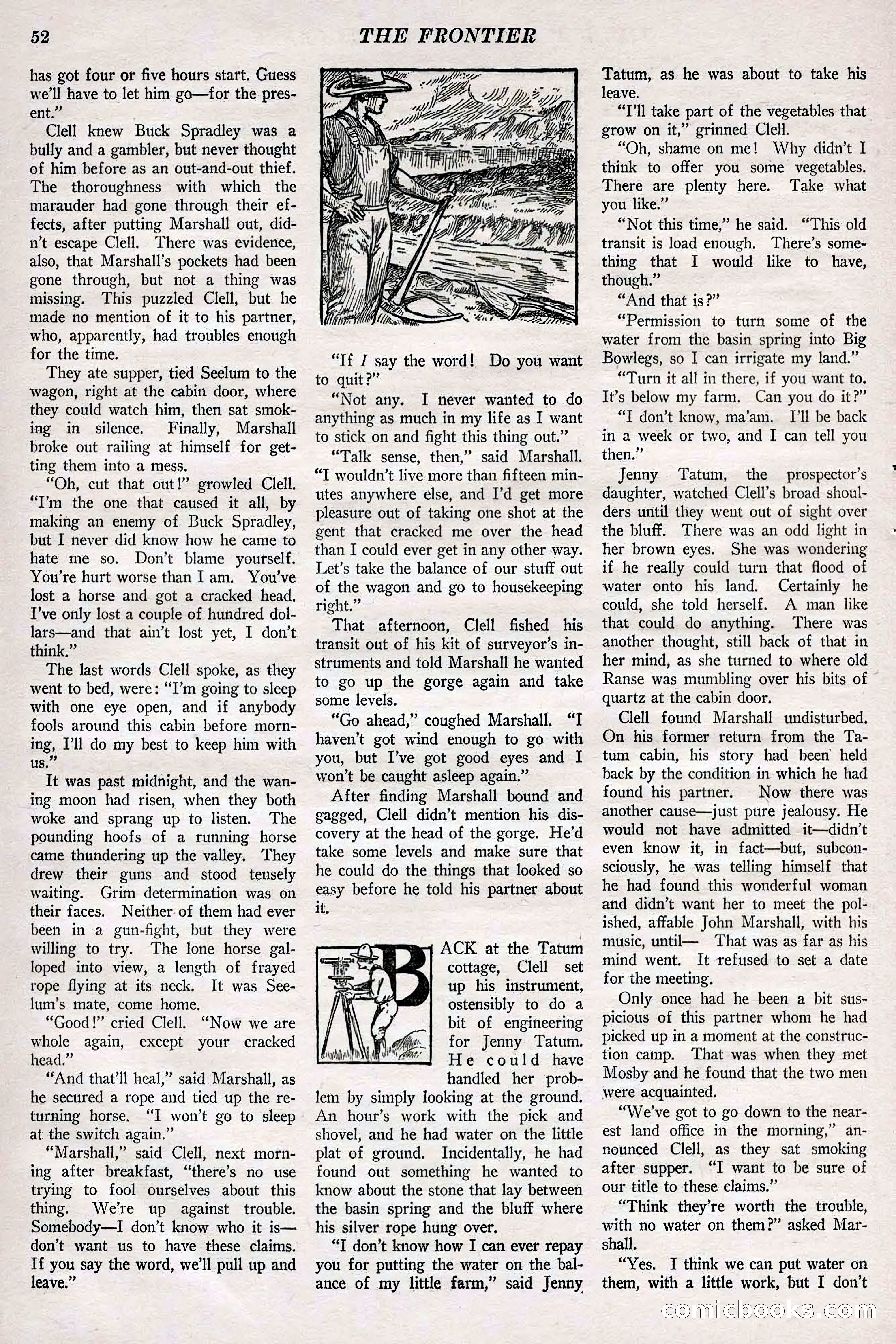
# Page 52 from "The Frontier" This page contains story prose with two black-and-white illustrations integrated into the text. The narrative appears to depict a conflict between frontier characters: Clell confronts Marshall about an encounter with Buck Spradley, a "bully and gambler," while they debate whether to abandon their claims and leave the area. The story involves surveying instruments, water rights from a basin spring, and jealousy regarding a woman named Jenny Tatum. The dialogue and action suggest a Western adventure story focused on land disputes and interpersonal tensions among prospectors or settlers in a frontier setting.
📄 Transcribed text from this page (OCR, searchable)
Machine-transcribed from the original scan — historical spelling and the odd misread are preserved.
52 has got four or five hours start. Guess we'll have to let him go—for the pres- ent.” Clell knew Buck Spradley was a bully and a gambler, but never thought of him before as an out-and-out thief. The thoroughness with which the marauder had gone through their ef- fects, after putting Marshall out, did- n't escape Clell. There was evidence, also, that Marshall’s pockets had been gone through, but not a thing was missing. This puzzled Clell, but he made no mention of it to his partner, who, apparently, had troubles enough for the time. They ate supper, tied Seelum to the wagon, right at the cabin door, where they could watch him, then sat smok- ing in silence. Finally, Marshall broke out railing at himself for get- ting them into a mess. “Oh, cut that out!” growled Clell. “I’m the one that caused it all, by making an enemy of Buck Spradley, but I never did know how he came to hate me so. Don’t blame yourself. You're hurt worse than Iam. You've lost a horse and got a cracked head. I’ve only Jost a couple of hundred dol- lars—and that ain’t lost yet, I don’t think,” The Jast words Clell spoke, as they went to bed, were: “I’m going to sleep with one eye open, and if anybody fools around this cabin before morn- ing, I'll do my best to keep him with us.” It was past midnight, and the wan- ing moon had risen, when they both woke and sprang up to listen. The pounding hoofs of a running horse came thundering up the valley. They drew their guns and stood tensely waiting. Grim determination was on their faces. Neither of them had ever been in a gun-fight, but they were willing to try. The lone horse gal- loped into view, a length of frayed rope flying at its neck. It was See- lum’s mate, come home, “Good!” cried Clell. whole again, except head,” “And that'll heal,” said Marshall, as he secured a rope and tied up the re- turning horse. “I won't go to sleep at the switch again.” “Marshall,” said Clell, next morn- ing after breakfast, “‘there’s no use trying to fool ourselves about this thing. We're up against trouble. Somebody—I don’t know who it is— don’t want us to have these claims. [f you say the word, we'll pull up and leave.” “Now we are your cracked THE FRONTIER $ os, = , = = hw Se = m === - 1 f ; | : e/) ‘ S ig) ii Wf —<— = (Ge. Wy), = Sag? Mit , IL ay ~ 4 —— 4 6 \s 4 2 “If J say the word! Do you want to quit?” “Not any. I never wanted to do anything as much in my life as I want to stick on and fight this thing out.” “Talk sense, then,” said Marshall. “T wouldn’t live more than fifteen min- utes anywhere else, and I’d get more pleasure out of taking one shot at the gent that cracked me over the head than I could ever get in any other way. Let’s take the balance of our stuff out of the wagon and go to housekeeping right.” That afternoon, Clell fished his transit out of his kit of surveyor’s in- struments and told Marshall he wanted to go up the gorge again and take some levels. “Go ahead,” coughed Marshall. “I haven’t got wind enough to go with you, but I’ve got good eyes and I won't be caught asleep again.” After finding Marshall bound and gagged, Clell didn’t mention his dis- covery at the head of the gorge. He’d take some levels and make sure that he could do the things that looked so easy before he told his partner about it. ACK at the Tatum cottage, Clell set up his instrument, ostensibly to do a bit of engineering for Jenny Tatum. He could have handled her prob- lem by simply looking at the ground. An hour’s work with the pick and shovel, and he had water on the little plat of ground. Incidentally, he had found out something he wanted to know about the stone that lay between the basin spring and the bluff where his silver rope hung over. “T don’t know how I can ever repay you for putting the water on the bal- ance of my little farm,’ said Jenny Tatum, as he was about to take his leave. 7 “T’ll take part of the vegetables that grow on it,” grinned Clell. “Oh, shame on me! Why didn’t I think to offer you some vegetables. There are plenty here. Take what you like.” “Not this time,” he said. “This old transit is load enough. There’s some- thing that I would like to have, though.” “And that is?” “Permission to turn some of the water from the basin spring into Big Bowlegs, so I can irrigate my land.” “Turn it all in there, if you want to. It’s below my farm, Can you do it?” “T don’t know, ma’am. Ill be back in a week or two, and I can tell you then.” Jenny Tatum, the prospector’s daughter, watched Clell’s broad shoul- ders until they went out of sight over the bluff. There was an odd light in her brown eyes. She was wondering if he really could turn that flood of water onto his land. Certainly he could, she told herself. A man like that could do anything. There was another thought, still back of that in her mind, as she turned to where old Ranse was mumbling over his bits of quartz at the cabin door. Clell found Marshall undisturbed. On his former return from the Ta- tum cabin, his story had been held back by the condition in which he had found his partner. Now there was another cause—just pure jealousy. He would not have admitted it—didn’t even know it, in fact—but, subcon- sciously, he was telling himself that he had found this wonderful woman and didn’t want her to meet the pol- ished, affable John Marshall, with his music, until— That was as far as his mind went. It refused to set a date for the meeting. Only once had he been a bit sus- picious of this partner whom he had picked up in a moment at the construc- tion camp. That was when they met Mosby and he found that the two men were acquainted. “We've got to go down to the near- est land office in the morning,” an- nounced Clell, as they sat smoking after supper. “I want to be sure of our title to these claims,” “Think they’re worth the trouble, with no water on them?” asked Mar- shall. “Yes. I think we can put water on them, with a little work, but I don’t COmniclboooxKxs. com