
Pulp Fiction, 1926 · page 89 of 114
The Frontier, May 1926 — page 89: what you’re looking at
What you’re looking at
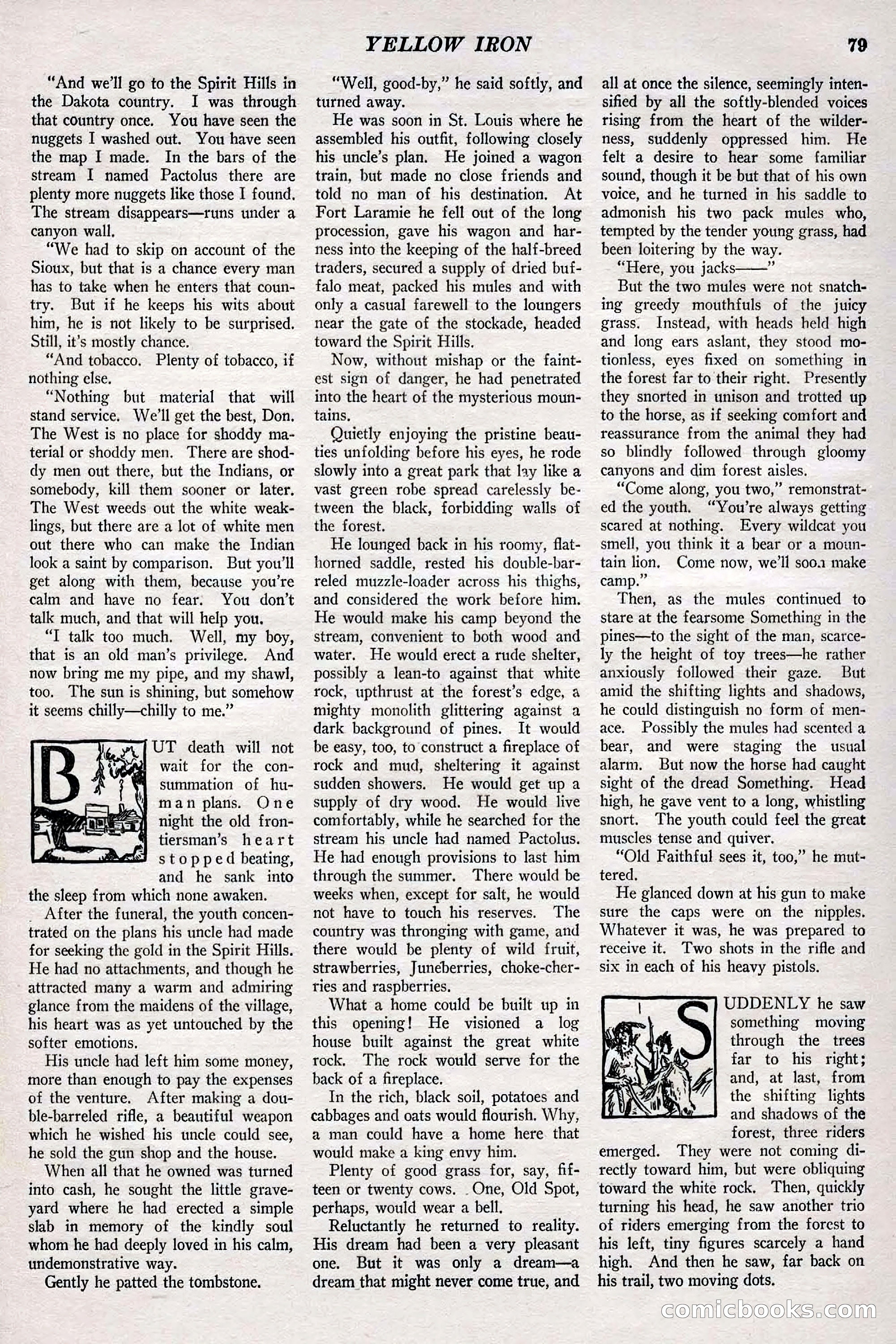
# Page 79 of "Yellow Iron" This is a text page from a pulp fiction story containing two illustrated drop caps. The narrative follows a young man preparing for a dangerous expedition into the Spirit Hills to seek gold, after his uncle's death. The prose describes his decision to abandon civilization, his journey by wagon and mule through wilderness, his plans to build a remote camp, and a tense moment when he spots mysterious riders emerging from the forest. The story emphasizes frontier hardship, isolation, and mounting danger as the protagonist ventures deeper into hostile territory.
📄 Transcribed text from this page (OCR, searchable)
Machine-transcribed from the original scan — historical spelling and the odd misread are preserved.
“And we'll go to the Spirit Hills in the Dakota country. I was through that country once. You have seen the nuggets I washed out. You have seen the map I made. In the bars of the stream I named Pactolus there are plenty more nuggets like those I found. The stream disappears—runs under a canyon wall, “We had to skip on account of the Sioux, but that is a chance every man has to take when he enters that coun- try. But if he keeps his wits about him, he is not likely to be surprised. Still, it’s mostly chance. “And tobacco. Plenty of tobacco, if nothing else, “Nothing but material that will stand service. We'll get the best, Don. The West is no place for shoddy ma- terial or shoddy men. There are shod- dy men out there, but the Indians, or somebody, kill them sooner or later. The West weeds out the white weak- lings, but there are a lot of white men out there who can make the Indian look a saint by comparison. But you'll get along with them, because you’re calm and have no fear. You don’t talk much, and that will help you, “I talk too much. Well, my boy, that is an old man’s privilege. And now bring me my pipe, and my shawl, too. The sun is shining, but somehow it seems chilly—chilly to me.” |} UT death will not wait for the con- summation of hu- man plans. One night the old fron- tiersman’s heart stopped beating, and he sank into the sleep from which none awaken. _ After the funeral, the youth concen- trated on the plans his uncle had made for seeking the gold in the Spirit Hills. He had no attachments, and though he attracted many a warm and admiring glance from the maidens of the village, his heart was as yet untouched by the softer emotions. His uncle had left him some money, more than enough to pay the expenses of the venture. After making a dou- ble-barreled rifle, a beautiful weapon which he wished his uncle could see, he sold the gun shop and the house. When all that he owned was turned into cash, he sought the little grave- yard where he had erected a simple slab in memory of the kindly soul whom he had deeply loved in his calm, undemonstrative way. Gently he patted the tombstone. YELLOW IRON “Well, good-by,” he said softly, and turned away. He was soon in St. Louis where he assembled his outfit, following closely his uncle’s plan. He joined a wagon train, but made no close friends and told no man of his destination, At Fort Laramie he fell out of the long procession, gave his wagon and _ har- ness into the keeping of the half-breed traders, secured a supply of dried buf- falo meat, packed his mules and with only a casual farewell to the loungers near the gate of the stockade, headed toward the Spirit Hills. Now, without mishap or the faint- est sign of danger, he had penetrated into the heart of the mysterious moun- tains. Quietly enjoying the pristine beau- ties unfolding before his eyes, he rode slowly into a great park that lay like a vast green robe spread carelessly be- tween the black, forbidding walls of the forest. He lounged back in his roomy, flat- horned saddle, rested his double-bar- reled muzzle-loader across his thighs, and considered the work before him. He would make his camp beyond the stream, convenient to both wood and water. He would erect a rude shelter, possibly a lean-to against that white rock, upthrust at the forest’s edge, a mighty monolith glittering against a dark background of pines. It would be easy, too, to construct a fireplace of rock and mud, sheltering it against sudden showers. He would get up a supply of dry wood. He would live comfortably, while he searched for the stream his uncle had named Pactolus. He had enough provisions to last him through the summer. There would be weeks when, except for salt, he would not have to touch his reserves. The country was thronging with game, and there would be plenty of wild fruit, strawberries, Juneberries, choke-cher- ties and raspberries. What a home could be built up in this opening! He visioned a _ log house built against the great white rock, The rock would serve for the back of a fireplace. In the rich, black soil, potatoes and cabbages and oats would flourish. Why, a man could have a home here. that would make a king envy him. Plenty of good grass for, say, fif- teen or twenty cows. .One, Old Spot, perhaps, would wear a bell. Reluctantly he returned to reality. His dream had been a very pleasant one. But it was only a dream—a dream that might never come true, and 79 all at once the silence, seemingly inten- sified by all the softly-blended voices rising from the heart of the wilder- ness, suddenly oppressed him. He felt a desire to hear some familiar sound, though it be but that of his own voice, and he turned in his saddle to admonish his two pack mules who, tempted by the tender young grass, had been loitering by the way. “Here, you jacks——” But the two mules were not snatch- ing greedy mouthfuls of the juicy grass. Instead, with heads held high and long ears aslant, they stood mo- tionless, eyes fixed on something in the forest far to their right. Presently they snorted in unison and trotted up to the horse, as if seeking comfort and reassurance from the animal they had so blindly followed through gloomy canyons and dim forest aisles. “Come along, you two,” remonstrat- ed the youth. “You're always getting scared at nothing. Every wildcat you smell, you think it a bear or a moun- tain lion, Come now, we'll sooa make camp.” Then, as the mules continued to stare at the fearsome Something in the pines—to the sight of the man, scarce- ly the height of toy trees—he rather anxiously followed their gaze. But amid the shifting lights and shadows, he could distinguish no form of men- ace. Possibly the mules had scented a bear, and were staging the usual alarm. But now the horse had caught sight of the dread Something. Head high, he gave vent to a long, whistling snort. The youth could feel the great muscles tense and quiver. “Old Faithful sees it, too,’ he mut- tered. He glanced down at his gun to make sure the caps were on the nipples. Whatever it was, he was prepared to receive it. Two shots in the rifle and six in each of his heavy pistols. UDDENLY he saw something moving through the trees far to his right; and, at last, from the shifting lights and shadows of the forest, three riders emerged. They were not coming di- rectly toward him, but were obliquing toward the white rock. Then, quickly turning his head, he saw another trio of riders emerging from the forest to his left, tiny figures scarcely a hand high. And then he saw, far back on his trail, two moving dots. Gomichboo <SEiGOimn