
Pulp Fiction, 1926 · page 14 of 114
The Frontier, May 1926 — page 14: what you’re looking at
What you’re looking at
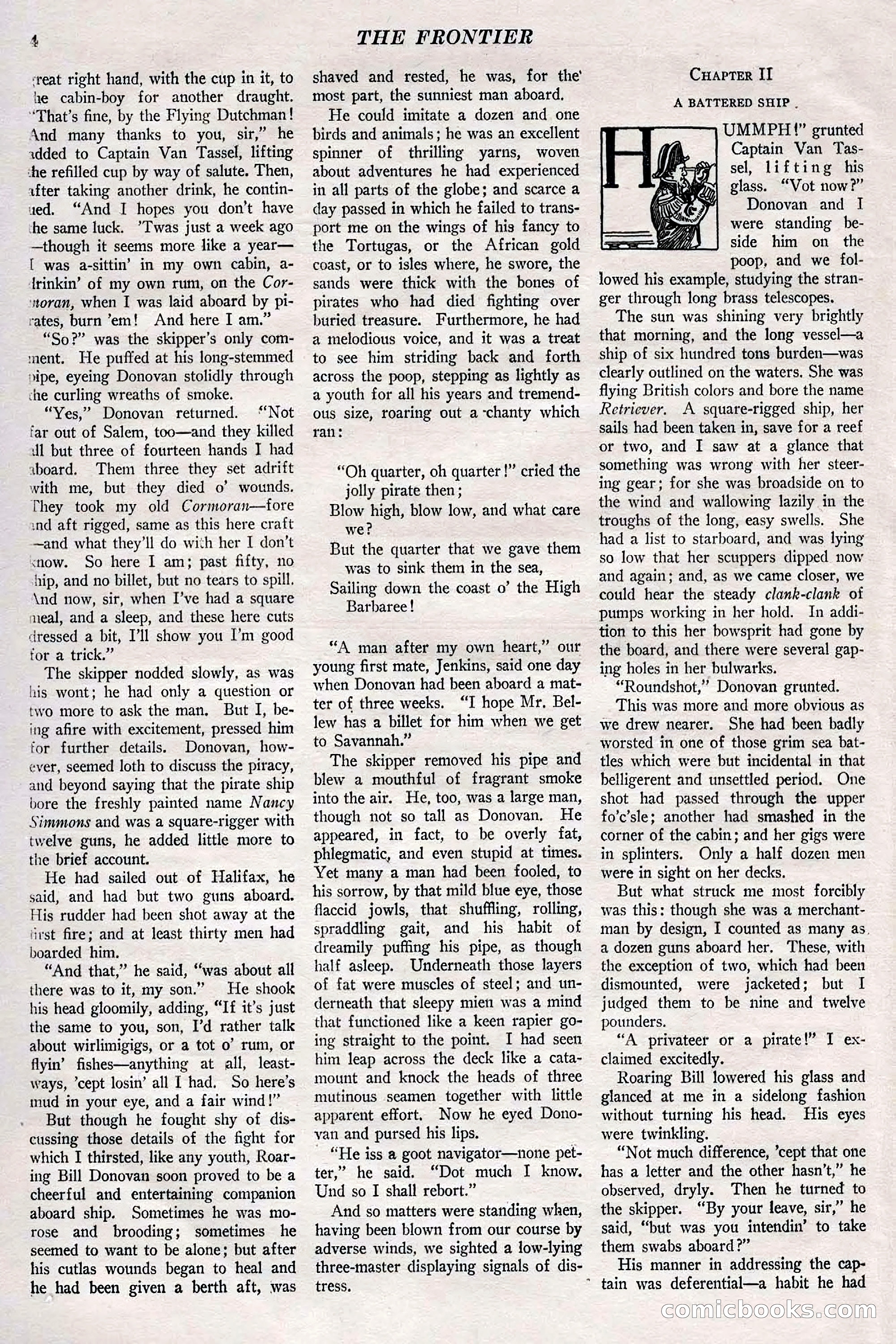
This is a page of story prose from "The Frontier," showing Chapter II titled "A Battered Ship." The text describes a conversation between sailors aboard a vessel, with one character named Donovan and another identified as Captain Van Tassel discussing encounters with pirates. The narrative mentions a ship named the *Iceluster*, which appears damaged and is described as a British merchant vessel with numerous battle wounds. The prose discusses the ship's condition, the crew's observations of damage from cannon shot, and dialogue between characters assessing the vessel's seaworthiness. A small illustration appears at the chapter heading showing what appears to be a ship's figurehead or nautical imagery.
📄 Transcribed text from this page (OCR, searchable)
Machine-transcribed from the original scan — historical spelling and the odd misread are preserved.
4 ‘reat right hand, with the cup in it, to he cabin-boy for another draught. “That’s fine, by the Flying Dutchman ! And many thanks to you, sir,” he added to Captain Van Tassel, lifting the refilled cup by way of salute. Then, ufter taking another drink, he contin- aed. “And I hopes you don’t have he same luck. ’Twas just a week ago —though it seems more like a year— [ was a-sittin’ in my own cabin, a- drinkin’ of my own rum, on the Cor- storan, when I was laid aboard by pi- rates, burn ’em! And here I am.” “So?” was the skipper’s only com- ment. He puffed at his long-stemmed nipe, eyeing Donovan stolidly through che curling wreaths of smoke. “Yes,” Donovan returned. “Not far out of Salem, too—and they killed Wl but three of fourteen hands J had aboard. Them three they set adrift with me, but they died o’ wounds. They took my old Cormoran—fore ind aft rigged, same as this here craft ~and what they’ll do with her [ don’t <now. So here I am; past fifty, no hip, and no billet, but no tears to spill. \nd now, sit, when I’ve had a square neal, and a sleep, and these here cuts dressed a bit, Pll show you I’m good tor a trick.” The skipper nodded slowly, as was his wont; he had only a question or two more to ask the man, But I, be- ing afire with excitement, pressed him for further details. Donovan, how- ever, seemed loth to discuss the piracy, and beyond saying that the pirate ship bore the freshly painted name Nancy Simmons and was a square-rigger with twelve guns, he added little more to the brief account. He had sailed out of Halifax, he said, and had but two guns aboard. His rudder had been shot away at the ‘rst fire; and at least thirty men had boarded him. “And that,” he said, “was about all there was to it, my son.” He shook his head gloomily, adding, “If it’s just the same to you, son, I’d rather talk about wirlimigigs, or a tot o’ rum, or flyin’ fishes—anything at all, least- ways, ’cept losin’ all I had. So here’s mud in your eye, and a fair wind!” But though he fought shy of dis- cussing those details of the fight for which I thirsted, like any youth, Roar- ing Bill Donovan soon proved to be a cheerful and entertaining companion aboard ship. Sometimes he was mo- rose and brooding; sometimes he seemed to want to be alone; but after his cutlas wounds began to heal and he had been given a berth aft, was THE FRONTIER shaved and rested, he was, for the’ most part, the sunniest man aboard. He could imitate a dozen and one birds and animals; he was an excellent spinner of thrilling yarns, woven about adventures he had experienced in all parts of the globe; and scarce a day passed in which he failed to trans- port me on the wings of his fancy to the Tortugas, or the African gold coast, or to isles where, he swore, the sands were thick with the bones of pirates who had died fighting over buried treasure. Furthermore, he had a melodious voice, and it was a treat to see him striding back and forth across the poop, stepping as lightly as a youth for all his years and tremend- ous size, roaring out a-chanty which rai: “Oh quarter, oh quarter!” cried the jolly pirate then ; Blow high, blow low, and what care we? But the quarter that we gave them was to sink them in the sea, Sailing down the coast o’ the High Barbaree ! “A man after my own heart,” our young first mate, Jenkins, said one day when Donovan had been aboard a mat- ter of three weeks. “I hope Mr, Bel- lew has a billet for him when we get to Savannah.” The skipper removed his pipe and blew a mouthful of fragrant smoke into the air. He, too, was a large man, though not so tall as Donovan. He appeared, in fact, to be overly fat, phlegmatic, and even stupid at times. Yet many a man had been fooled, to his sorrow, by that mild blue eye, those flaccid jowls, that shuffling, rolling, spraddling gait, and his habit of dreamily puffing his pipe, as though half asleep. Underneath those layers of fat were muscles of steel; and un- derneath that sleepy mien was a mind that functioned like a keen rapier go- ing straight to the point. I had seen him leap across the deck like a cata- mount and knock the heads of three mutinous seamen together with little apparent effort. Now he eyed Dono- van and pursed his lips. - “He iss a goot navigator—none pet- ter,’ he said. “Dot much I know. Und so I shall rebort.” And so matters were standing when, having been blown from our course by adverse winds, we sighted a low-lying three-tnaster displaying signals of dis- tress. CHapter II A BATTERED SHIP . — UMMPH!” grunted Captain Van Tas- sel, lifting his glass. “Vot now?” Donovan and I were standing be- | side him on the poop, and we fol- lowed his example, studying the stran- ger through long brass telescopes. The sun was shining very brightly that morning, and the long vessel—a ship of six hundred tons burden—was clearly outlined on the waters. She was flying British colors and bore the name Retriever. A square-rigged ship, her sails had been taken in, save for a reef or two, and I saw at a glance that something was wrong with her steer- ing gear; for she was broadside on to the wind and wallowing lazily in the troughs of the long, easy swells. She had a list to starboard, and was lying so low that her scuppers dipped now and again; and, as we came closer, we could hear the steady clank-clank ot pumps working in her hold. In addi- tion to this her bowsprit had gone by the board, and there were several gap- ing holes in her bulwarks. “Roundshot,” Donovan grunted. This was more and more obvious as we drew nearer. She had been badly worsted in one of those grim sea bat- tles which were but incidental in that belligerent and unsettled period. One shot had passed through the upper fo’c’sle; another had smashed in the corner of the cabin; and her gigs were in splinters. Only a half dozen men were in sight on her decks. But what struck me most forcibly was this: though she was a merchant- man by design, I counted as many as. a dozen guns aboard her. These, with the exception of two, which had been dismounted, were jacketed; but I[ judged them to be nine and twelve pounders. “A privateer or a pirate!” I ex- claimed excitedly. Roaring Bill lowered his glass and glanced at me in a sidelong fashion without turning his head. His eyes were twinkling. “Not much difference, ’cept that one has a letter and the other hasn’t,” he observed, dryly. Then he turned to the skipper. “By your leave, sir,” he said, “but was you intendin’ to take them swabs aboard ?” His manner in addressing the cap- Ly Eb, f°: oY, tf GAY ng ° tain was deferential—a habit he had CORDIC OOKS COM