
Pulp Fiction, 1926 · page 53 of 114
The Frontier, May 1926 — page 53: what you’re looking at
What you’re looking at
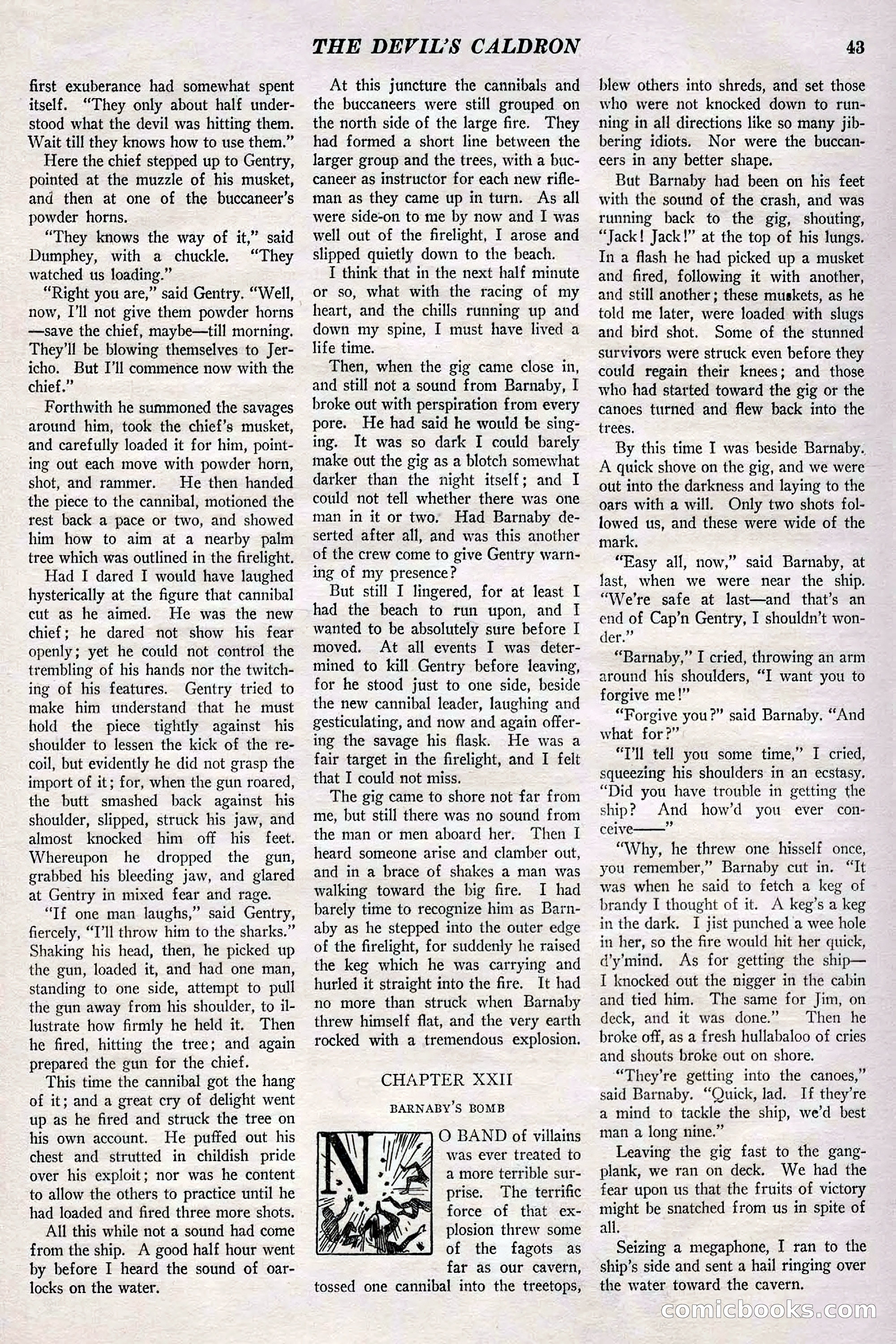
# Page Analysis: "The Devil's Caldron" This is a prose text page (page 43) from a pulp fiction story titled "The Devil's Caldron." The visible text comprises two chapters: the conclusion of an unnamed chapter featuring combat between the narrator and armed cannibals on a beach, and Chapter XXII titled "Barnaby's Bomb," which begins at the bottom with a decorative initial letter. The narrative describes intense action—gunfire, hand-to-hand fighting, and an explosion—followed by dialogue between characters named Barnaby and the narrator about escaping by canoe. The text is densely printed in two columns with no illustrations visible on this page.
📄 Transcribed text from this page (OCR, searchable)
Machine-transcribed from the original scan — historical spelling and the odd misread are preserved.
first exuberance had somewhat spent itself. “They only about half under- stood what the devil was hitting them. Wait till they knows how to use them.” Here the chief stepped up to Gentry, pointed at the muzzle of his musket, and then at one of the buccaneer’s powder horns. “They knows the way of it,” said Dumphey, with a chuckle. “They watched us loading.” “Right you are,” said Gentry. “Well, now, I'll not give them powder horns —save the chief, maybe—till morning. They'll be blowing themselves to Jer- icho. But I’ll commence now with the chief.” Forthwith he summoned the savages around him, took the chief’s musket, and carefully loaded it for him, point- ing out each move with powder horn, shot, and rammer. He then handed the piece to the cannibal, motioned the rest back a pace or two, and showed him how to aim at a nearby palm tree which was outlined in the firelight. Had I dared I would have laughed hysterically at the figure that cannibal cut as he aimed. He was the new chief; he dared not show his fear openly; yet he could not control the trembling of his hands nor the twitch- ing of his features. Gentry tried to make him understand that he must hold the piece tightly against his shoulder to lessen the kick of the re- coil, but evidently he did not grasp the import of it; for, when the gun roared, the butt smashed back against his shoulder, slipped, struck his jaw, and almost knocked him off his feet. Whereupon he dropped the gun, grabbed his bleeding jaw, and glared at Gentry in mixed fear and rage. “If one man laughs,” said Gentry, fiercely, “I'll throw him to the sharks.” Shaking his head, then, he picked up the gun, loaded it, and had one man, standing to one side, attempt to pull the gun away from his shoulder, to il- lustrate how firmly he held it. Then he fired, hitting the tree; and again prepared the gun for the chief. This time the cannibal got the hang of it; and a great cry of delight went up as he fired and struck the tree on his own account. He puffed out his chest and strutted in childish pride over his exploit; nor was he content to allow the others to practice until he had loaded and fired three more shots. All this while not a sound had come from the ship. A good half hour went by before I heard the sound of oar- locks on the water. THE DEVIL'S CALDRON At this juncture the cannibals and the buccaneers were still grouped on the north side of the large fire. They had formed a short line between the larger group and the trees, with a buc- caneer as instructor for each new rifle- man as they came up in turn. As all were side-on to me by now and I was well out of the firelight, I arose and slipped quietly down to the beach. I think that in the next half minute or so, what with the racing of my heart, and the chills running up and down my spine, I must have lived a life time. Then, when the gig came close in, and still not a sound from Barnaby, I broke out with perspiration from every pore. He had said he would be sing- ing. It was so dark I could barely make out the gig as a blotch somewhat darker than the night itself; and I could not tell whether there was one man in it or two. Had Barnaby de- serted after all, and was this another of the crew come to give Gentry warn- ing of my presence? But still I lingered, for at least I had the beach to run upon, and I wanted to be absolutely sure before I moved. At all events I was deter- mined to kill Gentry before leaving, for he stood just to one side, beside the new cannibal leader, laughing and gesticulating, and now and again offer- ing the savage his flask. He was a fair target in the firelight, and I felt that I could not miss. The gig came to shore not far from me, but still there was no sound from the man or men aboard her, Then I heard someone arise and clamber out, and in a brace of shakes a man was walking toward the big fire. I had barely time to recognize him as Barn- aby as he stepped into the outer edge of the firelight, for suddenly he raised the keg which he was carrying and hurled it straight into the fire. It had no more than struck when Barnaby threw himself flat, and the very earth rocked with a tremendous explosion. CHAPTER XXII BARNABY'S BOMB O BAND of villains was ever treated to a more terrible sur- prise. The terrific force of that ex- plosion threw some of the fagots as far as our cavern, tossed one cannibal into the treetops, 43 blew others into shreds, and set those who were not knocked down to run- ning in all directions like so many jib- bering idiots. Nor were the buccan- eers in any better shape. But Barnaby had been on his feet with the sound of the crash, and was running back to the gig, shouting, “Jack! Jack!” at the top of his lungs. In a flash he had picked up a musket and fired, following it with another, and still another; these muskets, as he told me later, were loaded with slugs and bird shot. Some of the stunned survivors were struck even before they could regain their knees; and those who had started toward the gig or the canoes turned and flew back into the trees. By this time I was beside Barnaby. A quick shove on the gig, and we were out into the darkness and laying to the oars with a will. Only two shots fol- lowed us, and these were wide of the mark, “Easy all, now,” said Barnaby, at last, when we were near the ship. “We're safe at last—and that’s an end of Cap’n Gentry, I shouldn’t won- der.” “Barnaby,” I cried, throwing an arm around his shoulders, “I want you to forgive me!” “Forgive you?” said Barnaby. “And what for?” “T’'ll tell you some time,” I cried, squeezing his shoulders in an ecstasy, “Did you have trouble in getting the ship? And how’d you ever con- ceive——”’ “Why, he threw one hisself once, you remember,” Barnaby cut in. “It was when he said to fetch a keg of brandy I thought of it. A keg’s a keg in the dark. I jist punched a wee hole in her, so the fire would hit her quick, d’y’mind. As for getting the ship— I knocked out the nigger in the cabin and tied him. The same for Jim, on deck, and it was done.’ Then he broke off, as a fresh hullabaloo of cries and shouts broke out on shore. “They're getting into the canoes,” said Barnaby. “Quick, lad. If they’re a mind to tackle the ship, we'd best man a long nine.” Leaving the gig fast to the gang- plank, we ran on deck. We had the fear upon us that the fruits of victory might be snatched from us in spite of all. Seizing a megaphone, I ran to the ship’s side and sent a hail ringing over the water toward the cavern. (C(O) mG 6)(0)(6) KS com