
Pulp Fiction, 1926 · page 83 of 114
The Frontier, May 1926 — page 83: what you’re looking at
What you’re looking at
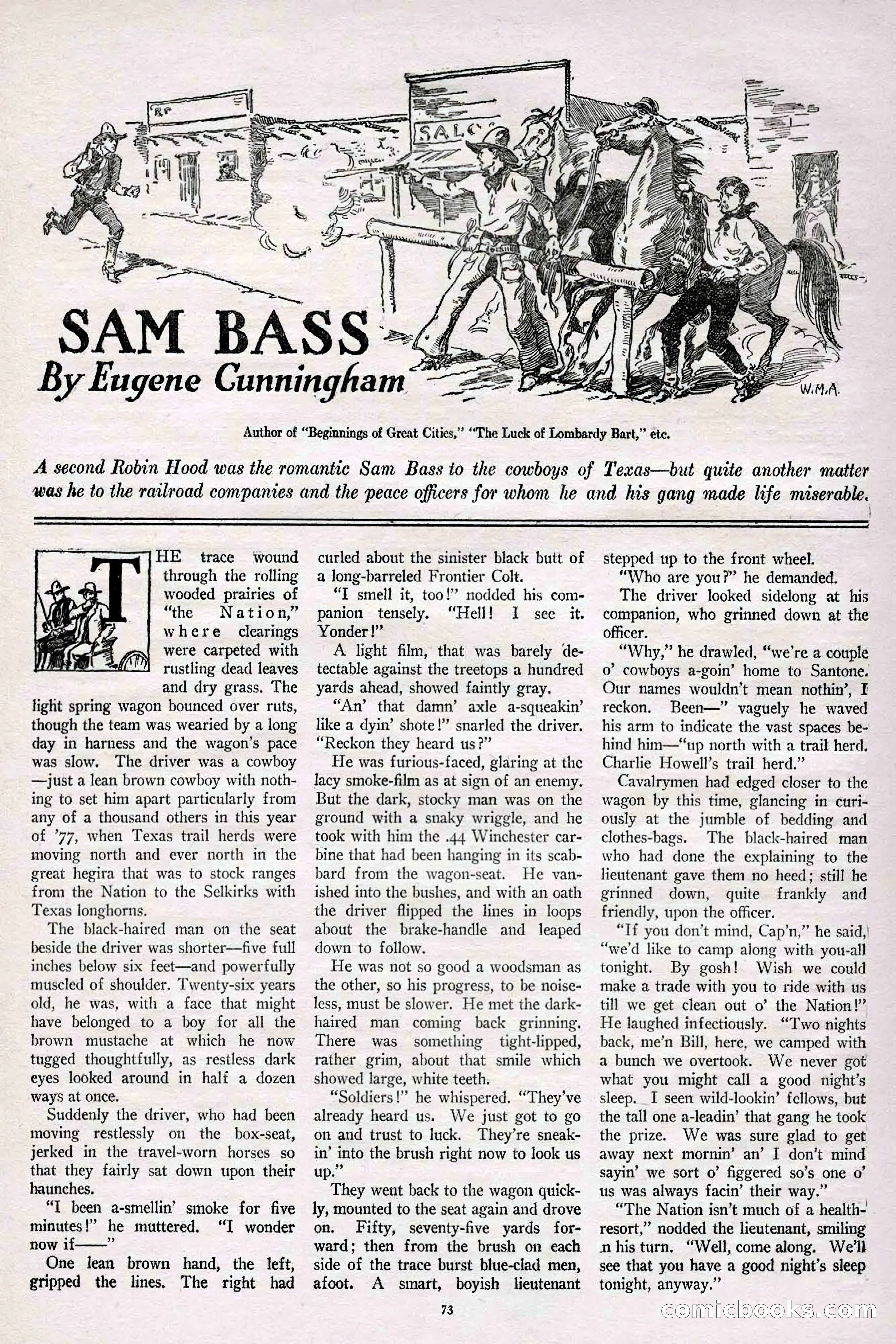
# Page 73: Story Text with Illustration This is a story page featuring "Sam Bass" by Eugene Cunningham. At the top is a sketch illustration showing a Western scene with multiple figures around a wagon and campsite, with period-appropriate clothing and equipment. The bulk of the page contains prose narrative text in two columns. The story depicts a scene on the frontier involving cowboys and a wagon journey, with dialogue between characters discussing travel plans and encounters. The narrative describes Western landscape, horse-drawn transportation, and interactions between what appear to be cowboy characters, with references to Texas and trail herding. The writing style and subject matter are consistent with early-20th-century Western pulp fiction.
📄 Transcribed text from this page (OCR, searchable)
Machine-transcribed from the original scan — historical spelling and the odd misread are preserved.
—, cs . By Eugene Cunningham Op l), {i Author of “Beginnings of Great Cities,” “The Luck of Lombardy Bart,”’ etc. A second Robin Hood was the romantic Sam Bass to the cowboys of Texas—but quite another matter was he to the railroad companies and the peace officers for whom he and his gang made life miserable. | HE trace wound through the rolling wooded prairies of “the Nation,” where _ clearings were carpeted with rustling dead leaves and dry grass. The light spring wagon bounced over ruts, though the team was wearied by a long day in harness and the wagon’s pace was slow. The driver was a cowboy —just a lean brown cowboy with noth- ing to set him apart particularly from any of a thousand others in this year of 77, when Texas trail herds were moving north and ever north in the great hegira that was to stock ranges from the Nation to the Selkirks with Texas longhorns. The black-haired man on the seat beside the driver was shorter—five full inches below six feet—and powerfully muscled of shoulder. Twenty-six years old, he was, with a face that might have belonged to a boy for all the brown mustache at which he now tugged thoughtfully, as restless dark eyes looked around in half a dozen ways at once. Suddenly the driver, who had been moving restlessly on the box-seat, jerked in the travel-worn horses so that they fairly sat down upon their haunches. “I been a-smellin’ smoke for five minutes!” he muttered. “I wonder now if——” One lean brown hand, the left, gripped the lines. The right had curled about the sinister black butt of a long-barreled Frontier Colt. “T smell it, too!” nodded his com- panion tensely. “Hell! I see it. Yonder !” | A light film, that was barely de- tectable against the treetops a hundred yards ahead, showed faintly gray. “An that damn’ axle a-squeakin’ like a dyin’ shote!”’ snarled the driver, “Reckon they heard us?” He was furious-faced, glaring at the lacy smoke-film as at sign of an enemy. But the dark, stocky man was on the ground with a snaky wriggle, and he took with him the .44 Winchester car- bine that had been hanging in its scab- bard from the wagon-seat. He van- ished into the bushes, and with an oath the driver flipped the lines in loops about the brake-handle and leaped down to follow. He was not so good a woodsman as the other, so his progress, to be noise- less, must be slower. He met the dark- haired man coming back grinning, There was something tight-lipped, rather grim, about that smile which showed large, white teeth. “Soldiers!” he whispered. “They've already heard us. We just got to go on and trust to luck. They’re sneak- in’ into the brush right now to look us up.” They went back to the wagon quick- ly, mounted to the seat again and drove on. Fifty, seventy-five yards for- ward; then from the brush on each side of the trace burst blue-clad men, afoot. A smart, boyish lieutenant 73 stepped wp to the front wheel. “Who are you?” he demanded. The driver looked sidelong at his companion, who grinned down at the officer. “Why,” he drawled, “we’re a couple 0’ cowboys a-goin’ home to Santone. Our names wouldn’t mean nothin’, I reckon. Been—” vaguely he waved his arm to indicate the vast spaces be- hind him—‘“up north with a trail herd. Charlie Howell’s trail herd.” Cavalrymen had edged closer to the wagon by this time, glancing in curi- ously at the jumble of bedding and clothes-bags. The black-haired man who had done the explaining to the lieutenant gave them no heed; still he grinned down, quite frankly and friendly, upon the officer. “Tf you don’t mind, Cap'n,” he said,! “we'd like to camp along with you-all tonight. By gosh! Wish we could make a trade with you to ride with us till we get clean out o’ the Nation!” He laughed infectiously. “Two nights back, me’n Bill, here, we camped with a bunch we overtook. We never got what you might call a good night’s sleep. I seen wild-lookin’ fellows, but the tall one a-leadin’ that gang he took the prize. We was sure glad to get away next mornin’ an’ I don’t mind sayin’ we sort o’ figgered so’s one 0’ us was always facin’ their way.” “The Nation isn’t much of a health- resort,” nodded the lieutenant, smiling nhis turn. “Well, come along. We'll see that you have a good night’s sleep tonight, anyway.” GOMmIiGcdoo COM S