
Pulp Fiction, 1926 · page 93 of 114
The Frontier, May 1926 — page 93: what you’re looking at
What you’re looking at
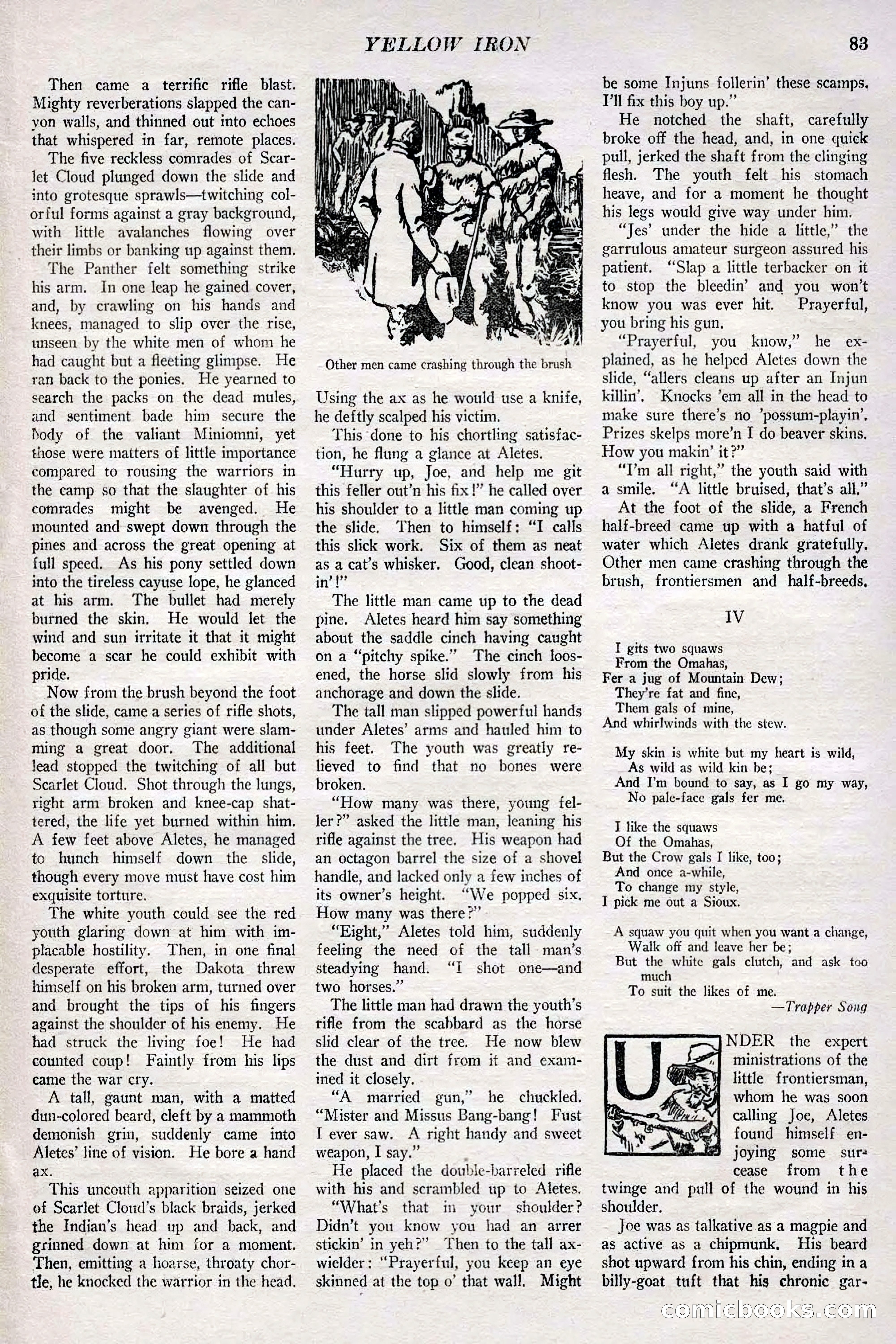
# Page 83: "Yellow Iron" This is a story page from a pulp magazine featuring both prose text and an illustration. The illustration shows several men in what appears to be a frontier or Western setting, with one man appearing to examine or work on something while others gather around. The visible prose describes a violent frontier conflict. The text recounts a rifle battle where men are killed, including detailed descriptions of casualties and combat. The narrative focuses on characters named Aletes and Scarlet Cloud, with dialogue about weapons ("a married gun"), horses, and survival in what appears to be an Indian conflict scenario. The page includes verse titled "Trapper Song" at the bottom.
📄 Transcribed text from this page (OCR, searchable)
Machine-transcribed from the original scan — historical spelling and the odd misread are preserved.
Then came a terrific rifle blast. Mighty reverberations slapped the can- yon walls, and thinned out into echoes that whispered in far, remote places. The five reckless comrades of Scar- let Cloud plunged down the slide and into grotesque sprawls—twitching col- orful forms against a gray background, with little avalanches flowing over their limbs or banking up against them. The Panther felt something strike his arm. In one leap he gained cover, and, by crawling on his hands and knees, managed to slip over the rise, unseen by the white men of whom he had caught but a fleeting glimpse. He ran back to the ponies. He yearned to search the packs on the dead mules, and sentiment bade him secure the Nody of the valiant Miniomni, yet those were matters of little importance compared to rousing the warriors in the camp so that the slaughter of his comrades might be avenged. He mounted and swept down through the pines and across the great opening at full speed. As his pony settled down into the tireless cayuse lope, he glanced at his arm. The bullet had merely burned the skin. He would let the wind and sun irritate it that it might become a scar he could exhibit with pride. Now from the brush beyond the foot of the slide, came a series of rifle shots, as though some angry giant were slam- ming a great door. The additional lead stopped the twitching of all but Scarlet Cloud. Shot through the lungs, right arm broken and knee-cap shat- tered, the life yet burned within him. A few feet above Aletes, he managed to hunch himself down the slide, though every move must have cost him exquisite torture. The white youth could see the red youth glaring down at him with im- placable hostility. Then, in one final desperate effort, the Dakota threw himself on his broken arm, turned over and brought the tips of his fingers against the shoulder of his enemy. He had struck the living foe! He had counted coup! Faintly from his lips came the war cry. A tall, gaunt man, with a matted dun-colored beard, cleft by a mammoth demonish grin, suddenly came into Aletes’ line of vision. He bore a hand ax. This uncouth apparition seized one of Scarlet Cloud’s black braids, jerked the Indian’s head twp and back, and grinned down at him for a moment. Then, emitting a hoarse, throaty chor- tle, he knocked the warrior in the head. VELLOW IRON Other men came crashing through the brush Using the ax as he would use a knife, he deftly scalped his victim. This done to his chortling satisfac- tion, he flung a glance at Aletes. “Hurry up, Joe, and help me git this feller out’n his fix!” he called over his shoulder to a little man coming up the slide. Then to himself: “TI calls this slick work. Six of them as neat as a cat’s whisker. Good, clean shoot- in’ de The little man came up to the dead pine. Aletes heard him say something about the saddle cinch having caught on a “pitchy spike.” The cinch loos- ened, the horse slid slowly from his anchorage and down the slide. The tall man slipped powerful hands under Aletes’ arms and hauled him to his feet. The youth was greatly re- lieved to find that no bones were broken. “How many was there, young fel- ler?” asked the little man, leaning his rifle against the tree. His weapon had an octagon barrel the size of a shovel handle, and lacked only a few inches of its owner’s height. “We popped six. How many was there?” “Eight,” Aletes told him, suddenly feeling the need of the tall man’s steadying hand. “I shot one—and two horses.” The little man had drawn the youth’s trifle from the scabbard as the horse slid clear of the tree. He now blew the dust and dirt from it and exam- ined it closely. “A married gun,” he chuckled. “Mister and Missus Bang-bang! Fust [ ever saw. A right handy and sweet weapon, I say.” He placed the double-barreled rifle with his and scrambled up to Aletes. “What's that in your shoulder? Didn’t you know you had an arrer stickin’ in yeh?” Then to the tall ax- wielder: ““Prayerful, you keep an eye skinned at the top o’ that wall. Might 83 be some Injuns follerin’ these scamps. Pll fix this boy up.” He notched the shaft, carefully broke off the head, and, in one quick pull, jerked the shaft from the clinging flesh. The youth felt his stomach heave, and for a moment he thought his legs would give way under him. “Jes’ under the hide a little,” the garrulous amateur surgeon assured his patient. “Slap a little terbacker on it to stop the bleedin’ and you won’t know you was ever hit. Prayerful, you bring his gun, “Prayerful, you know,” he ex- plained, as he helped Aletes down the slide, “allers cleans up after an Injun killin’. Knocks ’em all in the head to make sure there’s no ’possum-playin’, Prizes skelps more’n I do beaver skins, How you makin’ it?” “I’m all right,” the youth said with a smile. “A little bruised, that’s all,” At the foot of the slide, a French half-breed came up with a hatful of water which Aletes drank gratefully, Other men came crashing through the brush, frontiersmen and half-breeds, IV I gits two squaws From the Omahas, Fer a jug of Mountain Dew; They’re fat and fine, Them gals of mine, And whirlwinds with the stew. My skin is white but my heart is wild, As wild as wild kin be; And I’m bound to say, as I go my way, No pale-face gals fer me. J like the squaws Of the Omahas, But the Crow gals I like, too; And once a-while, To change my style, I pick me out a Sioux. A squaw you quit when you want a change, Walk off and leave her be; But the white gals clutch, and ask too much To suit the likes of me. —Trapper Song NDER the expert ministrations of the little frontiersman, whom he was soon calling Joe, Aletes found himself en- joying some sure cease from the twinge and pull of the wound in his shoulder. Joe was as talkative as a magpie and as active as a chipmunk, His beard shot upward from his chin, ending in a billy-goat tuft that his chronic gar- COMMicoookxs.CORl