
Pulp Fiction, 1926 · page 103 of 114
The Frontier, May 1926 — page 103: what you’re looking at
What you’re looking at
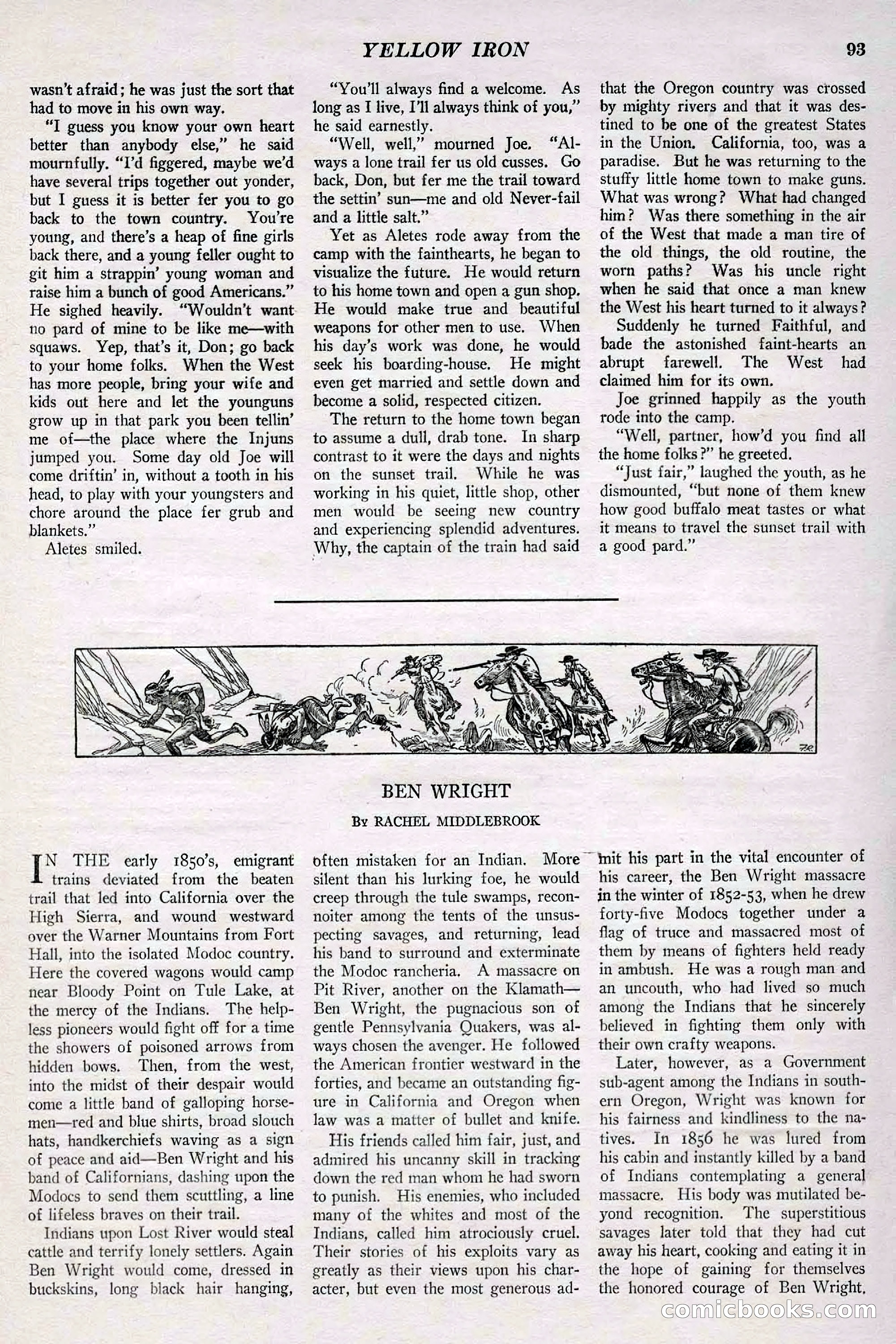
# Page 93 of "Yellow Iron" / Page 1 of "Ben Wright" This page contains the conclusion of a story called "Yellow Iron" (top section) followed by the opening page of a new story titled "Ben Wright" by Rachel Middlebrook (bottom section). The top portion concludes a narrative about frontier life, with dialogue about settling in the American West and opening a gun shop. The bottom section introduces a new story set in the 1850s about an emigrant often mistaken for a Native American, describing early California frontier conflicts. An illustration of horsemen in action appears between the two stories.
📄 Transcribed text from this page (OCR, searchable)
Machine-transcribed from the original scan — historical spelling and the odd misread are preserved.
wasn’t afraid; he was just the sort that had to move in his own way. “T guess you know your own heart better than anybody else,” he said mournfully. “I’d figgered, maybe we'd have several trips together out yonder, but I guess it is better fer you to go back to the town country. You're young, and there’s a heap of fine girls back there, and a young feller ought to git him a strappin’ young woman and raise him a bunch of good Americans.” He sighed heavily. “Wouldn’t want no pard of mine to be like me—with squaws. Yep, that’s it, Don; go back to your home folks. When the West has more people, bring your wife and kids out here and let the younguns grow up in that park you been tellin’ me of—the place where the Injuns jumped you. Some day old Joe will come driftin’ in, without a tooth in his head, to play with your youngsters and chore around the place fer grub and blankets.” Aletes smiled. YELLOW IRON “You'll always find a welcome. As long as I live, I'll always think of you,” he said earnestly. “Well, well,” mourned Joe. “AI- ways a lone trail fer us old cusses. Go back, Don, but fer me the trail toward the settin’ sun—me and old Never-fail and a little salt.” Yet as Aletes rode away from the camp with the fainthearts, he began to visualize the future. He would return to his home town and open a gun shop. He would make true and _ beautiful weapons for other men to use. When his day’s work was done, he would seek his boarding-house. He might even get married and settle down and become a solid, respected citizen. The return to the home town began to assume a dull, drab tone. In sharp contrast to it were the days and nights on the sunset trail. While he was working in his quiet, little shop, other men would be seeing new country and experiencing splendid adventures. Why, the captain of the train had said 93 that the Oregon country was crossed by mighty rivers and that it was des- tined to be one of the greatest States in the Union. California, too, was a paradise. But he was returning to the stuffy little home town to make guns. What was wrong? What had changed him? Was there something in the air of the West that made a man tire of the old things, the old routine, the worn paths? Was his uncle right when he said that once a man knew the West his heart turned to it always? Suddenly he turned Faithful, and bade the astonished faint-hearts an abrupt farewell. The West had claimed him for its own. Joe grinned happily as the youth rode into the camp. “Well, partner, how’d you find all the home folks ?” he greeted. “Just fair,” laughed the youth, as he dismounted, “but none of them knew how good buffalo meat tastes or what it means to travel the sunset trail with a good pard.” is THE early 1850's, emigrant trains deviated from the beaten trail that led into California over the High Sierra, and wound westward over the Warner Mountains from Fort Hall, into the isolated Modoc country. Here the covered wagons would camp near Bloody Point on Tule Lake, at the mercy of the Indians. The help- less pioneers would fight off for a time the showers of poisoned arrows from hidden bows. Then, from the west, into the midst of their despair would come a little band of galloping horse- men—tred and blue shirts, broad slouch hats, handkerchiefs waving as a sign of peace and aid—Ben Wright and his band of Californians, dashing upon the Modocs to send them scuttling, a line of lifeless braves on their trail. Indians upon Lost River would steal cattle and terrify lonely settlers. Again Ben Wright would come, dressed in buckskins, long black hair hanging, BEN WRIGHT By RACHEL MIDDLEBROOK often mistaken for an Indian. silent than his lurking foe, he would creep through the tule swamps, recon- noiter among the tents of the unsus- pecting savages, and returning, lead his band to surround and exterminate the Modoc rancheria, A massacre on Pit River, another on the Klamath— Ben Wright, the pugnacious son of gentle Pennsylvania Quakers, was al- ways chosen the avenger. He followed the American frontier westward in the forties, and became an outstanding fig- ure in California and Oregon when law was a matter of bullet and knife. His friends called him fair, just, and admired his uncanny skill in tracking down the red man whom he had sworn to punish. His enemies, who included many of the whites and most of the Indians, called him atrociously cruel. Their stories of his exploits vary as greatly as their views upon his char- acter, but even the most generous ad- More ~ mit his part in the vital encounter of his career, the Ben Wright massacre in the winter of 1852-53, when he drew forty-five Modocs together under a flag of truce and massacred most of them by means of fighters held ready in ambush. He was a rough man and an uncouth, who had lived so much among the Indians that he sincerely believed in fighting them only with their own crafty weapons. Later, however, as a Government sub-agent among the Indians in south- ern Oregon, Wright was known for his fairness and kindliness to the na- tives. In 1856 he was lured from his cabin and instantly killed by a band of Indians contemplating a general massacre. His body was mutilated be- yond recognition. The superstitious savages later told that they had cut away his heart, cooking and eating it in the hope of gaining for themselves the honored courage of Ben Wright, Gomicbooksscom