
Pulp Fiction, 1926 · page 63 of 114
The Frontier, May 1926 — page 63: what you’re looking at
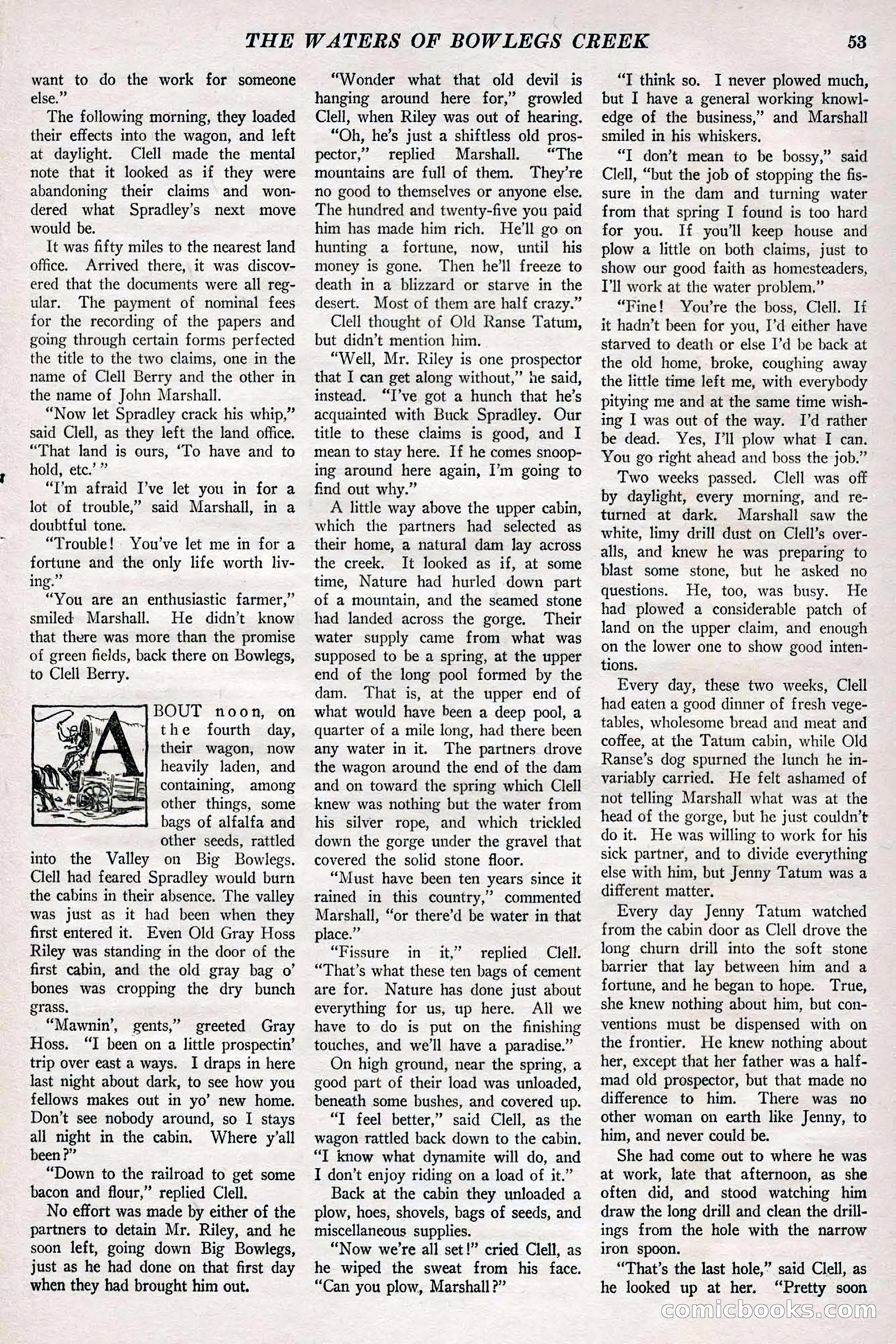
A restored page from Pulp Fiction, 1926. Page through the whole issue in the reader above.
📄 Transcribed text from this page (OCR, searchable)
Machine-transcribed from the original scan — historical spelling and the odd misread are preserved.
THE WATERS OF BOWLEGS CREEK want to do the work for someone else.” The following morning, they loaded their effects into the wagon, and left at daylight. Clell made the mental note that it looked as if they were abandoning their claims and won- dered what Spradley’s next move would be. It was fifty miles to the nearest land office. Arrived there, it was discov- ered that the documents were all reg- ular. The payment of nominal fees for the recording of the papers and going through certain forms perfected the title to the two claims, one in the name of Clell Berry and the other in the name of John Marshall. “Now let Spradley crack his whip,” said Clell, as they left the land office. “That land is ours, “To have and to hold, etc.’ ” “I’m afraid I’ve let you in for a lot of trouble,” said Marshall, in a doubtful tone. “Trouble! You've let me in for a fortune and the only life worth liv- ing.” “You are an enthusiastic farmer,” smiled Marshall. He didn’t know that there was more than the promise of green fields, back there on Bowlegs, to Clell Berry. BOUT noon, on the fourth day, their wagon, now heavily laden, and containing, among other things, some bags of alfalfa and other seeds, rattled into the Valley on Big Bowlegs. Clell had feared Spradley would burn the cabins in their absence. The valley was just as it had been when they first entered it. Even Old Gray Hoss Riley was standing in the door of the first cabin, and the old gray bag 0’ bones was cropping the dry bunch srass, “Mawnin’, gents,” greeted Gray Hoss. “I been on a little prospectin’ trip over east a ways. I draps in here last night about dark, to see how you fellows makes out in yo’ new home. Don’t see nobody around, so I stays all night in the cabin, Where y’all been ?” “Down to the railroad to get some bacon and flour,” replied Clell. No effort was made by either of the partners to detain Mr. Riley, and he soon left, going down Big Bowlegs, just as he had done on that first day when they had brought him out. “Wonder what that old devil is hanging around here for,’ growled Clell, when Riley was out of hearing. “Oh, he’s just a shiftless old pros- pector,”’ replied Marshall. “The mountains are full of them. They’re no good to themselves or anyone else. The hundred and twenty-five you paid him has made him rich, He'll go on hunting a fortune, now, until his money is gone. Then he'll freeze to death in a blizzard or starve in the desert. Most of them are half crazy.” Clell thought of Old Ranse Tatum, but didn’t mention him, “Well, Mr. Riley is one prospector that I can get along without,” he said, instead. “I’ve got a hunch that he’s acquainted with Buck Spradley. Our title to these claims is good, and I mean to stay here. If he comes snoop- ing around here again, I’m going to find out why.” A little way above the upper cabin, which the partners had selected as their home, a natural dam lay across the creek. It looked as if, at some time, Nature had hurled down part of a mountain, and the seamed stone had landed across the gorge. Their water supply came from what was supposed to be a spring, at the upper end of the long pool formed by the dam. That is, at the upper end of what would have been a deep pool, a quarter of a mile long, had there been any water in it. The partners drove the wagon around the end of the dam and on toward the spring which Clell knew was nothing but the water from his silver rope, and which trickled down the gorge under the gravel that covered the solid stone floor. “Must have been ten years since it rained in this country,” commented Marshall, “or there’d be water in that place.” “Fissure in it,” replied Clell. “That’s what these ten bags of cement are for. Nature has done just about everything for us, up here. All we have to do is put on the finishing totiches, and we'll have a paradise.” On high ground, near the spring, a good part of their load was unloaded, beneath some bushes, and covered up. “T feel better,” said Clell, as the wagon rattled back down to the cabin. “T know what dynamite will do, and I don’t enjoy riding on a load of it.” Back at the cabin they unloaded a plow, hoes, shovels, bags of seeds, and miscellaneous supplies. “Now we're all set!” cried Clell, as he wiped the sweat from his face. “Can you plow, Marshall ?” 58 “T think so. I never plowed much, but I have a general working knowl- edge of the business,’ and Marshall smiled in his whiskers. “I don’t mean to be bossy,” said Clell, “but the job of stopping the fis- sure in the dam and turning water from that spring I found is too hard for you. If you'll keep house and plow a little on both claims, just to show our good faith as homesteaders, I'll work at the water problem.” “Fine! You’re the boss, Clell. Ii it hadn’t been for you, I’d either have starved to death or else I’d be back at the old home, broke, coughing away the little time left me, with everybody pitying me and at the same time wish- ing I was out of the way. I’d rather be dead. Yes, Ill plow what I can. You go right ahead and boss the job.” Two weeks passed. Clell was off by daylight, every morning, and re- turned at dark. Marshall saw the white, limy drill dust on Clell’s over- alls, and knew he was preparing to blast some stone, but he asked no questions. He, too, was busy. He had plowed a considerable patch of land on the upper claim, and enough on the lower one to show good inten- tions. Every day, these two weeks, Clell had eaten a good dinner of fresh vege- tables, wholesome bread and meat and coffee, at the Tatum cabin, while Old Ranse’s dog spurned the lunch he in- variably carried. He felt ashamed of not telling Marshall what was at the head of the gorge, but he just couldn’t do it. He was willing to work for his sick partner, and to divide everything else with him, but Jenny Tatum was a different matter. Every day Jenny Tatum watched from the cabin door as Clell drove the long churn drill into the soft stone barrier that lay between him and a fortune, and he began to hope. True, she knew nothing about him, but con- ventions must be dispensed with on the frontier. He knew nothing about her, except that her father was a half- mad old prospector, but that made no difference to him. There was no other woman on earth like Jenny, to him, and never could be. She had come out to where he was at work, late that afternoon, as she often did, and stood watching him draw the long drill and clean the driil- ings from the hole with the narrow Iron spoon. “That’s the last hole,” said Clell, as he looked up at her. “Pretty soon COMMicoookxsS.COnl