
Pulp Fiction, 1926 · page 21 of 114
The Frontier, May 1926 — page 21: what you’re looking at
What you’re looking at
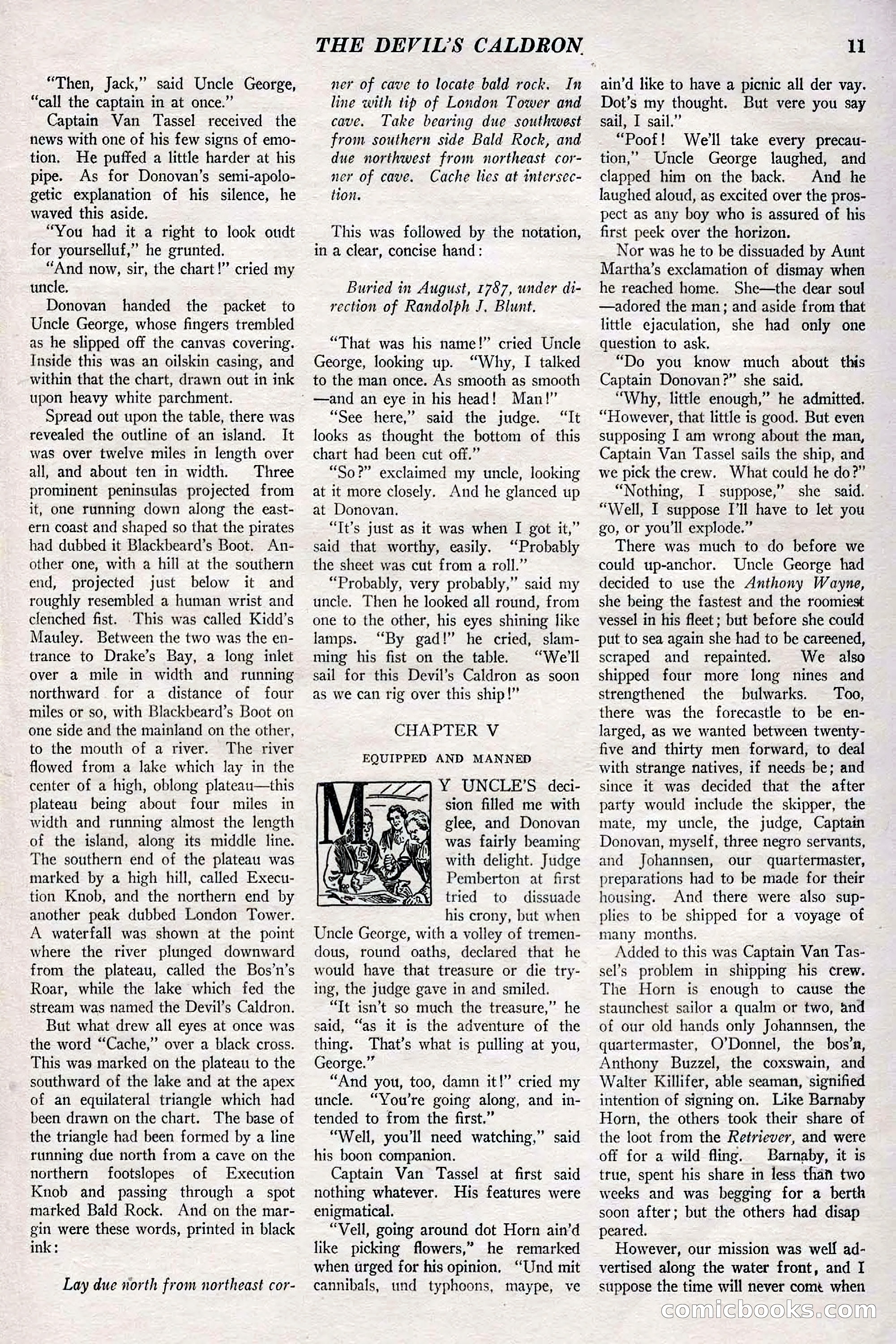
# Page Analysis This is a story text page (page 11) from a pulp fiction magazine titled "The Devil's Caldron." The page contains two chapters: the conclusion of an earlier chapter and Chapter V ("Equipped and Manned"), which begins with a small illustration showing what appears to be several people in period dress. The text concerns a group preparing a ship for an expedition. Characters named Uncle George, Captain Van Tassel, and others discuss organizing a crew and supplies for a voyage. The narrative mentions acquiring a vessel called the "Anthony Wayne," hiring crew members, and making preparations for what appears to be an adventure or treasure-hunting expedition. The tone and language suggest early 20th-century adventure fiction.
📄 Transcribed text from this page (OCR, searchable)
Machine-transcribed from the original scan — historical spelling and the odd misread are preserved.
“Then, Jack,” said Uncle George, “call the captain in at once.” Captain Van Tassel received the news with one of his few signs of emo- tion. He puffed a little harder at his pipe. As for Donovan’s semi-apolo- getic explanation of his silence, he waved this aside. “You had it a right to look oudt for yourselluf,” he grunted. “And now, sir, the chart!” cried my uncle, Donovan handed the packet to Uncle George, whose fingers trembled as he slipped off the canvas covering. Inside this was an oilskin casing, and within that the chart, drawn out in ink upon heavy white parchment. Spread out upon the table, there was revealed the outline of an island. It was over twelve miles in length over all, and about ten in width. Three prominent peninsulas projected from it, one running down along the east- ern coast and shaped so that the pirates had dubbed it Blackbeard’s Boot. An- other one, with a hill at the southern end, projected just below it and roughly resembled a human wrist and clenched fist. This was called Kidd’s Mauley. Between the two was the en- trance to Drake’s Bay, a long inlet over a mile in width and running northward for a distance of four miles or so, with Blackbeard’s Boot on one side and the mainland on the other, to the mouth of a river. The river flowed from a lake which lay in the center of a high, oblong plateau—this plateau being about four miles in width and running almost the length of the island, along its middle line. The southern end of the plateau was marked by a high hill, called Execu- tion Knob, and the northern end by another peak dubbed London Tower. A waterfall was shown at the point where the river plunged downward from the plateau, called the Bos’n’s Roar, while the lake which fed the stream was named the Devil’s Caldron. But what drew all eyes at once was the word “Cache,” over a black cross. This was marked on the plateau to the southward of the lake and at the apex of an equilateral triangle which had been drawn on the chart. The base of the triangle had been formed by a line running due north from a cave on the northern footslopes of Execution Knob and passing through a_ spot matked Bald Rock. And on the mar- gin were these words, printed in black ink: Lay due north from northeast cor- ' —and an eye in his head! THE DEVIL'S CALDRON ner of cave to locate bald rack. In line with tip of London Tower and cave. Take bearing due southwest from southern side Bald Rock, and due northwest from northeast cor- ner of cave. Cache lies at intersec- tion. This was followed by the notation, in a clear, concise hand: Burted in August, 1787, under di- rection of Randolph J. Blunt. “That was his name!” cried Uncle George, looking up. “Why, I talked to the man once. As smooth as smooth Man!” “See here,” said the judge. “It looks as thought the bottom of this chart had been cut off.” “So?” exclaimed my uncle, looking at it more closely. And he glanced up at Donovan. “It’s just as it was when I got it,” said that worthy, easily. ‘Probably the sheet was cut from a roll.” “Probably, very probably,” said my uncle. Then he looked all round, from one to the other, his eyes shining like lamps. “By gad!” he cried, slam- ming his fist on the table. “We'll sail for this Devil’s Caldron as soon as we Cat rig over this ship!” CHAPTER V EQUIPPED AND MANNED Y UNCLE’S deci- sion filled me with glee, and Donovan was fairly beaming with delight. Judge Pemberton at first tried to dissuade his crony, but when Uncle George, with a volley of tremen- dous, round oaths, declared that he would have that treasure or die try- ing, the judge gave in and smiled. “It isn’t so much the treasure,” he said, “as it is the adventure of the thing. That’s what is pulling at you, George.” “And you, too, damn it!” cried my uncle. “You're going along, and in- tended to from the first.” “Well, you'll need watching,” said his boon companion. Captain Van Tassel at first said nothing whatever. His features were enigmatical. “Vell, going around dot Horn ain’d like picking flowers,” he remarked when urged for his opinion. “Und mit cannibals, und typhoons, maype, ve 11 ain’d like to have a picnic all der vay. Dot’s my thought. But vere you say sail, I sail.” “Poof! We'll take every precau- tion,” Uncle George laughed, and clapped him on the back. And he laughed aloud, as excited over the pros- pect as any boy who is assured of his first peek over the horizon. Nor was he to be dissuaded by Aunt Martha’s exclamation of dismay when he reached home. She—the dear soul —adored the man; and aside from that little ejaculation, she had only one question to ask. “Do you know much about this Captain Donovan?” she said. “Why, little enough,” he admitted, “However, that little is good. But even supposing I am wrong about the man, Captain Van Tassel sails the ship, and we pick the crew. What could he do?” “Nothing, I suppose,” she said. “Well, I suppose I’ll have to let you go, or you'll explode.” There was much to do before we could up-anchor. Uncle George had decided to use the Anthony Wayne, she being the fastest and the roomiest vessel in his fleet; but before she could put to sea again she had to be careened, scraped and repainted. We also shipped four more long nines and strengthened the bulwarks. Too, there was the forecastle to be en- larged, as we wanted between twenty- five and thirty men forward, to deal with strange natives, if needs be; and since it was decided that the after party would include the skipper, the mate, my uncle, the judge, Captain Donovan, myself, three negro servants, and Johannsen, our quartermaster, preparations had to be made for their housing. And there were also sup- plies to be shipped for a voyage of many months. Added to this was Captain Van Tas- sel’s problem in shipping his crew. The Horn is enough to cause the staunchest sailor a qualm or two, and of our old hands only Johannsen, the quartermaster, O’Donnel, the bos’a, Anthony Buzzel, the coxswain, and Walter Killifer, able seaman, signified intention of signing on. Like Barnaby Horn, the others took their share of the loot from the Retriever, and were off for a wild fling. Barnaby, it is true, spent his share in less than two weeks and was begging for a berth soon after; but the others had disap peared. However, our mission was well ad- vertised along the water front, and I suppose the time will never com’ when COnmlclooOoks. Com