
A complete issue · 108 pages · 1912
Life — January 4, 1912
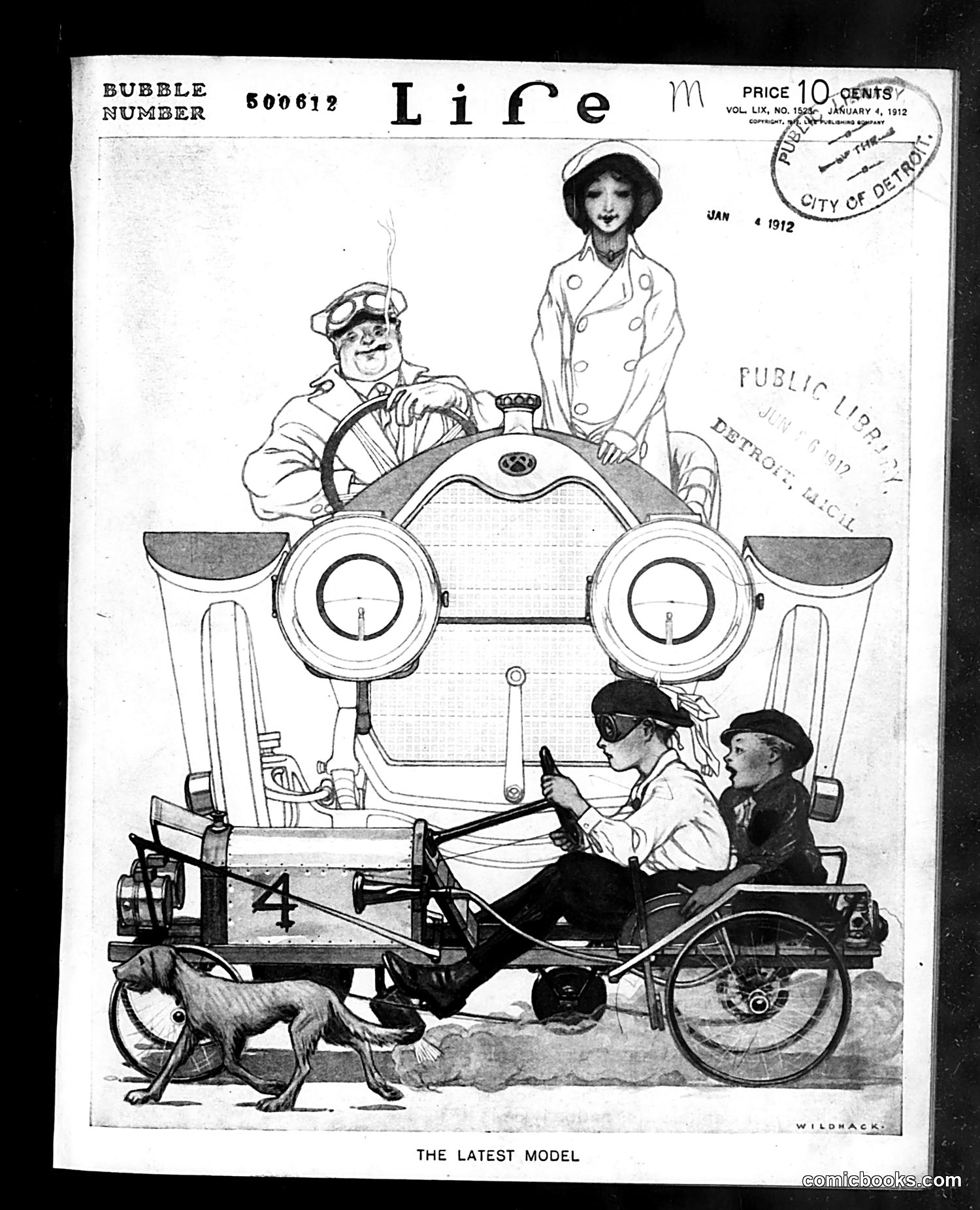
This satirical cartoon depicts an enormous automobile being operated by a uniformed chauffeur, with a fashionable woman passenger standing atop it. Below, two boys in a cart pulled by a dog race alongside, appearing to mock or compete with the vehicle. The joke likely comments on early-1900s automobile culture—specifically the contrast between wealthy car owners and common people. The "latest model" caption suggests satire about excessive automotive design and status-seeking among the affluent. The dog-drawn cart of working-class children racing the fancy automobile humorously undermines the car's supposed superiority, suggesting that despite technological advancement and expense, simpler transportation could keep pace—a commentary on automotive pretension and economic inequality during the early industrial age.
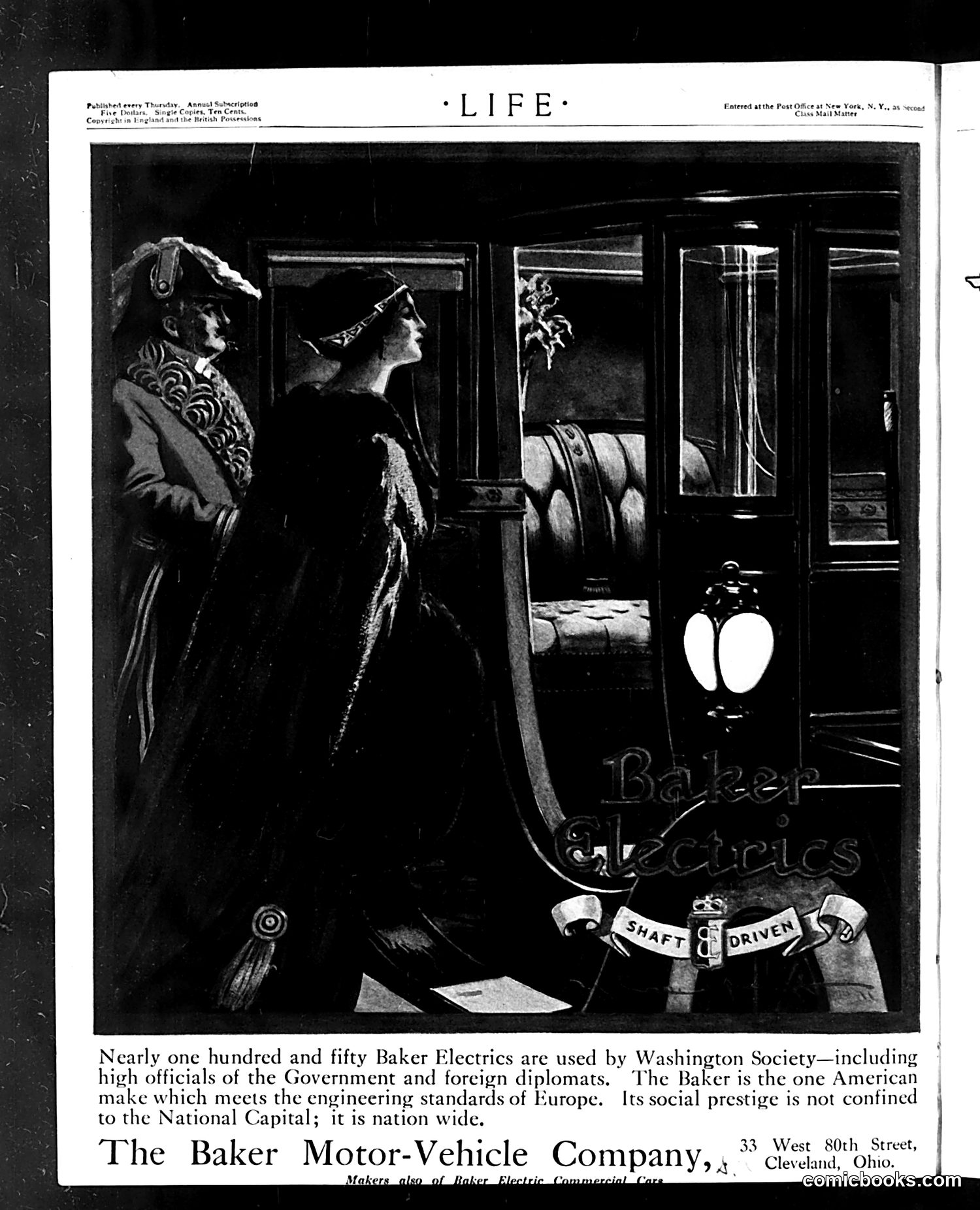
This is primarily **advertising**, not political satire. The Baker Motor-Vehicle Company is marketing their electric automobiles ("Baker Electrics") to wealthy, prestigious clientele. The image depicts two elegantly dressed figures—apparently representing high society—viewing a Baker Electric vehicle. The text claims nearly 150 Baker Electrics are used by Washington Society, including government officials and foreign diplomats, positioning the vehicle as meeting European engineering standards and possessing "social prestige." The illustration's theatrical lighting and formal dress suggest luxury and exclusivity. This was common marketing strategy for early electric vehicles, which were expensive and associated with affluent consumers. The company's Cleveland, Ohio address appears at bottom. The "Shaft Driven" emblem indicates a technical feature meant to appeal to discerning buyers.
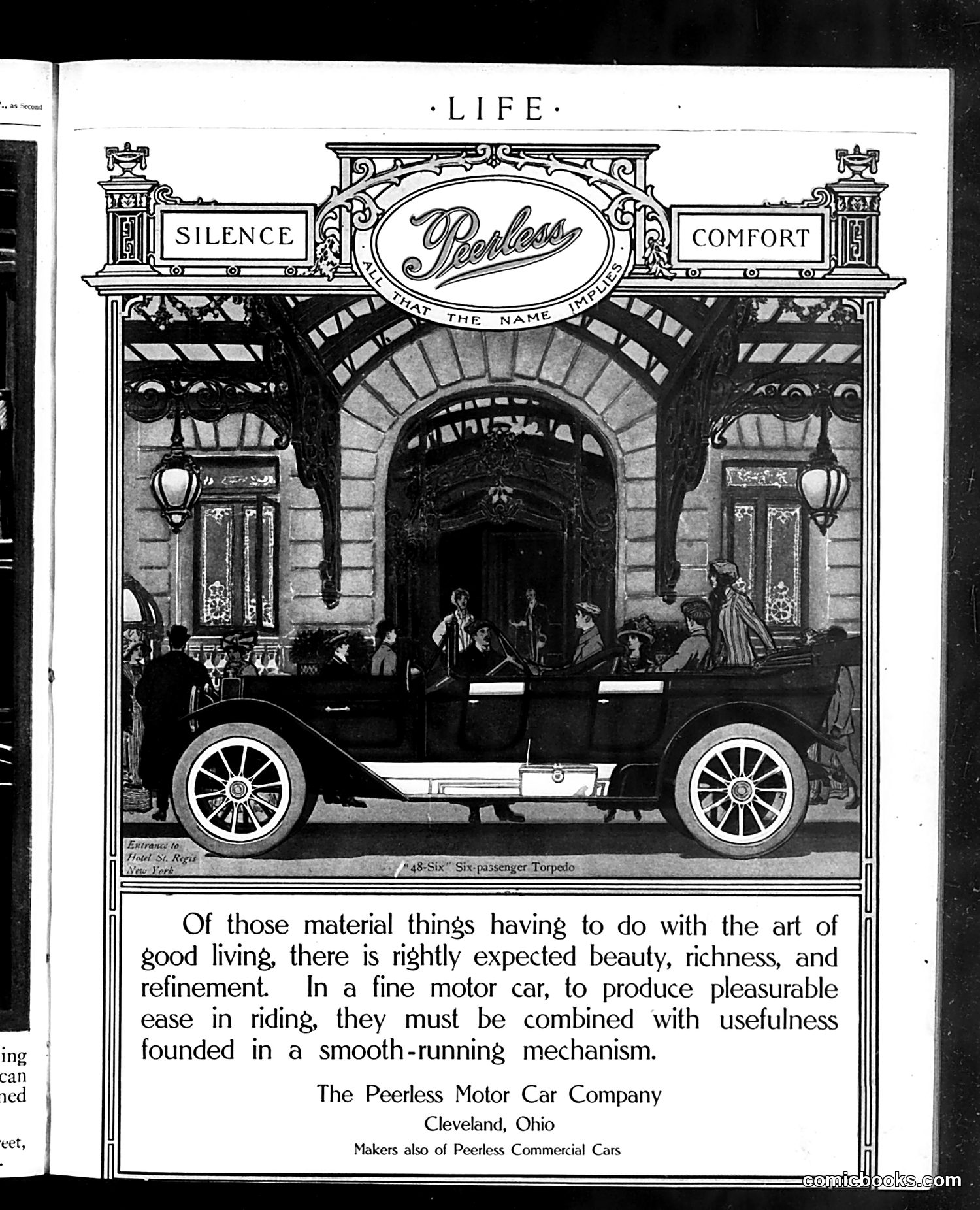
This is **not a satirical cartoon** but rather a **luxury automobile advertisement** for the Peerless Motor Car Company of Cleveland, Ohio. The image shows a high-end "48-Six" six-passenger torpedo automobile parked beneath an ornate architectural entrance (labeled "Entrance to Hotel St. Regis, New York"). Well-dressed passengers and attendants surround the vehicle. The advertising copy emphasizes that fine motor cars must combine aesthetic qualities—"beauty, richness, and refinement"—with mechanical reliability and smooth operation. The prestigious hotel setting and elegantly dressed figures signal this vehicle's appeal to wealthy consumers. This represents typical early 20th-century luxury automotive marketing, targeting affluent buyers by associating the product with sophistication and refined living.
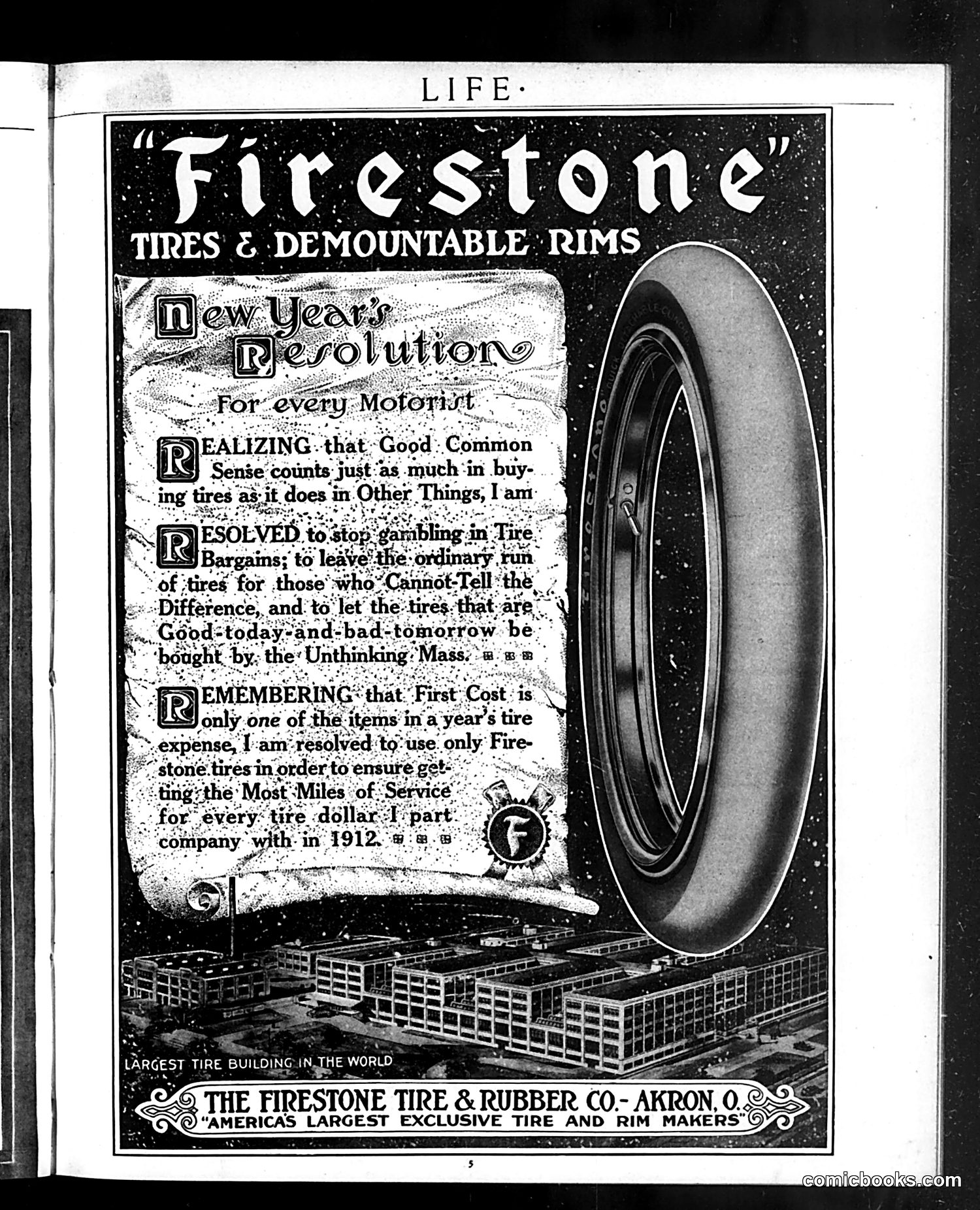
This page is **primarily a Firestone Tire & Rubber Company advertisement**, not a political cartoon or satire. It appears in *Life* magazine and presents a "New Year's Resolution" framed as personal commitments from a motorist. The ad uses a rhetorical device where the unnamed motorist "resolves" to stop buying cheap tires and commit exclusively to Firestone products, justifying this through claims about value and durability ("Most Miles of Service"). The reference to "1912" dates this advertisement to around that era. The imagery—a massive tire displayed beside the "Largest Tire Building in the World"—functions as corporate boasting rather than satire. There is no identifiable political commentary or caricature here; it's straightforward product marketing using aspirational messaging about wise consumer choices.
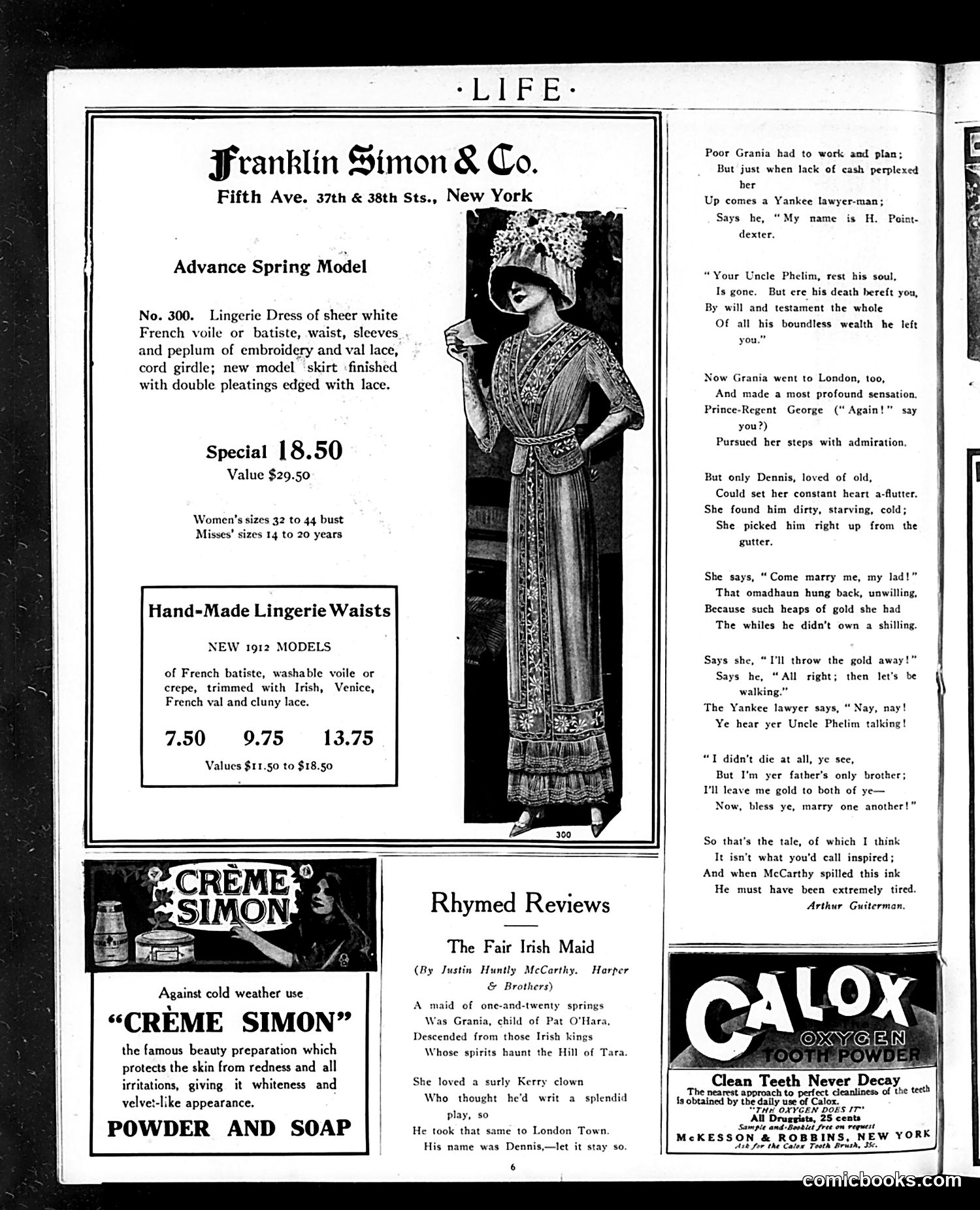
This page is primarily **commercial advertising**, not political satire. The main content features: 1. **Franklin Simon & Co.** advertisement for women's spring clothing—a lingerie dress and hand-made waists with prices and sizing information. 2. **Crème Simon** beauty product advertisement promising skin protection and a "velvet-like appearance." 3. **Calox Tooth Powder** advertisement claiming teeth "never decay." 4. **"Rhymed Reviews"** section by Arthur Gutterman reviewing "The Fair Irish Maid" by Justin Huntly McCarthy—a romantic narrative poem about an Irish woman named Grania who pursues various suitors with ultimately modest results. The page reflects early 1910s consumer culture and women's fashion interests rather than containing political commentary or satire.
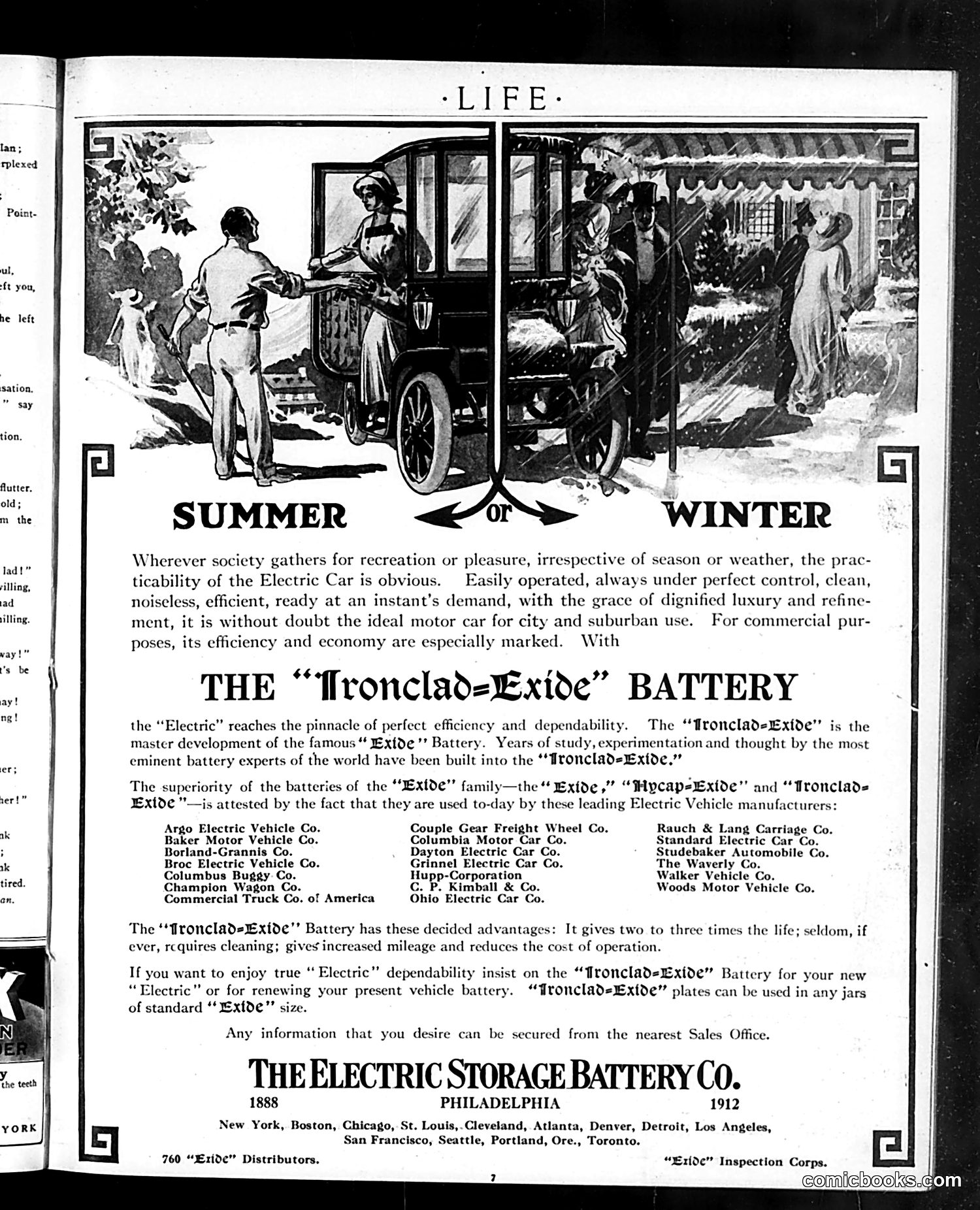
This is primarily a **full-page advertisement** for the Ironclad-Exide Battery, not a satirical cartoon or political commentary. The two illustrated panels contrast "Summer" and "Winter" use of an electric automobile—showing the vehicle operating smoothly in both seasons. The ad emphasizes the battery's reliability and efficiency for electric cars, which were a legitimate commercial option in this 1912 era before gasoline vehicles dominated. The advertisement lists numerous electric vehicle manufacturers as clients, indicating electric cars were still competitively marketed. The copy stresses the battery's superior durability, longevity, and reduced operating costs. **No satire is present.** This represents period advertising for emerging automotive technology, before the internal combustion engine became standard.
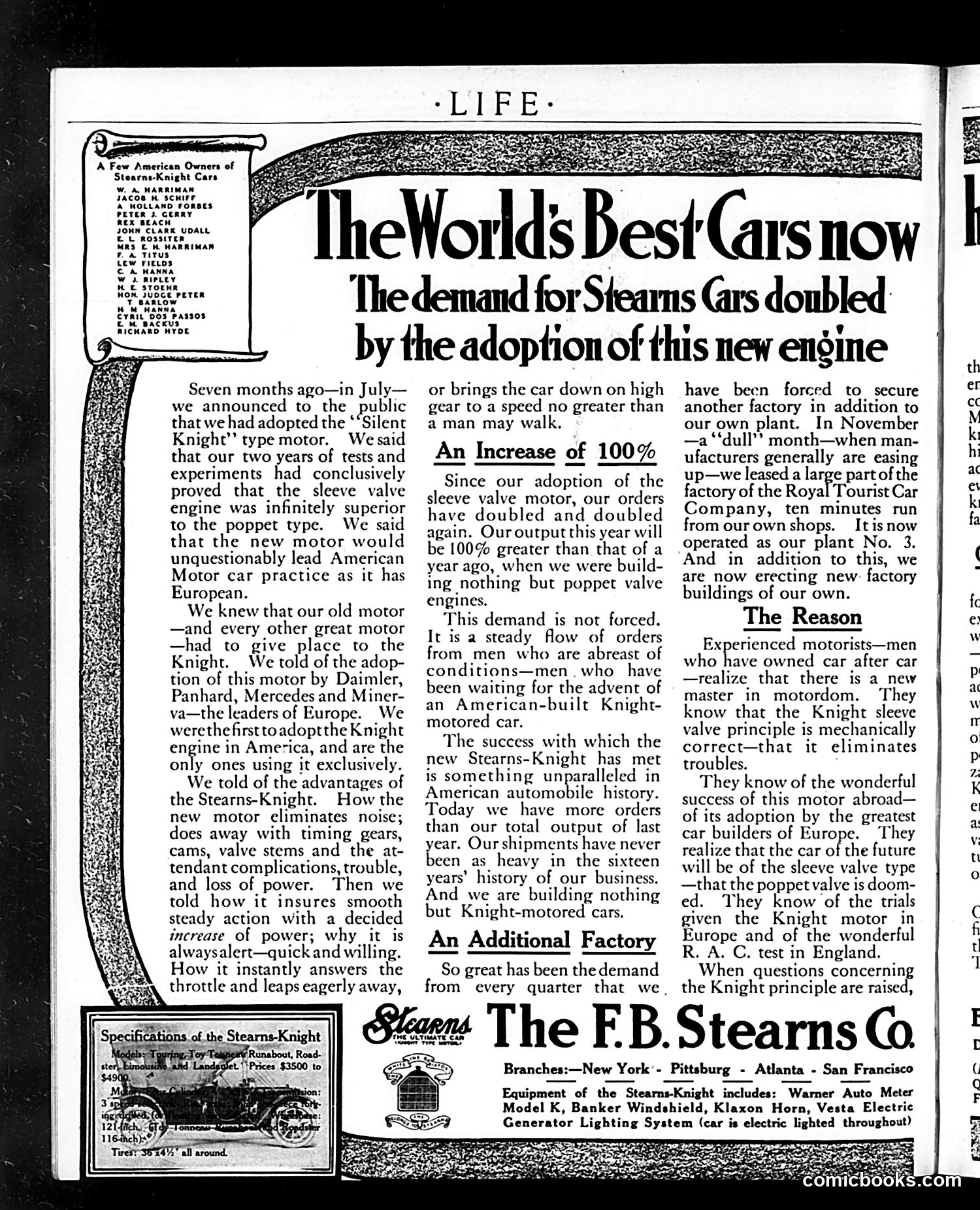
This page is primarily a **full-page advertisement for the Sterns-Knight automobile**, not satirical content. The ad announces the adoption of a new "sleeve valve" engine that allegedly doubled demand for Sterns cars. The company claims this motor eliminates noise, vibration, and mechanical complexity compared to traditional engines with "valve stems and attendant complications." The text boasts of increased production and a second factory to meet demand, positioning the sleeve valve as revolutionary for American automobile manufacturing. The left sidebar lists what appear to be company directors or stockholders. There is **no political cartoon or satire** on this page—it's straightforward automotive marketing from the early 20th century, emphasizing technical innovation as a sales point.
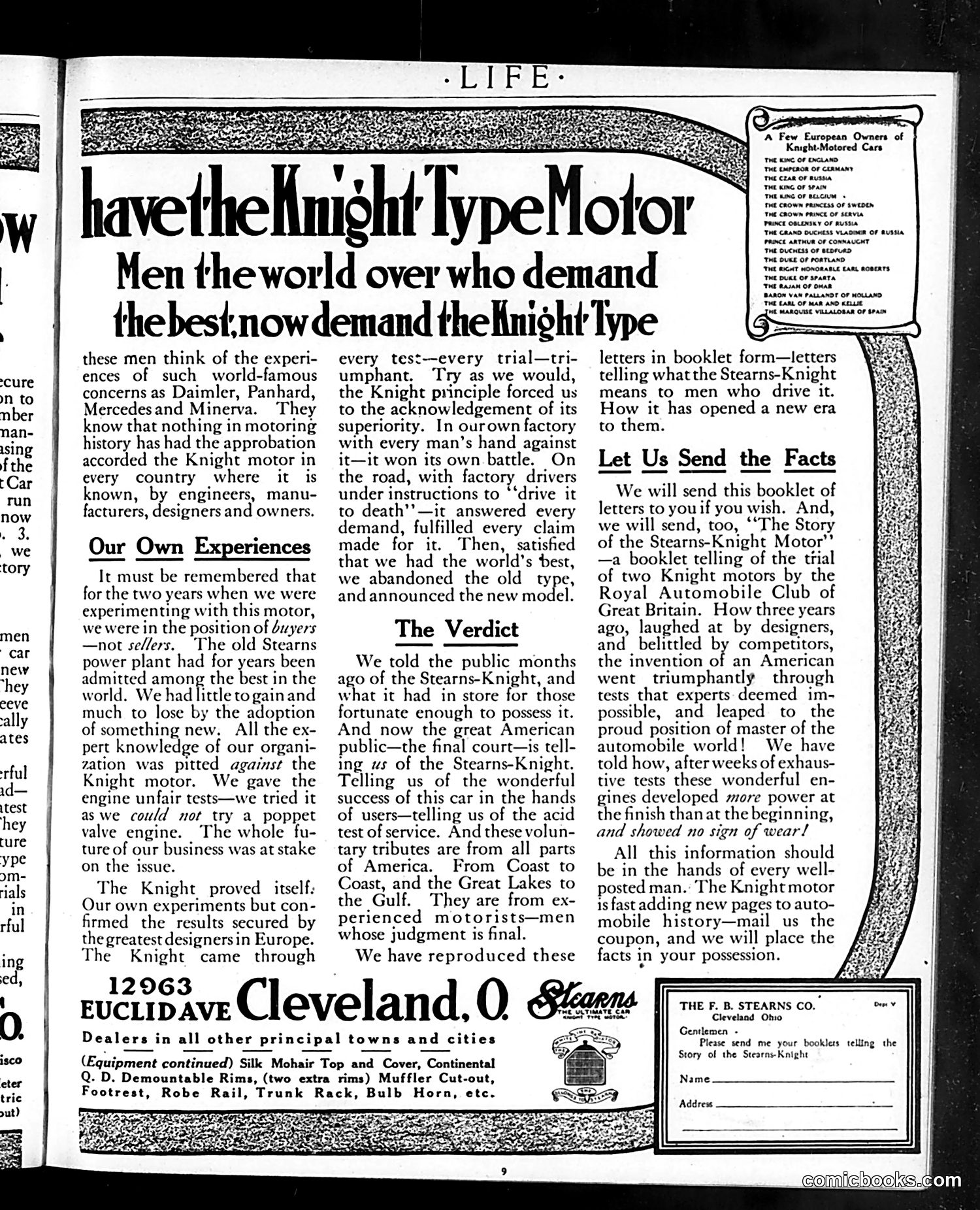
This page is primarily a **Knight-Type Motor automobile advertisement**, not a satirical cartoon. The ad promotes the Stearns-Knight motor car by claiming superiority based on extensive testing. The text argues that prestigious European owners (listed in a decorative box—various royalty and nobility) and American experts have validated the Knight motor's quality. Key claims include: the Knight principle "forced us to acknowledge" superiority; factory drivers outperformed competitors; and American automobile clubs initially "laughed at designers" before the car "went triumphantly through tests." The ad invites readers to request a booklet of testimonial letters. There is a coupon at bottom-right for ordering this promotional material. This represents early 1900s automotive marketing emphasizing endorsements from wealthy, prestigious figures as proof of product excellence.
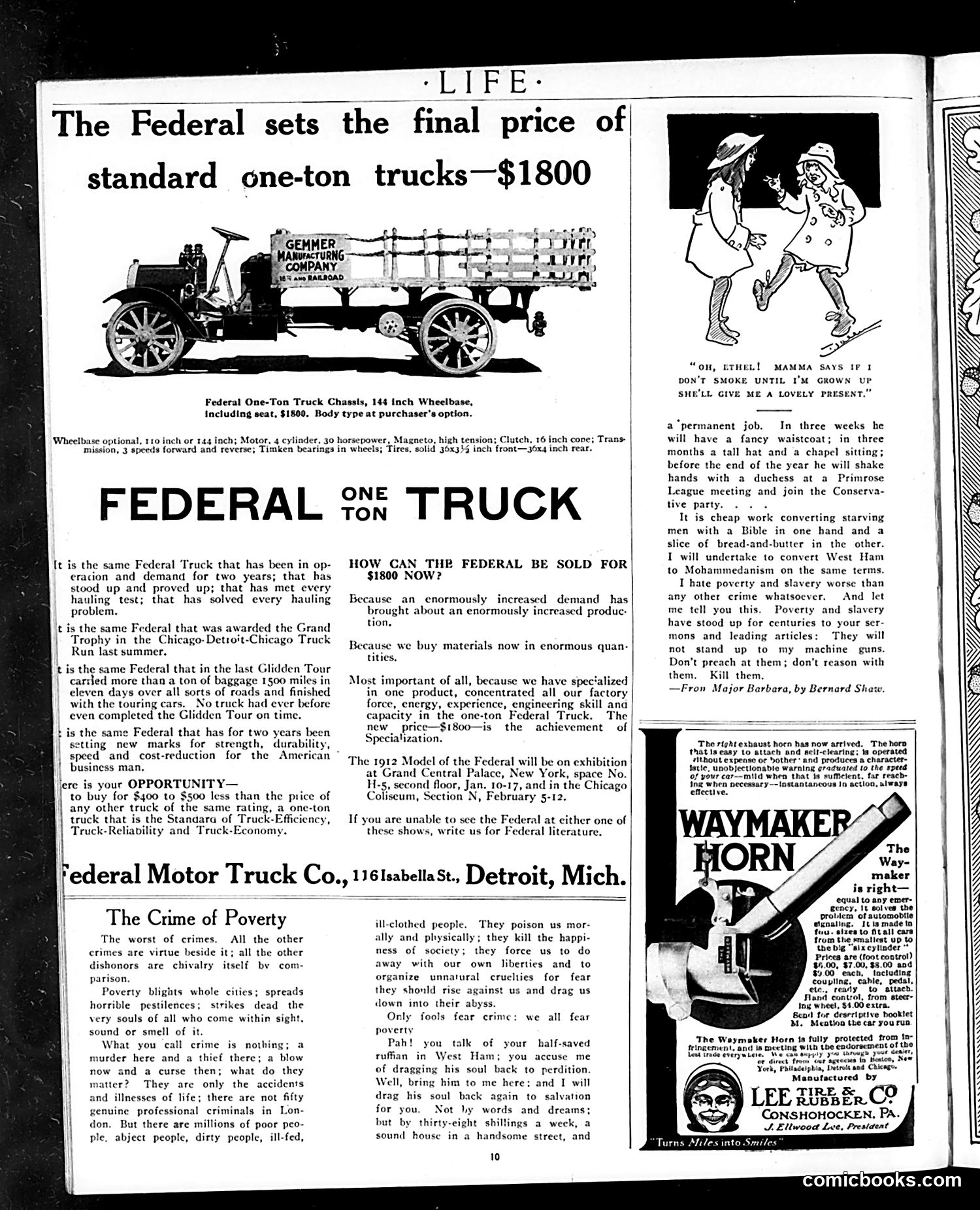
This page is primarily **advertising and editorial content**, not political satire. The main illustration shows a **Federal one-ton truck** ($1,800 price point). The small cartoon in the upper right depicts two figures—a child and what appears to be Santa Claus or a gift-giver—with dialogue about presents and not smoking until grown up. This is a straightforward **wholesome domestic joke** about children and gift-giving, lacking satirical intent. The "Crime of Poverty" essay below is serious social commentary on poverty as a moral failing of society, not satire. The remaining content consists of **product advertisements** (Waymaker Horn, Lee Rubber Company), which occupy significant space. The page reflects early 1910s consumer culture and industrial marketing rather than political cartoon satire.
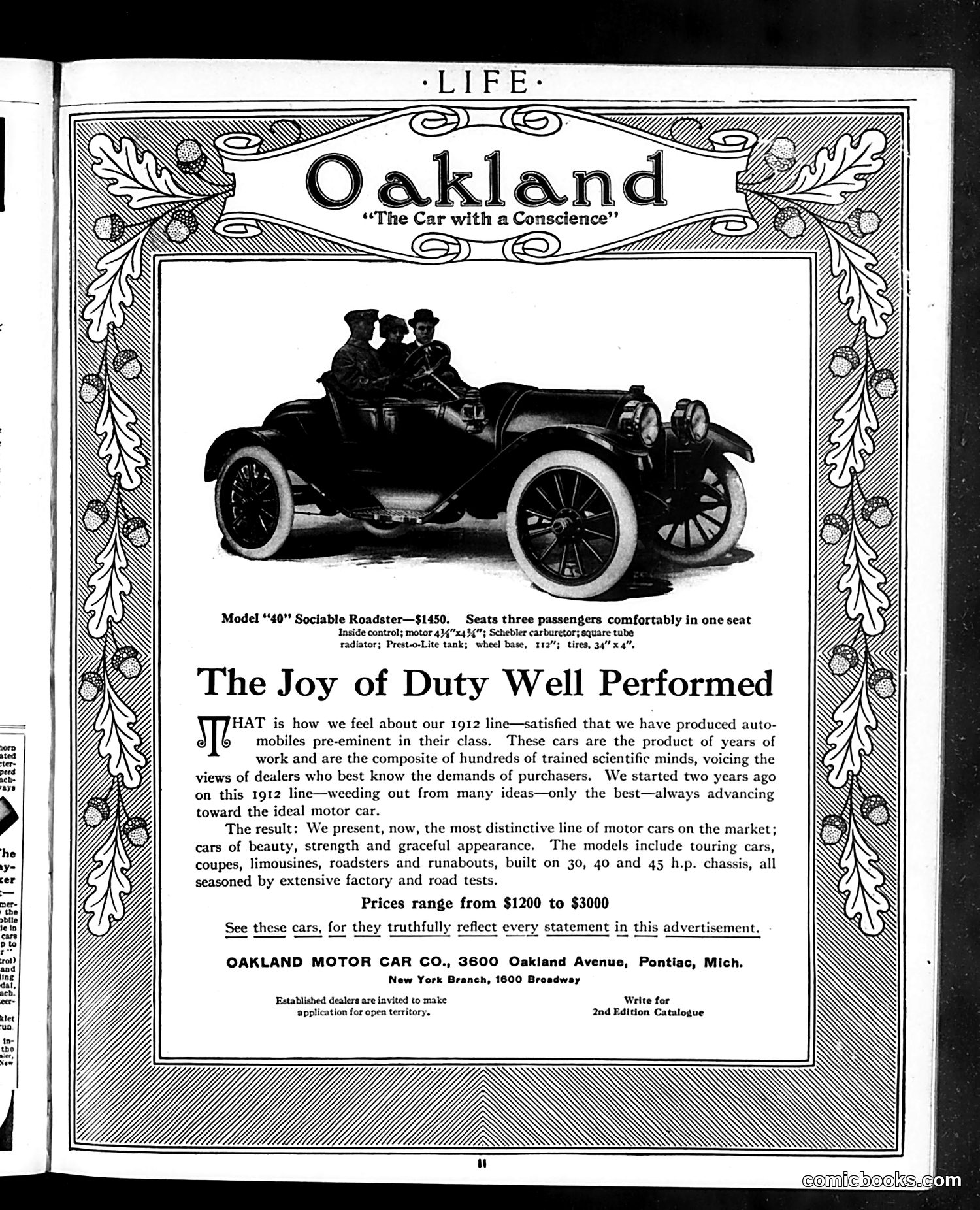
This is a **1912 automobile advertisement**, not a political cartoon. It promotes Oakland Motor Cars, manufactured by Oakland Motor Car Co. in Pontiac, Michigan. The ad features a Model "40" Sociable Roadster priced at $1,450, depicted with three passengers. The marketing emphasizes "The Joy of Duty Well Performed," claiming Oakland cars represent the "most distinctive line of motor cars on the market" through years of engineering refinement. The text highlights various chassis options (30, 40, 45 h.p.) and price range ($1,200-$3,000). The decorative art nouveau border and formal layout are typical of early 20th-century trade magazine advertising. This reflects the era when automobiles were luxury goods marketed to affluent consumers.
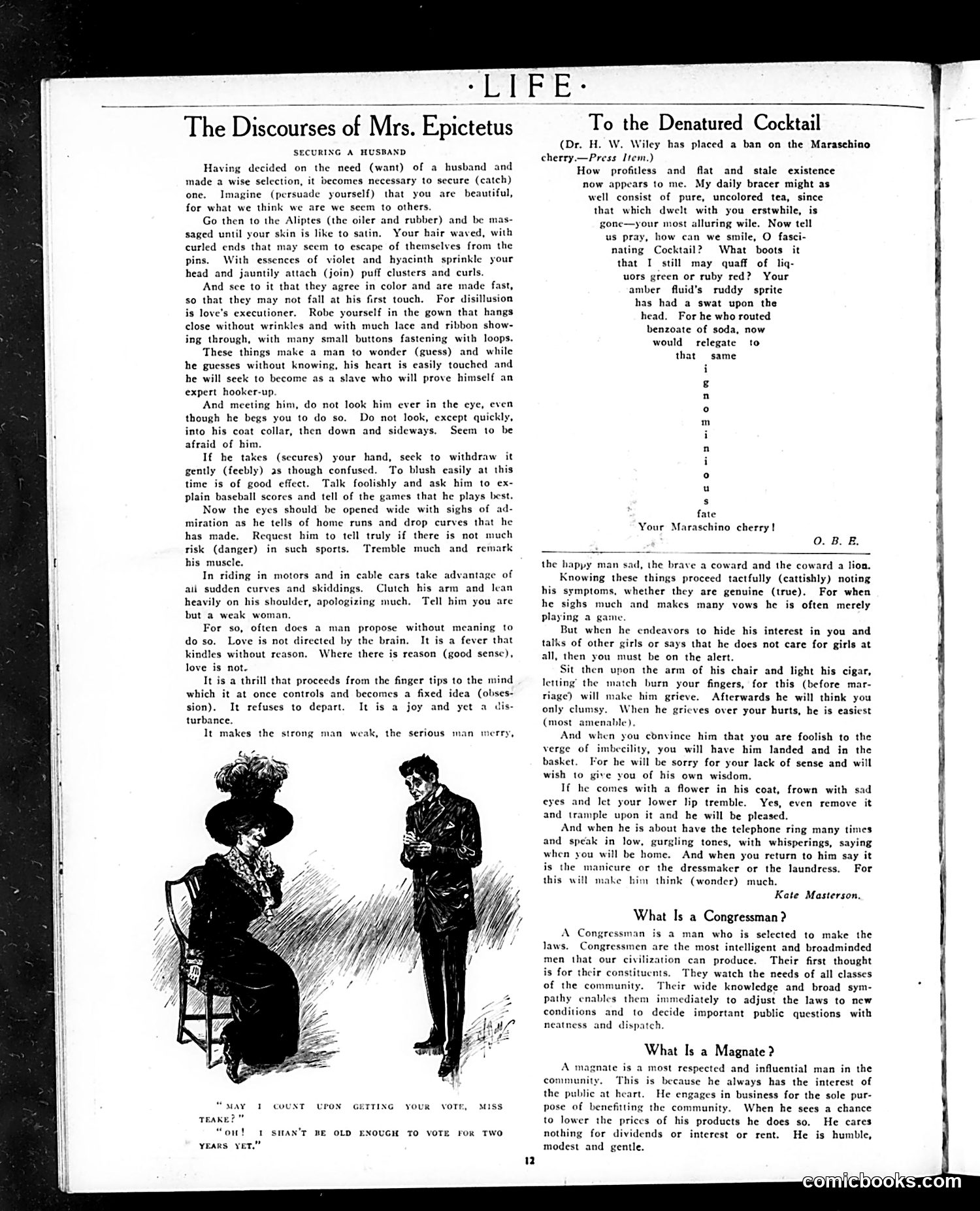
This page contains satirical advice columns and definitions rather than political cartoons. "The Discourses of Mrs. Epictetus" offers tongue-in-cheek instructions for women on securing a husband—advising flirtation tactics, physical appearance management, and strategic manipulation of male attention. The accompanying illustration shows a woman and man in conversation. The right column includes humorous definitions: "What Is a Congressman?" describes them as intelligent, broad-minded men serving constituents' interests. "What Is a Magnate?" defines such figures as respected community members engaged in business for public benefit. These are gentle satires of social conventions and political self-importance rather than attacks on specific individuals or events. The humor targets general social pretense and gender dynamics of the era.
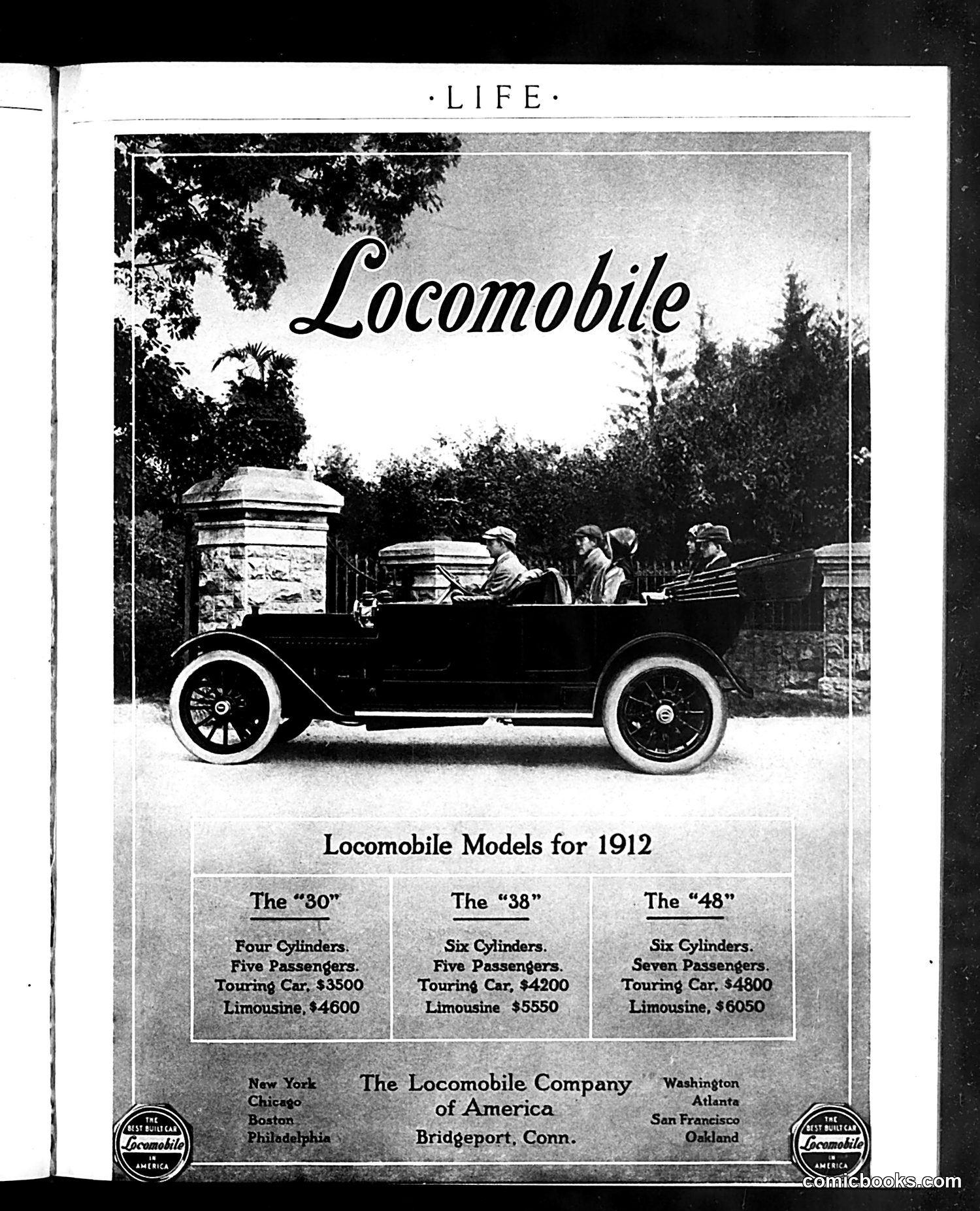
This is a **product advertisement**, not political satire or a cartoon. The page promotes the Locomobile automobile company's 1912 model lineup. The image shows a touring car with several passengers in period dress traveling through a natural landscape. The ad presents three models: the "30" (four cylinders, $3,500), the "38" (six cylinders, $4,200), and the "48" (six cylinders, $4,800), available as either touring cars or limousines. The Locomobile Company of America, headquartered in Bridgeport, Connecticut, lists offices in major American cities. The "Best Built Cars in America" seal appears at the bottom. This reflects early automotive marketing emphasizing luxury, passenger capacity, and engine specifications to affluent buyers.
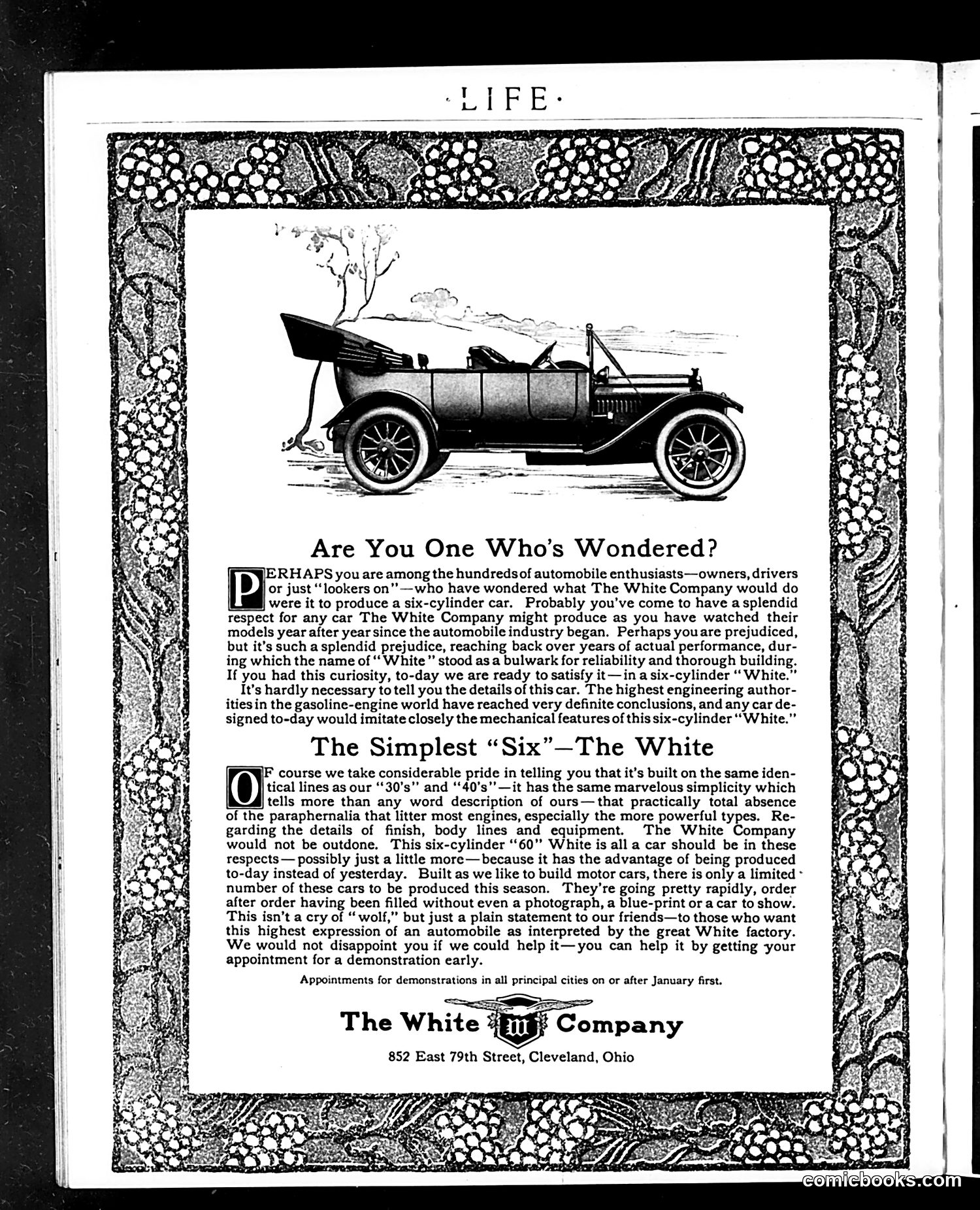
This is **not a cartoon or satire**, but rather a **straight advertisement** for The White Company's six-cylinder automobile, published in Life magazine. The ad addresses potential customers who've wondered about the company's plans to produce a six-cylinder car. It emphasizes the vehicle's simplicity and reliability—claiming it matches the engineering principles of their existing "30s" and "40s" models. The sales pitch highlights limited production and the car's availability "produced to-day instead of yesterday," suggesting exclusivity and immediacy as selling points. The decorative floral border and period typography are typical of early 1910s magazine design. This represents straightforward automotive marketing from the era's competitive nascent automobile industry, not satire.
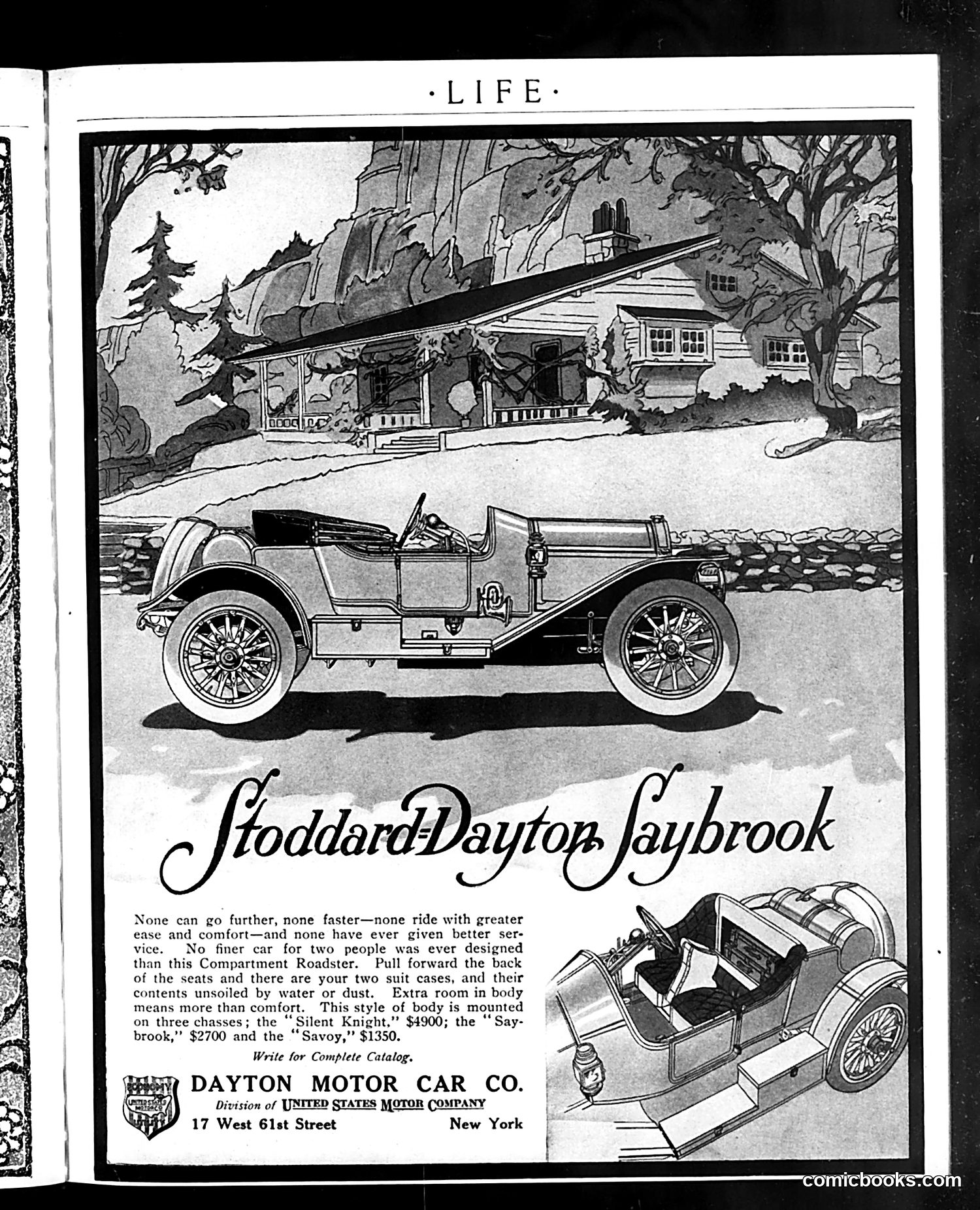
This is **not a political cartoon or satire**—it's a straightforward automobile advertisement from Life magazine's advertising section. The page promotes the **Stoddard-Dayton Jaybrook**, a luxury car marketed as ideal for two-person travel. The ad emphasizes practical features: fold-down rear seats that convert to storage for luggage, extra interior space, and comfort. Three chassis options are listed at different price points ($4,900 to $1,350), suggesting various market segments. The accompanying illustration shows the car's side profile and a detail drawing of the innovative seat mechanism. The idyllic house illustration establishes aspirational, upper-class lifestyle imagery typical of early automotive advertising. This represents early 1910s consumer marketing—no satire intended.
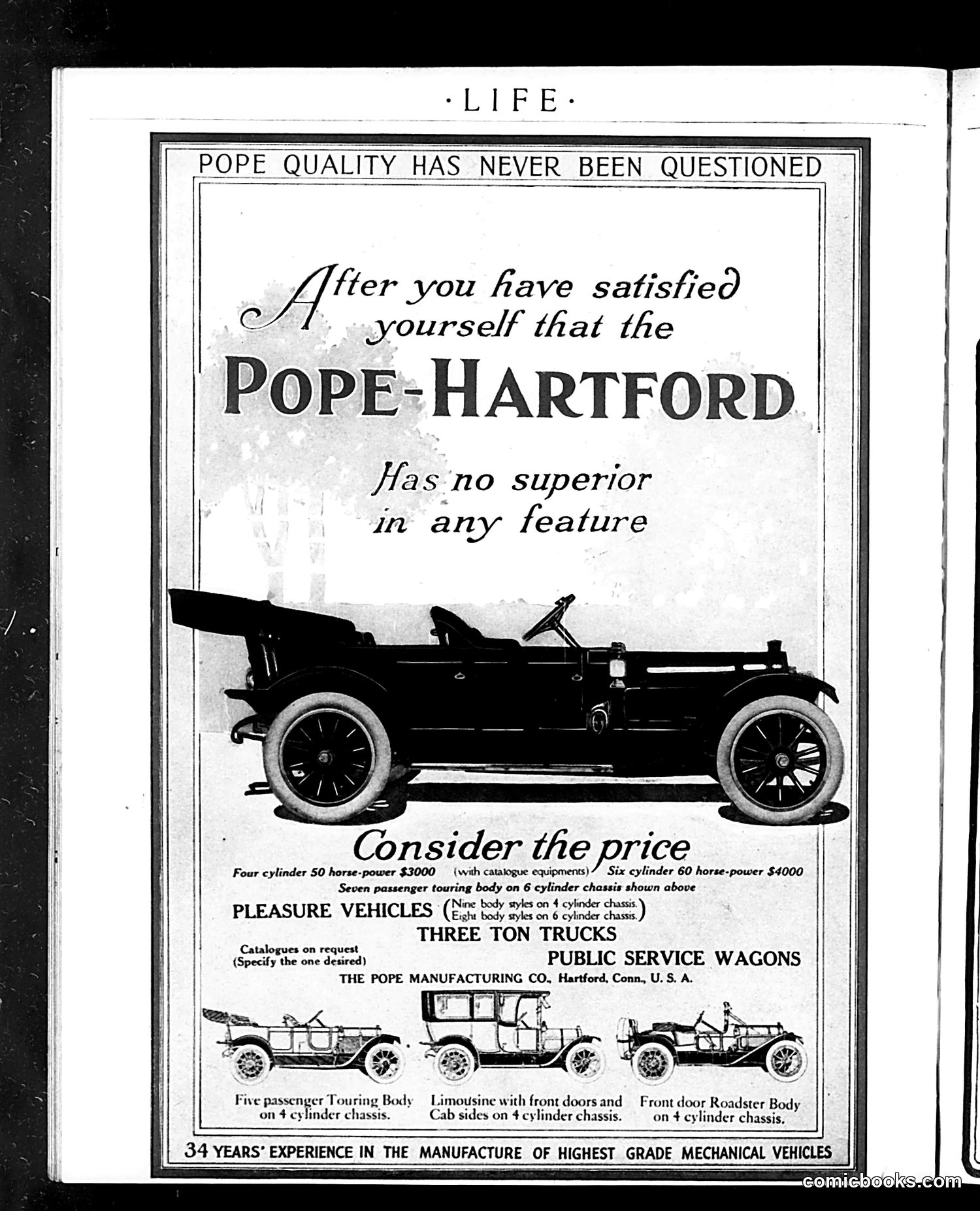
This is a **straightforward automobile advertisement**, not satire or political commentary. The Pope Manufacturing Company of Hartford, Connecticut marketed the Pope-Hartford automobile with a confident sales pitch: after comparing features, you'll find it has "no superior in any feature," yet consider its competitive pricing ($3,000-$4,000). The ad emphasizes the company's legitimacy—34 years' manufacturing experience—and displays various vehicle models: pleasure vehicles, trucks, and service wagons in different body configurations. The title "Pope Quality Has Never Been Questioned" simply asserts brand reliability. The clever framing ("After you have satisfied yourself...") presents a logical sales argument: examine competitors, then note Pope-Hartford's superior value. This reflects early automotive-industry marketing when establishing credibility and price-value positioning were primary advertising strategies.
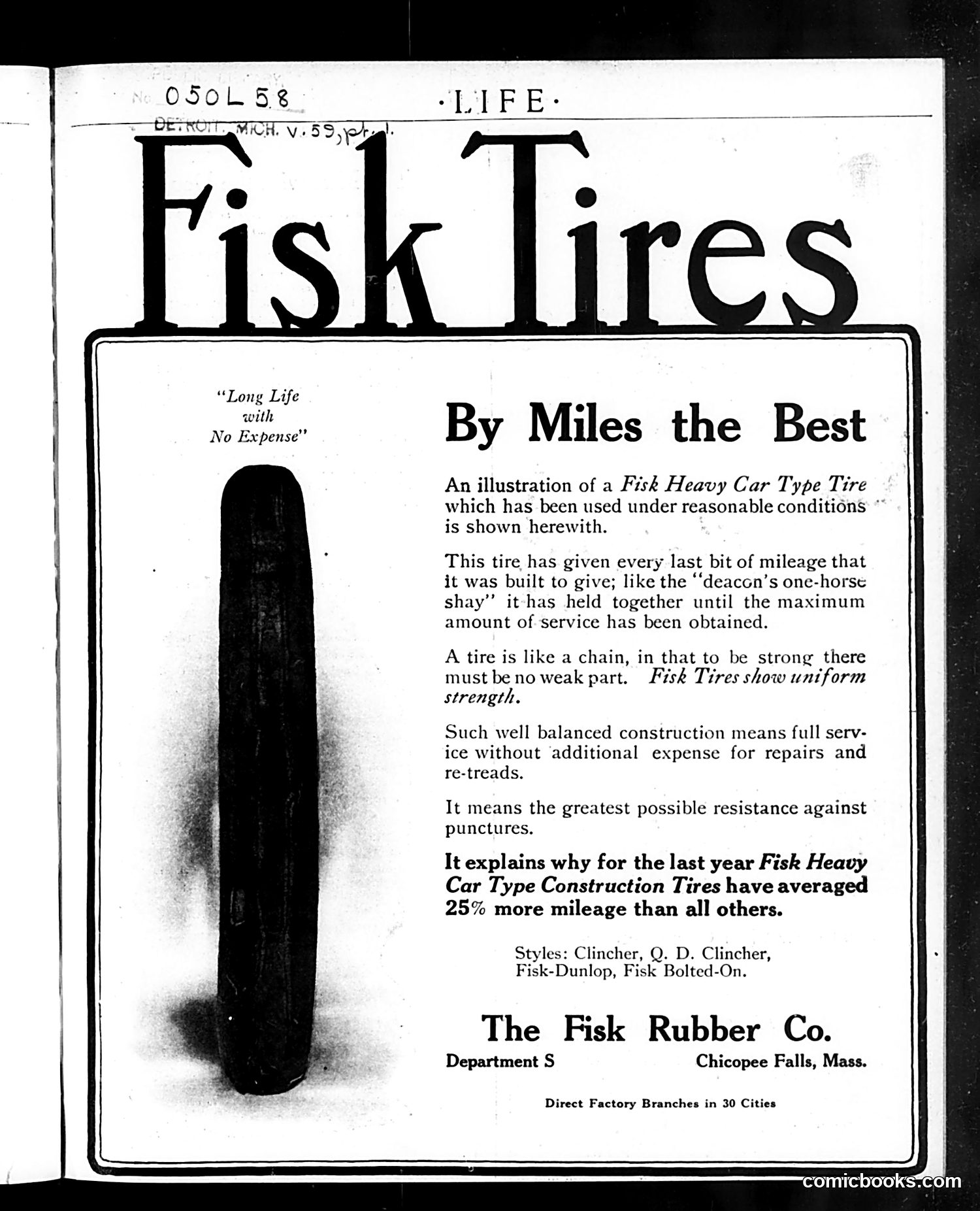
This is a **tire company advertisement**, not a political cartoon. The Fisk Rubber Company showcases a heavily worn tire to demonstrate product durability and value. The advertisement references the "deacon's one-horse shay"—a literary allusion to Oliver Wendell Holmes's 1858 poem about a carriage that lasted exactly 100 years before suddenly falling apart. By comparing their tire to this tale, Fisk claims their product extracts maximum utility before failure, with "no weak part." The worn tire photograph serves as proof of longevity. The ad emphasizes uniform construction, resistance to punctures, and claims 25% better mileage than competitors—marketing messages typical of early automotive advertising when tire reliability was a major selling point for consumers. This represents commercial advertising rather than satire or political commentary.
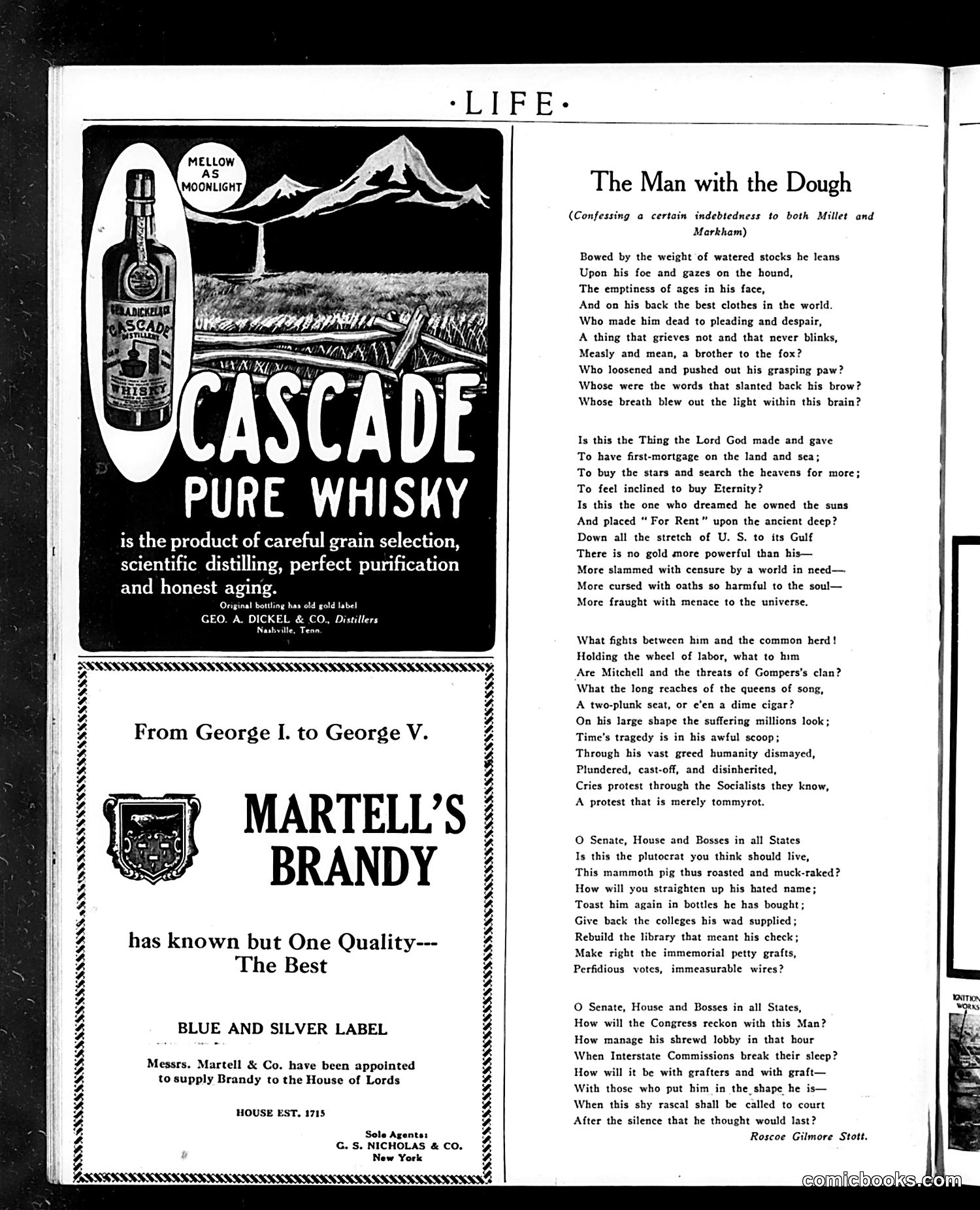
This poem by Roscoe Gilmore Stott satirizes wealthy industrialists and plutocrats of the early 20th century. The "man with the dough" is a wealthy businessman, depicted as spiritually and morally dead despite material success—"bowed by the weight of watered stocks" (fraudulent investments). The satire targets corporate greed and corruption: the figure owns vast wealth yet the common people suffer "plundered, cast-off, and disinherited." References to "Mitchell" (likely J.P. Morgan associate) and "Gompers's clan" (labor leader Samuel Gompers) highlight class conflict. The poem accuses politicians—"Senate, House and Bosses"—of complicity, asking how they'll reckon with this corrupt plutocrat when "Interstate Commissions break their sleep" and he faces court. It's Progressive Era criticism of robber barons, corrupt government, and labor exploitation, written in mock-heroic style echoing Millet and Markham's depictions of suffering workers—but inverted to condemn the wealthy oppressor instead.
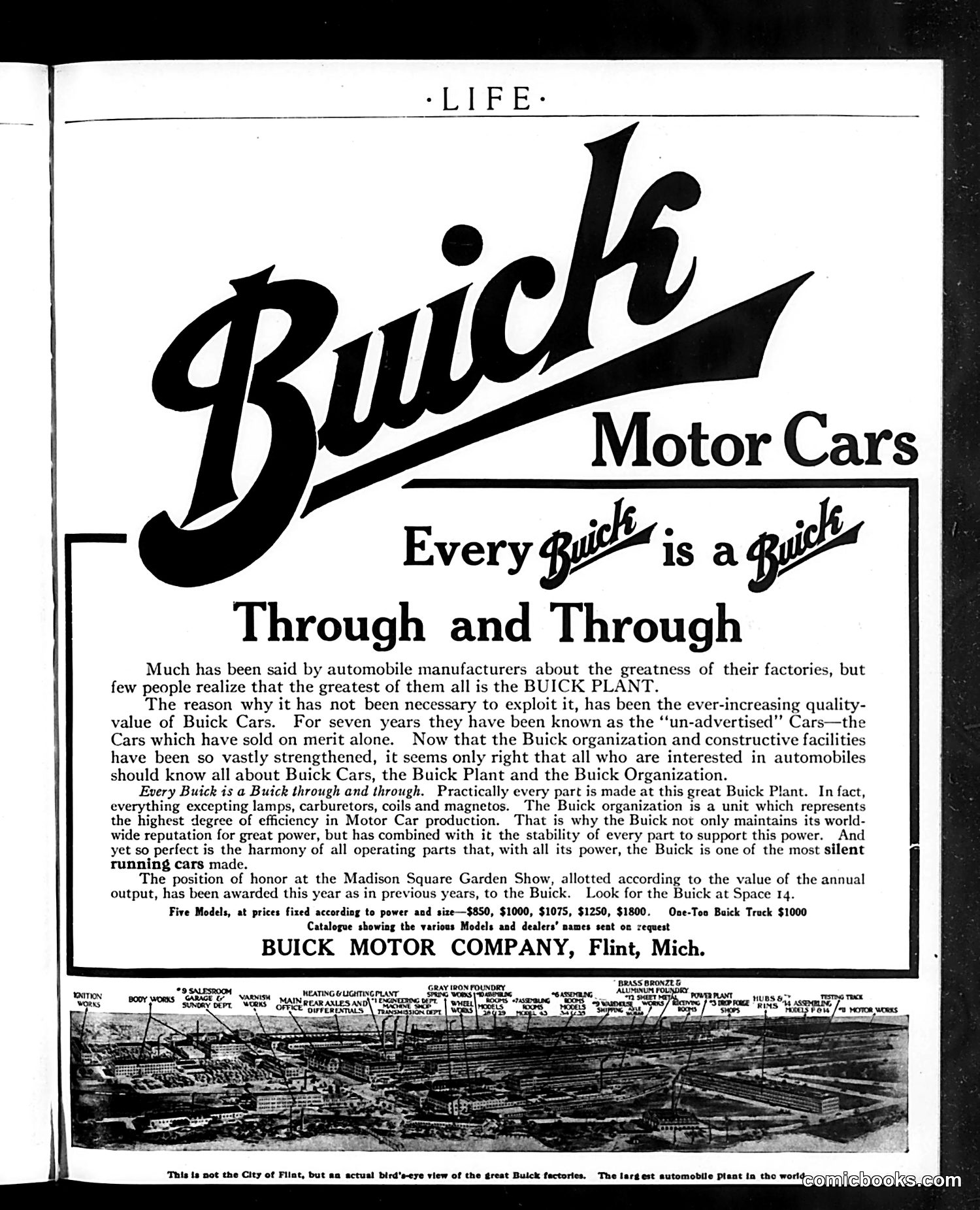
This is a **full-page automobile advertisement**, not satire or political commentary. Buick Motor Company uses it to promote their manufacturing excellence and vehicles. The key claims: Buick cars have sold for seven years on "merit alone" without heavy advertising. The company emphasizes that their Flint factory is "the greatest" automobile plant, producing nearly all components in-house. The ad stresses quality, power, and harmony of engineering—"one of the most silent running cars made." The large photograph shows an aerial view of the sprawling Buick factory complex to demonstrate industrial scale and sophistication. Pricing ranges from $850 to $1800, with a one-ton truck at $1000. The headline "Every Buick is a Buick Through and Through" suggests consistency and authenticity—each car meets the same high standards. This appears to be from an era when automobile manufacturers competed heavily on factory prestige and engineering reputation rather than styling.
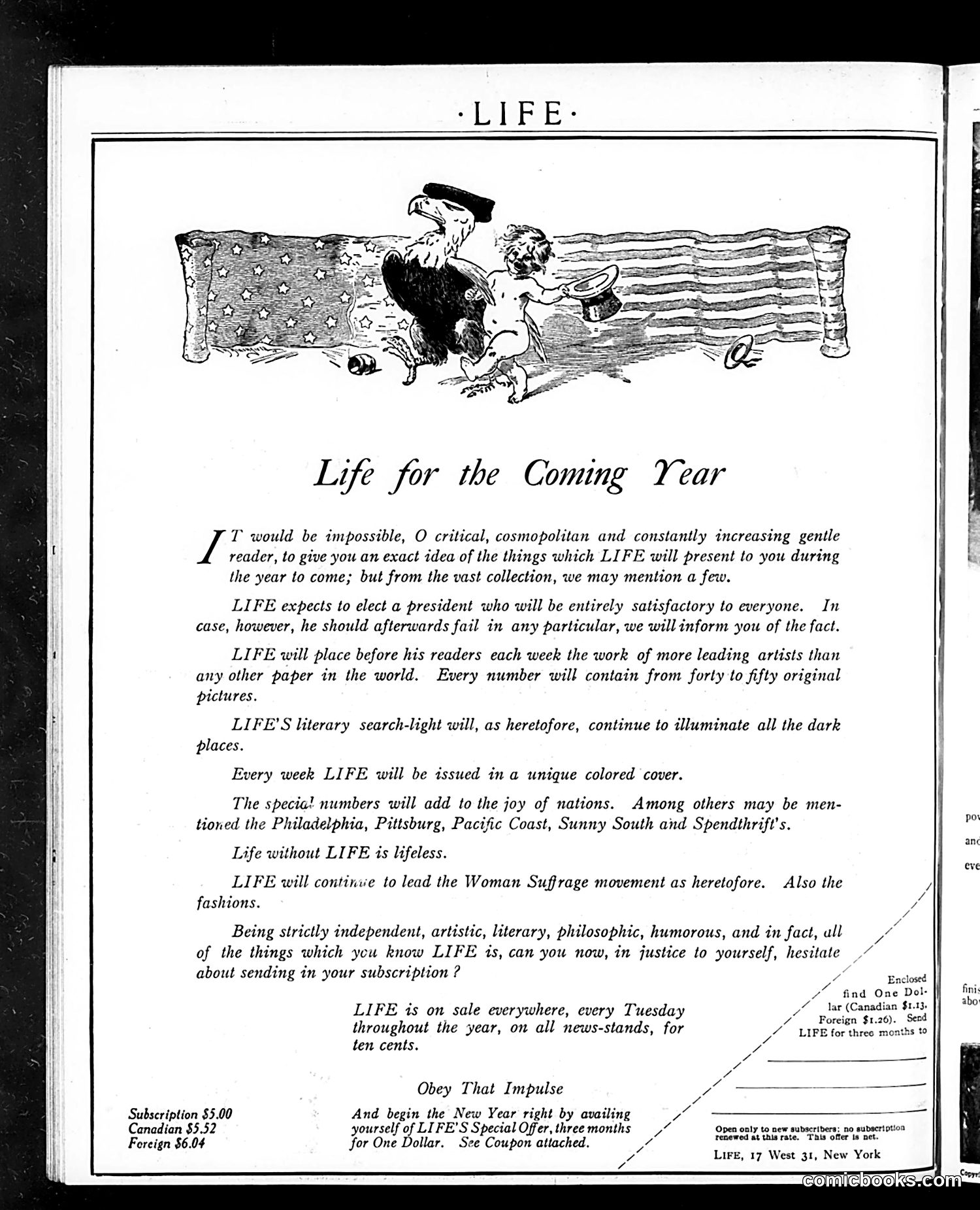
This is primarily a **promotional announcement** for Life magazine's upcoming content, with satirical self-promotion characteristic of early 20th-century American humor magazines. The cartoon shows a figure in bed with pillows and blankets—likely representing the reader or the public—being roused awake, presumably by Life's editorial mission. The text employs **mock-grandiose promises**: Life will elect a president "entirely satisfactory to everyone" (clearly impossible, the joke being their overconfidence). The magazine boasts superior artistic content and pledges to continue championing women's suffrage and fashion coverage. **Key satire**: The phrase "Life without LIFE is lifeless" and rhetorical questions like "can you now hesitate about sending in your subscription?" parody advertising hyperbole. Life is simultaneously claiming to be independent, artistic, literary, *and* humorous—essentially everything at once. This reads as self-aware mockery of magazine advertising conventions of the era, while genuinely promoting subscriptions at $5.00 annually ($0.10 per newsstand copy).
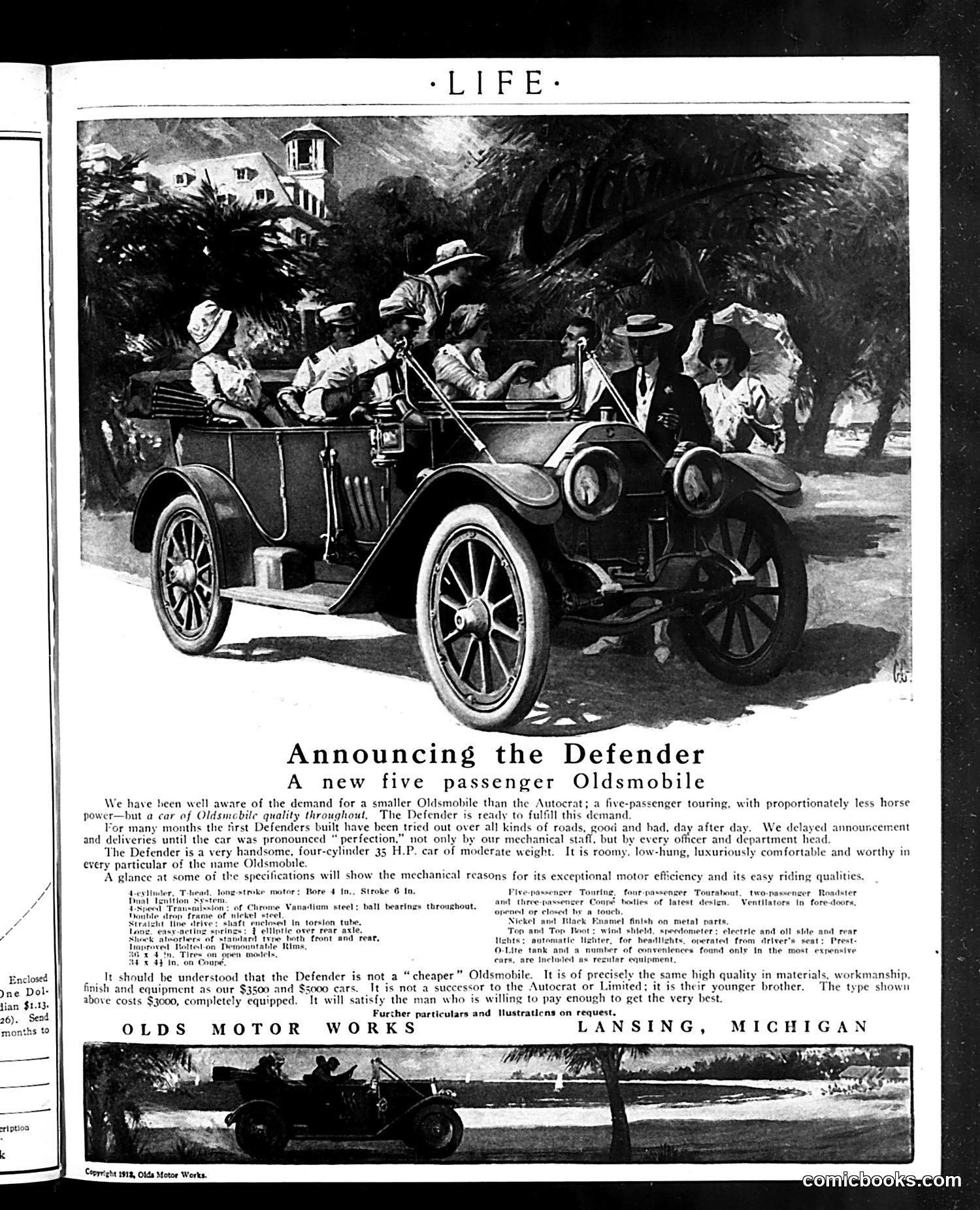
This is **not a cartoon or satire**—it's a straightforward automobile advertisement from 1918 for the Oldsmobile "Defender," a new five-passenger car. The image shows well-dressed passengers (men in suits and hats, women in elaborate period dress) enjoying a leisurely drive through a palm-lined landscape, suggesting comfort and luxury. The advertisement's key pitch: this is a smaller, less powerful Oldsmobile than their flagship "Autocrat" model, but maintains full Oldsmobile quality—it's a "younger brother" to their premium cars. Notably, the company emphasizes the Defender is **not** a "cheaper" alternative; it's positioned as quality engineering at a moderate price point ($3000, "completely equipped"). Technical specifications highlight mechanical efficiency and comfort features (ball bearings, electric lights, windshield). The satire or humor—if any—lies in the aspirational lifestyle messaging: ordinary people could now afford the Oldsmobile quality experience, not just the wealthy.
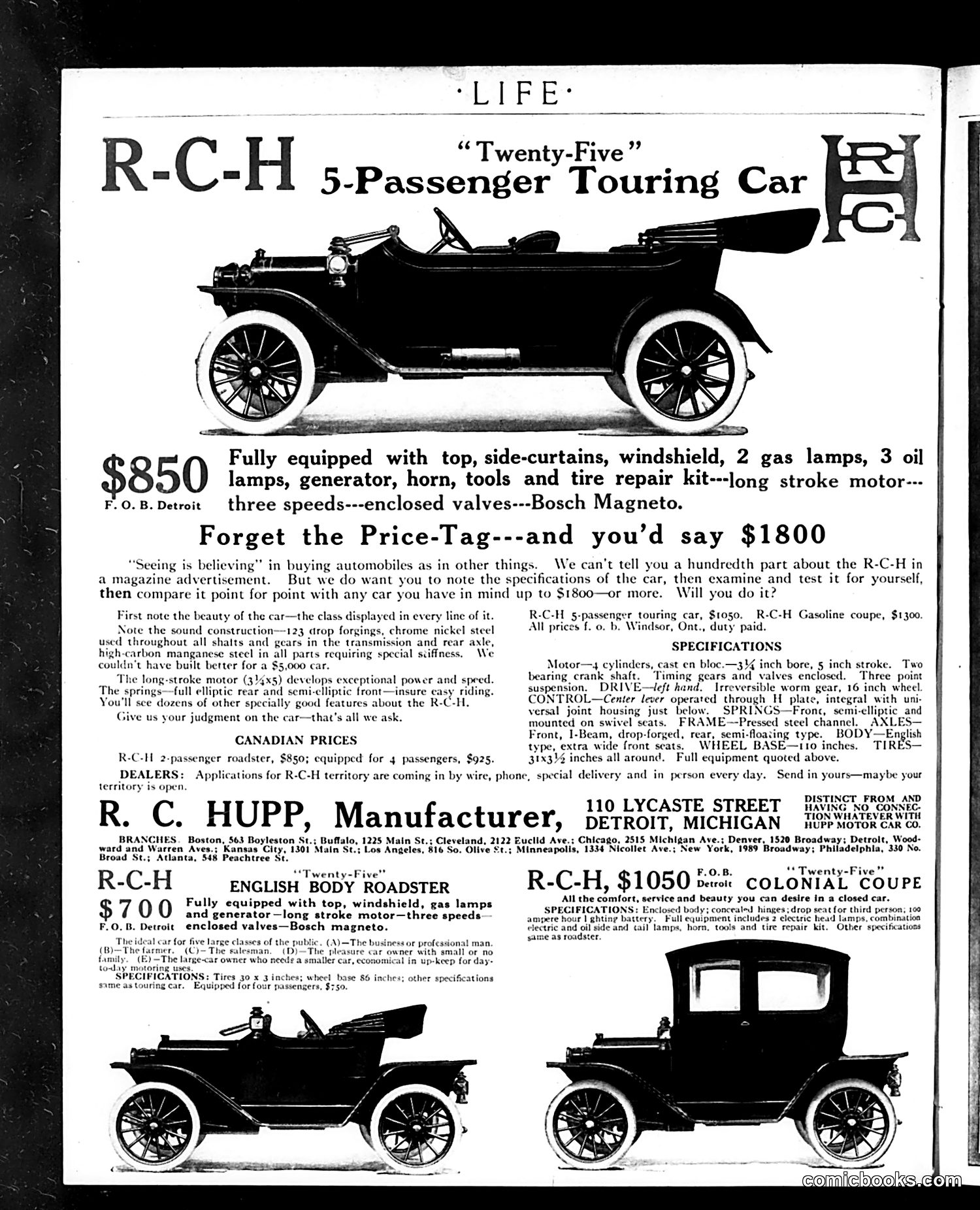
This is a **product advertisement page** from Life magazine, not a political cartoon or satirical content. It features advertising for R-C-H automobiles manufactured by R. C. Hupp in Detroit. The page showcases three car models with prices ranging from $700 to $1,050. The advertising copy uses a rhetorical strategy—inviting consumers to compare the R-C-H against cars costing up to $1,800, suggesting exceptional value. The tagline "Forget the Price-Tag—and you'd say $1800" is the core sales pitch: the car's quality supposedly exceeds its price point. The detailed specifications (motor specifications, suspension type, materials) aim to establish technical credibility. Multiple branch locations listed indicate this was a significant manufacturer of the early automotive era. **This is commercial content, not political satire or humor.** Life magazine's satirical content appears elsewhere in the publication.
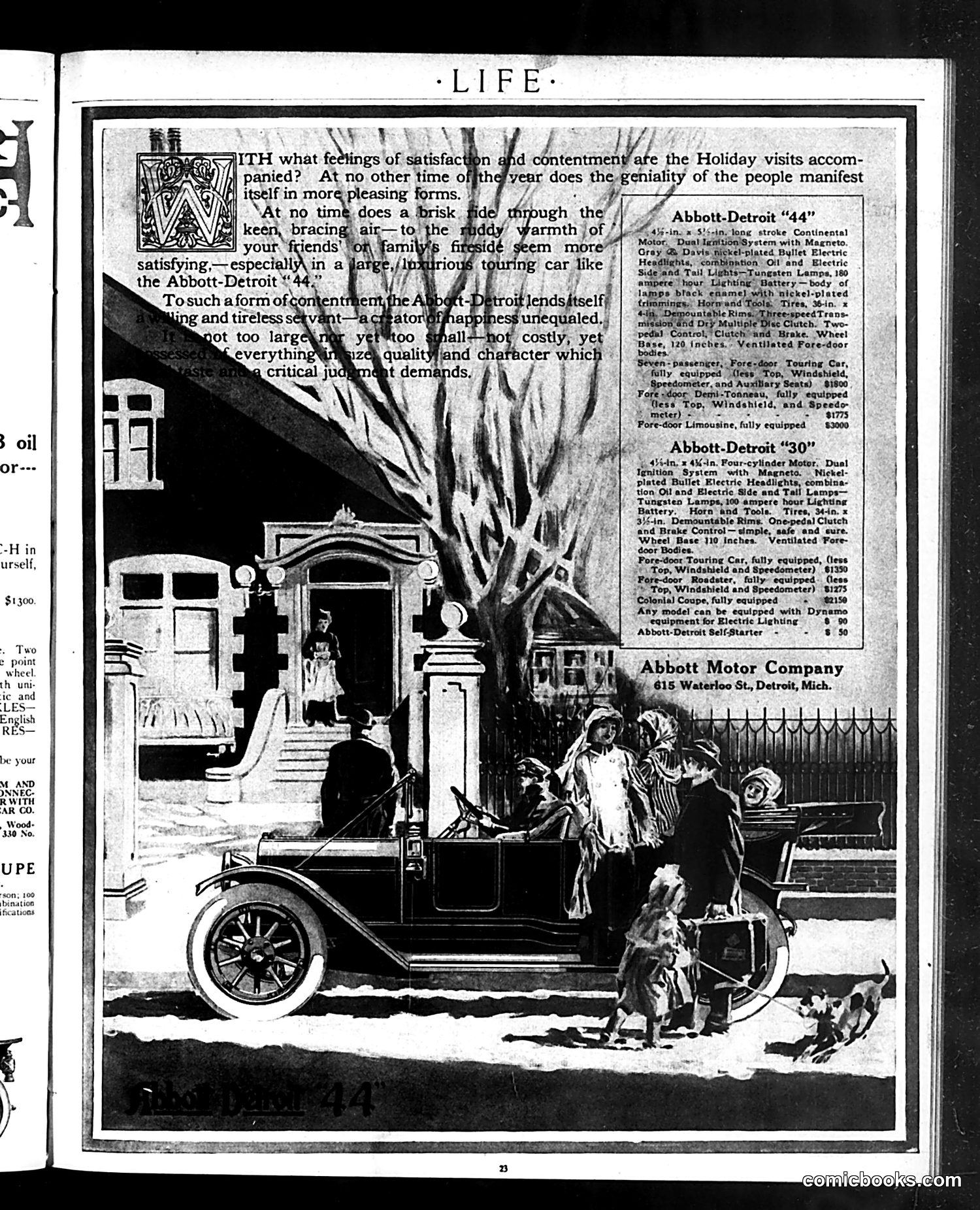
This page is primarily **automobile advertising**, not political satire. The main content promotes Abbott-Detroit motor cars (the "44" and "30" models) through an illustrated advertisement showing a family departing on a holiday automobile trip. The text opening discusses how holiday visits bring satisfaction and contentment, using this seasonal theme to market the cars as vehicles enabling pleasant family outings. The illustration depicts well-dressed passengers and children boarding or riding in an Abbott-Detroit automobile near a house, with a large tree—evoking leisurely holiday travel. The accompanying specifications lists technical features (Continental motors, electric headlights, demountable rims) and pricing ($1,350-$3,000), typical of early-1900s automotive marketing in *Life* magazine, which regularly featured such advertisements alongside satirical content. This represents consumer advertising rather than editorial commentary or political cartooning.
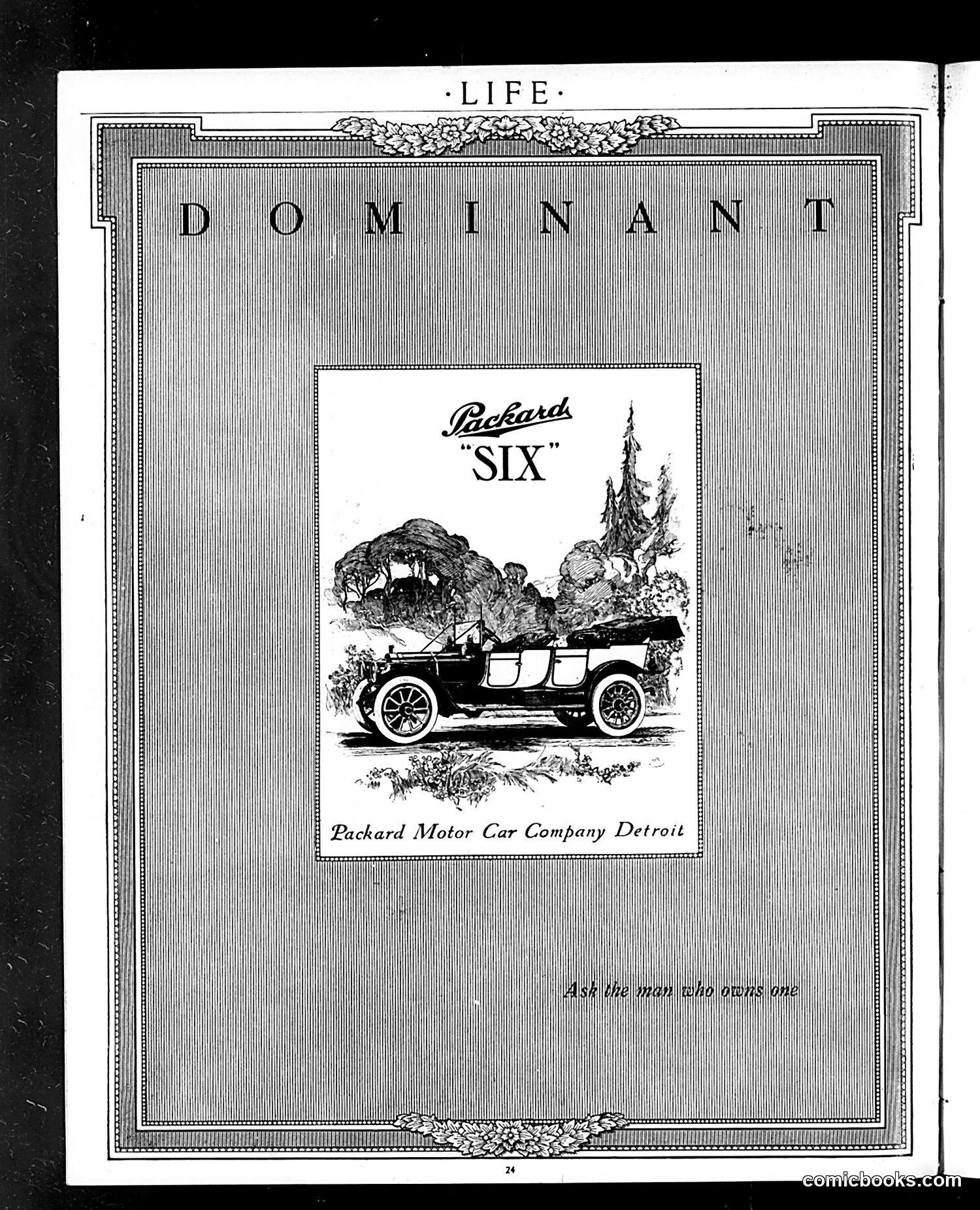
This is primarily a **full-page advertisement** for the Packard Motor Car Company of Detroit, appearing in *Life* magazine. The page is titled "DOMINANT" at the top, emphasizing the car's market position. The advertisement features an illustration of a Packard "SIX" automobile—a luxury touring car from the early automotive era—positioned in a pastoral landscape with trees. Below the image appears the phrase "Ask the man who owns one," which was Packard's actual advertising slogan. This is not satire or political commentary, but rather a straight commercial advertisement leveraging *Life* magazine's readership to promote automobiles to affluent consumers. The "dominant" framing suggests market leadership and prestige associated with owning a Packard.
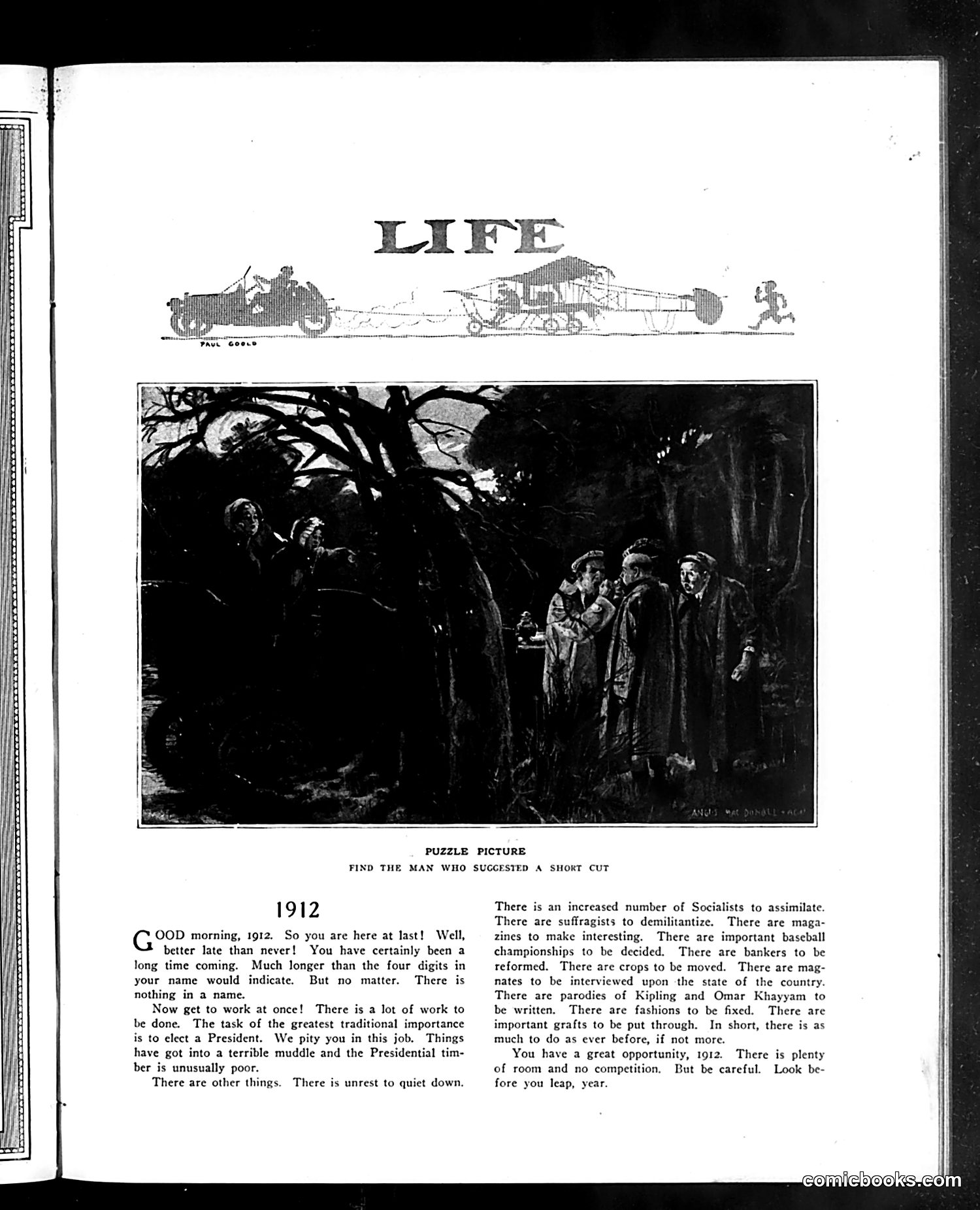
This is a satirical "puzzle picture" where readers must identify a hidden figure—"the man who suggested a short cut"—in the dark, crowded woodland scene. The accompanying text personifies 1912 as a character arriving to face immense challenges: electing a president amid poor candidates, managing socialist agitation, dealing with suffragists, fixing fashions, and conducting various reforms and business dealings. The "short cut" reference is unclear from the image alone, but likely alludes to a political figure proposing a problematic solution to one of these issues. The satire mocks 1912's overwhelming complexity—suggesting that "nothing in a name" matters when the year must navigate contradictory demands from different social movements (progressivism, labor unrest, women's suffrage) while maintaining traditional institutions. The puzzle format invites readers to participate in identifying who among the crowd represents a dangerous shortcut to solving these problems.
This is editorial commentary on the upcoming 1912 U.S. presidential election, not a cartoon page. The text discusses potential Republican and Democratic candidates. **Key figures discussed:** - **President Taft**: The incumbent Republican, whose renomination is uncertain. The article acknowledges his political mistakes hurt his reputation, though his actual policy record is solid. - **Theodore Roosevelt**: The former president and current *Life* Contributing Editor. The article sarcastically suggests ways Roosevelt could avoid appearing to seek the nomination (like staging an airplane accident), implying he's maneuvering behind the scenes. - **Democratic prospects**: Governor Harmon is praised as capable but too old; the article notes Bryan's influence in Democratic councils. **The satire's point:** Life mocks the political theater surrounding 1912—particularly Roosevelt's coy denials of presidential ambition while remaining publicly active in politics. The tone is skeptically amused at candidates' transparent positioning.
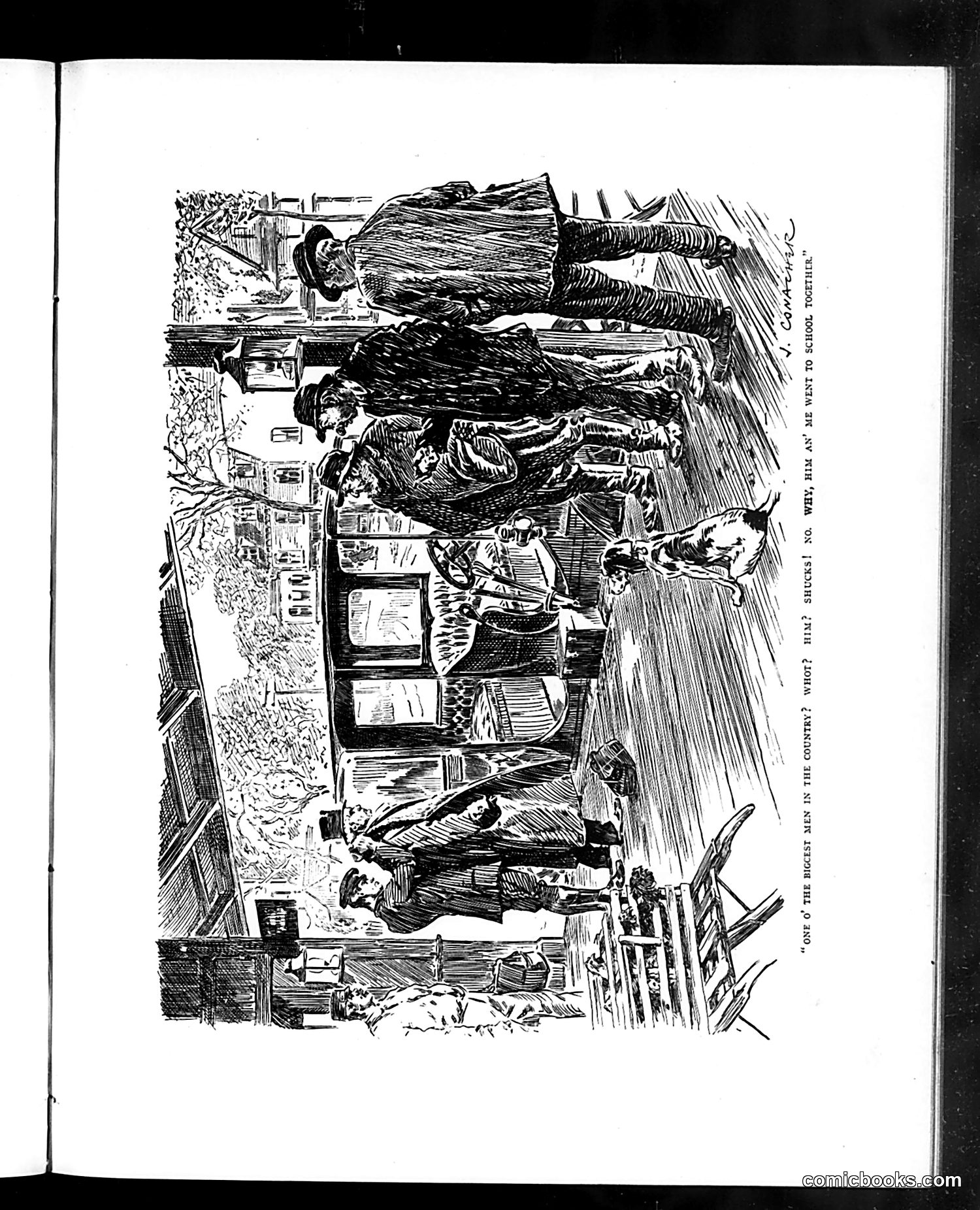
This is a satirical cartoon depicting a scene that appears to be rotated 90 degrees. The text "WHAT? HIM? 'ONE O' THE BIGGEST MEN IN THE COUNTRY?'" suggests ironic commentary on someone's importance or status. The sketch shows an interior scene with multiple figures, though exact identities are unclear. The dialogue implies the cartoon is mocking the inflated reputation or self-importance of a particular public figure—someone being called "one of the biggest men in the country" despite apparent evidence to the contrary visible in the scene. Without additional context about the magazine's publication date or accompanying articles, I cannot definitively identify the specific person being satirized or the particular event being referenced. The humor relies on readers' contemporary knowledge of whoever this "biggest man" refers to.
This is a boastful monologue personifying the automobile, read at a New York Automobile Club dinner. The car celebrates its dominance over horses and its role modernizing America—hauling fire engines, transporting injured people, delivering children to school, and building roads that connect rural and urban areas. The satire lies in the car's self-aggrandizing claims. It dismisses the horse as obsolete, admits it's "not a thing at all" yet paradoxically claims to embody "time," "space," "power," and "health." The poem gently mocks the automobile industry's breathless rhetoric about progress while acknowledging competitors like trolleys and horse-drawn vehicles still have value. Written in 1911, this reflects early-20th-century anxieties and enthusiasm about automotive technology reshaping American society—the replacement of traditional transport, road construction, and the car's cultural status as a symbol of modernity and efficiency.
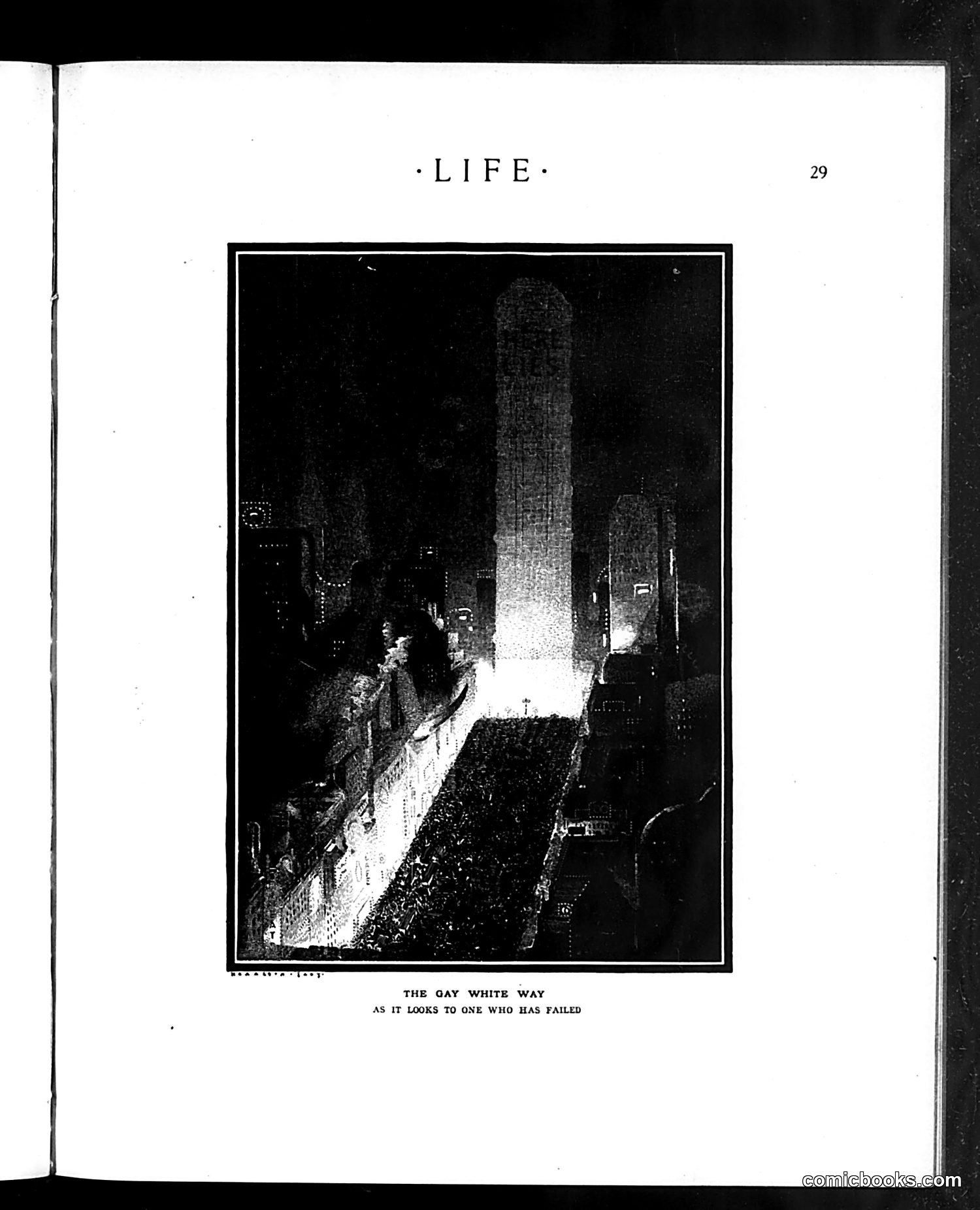
This is a nighttime photograph of Broadway or a similar theater district, showing illuminated buildings and crowds. The caption suggests a pessimistic perspective—viewing the bright, bustling entertainment district through the eyes of someone who has experienced failure or disappointment. The "Gay White Way" was a contemporary nickname for Broadway's glittering theater district, known for its electric lights and entertainment venues. By framing this scene through "one who has failed," the image likely critiques the stark contrast between Broadway's glamorous facade and the despair felt by those unable to succeed in that competitive world—a commentary on urban inequality and the psychological toll of unfulfilled ambition during this era.
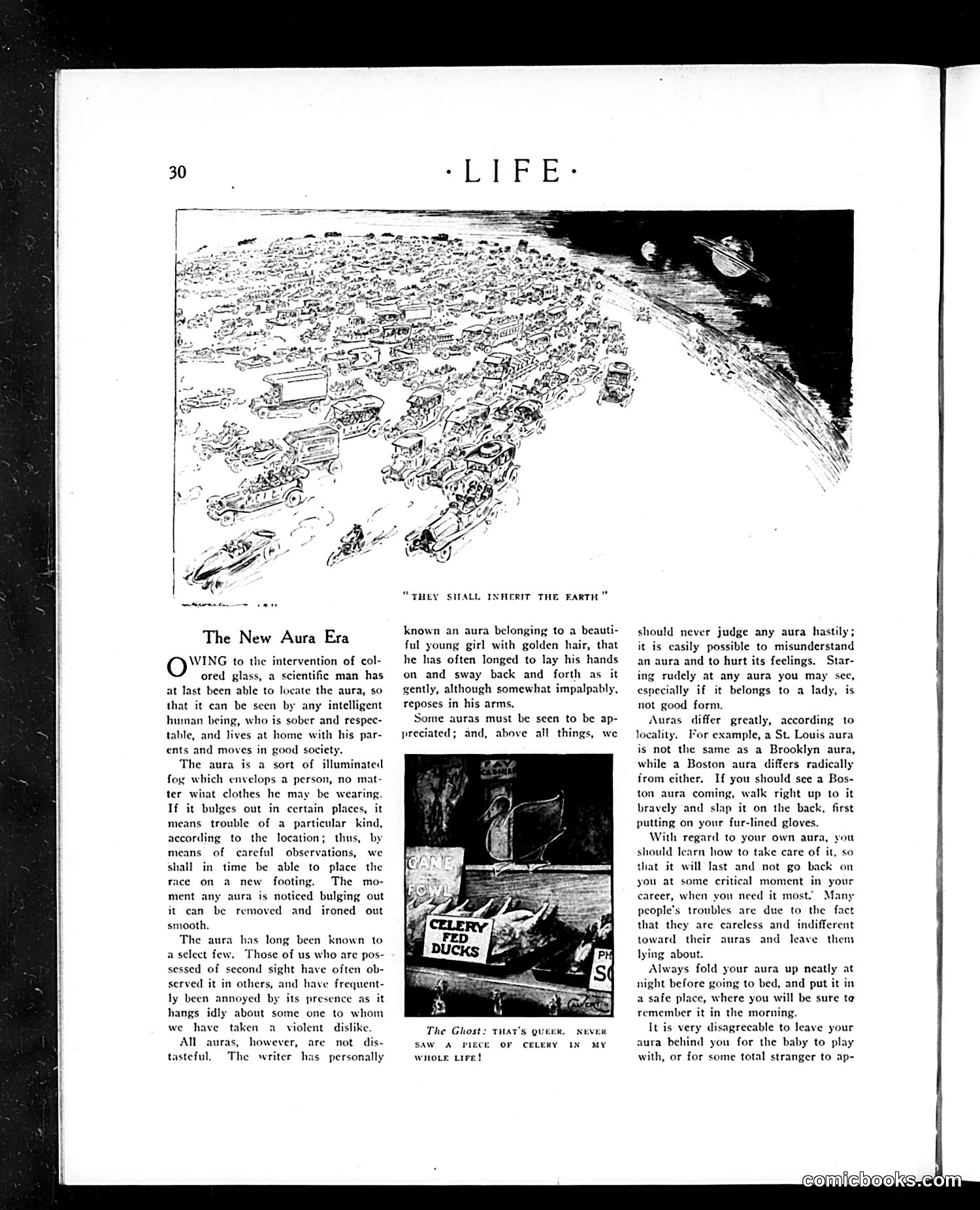
This page satirizes the early 20th-century fad of "aura" pseudoscience — the belief that spiritually advanced people could see invisible energy fields surrounding individuals. The text mocks this credulity by presenting increasingly absurd "rules" for auras: they vary by geography (Boston auras differ from Brooklyn ones), they can be "ironed out smooth" if they bulge wrongly, and they require careful nighttime storage like household items. The large illustration (captioned "They Shall Inherit the Earth") appears to depict an aerial view of crowded urban or industrial activity — possibly factories, vehicles, or crowds — suggesting the satirist's view that this spiritualist nonsense appeals to the masses rather than genuinely enlightened people. The inserted anecdote about celery ("That's queer, never saw a piece of celery in my whole life!") seems a non-sequitur joke, typical of Life's absurdist humor style. The satire targets both gullible believers in spiritualism and the pseudo-scientific charlatans marketing aura-viewing technology to them.
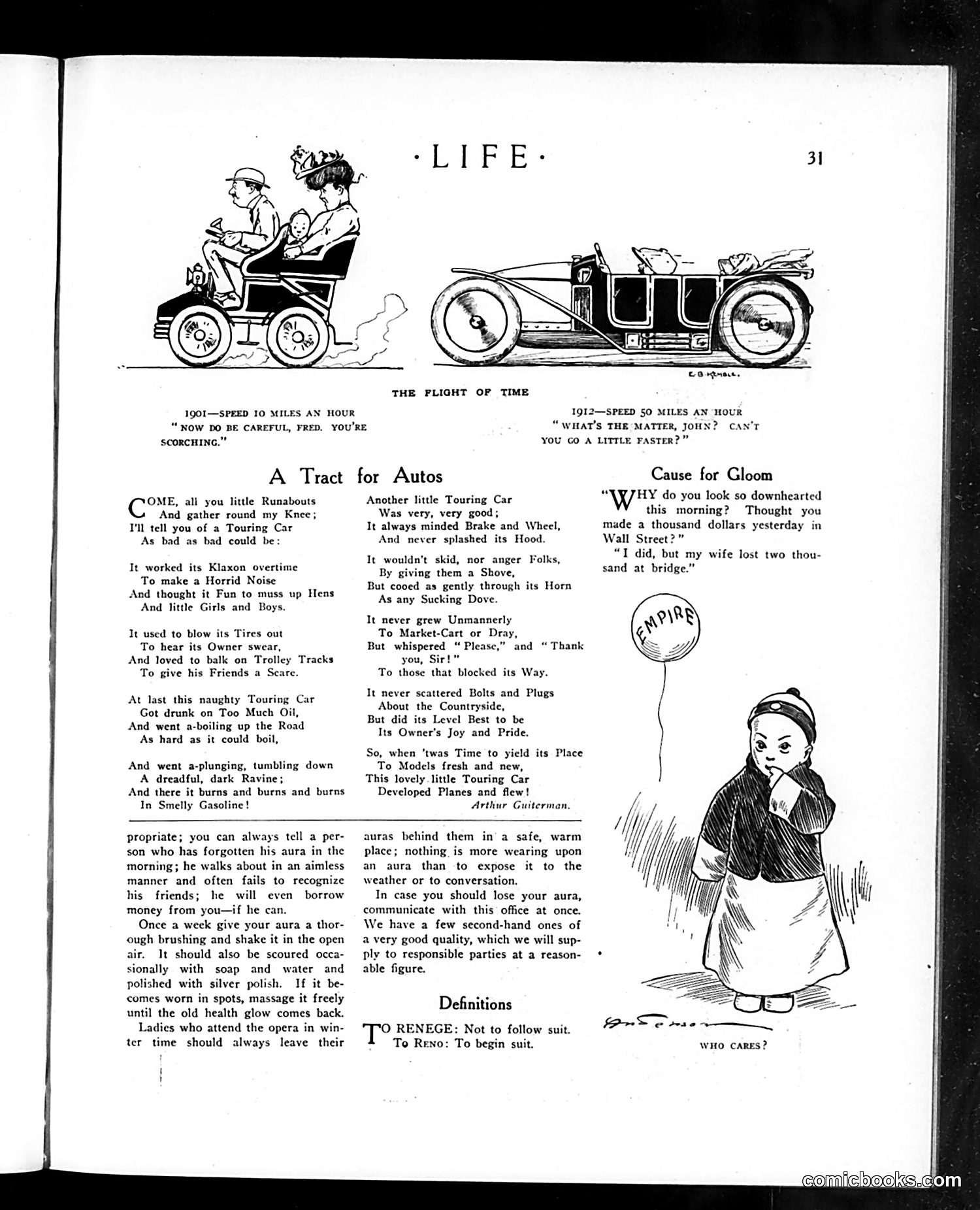
This Life magazine page satirizes early automotive culture through two main pieces: **"The Flight of Time" cartoons** contrast driving attitudes between 1901 (cautious, 10 mph) and 1912 (reckless, 50 mph). The joke: in just over a decade, cars became so fast that safety concerns vanished—passengers now urged drivers to go *faster* rather than slower. This mocks how quickly society normalized dangerous speeds. **"A Tract for Autos"** is a mock-morality tale (parodying children's fables) comparing a "bad" touring car that speeds recklessly, blares its horn, and endangers pedestrians versus a "good" car that's courteous. The punchline: the bad car crashes and burns; the good car "developed Planes and flew"—absurdist humor suggesting only escape to the sky saves you from automotive chaos. **"Cause for Gloom"** jokes about nouveau riche anxiety: a man makes $1,000 on Wall Street but his wife loses $2,000 at bridge (gambling). The cartoon ridicules both wealthy excess and the social acceptance of women's high-stakes gambling. The page reflects 1910s anxieties about rapid technological change and shifting social norms.
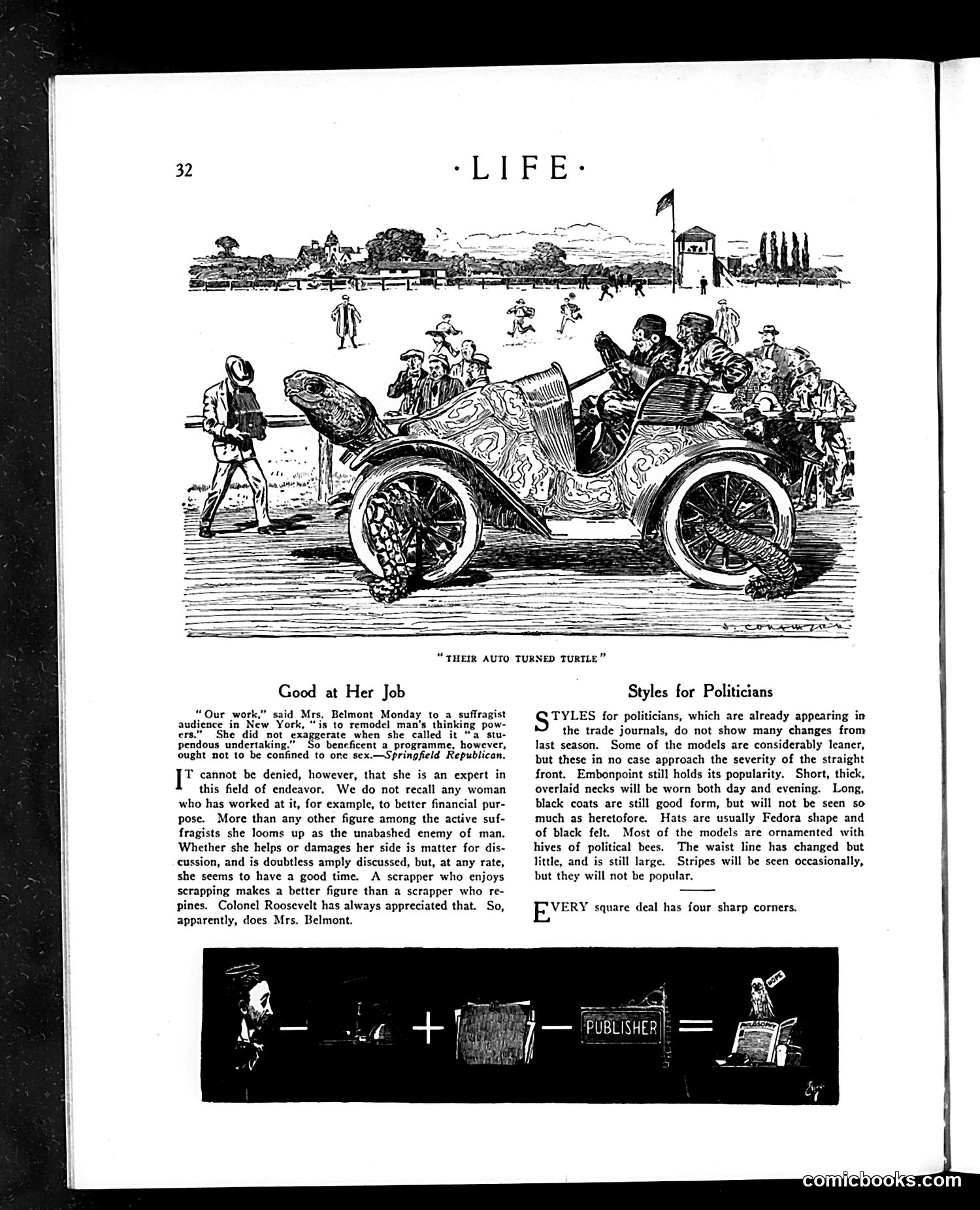
The main cartoon depicts an ornate automobile flipped upside down ("turned turtle"), with elegantly dressed passengers tumbling out—a visual pun on the phrase. This illustrates the article "Good at Her Job," which discusses **Mrs. Belmont**, a prominent suffragist activist working to "remodel man's thinking." The text praises her aggressive advocacy while noting she's the "unabashed enemy of man," suggesting her militant suffrage work is controversial but effective. The "Styles for Politicians" section is satirical commentary on political fashion and appearance—politicians' typical conservative dress (black coats, Fedora hats, portly builds). The final illustration shows a crude equation: Author + Publisher = Money-grubbing result, mocking the commercial relationship. The closing line "Every square deal has four sharp corners" references Theodore Roosevelt's "Square Deal" political platform, suggesting even fair policies have harsh consequences.
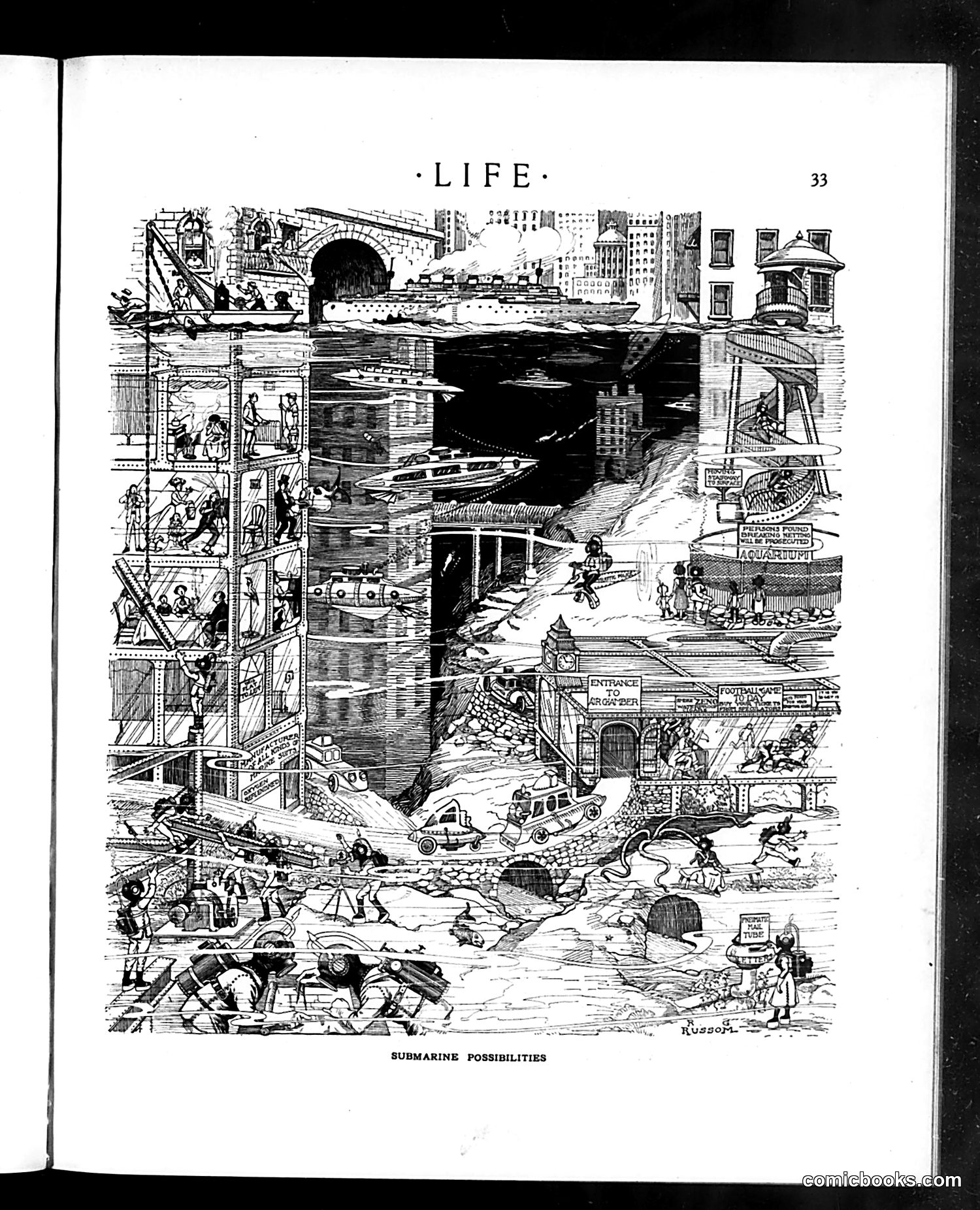
This satirical illustration depicts an imaginative cross-section of urban and waterfront life, centered on a large tower or fortress structure. The caption "SUBMARINE POSSIBILITIES" suggests the cartoon comments on emerging submarine technology and its potential military applications—likely referencing early 20th-century naval anxieties. The detailed scene shows civilians, ships, and activities both above and below ground level, humorously illustrating how submarines might infiltrate or threaten domestic infrastructure. The artist (signed "Russoff") uses crowded, chaotic imagery to satirize public concerns about new military technology and vulnerability. This appears to be social commentary on technological change and its implications for urban security and civilian life.
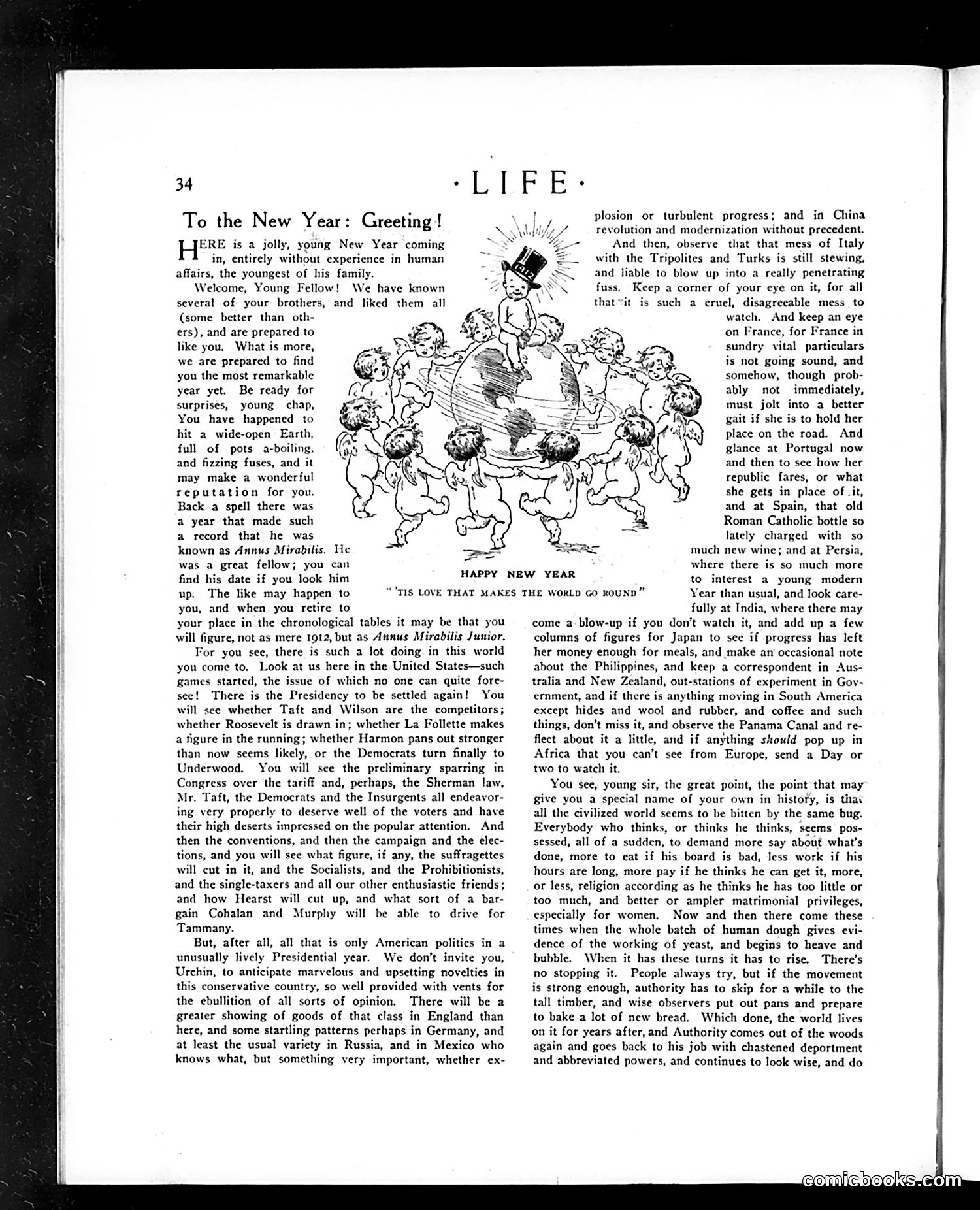
This is a New Year's greeting editorial addressing 1912 as a personified "young fellow" entering an eventful year. The central illustration shows cherubs dancing around a globe, captioned "'TIS LOVE THAT MAKES THE WORLD GO ROUND"—ironic given the text's enumeration of global conflicts. The satire catalogs impending turbulence: the U.S. Presidential race (Taft, Wilson, Roosevelt, La Follette, Harmon competing), Congressional tariff debates, women's suffrage activism, and Socialist/Prohibitionist agitation. Internationally, it flags Italy's war with Turkey over Tripoli, instability in France, Spain's political upheaval, Portugal's struggling republic, and potential unrest in India and Japan. The tone is sardonic—Life frames 1912 as a "wide-open Earth, full of pots a-boiling" despite America's supposed political stability. The contrast between the cherubs' cheerful dance and the litany of coming crises creates the humor: a supposedly calm year actually bristles with danger and disruption.
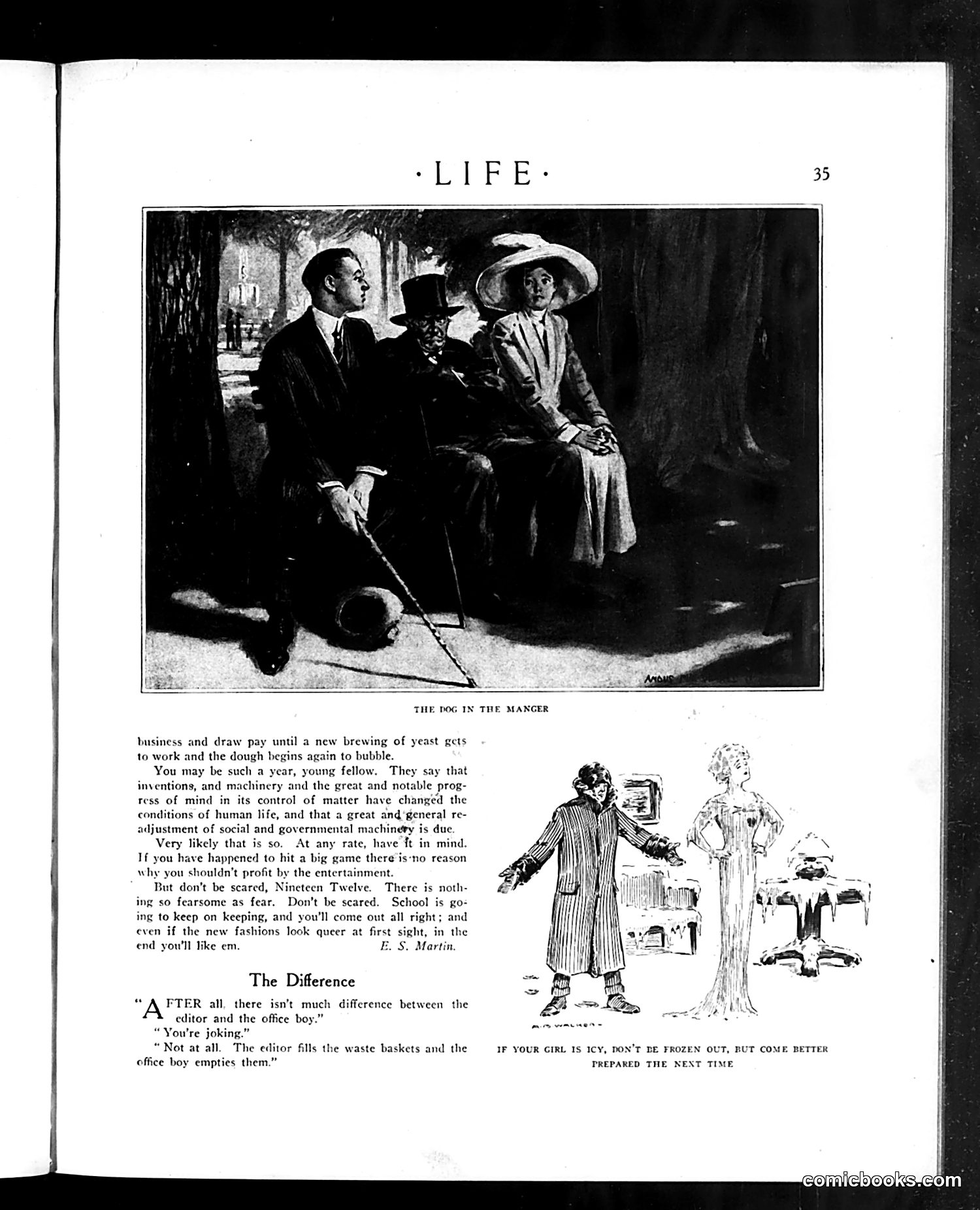
**"The Dog in the Manger"** (top image): Shows three well-dressed men in what appears to a park or street setting. The title references Aesop's fable about someone preventing others from enjoying something they themselves won't use—here likely satirizing obstruction or selfish behavior, though the specific target isn't clear from the image alone. The accompanying text, signed "F. S. Martin," addresses "Nineteen Twelve" (a personified year), advising young people not to fear economic or social changes, suggesting the cartoon may critique business resistance to progress during that era. **"The Difference"** (bottom): A simple joke comparing an editor and office boy—the editor fills waste baskets while the boy empties them, suggesting they perform essentially the same function despite their different ranks. This satirizes workplace hierarchy's superficiality. **Right cartoon**: Depicts figures in winter clothing with text about girls being "icy"—likely a flirtation joke about cold romantic behavior.
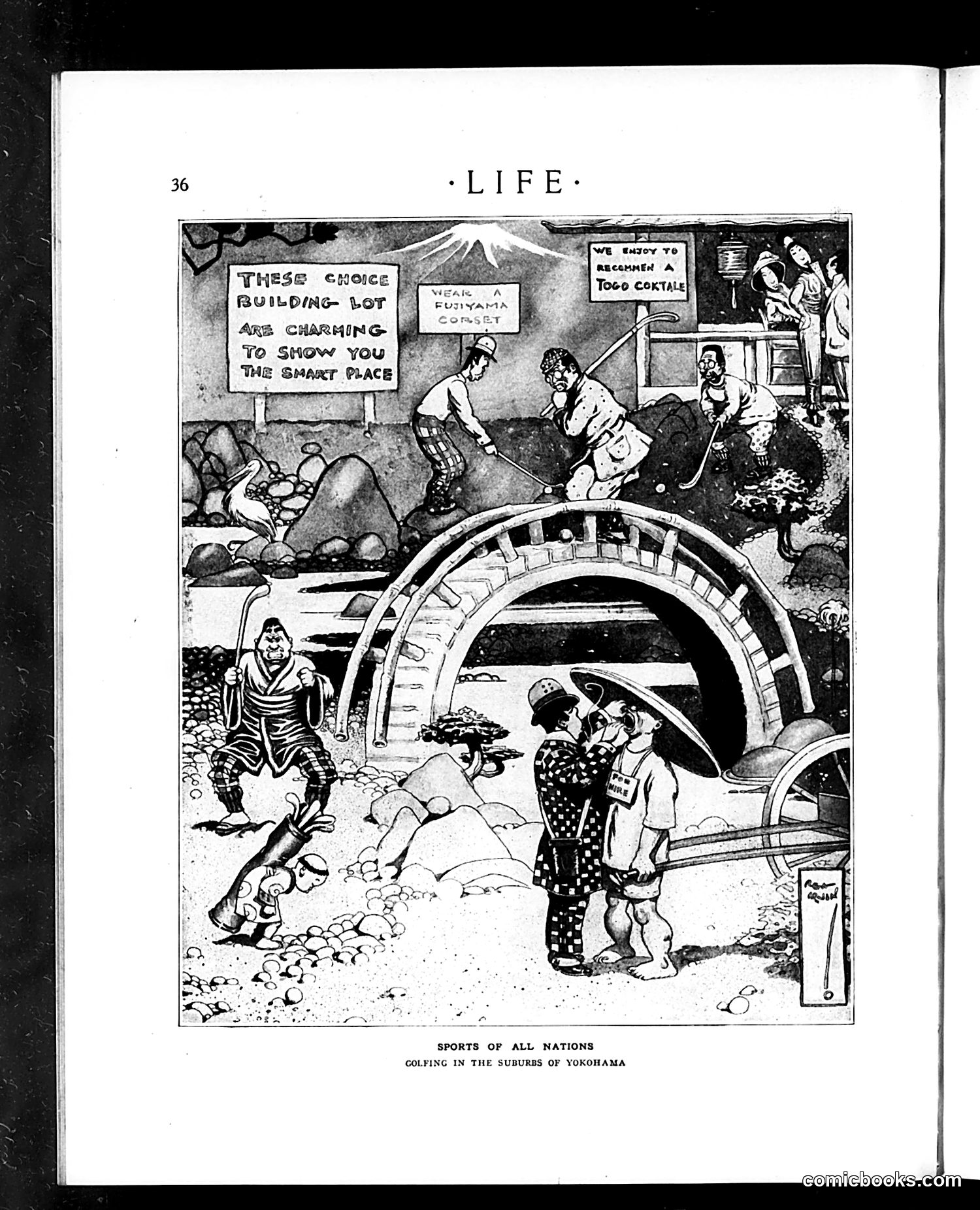
This is a satirical cartoon depicting Westerners golfing near Yokohama, Japan. The humor relies on cultural clash: American/European golfers attempt their leisure sport in an incongruous Japanese setting, complete with Mount Fuji in the background and Japanese architecture. The sign advertising "choice building lots" as "charming" and "smart" suggests real estate development marketing to Western expatriates. Another sign advertises a "food cocktail," implying Western commercial establishments catering to foreign residents. The cartoon satirizes Western imperialism and cultural imperialism—how Western colonists imposed their customs and recreational practices on foreign lands, treating non-Western locations as extensions of home rather than respecting local culture. The "Sports of All Nations" title ironically frames this as comparative cultural observation, when it's actually mocking Western obliviousness to how incongruous their presence appears.
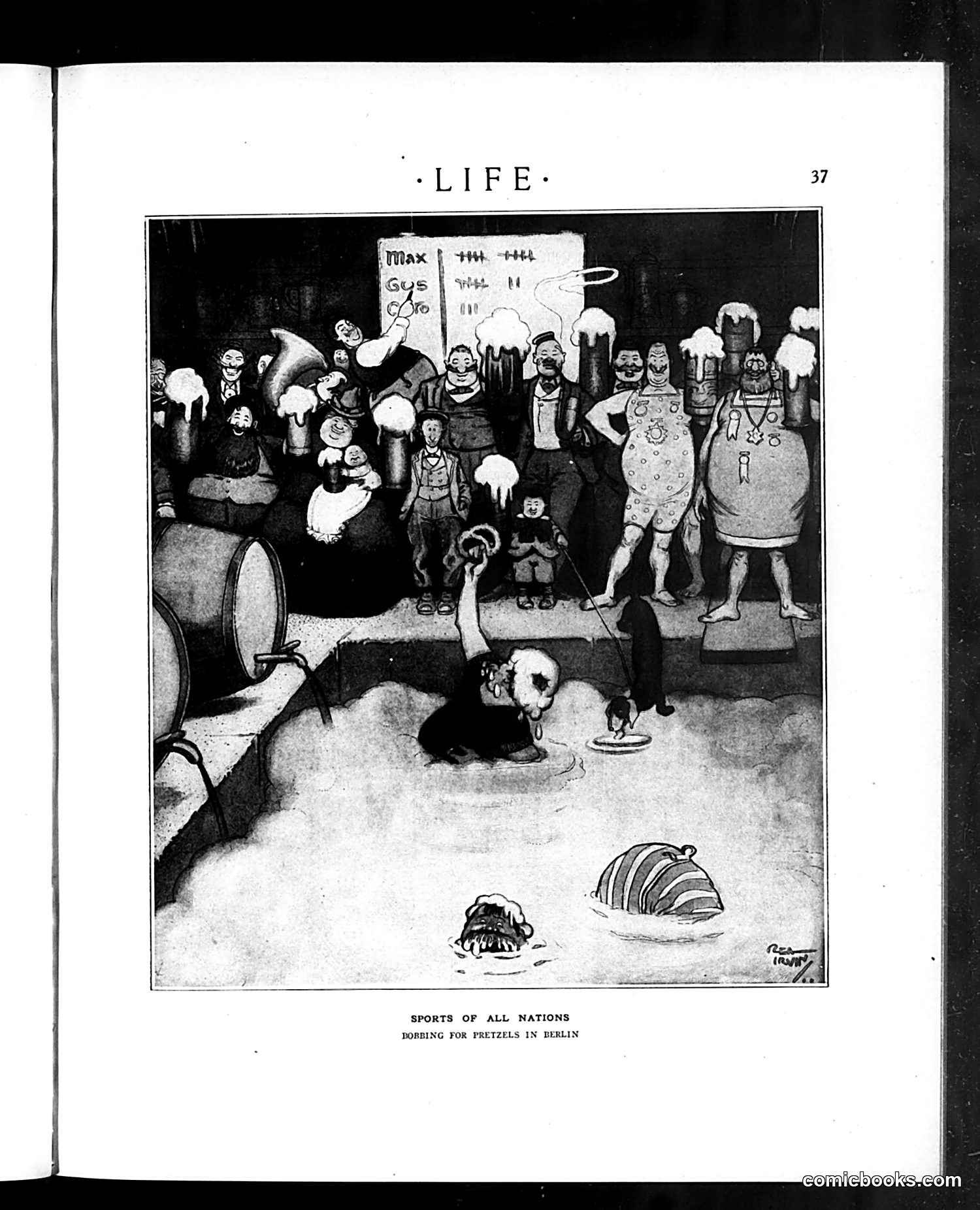
This satirical cartoon depicts a competitive sport titled "Dorbing for Pretzels in Berlin," a play on the British pastime of "bobbing for apples." The joke combines several elements: spectators from various nations watch as people in what appear to be large, round protective gear or costumes dive into sand or shallow water to retrieve pretzels—a German staple food. The cartoon appears to mock post-WWI international relations and national stereotypes, presenting an absurd "sport" that plays on German cultural symbols (pretzels) and wartime imagery. The scoreboard visible in the background and the enthusiastic crowd suggest this parodies both nationalist competition and the widespread fascination with novelty sports entertainment during this era. The satire likely comments on either international tensions or the trivial nature of emerging popular entertainments.
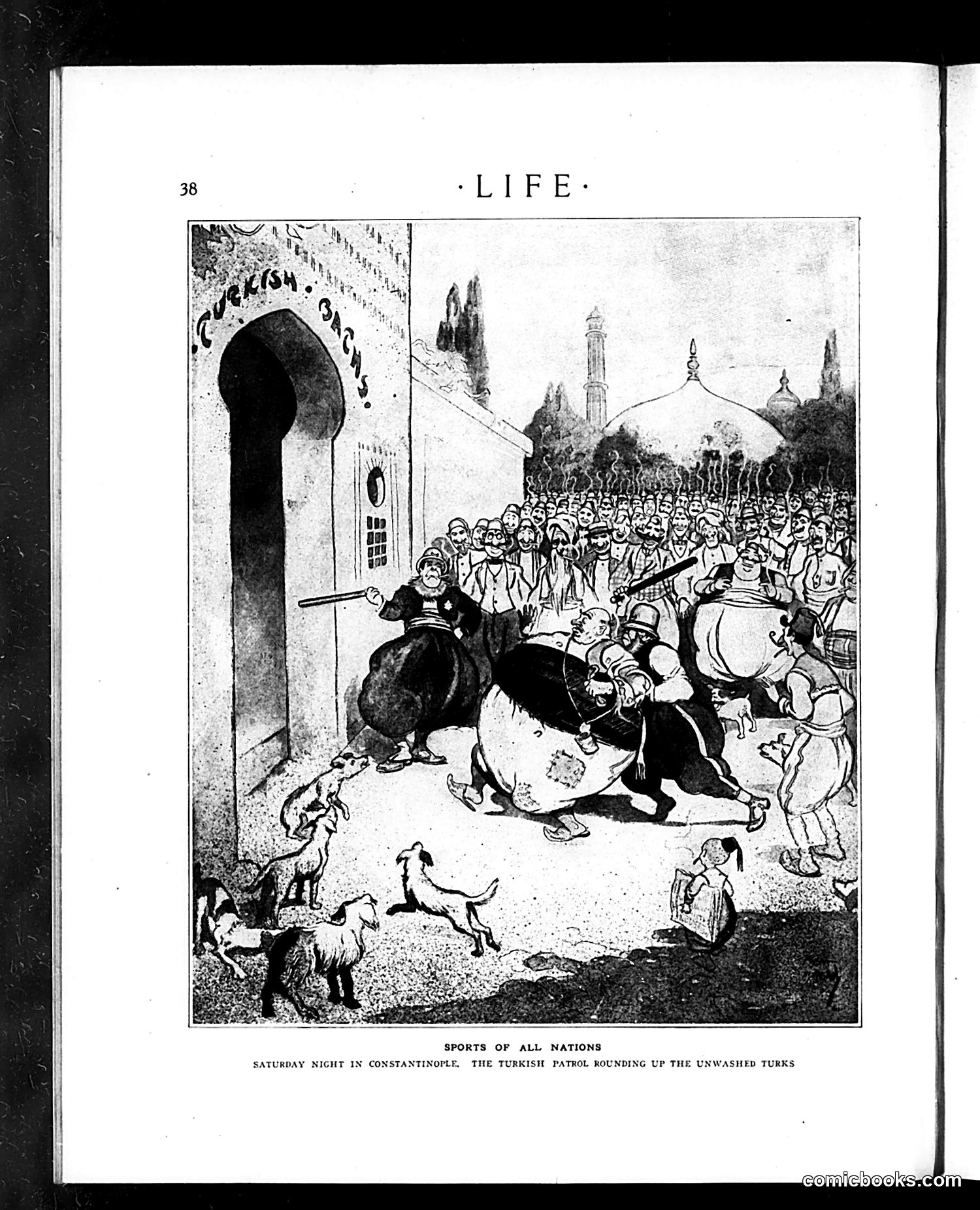
This satirical cartoon depicts a Turkish patrol rounding up disheveled civilians in Constantinople, presented under the heading "Sports of All Nations" — framing brutality as entertainment. The imagery shows mounted soldiers herding poor, ragged people before a crowd and Islamic architecture. The caption's sardonic phrase "unwashed Turks" suggests the authorities are treating their own citizens as undesirable or subhuman. The satire likely critiques Turkish government oppression or police violence, possibly during a period of Ottoman instability or reform. By labeling state brutality as a "sport," the cartoon exposes the callousness of authorities toward ordinary people. The cartoon mocks both Turkish governance and perhaps Western audiences who view such violence as exotic spectacle.
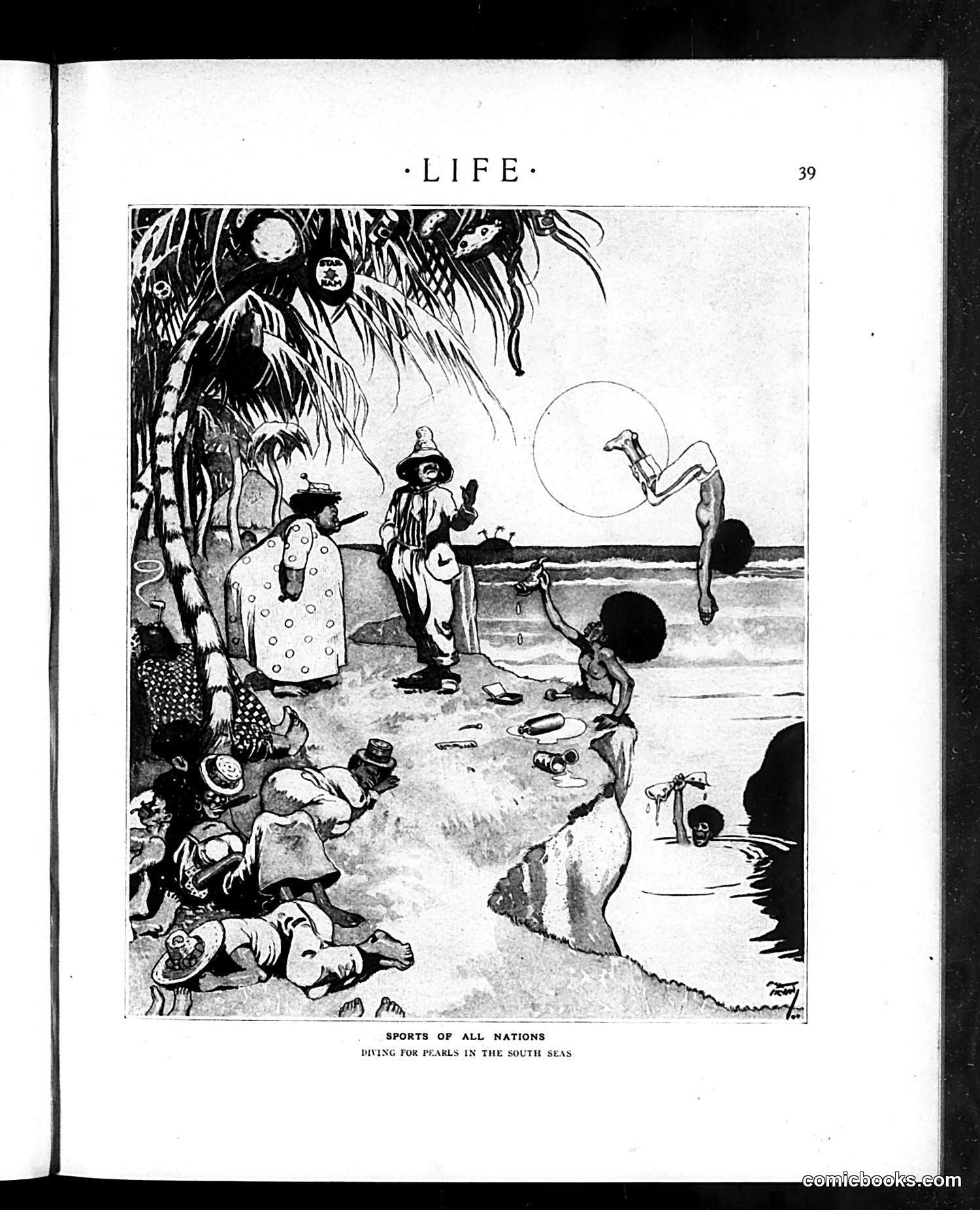
This satirical cartoon presents pearl diving as an exotic "sport," mocking Western attitudes toward non-Western peoples. The image depicts indigenous South Pacific divers alongside caricatured Western tourists and colonizers on a beach, with palm trees and ocean visible. The satire works on multiple levels: it treats the dangerous labor of pearl diving—an actual economic activity in colonial territories—as mere recreational sport for Western amusement. The contrast between the working divers and the leisured Western onlookers highlights the exploitative colonial dynamic. The "Sports of All Nations" framing suggests false equivalence, suggesting Western powers view colonized peoples' work as entertainment rather than serious labor. The cartoon critiques both colonial exploitation and the Western tendency to exoticize and trivialize non-Western cultures as curiosities for tourist consumption.
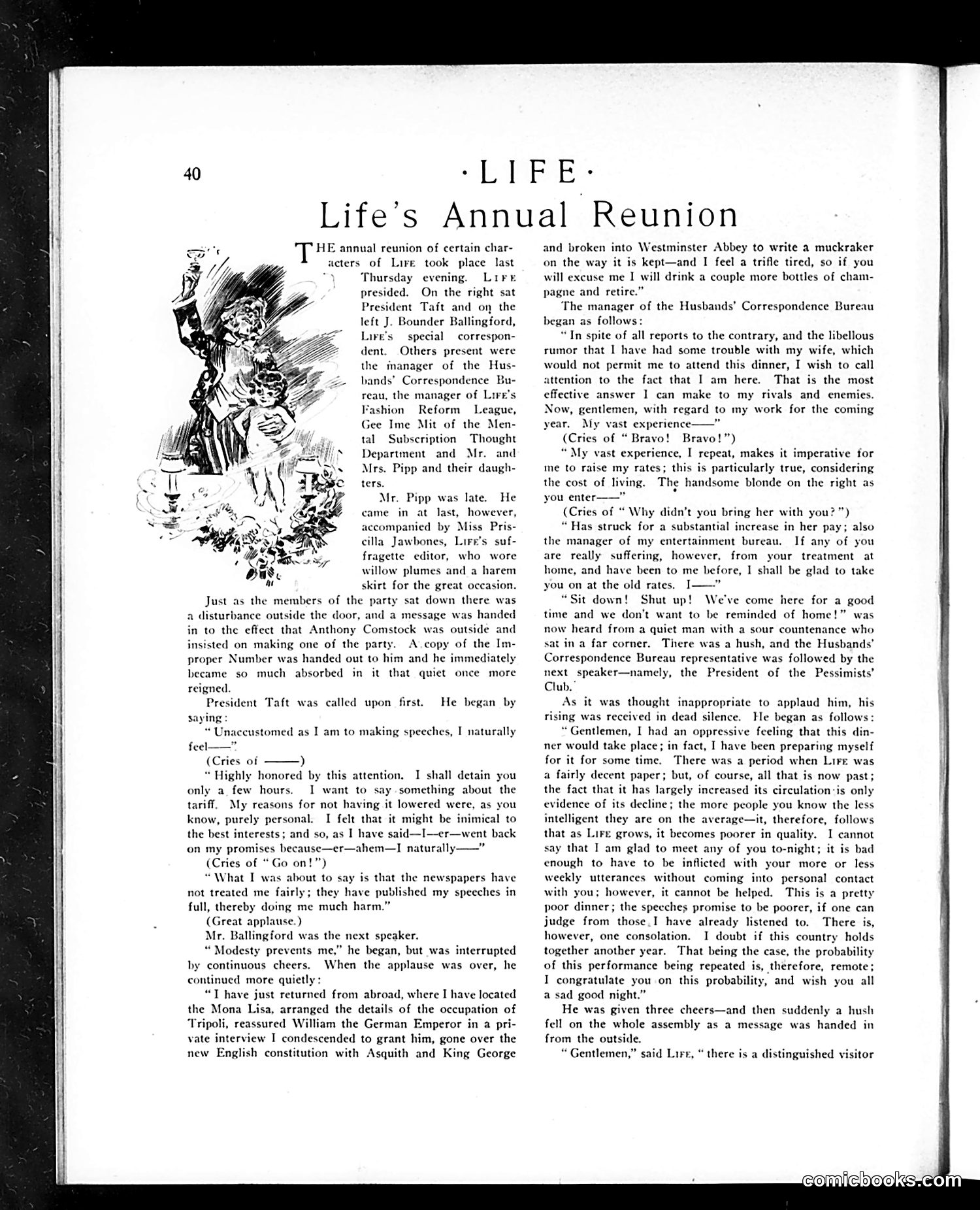
This page depicts a fictional dinner gathering of *Life* magazine's regular characters, including President Taft and J. Bounder Ballingford (a recurring satirical figure). The cartoonist mercilessly mocks Taft for his broken campaign promises regarding tariff reduction, having him blame personal interests and deny responsibility. Ballingford's boastful speech—claiming credit for solving international crises—parodies contemporary jingoism and self-aggrandizing political figures. Other speakers represent recurring *Life* satire targets: the "Husbands' Correspondence Bureau" mocks marital advice industries; Priscilla Jawbones represents suffragette movements; and Anthony Comstock (an infamous censor) is barred by distracting him with *Life*'s supposedly scandalous content. The humor relies on readers' familiarity with *Life*'s recurring satirical characters and contemporary political embarrassments, particularly Taft's political failures.
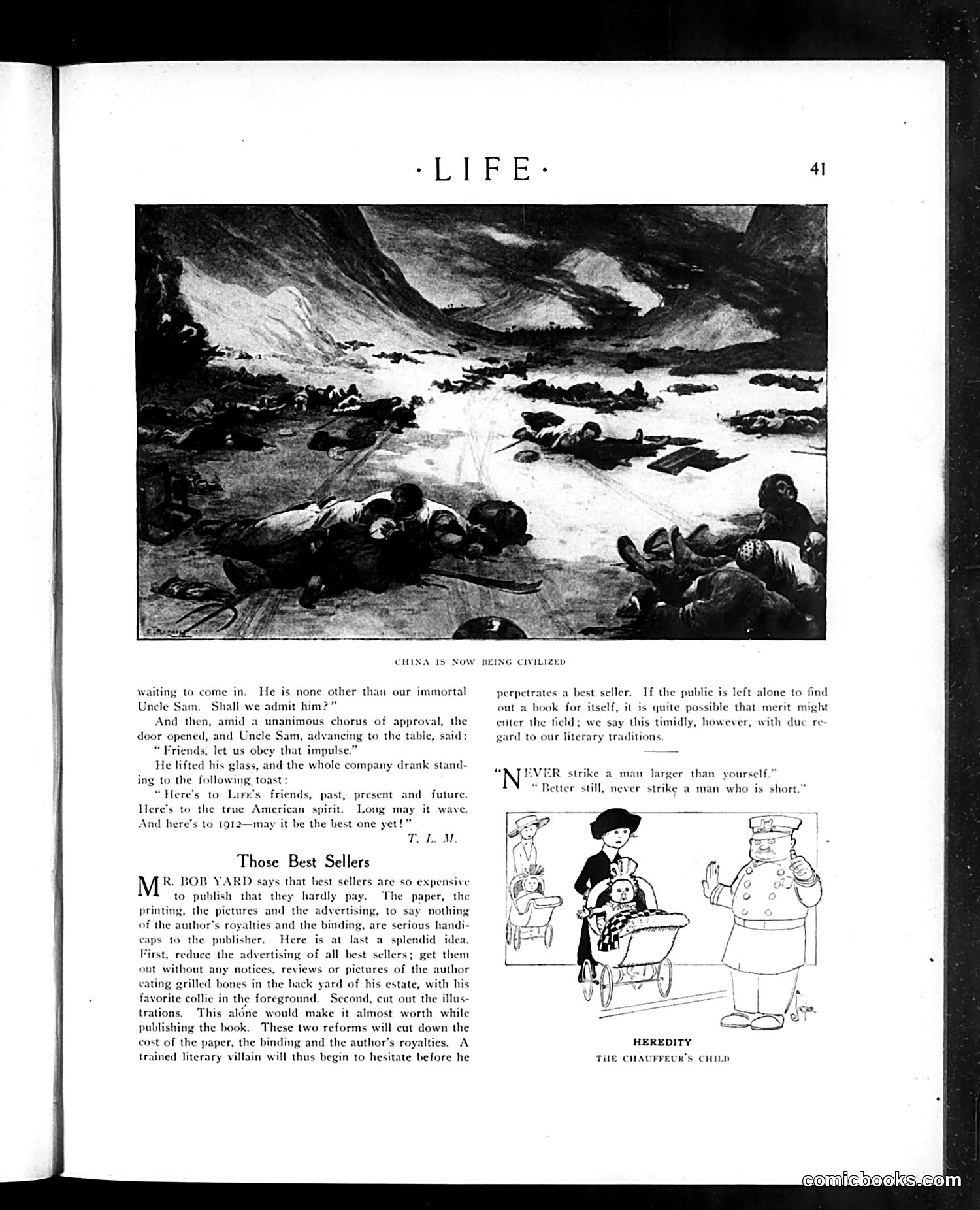
**Top Image:** "China Is Now Being Civilized" depicts a dramatic desert/mountain landscape with multiple bodies lying on the ground. This appears to reference Western military intervention in China—likely the Boxer Rebellion aftermath (1900-1901) or similar colonial conflicts. The caption's ironic title suggests satirical critique of the violence accompanying Western "civilization" efforts in China. **Middle Section:** A humorous piece by T.L.M. mocks pretentious American social rituals, depicting Uncle Sam toasting to American spirit and the year 1912. The satire targets self-congratulatory patriotism and shallow optimism. **"Those Best Sellers":** Bob Yard satirizes the publishing industry's expensive practices—extravagant advertising, author photos, and illustrations—that inflate book costs while potentially compromising literary quality. The suggestion to remove these elements and hire a "trained literary villain" mocks how commercial concerns override artistic merit. **"Heredity - The Chauffeur's Child":** A cartoon (caption only visible) likely plays on class inheritance and social expectations—unclear without seeing the full cartoon, but appears to satirize assumptions about children inheriting their parents' social station or character.
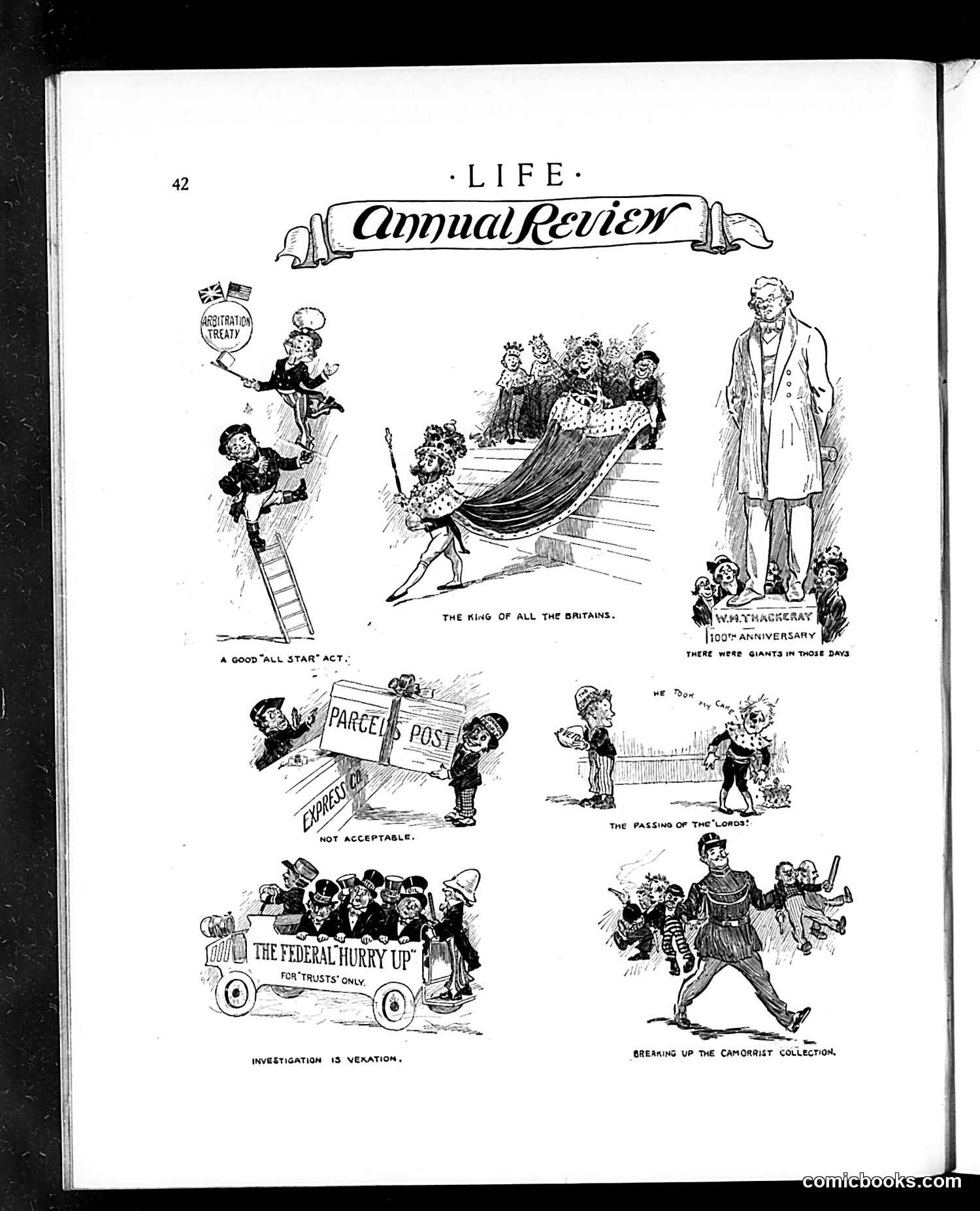
This page presents satirical cartoons commenting on early 20th-century American politics and society. Key panels include: - **"A Good 'All Star' Act"**: Figure climbing a ladder holding "Arbitration Treaty," mocking diplomatic efforts. - **"The King of All the Britains"**: A theatrical scene satirizing British royalty or leadership. - **"W.M. Thackeray 100th Anniversary"**: References the celebrated author, depicting "giants in those days." - **"Not Acceptable"**: Postal workers rejecting parcels, likely criticizing government services or policy. - **"Investigation is Vexation"**: A vehicle labeled "Federal Hurry Up" crowded with officials, satirizing government inquiries as chaotic and ineffective. - **"The Passing of the Lords"**: Social commentary on British aristocracy. - **"Breaking Up the Camorrist Collection"**: References the Camorra (Italian mafia), suggesting anti-corruption efforts. The cartoons employ exaggerated caricature to mock bureaucratic incompetence and political pretension.
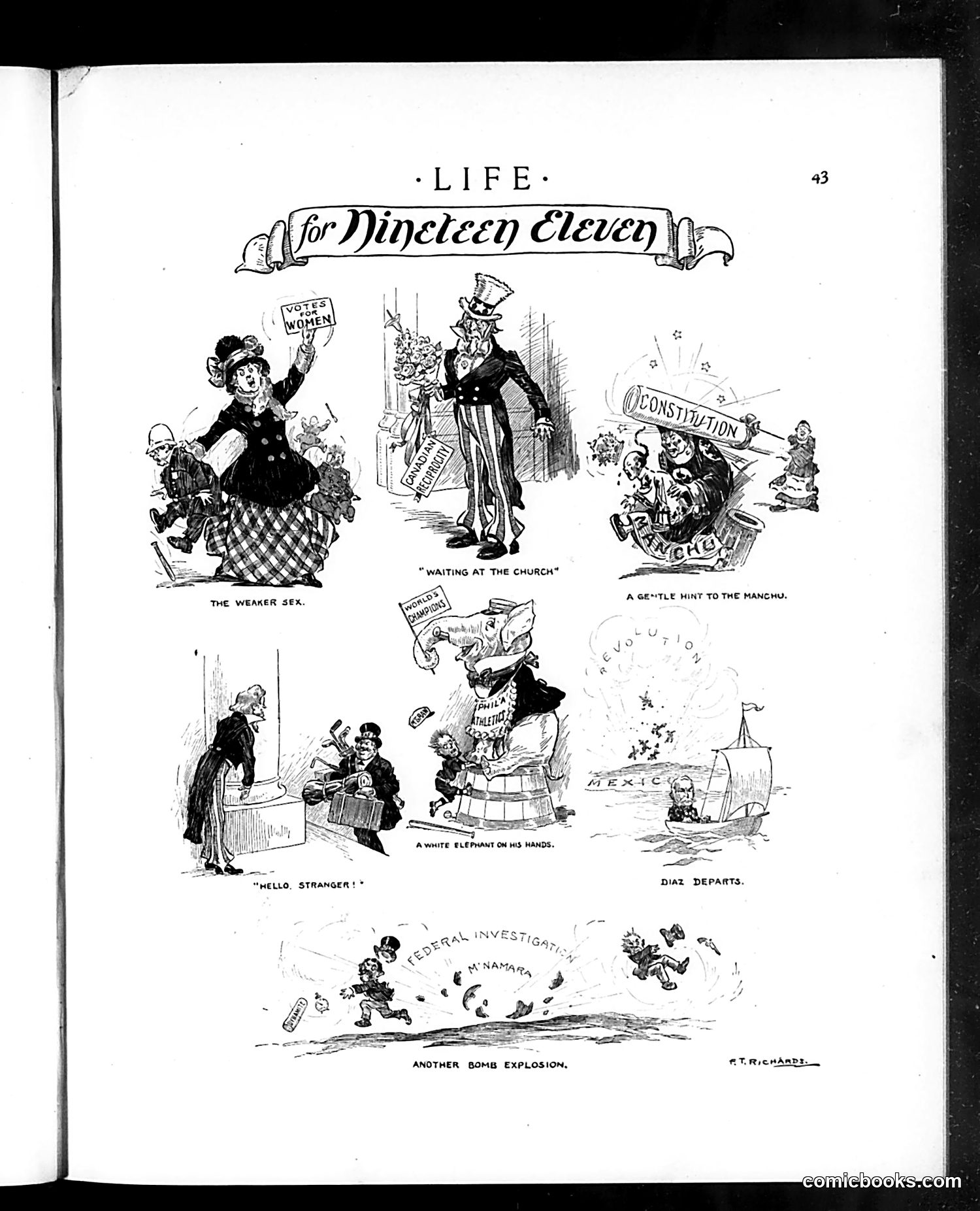
This satirical page mocks American political and social turmoil circa 1911. The cartoons depict contemporary anxieties: "The Weaker Sex" shows a suffragist demanding votes; "Waiting at the Church" references marriage uncertainty; "A Gentle Hint to the Manchu" addresses Chinese imperial instability; "A White Elephant on His Hands" appears to reference political burden; and "Diaz Departs" likely alludes to Mexican political upheaval. The recurring bomb-explosion imagery—both "Another Bomb Explosion" at the bottom and references throughout—suggests anarchist violence or labor unrest was a prominent contemporary fear. The "Hello, Stranger" greeting frames these as unexpected, disruptive events dominating the year's news cycle. The overall effect satirizes 1911 as a year of chaos, instability, and social disruption across multiple fronts.
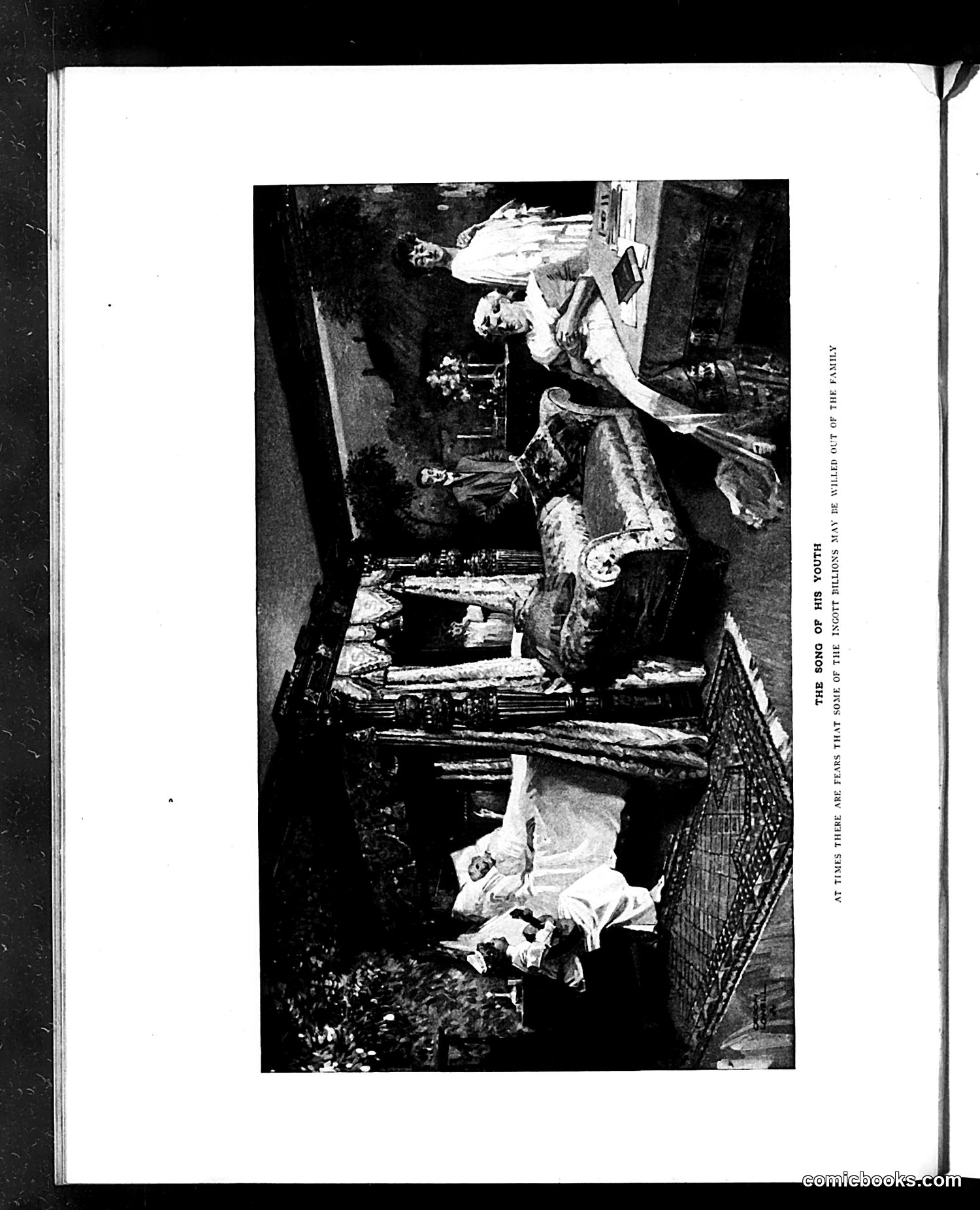
I cannot reliably interpret this page. The OCR text appears corrupted or reversed and is illegible. While the image shows a black-and-white photograph that appears to depict figures in an interior domestic scene (possibly from early 20th century based on clothing and furnishings), without clear text or captions identifying the subjects, the political or satirical point cannot be determined with confidence. The photograph's orientation relative to the page layout is also unclear. To properly explain this as satire for modern readers, I would need legible caption text identifying the figures and context referenced.
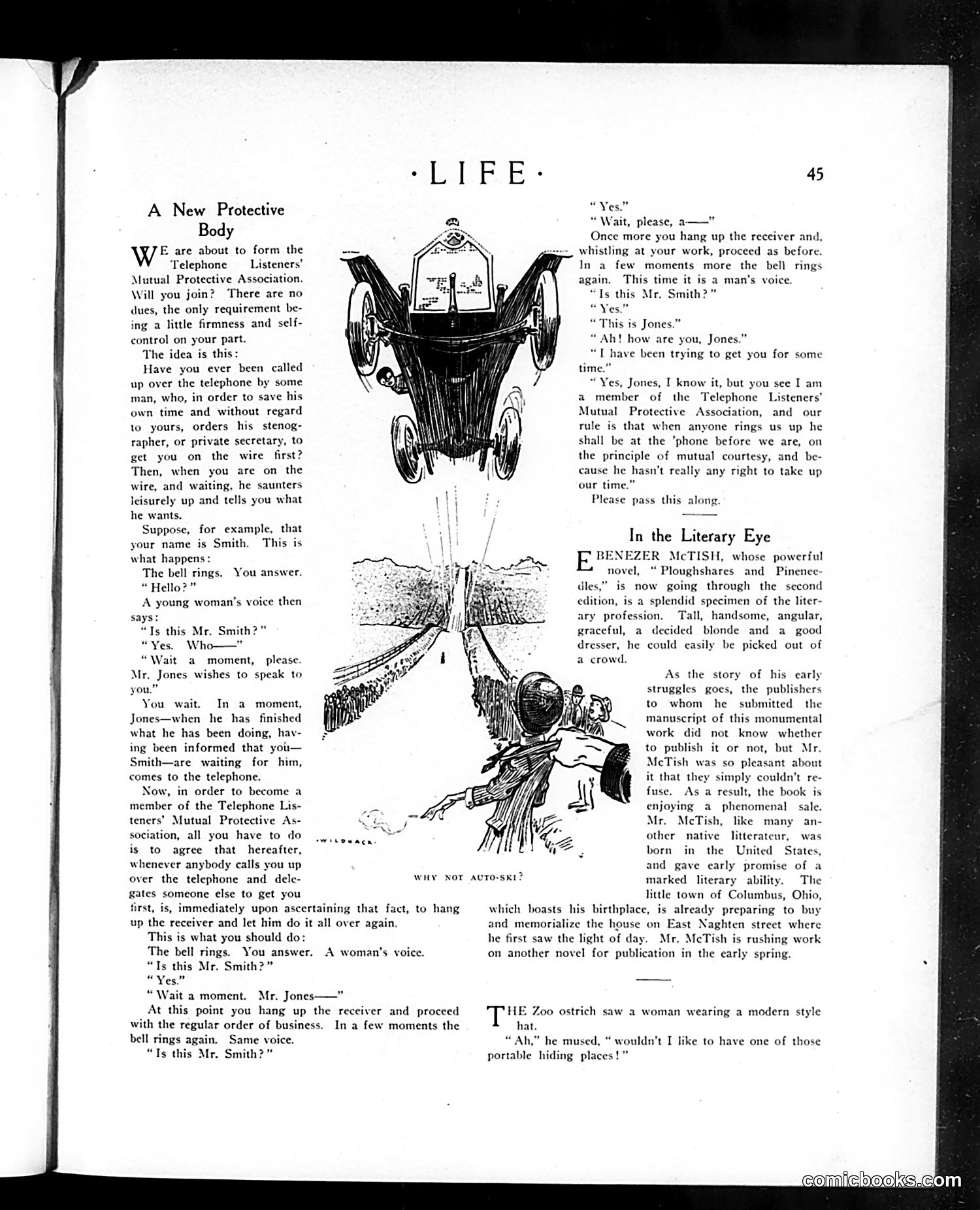
This page contains two main satirical pieces: **"A New Protective Body"** mocks the rudeness of early telephone etiquette. The cartoon illustrates a common annoyance: businessmen (like "Mr. Jones") would have secretaries call ahead and place callers on hold, forcing them to wait while the executive finished other business. The satire proposes a "Telephone Listeners' Mutual Protective Association" where callers would hang up if not immediately greeted by the person calling them—asserting mutual respect through refusal to wait. The cartoon depicts a telephone receiver seemingly being hung up from above, humorously visualizing this act of defiance. **"In the Literary Eye"** is a lighter satirical sketch about author E. Benezer McTish, whose novel "Ploughshears and Pineneedles" is selling well. The joke: publishers accepted it not because of merit but because McTish was so pleasant they "simply couldn't refuse." The humor lies in suggesting his charm mattered more than literary quality. A brief quip about a zoo ostrich envying a woman's modern hat as a "portable hiding place" appears at bottom.
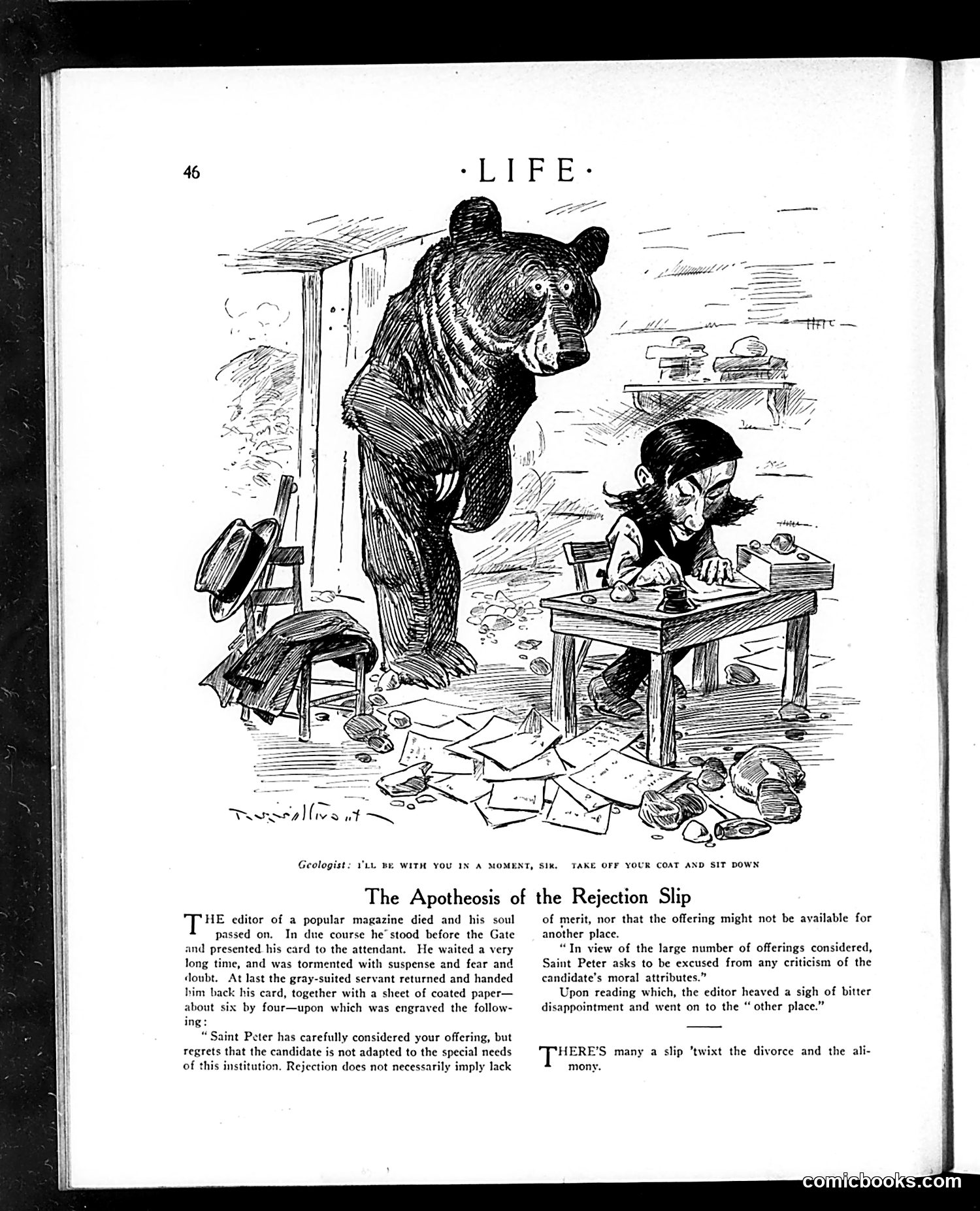
This two-part satirical page mocks the magazine publishing world and human fate itself. **Main cartoon:** A large bear (representing a geologist or academic figure) visits a small man at a desk, offering his work. The satire parodies the standard "rejection slip"—the form letter publishers sent to unwanted submissions. The humor lies in depicting this humiliating professional rejection in absurdly formal, bureaucratic language. **The story below** extends this mockery to the afterlife: a magazine editor dies and faces Saint Peter, only to receive—of all things—a rejection slip from Heaven itself. The slip uses the exact passive-aggressive language real editors employed ("does not necessarily imply lack of merit"), suggesting that rejection follows us even beyond death. **The final quip** about divorce and alimony adds contemporary social commentary, implying legal/financial misfortunes are as inevitable as rejected manuscripts. The satire targets both the publishing industry's impersonal cruelty and life's general unfairness.
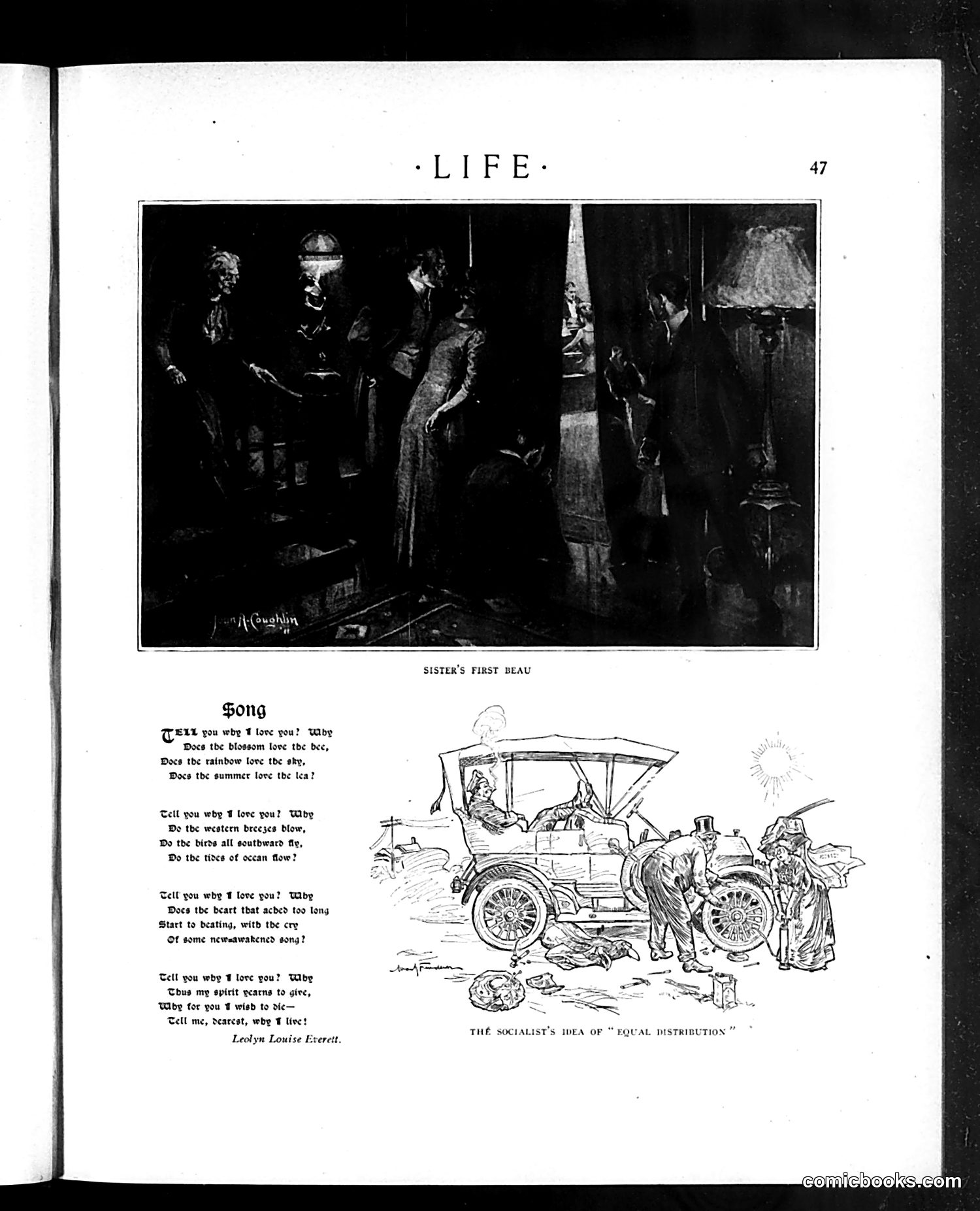
**Upper Image:** "Sister's First Beau" depicts a formal social scene—likely an upper-class family meeting a young man courting their daughter. The dramatic lighting and formal dress suggest this is satirizing Victorian courtship rituals. **Lower Cartoon:** "The Socialist's Idea of 'Equal Distribution'" shows a broken-down automobile surrounded by poor people, with wealthy individuals stranded beside it. This mocks socialist economic theory by suggesting that redistribution policies would result in everyone being equally impoverished—literally "leveling down" rather than lifting up. The wrecked car symbolizes destroyed wealth and prosperity. The song between them is sentimental verse about love, possibly included for tonal contrast with the political satire below. Life magazine frequently juxtaposed sentimental poetry with sharp social commentary to highlight life's contradictions.
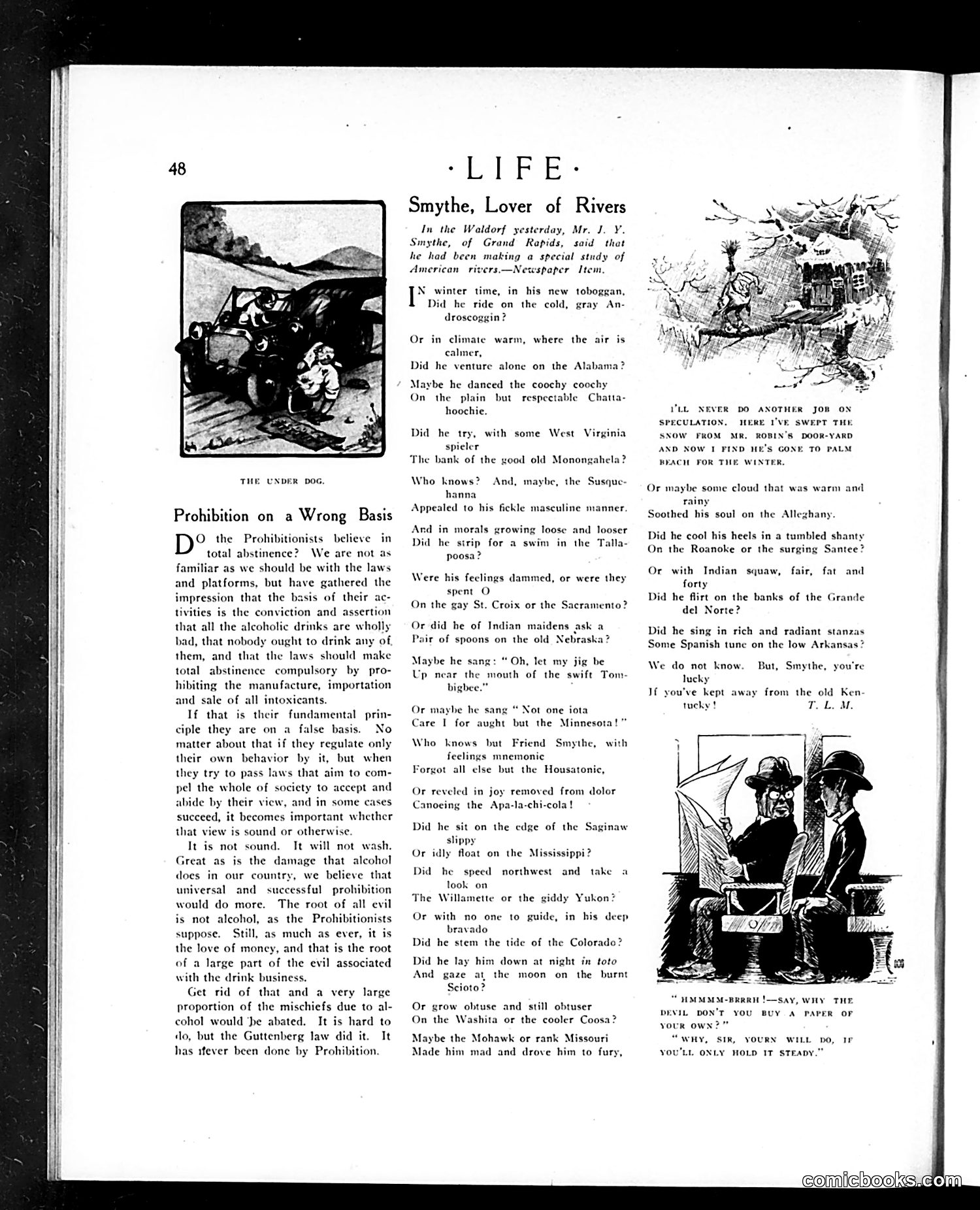
This page contains two satirical pieces attacking Prohibition and poking fun at a newspaper item. **"Prohibition on a Wrong Basis"** (left column): Life's editors argue against the Prohibitionists' absolutist stance, claiming total alcohol prohibition would cause *more* harm than good. They contend the real "root of all evil" is love of money, not alcohol itself—a rhetorical jab suggesting Prohibitionists misdiagnose society's problems. **"Smythe, Lover of Rivers"** (right): This mock-heroic poem ridicules a newspaper item about J. Y. Smythe of Grand Rapids supposedly studying American rivers. The poem comically catalogs dozens of river names in increasingly absurd scenarios (strip-teasing, canoeing, going mad), suggesting the original news item was either fabricated or absurdly trivial. The paired cartoon shows two men discussing buying a newspaper, one claiming speculation ruined him—implying Life itself questions the reliability of such "news." Both pieces exemplify Life's satirical mission: deflating Prohibition zealotry and mocking sensationalist journalism.
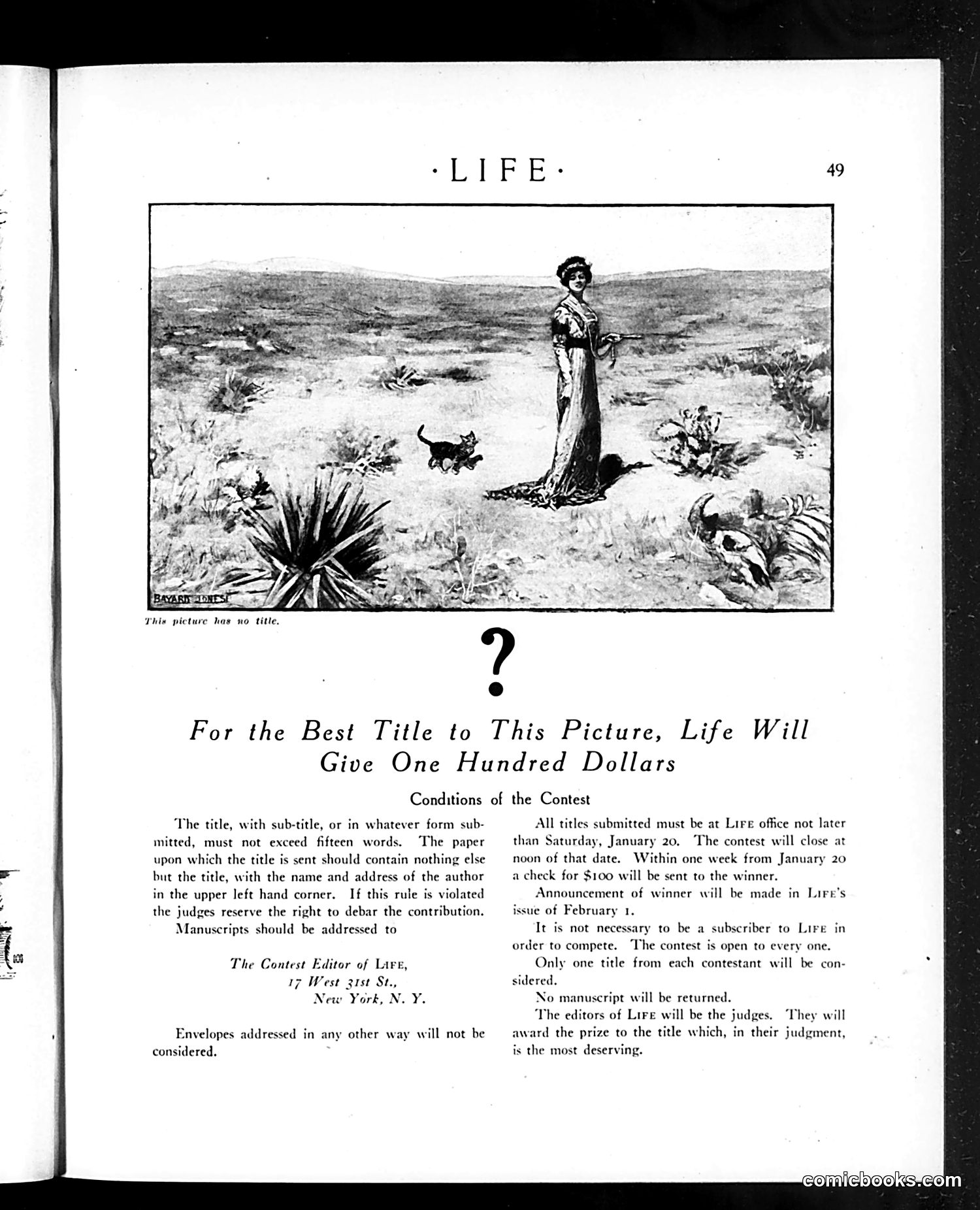
This page announces a $100 contest for readers to title an untitled illustration. The image shows a elegantly dressed woman standing alone in a sparse desert landscape with scattered desert plants and a small black cat or dog nearby. The woman appears fashionably dressed in what looks like early 1900s attire with a large hat. The contest invites public submissions of titles (maximum fifteen words) to *Life* magazine's New York office by January 20. The winning title will be announced February 1. This reflects *Life*'s era as a prominent American humor and satire magazine that engaged readers through interactive contests. The ambiguous desert scene—pairing refined femininity with desolate terrain—likely suggests a humorous commentary on modern life, possibly about isolation, displacement, or the incongruity between social pretense and harsh reality, though the specific satirical point remains open-ended, which was the contest's appeal.
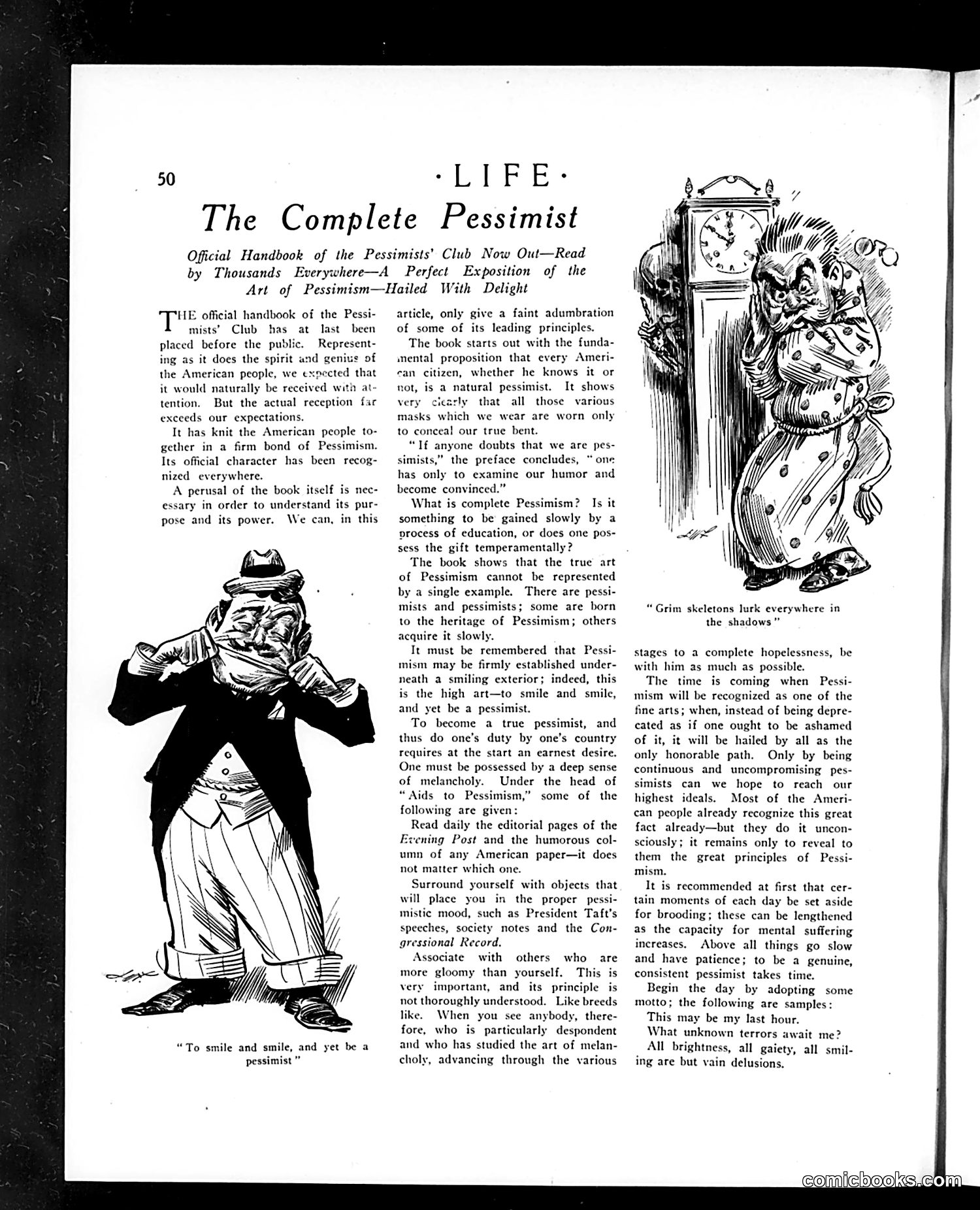
This article satirizes American pessimism by presenting a fake "official handbook" as if pessimism were an organized philosophy or club. The satire targets the prevailing mood of early 20th-century America—a culture of complaining masked by forced cheerfulness. The two accompanying cartoons illustrate this hypocrisy: figures in formal dress embody the contradiction of maintaining a respectable exterior while harboring deep gloom. One caption quotes Shakespeare ("To smile and smile, and yet be a pessimist"), emphasizing the performative nature of American optimism. The article mocks specific targets: President Taft's speeches, congressional records, and newspaper editorials are listed as tools for inducing despair—suggesting these institutions themselves were seen as depressing or incompetent. The satire suggests that Americans instinctively understand pessimism but haven't consciously acknowledged it. The overall joke: pessimism isn't learned; it's the natural American condition, merely dressed up in polite society.
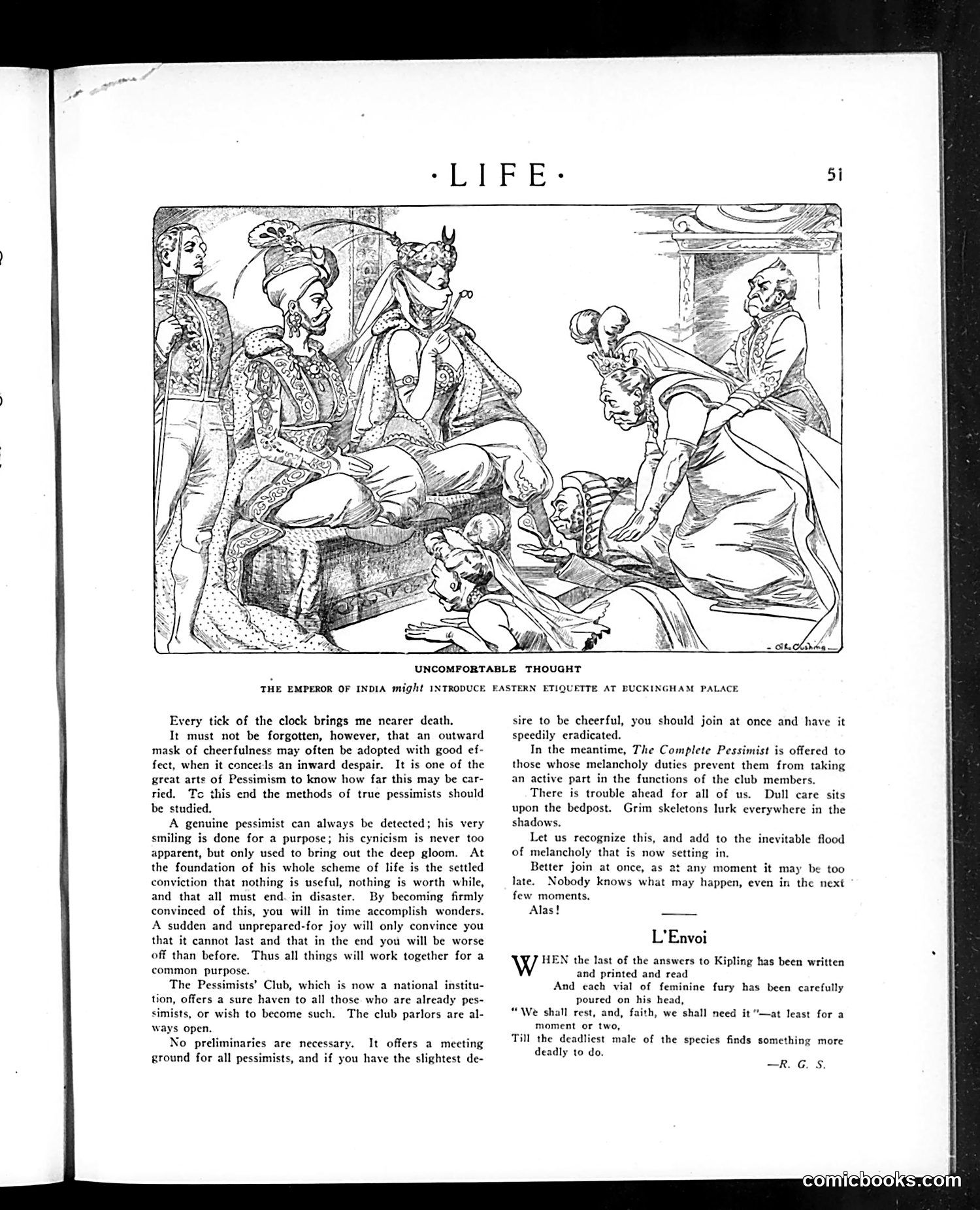
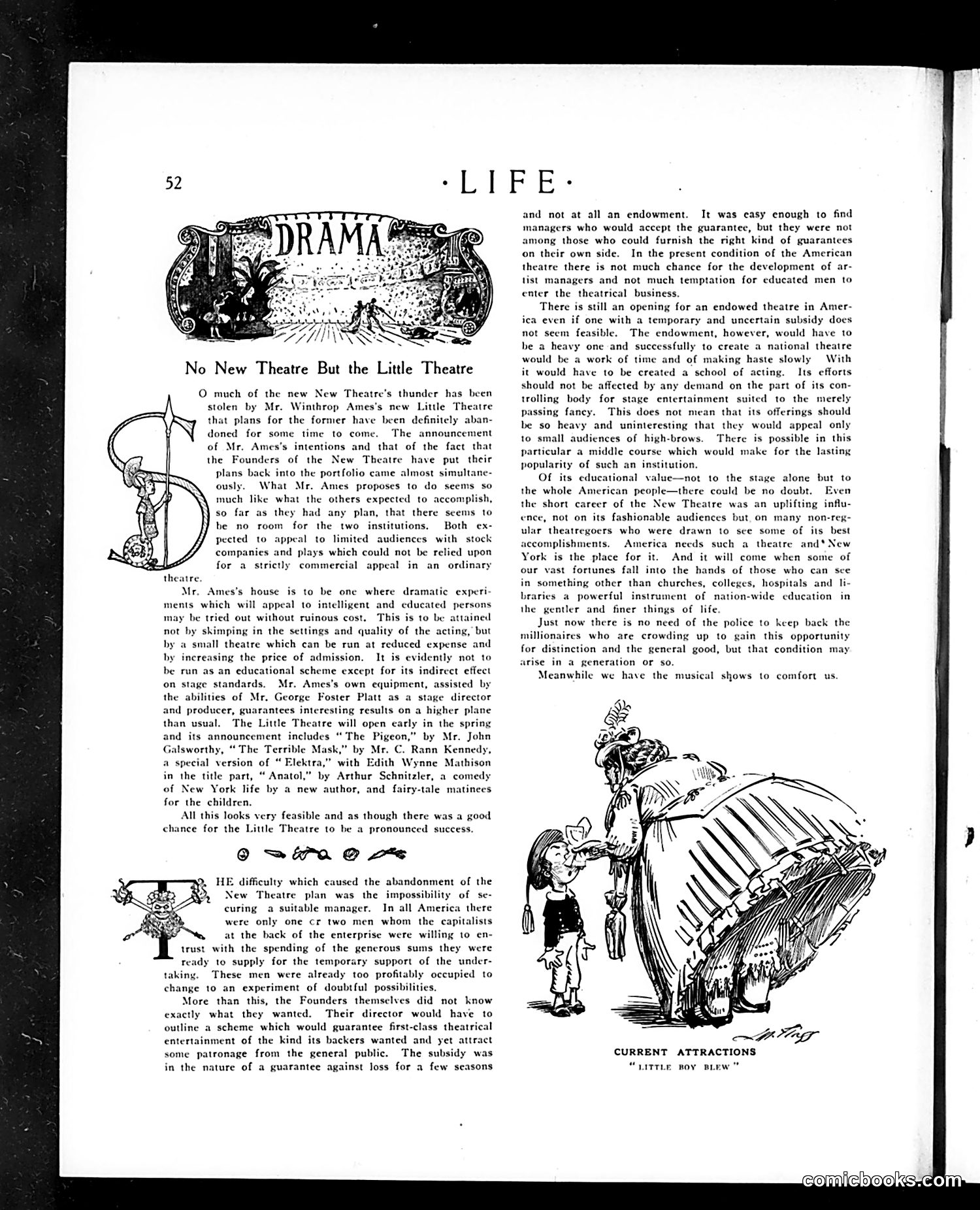
This page discusses the theatrical landscape of early 20th-century America. The article explains why the ambitious "New Theatre" project was abandoned in favor of Winthrop Ames's smaller "Little Theatre." The key satire targets the impracticality of the New Theatre's grand vision: wealthy backers wanted an prestigious institution but couldn't find a suitable manager willing to take on such uncertain financial prospects. The piece argues that America's commercial theater system offered little incentive for serious artists or educated managers to risk experimental work. Ames's alternative—a smaller venue with higher ticket prices and lower production costs—appears more feasible. The text and accompanying illustration ("Little Boy Blew," showing a child with what appears to be theatrical imagery) suggest that scaling down theatrical ambitions to match available resources and talent was the more realistic path forward. The underlying joke: America's theater establishment was too commercially driven to sustain genuine artistic innovation at grand scale.
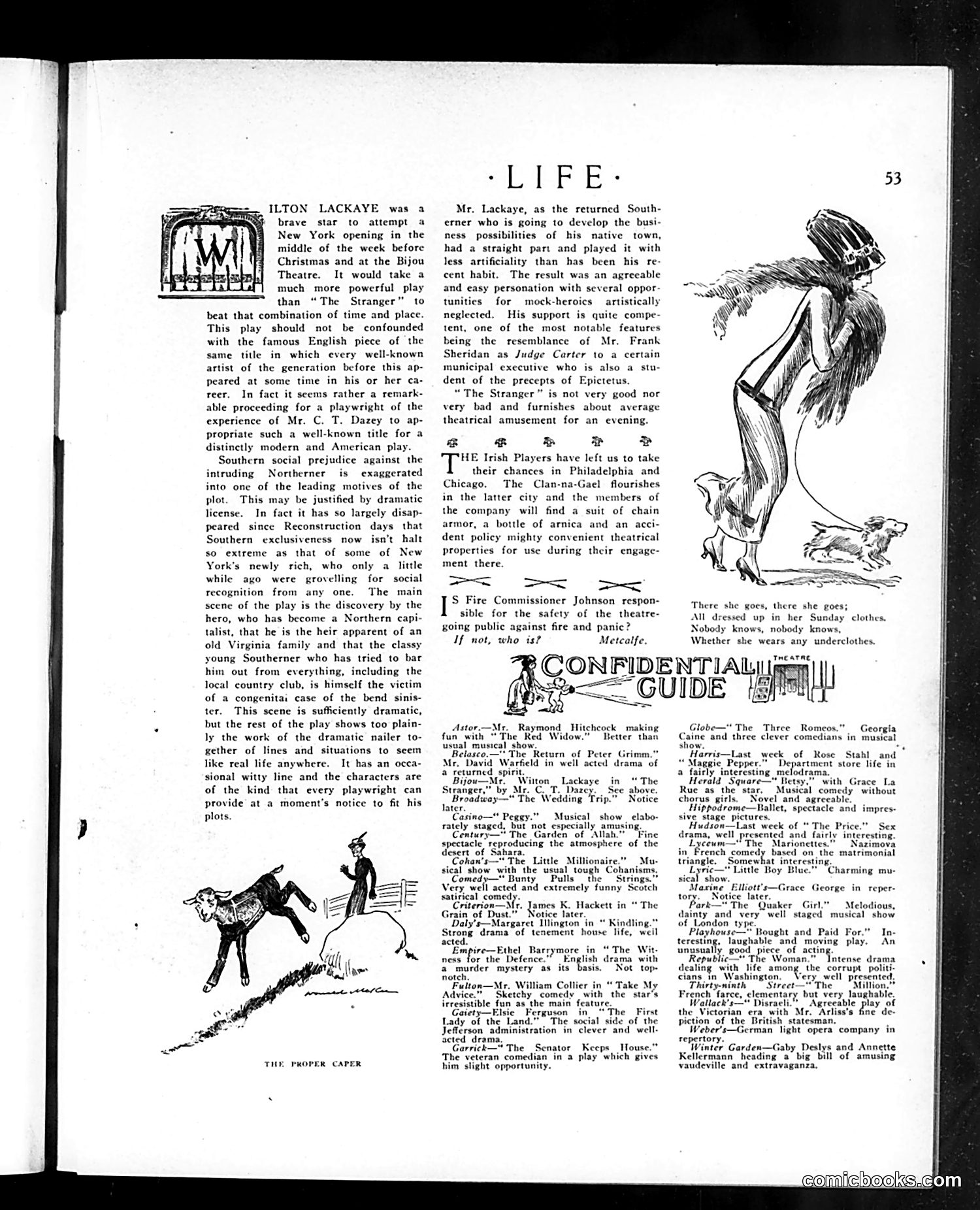
This page reviews theatrical productions, focusing on actor Milton Lackaye's performance in "The Stranger" at the Bijou Theatre. **The Main Review:** The critic acknowledges Lackaye's bravery opening a play the week before Christmas during poor theater attendance. The plot concerns a Northern capitalist who discovers he's the heir to a Virginia family, satirizing post-Reconstruction Southern social prejudice against Northerners. The reviewer notes this prejudice has actually faded—modern New York's newly wealthy are now the real snobs, desperately seeking social recognition. **The Cartoons:** Two illustrated vignettes ("The Proper Caper" at bottom left) appear unrelated to the reviews, showing slapstick scenes typical of period humor. **The Satire:** The review's sharpest barb mocks Southern exclusivity by noting New York's "newly rich" are worse offenders, having recently "grovelled for social recognition." The page ends with brief reviews of other Broadway shows and a gossipy "Confidential Guide" section.
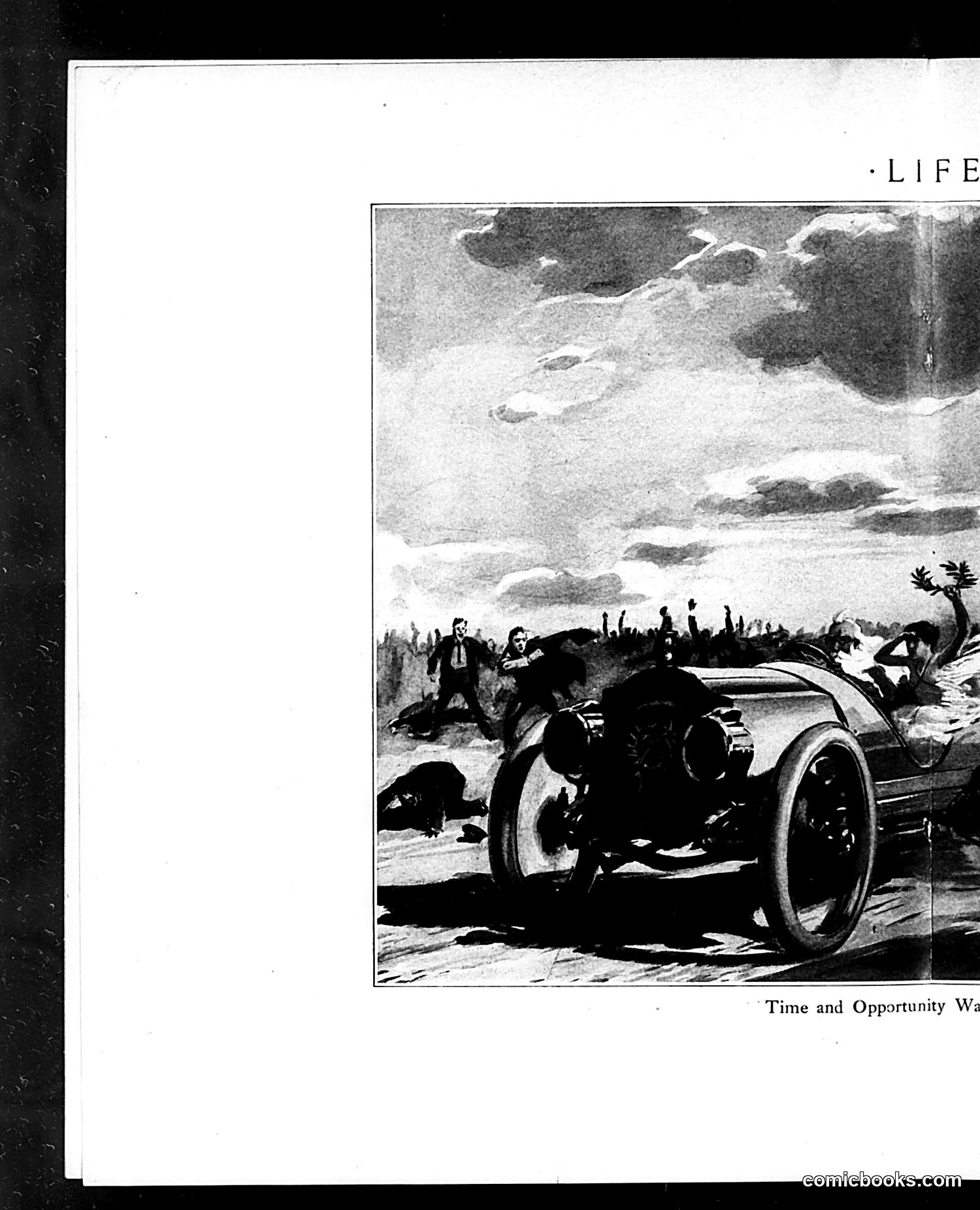
This page from *Life* magazine shows an illustration of an early automobile with several figures nearby. The partially visible caption reads "Time and Opportunity Wa[its]" (text appears cut off). The image depicts what appears to be a racing or automotive scene, with a driver in the vehicle and observers standing at a distance. The style and vehicle design suggest early 20th-century content, likely referencing either automotive innovation, a famous race, or a contemporary news event involving automobiles. However, without the complete caption text or additional context, I cannot definitively identify which specific historical event, figures, or political/social commentary this satire references. The truncated caption prevents certain interpretation of the cartoon's intended meaning.
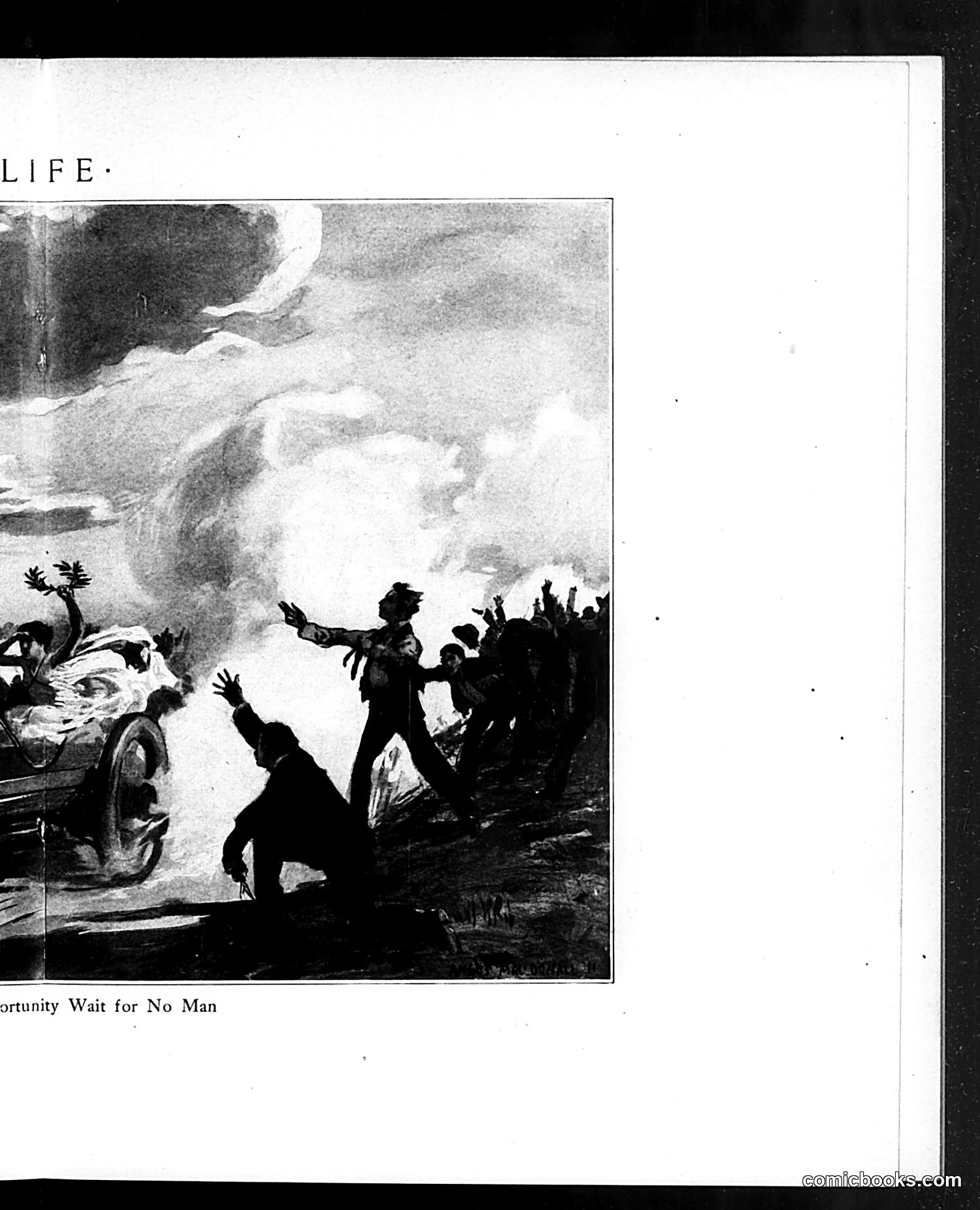
This Life magazine page presents a dramatic illustration titled "Opportunity Wait for No Man." The image depicts silhouetted figures in what appears to be an urgent or chaotic scene, with smoke or flames visible in the background and what looks like an overturned vehicle on the left. The partial caption suggests a cautionary message about seizing moments before they pass. The silhouetted composition and dramatic staging indicate this is likely satirizing human nature—people's tendency to hesitate or delay when action is needed, only to find opportunities have vanished. Without additional context or visible publication date, the specific historical reference remains unclear, though the style suggests early-to-mid 20th century publication. The message appears broadly moralistic rather than targeting specific political figures.
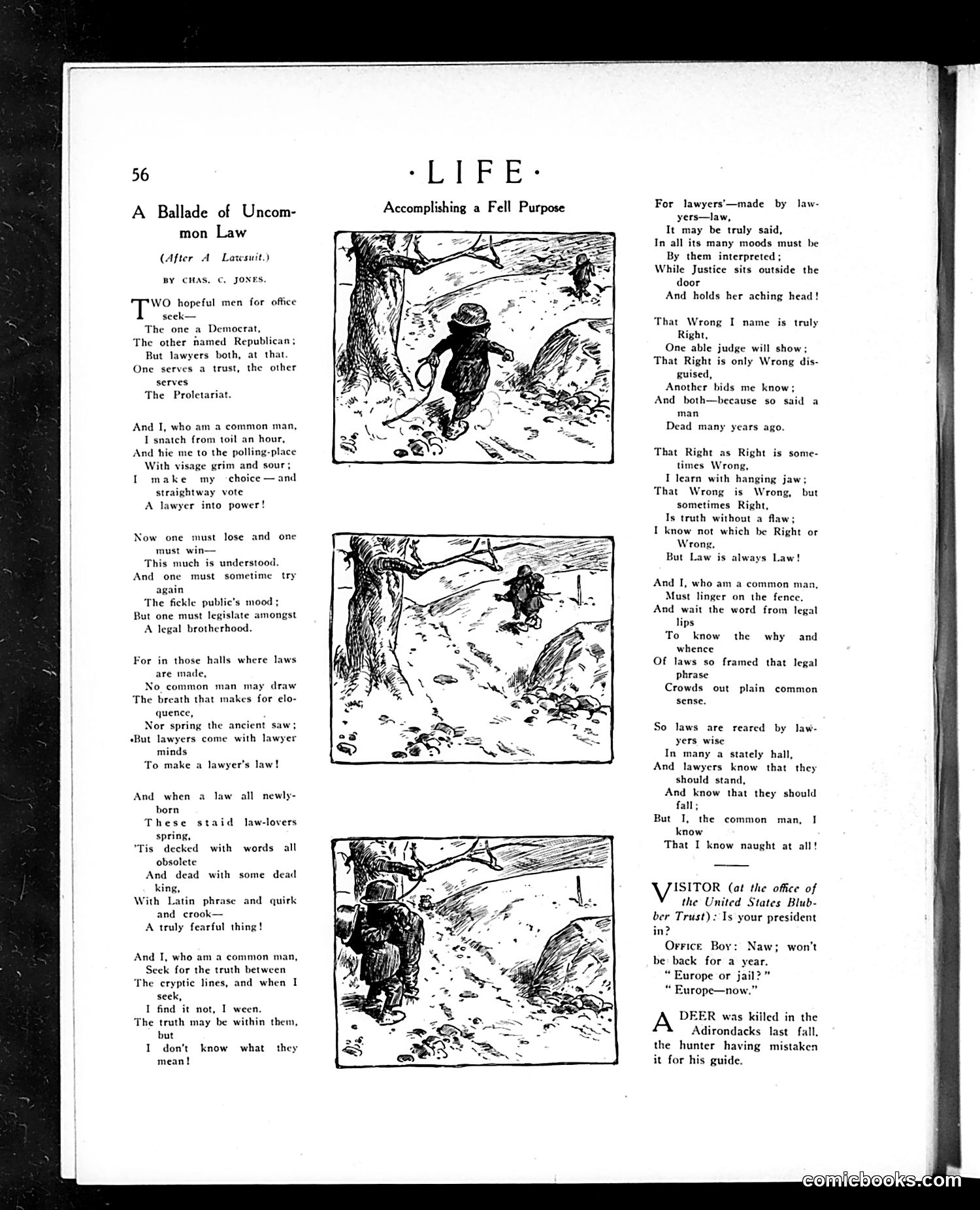
This satirical poem by Chas. C. Jones (after A Lawsuit) critiques how lawyers dominate legislation and obscure justice through deliberate complexity. **The Setup:** A common man votes a lawyer into power, choosing between two lawyer-politicians (Democrat and Republican). Both serve different interests but share lawyer mentality. **The Satire's Point:** Jones attacks lawyers for: - Making laws incomprehensible to ordinary citizens through archaic Latin phrases and dead legal precedents - Using circular logic where "Right" becomes "Wrong" and vice versa, depending on which lawyer interprets it - Prioritizing legal procedure over actual justice (Justice "sits outside the door / And holds her aching head") - Creating a self-serving legal system only lawyers understand **The Cartoon Images:** Show a common man repeatedly trying to understand the law's meaning, appearing confused and frustrated. **The Modern Equivalent:** Criticizing how lawyers and legislatures intentionally use jargon to maintain power and exclude public understanding—a timeless complaint about legal opacity.
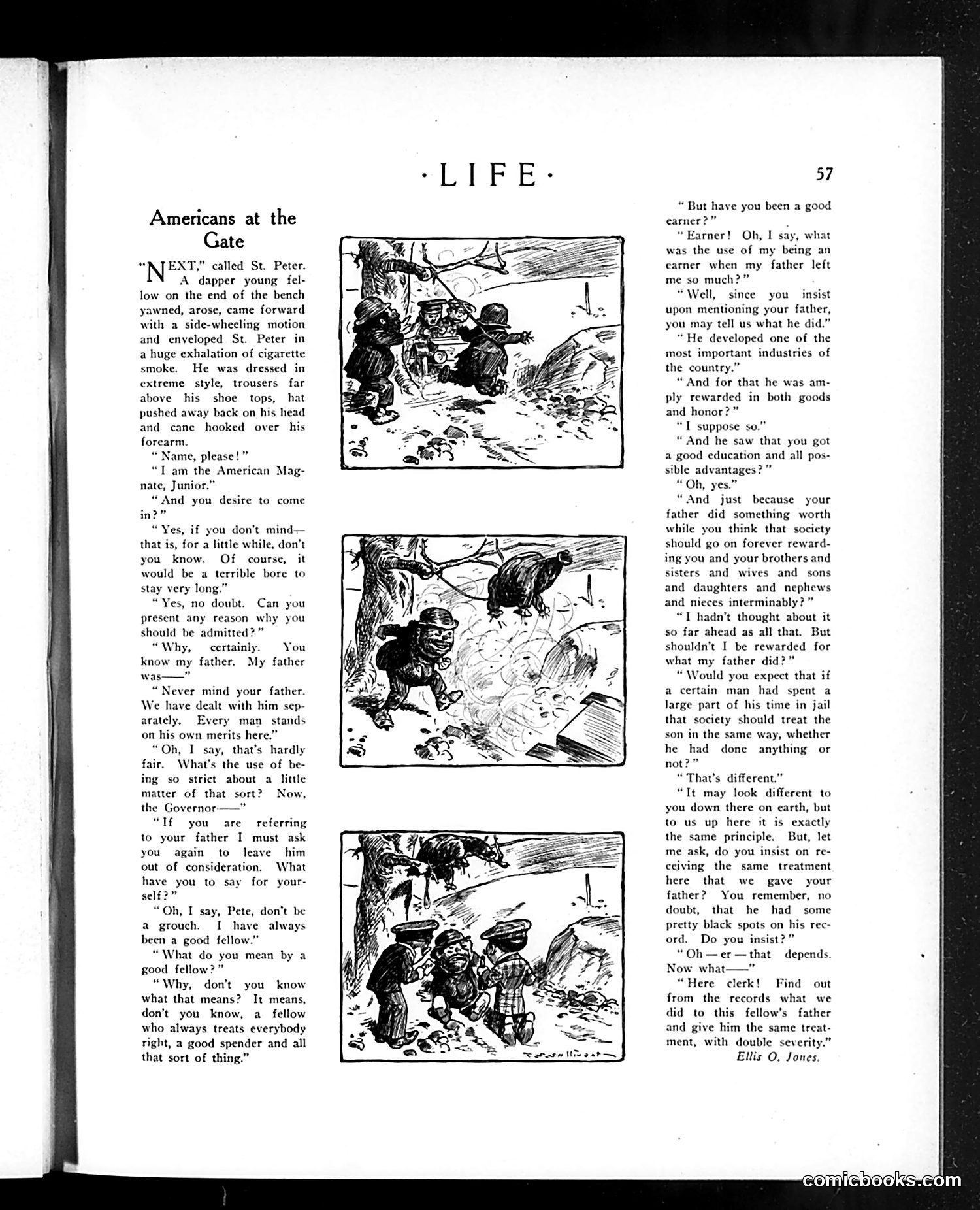
This is a satirical critique of wealthy American inheritors and the concept of inherited privilege. St. Peter interviews "the American Magnate, Junior" — a caricatured rich young man distinguished by exaggerated fashion (high-water pants, pushed-back hat, cane) and casual arrogance. The satire targets: **The protagonist's entitlement**: He assumes admission to heaven based solely on his father's accomplishments and wealth, not his own merits. He's confused when told he must earn entry independently. **"Good fellow" hypocrisy**: When asked to justify himself, he defines being "good" as spending money lavishly and treating people "right" — a shallow, consumerist morality. **Inherited privilege critique**: St. Peter's argument—that society shouldn't perpetually reward descendants for ancestors' achievements—directly challenges Gilded Age dynastic wealth concentration. The punchline: St. Peter orders the young man punished with the *same severity* his father received, rejecting any claim to preferential treatment. This reflects Progressive Era skepticism toward unearned wealth and dynastic power consolidation.
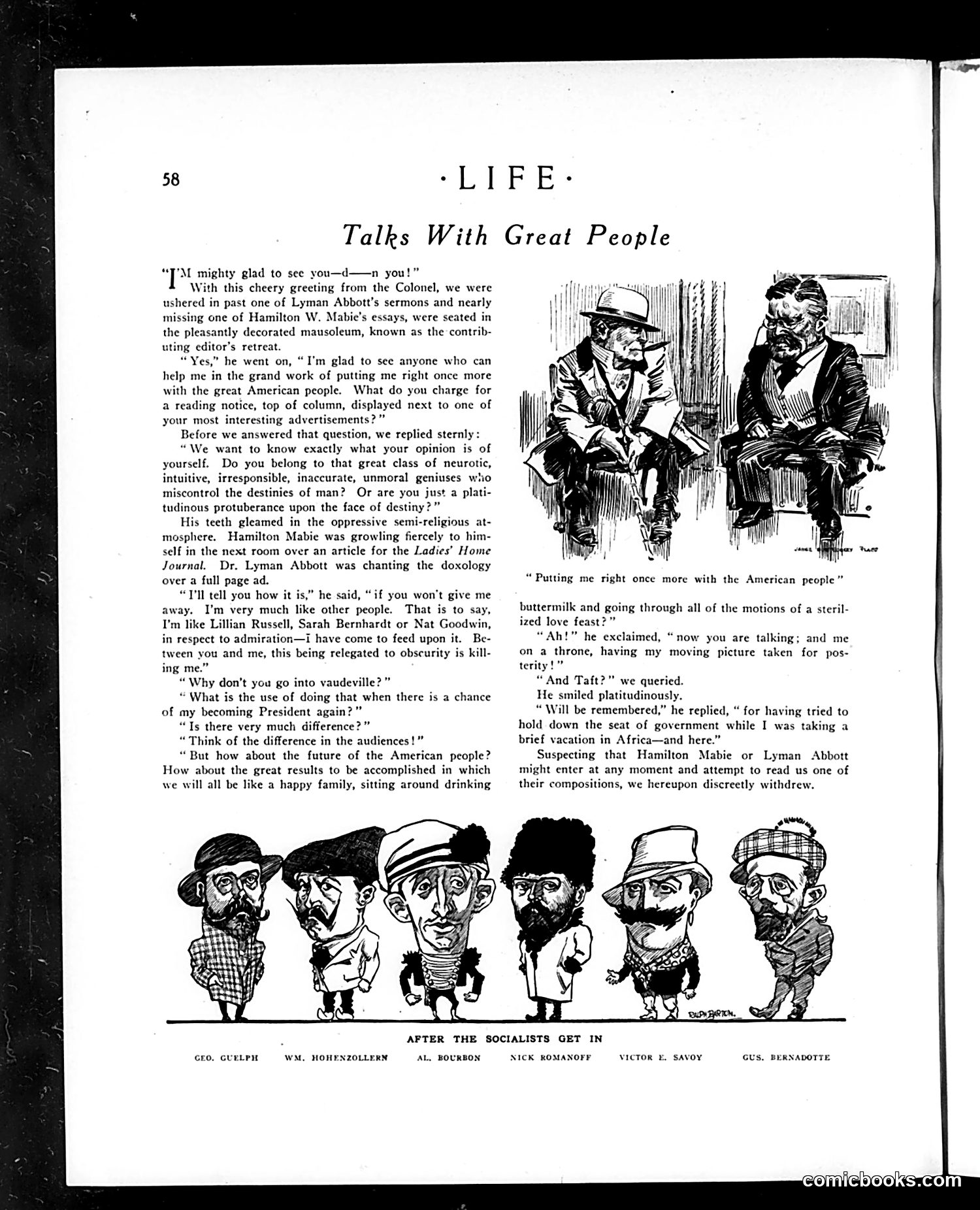
This page satirizes prominent American editors and intellectuals of the early 1900s. The main article mocks an unnamed "Colonel" (likely a Life editor or contributor) who represents vanity and self-importance. The piece ridicules his obsession with public image, comparing him to celebrities like Lillian Russell and Sarah Bernhardt—people known for courting attention. The dialogue lampoons intellectual pretension: references to Hamilton Mabie and Lyman Abbott (real editors/writers) suggest Life viewed them as pompous. The Colonel's desire to become President and his boasts about his importance are portrayed as absurd ego-stroking. The bottom cartoon, titled "After the Socialists Get In," presents caricatured European monarchs and nobility (identified by name: Guelph, Hohenzollern, Bourbon, Romanoff, Savoy, Bernadotte). This satirizes fears about socialist revolution potentially overthrowing aristocracy—a topical concern during the early 20th century's labor unrest.
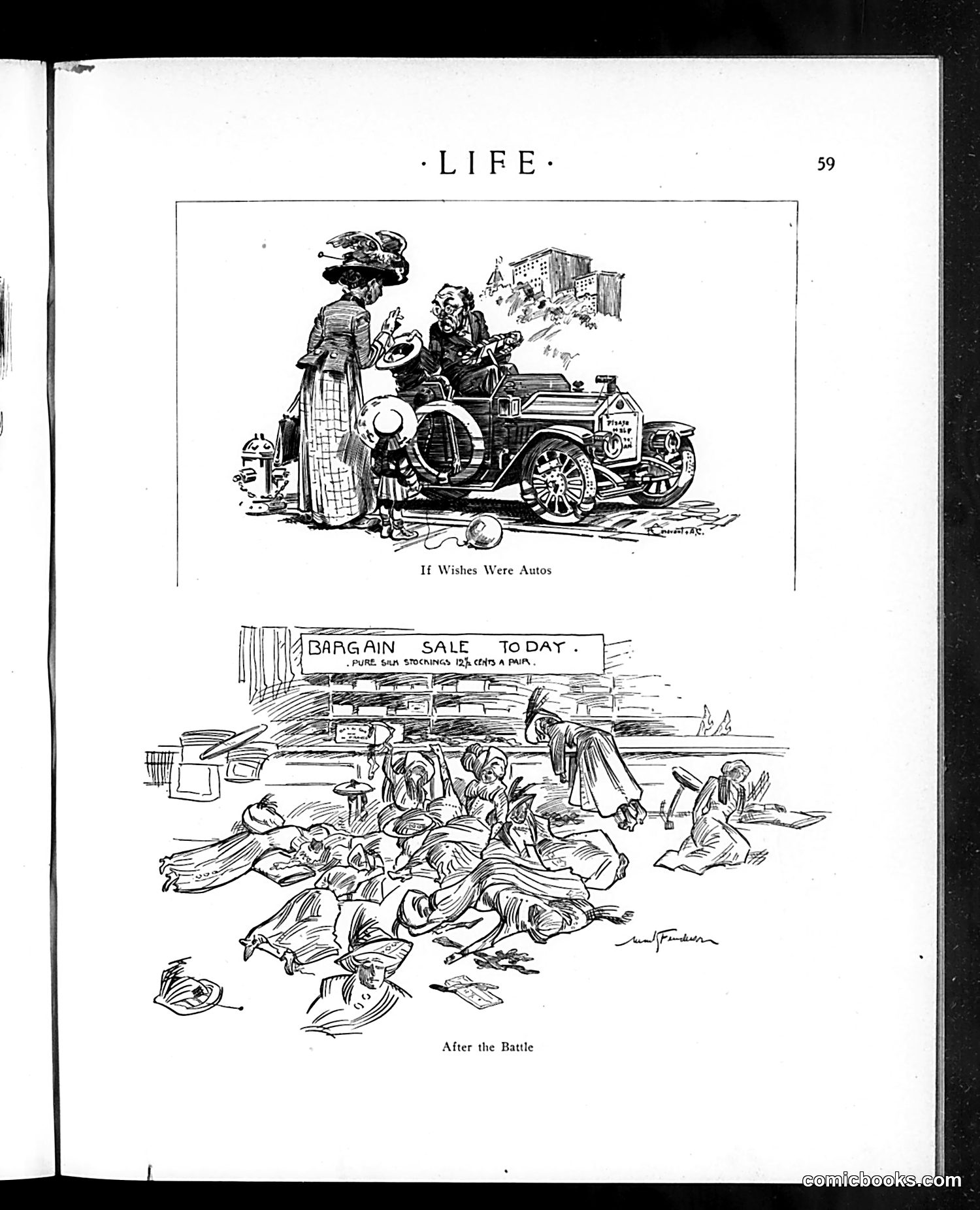
**Top cartoon, "If Wishes Were Autos":** A well-dressed woman and child admire an early automobile while a man in the vehicle gestures grandly. The satire mocks the gap between aspirations and reality—ordinary people fantasizing about owning expensive cars, which were luxury items in the early 1900s. **Bottom cartoon, "After the Battle":** A "Bargain Sale Today" sign advertises cheap stockings (5 cents per pair), but beneath it lies a chaotic battlefield of women fighting over merchandise. The corpse-like figures and violent struggle satirize the frenzy of bargain-hunting shoppers, suggesting that discount sales turn reasonable consumers into desperate combatants willing to literally fight for savings. Together, these cartoons mock both consumer desire and the economic anxieties driving it.
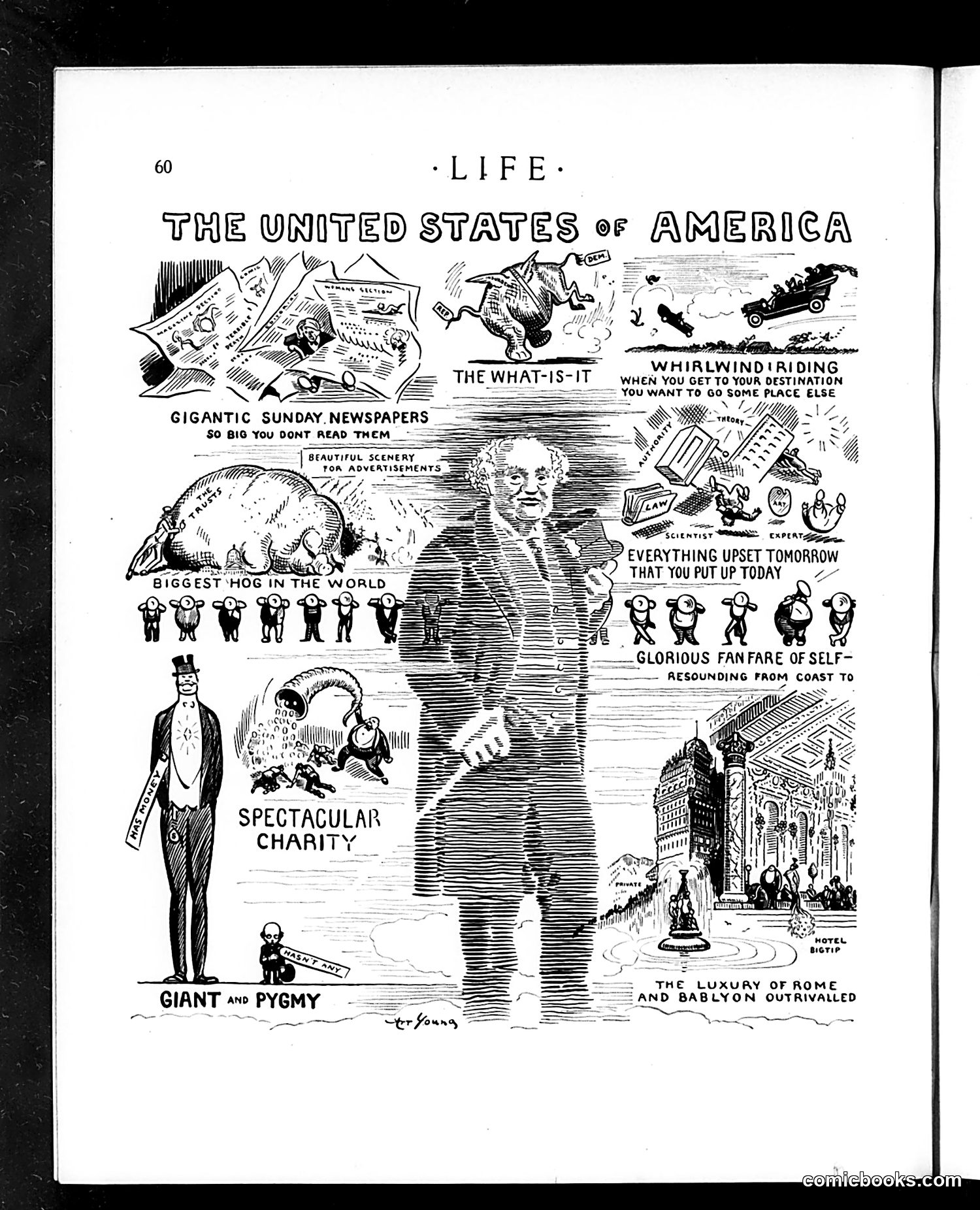
This Life magazine page satirizes American excess and superficiality around the early 20th century. The central giant figure is surrounded by caricatured aspects of American life: **Key targets:** - **Gigantic Sunday newspapers** too large to actually read—mocking bloated media - **"Biggest hog in the world"**—satirizing American materialism and scale-obsession - **Whirlwind riding to unwanted destinations**—critiquing restless consumption and travel for its own sake - **"Spectacular charity"** and **"Giant and Pygmy"**—suggesting charity as performative spectacle masking inequality - **Roman/Babylonian luxury**—implying Americans wastefully ape ancient empires The overall message: American society prioritizes size, spectacle, and self-aggrandizement over substance, creating a culture of perpetual dissatisfaction ("everything upset tomorrow"). It's classic Progressive Era critique of Gilded Age excess.
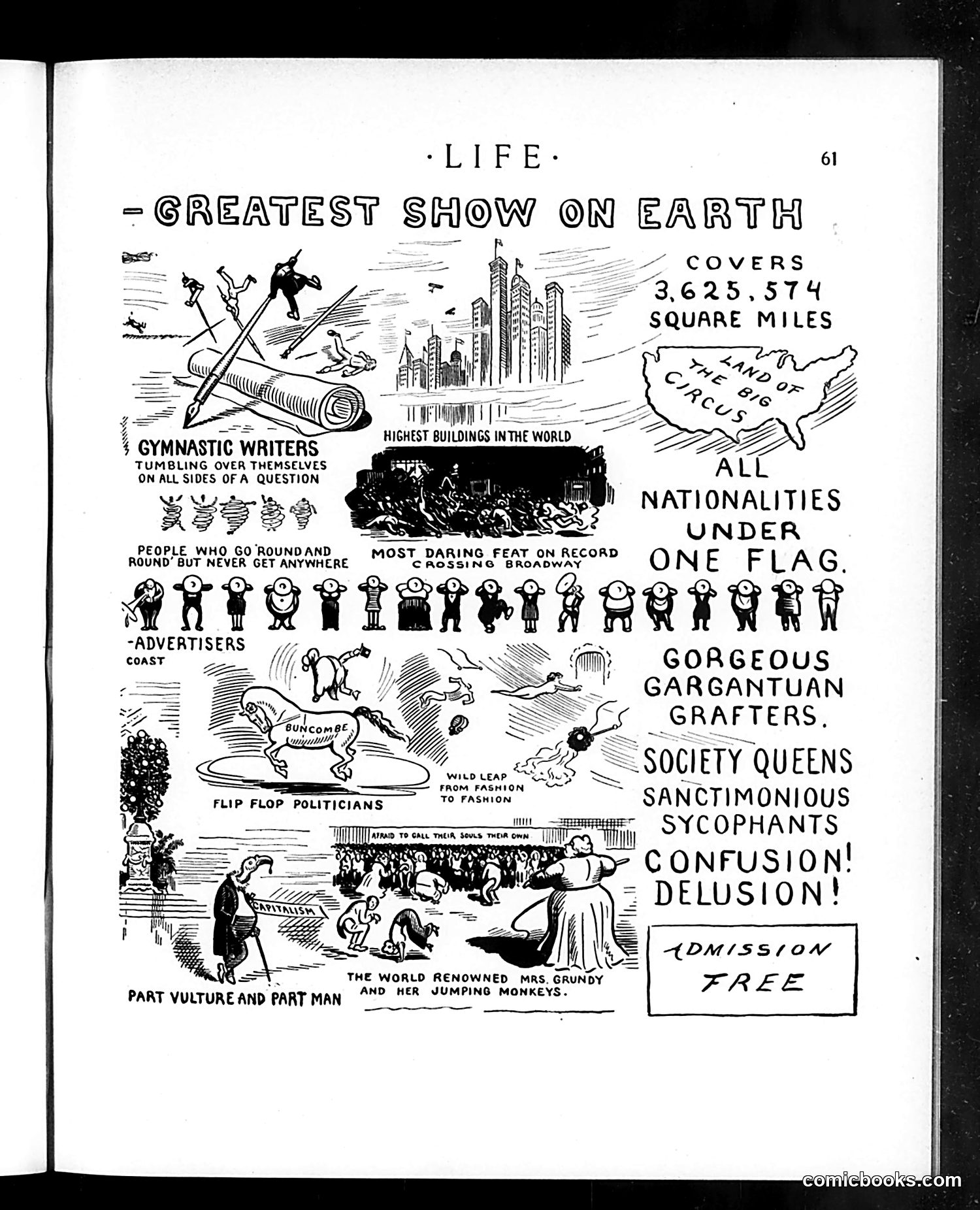
This satirical page mocks American society as a circus attraction. The central metaphor compares the USA to a traveling carnival, with various social types presented as exhibits: **Key caricatures/groups ridiculed:** - "Gymnastic writers" — journalists contorting themselves with contradictory arguments - "Flip flop politicians" — inconsistent public figures - "Advertisers' coast" — commercial manipulation - "Society queens" and "gargantuan grafters" — wealthy elites and corrupt businesspeople - "Part vulture and part man" — appears to reference predatory behavior, possibly capitalists **The satire's point:** Despite covering 3,625,574 square miles and uniting diverse nationalities "under one flag," America is actually a chaotic spectacle of confusion, delusion, hypocrisy, and moral decay. Rather than a beacon of unity and progress, the nation is portrayed as entertainment for the morally bankrupt—admission free, suggesting everyone can participate in the absurdity. The tone is sharply critical of American institutions, elites, and media during what appears to be the early 20th century.
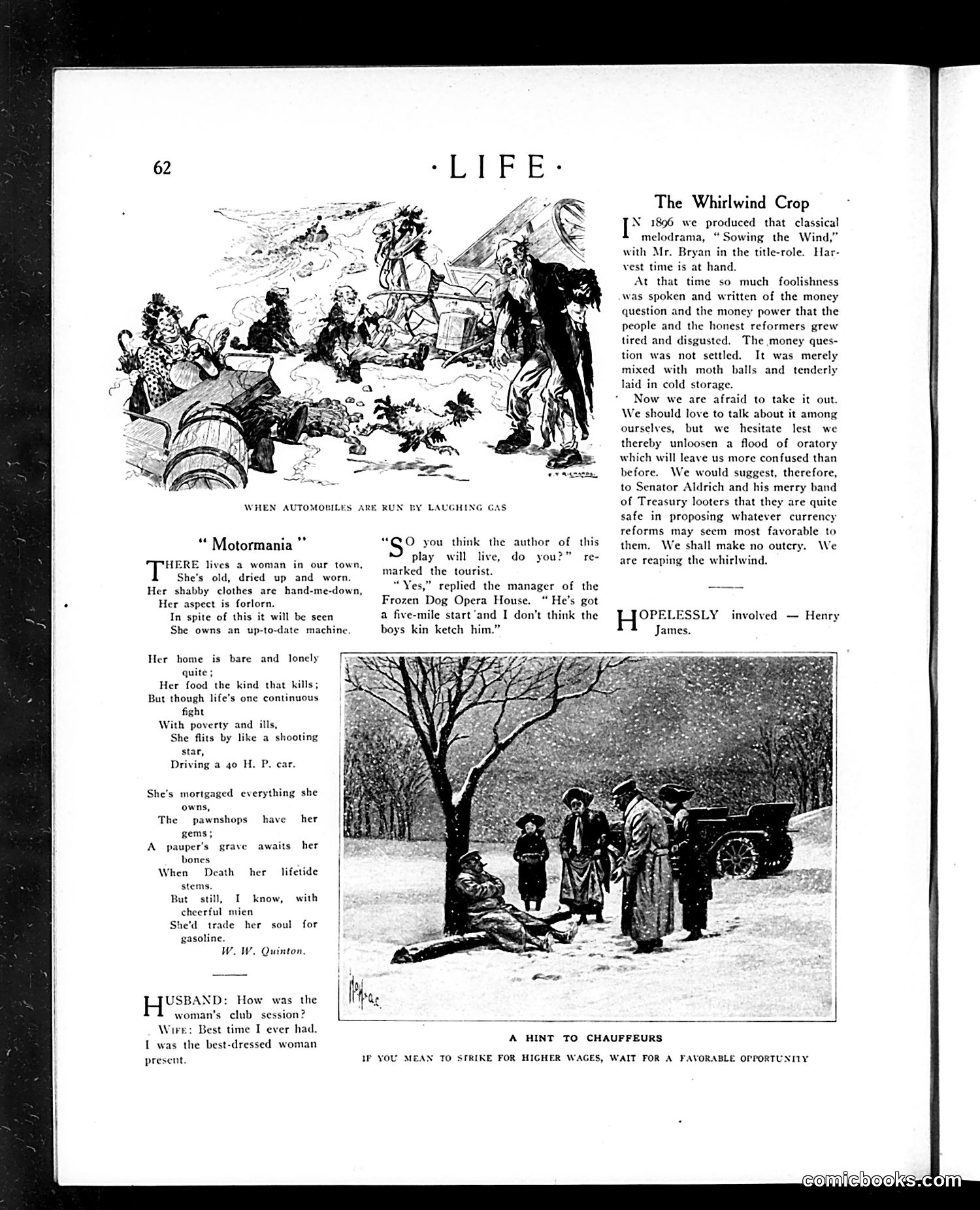
This page satirizes early 20th-century American consumerism and financial recklessness through multiple pieces: **"Motormania"** (poem): Mocks a poor woman who mortgages everything to own a 40-horsepower automobile—a luxury vehicle. She's shabby and impoverished but drives "like a shooting star." The satire targets how ordinary people sacrifice financial stability for status symbols and the automobile craze. **"The Whirlwind Crop"** (editorial): References William Jennings Bryan's 1896 presidential campaign ("Sowing the Wind") and the monetary debates it stirred. The piece criticizes how the money question was shelved rather than resolved, now resurfacing. It mocks Senator Aldrich's Treasury policies as self-serving, suggesting the public is too exhausted by past rhetoric to protest further—hence "reaping the whirlwind." **The cartoons** illustrate automobile absurdity: one shows cars run by "laughing gas"; another depicts a frozen-dog opera house manager confident a playwright will escape justice via a five-mile head start. **"Hint to Chauffeurs"**: Sarcastically advises drivers seeking wage increases to strike when convenient—implying conditions never will be favorable. The overall theme: blind consumerism and unresolved financial/political crises.
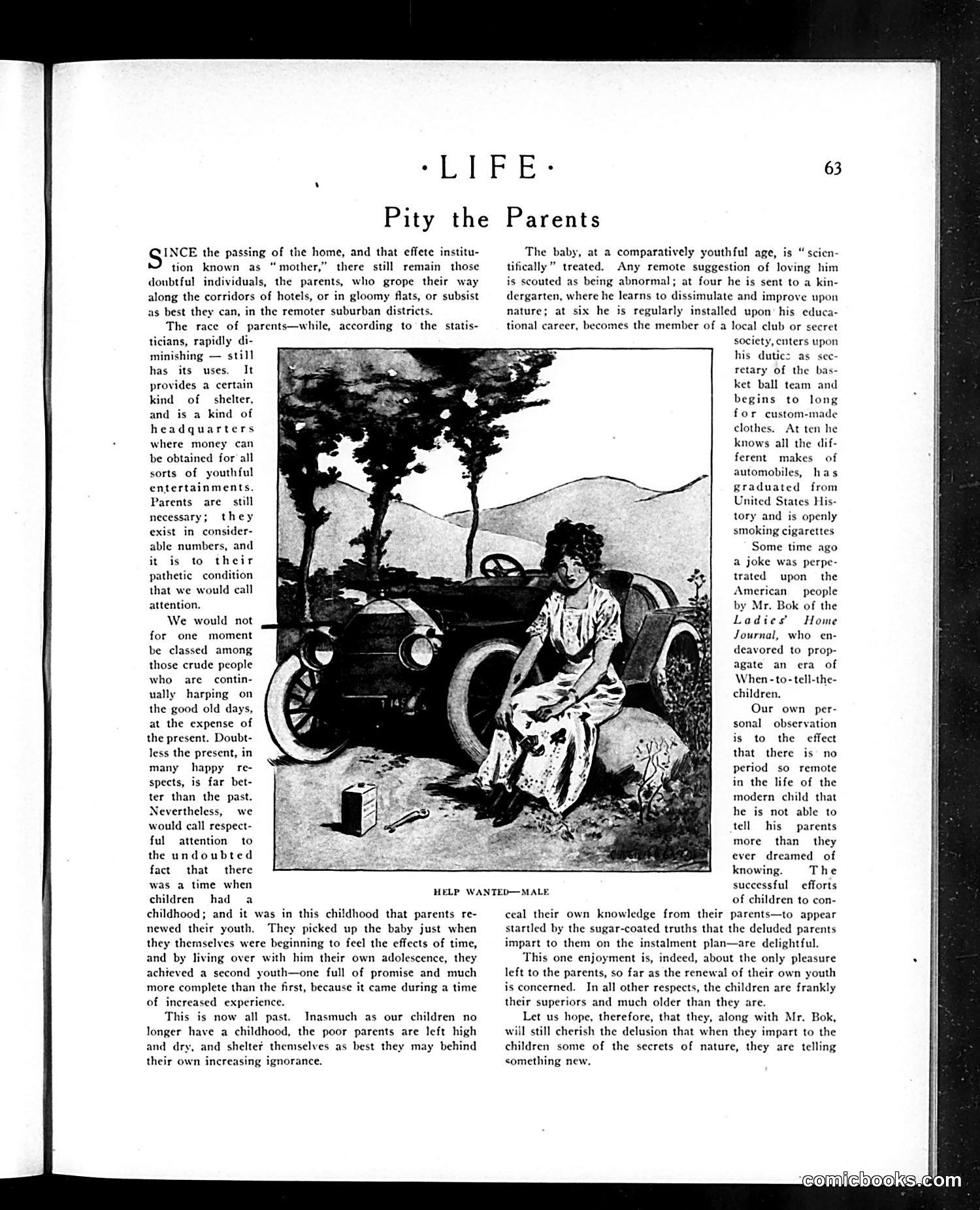
This article satirizes the decline of parental authority and relevance in modern American life. The accompanying illustration shows a parent (likely a mother) sitting beside an automobile—a symbol of modern youth culture and independence—emphasizing how outdated parents have become. The satire's targets: **The main complaint**: Children no longer have extended childhoods, so parents lose the vicarious youth-renewal that came from raising kids through their formative years. **Modern child-rearing**: Scientific, emotionally-detached parenting has replaced affectionate nurturing. Children are institutionalized early (kindergarten at four, clubs at six). **Children's precocity**: Ten-year-olds know car makes, smoke cigarettes, and understand adult topics—leaving parents ignorant and irrelevant. **The "When-to-tell-the-children" movement**: The article mocks Edward Bok's *Ladies' Home Journal* campaign promoting frank parent-child sex education, noting children already know everything and only pretend ignorance to amuse their bewildered parents. The joke: parents are now merely ATMs and shelter-providers, their only remaining pleasure being the delusion that they're teaching children anything new.
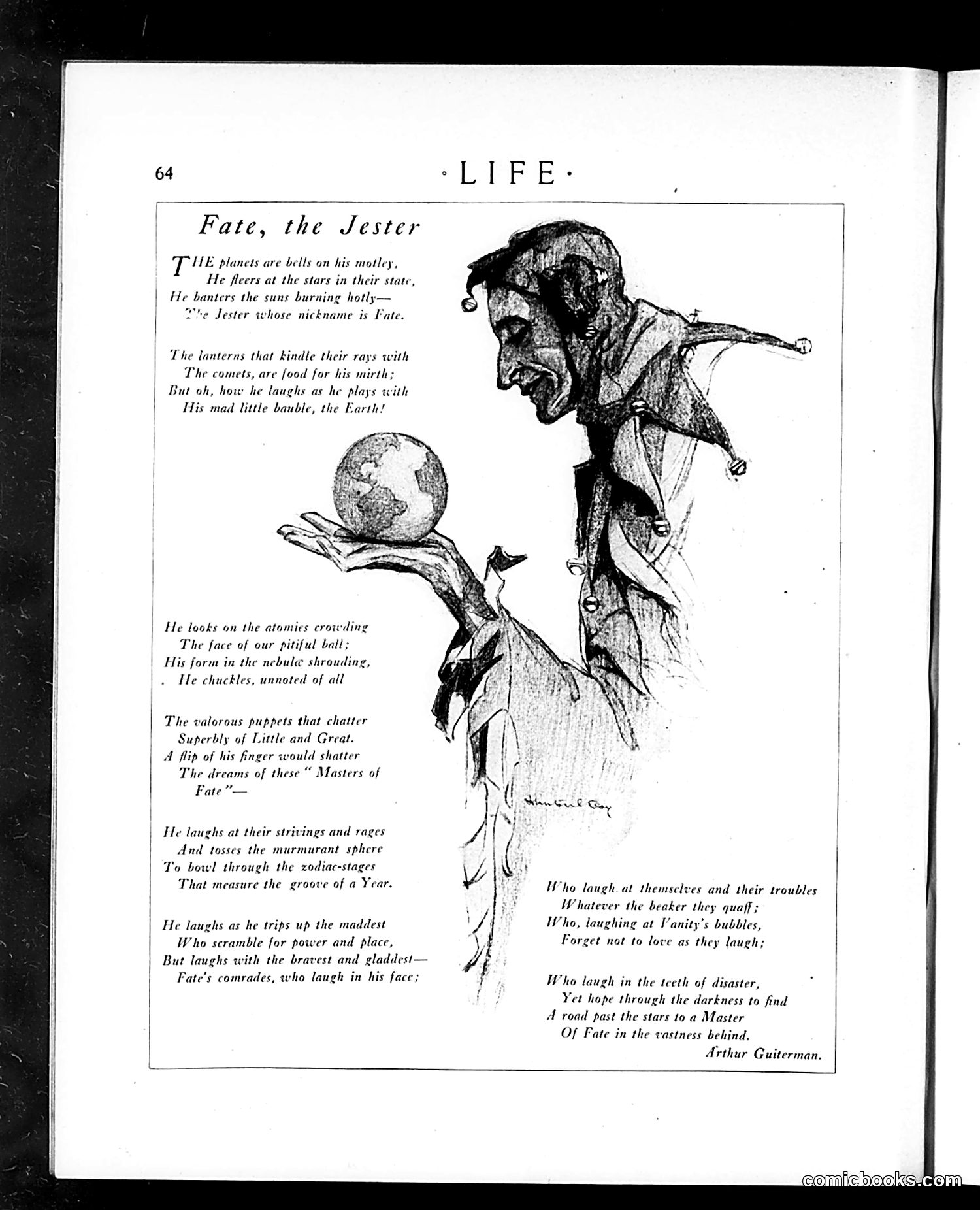
This poem by Arthur Guiterman presents Fate as a cosmic jester who toys with human affairs. The accompanying illustration shows a grotesque, grinning figure holding Earth like a bauble while cosmic elements surround him. The satire targets human pretension: those who consider themselves "Masters of Fate" are mere puppets to this all-powerful cosmic force. The poem mocks people who "scramble for power and place," whose ambitions Fate can shatter with a finger's flip. However, the poem offers redemption for those who laugh *with* Fate rather than against it—those with humility, courage, and compassion who recognize life's futility yet maintain hope and love. The final lines suggest spiritual transcendence: accepting Fate's supremacy may lead to discovering a greater Master beyond the material universe. The overall message: wisdom lies in humility and good humor about one's cosmic insignificance, not in struggling against inevitable forces.
This is a book review essay, not a political cartoon. The "maiden aunt" is a metaphorical figure representing literary critics who judge books moralistically, like disapproving family elders. The essay uses Theodore Dreiser as its central example. Ten years prior, critics (the "aunts") condemned his novel *Sister Carrie* as scandalous—featuring "disreputable" content and disrespectful language toward authority. Dreiser responded by withdrawing from public life ("ran away to sea"). Now, reviewing his new novel *Jennie Gerhardt*, the critic reflects that those earlier judgments were premature and self-righteous. Dreiser has matured beyond "adolescent rancor," proving the aunts wrong. The satire targets critical smugness: how literary arbiters mistake youthful rebellion for moral corruption, only to be humbled by an author's later success and artistic growth.
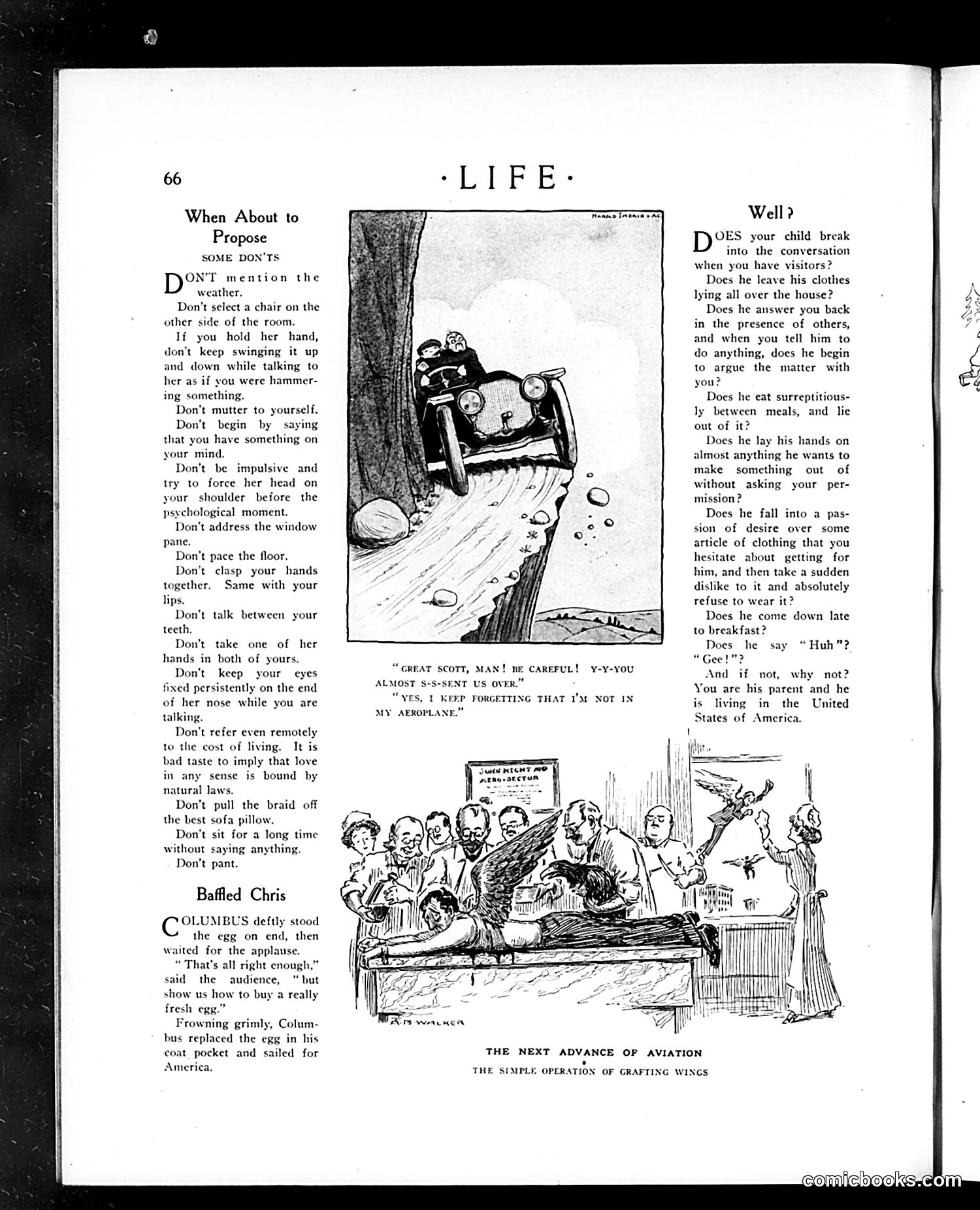
This page from *Life* magazine contains satirical advice columns and cartoons: **"When About to Propose"** offers humorous "don'ts" for men planning marriage proposals—advice against nervous habits (pacing, hand-wringing, staring at her nose) and tactless comments (mentioning weather or cost of living). The satire mocks both male awkwardness and the era's rigid courtship conventions. **"Baffled Chris"** is a clever wordplay piece. Columbus famously stood an egg on end; when asked to prove it's "fresh," he gives up and sails to America instead. The joke satirizes how some accomplishments seem impressive until questioned for practical value. **"Well?"** uses ironic questions about misbehaving children, culminating in the punchline: if your child *doesn't* misbehave this way, "why not? You are his parent and he is living in the United States of America." This mocks American parenting permissiveness and the notion that American children are naturally undisciplined. **"The Next Advance of Aviation"** shows a surgeon grafting bird wings onto a patient—absurdist humor about aviation's rapid development, suggesting increasingly ridiculous "solutions."
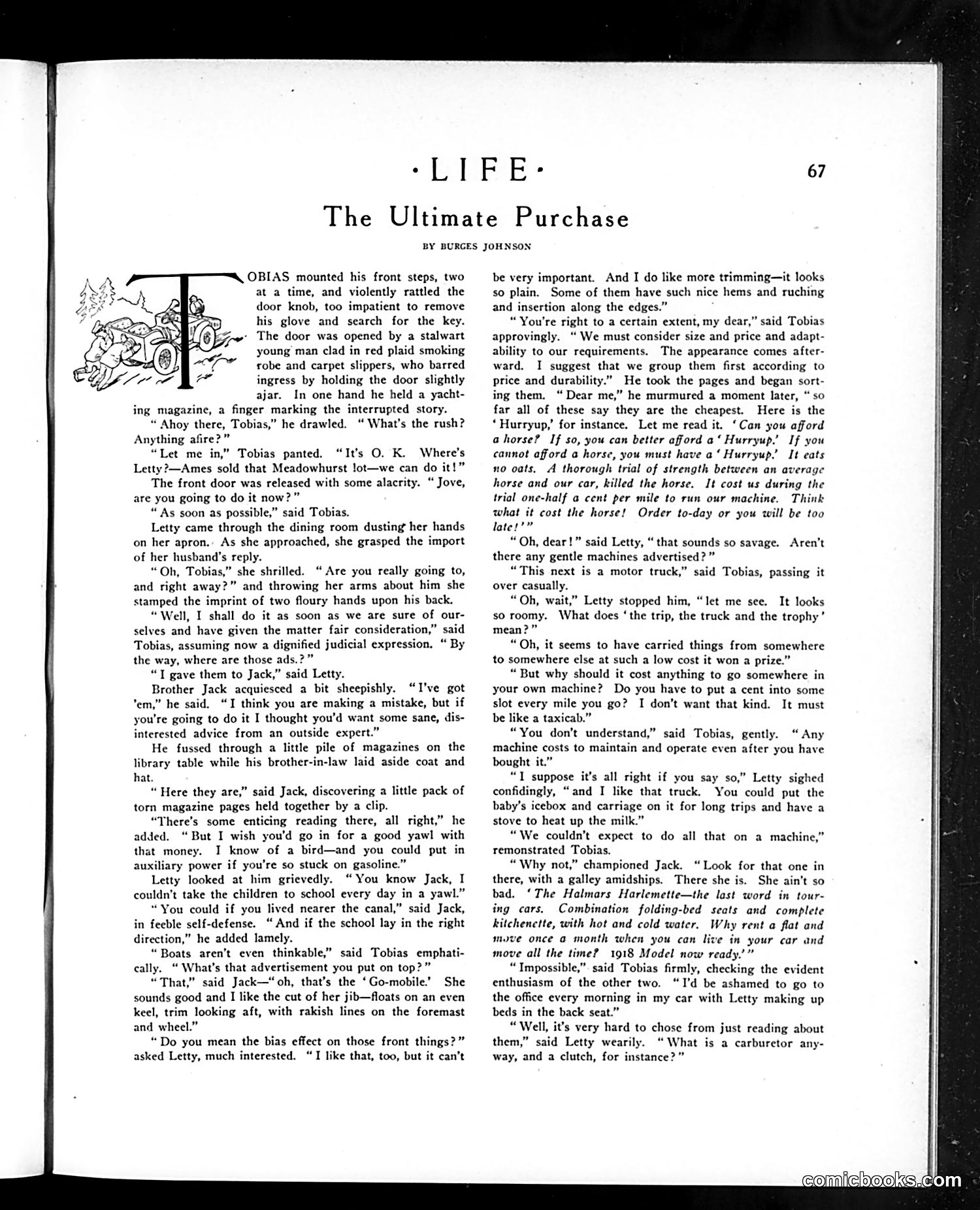
This story satirizes early automobile advertising and consumer decision-making circa 1910s. Tobias and his wife Letty decide to purchase a car after their neighbor Ames sells his property. Brother Jack helpfully provides magazine advertisements for various automobiles. The satire targets absurd car advertisements of the era—particularly one called the "Hurryup," which uses laughable logic: claiming the car is affordable because it costs less than maintaining a horse (even boasting that a car "killed" a horse in a durability test). The humor lies in how seriously Tobias approaches the decision with "dignified judicial expression" while Letty focuses on cosmetic details ("hems and ruching"), and how the ridiculous ads employ exaggerated comparative claims to sell vehicles to middle-class families. The cartoon illustration shows Tobias rushing home excitedly, capturing the era's new consumer enthusiasm for automobiles as status symbols.
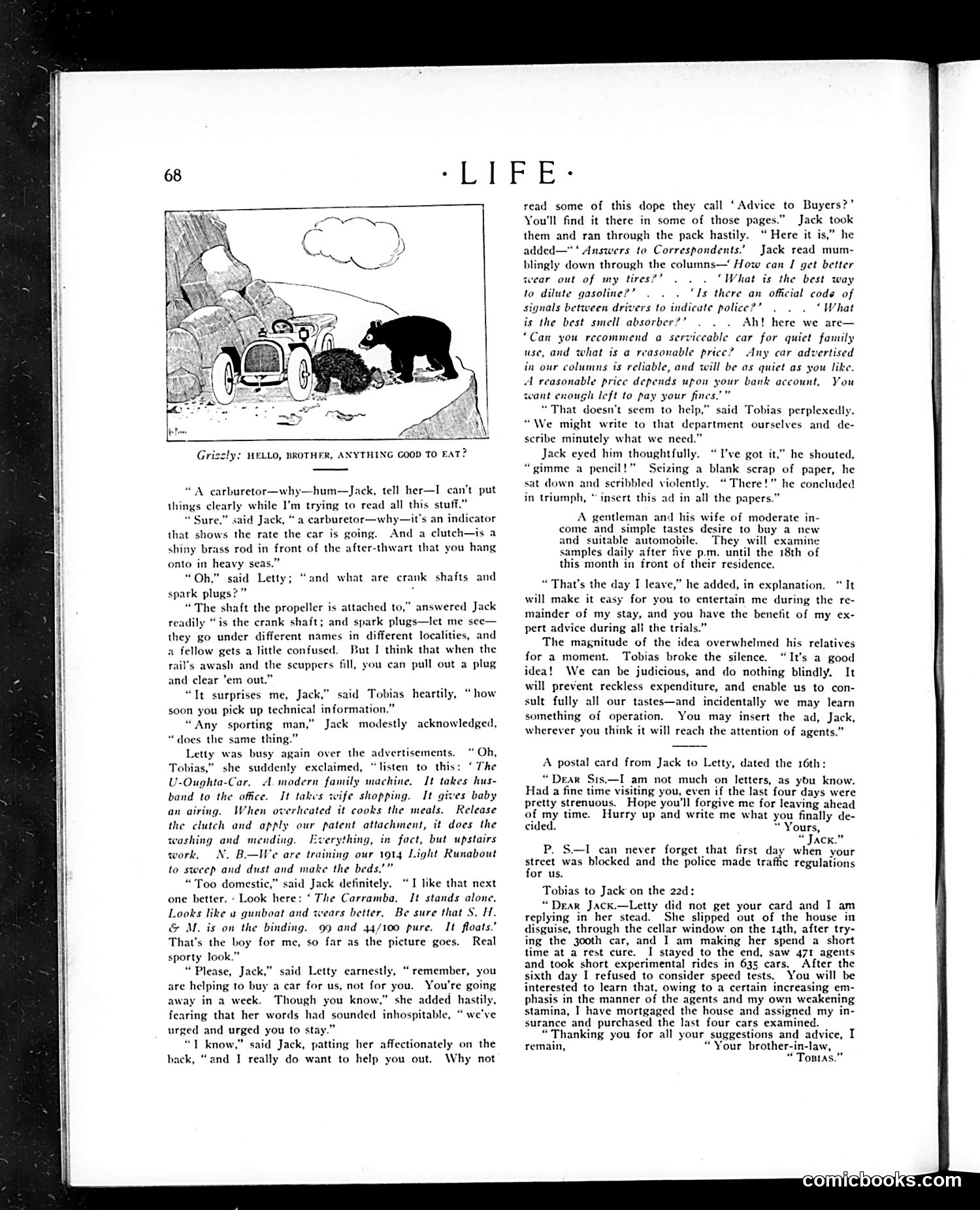
This cartoon satirizes the absurdity of early automobile advertising. A bear encounters a car, humorously asking if there's anything "good to eat"—suggesting the machine itself might be consumable or that early cars were so newfangled they seemed like alien objects. The accompanying text mocks automobile ads of the 1910s era by depicting characters hilariously misunderstanding or inventing fake technical specifications. Jack confidently but incorrectly explains car parts using nautical terminology (calling a clutch a "brass rod" from ships), and Letty reads parody ads for ridiculous vehicles like the "U-Oughta-Car" (a pun on "ought-to") that supposedly cooks, cleans, and does laundry. The satire targets both the confusing jargon manufacturers used and consumers' gullibility when buying these new, poorly-understood machines. It's a gentle mockery of the automobile boom and the misleading advertisements that accompanied it during the early automotive age.
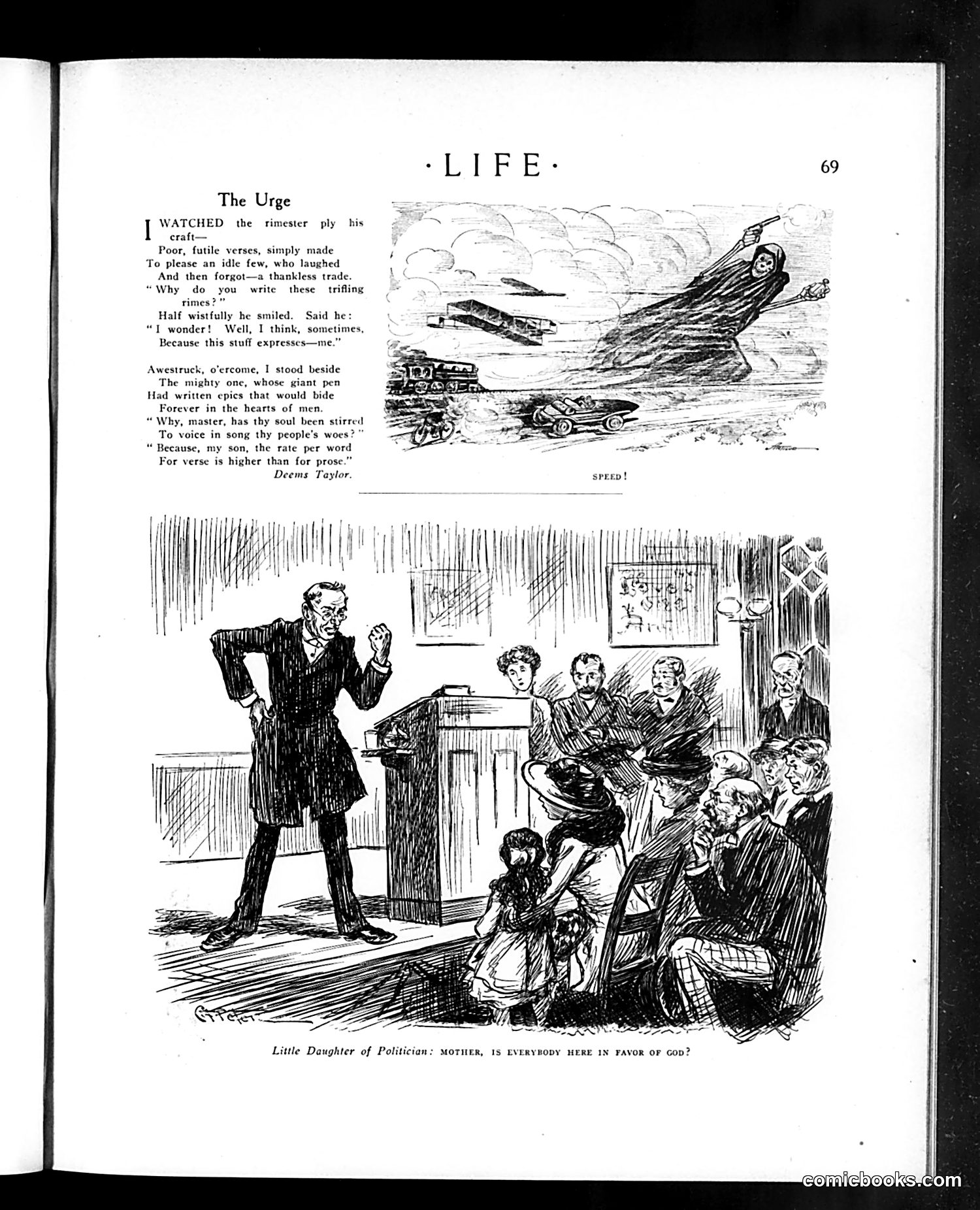
The page contains two satirical pieces by Deems Taylor: **Top cartoon ("Speed!")** depicts various vehicles racing—likely mocking the era's obsession with speed and modern transportation competition. **Bottom cartoon ("Little Daughter of Politician")** shows a young girl asking her mother if "everybody here in favor of God?" at what appears to be a political gathering. The satire targets politicians' opportunistic invocation of religious sentiment for political gain. The "little daughter" naively exposes the hypocrisy: politicians publicly perform piety and moral virtue while their actual motivations are partisan and self-interested. This reflects early 20th-century skepticism about politicians' cynical exploitation of religious language for electoral advantage. The accompanying poem contrasts a struggling poet motivated by artistic expression versus an acclaimed author cynically motivated by payment rates—similarly exposing gap between public claims and private incentives.
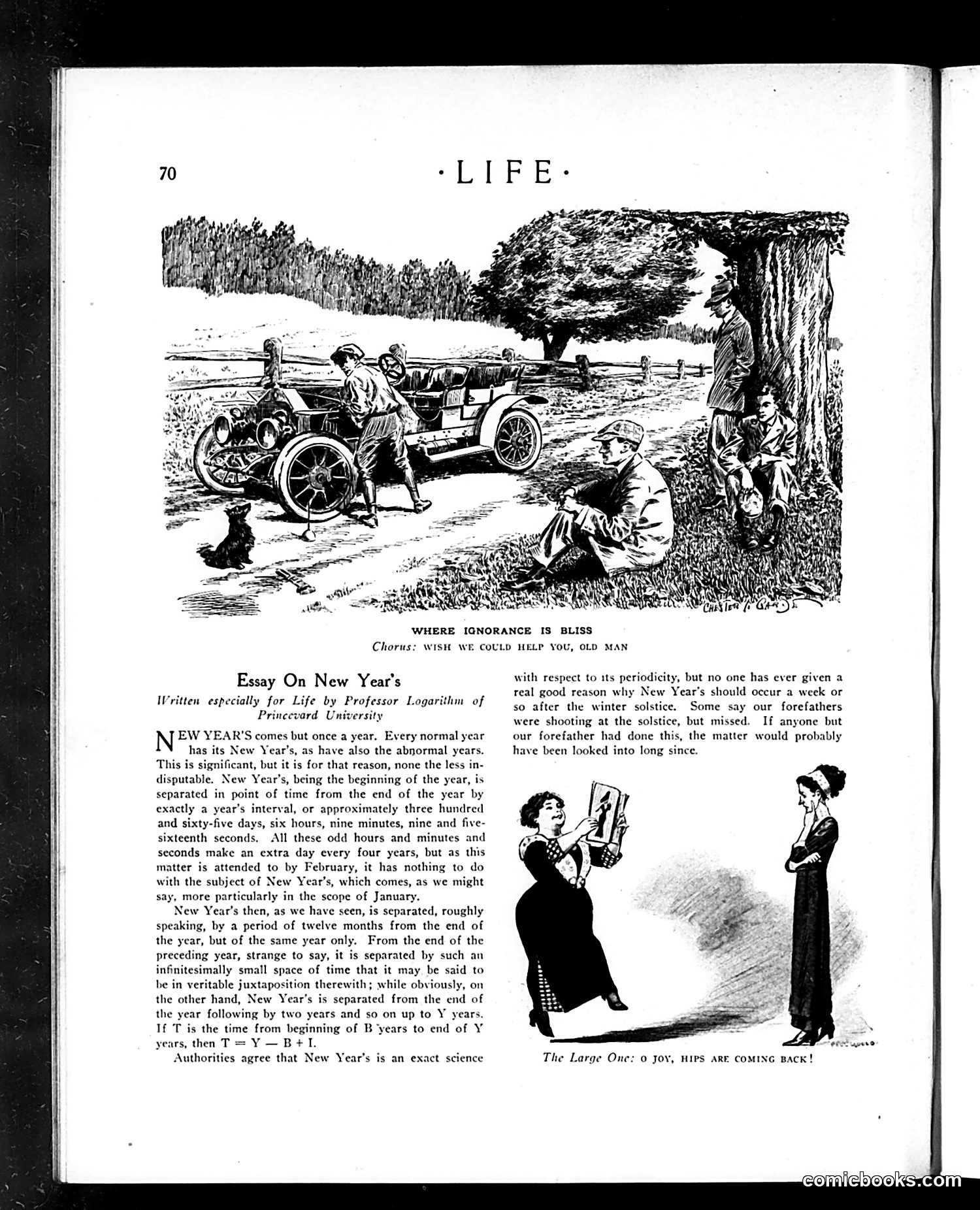
This page contains **two distinct satirical pieces**: **Top cartoon ("Where Ignorance Is Bliss"):** Shows rural figures observing wealthy tourists in an automobile—early-1900s technology symbolizing modernity and urban sophistication. The title suggests the rural characters' contentment in their ignorance of city life, satirizing the cultural gap between rural and urban America during the automobile age. **Main essay:** A mock-academic parody by fictional "Professor Logarithm," deliberately over-complicating New Year's with pseudo-scientific mathematical formulas and circular reasoning. The absurd logic (explaining why New Year's occurs when it does by blaming ancestors' poor marksmanship at the winter solstice) mocks pretentious academic writing and the human tendency to rationalize arbitrary traditions. **Bottom cartoon:** A woman exclaiming about hips "coming back" as a fashion trend—likely satirizing women's fashion cycles and vanity. The page's humor targets intellectual pretension, rural-urban class divisions, and fashion obsession.
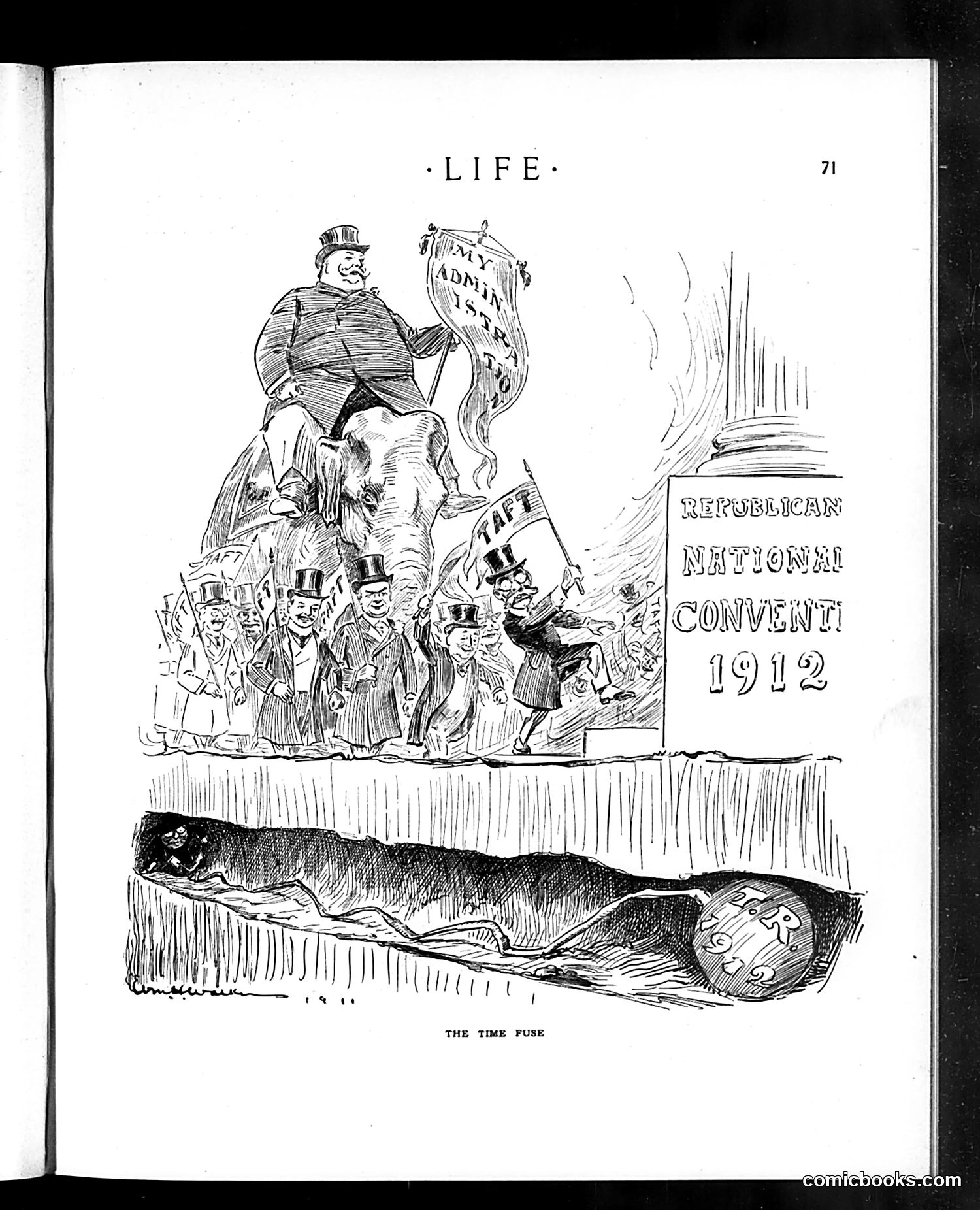
This political cartoon satirizes the Republican National Convention of 1912. An elephant (the Republican mascot) sits atop a platform where party leaders stand holding a banner reading "My Admission 1854." Below ground, a lit fuse burns toward a bomb labeled "1912," suggesting the convention is a powder keg about to explode. The cartoon likely references the bitter Republican Party split of 1912, when President Theodore Roosevelt challenged incumbent William Howard Taft for the nomination. This internal conflict would fracture the party, with Roosevelt forming the Progressive "Bull Moose" Party and splitting the Republican vote, ultimately helping Democrat Woodrow Wilson win the presidency. The "time fuse" represents the impending political disaster threatening Republican unity.
This is a satirical short story (not a cartoon) about George, a perpetually unemployed young man living with his parents. The humor lies in George's character: he's handsome and articulate but chronically jobless, always blaming employers for "conspiracies" against him rather than accepting responsibility. The "Vesuvius" metaphor refers to George's mother—a domineering woman who erupts in rage whenever her husband gently criticizes their son. Mr. Landstand, the father, has learned to suppress all honest opinion to avoid her volcanic temperament. The satire targets a recognizable social type: the privileged, delusional young man who mistakes sensitivity and self-regard for intelligence, expecting the world to accommodate his inflated sense of worth. His engagement announcement triggers the family drama that unfolds across the page, with his mother's irrational protectiveness portrayed as both comic and pathetic.
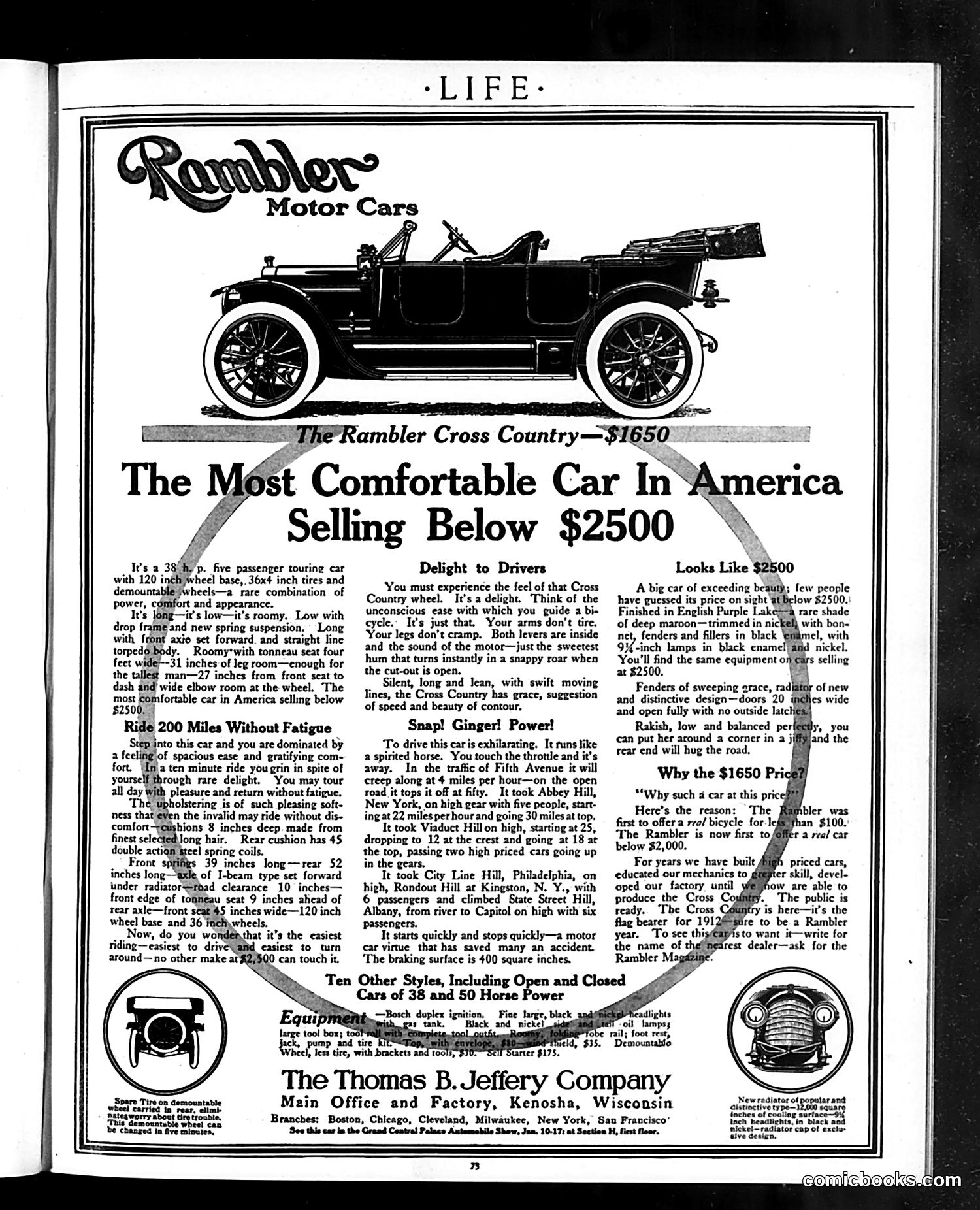
This is a **full-page automobile advertisement**, not political satire. It promotes the Rambler Cross Country, priced at $1,650, marketed as "The Most Comfortable Car In America Selling Below $2500." The ad emphasizes practical features: spacious seating (39-52 inches), deep cushioning (45 spring coils), excellent suspension for a 200-mile ride "without fatigue," and responsive steering. Performance claims include hill-climbing ability and speeds up to 50 mph. The rhetorical strategy positions the car as a luxury value—it "looks like" cars costing $2,500 but costs significantly less. The Jeffery Company (Kenosha, Wisconsin) targets middle-class buyers seeking comfort and reliability. Technical specifications and customer testimonials about climbing famous hills (Abbey Hill, Viaduct Hill) establish credibility. This reflects early 1900s automotive marketing when cars were expensive novelties; advertising emphasized engineering details and endurance rather than styling or speed alone.
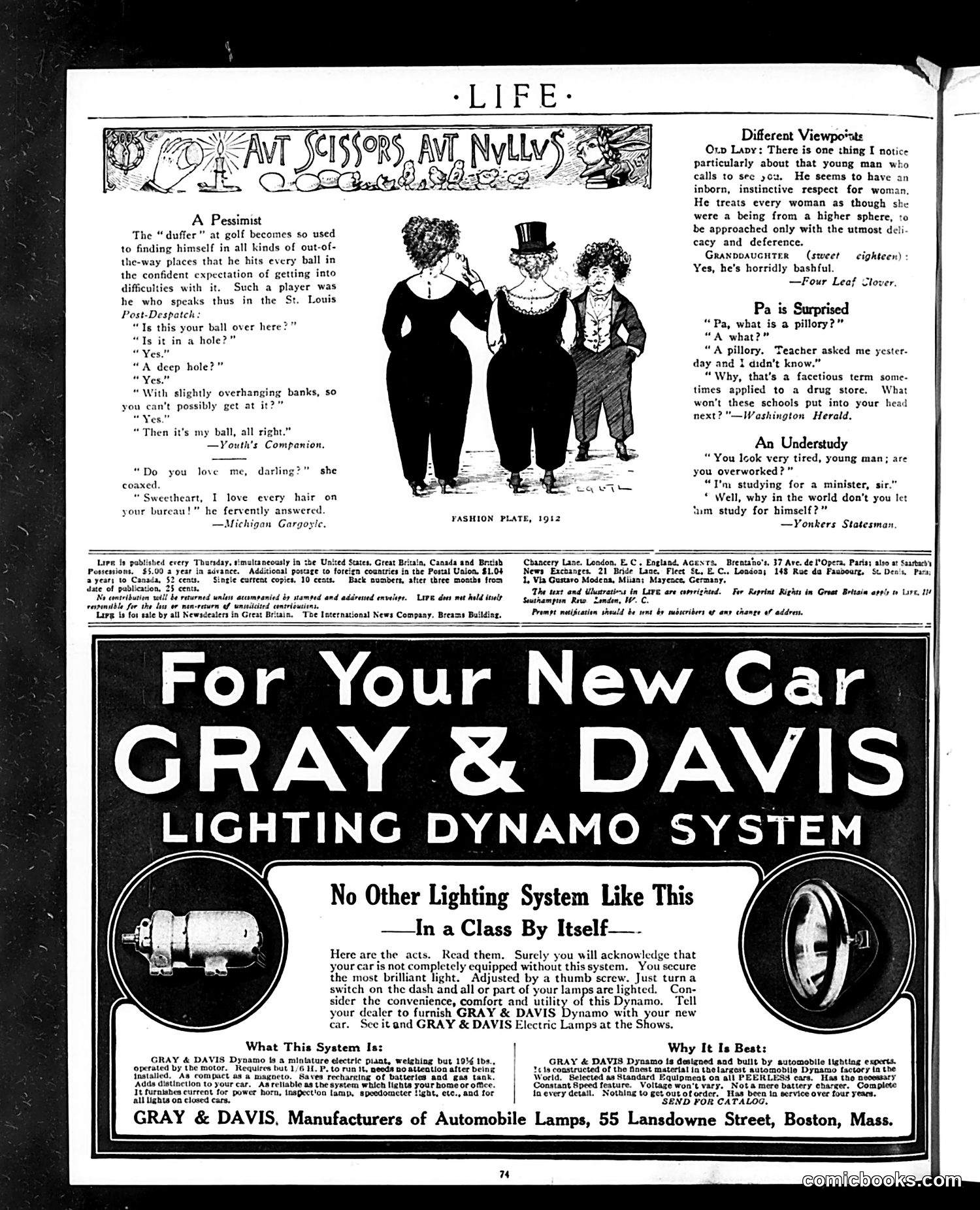
This page contains **humorous short jokes and anecdotes** rather than political cartoons. The content reflects early 20th-century American humor: **Jokes featured:** - "A Pessimist": A golfer so accustomed to landing in difficult spots that he assumes any ball must be his - Romantic exchanges and misunderstandings between couples - Generational humor (grandfather/granddaughter about a "pillory"; father/son about studying for ministry) **Fashion Plate illustration (1912):** Shows three women in period dress, likely satirizing contemporary fashion or social attitudes toward women. The **dominant content is advertising**: A Gray & Davis automobile lighting system dominates the lower half, promoting electric dynamos as modern car equipment. **Context for modern readers:** This reflects a pre-WWI American magazine mixing genteel social satire with emerging consumer advertising. The humor relies on wordplay, romantic mishaps, and generational gaps—typical entertainment for the era's middle-class readership.
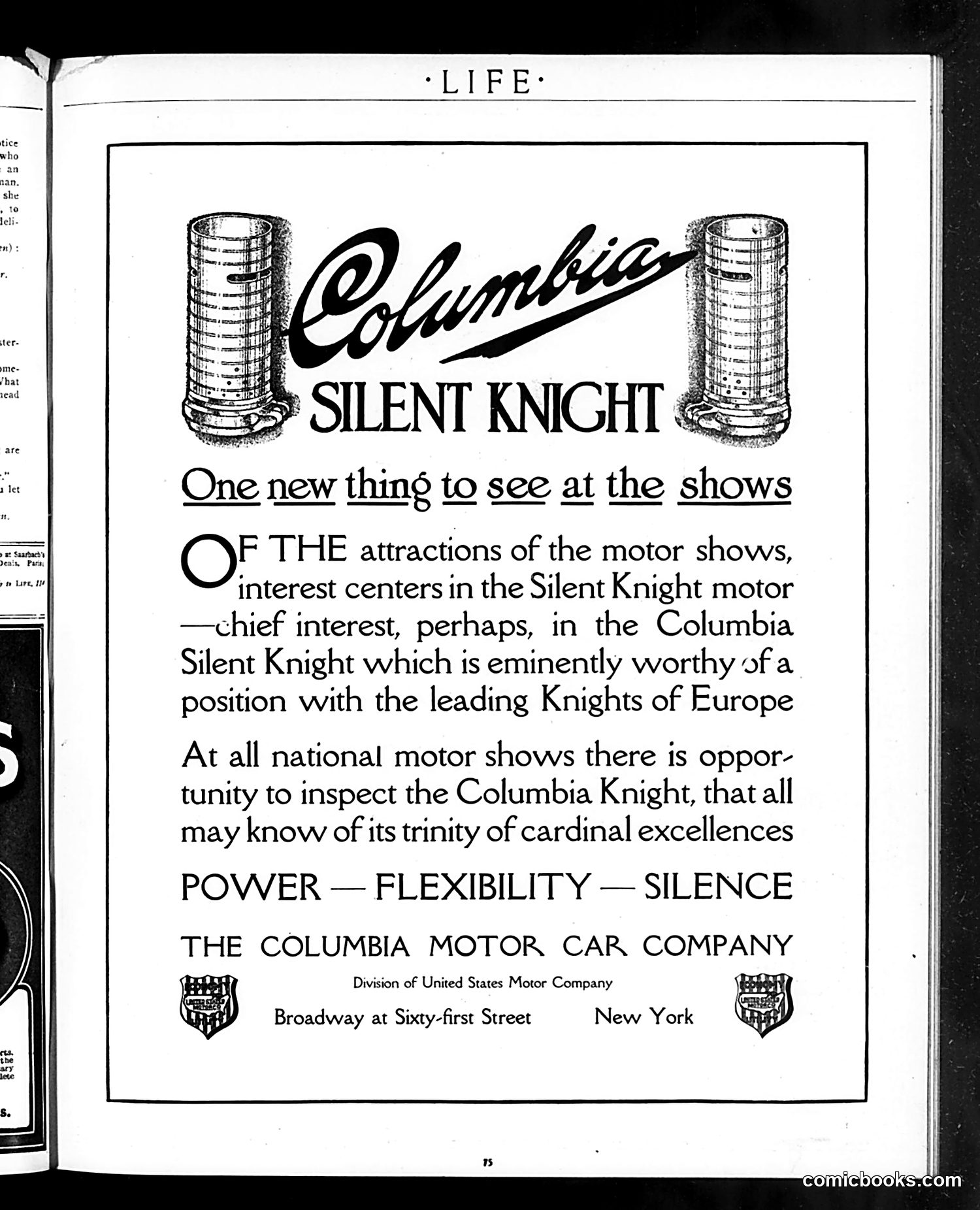
This is **a full-page advertisement**, not satire or editorial content. It promotes the Columbia Silent Knight automobile, manufactured by the Columbia Motor Car Company (a division of United States Motor Company), located in New York. The ad uses the word "Knight" as a product name, playing on medieval imagery with ornamental shield emblems. The "Silent Knight" refers to the car's engine technology—specifically its quiet operation, a selling point for early automobiles. The three "cardinal excellences" advertised are **Power, Flexibility, and Silence**. For a modern reader: early cars were notoriously loud and unreliable; emphasizing silence was a genuine marketing advantage, signaling advanced engineering. The reference to "leading Knights of Europe" simply means comparable European luxury automobiles—not political satire. This appears to be circa 1910s-1920s based on typography and the United States Motor Company's operational period.
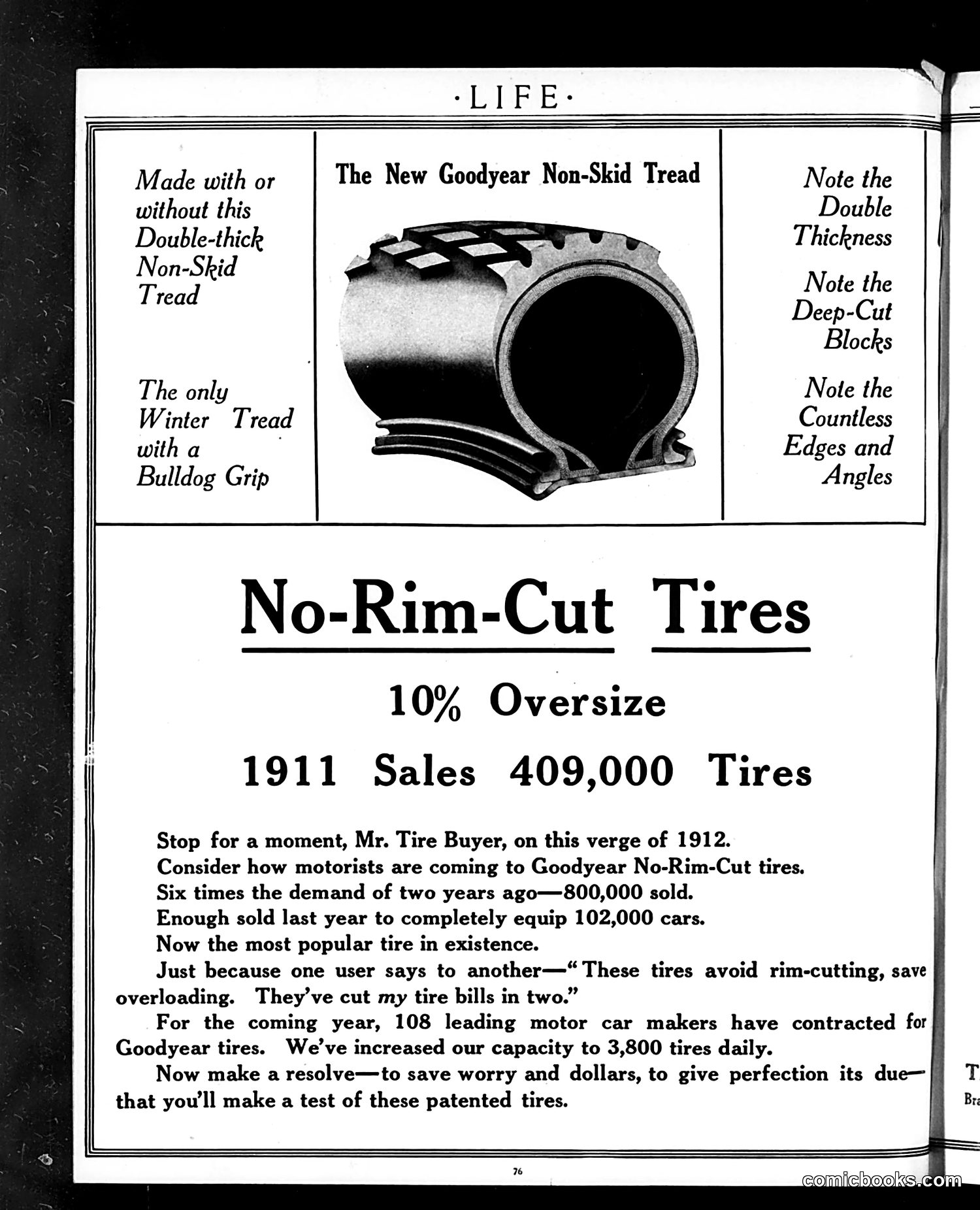
This is a **Goodyear tire advertisement** from Life magazine, circa 1911-1912. It's not satirical content but rather corporate marketing. The page promotes Goodyear's "No-Rim-Cut" tire, a patented innovation featuring a double-thick, non-skid tread designed to prevent the common problem of rims being damaged by tire wear—a significant issue for early motorists. The ad emphasizes rapid market adoption: 409,000 tires sold in 1911, with demand stated as six times that of two years prior. It notes that 108 major automobile manufacturers contracted to use Goodyear tires, and the company increased daily production to 3,800 units. The appeal targets practical motorist concerns: the tire saves money on replacements and reduces maintenance worries. The "Bulldog Grip" reference suggests superior winter traction—important for pre-1912 vehicles lacking modern safety features. This represents early automotive advertising during the rapid motorization of America.
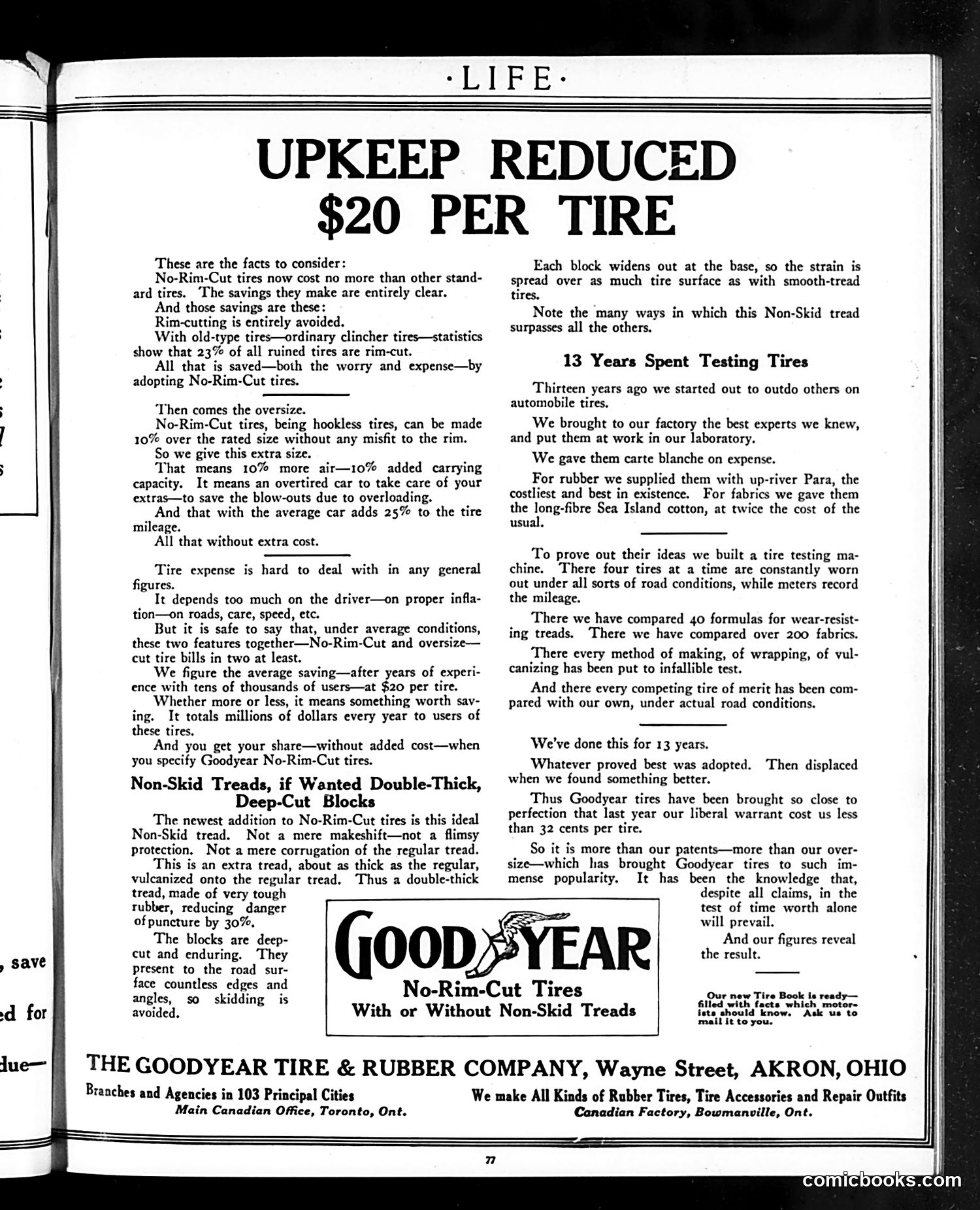
This is primarily **a full-page advertisement** for Goodyear tires, not a political cartoon or satire. It contains no caricatures or satirical figures. The ad promotes Goodyear's "No-Rim-Cut" tires, claiming $20 savings per tire through two innovations: (1) avoiding rim damage common in conventional tires (23% failure rate), and (2) offering 10% larger sizing for extra capacity and mileage without additional cost. The secondary feature highlights optional "Non-Skid Treads"—extra-thick, deep-cut rubber vulcanized onto regular treads for improved traction. The ad emphasizes Goodyear's credibility through 13 years of tire-testing research, comparing 40 formulas and 200+ fabrics. It positions the company's success not just on patents and oversizing, but on rigorous testing proving durability. This reflects early automotive-era marketing: emphasizing technical superiority and safety improvements as selling points to consumers increasingly concerned with car maintenance costs.
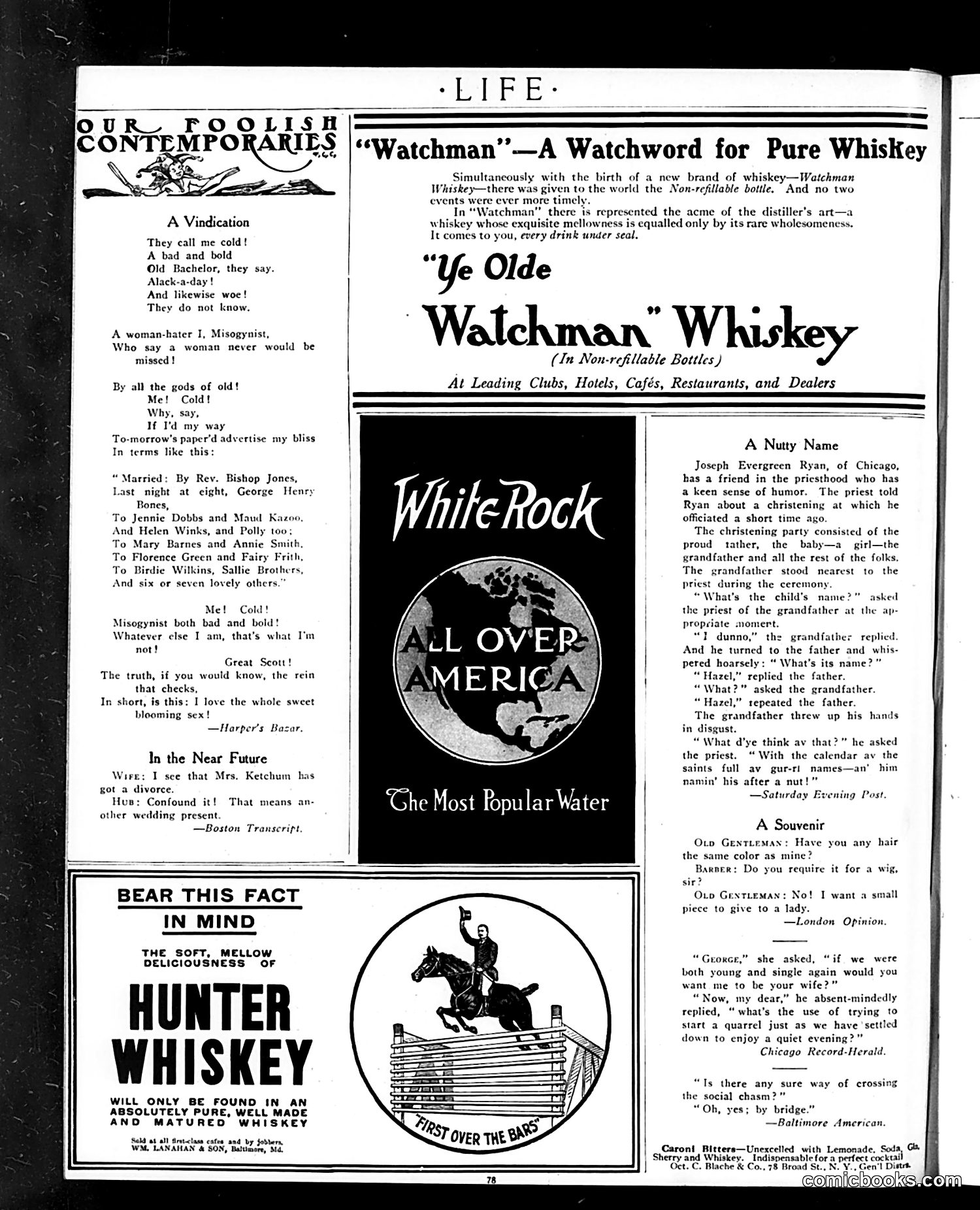
This page is primarily **advertising and humor content** rather than political satire. The left column features humorous poetry titled "Our Foolish Contemporaries" — a bachelor defensively denying he's cold and misogynistic while fantasizing about marrying multiple women simultaneously. It's light social satire about marriage customs. The center features two whiskey advertisements: "Ye Olde Watchman" whiskey (emphasizing purity and non-refillable bottles) and "Hunter Whiskey" (stressing mellowness and quality). The "White Rock" water ad shows a globe with "First Over the Bars" imagery. The right column contains brief humorous anecdotes about everyday life: a priest's christening mix-up, a barber's witty response about hair color, and marital banter. These gentle jokes reflect early 20th-century domestic humor. **Context for modern readers:** This reflects pre-Prohibition advertising celebrating alcohol openly, and period attitudes toward bachelorhood and marriage as comedic subjects.
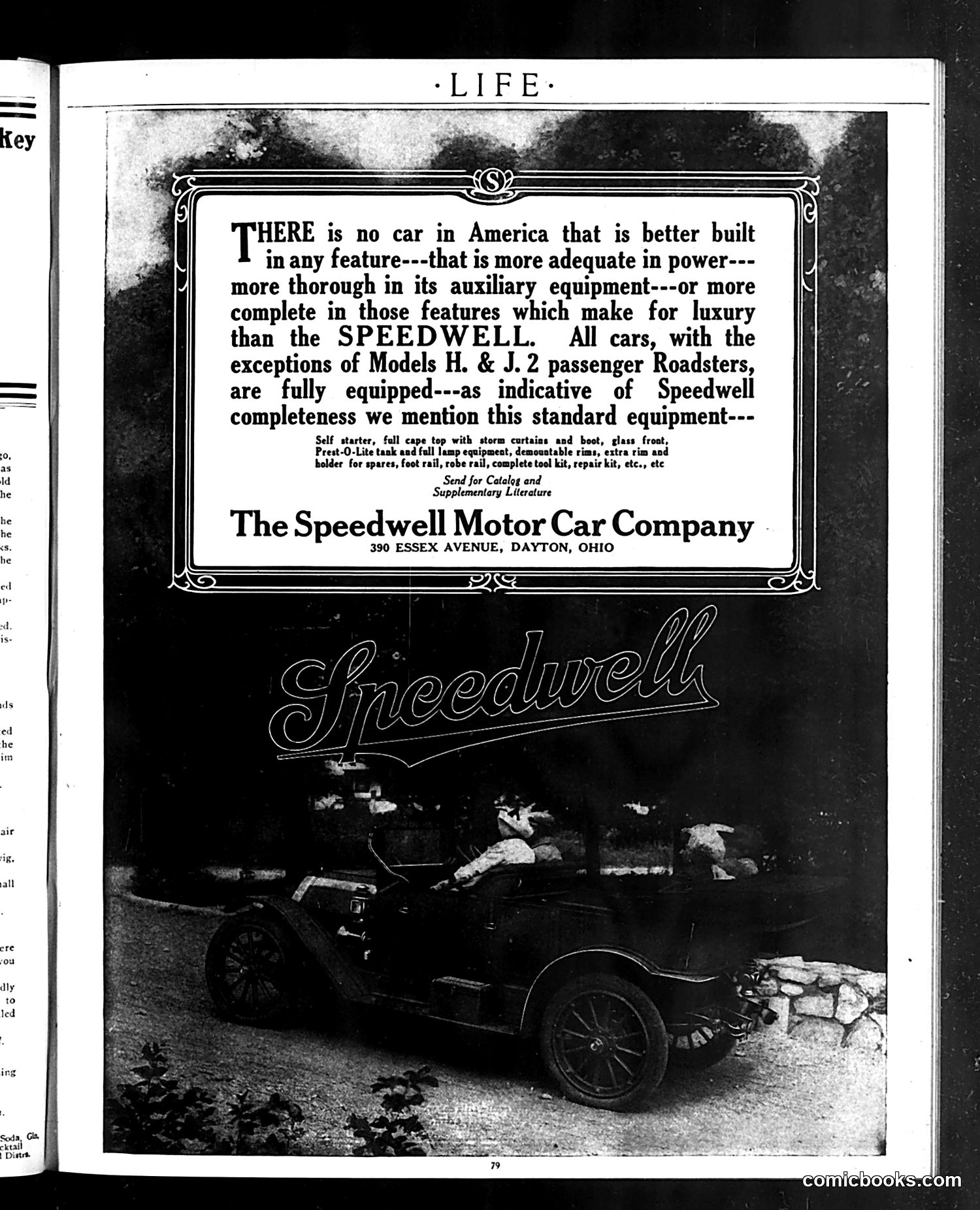
This page is primarily **advertising, not satire or political commentary**. It's a full-page advertisement for the Speedwell Motor Car Company of Dayton, Ohio, appearing in Life magazine. The ad makes aggressive competitive claims: that no American car is "better built" in power, equipment, or luxury features. It lists standard amenities (self-starter, lamp equipment, demountable rims, tool kit, etc.) as evidence of thoroughness—details that would have impressed early 1900s car buyers as luxurious. The photograph shows an open-air touring car with passengers, typical marketing imagery of the era meant to suggest lifestyle and leisure. **Historical context for modern readers**: This represents the era when numerous American automobile manufacturers competed intensely, before consolidation left only a few major producers. Speedwell's emphatic claims reflect this competitive market.
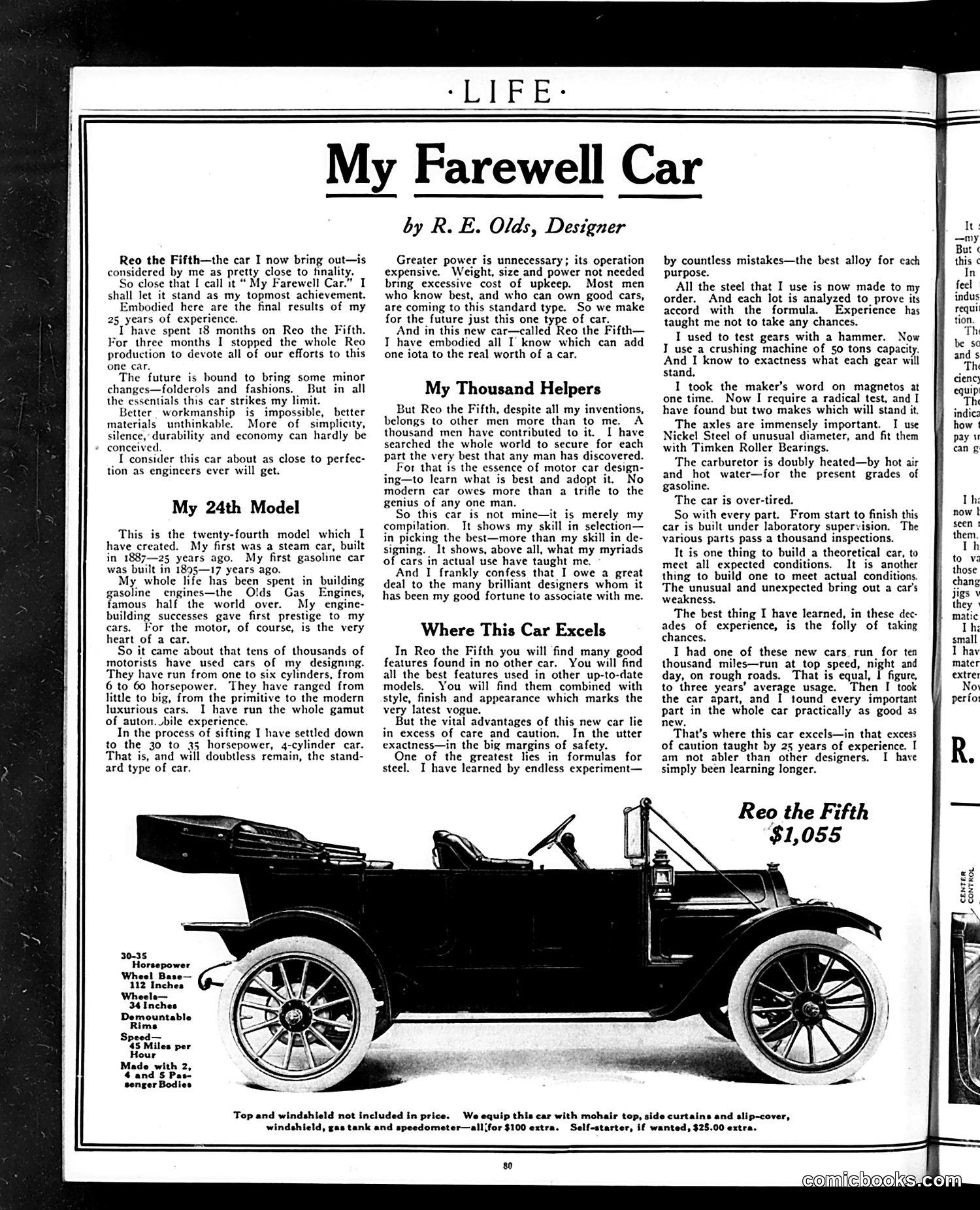
This is not a cartoon or satire, but a **product advertisement** disguised as editorial content in *Life* magazine. R.E. Olds, founder of the Reo automobile company, presents the "Reo the Fifth" ($1,055) as his final masterwork after 25 years in the industry. The appeal is to *authority and nostalgia*: Olds claims the 30-35 horsepower, four-cylinder car represents the perfected "standard type" that sensible buyers prefer. He credits "a thousand helpers" rather than his own genius—a rhetorical move emphasizing collaborative refinement over individual innovation. For modern readers: this reflects early automotive marketing's emphasis on *engineering credentials* and *permanence* rather than style or speed. The "farewell" framing suggests finality—this is as good as cars will get—a claim that would prove laughably wrong within years as technology rapidly evolved.
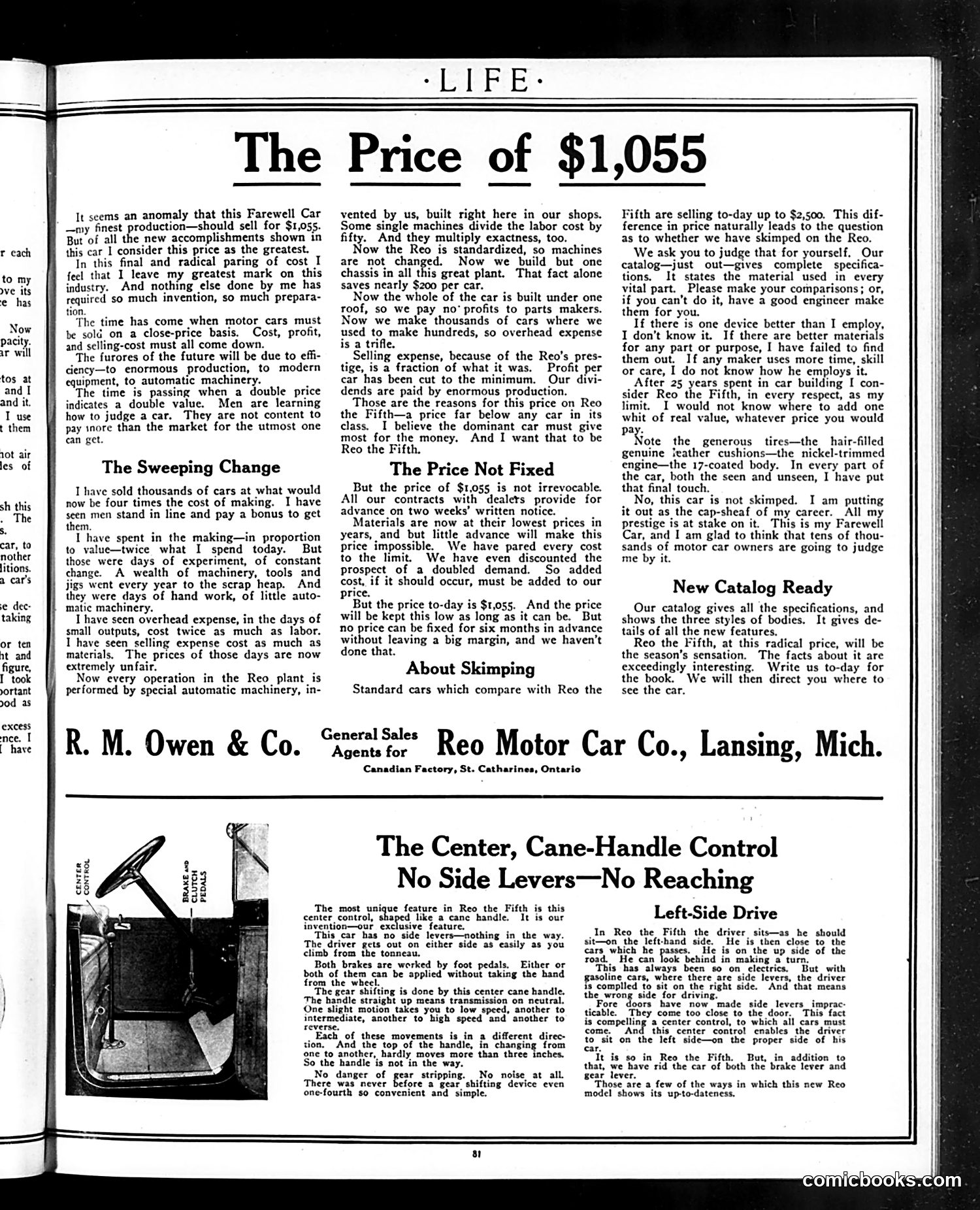
This is **not a cartoon or satirical content**—it's a straightforward advertisement for the Reo Motor Car Company's "Reo the Fifth" automobile, priced at $1,055. The page features an extended sales pitch, apparently written by R.M. Owen (the manufacturer), defending the surprisingly low price point. Owen argues that modern manufacturing innovations—automatic machinery, standardized parts, consolidated production under one roof, and elimination of hand labor—allow him to sell at this price while maintaining quality. The defensive tone ("We ask you to judge that for yourself") suggests contemporary skepticism that such a low price didn't mean cutting corners. Owen also acknowledges price volatility due to material costs, warning the $1,055 price isn't permanently fixed. Below the main text is technical information about the car's distinctive "cane-handle" steering control and left-side drive positioning. This is product advertising, not satire.
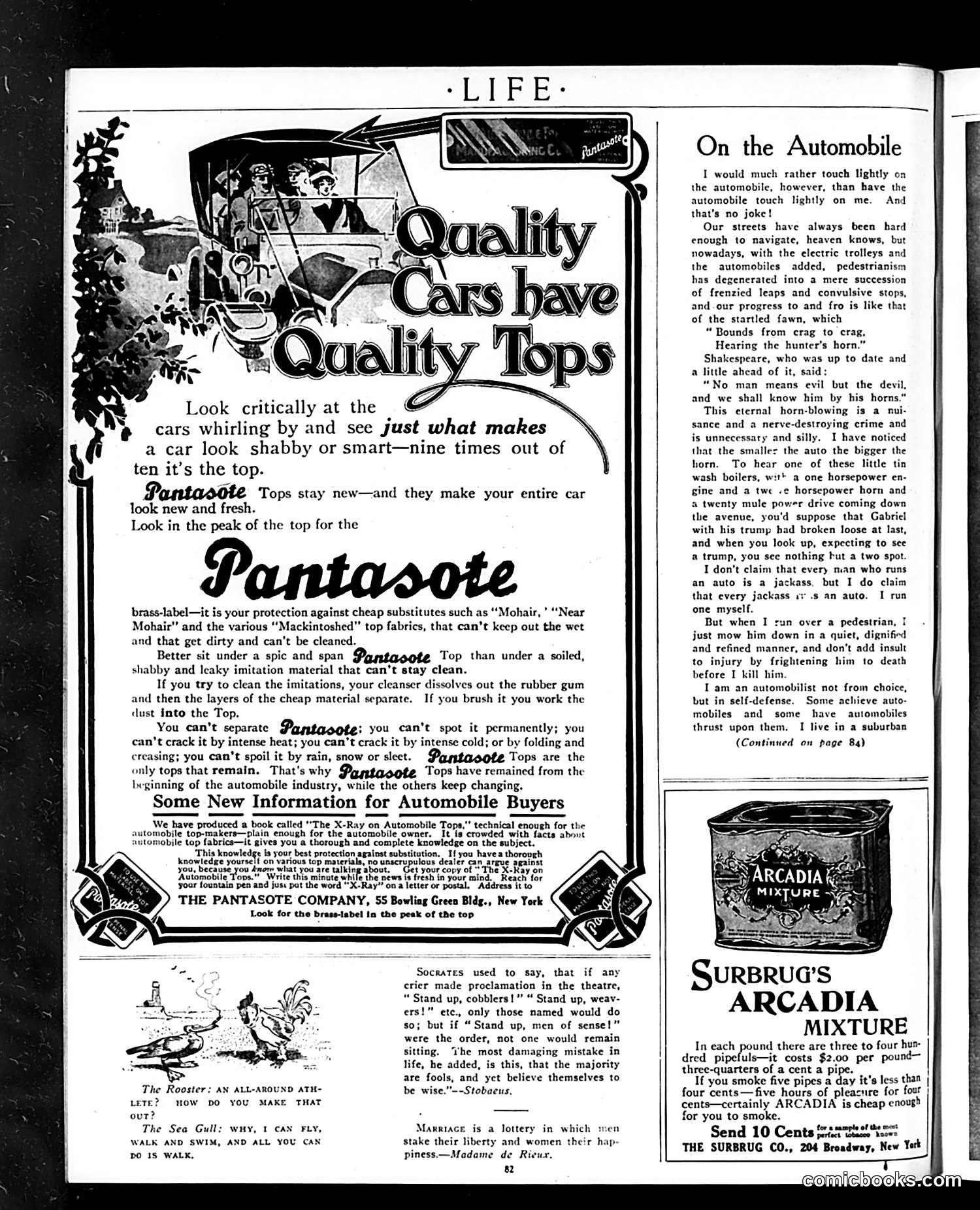
This page combines **automobile advertising** with **editorial commentary and humor**. The main advertisement promotes **Pantasote car tops**, emphasizing their durability and quality compared to cheap imitations ("Mohair," "Mackintoshed" fabrics). The pitch targets consumers concerned about maintaining their vehicle's appearance—nine times out of ten, a shabby car looks shabby because of its top. The editorial section "On the Automobile" expresses **satirical frustration with early automobile culture**: pedestrians must navigate dangerous streets while dodging cars and trolleys in "frenzied leaps." The author mocks automobiles' constant horn-blowing, noting the irony that smaller cars have louder horns—a humorous exaggeration of an already-annoying urban phenomenon. Two humorous exchanges appear: a rooster-and-seagull joke about versatility, and classical quotations about human foolishness and marriage, providing satirical social commentary typical of *Life* magazine's tone.
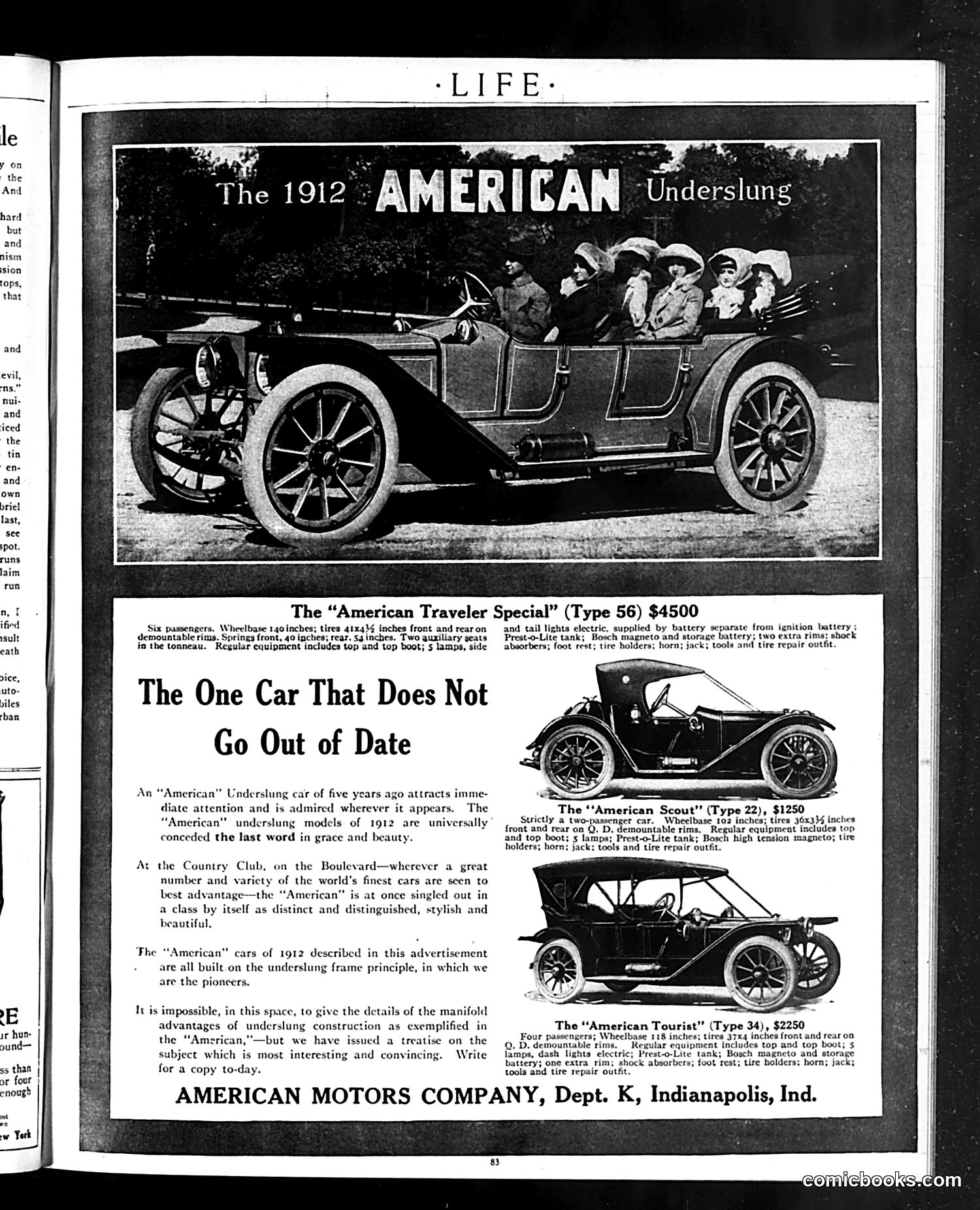
This is **primarily an advertisement**, not a political cartoon. The page features American Motors Company promoting their 1912 automobile line in *Life* magazine. The "satire" element lies in the ad's headline: "The One Car That Does Not Go Out of Date." This is a tongue-in-cheek marketing claim—the copy argues that American's "underslung" frame design (positioning the car body low between the wheels) gives their models timeless elegance, unlike competitors' cars that quickly appear outdated. The advertisement showcases three models with prices ranging from $1,250 to $4,500, emphasizing luxury features and superior construction. The top image depicts well-dressed passengers enjoying the spacious "Traveler Special," positioned as a status symbol seen at exclusive venues like country clubs. The humor appeals to wealthy readers through self-aware, aspirational messaging rather than satirical critique. It's typical of early automotive advertising that emphasized both technological innovation and social prestige.
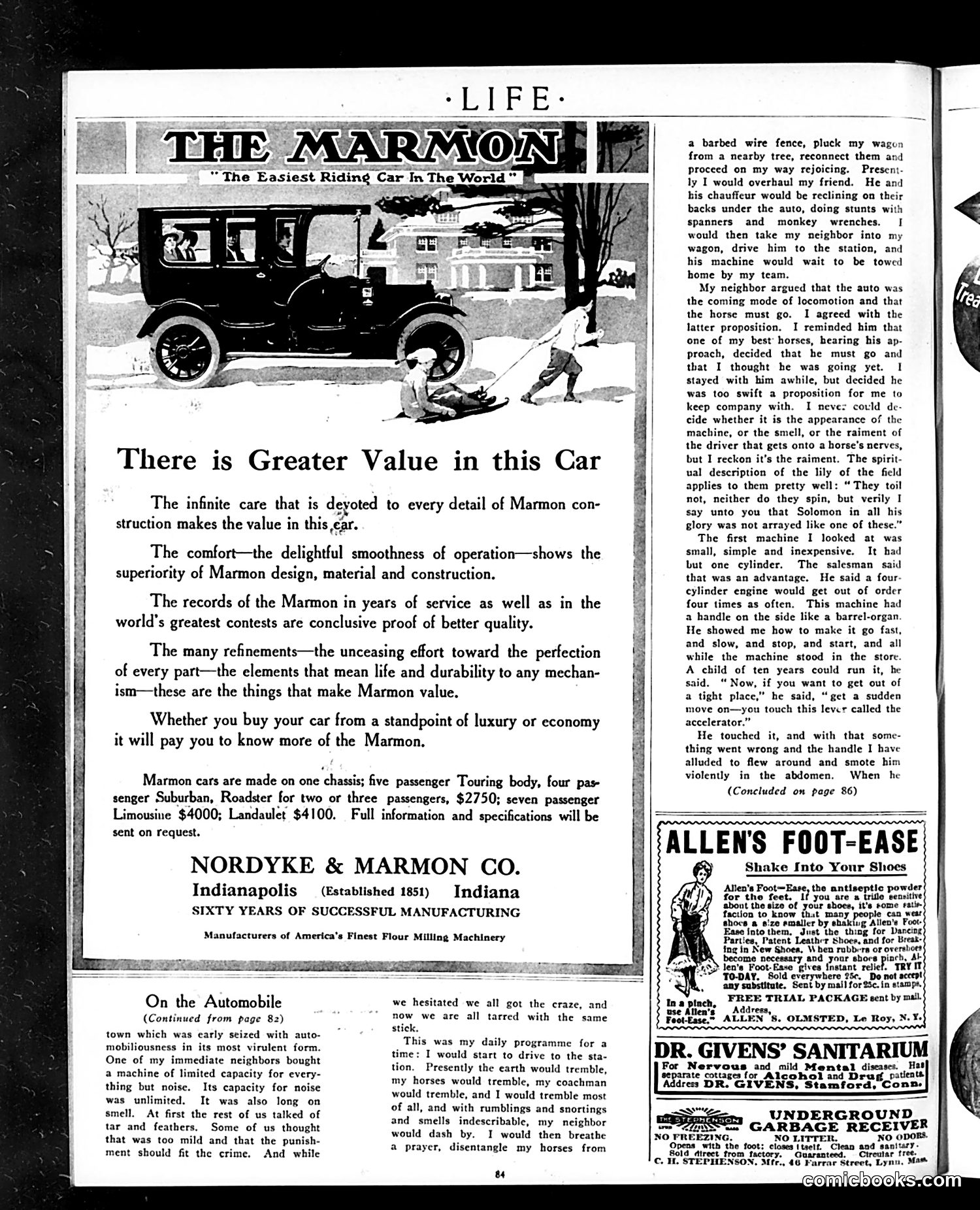
This page contains a **satirical narrative essay about early automobiles** (continued from page 82), alongside period advertisements. ## The Satire The unnamed narrator describes his skeptical encounter with early motorcar technology versus horse-drawn wagons. The humor derives from: - **The automobile's unreliability**: The narrator contrasts his horse-wagon's dependability with the auto's constant breakdowns requiring mechanics to lie "under the auto, doing stunts with spanners." - **The salesman's absurd pitch**: A single-cylinder engine is marketed as superior because a four-cylinder would break down "four times as often"—backwards logic presented deadpan. - **Slapstick mishap**: When demonstrating the "accelerator," the handle spins violently and strikes the salesman in the abdomen—physical comedy emphasizing the machine's unpredictability. The piece gently mocks early automotive enthusiasm and skeptics' reasonable doubts about this emerging technology's practicality compared to established horse transportation. ## Context This reflects the 1910s transitional period when automobiles were luxury items with notorious reliability issues, making horses still competitive for practical transport.
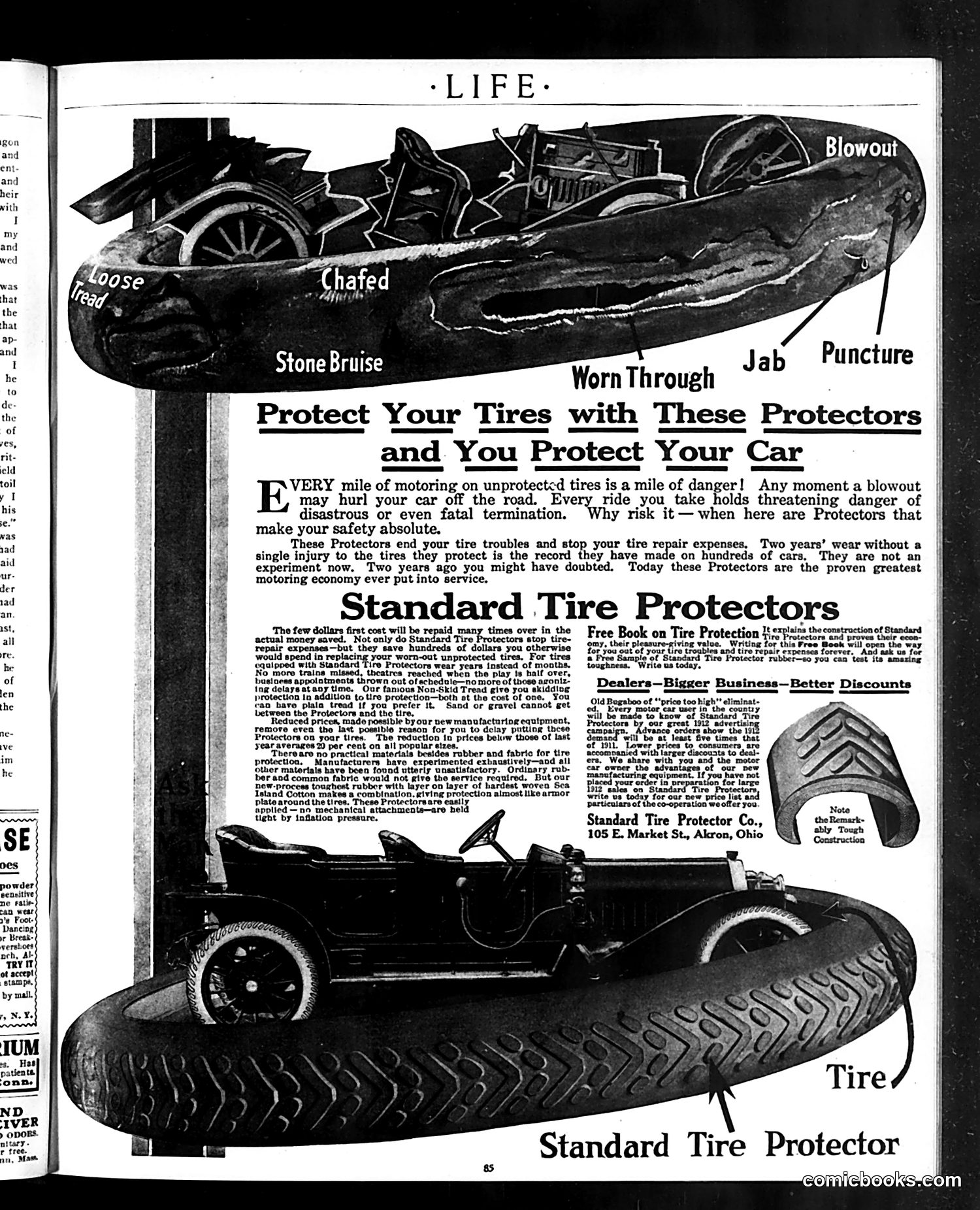
This is a **product advertisement**, not a political cartoon. The page promotes "Standard Tire Protectors"—rubber sleeves designed to wrap around automobile tires to prevent damage. The top image shows a damaged tire cross-section labeled with various failure modes: "Loose Tread," "Chafed," "Stone Bruise," "Worn Through," "Jab," "Puncture," and "Blowout." Below, a tire protector (shown as a ribbed rubber band) surrounds an automobile tire for comparison. The advertisement emphasizes safety and economy: tire protectors allegedly save money by extending tire life and preventing dangerous blowouts that could cause accidents. It addresses dealer concerns about pricing and promises discounts for bulk orders. This reflects early automotive culture (likely 1910s-1920s) when tire failures were common hazards and tire maintenance was a significant expense. The copy appeals to motorists' safety concerns and practical economics.
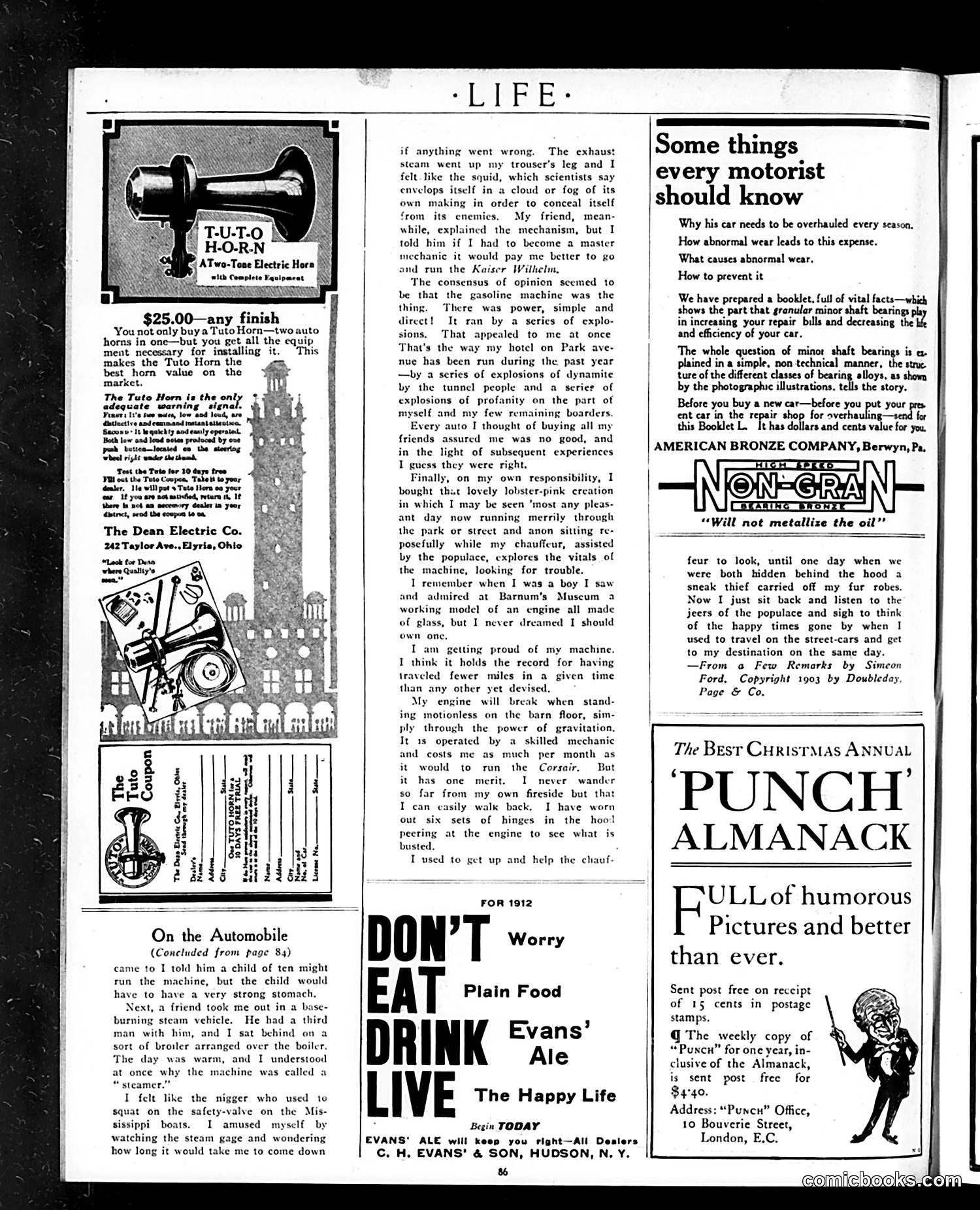
This page from *Life* magazine contains a satirical essay "On the Automobile" (continued from page 84) by an unnamed author mocking early automobile ownership. The piece humorously describes the author's experiences test-driving various cars—a steam vehicle (which he compares to sitting on a boiler), and finally purchasing a "lobster-pink" gasoline automobile that constantly breaks down. The satire targets the impracticality and unreliability of early automobiles: his engine breaks while stationary, requires a skilled mechanic costing as much monthly as operating a yacht, and has traveled fewer miles than any other car—because it's always broken. He's worn out six sets of hinges peering into the engine. The surrounding advertisements (Tuto Horn, Dean Electric Co., Evans' Ale, Punch Almanack) are period commercial content unrelated to the satire's message about automobile frustration.
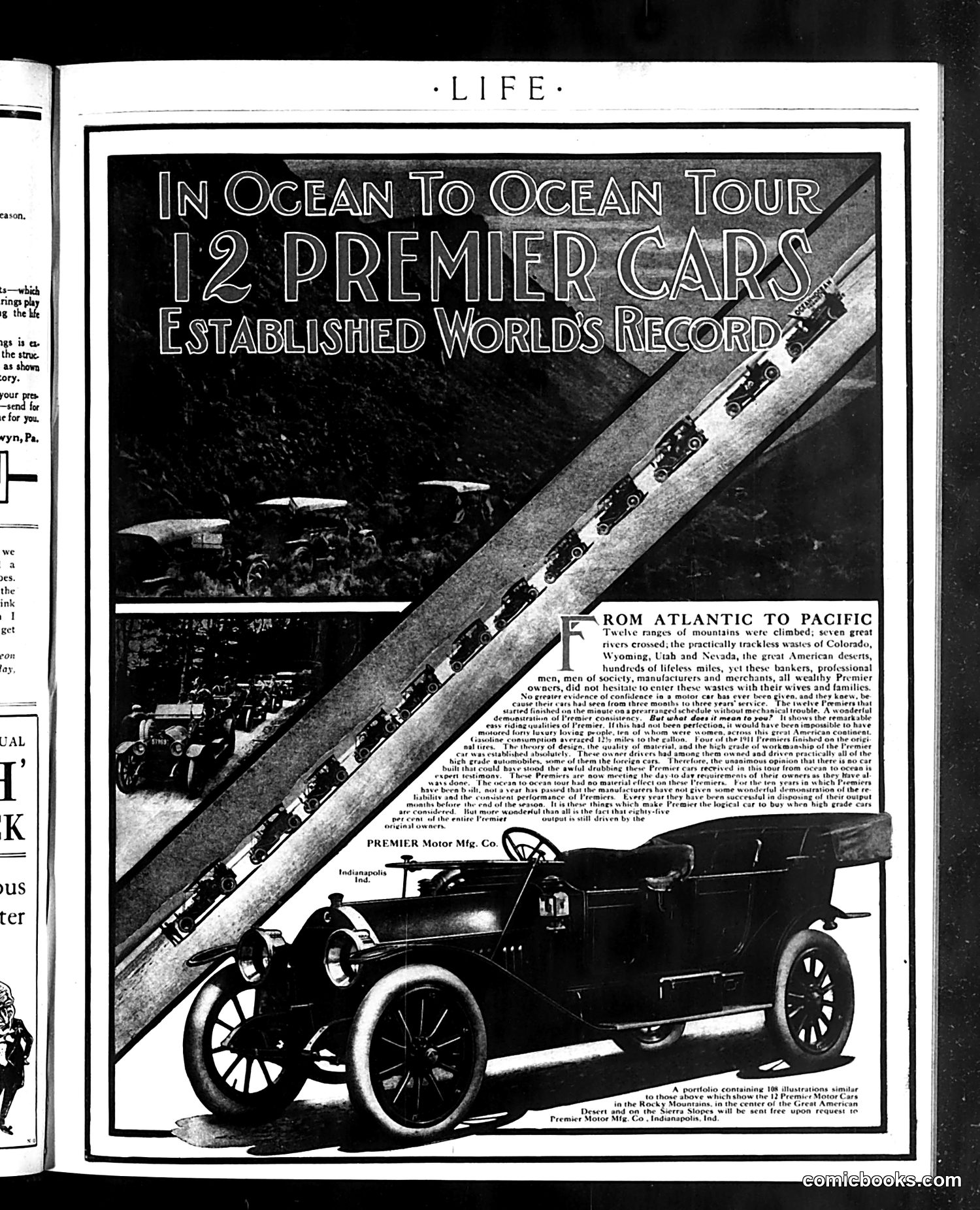
This is primarily a **Premier Motor Company advertisement**, not political satire. The page showcases an "Ocean to Ocean Tour" completed by 12 Premier automobiles—described as establishing a world record for a cross-country journey. The advertisement emphasizes that wealthy businessmen, professionals, society figures, and manufacturers successfully drove their families across difficult American terrain including Rocky Mountain ranges and deserts (Colorado, Wyoming, Utah, Nevada). The underlying marketing message is straightforward: if Premier cars can handle this extreme transcontinental journey with society's elite passengers and their families, they are reliable, high-quality vehicles worth purchasing. This is **aspirational advertising**—associating the brand with wealth, adventure, and achievement rather than political commentary or satire.
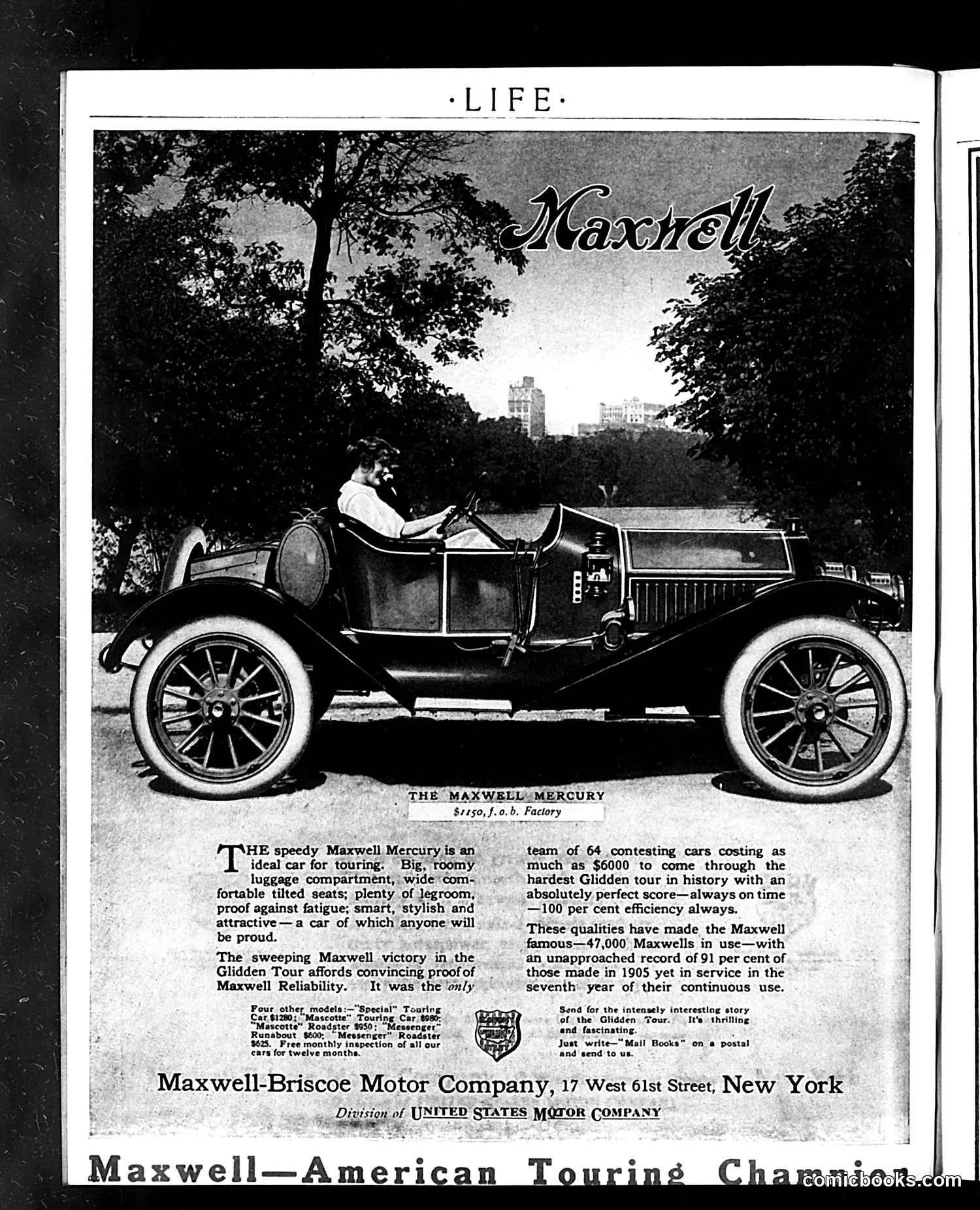
This is not a political cartoon but rather a **automobile advertisement** from Life magazine. It promotes the Maxwell Mercury touring car, manufactured by Maxwell-Briscoe Motor Company in New York. The page features a photograph of the vehicle with a driver, positioned in an idealized outdoor setting with trees and city buildings visible in the background. The advertisement emphasizes the car's reliability and comfort features—spacious seating, luggage capacity, and stylish design. The key sales pitch centers on the Maxwell's victory in the Glidden Tour, a famous automotive endurance race. The text claims it was the only "special touring" car among 64 competitors (some costing up to $6,000) to complete the grueling route with a perfect score. The advertisement further boasts that 47,000 Maxwells were in use, with 91 percent of those manufactured in 1905 still in service seven years later—positioning reliability as the brand's primary competitive advantage. This reflects early-1900s automobile marketing, targeting affluent consumers concerned with both vehicle performance and social status.
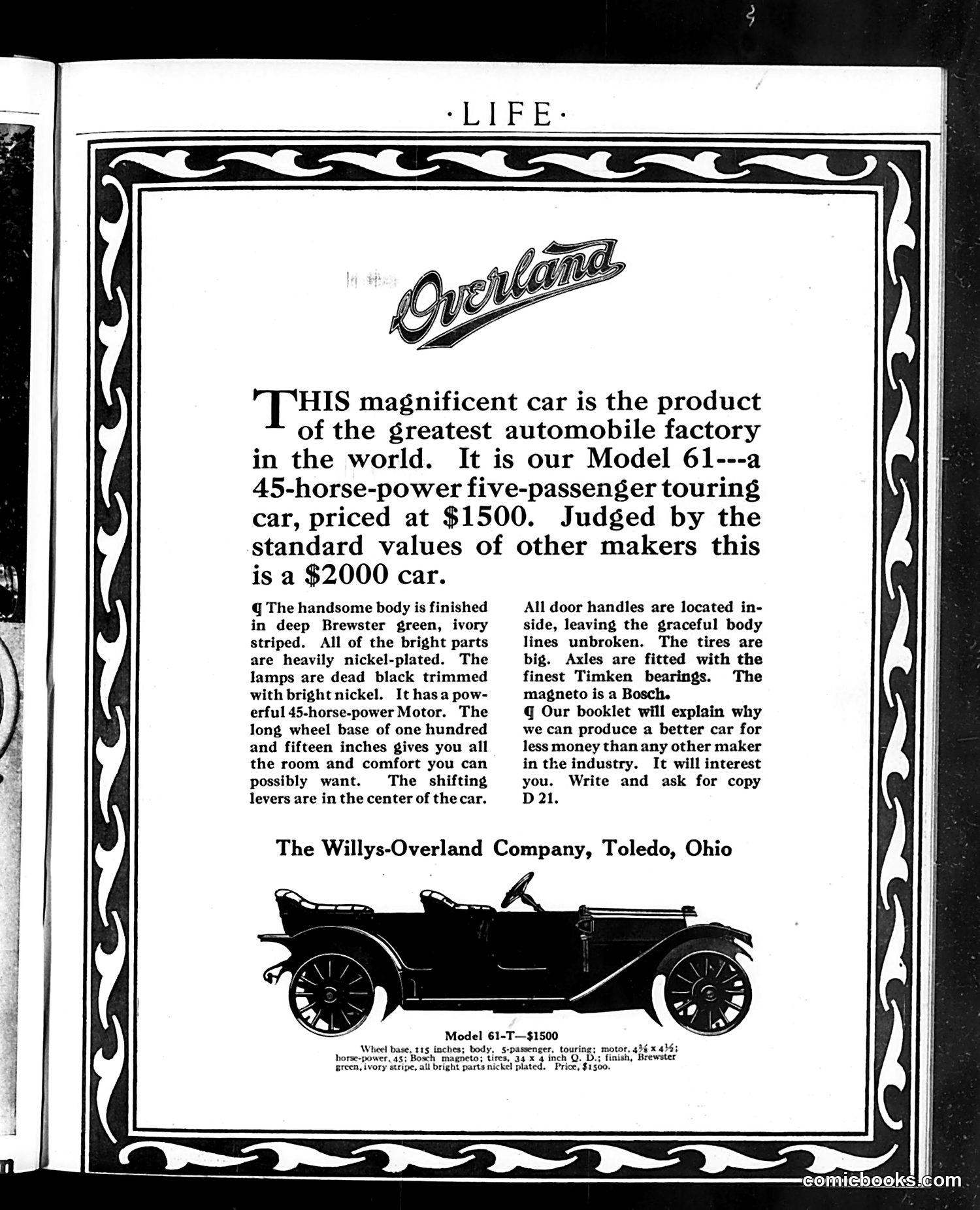
This is **not a cartoon or satirical content** — it's a straightforward automobile advertisement for the Willys-Overland Company's Model 61-T touring car. The ad presents the vehicle as a luxury product: a 45-horsepower, five-passenger car priced at $1500, which the manufacturer claims rivals competitors' $2000 models. It emphasizes premium features — Brewster green finish with ivory striping, nickel-plated components, Timken bearings, and a Bosch magneto — and promises comfort and room. The page appears in *Life* magazine, which published both satirical content and conventional advertisements. This particular page is purely promotional advertising, using the decorative border typical of early 20th-century magazine design. There is no discernible satire or hidden commentary — it's a direct sales pitch to readers who might afford an automobile during the early automotive era.
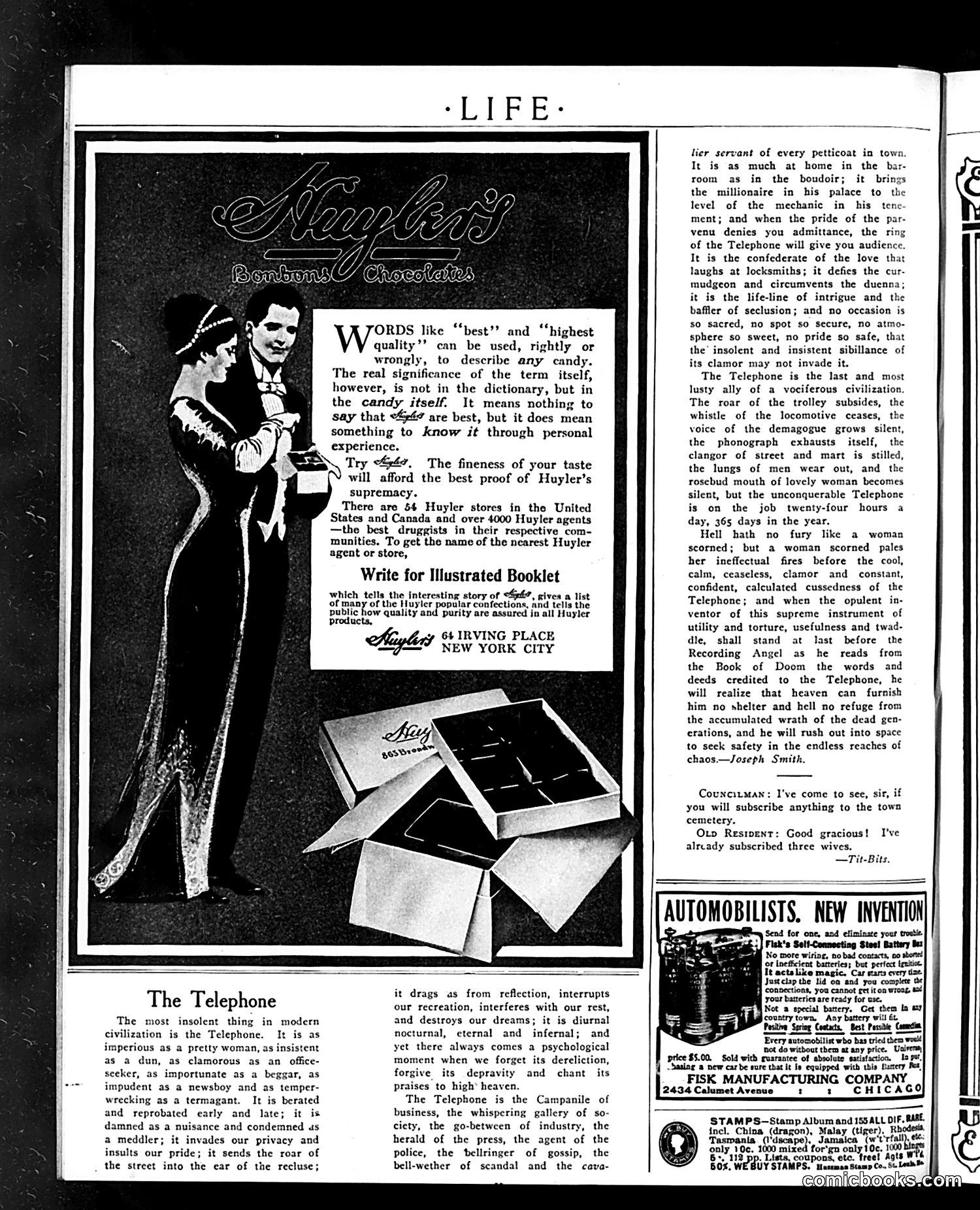
This page contains **Huyler's chocolate advertising** (top left) and two satirical pieces on the telephone. **The Huyler's ad** shows a well-dressed man and woman with chocolate boxes, using marketing language about "quality" and "personal experience" to sell candy. It's straightforward early 20th-century advertising. **"The Telephone" essay** (bottom) is the page's satire. Written in mock-grandiose language, it catalogs the telephone as a modern nuisance—imperious, intrusive, invading privacy at all hours. The author uses absurdly elevated rhetoric ("confederate of the love that laughs at locksmiths," comparisons to hell's fury) to mock both the device and the overwrought complaints about it. The humor lies in the **contradiction**: the piece savagely denounces the telephone as society's worst invention, then admits we forget our complaints and "chant its praises to high heaven." It's satirizing how people simultaneously despise yet depend on modern technology—a complaint pattern that remains recognizable today. The final joke (about a man subscribing "three wives" to a cemetery) is unrelated wordplay humor typical of the era.
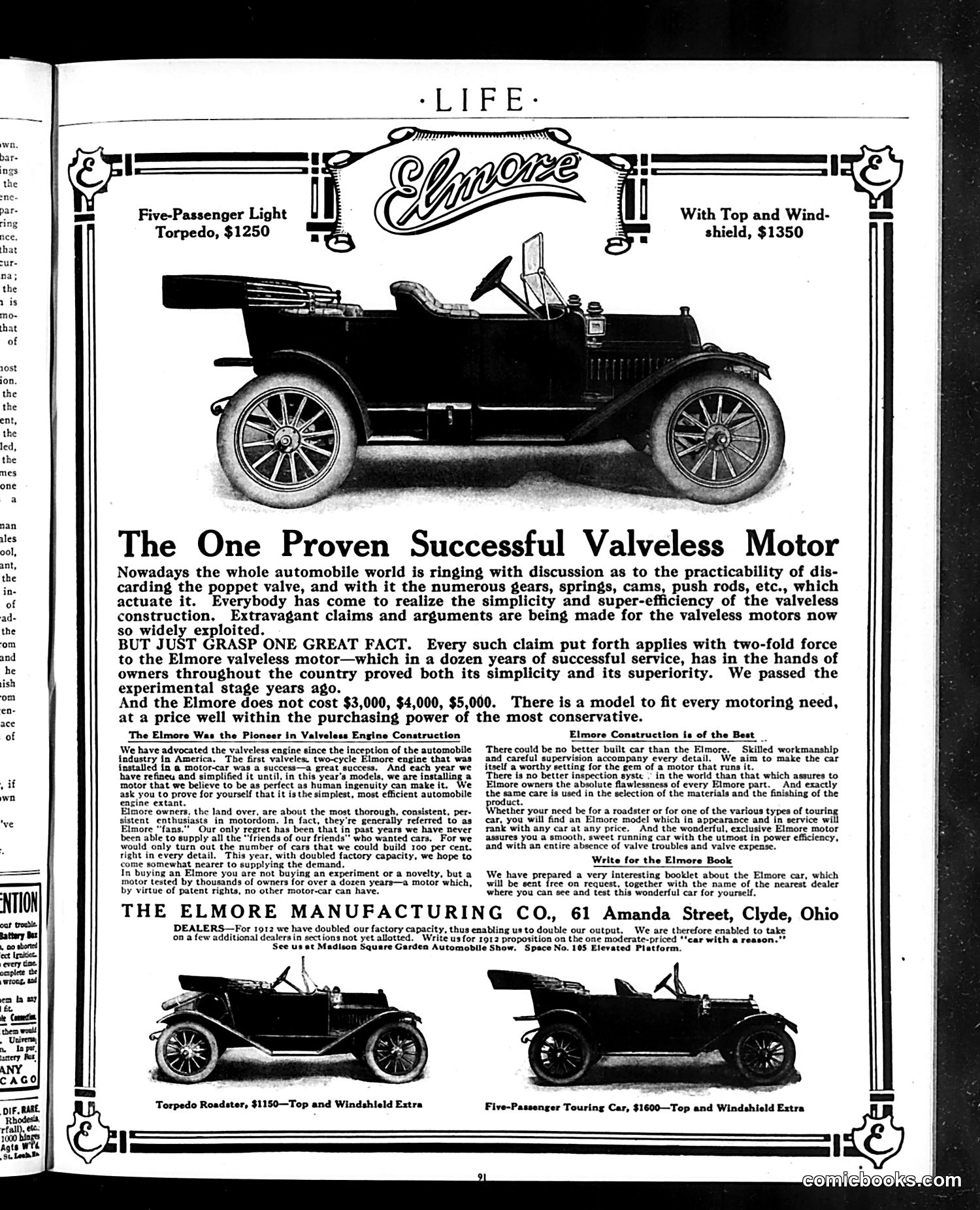
This is **not a cartoon or satire**, but rather a **full-page automobile advertisement** from Life magazine for the Elmore Manufacturing Company of Clyde, Ohio. The ad promotes the Elmore's "valveless motor"—a technological innovation of the era. It addresses contemporary automotive industry debate about whether traditional poppet valves (complex mechanical components) could be replaced with simpler valve-free engine designs. The advertisement's strategy is to position Elmore as the **proven pioneer** in this technology, having tested valveless engines for over a dozen years. It emphasizes reliability, affordability (starting at $1,250), and simplicity while acknowledging competitors making similar claims. The ad includes several car model illustrations and asserts that Elmore's long track record demonstrates superiority over newer, unproven valveless designs flooding the market. This reflects genuine early-1900s automotive competition over engine design.
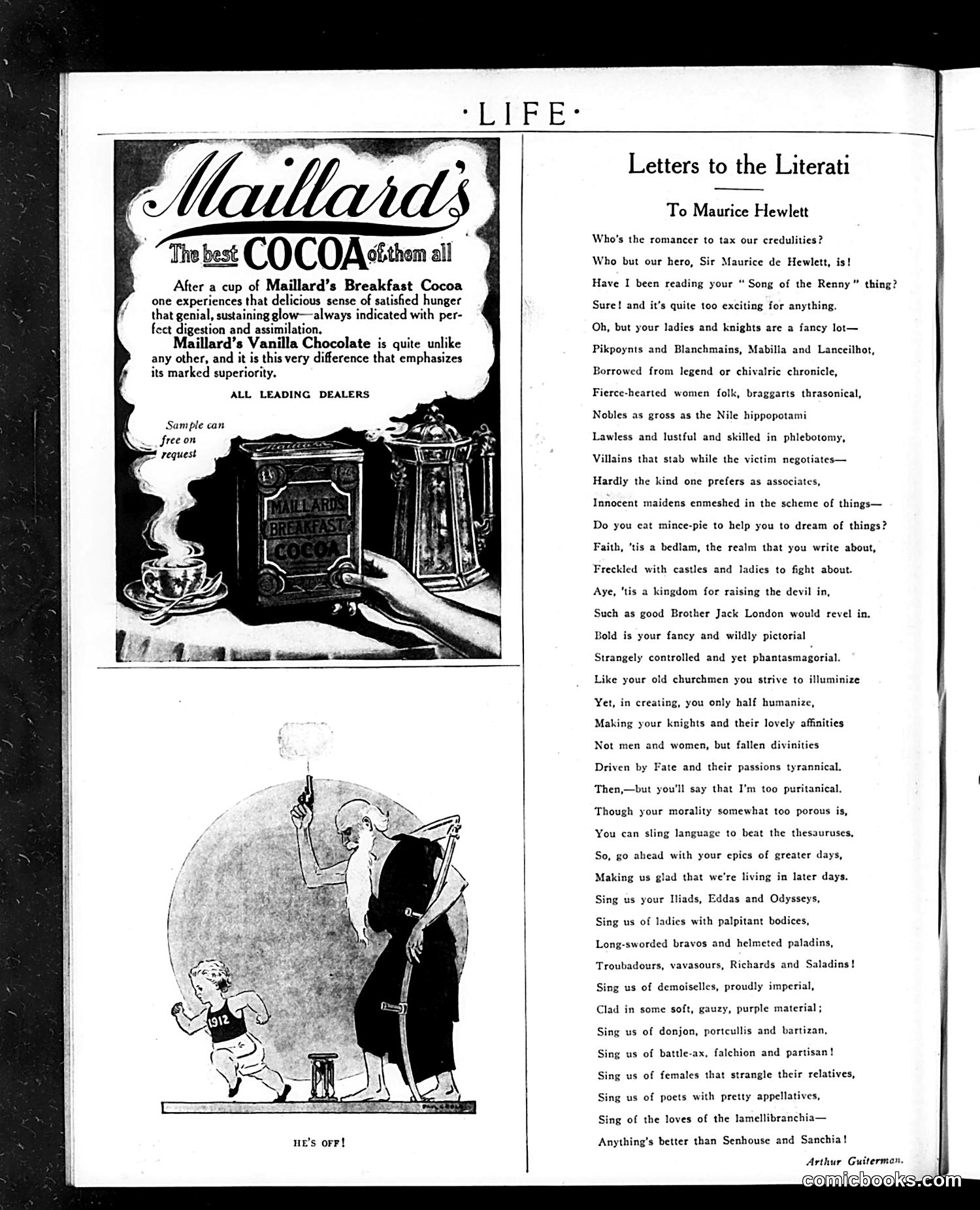
**Maillard's Cocoa Advertisement** (top left): Standard early 20th-century product advertising claiming superior digestive benefits—typical of an era before FDA regulation when such health claims were unregulated. **"He's Off!" Cartoon** (bottom left): Shows an adult (likely a governess or nanny) launching a small child like a projectile. The joke appears to be dark humor about child-rearing frustrations—a period-appropriate satire on exasperated caretakers, though it would be considered shockingly inappropriate today. **"Letters to the Literati"** (right): A satirical poem by Arthur Guiterman mocking novelist Maurice Hewlett's romantic fantasy fiction. Guiterman criticizes Hewlett's medieval-themed novels as overstuffed with borrowed legendary characters, exaggerated emotions, and unrealistic heroics—essentially complaining that the author trades genuine humanity for theatrical excess. The closing suggests *any* fantasy content beats contemporary realistic fiction by Senhouse and Sanchia.
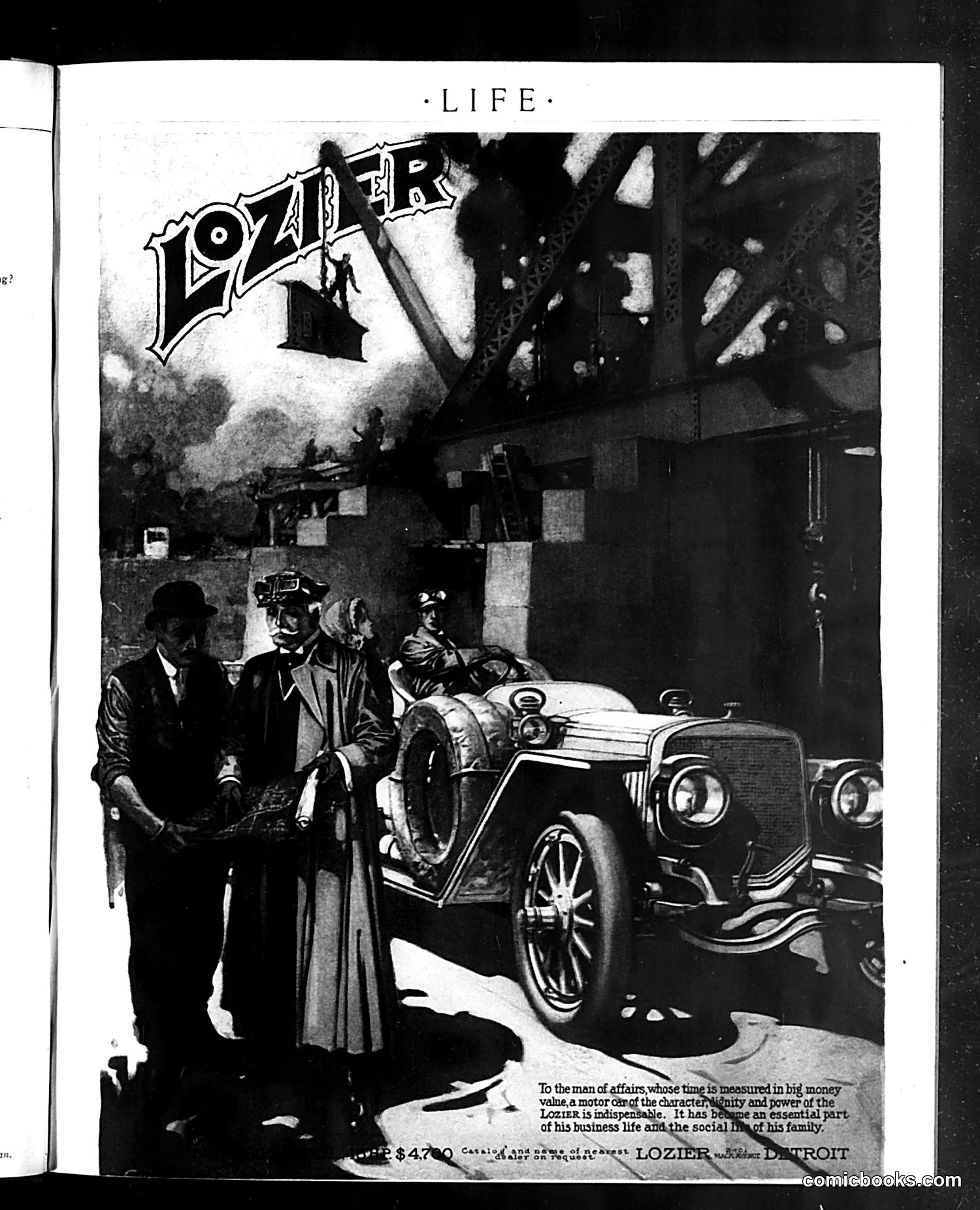
This is a **Loziér automobile advertisement** masquerading as editorial content in Life magazine's "LIFE" section. The image depicts a well-dressed couple and chauffeur admiring a Loziér motorcar outside an elegant building, with smoke billowing behind. The accompanying text argues that for wealthy, busy men whose time has monetary value, owning a Loziér automobile is "indispensable" — essential to conducting business and maintaining social standing. This is **not satire**, but rather a period advertisement using the lifestyle aspirations of the wealthy as a sales pitch. The "satire" of Life magazine itself would have been recognizing this as transparent class-based marketing dressed up as lifestyle advice. The price "$47.00" likely refers to catalog cost.
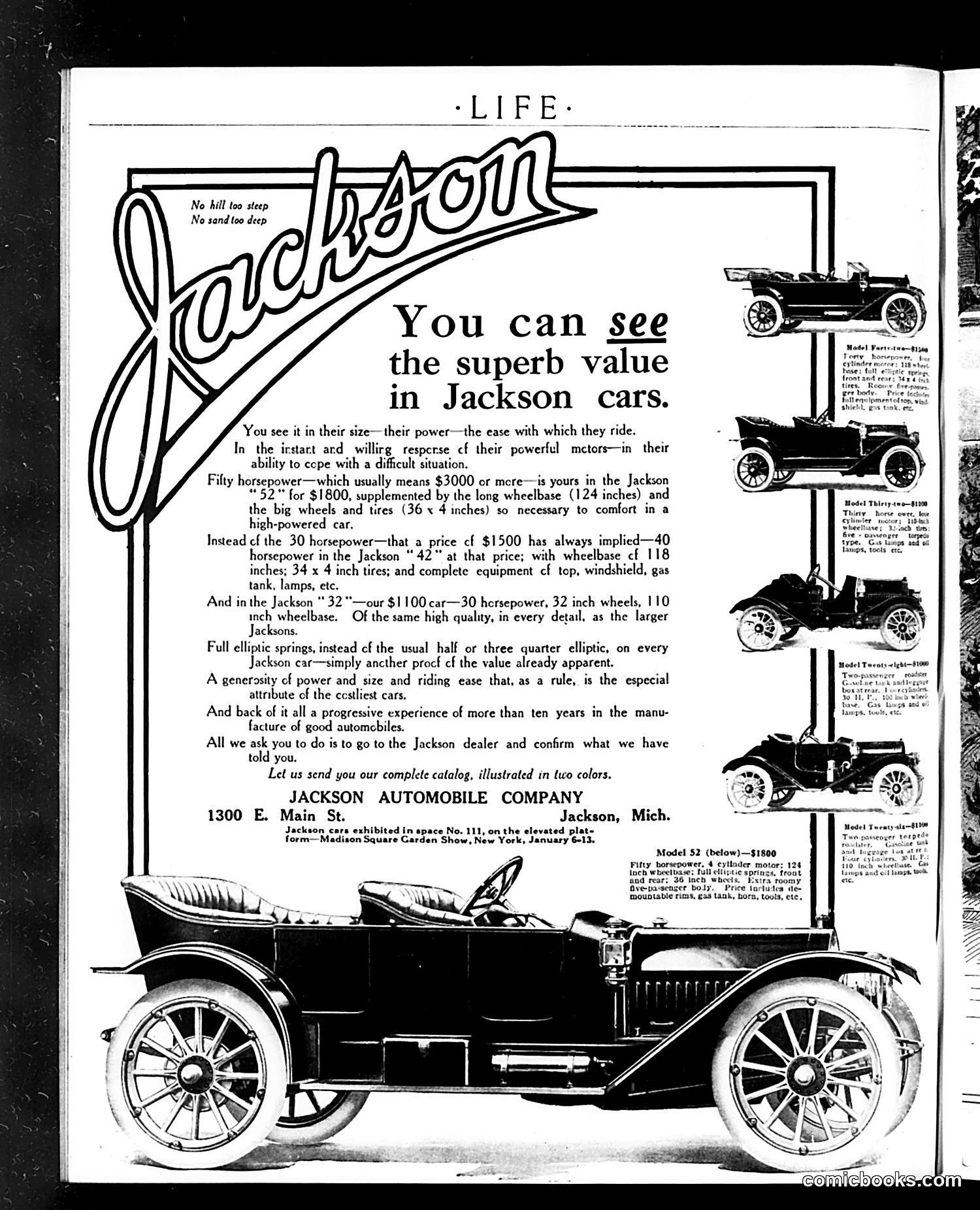
This page is **primarily an advertisement**, not political satire. It's a Jackson Automobile Company ad from *Life* magazine, promoting their car models. The ad makes no satirical or political commentary. Instead, it uses straightforward marketing rhetoric to sell three Jackson car models ($1100, $1800, and higher price points) by emphasizing their value: claiming 50 horsepower at lower prices than competitors, long wheelbases, large tires, and full elliptic springs. The small phrase "No hill too steep / No sand too deep" appears decorative rather than satirical—it's marketing copy suggesting capability. Multiple car illustrations on the right show different Jackson models with specifications. The bottom features a detailed side-view of the Model 52. For modern readers: this is essentially a vintage car advertisement touting engineering features and competitive pricing, not commentary on social or political issues.
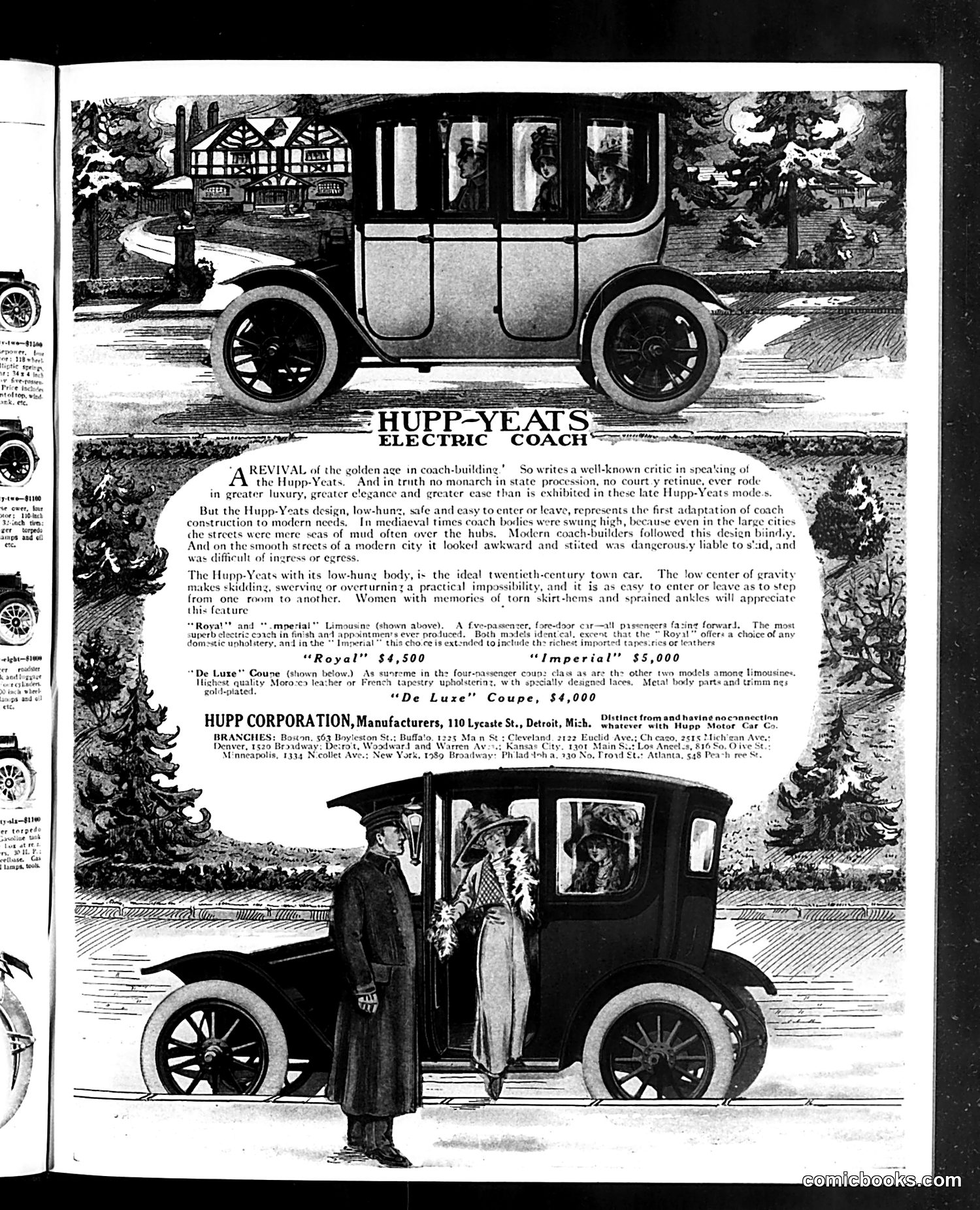
This is primarily **automobile advertising**, not political satire. The Hupp-Yeats Corporation showcases their new "Electric Coach" models—luxury cars marketed as representing "a revival of the golden age in coach-building." The satirical *angle* (implied by the text's tone) targets outdated carriage design. The ad argues that traditional high-slung coach bodies, once necessary for muddy medieval streets, persist absurdly on smooth modern city streets. The Hupp-Yeats's innovation is a **low-hung body**—easier to enter/exit and safer (with a lower center of gravity reducing tipping risk). The women shown appreciating ease of entry suggests the ad targets female buyers, noting practical benefits like avoiding "torn skirt-hems and sprained ankles." Three luxury models are advertised: "Royal" ($4,500), "Imperial" ($5,000), and "De Luxe Coupe" ($4,000)—premium pricing for the early automotive era. This is a straightforward commercial appeal dressed in gentle mockery of outdated design conventions.
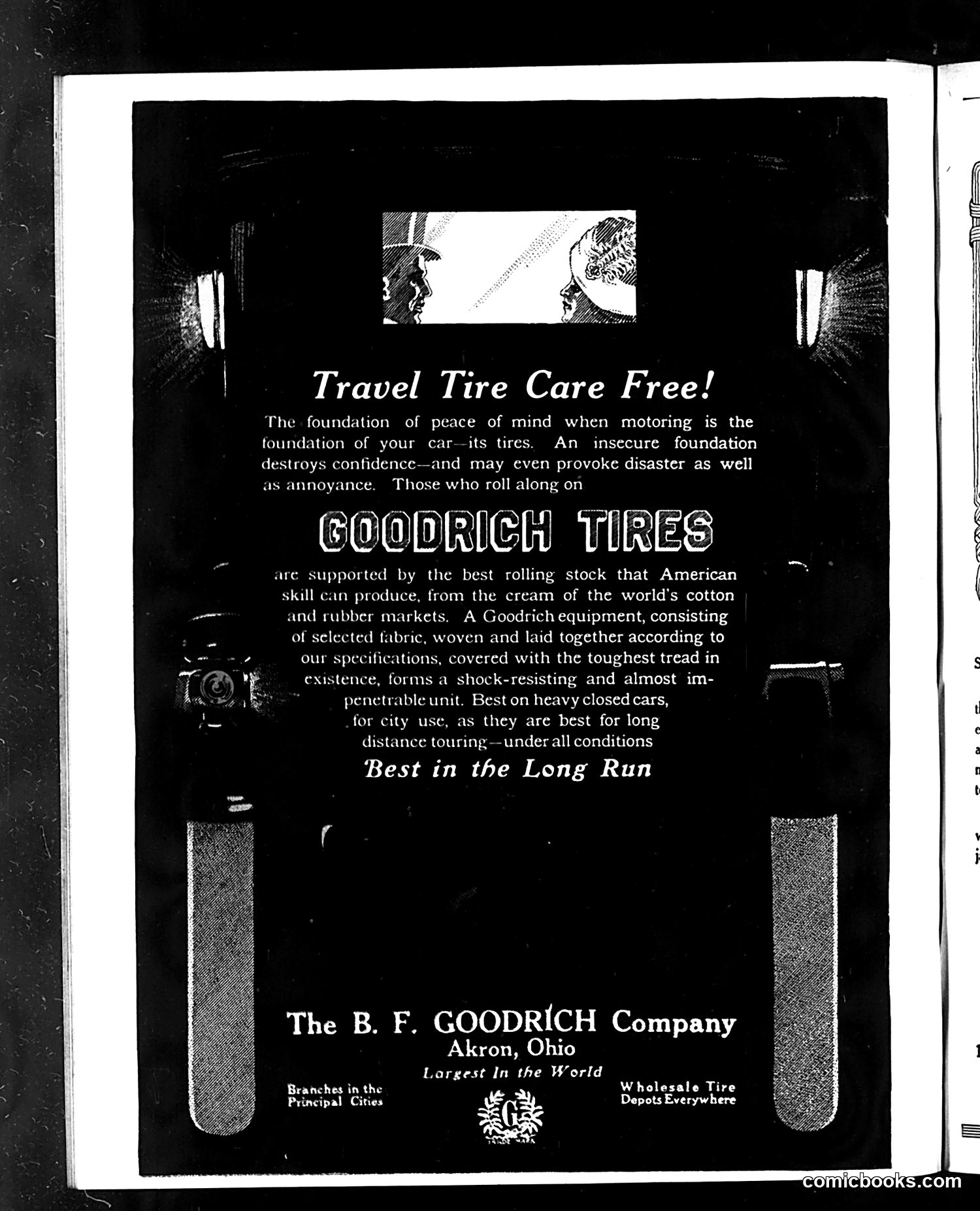
This is **primarily an advertisement**, not a political cartoon. It's a full-page ad for B.F. Goodrich tires from the Akron, Ohio company. The page features small illustrations at the top showing two men in profile (appearing to be ordinary motorists rather than specific caricatures), flanked by decorative lighting fixtures. The ad uses the metaphor of tires as a "foundation" for safe motoring—equating tire quality with peace of mind and confidence while traveling. The marketing pitch emphasizes American manufacturing quality, durability ("best in the long run"), and versatility for different driving conditions. The phrase "Travel Tire Care Free!" is a pun playing on "carefree" travel. There is no satirical content or political commentary visible. This represents straightforward early 20th-century automotive advertising emphasizing reliability and American industrial superiority.
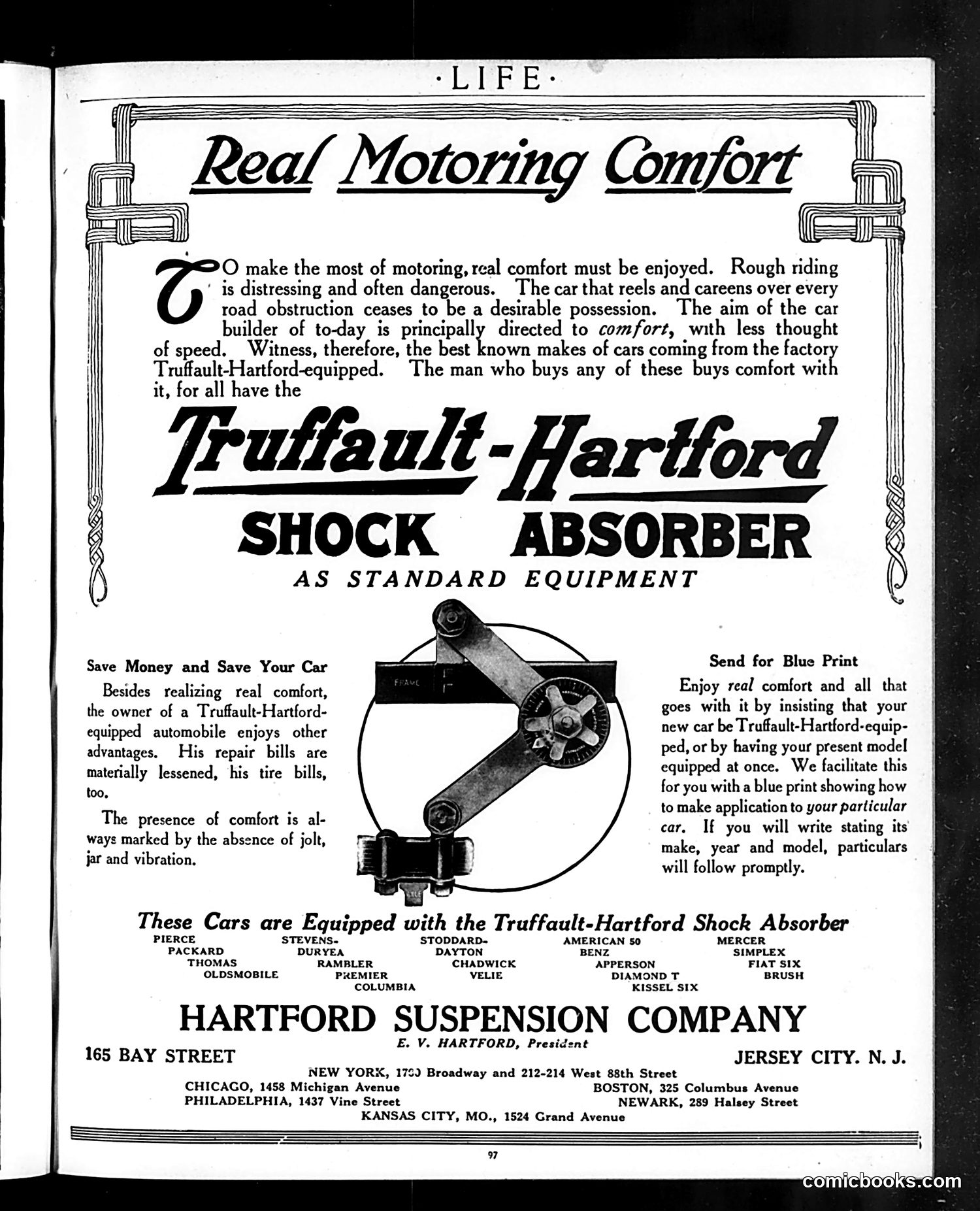
This is **not a cartoon or satire**—it's a straightforward automobile parts advertisement from an early 20th-century *Life* magazine. The ad promotes the Truffault-Hartford shock absorber as standard equipment, targeting car buyers concerned with ride comfort. The central image shows a technical diagram of the shock absorber mechanism. The pitch emphasizes that modern car design prioritizes **comfort over speed**—a significant claim for the era, when automotive performance was typically the selling point. The ad argues that smoother rides mean lower repair and tire costs, positioning the product as economical. The extensive list of compatible car brands (Pierce, Packard, Oldsmobile, Benz, Fiat, etc.) demonstrates the absorber's broad market applicability. Multiple office locations suggest a well-established company. For modern readers: this represents early automotive marketing focused on mechanical reliability and passenger comfort rather than speed or style.
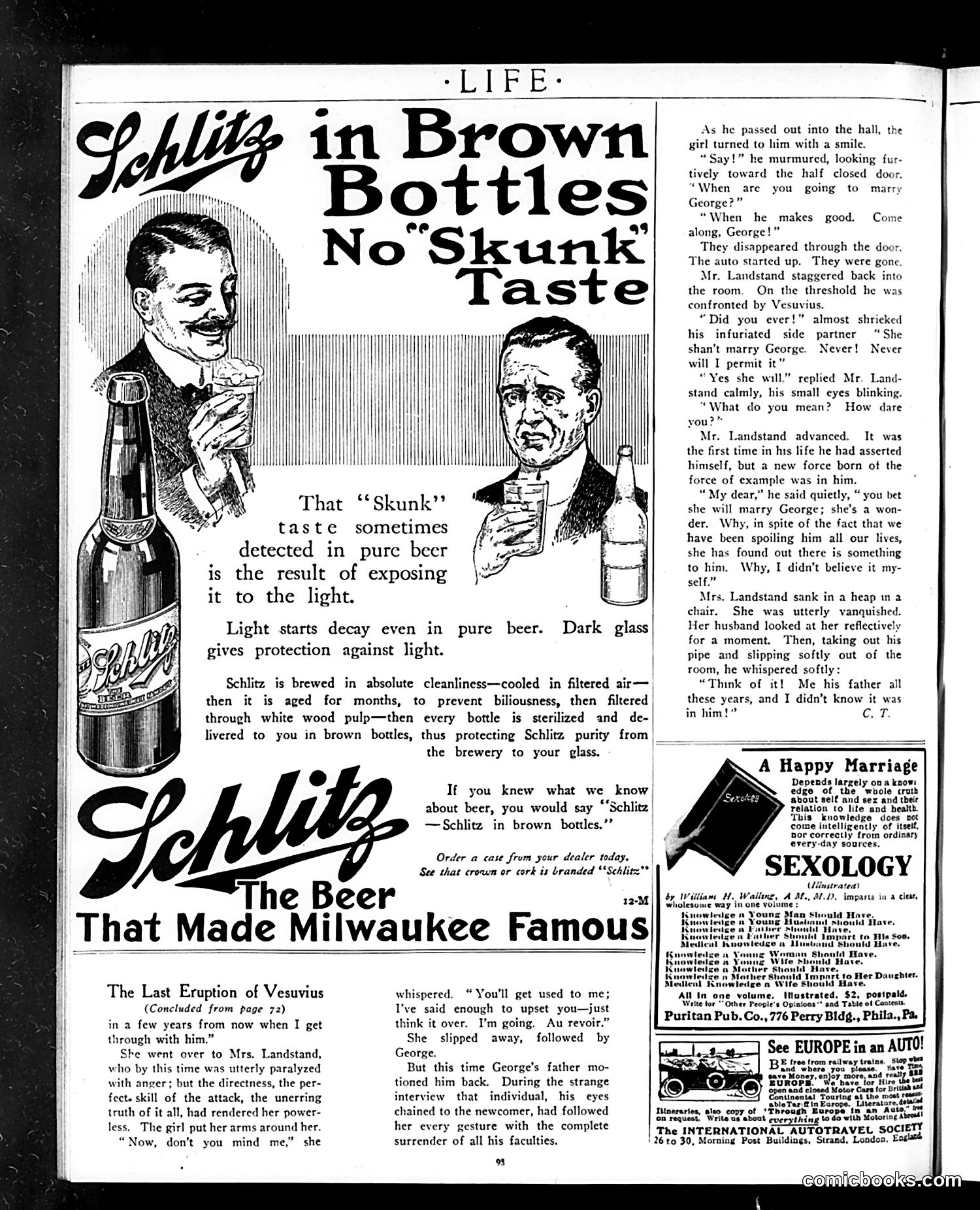
This page is primarily a **beer advertisement** for Schlitz, a Milwaukee brewery. The main visual shows two men—one refined, one skeptical—examining bottles. The ad claims that Schlitz's brown bottles protect beer from light decay that causes a "skunk" taste, positioning the dark glass as a quality feature. The page also continues "The Last Eruption of Vesuvius," a serialized romantic story. The narrative depicts a young woman confronting Mr. and Mrs. Landstand about George (their son). She's assertive and confident; Mr. Landstand is impressed by her character and finally asserts himself against his wife's objections to the marriage. The conclusion suggests he's realized his wife has been overindulging George, while this woman has recognized his potential. Below are period advertisements for a "Sexology" book and European auto travel. The content reflects early 20th-century American magazine entertainment: commercial advertising mixed with serialized fiction and self-improvement promotion.
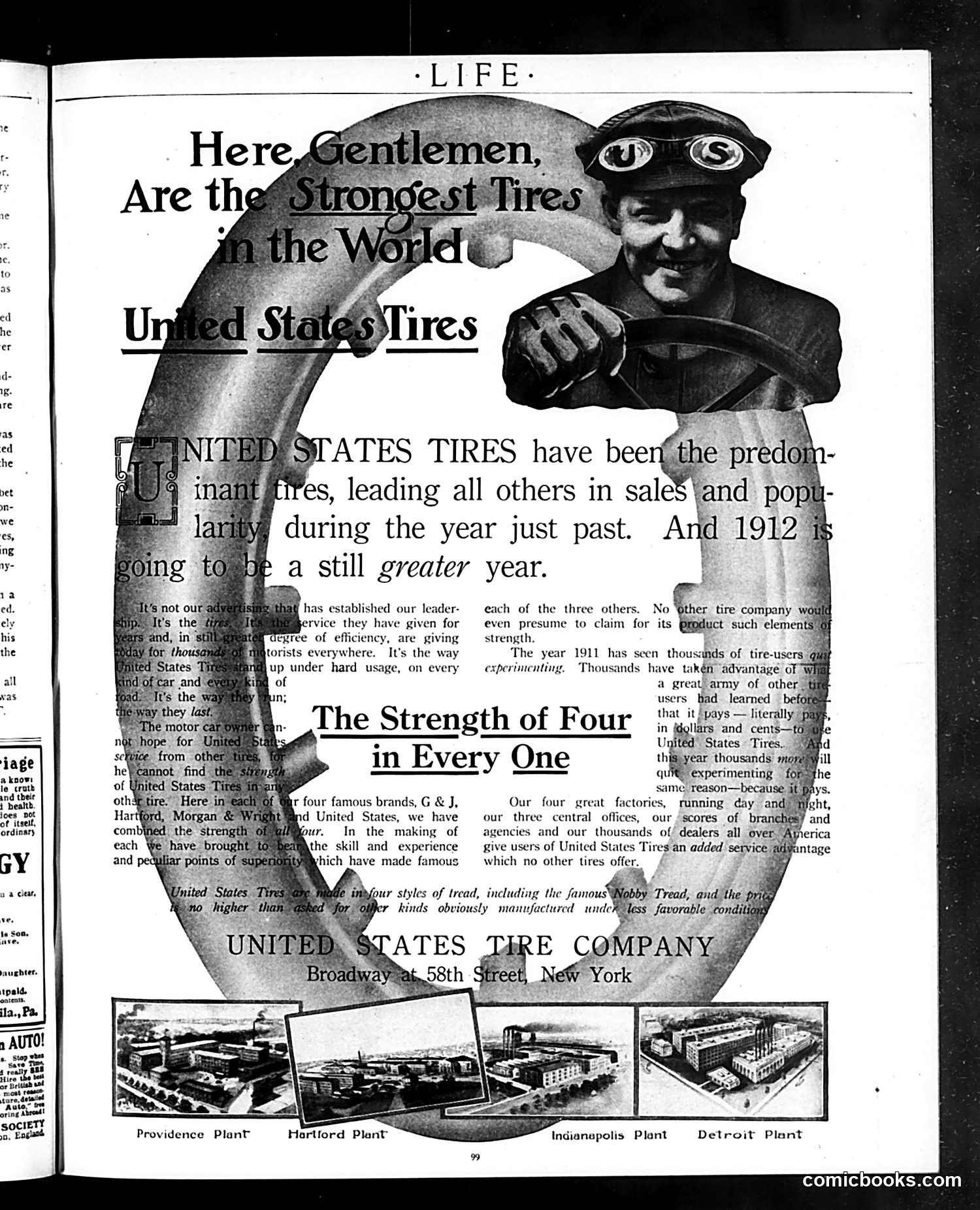
This is primarily a **tire company advertisement**, not political satire. The page features United States Tire Company promoting their products in *Life* magazine (circa 1912, based on context). **The imagery:** A muscular, mustachioed man in driving goggles flexes his arm in a strongman pose, with a large tire replacing his bicep. This visual metaphor conveys strength and power—equating the tire's durability with physical force. **The message:** The ad claims United States Tires are "the strongest tires in the world" and highlights their market dominance in 1911. It emphasizes their four factories (Providence, Hartford, Indianapolis, Detroit) and multiple tire tread options. **For modern readers:** This represents early automotive advertising's focus on performance and reliability before safety became a marketing priority. The strongman imagery was common period advertising that wouldn't be used today. The ad targets "gentlemen" car owners—a demographic marker showing cars were still luxury items in 1912. This is commercial content, not social commentary.
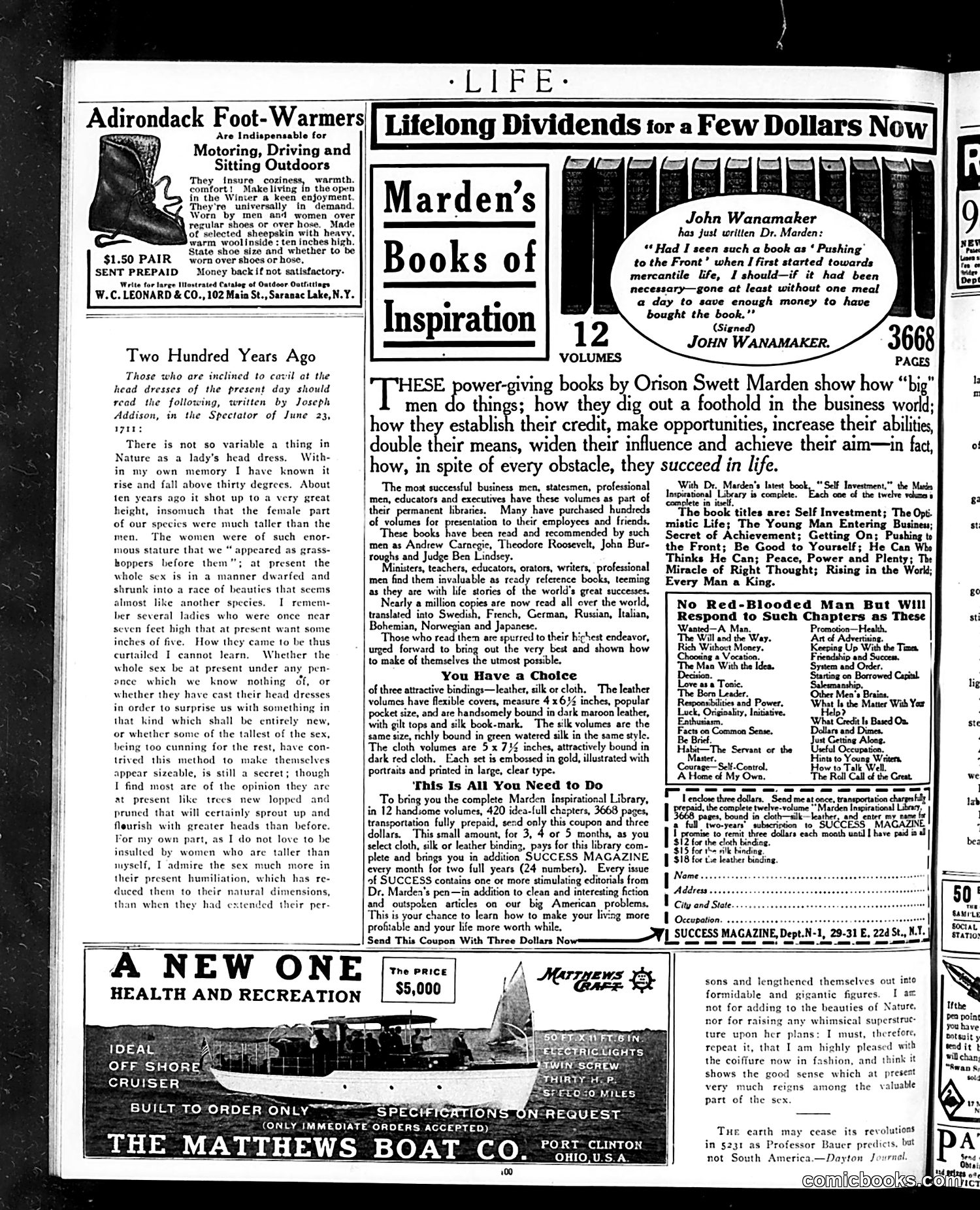
This page is primarily **advertising and self-help promotion**, not satirical content. The main feature advertises **Orison Swett Marden's "Books of Inspiration"** — a 12-volume self-help series. The testimonial from retail magnate **John Wanamaker** endorses the books' business wisdom, claiming he would have skipped meals to afford them early in his career. The left sidebar contains a humorous **historical piece by Joseph Addison (1711)** satirizing women's changing hairstyles and head coverings. Addison mockingly compares shifting fashion trends to nature's variability, noting how women's apparent height fluctuates with headdress styles — suggesting current fashion makes women appear shorter, which he finds preferable to when they towered over men. Other advertisements include **Adirondack Foot-Warmers** for winter outdoor activities and a **Matthews Boat Company cruiser** ($5,000). The page reflects early 20th-century American consumer culture and the era's popular self-improvement movement.
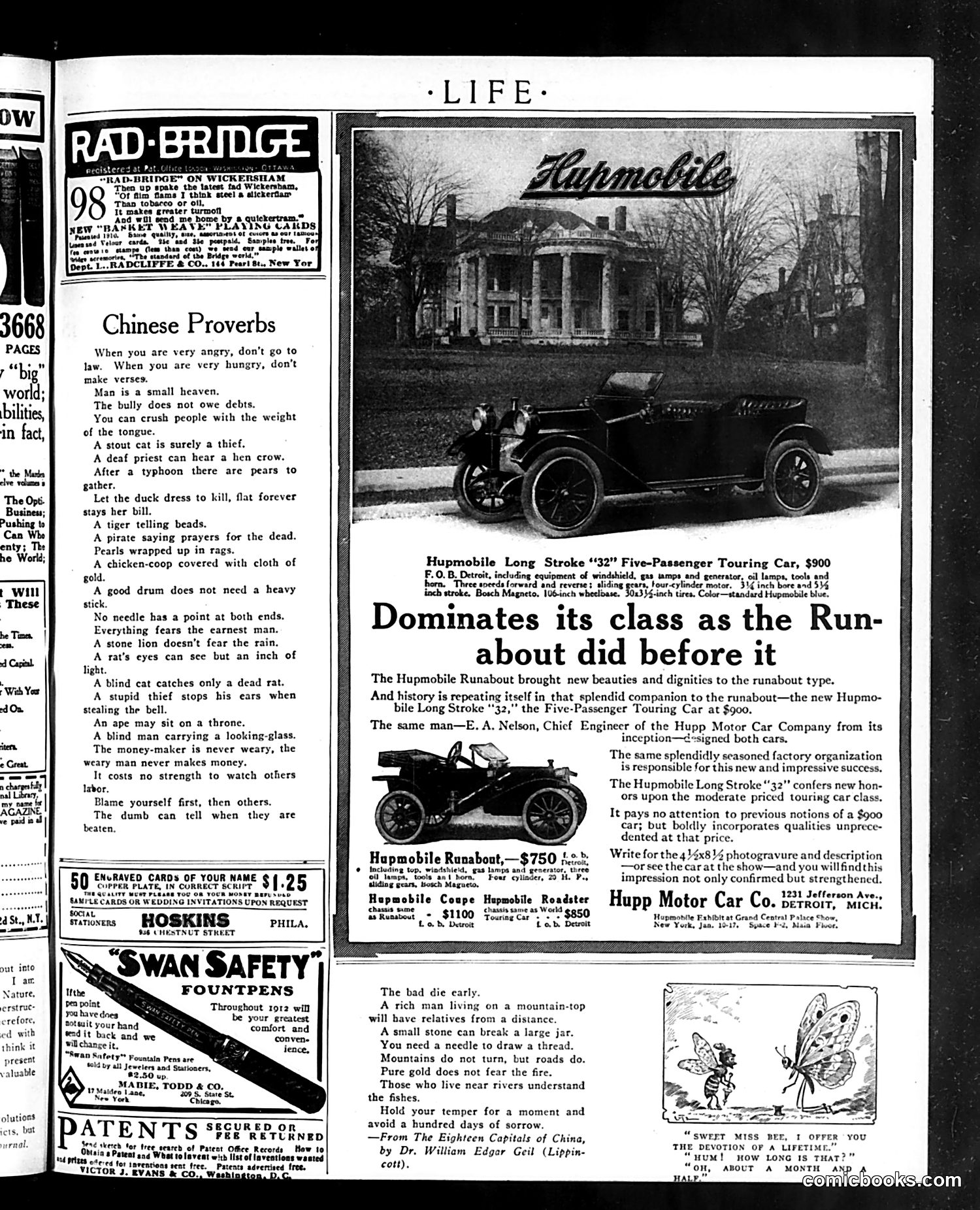
This page is primarily **automotive advertising** rather than political satire. The dominant content features a Hupmobile automobile advertisement showcasing their new Long Stroke "32" Five-Passenger Touring Car ($900), with photographs and detailed specifications. The page includes **"Chinese Proverbs"** — a collection of traditional wisdom sayings presented as cultural curiosities for American readers. These appear designed as lighthearted filler content reflecting early-20th-century Western fascination with exotic Eastern philosophy. Minor advertisements include **Swan Safety Fountain Pens** and **patents services**, typical period business ads. No political cartoons or caricatures appear on this page. The Hupmobile section uses straightforward product marketing language emphasizing engineering innovation and affordability rather than satire. The overall page reflects Life's dual function as satirical magazine and advertising vehicle during this era.
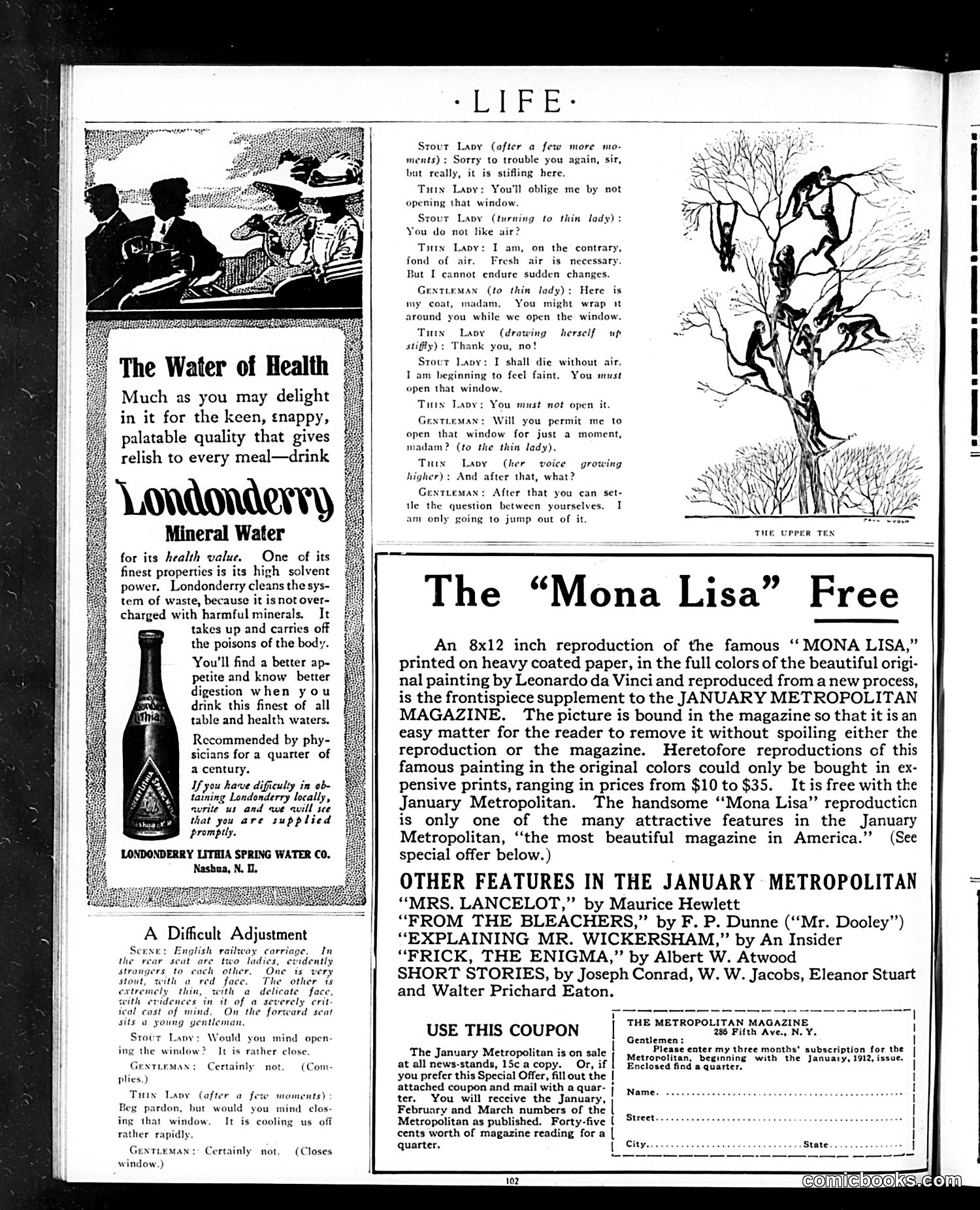
This satirical sketch depicts a common social predicament: two women with opposing comfort needs share a railway carriage. A **stout lady** demands the window open for air, while a **thin lady** insists it stay closed, fearing sudden temperature changes will make her ill. A **young gentleman** sits between them, repeatedly opening and closing the window per their conflicting demands. The humor lies in the escalating absurdity: unable to compromise, the exasperated gentleman finally declares he'll simply **jump out the window** himself rather than continue mediating their impossible dispute. The satire likely mocks rigid, unreasonable social etiquette and the inability of Victorian-era individuals (particularly women) to negotiate practical solutions. It's a commentary on excessive concern with propriety and health anxieties that prevent rational problem-solving. The gentleman's desperation represents the exhaustion caused by catering to unreasonable demands.
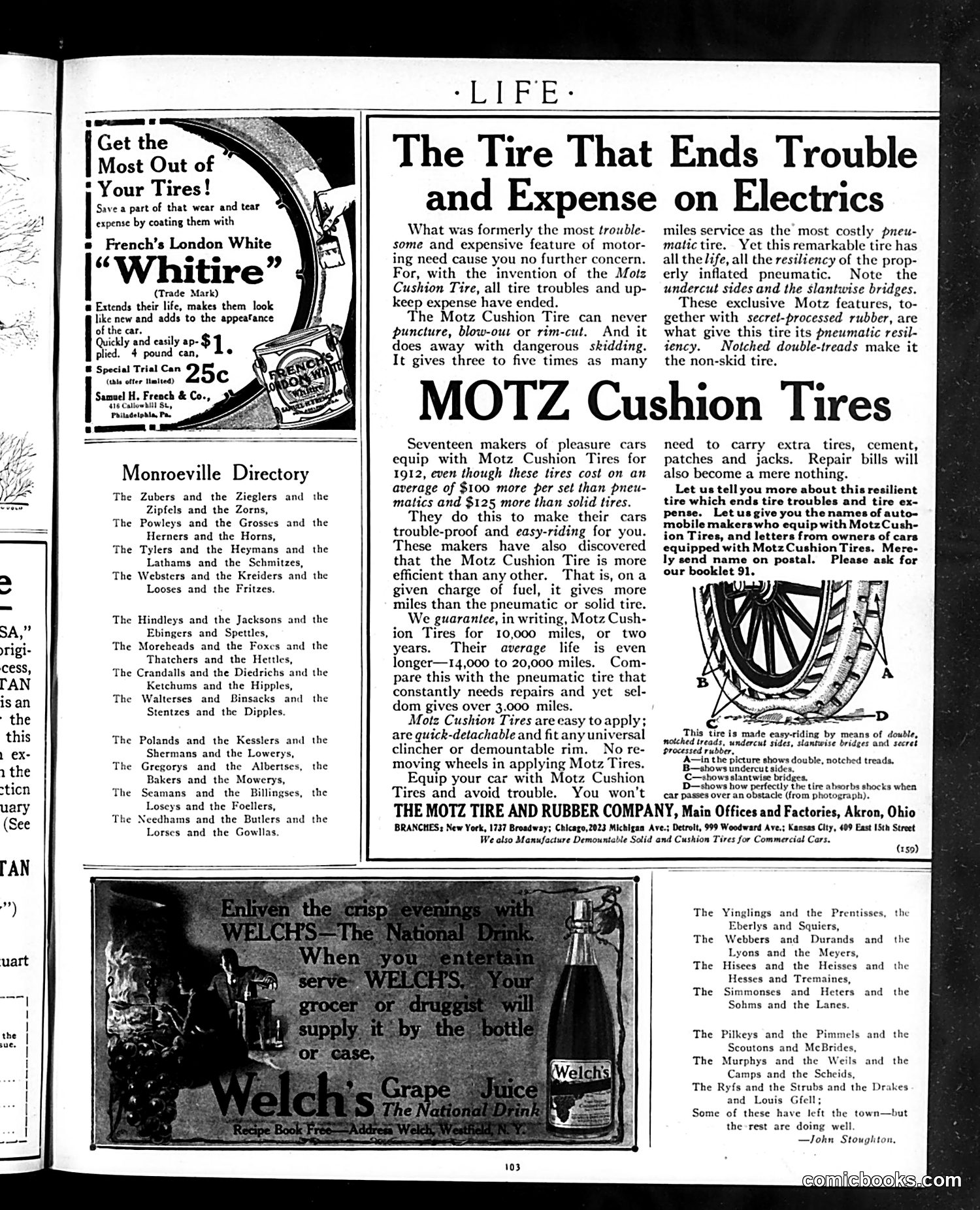
This page is primarily **advertising, not political satire**. It contains three separate commercial advertisements typical of early 1910s American magazines: 1. **French's London White "Whitire"** – a tire coating product promising to extend tire life and appearance 2. **MOTZ Cushion Tires** – the major advertisement claiming superior durability and safety over pneumatic tires for early electric automobiles 3. **Welch's Grape Juice** – positioned as "The National Drink" for entertaining The page also includes a **"Monroeville Directory"** listing family names, likely a humorous local feature referencing community members. There is **no political cartoon or satire** visible. The only potential humor lies in the directory's exhaustive enumeration of ordinary surnames, which appears to be gentle local humor rather than commentary. The tire advertisements represent genuine product competition of the era between pneumatic, solid, and cushion tire technologies.
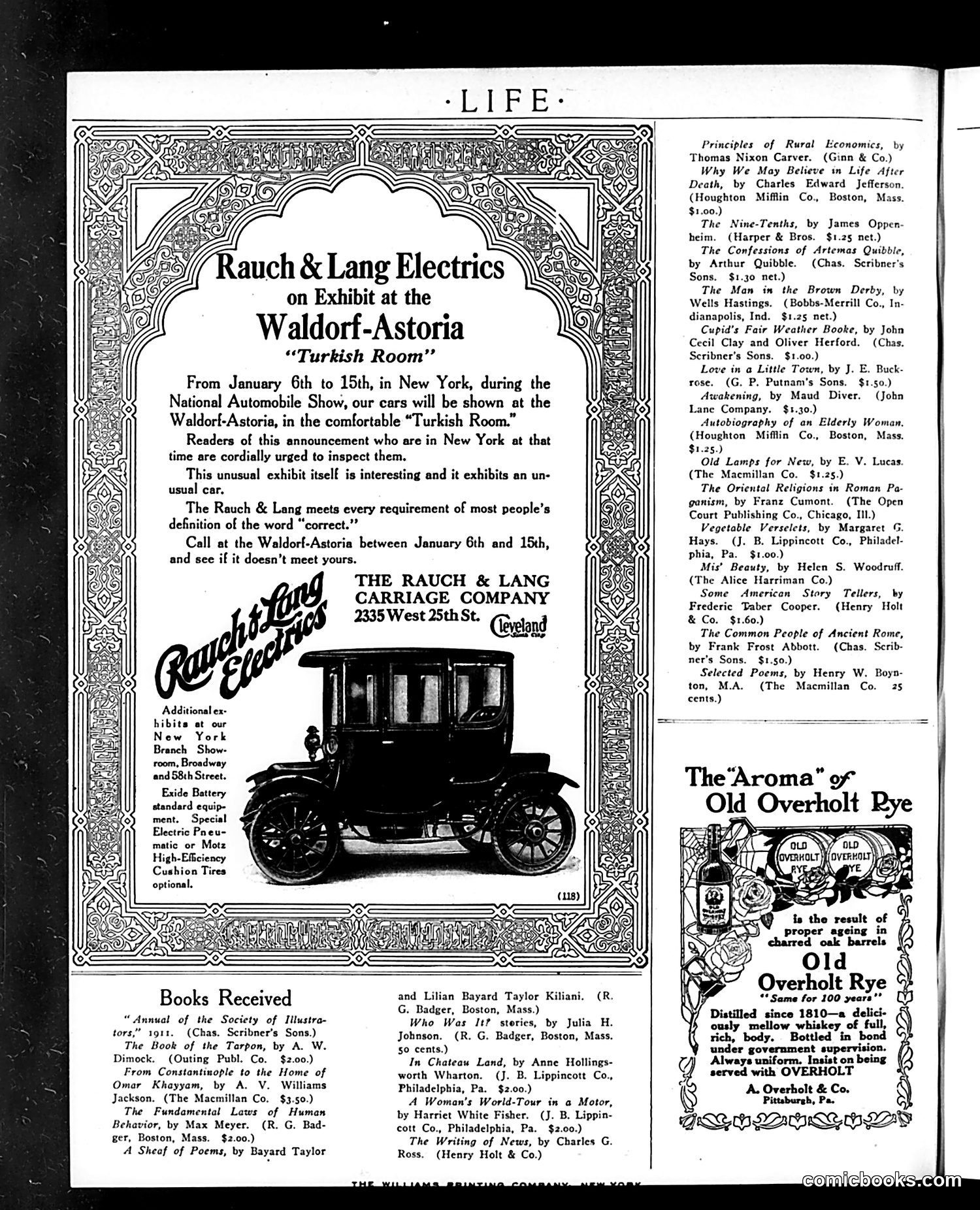
This page is primarily advertising and book reviews from an early 1900s Life magazine, with no political cartoons or satirical content to analyze. The main advertisement promotes Rauch & Lang electric automobiles, displayed at the Waldorf-Astoria's "Turkish Room" during the National Automobile Show (January 6-15, appearing to be around 1911). The company emphasizes the car's "correctness" and luxury features—positioning electric vehicles as refined, upscale transportation for wealthy customers. A secondary ad touts Old Overholt Rye whiskey, highlighting its century-old pedigree ("same for 100 years") and government-bond bottling as markers of quality. The bulk of the page lists newly received books on varied topics: rural economics, poetry, world travel, history, and fiction—typical literary fare for educated American readers of the period. No satire or commentary is evident; this is straightforward commercial and cultural content.
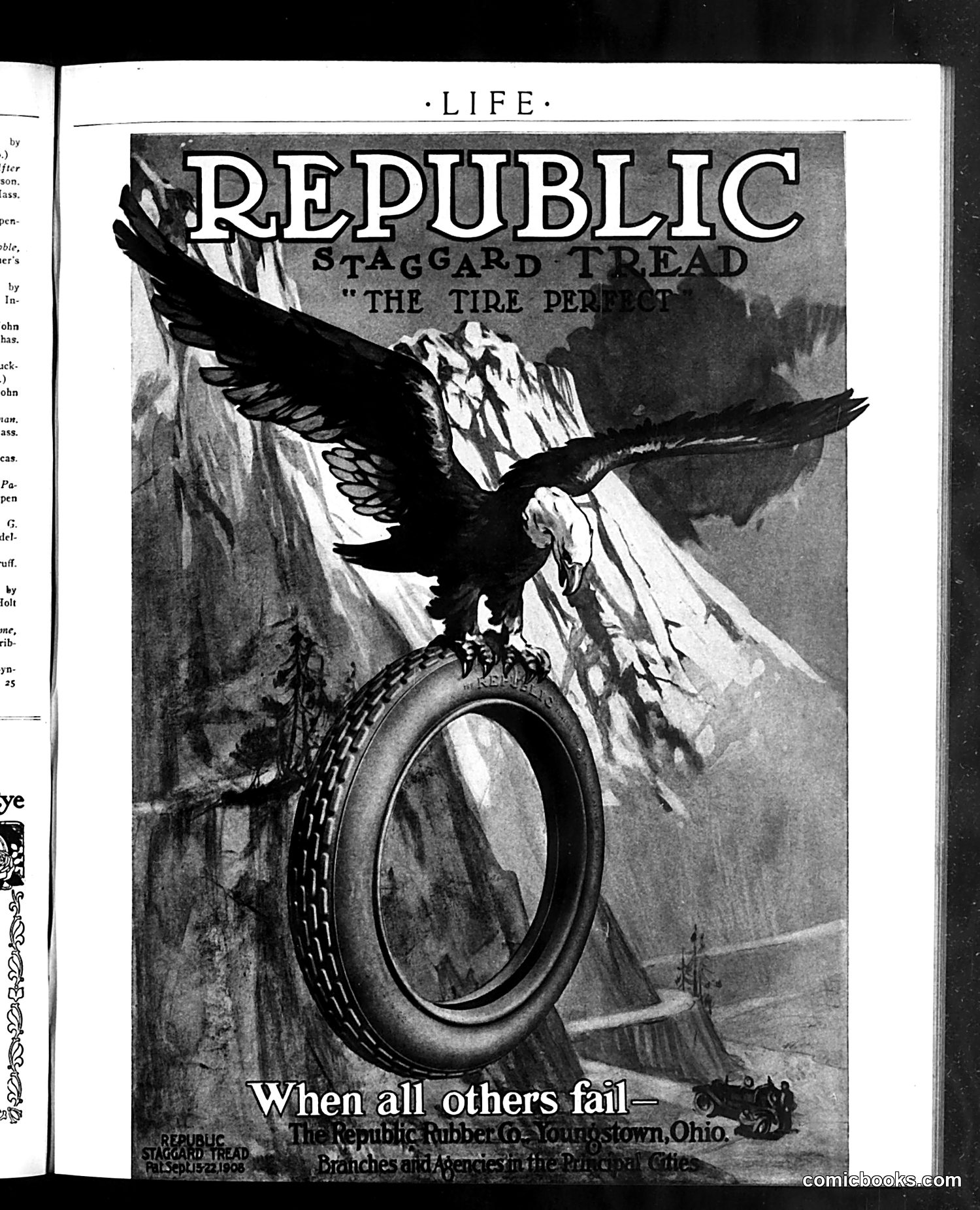
This is a **product advertisement** for Republic Staggard Tread tires, not a political cartoon. The ad features an eagle perched atop a large tire against a mountainous landscape, with the tagline "When all others fail—" The imagery appeals to American patriotism (the eagle as national symbol) to suggest Republic tires' reliability and superiority. The eagle's commanding posture on the tire implies strength and dependability. The company, Republic Rubber Co., was located in Youngstown, Ohio, with branches in major cities. The ad ran in *Life* magazine, which published both satirical content and advertisements. This represents early 20th-century advertising strategy: associating consumer products with patriotic symbols and national pride to encourage purchases.
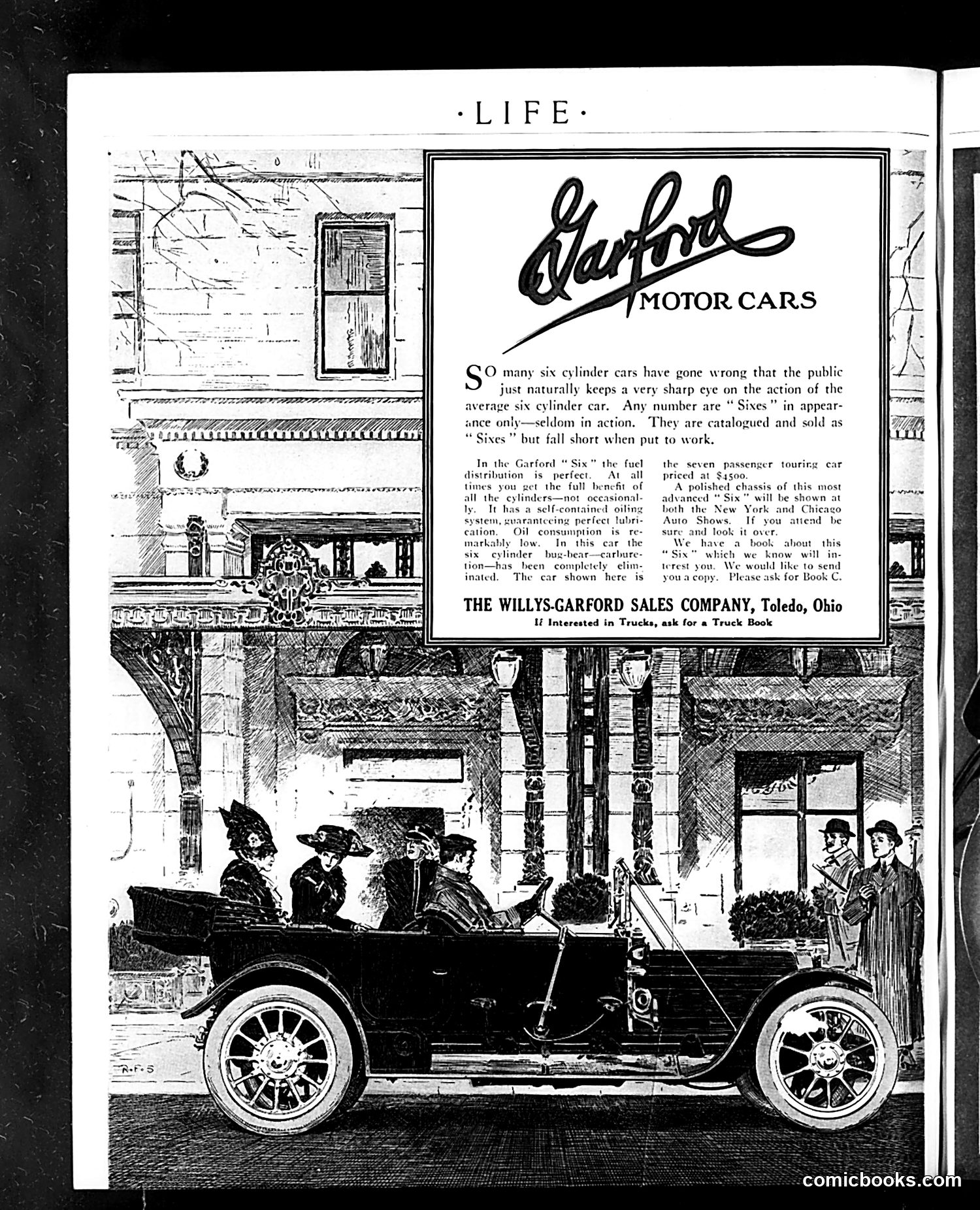
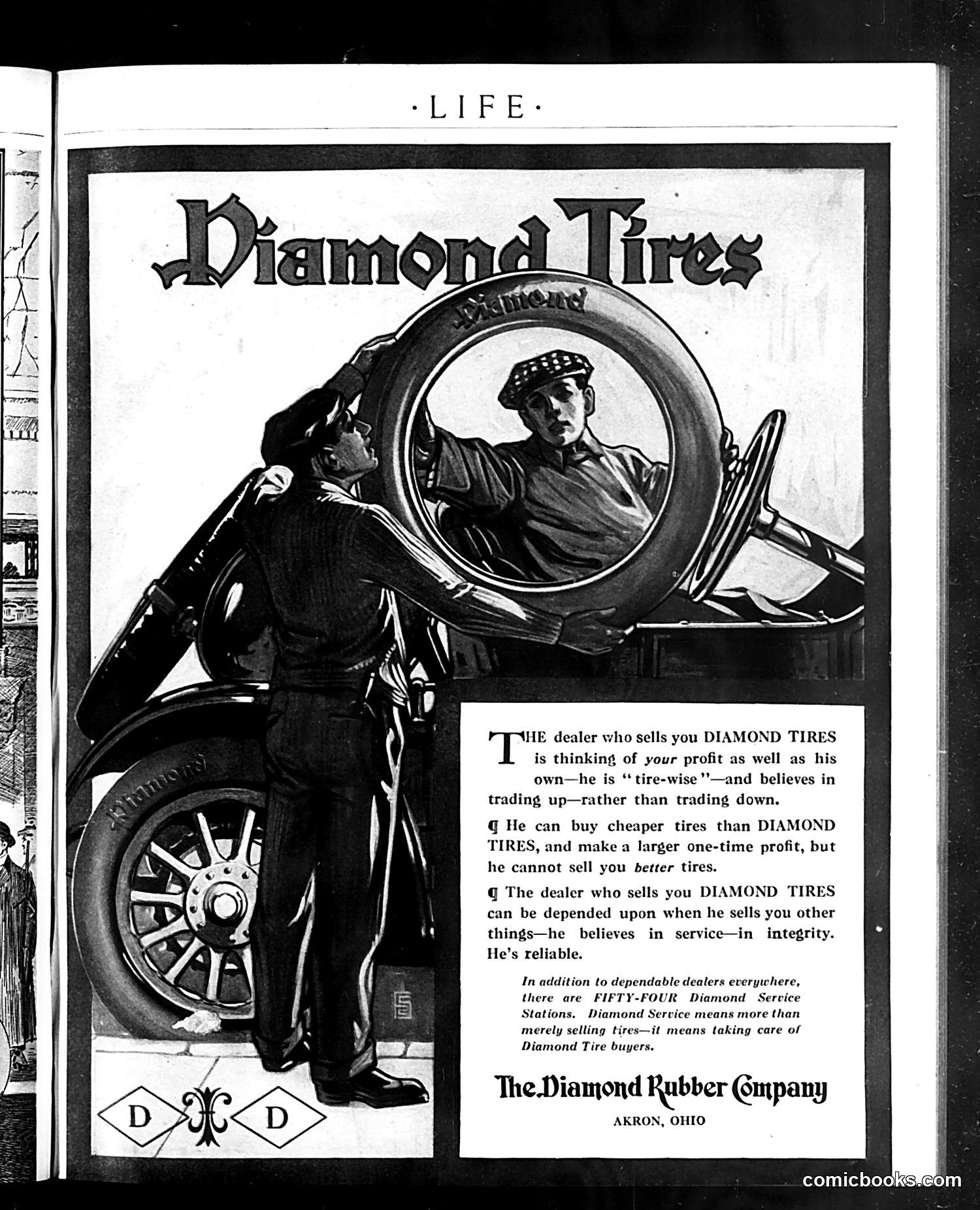
This is a **full-page advertisement**, not satire or political commentary. The Diamond Rubber Company (Akron, Ohio) uses a straightforward sales pitch: an illustration of a mechanic examining a tire serves as the visual hook. The ad's argument targets dealers: selling Diamond Tires means prioritizing customer loyalty and long-term reputation ("trading up") over quick profits from cheaper alternatives. The repeated emphasis on "integrity," "reliability," and "service" frames the brand as trustworthy—a dealer selling Diamond Tires is someone who cares about customers' welfare, not just one-time sales. The reference to "Fifty-Four Diamond Service Stations" suggests an early automotive service network. For modern readers, this reflects pre-standardized gas station era marketing, when tire quality and dealer reputation were primary purchase factors.
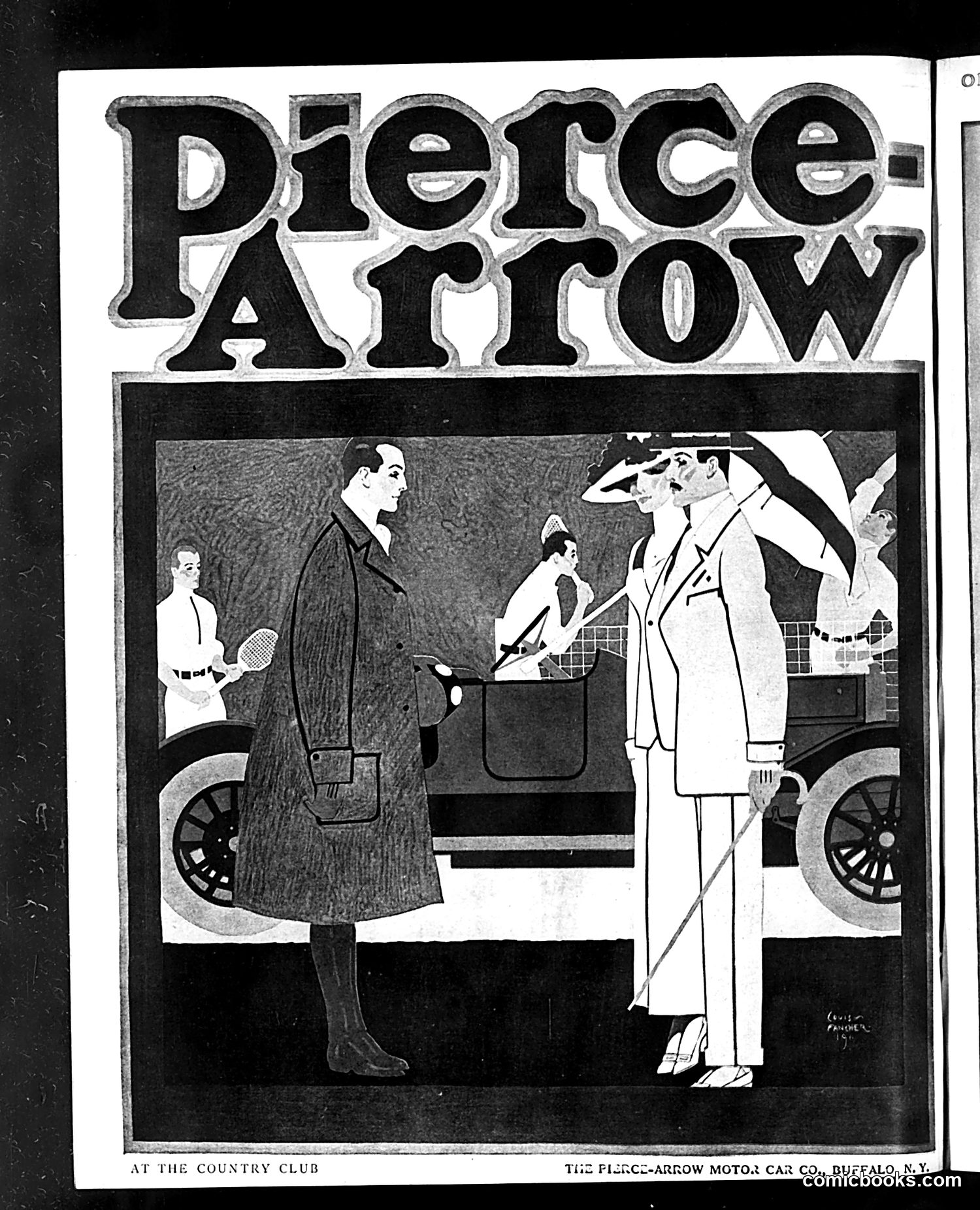
This is an advertisement for Pierce-Arrow automobiles disguised as a satirical cartoon titled "Pierce-Arrow." The image depicts a scene "At the Country Club" showing wealthy, fashionably-dressed figures posing with an expensive car. The satire likely mocks the pretensions of the wealthy leisure class and their obsession with displaying status symbols. The elongated, stylized figures in fashionable clothing exemplify Art Deco aesthetic conventions used in 1920s-era advertising to suggest sophistication and exclusivity. The joke for contemporary readers would be recognizing how automobile advertising exploited social aspiration—associating the product with country club membership, fashionable dress, and upper-class leisure activities to convince consumers that buying this car signified membership in an elite social world.