
Life, 1912-01-04 · page 50 of 108
Life — January 4, 1912 — page 50: what you’re looking at
What you’re looking at
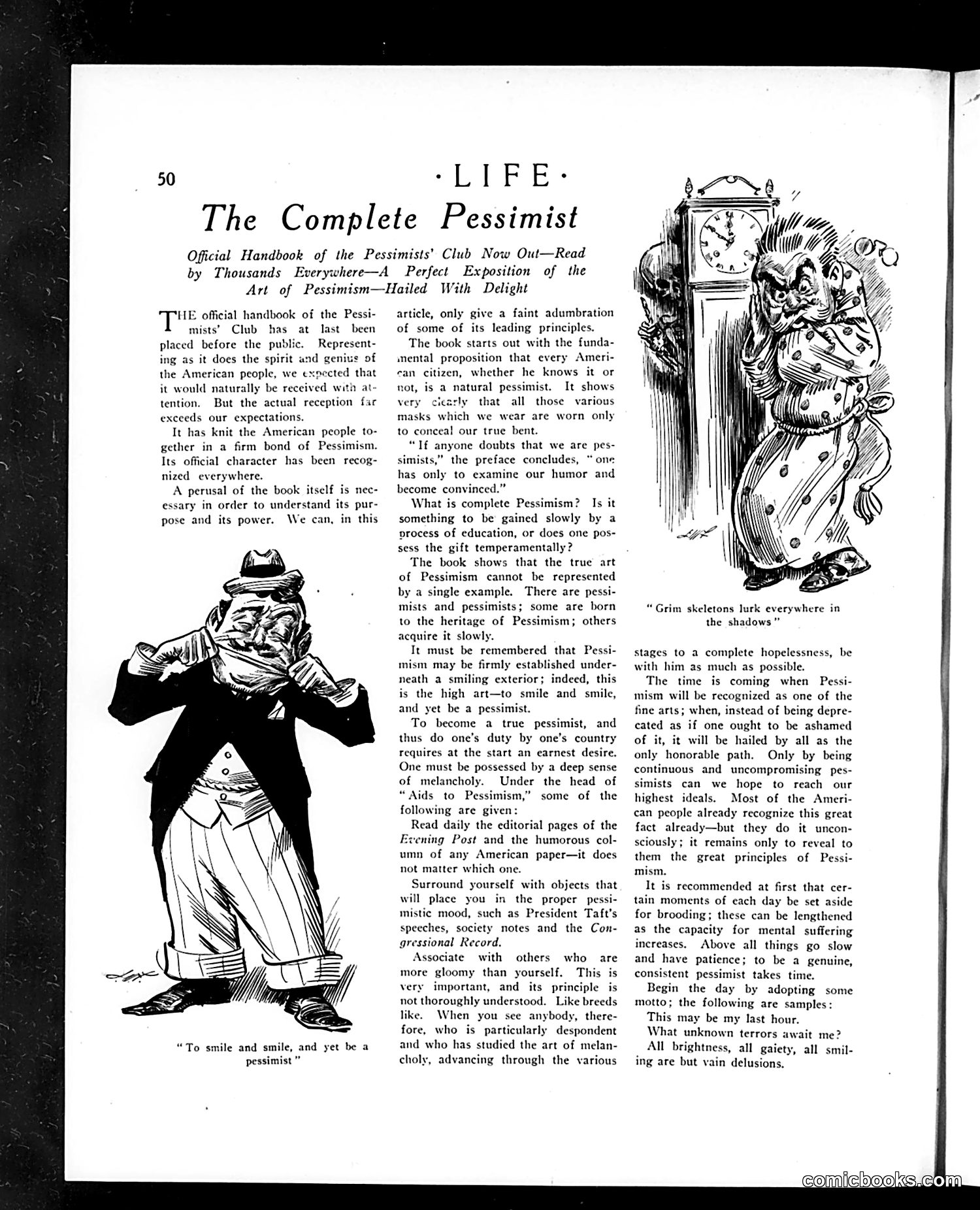
This article satirizes American pessimism by presenting a fake "official handbook" as if pessimism were an organized philosophy or club. The satire targets the prevailing mood of early 20th-century America—a culture of complaining masked by forced cheerfulness. The two accompanying cartoons illustrate this hypocrisy: figures in formal dress embody the contradiction of maintaining a respectable exterior while harboring deep gloom. One caption quotes Shakespeare ("To smile and smile, and yet be a pessimist"), emphasizing the performative nature of American optimism. The article mocks specific targets: President Taft's speeches, congressional records, and newspaper editorials are listed as tools for inducing despair—suggesting these institutions themselves were seen as depressing or incompetent. The satire suggests that Americans instinctively understand pessimism but haven't consciously acknowledged it. The overall joke: pessimism isn't learned; it's the natural American condition, merely dressed up in polite society.
📄 Transcribed text from this page (OCR, searchable)
Machine-transcribed from the original scan — historical spelling and the odd misread are preserved.
«LIFE The Complete Pessimist Official Handbook of the Pessimists' Club Now Out—Read by Thousands Everywhere—A Perfect Exposition of the Art of Pessimism—Hailed With Delight HE official handbook of the Pessi- mists’ Club has at last been placed before the pub Represent- ing as it does the spirit and genius of the American people, we expected that it would naturally be received with at- tention. But the actual reception far exceeds our expectations. It has knit the American people to- gether in a firm bond of Pessimism. Its official character has been recog- nized 1 vhere. A perusal of the book itself is nec- essary in order to understand its pur- pose and its power. We can, in this “To smile and smile, and yet be a pessimist " article, only give a faint adumbration of some of its leading principles. The book starts out with the funda- mental proposition that every Ameri- can citizen, whether he knows it or not, is a natural pessimist. It shows very clearly that all those various masks which we wear are worn only to conceal our true bent. “If anyone doubts that we are pes- simists,” the preface concludes, “ one has only to examine our humor and become convinced.” What is complete Pessimism? Is it something to be gained slowly by a process of education, or does one pos- sess the gift temperamentally? The book shows that the true art of Pessimism cannot be represented by a single example. There are pessi- mists and pessimists; some are born to the heritage of Pessimism; others acquire it slowly. It must be remembered that Pessi- mism may be firmly established under- neath a smiling exterior; indeed, this is the high art—to smile and smile, and yet be a pessimist. To become a true pessimist, and thus do one’s duty by one’s country requires at the start an earnest desire. One must be possessed by a deep sense of melancholy. Under the head of “Aids to Pessimism,” some of the following are given: Read daily the editorial pages of the ning Post and the humorous col- umn of any American paper—it does not matter which one. Surround yourself with objects that will place you in the proper pessi- mistic mood, such as President Taft's speeches, society notes and the Con- gressional Record, Associate with others who are more gloomy than yourself. This is very important, and its principle is not thoroughly understood. Like breeds When you see anybody, there- Who is particularly despondent and who has studied the art of melan- choly, advancing through the various | UM tet, “Grim skeletons lurk everywhere in the shadows” stages to a complete hopelessness, be with him as much as possible. The time is coming when Pessi- mism will be recognized as one of the fine arts; when, instead of being depre- cated as if one ought to be ashamed of it, it will be hailed by all as the only honorable path. Only by being continuous and uncompromising pes- simists can we hope to reach our highest ideals. Most of the Ameri- can people already recognize this great fact already—but they do it uncon- sciously; it remains only to reveal to them the great principles of Pessi- mism. It is recommended at first that cer- tain moments of each day be set aside for brooding; these can be lengthened as the capacity for mental suffering increases. Above all things go slow and have patience; to be a genuine, consistent pessimist takes time. Begin the day by adopting some motto; the following are samples: This may be my last hour. What unknown terrors await me? All brightness, all gaiety, all smil- ing are but vain delusions,