
Life, 1912-01-04 · page 57 of 108
Life — January 4, 1912 — page 57: what you’re looking at
What you’re looking at
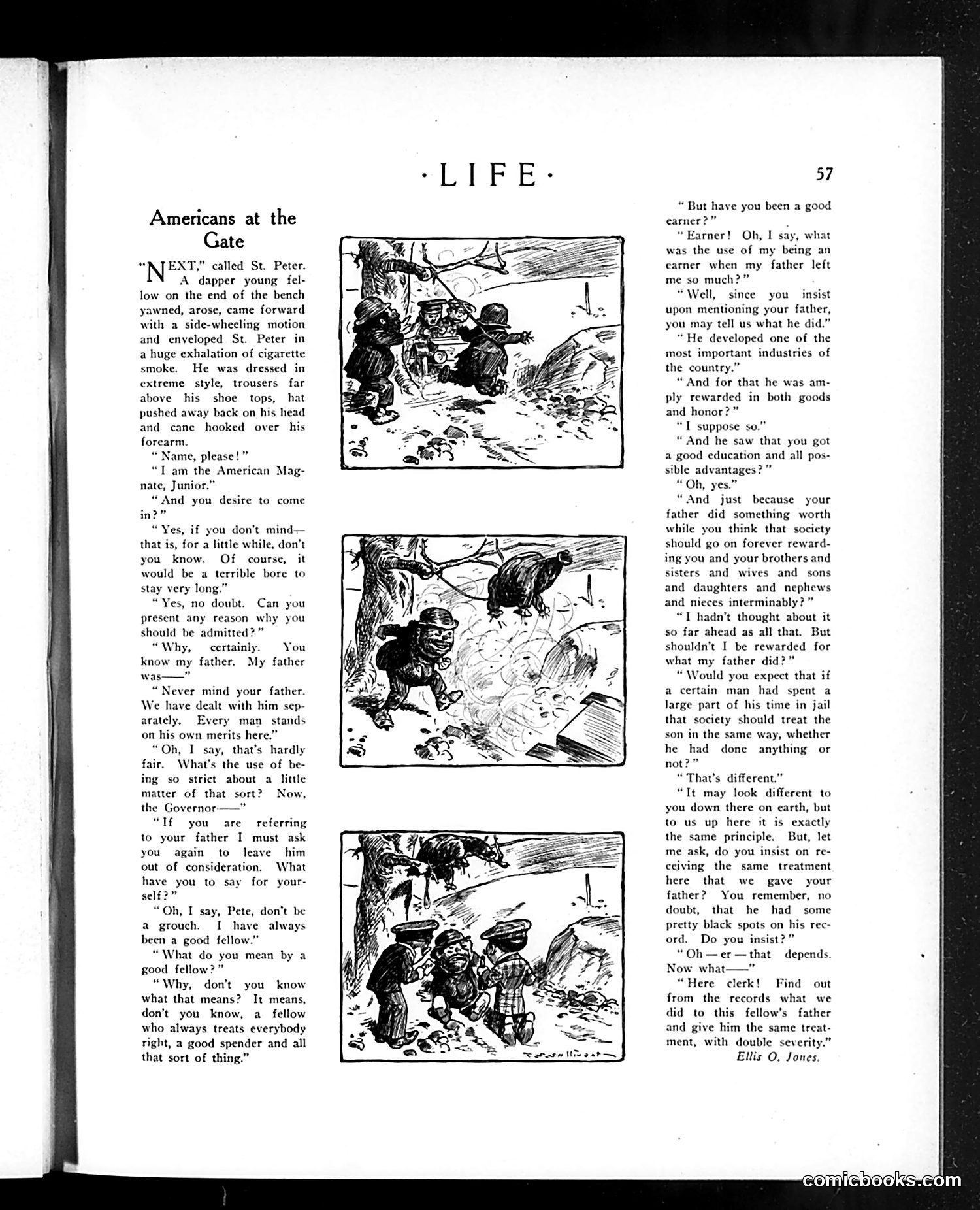
This is a satirical critique of wealthy American inheritors and the concept of inherited privilege. St. Peter interviews "the American Magnate, Junior" — a caricatured rich young man distinguished by exaggerated fashion (high-water pants, pushed-back hat, cane) and casual arrogance. The satire targets: **The protagonist's entitlement**: He assumes admission to heaven based solely on his father's accomplishments and wealth, not his own merits. He's confused when told he must earn entry independently. **"Good fellow" hypocrisy**: When asked to justify himself, he defines being "good" as spending money lavishly and treating people "right" — a shallow, consumerist morality. **Inherited privilege critique**: St. Peter's argument—that society shouldn't perpetually reward descendants for ancestors' achievements—directly challenges Gilded Age dynastic wealth concentration. The punchline: St. Peter orders the young man punished with the *same severity* his father received, rejecting any claim to preferential treatment. This reflects Progressive Era skepticism toward unearned wealth and dynastic power consolidation.
📄 Transcribed text from this page (OCR, searchable)
Machine-transcribed from the original scan — historical spelling and the odd misread are preserved.
Americans at the Gate “NTEXT,” called St. Peter. A dapper young fel- low on the end of the bench yawned, arose, came forward with a side-wheeling motion and enveloped St. Peter in a huge exhalation of cigarette smoke. He was dressed in extreme style, trousers far above his shoe tops, hat pushed away back on his head and cane hooked over his forearm. “ Name, please!” “Tam the American Mag- nate, Junior.” And you desire to come in?” “Yes, if you don’t mind— that is, for a little while, don’t you know. Of course, it would be a terrible bore to stay very long.” “Yes, no doubt. Can you present any reason why you should be admitted?” “Why, certainly. You know my father. My father was—” ver mind your father. We have dealt with him sep- arately. Every man stands on his own merits here,” “Oh, I say, that’s hardly fair. yi the use of be- ing so strict about a little matter of that sort? Now, the Governor—” “Tf you are referring to your father I must ask you again to leave him out of consideration. What have you to say for your- self?” “Oh, I say, Pete, don’t be a grouch. I have always been a good fellow “What do you mean by a good fellow? “Why, don't you know what that means? It means, don’t you know, a_ fellow who always treats everybody right, a good spender and all that sort of thing.” 57 “ But have you been a good earner?” arner! Oh, I say, what was the use of my being an earner when my father left me so much?” “Well, since you insist upon mentioning your father, you may tell us what he did.” “He developed one of the most important industries of the country.” “And for that he was am- ply rewarded in both goods and honor?” “T suppose so.” “And he saw that you got a good education and all pos- sible advantages?” “Oh, yes.” “And just’ because your father did something worth while you think that society should go on forever reward- ing you and your brothers and sisters and wives and sons and daughters and nephews and nieces interminably?” “T hadn’t thought about it so far ahead as all that. But shouldn't I be rewarded for what my father did?” “Would you expect that if a certain man had spent a large part of his time in jail that society should treat the son in the same way, whether he had done anything or not?” “That's different.” “Tt may look different to you down there on earth, but to us up here it is exactly the same principle. But, let me ask, do you insist on re- ceiving the same treatment here that we gave your father? You remember, no doubt, that he had some pretty black spots on his rec- ord. Do you insist?” “Oh—er—that depends Now what—' “Here clerk! Find out from the records what we did to this fellow’s father and give him the same treat- ment, with double severity.” Ellis O. Jones.