
Life, 1912-01-04 · page 65 of 108
Life — January 4, 1912 — page 65: what you’re looking at
What you’re looking at
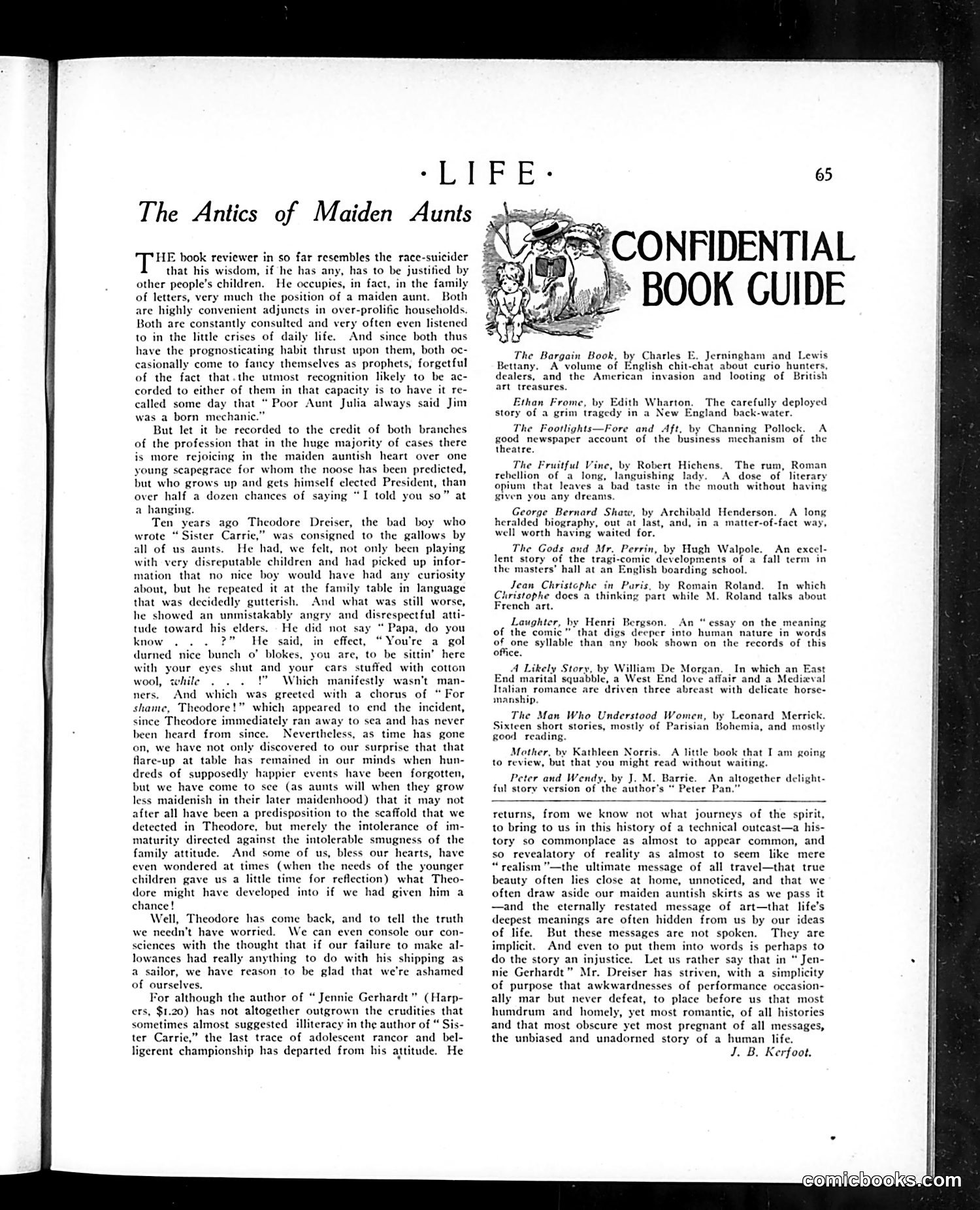
This is a book review essay, not a political cartoon. The "maiden aunt" is a metaphorical figure representing literary critics who judge books moralistically, like disapproving family elders. The essay uses Theodore Dreiser as its central example. Ten years prior, critics (the "aunts") condemned his novel *Sister Carrie* as scandalous—featuring "disreputable" content and disrespectful language toward authority. Dreiser responded by withdrawing from public life ("ran away to sea"). Now, reviewing his new novel *Jennie Gerhardt*, the critic reflects that those earlier judgments were premature and self-righteous. Dreiser has matured beyond "adolescent rancor," proving the aunts wrong. The satire targets critical smugness: how literary arbiters mistake youthful rebellion for moral corruption, only to be humbled by an author's later success and artistic growth.
📄 Transcribed text from this page (OCR, searchable)
Machine-transcribed from the original scan — historical spelling and the odd misread are preserved.
-LIFE- 65 The Antics of Maiden Aunts HE book reviewer in so far resembles the race-suicider that his wisdom, if he has any, has to be justified by other people’s children. He occupies, in fact, in the family of letters, very much the position of a maiden aunt. Both are highly convenient adjuncts in over-prolific households. Both are constantly consulted and very often even listened to in the little crises of daily life. And since both thus have the prognosticating habit thrust upon them, both oc- casionally come to fancy themselves as prophets, forgetful of the fact that.the utmost recognition likely to be ac- corded to either of them in that capacity is to have it re- called some day that “Poor Aunt Julia always said Jim was a born mechanic.” But let it be recorded to the credit of both branches of the profession that in the huge majority of cases there is more rejoicing in the maiden auntish heart over one young scapegrace for whom the noose has been predicted, but who grows up and gets himself elected President, than over half a dozen chances of saying “I told you so” at a hangin; Ten years ago Theodore Dreiser, the bad boy who wrote “Sister Carrie,” was consigned to the gallows by 1 of us aunts. He had, we felt, not only been playing with very disreputable children and had picked up infor- mation that no nice boy would have had any curiosity about, but he repeated it at the family table in language that was decidedly gutterish, And what was still worse, he showed an unmistakably angry and disrespectful atti- tude toward his elders. He did not say “Papa, do you know . . . ?” He said, in effect, “You're a gol durned nice bunch o’ blokes, you are, to be sittin’ here with your eyes shut and your cars stuffed with cotton wool, while... !" Which manifestly wasn’t: man- ners. And which was greeted with a chorus of “ For shame, Theodore!” which appeared to end the incident, since Theodore immediately ran away to sea and has never been heard from since. Nevertheless, as time has gone on, we have not only discovered to our surprise that that flare-up at table has remained in our minds when hun- dreds of supposedly happier events have been forgotten, but we have come to sce (as aunts will when they grow less maidenish in their later maidenhood) that it may not after all have been a predisposition to the scaffold that we detected in Theodore, but merely the intolerance of im- maturity directed against the intolerable smugness of the family attitude. And some of us, bless our hearts, have even wondered at times (when the needs of the younger children gave us a little time for reflection) what Theo- dore might have developed into if we had given him a chance! Well, Theodore has come back, and to tell the truth we needn't have worried. We can even console our con- sciences with the thought that if our failure to make al- lowances had really anything to do with his shipping as a sailor, we have reason to be glad that we're ashamed of ourselves, For although the author of “ Jennie Gerhardt” (Harp- ers, $1.20) has not altogether outgrown the crudities that sometimes almost suggested illiteracy in the author of “ Sis- ter Carrie,” the last trace of adolescent rancor and bel- ligerent championship has departed from his attitude. He CONFIDENTIAL BOOK GUIDE The Bargain Book, by Charles E. Jerningham and Lewis Bettany, A volume of English chit-chat about curio hunters, dealers, and the American invasion and looting of British art treasures. Ethan Frome, by Edith Wharton. The carefully deployed story of a grim tragedy in a New England back-water. The Footlights—Fore and Aft. by Channing Pollock. A good newspaper account of the business mechanism of the theatre. The Fruitful Vine, by Robert Hichens. The rum, Roman rebellion of a long, languishing lady. A dose of’ literary opium that leaves a’ bad taste in the mouth without having given you any dreams George Bernard Shaw, by Archibald Henderson. A long heralded biography, out at last, and, in a matter-of-fact way, well worth having waited for. The Gods and Mr. Perrin, by Hugh Walpole. An excel- lent story of the tragi-comic ‘developments of a fall term in the masters’ hall at an English boarding school. Jean Christophe in Paris, by Romain Roland. In which Christophe does a thinking part while M. Roland talks about French art. Laughter, by Henri Bergson. An “essay on the meaning of the comic” that digs deeper into human nature in words of one syllable than any hook shown on the records of this office. __ A Likely Story, by William De Morgan. In which an East End marital squabble, a West End love affair and a Medieval Italian romance are driven three abreast with delicate horse- manship. _ The Man Who Understood Women, by Leonard Merrick Sixteen short stories, mostly of Parisian Bohemia, and mostly good reading. Mother, by Kathleen Norris. A little book that I am going to review, but that you might read without waiting. Peter and Wendy, by J. M. Barrie ful story version of the author's “ An altogether delight- Peter Pan.” returns, from we know not what journeys of the spirit, to bring to us in this history of a technical outcast—a his- tory so commonplace as almost to appear common, and so revealatory of reality as almost to seem like mere “realism "—the ultimate message of all travel—that true beauty often lies close at home, unnoticed, and that we often draw aside our maiden auntish skirts as we pass it —and the eternally restated message of art—that life’s deepest meanings are often hidden from us by our ideas of life. But these messages are not spoken. They are implicit. And even to put them into words is perhaps to do the story an injustice. Let us rather say that in “ Jen- nie Gerhardt” Mr. Dreiser has striven, with a simplicity of purpose that awkwardnesses of performance occasion- ally mar but never defeat, to place before us that mos' humdrum and homely, yet most romantic, of all histories and that most obscure yet most pregnant of all messages, the unbiased and unadorned story of a human life. J. B. Kerfoot.