
Life, 1912-01-04 · page 92 of 108
Life — January 4, 1912 — page 92: what you’re looking at
What you’re looking at
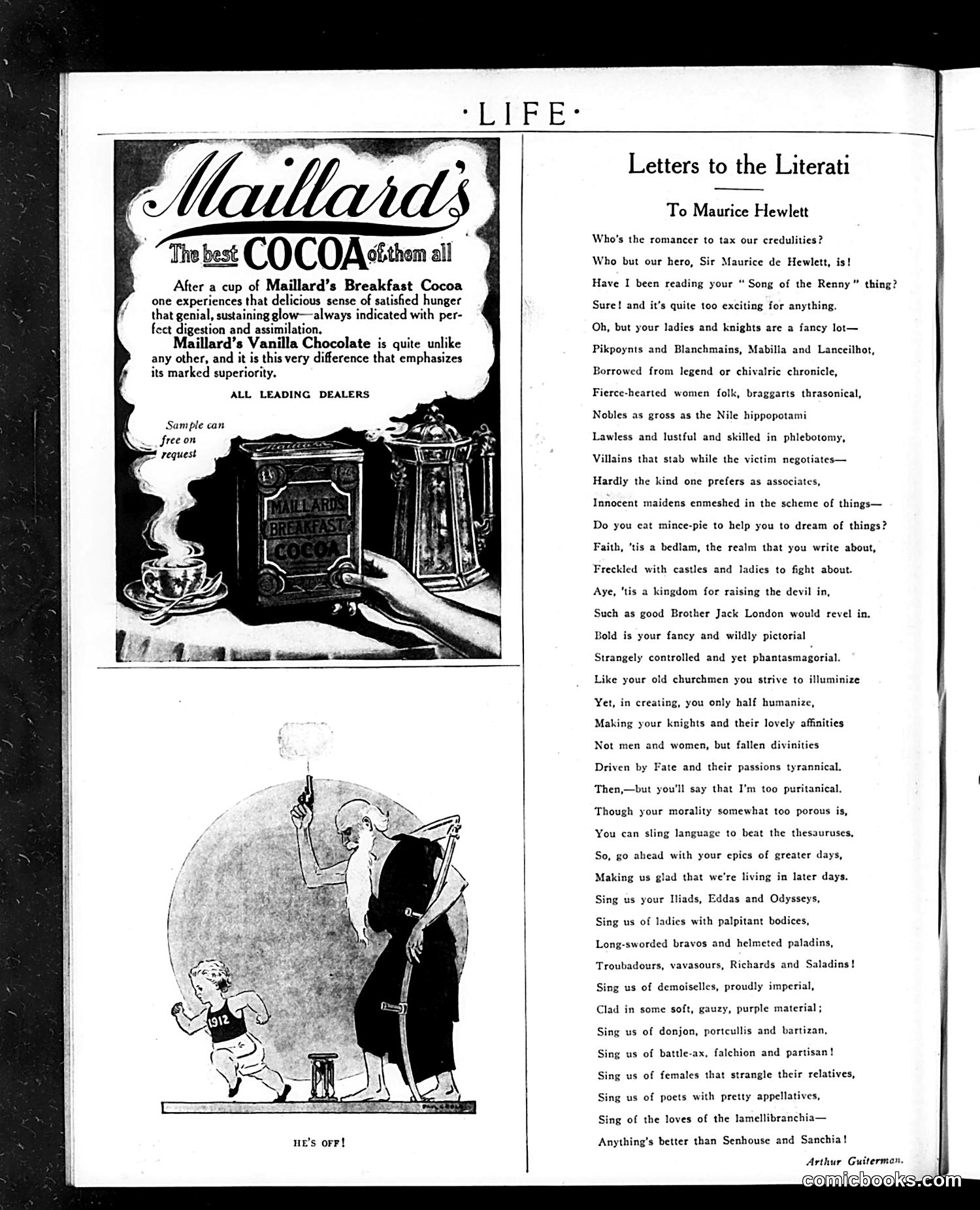
**Maillard's Cocoa Advertisement** (top left): Standard early 20th-century product advertising claiming superior digestive benefits—typical of an era before FDA regulation when such health claims were unregulated. **"He's Off!" Cartoon** (bottom left): Shows an adult (likely a governess or nanny) launching a small child like a projectile. The joke appears to be dark humor about child-rearing frustrations—a period-appropriate satire on exasperated caretakers, though it would be considered shockingly inappropriate today. **"Letters to the Literati"** (right): A satirical poem by Arthur Guiterman mocking novelist Maurice Hewlett's romantic fantasy fiction. Guiterman criticizes Hewlett's medieval-themed novels as overstuffed with borrowed legendary characters, exaggerated emotions, and unrealistic heroics—essentially complaining that the author trades genuine humanity for theatrical excess. The closing suggests *any* fantasy content beats contemporary realistic fiction by Senhouse and Sanchia.
📄 Transcribed text from this page (OCR, searchable)
Machine-transcribed from the original scan — historical spelling and the odd misread are preserved.
The best COCOA stthen ail . After a cup of Maillard’s Breakfast Cocoa one experiences that delicious sense of satisfied hunger that genial, sustaining glow—always indicated per- feet digestion and assimilation. Maillard’s Vanilla Chocolate is quite unlike any other, and it is this very difference that emphasizes its marked superiority. ALL LEADING DEALERS Sample can free on request E's oFF! Letters to the Literati To Maurice Hewlett Who's the romancer to tax our credulities? Who but our hero, Sir Maurice de Hewlett, is! Have I been reading your “ Song of the Renny” thing? Sure! and it’s quite too exciting for anything. Oh, but your ladies and knights are a fancy lot— Pikpoynts and Blanchmains, Mabilla and Lanceilhot, Borrowed from legend or chivalric chronicle, Fierce-hearted women folk, braggarts thrasonical, Nobles as gross as the Nile hippopotami Lawless and lustful and skilled in phlebotomy, Villains that stab while the victim negotiates— Hardly the kind one prefers as associates, Innocent maidens enmeshed in the scheme of things— Do you eat mince-pie to help you to dream of things? Faith, ‘tis a bedlam, the realm that you write about, Freckled with castles and ladies to fight about. Aye, 'tis a kingdom for raising the devil in, Such as good Brother Jack London would revel in. Bold is your fancy and wildly pictorial Strangely controlled and yet phantasmagorial. Like your old churchmen you strive to illuminize Yet, in creating, you only half humanize, Making your knights and their lovely affinities Not men and women, but fallen divinities Driven by Fate and their passions tyrannical. Then,—but you'll say that I'm too puritanical. Though your morality somewhat too porous is, You can sling language to beat the thesauruses, So, go ahead with your epics of greater days, Making us glad that we're living in later days. Sing us your Iliads, Eddas and Odysseys, Sing us of ladics with palpitant bodices, Long-sworded bravos and helmeted paladins, Troubadours, vavasours, Richards and Saladins! Sing us of demoiselles, proudly imperia Clad in some soft, gauzy, purple material; Sing us of donjon, portcullis and bartizan, Sing us of battle-ax, falchion and partisan! Sing us of females that strangle their relatives, Sing us of poets with pretty appellatives, Sing of the loves of the lamellibranchia— Anything's better than Senhouse and Sanchia! Arthur Guiterman.