
Life, 1912-01-04 · page 72 of 108
Life — January 4, 1912 — page 72: what you’re looking at
What you’re looking at
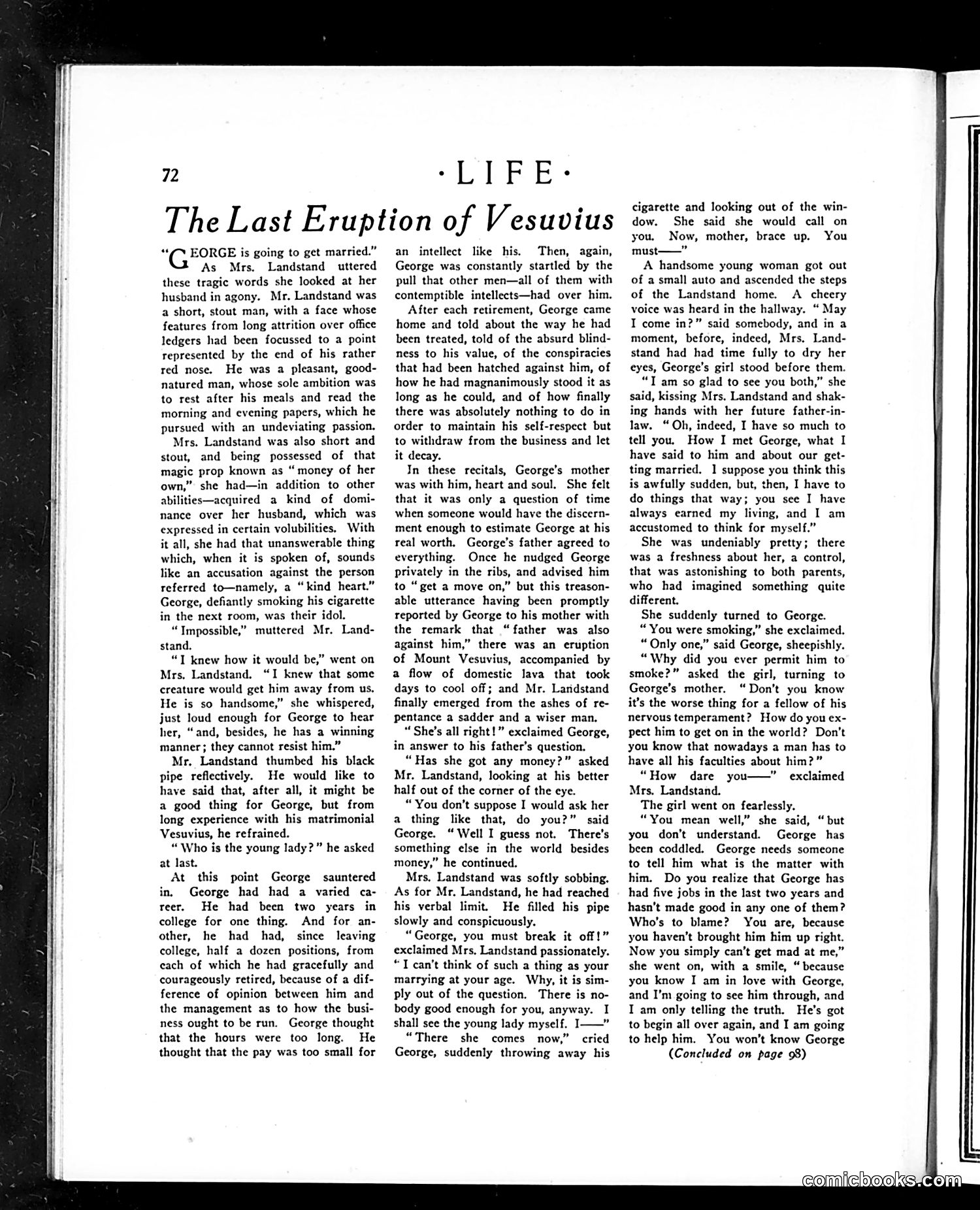
This is a satirical short story (not a cartoon) about George, a perpetually unemployed young man living with his parents. The humor lies in George's character: he's handsome and articulate but chronically jobless, always blaming employers for "conspiracies" against him rather than accepting responsibility. The "Vesuvius" metaphor refers to George's mother—a domineering woman who erupts in rage whenever her husband gently criticizes their son. Mr. Landstand, the father, has learned to suppress all honest opinion to avoid her volcanic temperament. The satire targets a recognizable social type: the privileged, delusional young man who mistakes sensitivity and self-regard for intelligence, expecting the world to accommodate his inflated sense of worth. His engagement announcement triggers the family drama that unfolds across the page, with his mother's irrational protectiveness portrayed as both comic and pathetic.
📄 Transcribed text from this page (OCR, searchable)
Machine-transcribed from the original scan — historical spelling and the odd misread are preserved.
72 ‘LIFE: The Last Eruption of Vesuvius “G FORGE is going to get married.” As Mrs. Landstand uttered these tragic words she looked at her husband in agony. Mr. Landstand was a short, stout man, with a face whose features from long attrition over office ledgers had been focussed to a point represented by the end of his rather red nose. He was a pleasant, good- natured man, whose sole ambition was to rest after his meals and read the morning and evening papers, which he pursued with an undeviating passion. Mrs. Landstand was also short and stout, and being possessed of that magic prop known as “money of her own,” she had—in addition to other abilities—acquired a kind of domi- nance over her husband, which was expressed in certain volubilities, With it all, she had that unanswerable thing which, when it is spoken of, sounds like an accusation against the person referred to—namely, a “kind heart.” George, defiantly smoking his cigarette in the next room, was their idol. “Impossible,” muttered Mr. Land- stand. “1 knew how it would be,” went on Mrs, Landstand. “I knew that some creature would get him away from us. He is so handsome,” she whispered, just loud enough for George to hear her, “and, besides, he has a winning manner; they cannot resist him.” Mr. Landstand thumbed his black pipe reflectively. He would like to have said that, after all, it might be a good thing for George, but from long experience with his matrimonial Vesuvius, he refrained. “Who is the young lady?” he asked at last. At this point George sauntered in. George had had a varied ca- reer. He had been two years in college for one thing. And for an- other, he had had, since leaving college, half a dozen positions, from each of which he had gracefully and courageously retired, because of a dif- ference of opinion between him and the management as to how the busi- ness ought to be run. George thought that the hours were too long. He thought that the pay was too small for an intellect like his. Then, again, George was constantly startled by the pull that other men—all of them with contemptible intellects—had over him. After each retirement, George came home and told about the way he had been treated, told of the absurd blind- ness to his value, of the conspiracies that had been hatched against him, of how he had magnanimously stood it as long as he could, and of how finally there was absolutely nothing to do in order to maintain his self-respect but to withdraw from the business and let it decay. In these recitals, George’s mother was with him, heart and soul. She felt that it was only a question of time when someone would have the discern- ment enough to estimate George at his real worth. George’s father agreed to everything. Once he nudged George privately in the ribs, and advised him to “get a move on,” but this treason- able utterance having been promptly reported by George to his mother with the remark that “father was also against him,” there was an eruption of Mount Vesuvius, accompanied by a flow of domestic Java that took days to cool off; and Mr. Laridstand finally emerged from the ashes of re- pentance a sadder and a wiser man, “ She’s all right!” exclaimed George, in answer to his father’s question. “Has she got any money?” asked Mr. Landstand, looking at his better half out of the corner of the eye. “You don’t suppose I would ask her a thing like that, do you?” said George. “Well I guess not. There’s something else in the world besides money,” he continued. Mrs. Landstand was softly sobbing. As for Mr. Landstand, he had reached his verbal limit. He filled his pipe slowly and conspicuously. “George, you must break it off!” exclaimed Mrs, Landstand passionately. “Tcan’t think of such a thing as your marrying at your age. Why, it is sim- ply out of the question. There is no- body good enough for you, anyway. I shall see the young lady myself. I——” “There she comes now,” cried George, suddenly throwing away his cigarette and looking out of the win- dow. She said she would call on you. Now, mother, brace up. You must——” A handsome young woman got out of a small auto and ascended the steps of the Landstand home. A cheery voice was heard in the hallway. “ May I come in?” said somebody, and in a moment, before, indeed, Mrs. Land- stand had had time fully to dry her eyes, George's girl stood before them. “T am so glad to see you both,” she said, kissing Mrs. Landstand and shak- ing hands with her future father-in- law. “Oh, indeed, I have so much to tell you. How I met George, what I have said to him and about our get- ting married. 1 suppose you think this is awfully sudden, but, then, I have to do things that way; you see I have always earned my living, and I am accustomed to think for myself.” She was undeniably pretty; there was a freshness about her, a control, that was astonishing to both parents, who had imagined something quite different. She suddenly turned to George. “You were smoking,” she exclaimed. “Only one,” said George, sheepishly. “Why did you ever permit him to smoke?” asked the girl, turning to George's mother. “Don’t you know it’s the worse thing for a fellow of his nervous temperament? How do you ex- pect him to get on in the world? Don't you know that nowadays a man has to have all his faculties about him?” “How dare you——” exclaimed Mrs. Landstand. The girl went on fearlessly. “You mean well,” she said, “but you don’t understand. George has been coddled. George needs someone to tell him what is the matter with him. Do you realize that George has had five jobs in the last two years and hasn't made good in any one of them? Who's to blame? You are, because you haven’t brought him him up right. Now you simply can’t get mad at me,” she went on, with a smile, “because you know I am in love with George, and I’m going to see him through, and I am only telling the truth. He’s got to begin all over again, and I am going to help him. You won't know George (Concluded on page 98)