
Life, 1912-01-04 · page 81 of 108
Life — January 4, 1912 — page 81: what you’re looking at
What you’re looking at
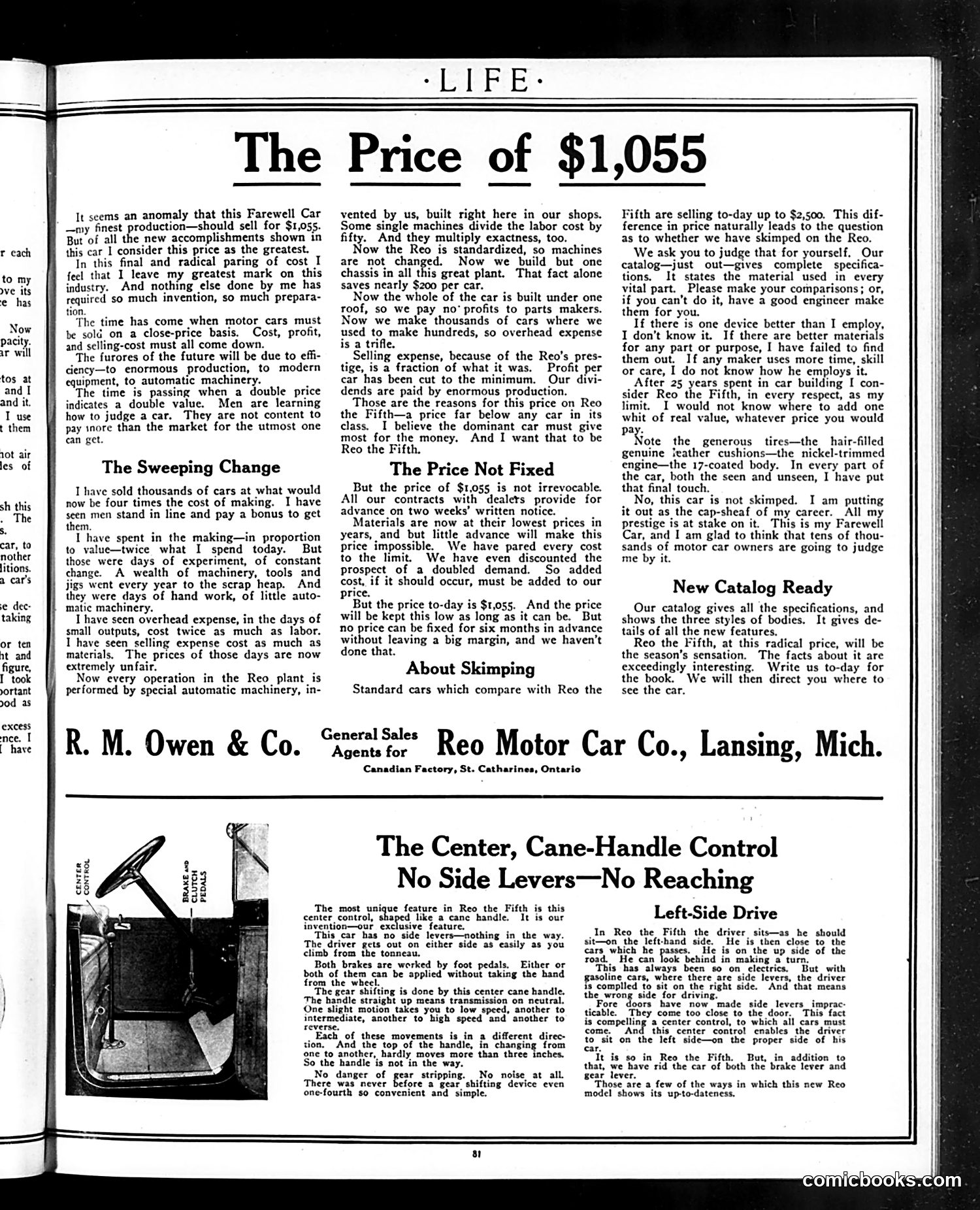
This is **not a cartoon or satirical content**—it's a straightforward advertisement for the Reo Motor Car Company's "Reo the Fifth" automobile, priced at $1,055. The page features an extended sales pitch, apparently written by R.M. Owen (the manufacturer), defending the surprisingly low price point. Owen argues that modern manufacturing innovations—automatic machinery, standardized parts, consolidated production under one roof, and elimination of hand labor—allow him to sell at this price while maintaining quality. The defensive tone ("We ask you to judge that for yourself") suggests contemporary skepticism that such a low price didn't mean cutting corners. Owen also acknowledges price volatility due to material costs, warning the $1,055 price isn't permanently fixed. Below the main text is technical information about the car's distinctive "cane-handle" steering control and left-side drive positioning. This is product advertising, not satire.
📄 Transcribed text from this page (OCR, searchable)
Machine-transcribed from the original scan — historical spelling and the odd misread are preserved.
r cach to my ve its e has Now pacity. ar will tos at and I and it. T use t them ot air les of sh this . The . car, to nother litions. a car's ie dec: taking or ten nt and figure, I took yortant od as excess nce. I | have | | It seems an anomaly that this Farewell Car —my finest production—should sell for $1,055. But of all the new accomplishments shown in this car 1 consider this price as the greatest. In this final and radical paring of cost I feel that I leave my greatest mark on this industry. And nothing else done by me has required so much invention, so much prepara- The time has come when motor cars must be sold on a close-price basis. Cost, profit, and selling-cost must all come down. The furores of the future will be due to effi- cency—to enormous production, to modern equipment, to automatic machinery. . The time is passing when a double price indicates a double value. Men are learning how to judge a car. They are not content to pay snore than the market for the utmost one can get. The Sweeping Change I have sold thousands of cars at what would now be four times the cost of making. I have seen men stand in line and pay a bonus to get them. I have spent in the making—in proportion to value—twice what I spend today. But those were days of experiment, of constant change. A wealth of machinery, tools and jigs went every year to the scrap heap. And they were days of hand work, of little auto- matic machinery. T have seen overhead expense, in the days of small outputs, cost twice as much as labor. T have seen selling expense cost as much as materials, The prices of those days are now extremely unfair. Now every operation in the Reo plant performed by special automatic machinery, it R. M. Owen & Co. General Sales Price of vented by us, built right here in our shops. Some single machines divide the labor cost by fifty. And they multiply exactness, too. Now the Reo is standardized, so machines are not changed. Now we build but one chassis in all this great plant. That fact alone saves nearly $200 per car. Now the whole of the car is built under one roof, so we pay no’ profits to parts makers. Now we make thousands of cars where we used to make hundreds, so overhead expense is a trifle. Selling expense, because of the Reo’s pres- tige, is a fraction of what it was. Profit per car has been cut to the minimum. Our divi- dends are paid by enormous production. Those are the reasons for this price on Reo the Fifth—a price far below any car in its class. I believe the dominant car must give most for the money. And I want that to be Reo the Fifth. The Price Not Fixed But the price of $1,055 is not irrevocable. All our contracts with dealers provide for advance on two weeks’ written notice. Materials are now at their lowest prices in years, and but little advance will make this price impossible. We have pared every cost to the limit. We have even discounted the Prospect of a doubled demand. So added cost, if it should occur, must be added to our price. But the price to-day is $1,055. And the price will be kept this low as long as it can be. But no price can be fixed for six months in advance without leaving a big margin, and we haven't done that. About Skimping Standard cars which compare with Reo the Agents for $1,055 Fifth are selling to-day up to $2,500. This dif- ference in price naturally leads to the question as to whether we have skimped on the Reo. We ask you to judge that for yourself. Our catalog—just out—gives complete specifica- tions. It states the material used in every vital part. Please make your comparisons; or, if you can’t do it, have a good engineer make them for you. If there is one device better than I employ, I don’t know it. If there are better materials for any part or purpose, I have failed to find them out. If any maker uses more time, skill or care, I do not know how he employs it. After 25 years spent in car building I con- sider Reo the Fifth, in every respect, as my limit. I would not know where to add one whit of real value, whatever price you would pay. Note the generous tires—the hair-filled genuine ieather cushions—the nickel-trimmed engine—the 17-coated body. In every part of the car, both the seen and unseen, I have put that final touch. No, this car is not skimped. I am putting it out as the cap-sheaf of my career. All my prestige is at stake on it. This is my Farewell Car, and I am glad to think that tens of thou- sands of motor car owners are going to judge me by it. New Catalog Ready Our catalog gives all the specifications, and shows the three styles of bodies. It gives de- tails of all the new features, Reo the Fifth, at this radical price, will be the season’s sensation. The facts about it are exceedingly interesting. Write us to-day for the book. We will then direct you where to see the car. Reo Motor Car Co., Lansing, Mich. Canadian Factory, St. Catharines, Ontario The Center, Cane-Handle Control No Side Levers—No Reaching The most alge feature in Reo the Fifth is this center control, invention—our exclu: This car has no The driver gets out on either side as easily as you climb from the tonneau. Both brakes are worked by foot pedals. like a cane handle. It is our ve feature. ide levers—nothing in the way. Either or Left-Side Drive _In Reo the Fifth the driver sits—as he should sit—on the left-hand side. i cars, which he passes road. He can look behind in making a turn. This has always been so on electrics. But with He is then close to the He is on the up side of the both of them can be applied without taking the hand from the wheel. ‘The gear shifting is done by this center cane handle. The handle straight up means transmission on neutral, One slight motion takes you to low speed, another to intermediate, another to high speed and’ another to reverse. _ Each of these movements is in a different direc- tion, And the top of the handle, in changing from one to another, hardly moves more than three inches. So the handle ‘is not in the way. No danger of gear stripping. No noise at all. There was never before a gear shifting device even one-fourth so convenient and simple. fasoline cars, where there are side levers, the driver is complled to sit on the right side. And’ that means the wrong side for driving. Fore doors have now made side levers_imprac- ticable. They come too close to the door. This fact is compelling a center control, to which ail cars must come. And this center contro! enables the driver to sit on the left side—on the proper side of his car, Tt is so in Reo the Fifth. But, in addition to that, we have rid the car of both the brake lever and gear lever. Those are a few of the ways in which this new Reo model shows its up-to-dateness.