
Life, 1912-01-04 · page 70 of 108
Life — January 4, 1912 — page 70: what you’re looking at
What you’re looking at
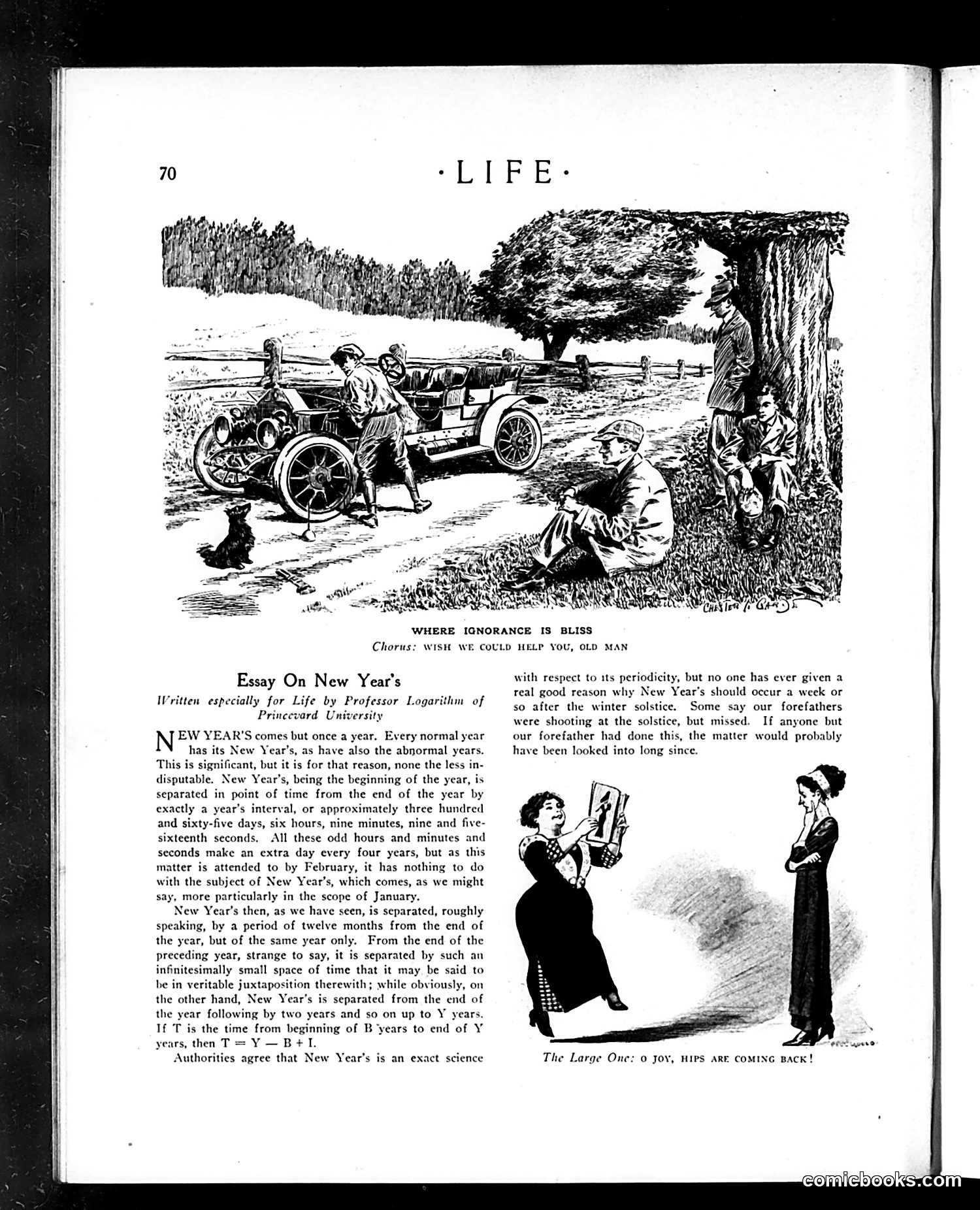
This page contains **two distinct satirical pieces**: **Top cartoon ("Where Ignorance Is Bliss"):** Shows rural figures observing wealthy tourists in an automobile—early-1900s technology symbolizing modernity and urban sophistication. The title suggests the rural characters' contentment in their ignorance of city life, satirizing the cultural gap between rural and urban America during the automobile age. **Main essay:** A mock-academic parody by fictional "Professor Logarithm," deliberately over-complicating New Year's with pseudo-scientific mathematical formulas and circular reasoning. The absurd logic (explaining why New Year's occurs when it does by blaming ancestors' poor marksmanship at the winter solstice) mocks pretentious academic writing and the human tendency to rationalize arbitrary traditions. **Bottom cartoon:** A woman exclaiming about hips "coming back" as a fashion trend—likely satirizing women's fashion cycles and vanity. The page's humor targets intellectual pretension, rural-urban class divisions, and fashion obsession.
📄 Transcribed text from this page (OCR, searchable)
Machine-transcribed from the original scan — historical spelling and the odd misread are preserved.
WHERE IGNORANCE IS BLISS Chorus: Wish WE COULD HELP YOU, OLD MAN Essay On New Year's Written especially for Life by Professor Logarithm of Princevard University EW YEAR'S comes but once a year. Every normal year has its New Year’s, as have also the abnormal years. This is significant, but it is for that reason, none the less in- disputable. New Year's, being the beginning of the year, is separated in point of time from the end of the year by exactly a year’s interval, or approximately three hundred and sixty-five days, six hours, nine minutes, nine and five- sixteenth seconds, All these odd hours and minutes and seconds make an extra day every four years, but as this matter is attended to by February, it has nothing to do with the subject of New Year’s, which comes, as we might say, more particularly in the scope of January. New Year's then, as we have seen, is separated, roughly speaking, by a period of twelve months from the end of the year, but of the same year only. From the end of the preceding year, strange to say, it is separated by such an infinitesimally small space of time that it may be said to be in veritable juxtaposition therewith; while obviously, on the other hand, New Year's is separated from the end of the year following by two years and so on up to Y years. If T is the time from beginning of B years to end of Y s, then T= Y— B+ I. Authorities agree that New Year's is an exact science with respect to its periodicity, but no one has ever given a real good reason why New Year's should occur a week or so after the winter solstice. Some say our forefathers were shooting at the solstice, but missed. If anyone but our forefather had done this, the matter would probably have been looked into long since. The Large One: 0 Joy, HIPS ARE COMING BACK!