
Life, 1912-01-04 · page 52 of 108
Life — January 4, 1912 — page 52: what you’re looking at
What you’re looking at
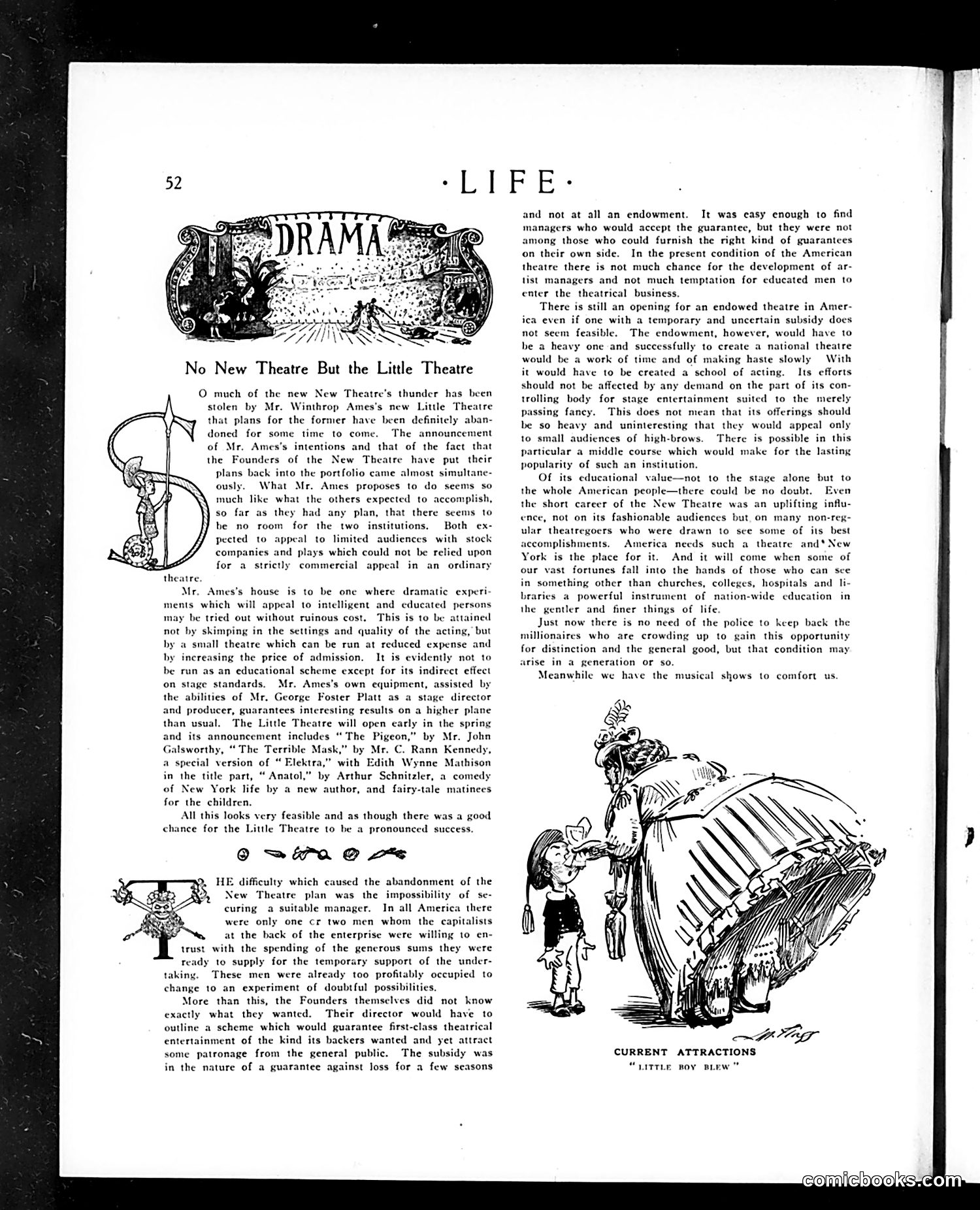
This page discusses the theatrical landscape of early 20th-century America. The article explains why the ambitious "New Theatre" project was abandoned in favor of Winthrop Ames's smaller "Little Theatre." The key satire targets the impracticality of the New Theatre's grand vision: wealthy backers wanted an prestigious institution but couldn't find a suitable manager willing to take on such uncertain financial prospects. The piece argues that America's commercial theater system offered little incentive for serious artists or educated managers to risk experimental work. Ames's alternative—a smaller venue with higher ticket prices and lower production costs—appears more feasible. The text and accompanying illustration ("Little Boy Blew," showing a child with what appears to be theatrical imagery) suggest that scaling down theatrical ambitions to match available resources and talent was the more realistic path forward. The underlying joke: America's theater establishment was too commercially driven to sustain genuine artistic innovation at grand scale.
📄 Transcribed text from this page (OCR, searchable)
Machine-transcribed from the original scan — historical spelling and the odd misread are preserved.
“LIFE= No New Theatre But the Little Theatre O much of the new New Theatre's thunder has been stolen by Mr. Winthrop Ames’s new Little Theatre that plans for the former have been definitely aban- doned for some time to come, The announcement of Mr. Ames’s intentions and that of the fact that the Founders of the New Theatre have put their plans back into the portfolio came almost simultane- ously. What Mr. Ames proposes to do seems so much like what the others expected to accomplish, so far as they had any plan, that there seems to be no room for the two institutions, Both ex pected to appeal to limited audiences with stoc’ companies and plays which could not be relied upon for a strictly commercial appeal in an ordinary theatre. Mr. Ames’s house is to be one where dramatic experi- ments which will appeal to intelligent and educated persons be tried out without ruinous cost. This is to be attained not by skimping in the settings and quality of the acting, but by a small theatre which can be run at reduced expense and by increasing the price of admission. It is evidently not to be run as an educational scheme except for its indirect effect fon stage standards. Mr. Ames’s own equipment, assisted by the abilities of Mr. George Foster Platt as a stage director and producer, guarantees interesting results on a higher plane than usual. The Little Theatre will open carly in the spring and its announcement includes “The Pigeon,” by Mr. John Galsworthy, “The Terrible ) by Mr. C. Rann Kennedy, a special version of “Elektra,” with Edith Wynne Mathison in the title part, “ Anatol,” by Arthur Schnitzler, a comedy of New York life by a new author, and fairy-tale matinees for the children. All this looks very feasible and as though there was a good chance for the Little Theatre to be a pronounced success. 0 =&. oO 2s HE difficulty which caused the abandonment of the New Theatre plan was the impossibility of se- curing a suitable manager. In all America there were only one cr two men whom the capitalists mat the back of the enterprise were willing to en- trust with the spending of the gencrous sums they were ready to supply for the temporary support of the under- taking. These men were already too profitably occupied to change to an experiment of doubtful possibilities. More than this, the Founders themselves did not know exactly what they wanted. Their director would have to outline a scheme which would guarantee first-class theatrical entertainment of the kind its backers wanted and yet attract some patronage from the general public. The subsidy was in the nature of a guarantee against loss for a few seasons and not at all an endowment. It was easy enough to find managers who would accept the guarantec, but they were not among those who could furnish the right kind of guarantees on thcir own side. In the present condition of the American theatre there is not much chance for the development of ar- tist managers and not much temptation for educated men to enter the theatrical business. There is still an opening for an endowed theatre in Amer- ica even if one with a temporary and uncertain subsidy does not seem feasible. The endowment, however, would have to be a heavy one and successfully to create a national theatre would be a work of time and of making haste slowly With it would have to be created a school of acting. Its efforts should not be affected by any demand on the part of its con- trolling body for stage entertainment suited to the merely passing fancy. This does not mean that its offerings should be so heavy and uninteresting that they would appeal only to small audiences of high-brows. There is possible in this particular a middle course which would make for the lasting popularity of such an institution. Of its educational value—not to the stage alone but to the whole American people—there could be no doubt. Even the short career of the New Theatre was an uplifting influ- ence, not on its fashionable audiences but. on many non-reg- ular theatregoers who were drawn to sce some of its best accomplishments. America necds such a theatre and*New York is the place for it. And it will come when some of our vast fortunes fall into the hands of those who can sce in something other than churches, colleges, hospitals and li- braries a powerful instrument of nation-wide education in the gentler and finer things of life Just now there is no need of the police to keep back the millionaires who are crowding up to gain this opportunity for distinction and the gencral good, but that condition may arise in a generation oF so. Meanwhile we have the musical shows to comfort us. CURRENT ATTRACTIONS “VITTLE Boy BLEW"