
Life, 1912-01-04 · page 53 of 108
Life — January 4, 1912 — page 53: what you’re looking at
What you’re looking at
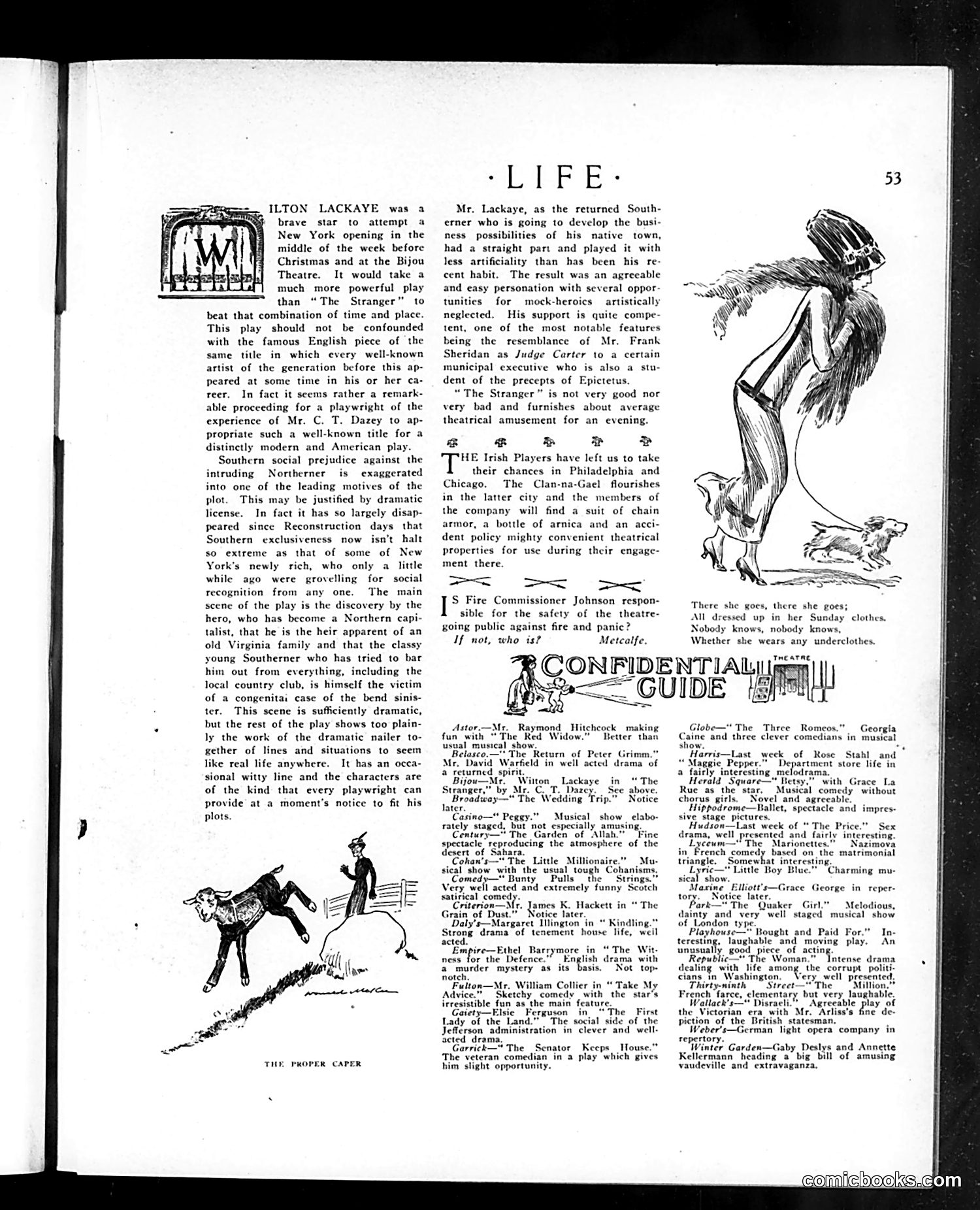
This page reviews theatrical productions, focusing on actor Milton Lackaye's performance in "The Stranger" at the Bijou Theatre. **The Main Review:** The critic acknowledges Lackaye's bravery opening a play the week before Christmas during poor theater attendance. The plot concerns a Northern capitalist who discovers he's the heir to a Virginia family, satirizing post-Reconstruction Southern social prejudice against Northerners. The reviewer notes this prejudice has actually faded—modern New York's newly wealthy are now the real snobs, desperately seeking social recognition. **The Cartoons:** Two illustrated vignettes ("The Proper Caper" at bottom left) appear unrelated to the reviews, showing slapstick scenes typical of period humor. **The Satire:** The review's sharpest barb mocks Southern exclusivity by noting New York's "newly rich" are worse offenders, having recently "grovelled for social recognition." The page ends with brief reviews of other Broadway shows and a gossipy "Confidential Guide" section.
📄 Transcribed text from this page (OCR, searchable)
Machine-transcribed from the original scan — historical spelling and the odd misread are preserved.
ILTON LACKAYE was a brave star to attempt a New York opening in the middle of the week before Christmas and at the Bijou Theatre. It would take a much more powerful play than “The Stranger” to beat that combination of time and place. This play should not be confounded with the famous English piece of ‘the same title in which every well-known artist of the generation before this ap- peared at some time in his or her ca- reer. In fact it seems rather a remark- able proceeding for a playwright of the experience of Mr. C. T. Dazey to ap- propriate such a well-known title for a distinctly modern and American play. Southern social prejudice against the intruding Northerner is exaggerated into one of the leading motives of the plot. This may be justified by dramatic license. In fact it has so largely disap- peared since Reconstruction days that Southern exclusiveness now isn't halt 80 extreme as that of some of New York’s newly rich, who only a little while ago were grovelling for social recognition from one. The main scene of the play is the discovery by the hero, who has become a Northern capi- talist, that he is the heir apparent of an old Virginia family and that the classy young Southerner who has tried to bar him out from everything, including the local country club, is himself the victim of a congenitai case of the bend sinis- ter. This scene is sufficiently dramatic, but the rest of the play shows too plain- ly the work of the dramatic nailer to- gether of lines and situations to seem like real life anywhere. It has an occa- sional witty line and the characters are of the kind that every playwright can provide at a moment's notice to fit his plots. ALLE Ee Mr. Lackaye, as the returned South- erner who is going to develop the busi- ness possibilities of his native town, had a straight part and played it with less artificiality than has been his re- cent habit, The result was an agreeable and easy personation with several oppor- tunities for mock-heroics artistically neglected, His support is quite compe- tent, one of the most notable features being the resemblance of Mr. Frank Sheridan as Judge Carter to a certain municipal executive who is also a stu- dent of the precepts of Epictetus. “The Stranger” is not very good nor very bad and furnishes about average theatrical amusement for an evening. Es ® % 2 ® HE Irish Players have left us to take their chances in Philadelphia and Chicago. The Clan-na-Gael flourishes in the latter city and the members of the company will find a suit of chain armor, a bottle of arnica and an acci- dent policy mighty convenient theatrical properties for use during their engage- ment there. ~ >a >= S Fire Commissioner Johnson respon- sible for the safety of the theatre- going public against fire and panic? If not, who is? Metcalfe. CONFIDENTIAL Asto r. Raymond Hi fun with “The Red Widow usual musical show. Belasco.—"* The Return of Peter Grimm. Mr, David Warfield in well acted drama of @ returned spirit Mr. Witton, Lackaye in“ The Stranger,” by Mr. C.T. Dazey. See above. 1 Broadway—" The Wedding Trip.” Notice later. Casino— Peggy.” Musical show _elabo- rately staged, but not especially amusing. Century—" The Garden of Allah.” Fine spectacle reproducing the atmosphere of the desert of Sahara Cohan’s—" The Little Millionaire.” sical show with the usual tough C Comedy—" Bunty Pulls the — Strings. Very well acted and extremely funny Scotch satirical comedy. Criterion—Mr. James K. Hackett in “ The Grain of Dust.” Notice later. Daly’s—Margaret Illington in “ Kindling.” Strong drama of tenement house life, weil acted. Empire—Ethel Barrymore in “The Wit- ness for the Defence.” glish drama with a murder mystery as its basis. Not top- notch, Fulton—Mr, William Collier in “ Take My Advice.” Sketchy comedy with the star’s irresistible fun as the main feature. Gaiety—Elsic Ferguson in. “The First Lady of the Land.” The social side of the Jefferson administration in clever and well- aeted drama, i . Garrick—* The Senator Keeps House.” The veteran comedian in a play which gives him slight opportunity. Better than There she goes, there she goes; AM dressed up in her Sunday clothes. Nobody knows, nobody knows, Whether she wears any underclothes. Globe—" The Three Romeos.” Georgia Caine and three clever comedians in musical Harris—Last_ week of Kose Stahl and “ Maggie, Pepper.” Department store life in a fairly interesting melodrama. Herald Square—" Wetsy,” with Grace La Rue as the star, Musical comedy without chorus girls. Novel and agreeable. _ Hippodrome—Ballet, spectacle and impres- sive stage pictures. Hudson—Last week of “The Price.” Sex drama, well presented and fairly interesting. Lyceum—" The Marionettes.” Nazimova French comedy based on the matrimonial Kringle. SomewHat interesting, Little Boy Blue.” Charming mu- sical show. Maxine Elliott's—Grace George in reper- tory. Notice later. Park—" The Quaker Girl.” Melodious, dainty and very. well staged musical show of London type Playhouse—" Tought and Paid For.” In- teresting, laughable and moving play. An unusually good piece of acti Republic—" The Woman. dealing cians in Washington ry well presented, Thirty-ninth — Street—"'The Million French farce, elementary but very laughable. Wallack’s—" Disraeli.” Agreeable play of the Victorian era with Mr. Arliss's fine de- piction of the British statesman. Weber’s—German light opera’ company in repertory. Winter Garden—Gaby Deslys and Annette Kellermann heading a big bill of amusing vaudeville and extravaganza, With Tife among. the corrupt polit e