
Life, 1912-01-04 · page 63 of 108
Life — January 4, 1912 — page 63: what you’re looking at
What you’re looking at
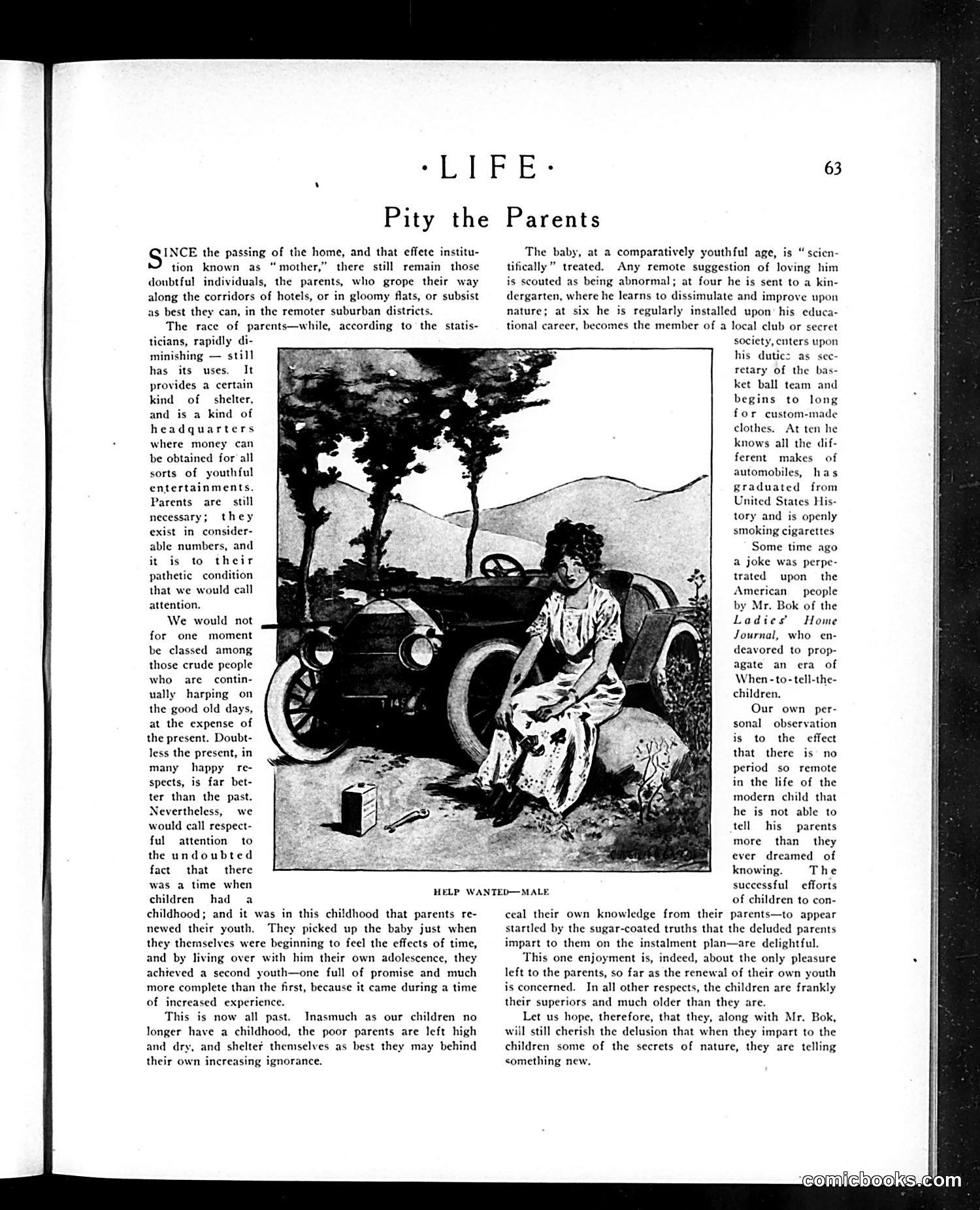
This article satirizes the decline of parental authority and relevance in modern American life. The accompanying illustration shows a parent (likely a mother) sitting beside an automobile—a symbol of modern youth culture and independence—emphasizing how outdated parents have become. The satire's targets: **The main complaint**: Children no longer have extended childhoods, so parents lose the vicarious youth-renewal that came from raising kids through their formative years. **Modern child-rearing**: Scientific, emotionally-detached parenting has replaced affectionate nurturing. Children are institutionalized early (kindergarten at four, clubs at six). **Children's precocity**: Ten-year-olds know car makes, smoke cigarettes, and understand adult topics—leaving parents ignorant and irrelevant. **The "When-to-tell-the-children" movement**: The article mocks Edward Bok's *Ladies' Home Journal* campaign promoting frank parent-child sex education, noting children already know everything and only pretend ignorance to amuse their bewildered parents. The joke: parents are now merely ATMs and shelter-providers, their only remaining pleasure being the delusion that they're teaching children anything new.
📄 Transcribed text from this page (OCR, searchable)
Machine-transcribed from the original scan — historical spelling and the odd misread are preserved.
Abe E* Pity the INCE the passing of the home, and that effete institu- tion known as “mother,” there still remain those doubtful individuals, the parents, who grope their way along the corridors of hotels, or in gloomy flats, or subsist as best they can, in the remoter suburban districts. The race of parents—while, according to the statis- ticians, rapidly minishing — still has its uses. It provides a certain kind of shelter, and is a kind of headquarters where money can be obtained for all sorts of youthful entertainments. Parents are still necessary; they exist in consider- able numbers, and it is to their pathetic condition that we would call attention. We would not for one moment be classed among those crude people who are contin- ually harping on the good old days, at the expense of the present. Doubt- less the present, in many happy re- spects, is far bet- ter than the past. Nevertheless, we would call respect- ful attention to the undoubted fact that there was a time when children had a childhood; and it was in this childhood that parents re- newed their youth. They picked up the baby just when they themselves were beginning to feel the effects of time, and by living over with him their own adolescence, they achieved a second youth—one full of promise and much more complete than the first, because it came during a time of increased experience. This is now all past. Inasmuch as our children no longer have a childhood, the poor parents are left high and dry, and shelter themselves as best they may behind their own increasing ignorance. HELP WANTED—MALE Parents The baby, at a comparatively youthful age, is “ scien- tifically” treated. Any remote suggestion of loving him is scouted as being abnormal; at four he is sent to a kin- dergarten, where he learns to dissimulate and improve upon nature; at six he is regularly installed upon his educa- tional career, becomes the member of a local club or secret society, cnters upon his dutic retary of the bas- ket ball team and begins to long for custom-made clothes. At ten he knows all the dif- ferent makes of automobiles, has graduated from United States His- tory and is openly smoking cigarettes as sec- Some time ago a joke was perpe- trated upon the American people by Mr. Bok of the Ladies Home Journal, who en- deavored to prop- agate an era of When -to-tell-the- children, Our own per- sonal observation is to the effect that there is no period so remote in the life of the modern child that he is not able to tell his parents more than they ever dreamed of knowing. The successful efforts of children to con- ceal their own knowledge from their parents—to appear startled by the sugar-coated truths that the deluded parents impart to them on the instalment plan—are delightful. This one enjoyment is, indeed, about the only pleasure left to the parents, so far as the renewal of their own youth is concerned. In all other respects, the children are frankly their superiors and much older than they are. Let us hope, therefore, that they, along with Mr. Bok, will still cherish the delusion that when they impart to the children some of the secrets of nature, they are telling something new.