
A complete issue · 87 pages · 1888
Judge — 1888
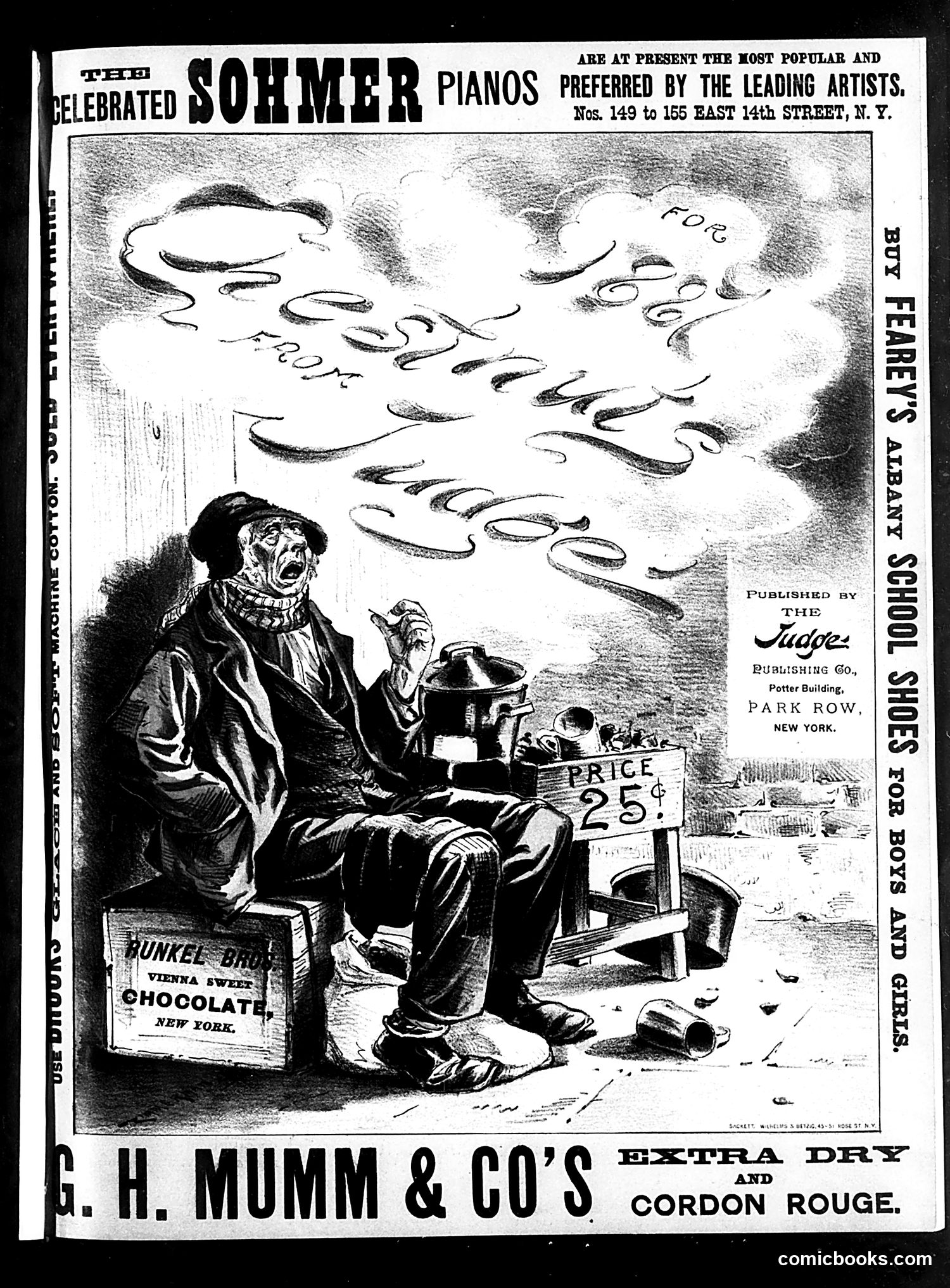
This page is primarily **advertising**, not political satire. It contains three distinct ads: 1. **Sohmer Pianos** (top): Promotes pianos as "preferred by leading artists," located on East 14th Street, NYC. 2. **Judge Publishing** (right side): Advertises Judge magazine's "Library School Smokes" collection for boys and circuses. 3. **Main cartoon** (center): A caricatured man—appearing to be a street vendor or lower-class figure—sits on a box of "Runkel Bros. Vienna Sweet Chocolate" selling what appears to be cheap beverages or food for 25¢. The speech bubble above contains indecipherable text. This likely mocks working-class street vendors or poverty-era commerce. 4. **G.H. Mumm & Co.** (bottom): Advertisement for champagne brands "Extra Dry" and "Cordon Rouge." The page juxtaposes luxury items (pianos, fine champagne) with satirized poverty imagery.
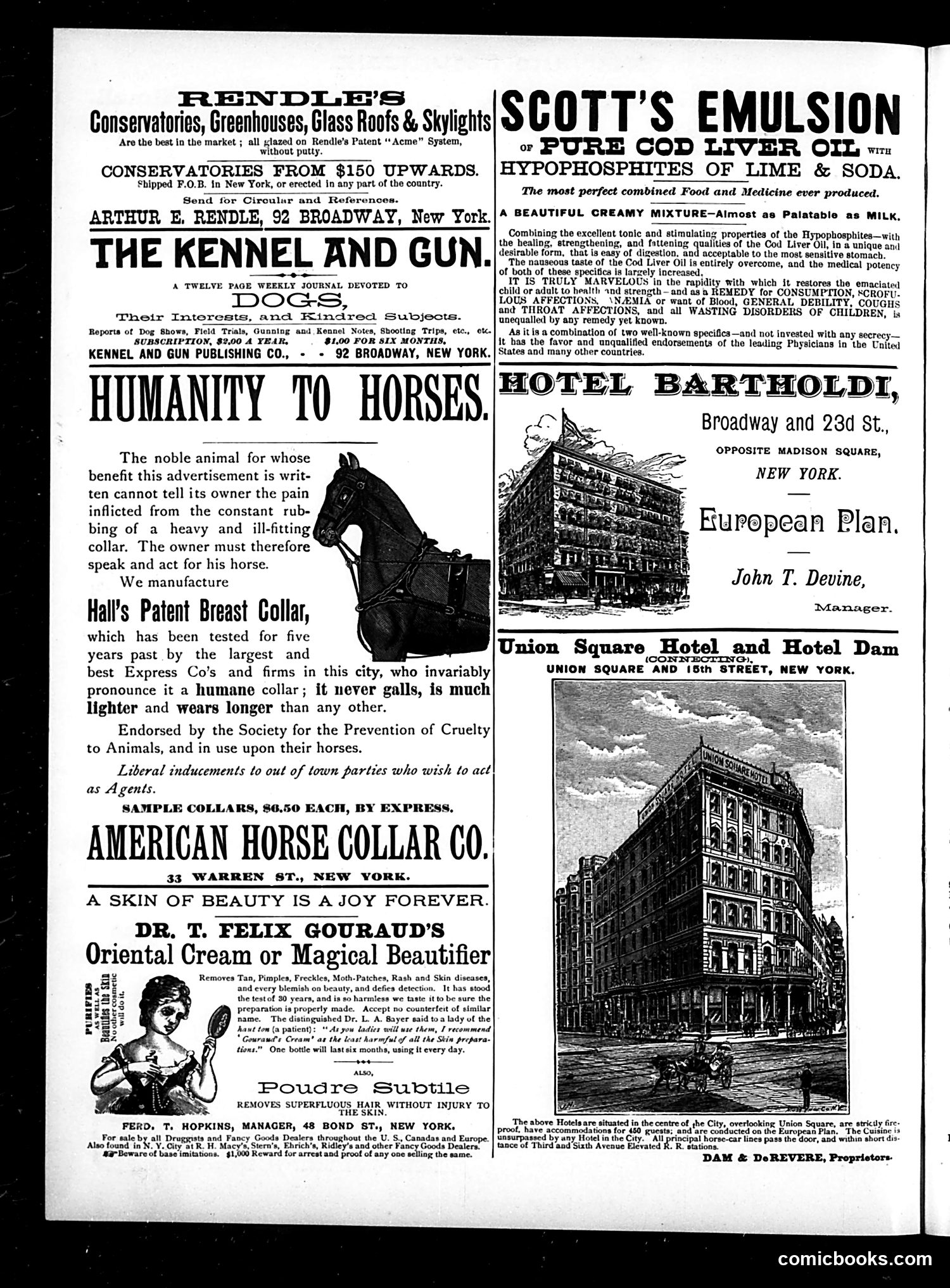
This page is **primarily advertising**, not satirical content. It contains multiple commercial advertisements typical of late 19th-century publications: - **Rendle's conservatories and greenhouses** (top left) - **The Kennel and Gun** magazine (center left) - **Hall's Patent Breast Collar** for horses, endorsed by the Society for Prevention of Cruelty to Animals (center) - **Scott's Emulsion** cod liver oil tonic (top right) - **Hotel Bartholdi** and **Union Square Hotel** (right side) - **Dr. T. Felix Gouraud's Oriental Cream** beauty product (bottom left) The only content with potential satirical edge is "Humanity to Horses," promoting a horse collar as humane. However, this appears to be straightforward product advertising rather than political satire. The page reflects Judge magazine's commercial focus alongside editorial content.
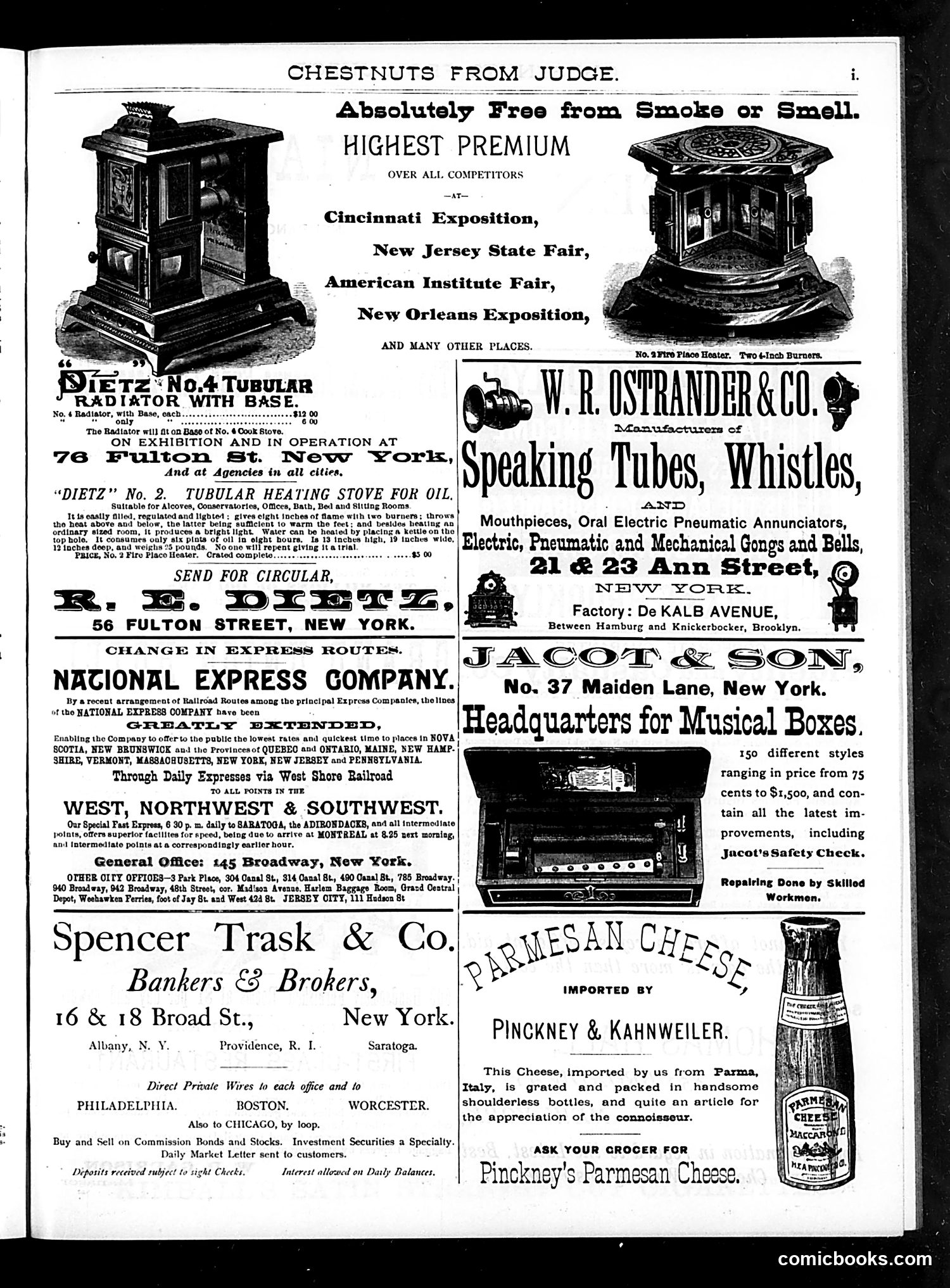
This page is **primarily advertising**, not political satire. The header "CHESTNUTS FROM JUDGE" appears to be a generic section title, but the content consists entirely of commercial advertisements for industrial and consumer products from the late 19th century. The advertisements include: - **Heating stoves and radiators** (Dietz brand) winning prizes at various expositions - **Speaking tubes and musical boxes** (W.R. Ostrander & Co., Jacot & Son) - **Express shipping services** (National Express Company) - **Financial services** (Spencer Trask & Co., bankers) - **Imported Parmesan cheese** (Pinckney & Kahnweiler) No political cartoons or satirical commentary are visible on this page. The images are product illustrations demonstrating the advertised goods. This reflects Judge magazine's business model: pages of paid advertisements supporting the publication's satirical content elsewhere.
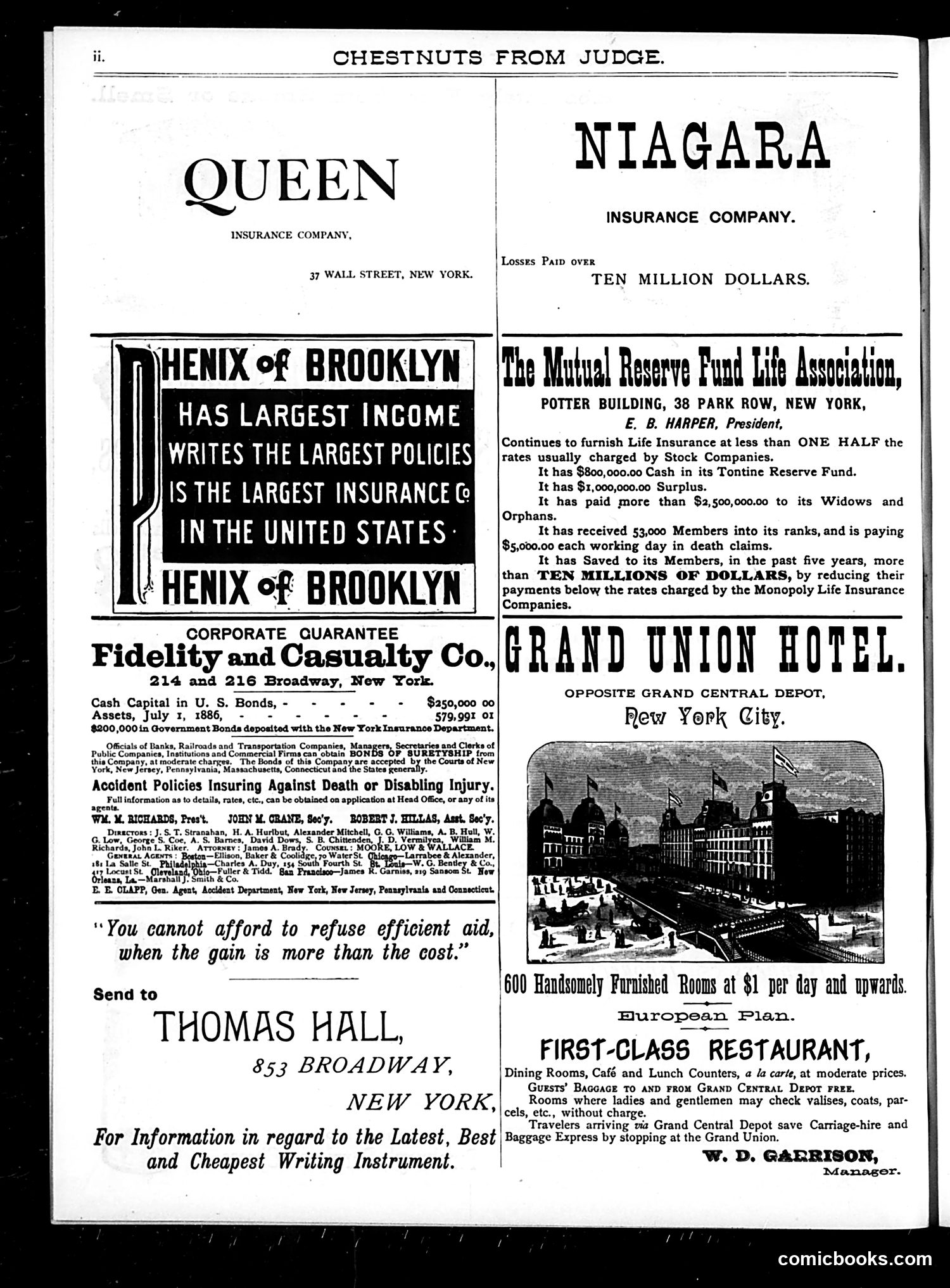
This page is primarily **advertising**, not political satire. The heading "Chestnuts from Judge" suggests reprinted material, but the content consists of insurance company and hotel advertisements typical of 1880s publications. The ads promote: - **Insurance companies** (Queen, Niagara, Phenix of Brooklyn, Fidelity and Casualty) competing for customers - **The Mutual Reserve Fund Life Association**, which explicitly positions itself as an alternative to "Monopoly Life Insurance Companies," offering lower rates and better member benefits - **Grand Union Hotel** and **Thomas Hall** (writing instruments) The only quasi-satirical element is the **anti-monopoly messaging**: the Mutual Reserve Fund's advertisement contrasts its cooperative structure against large insurance monopolies, suggesting late-19th-century anxiety about corporate consolidation and high insurance costs affecting ordinary people. The quote—"You cannot afford to refuse efficient aid, when the gain is more than the cost"—appears to promote pragmatic consumerism rather than social commentary.
This is a title page from an 1886 Judge magazine collection. "Chestnuts" was period slang for old, worn-out jokes—the page announces a compilation of previously published cartoons and humor pieces by multiple illustrators (Gillam, Zimmerman, Hamilton, and others who were prominent Judge contributors). The actual satirical content isn't visible on this page—it's purely a frontispiece identifying the book's contents and publisher. The cigarette advertisement at the bottom (Kimball's Satin Straight Cut) was typical of period publications. The book appears to be a "greatest hits" collection of Judge's recurring jokes and gags, explaining the self-aware title "Chestnuts"—Judge was essentially republishing and repackaging material readers already knew.
This page is **not a cartoon or satirical content** — it's a commercial advertisement section titled "Chestnuts from Judge," which appears to be a paid advertising space in the satirical magazine *Judge*. The page advertises **Lockwood & Geery**, a New York merchant firm (located at 165 Front Street), promoting their various product lines: British beers and stouts, Colman's mustard oil (marketed as a rheumatism remedy), sherry wines, champagne, and imported cigars. The term "chestnuts" in the header likely refers to old or recurring advertisements — a humorous nod to the magazine's satirical nature while hosting routine commercial content. **There is no political satire or cartoon humor on this page.** It's straightforward period advertising from a 19th-century trade publication.
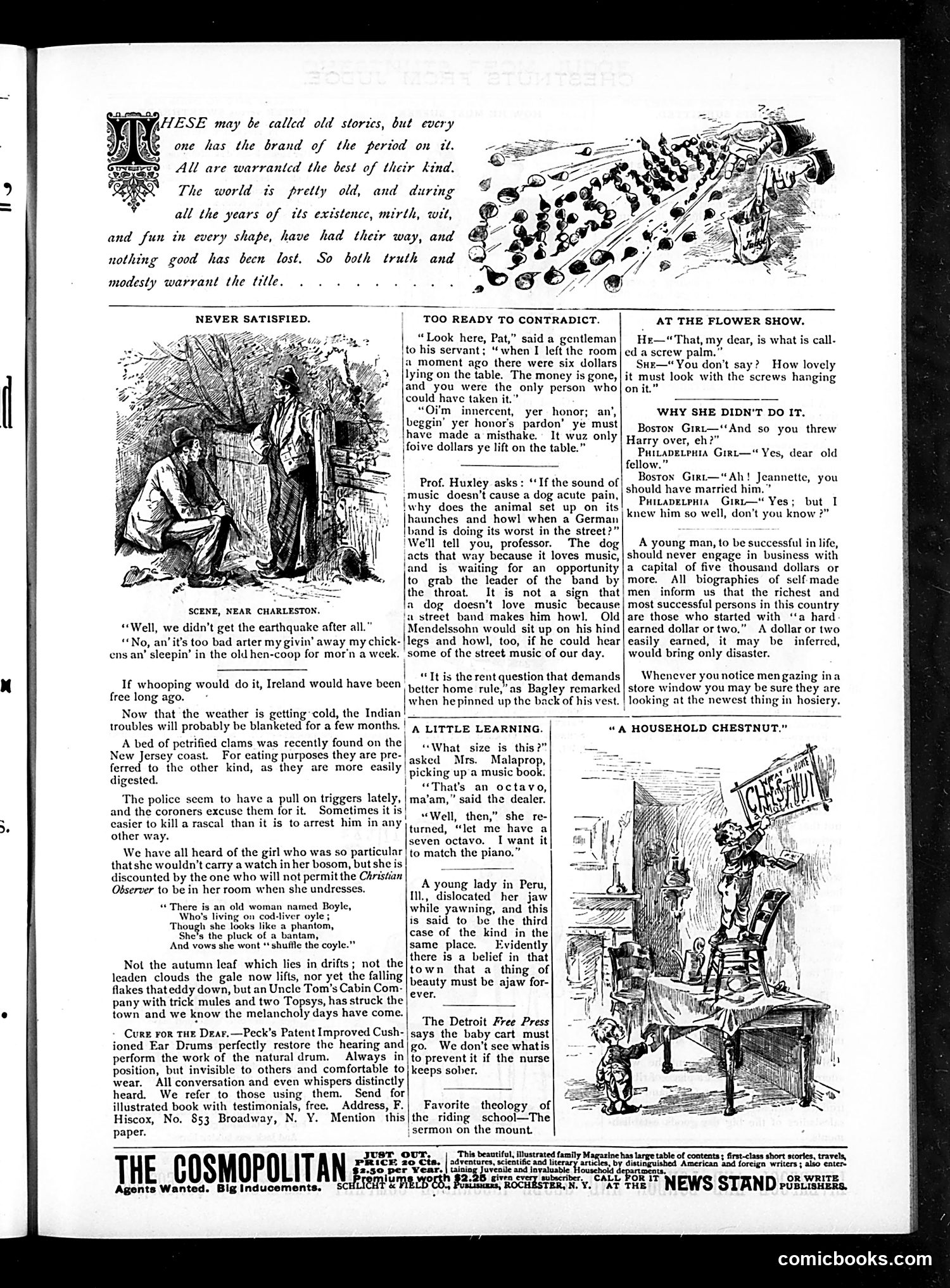
This page from the satirical magazine *Judge* contains several short humorous anecdotes mocking various contemporary figures and issues, likely from the 1880s-90s based on references and style. **Notable content includes:** - **"Never Satisfied"**: A joke about poor Southern farmers who gave away chickens hoping for an earthquake (likely referencing Charleston earthquake predictions), disappointed it didn't occur. - **"Too Ready to Contradict"**: A servant inadvertently confesses to theft by correcting his employer's statement about the amount stolen—satire on Irish immigrant servants and their supposed foolishness. - **Prof. Huxley reference**: Uses the naturalist's question about dogs' reactions to German bands to mock street musicians. - **Political/social commentary**: Brief jabs at police violence, Indian conflicts, and various absurdities of American life. The page also includes advertisement for Peck's Patent Ear Drums and promotion for *The Cosmopolitan* magazine, typical of period publications mixing content and advertising.
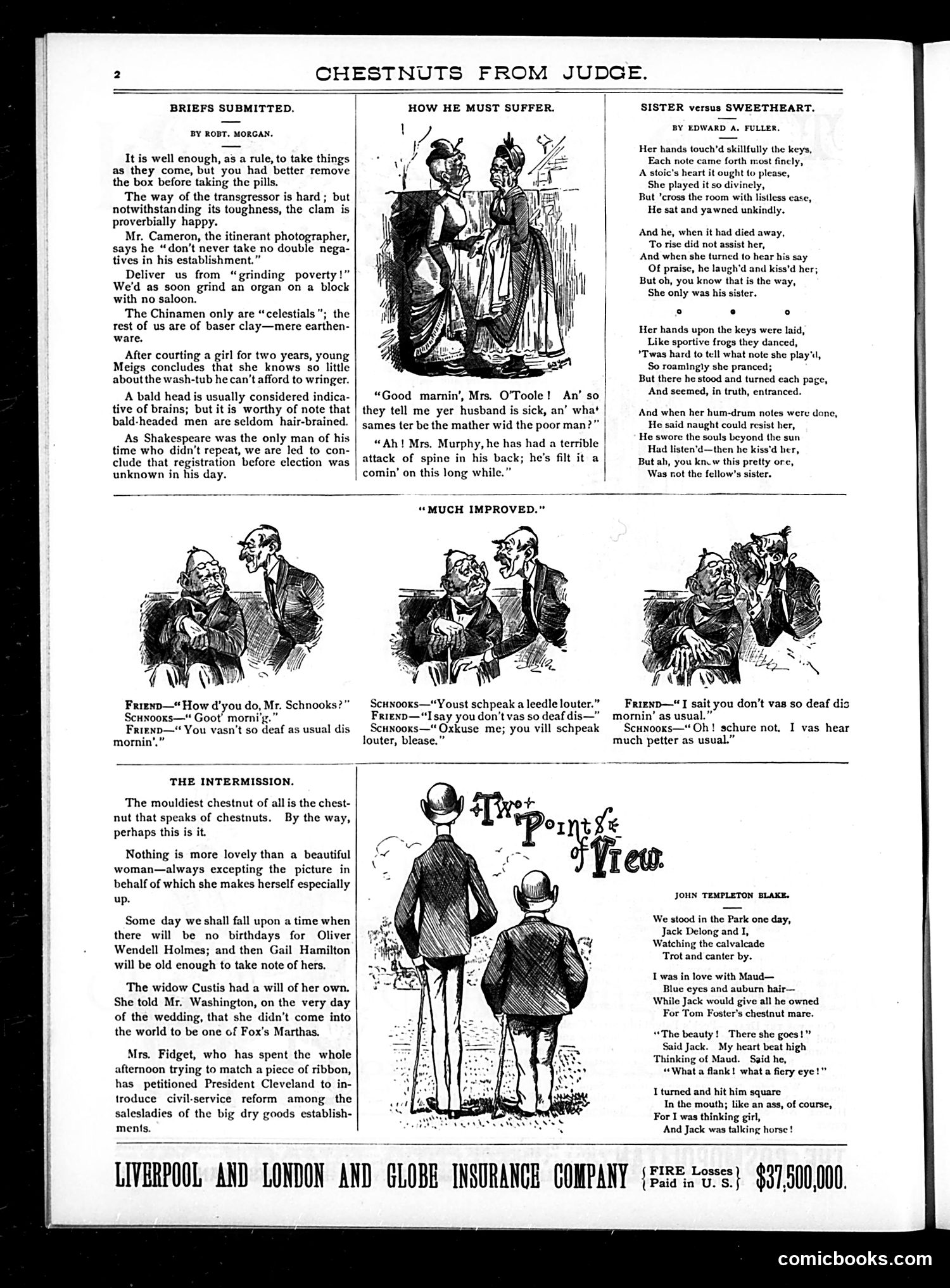
This page contains three distinct sections: a brief essay by Rort Morgan about removing boxes before inheriting, a central illustration titled "How He Must Suffer" depicting a man receiving bad news about his mother-in-law's health, and a comic sequence called "Much Improved" showing dialogue between friends and Mr. Schnooks about his hearing. The humor centers on domestic situations—inheritance logistics, spousal relations, and physical ailments. A poem titled "A Poet's Point of View" by John Templeton Black appears to reference Jack Delogg and observations about romantic relationships. The page concludes with insurance company advertising. These represent typical Judge magazine content: light domestic satire and social commentary aimed at middle-class readers.
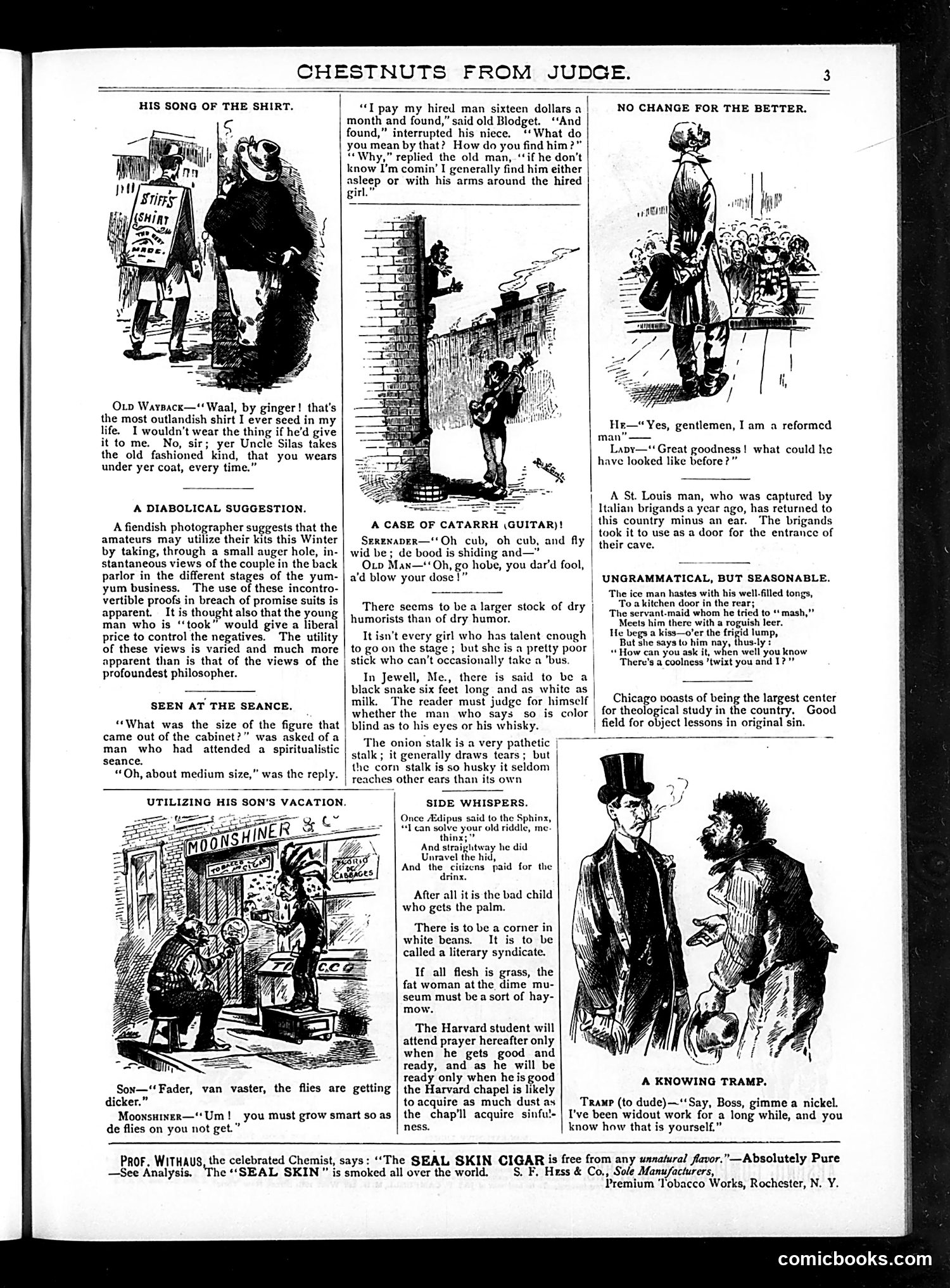
This page collects brief satirical observations on American life and manners, typical of Judge magazine's humor style. **Key items:** - **"His Song of the Shirt"**: Rural character mocks fashionable/exposed shirt styles, preferring traditional hidden undergarments—poking fun at fashion trends. - **"Diabolical Suggestion"**: Darkly jokes about photographers using hidden cameras in parlors to spy on couples for blackmail or breach-of-promise lawsuits—commenting on both invasive technology and social scandal. - **"Seen at the Seance"**: Mocks spiritualism's popularity by satirizing mediums' vague claims. - Various short quips target: hired workers' laziness, poor theatrical talent, regional oddities (Maine's white snake), ethnic stereotypes (Yiddish-speaking father), Harvard students' hypocrisy about prayer, and Chicago's theological schools' irony. The humor is period-typical: focused on social pretension, technological novelty, rural vs. urban contrasts, and gentle ethnic caricature. These represent mainstream American satire circa late 19th century.
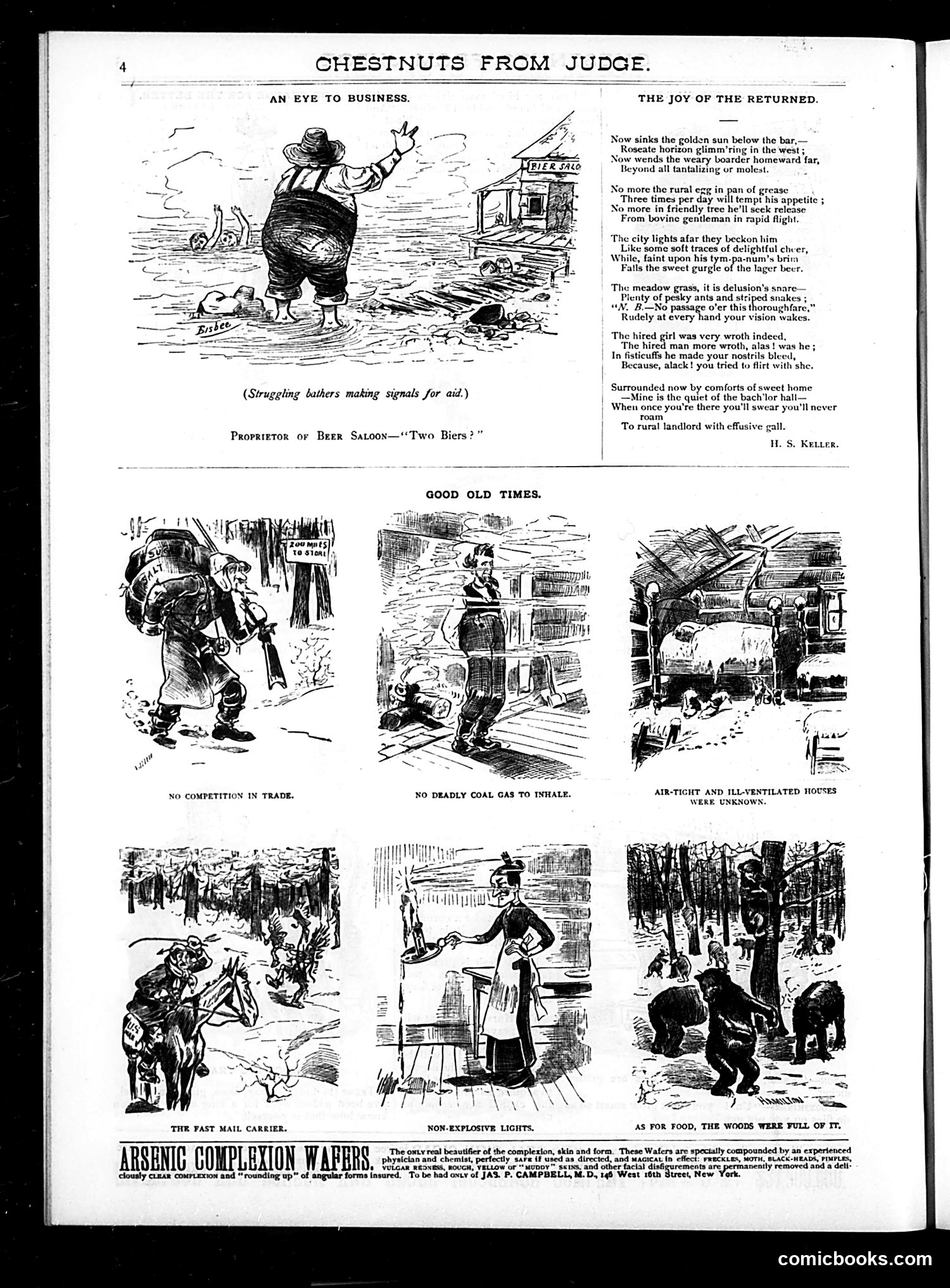
This Judge magazine page contains satirical commentary on nostalgia and modern life problems. **"An Eye to Business"** mocks a beer saloon proprietor who, seeing struggling bathers signaling for help, cynically interprets their distress as potential customers ordering "two beers." **"The Joy of the Returned"** is a poem celebrating a boarder's escape from rural life—mocking both rural hardships (greasy eggs, farm animals, aggressive hired hands) and the relief of returning to urban comforts, particularly beer. **"Good Old Times"** presents six scenes ironically titled to contrast past conditions with present improvements: no business competition, no deadly coal gas, better-ventilated houses, faster mail, safer lighting, and abundant food. The satire suggests these "good old times" were actually worse—the opposite message of typical nostalgia. The page concludes with an advertisement for "Arsenic Complexion Wafers," a skin treatment containing arsenic—revealing the era's dangerous, unregulated patent medicines.
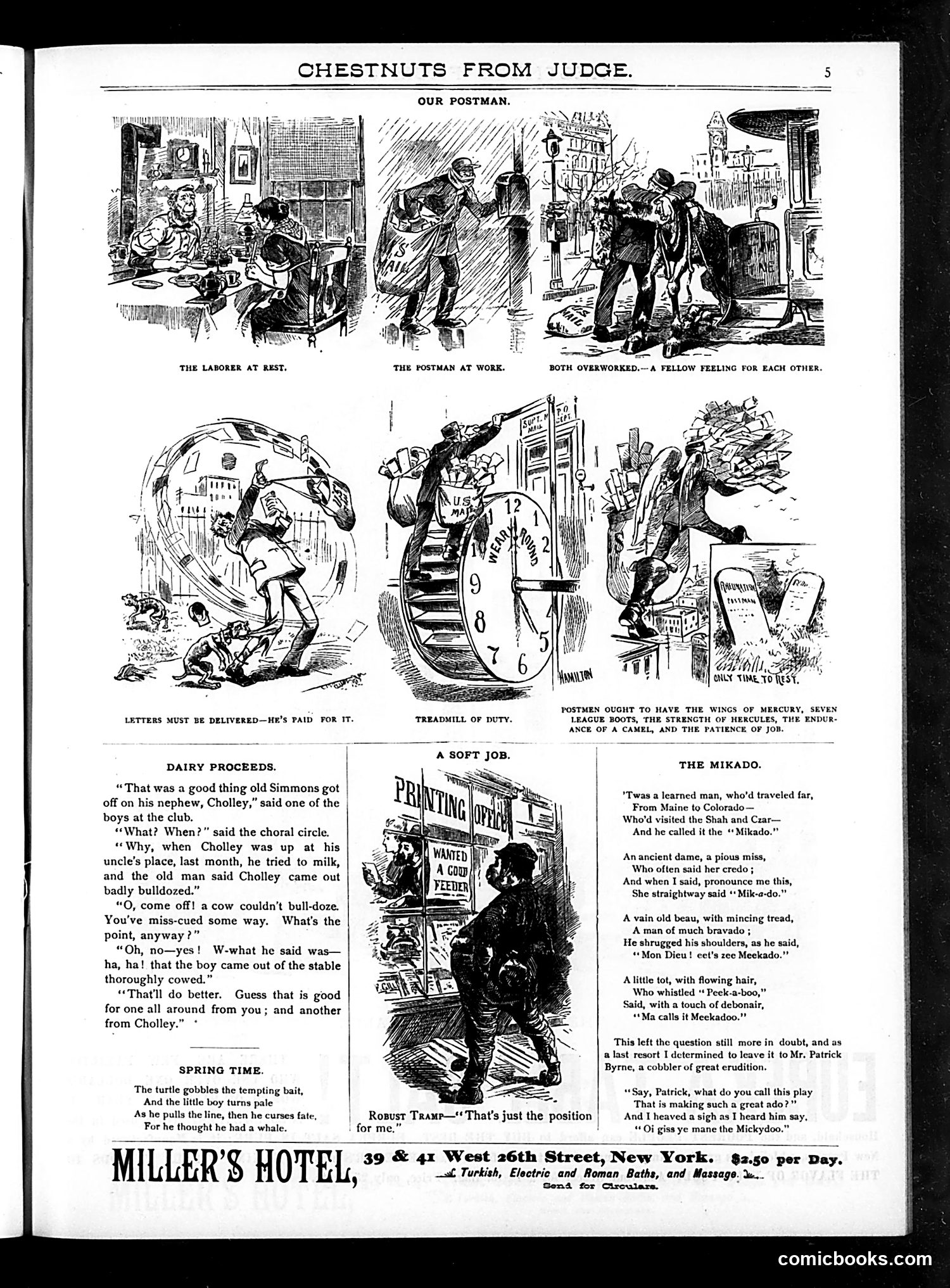
This page contains multiple satirical pieces typical of Judge magazine's humor: **Top cartoons ("Our Postman"):** Mock the postal worker's grueling job through comparative sketches showing laborers resting while postmen work constantly, emphasizing overwork and the impossible physical demands (needing "wings of Mercury" and "strength of Hercules"). **"Dairy Proceeds":** A punning joke about a boy named Cholley who gets "bulldozed" by a cow—the humor relies on wordplay where "cowed" (intimidated) echoes "cow." **"The Mikado":** Satirizes confusion over pronouncing the title of Gilbert & Sullivan's recently popular operetta *The Mikado* (1885). Various characters mispronounce it differently (Mik-a-do, Meekado, Mickydoo), culminating in an Irishman's comedic butchering. The joke mocks both the opera's fashionable status and immigrant/class-based speech patterns. Minor pieces include fishing and tramp humor. The page is predominantly entertainment content with period advertising below.
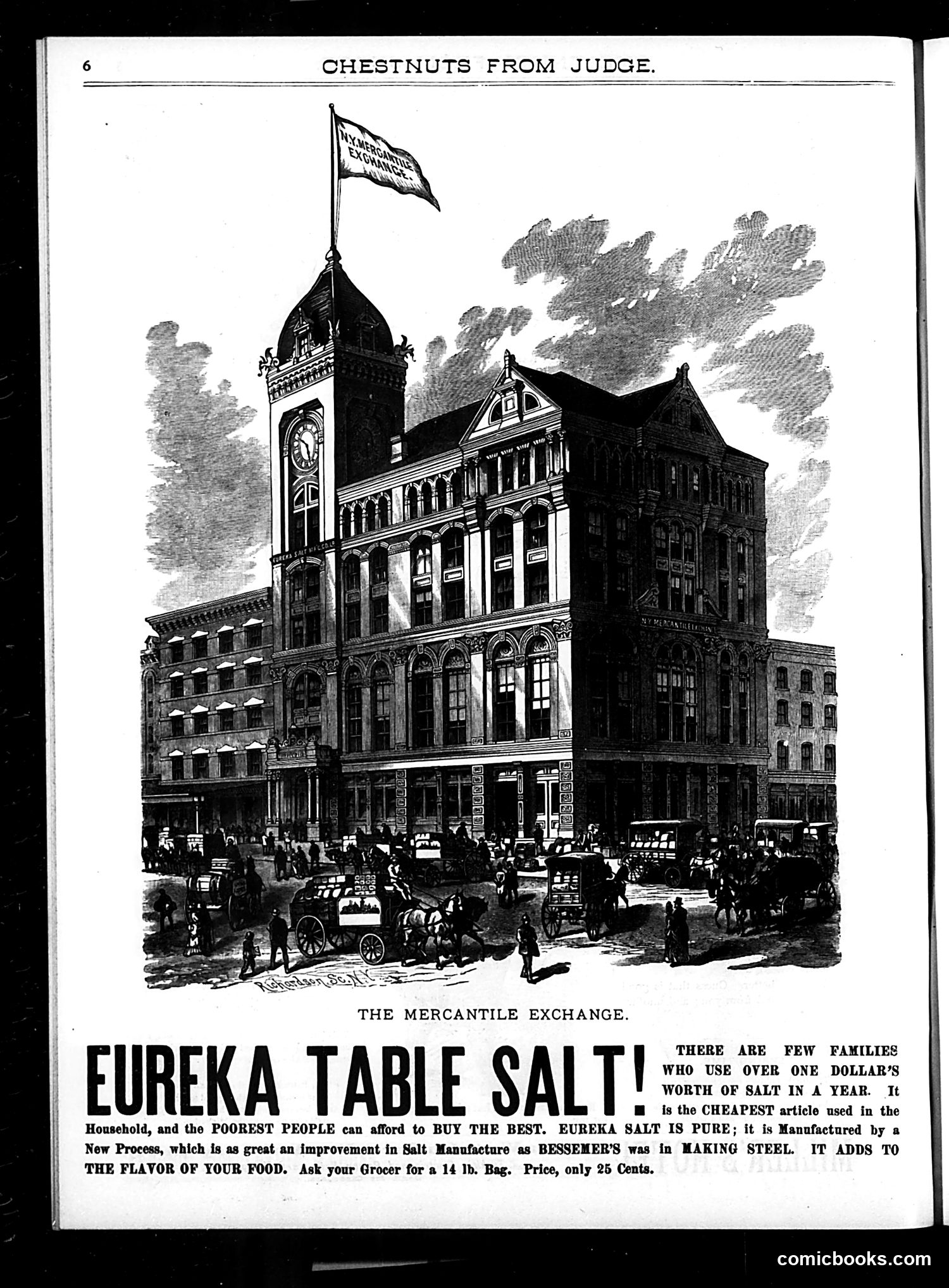
This page is primarily an **advertisement for Eureka Table Salt**, not a political cartoon. The illustration shows the Mercantile Exchange building (a real Chicago landmark), bustling with commercial activity and horse-drawn vehicles. The ad's pitch claims Eureka Salt is "PURE" and manufactured by a "New Process" comparable to Bessemer steel-making improvements. It emphasizes affordability—"THE POOREST PEOPLE can afford to BUY THE BEST"—positioning the product as democratically accessible quality goods. The appeal to working-class families ("Household") reflects late 19th-century marketing tactics leveraging industrial progress and egalitarian rhetoric. There is no apparent satire here; this is straightforward period advertising using the magazine's pages for commercial messaging.
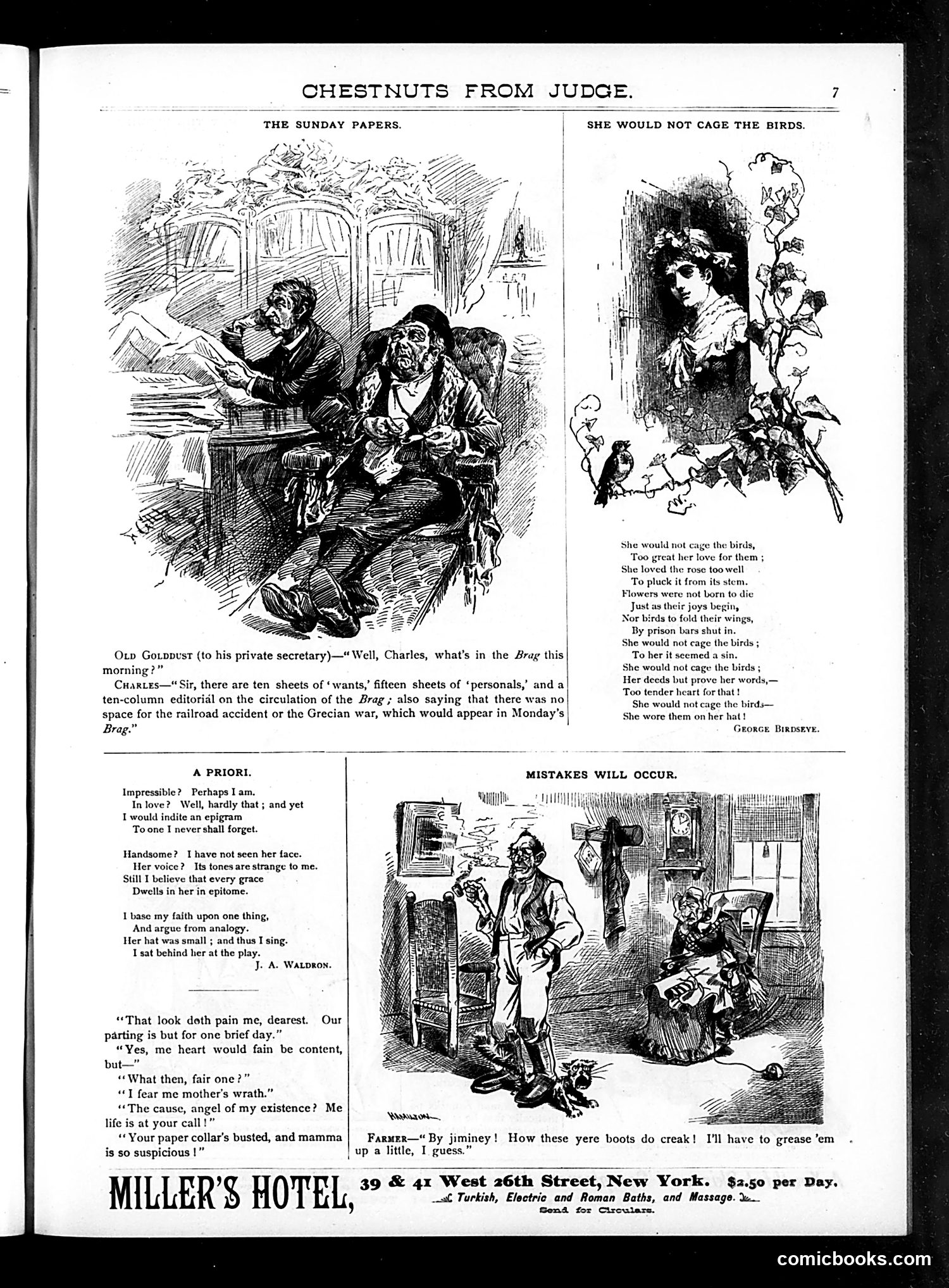
This page contains four separate satirical pieces from Judge magazine: **"The Sunday Papers"** mocks newspaper editors obsessed with circulation—Old Golddust's secretary reports the paper is filled with "wants" and "personals" ads and self-promotional editorials, leaving no room for actual news like railroad accidents or the Greco-Grecian war. **"She Would Not Cage the Birds"** is a humorous poem about a woman who refuses to trap birds—the punchline reveals she wears dead birds as decoration on her hat, making her animal-loving principles hypocritical. **"A Priori"** satirizes romantic infatuation based on superficial observation: a man falls in love with a woman he's never seen, basing his devotion solely on her small hat worn at a theater. **"Mistakes Will Occur"** depicts a farmer whose squeaky boots need greasing—a simple domestic mishap. The overall theme is human contradiction and foolishness. The page is typical Judge humor: wordplay, ironic twists, and gentle social mockery targeting vanity, hypocrisy, and absurd logic.
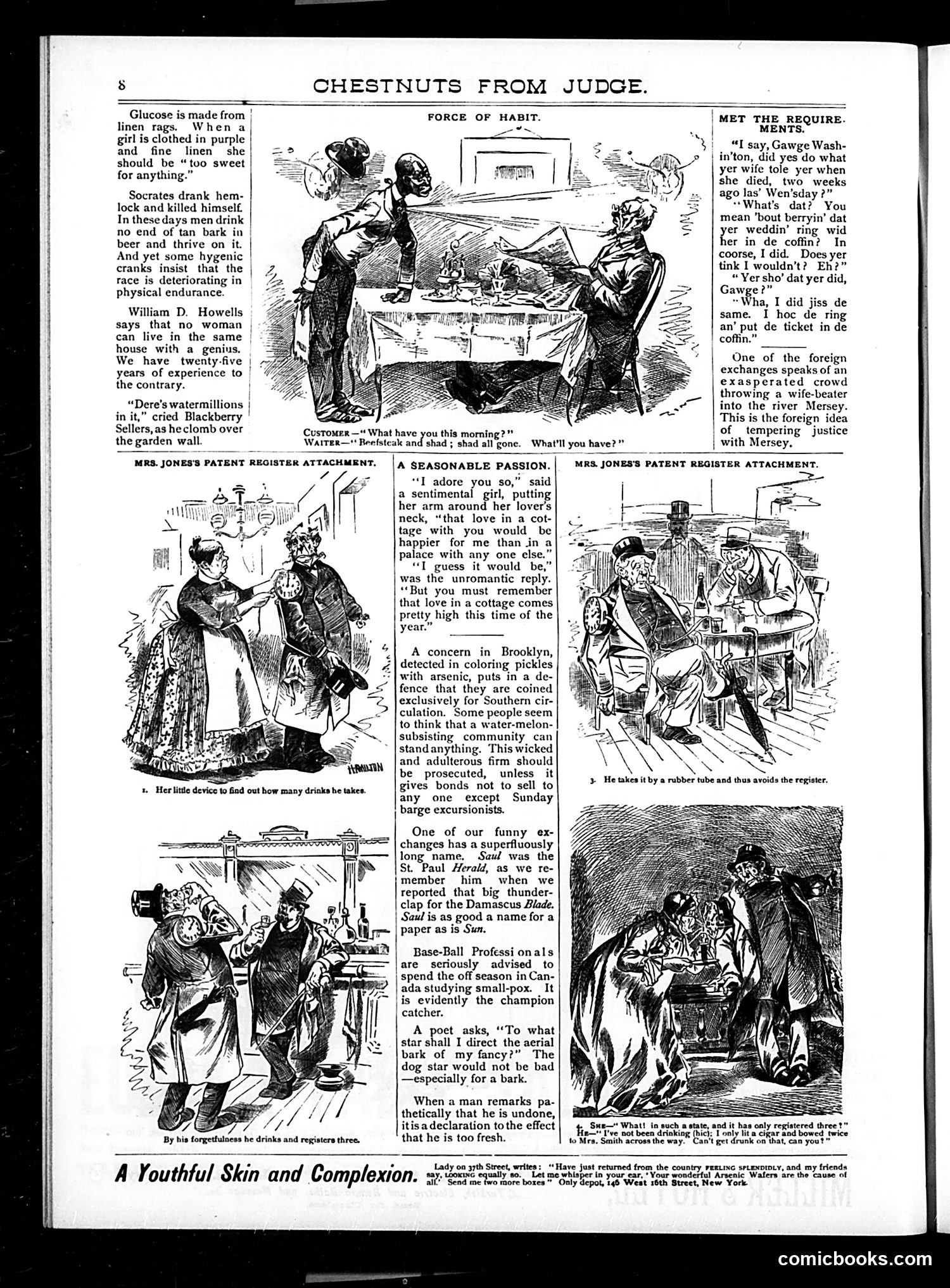
This page collects brief satirical observations ("chestnuts"—old jokes) on American life. Key pieces include: **"Force of Habit"**: A waiter automatically offers shad despite having none—mocking mindless routine in service work. **"A Seasonable Passion"**: A sentimental young woman declares cottage love preferable to palace luxury; her boyfriend pragmatically notes cottage living is expensive "this time of year"—deflating romantic idealism with economic reality. **Various one-liners** mock: false health claims (arsenic-colored pickles marketed to Southern buyers), newspaper naming conventions, and social pretension. The cartoons show domestic situations and urban life. One illustration depicts what appears to be a device tracking drink consumption—satirizing either temperance concerns or marital oversight. The closing advertisement ironically advertises "Arsenic Waters" for youthful skin, parodying dangerous patent medicines of the era—itself satirizing the very health fraud discussed in the page's text.
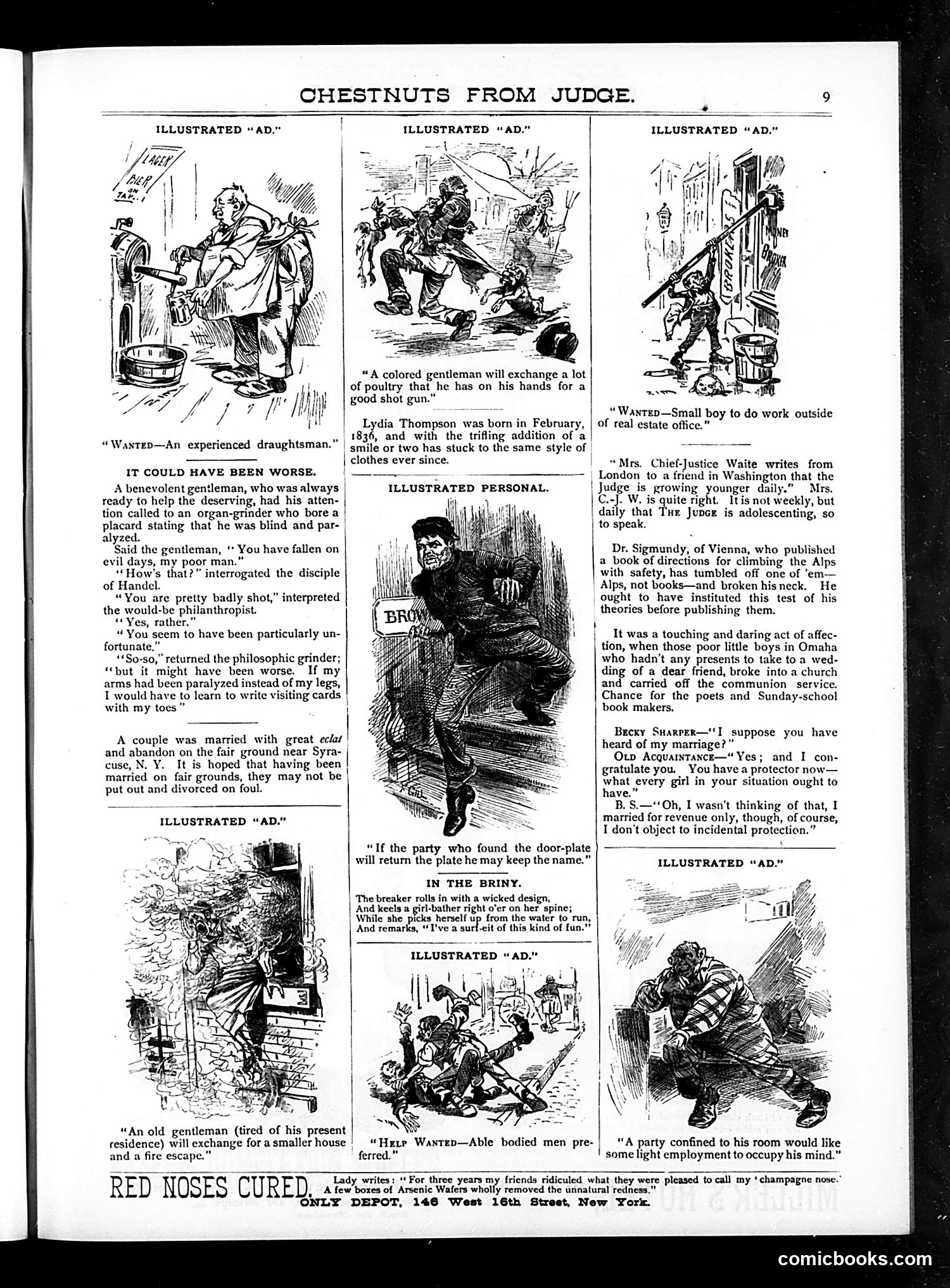
This page collects satirical humor pieces typical of Judge magazine's style. The cartoons mock various social pretenses and absurdities through illustrated "want ads" and brief anecdotes. **Key content:** - **"Experienced draughtsman" wanted**: Visual joke showing a man being thrown out a window—dark humor about workplace hazards - **Organ-grinder dialogue**: A blind, paralyzed street musician philosophically notes things could be worse; satire on Victorian sentimentality about the poor - **Colored gentleman's ad**: Reflects period racial stereotypes in a crude joke about exchanging poultry for a gun - **Lydia Thompson reference**: Notes the actress wore identical clothing styles for decades (1836 onward) - **Various absurd ads**: Seeking "fire escapes" from residences, "able-bodied men," or employing a child outside a "real estate office"—double meanings suggesting questionable activities **Overall point**: Judge mocks Victorian propriety, social climbing, racial attitudes, and everyday hypocrisy through deadpan, darkly humorous scenarios. The satire relies on recognizing period-specific social anxieties and conventions.
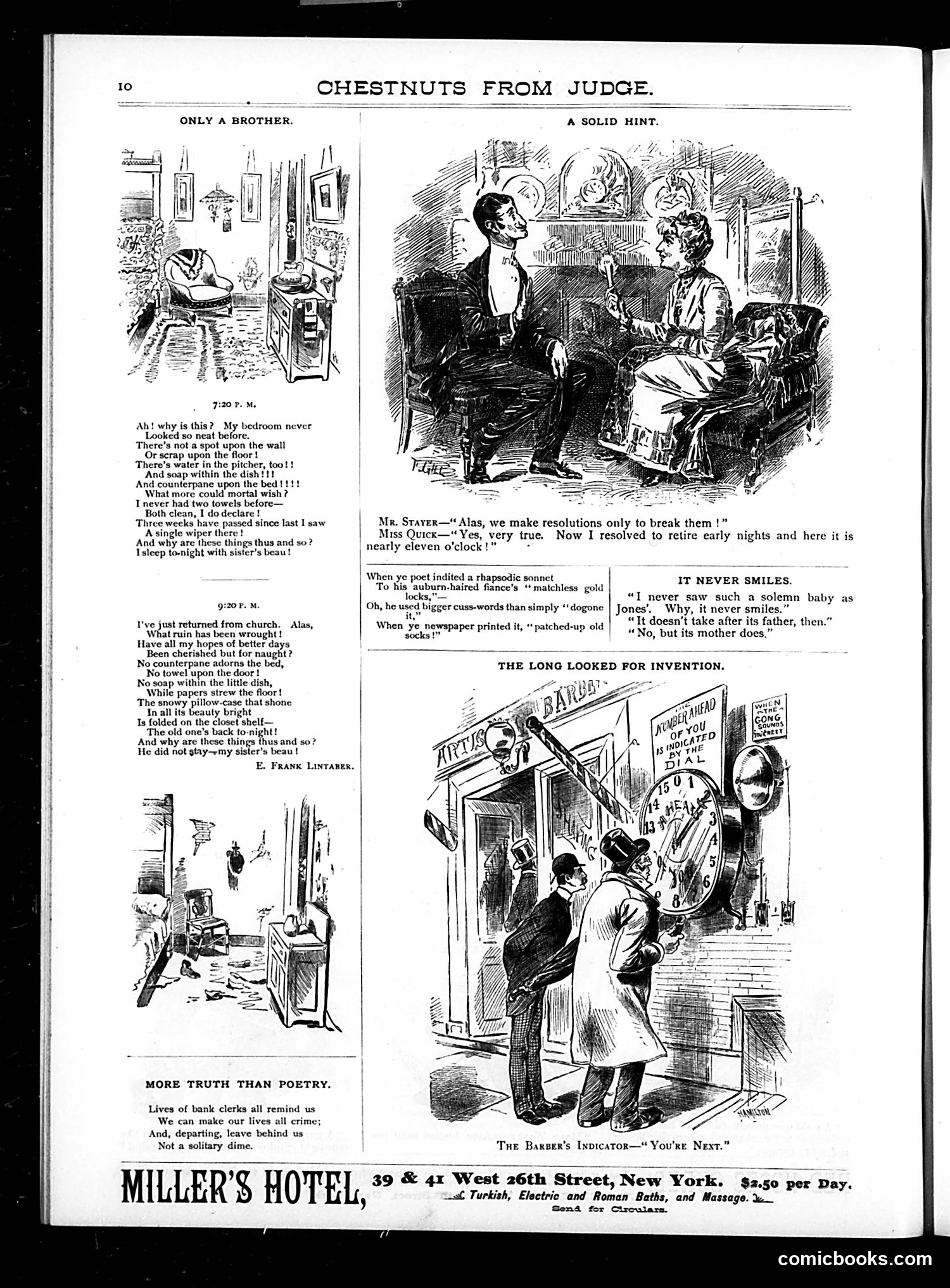
This page contains several satirical pieces mocking everyday human behavior rather than specific political figures. **"Only a Brother"** (7:30 P.M.) depicts a messy bedroom with humorous verse about domestic disorder—clothing strewn about, water in the basin, and a counterpane on the floor. The satire targets the typical slovenliness of male household members. **"A Solid Hint"** shows a conversation between Mr. Stayer and Miss Quick about broken New Year's resolutions, satirizing the universal human tendency to abandon self-improvement pledges almost immediately. **"The Long-Looked-For Invention"** illustrates a barber's shop indicator—a dial showing wait times—poking fun at barber shop delays. The page mixes humor about domestic life, social conventions, and modern inconveniences rather than addressing specific political events or identifiable public figures.
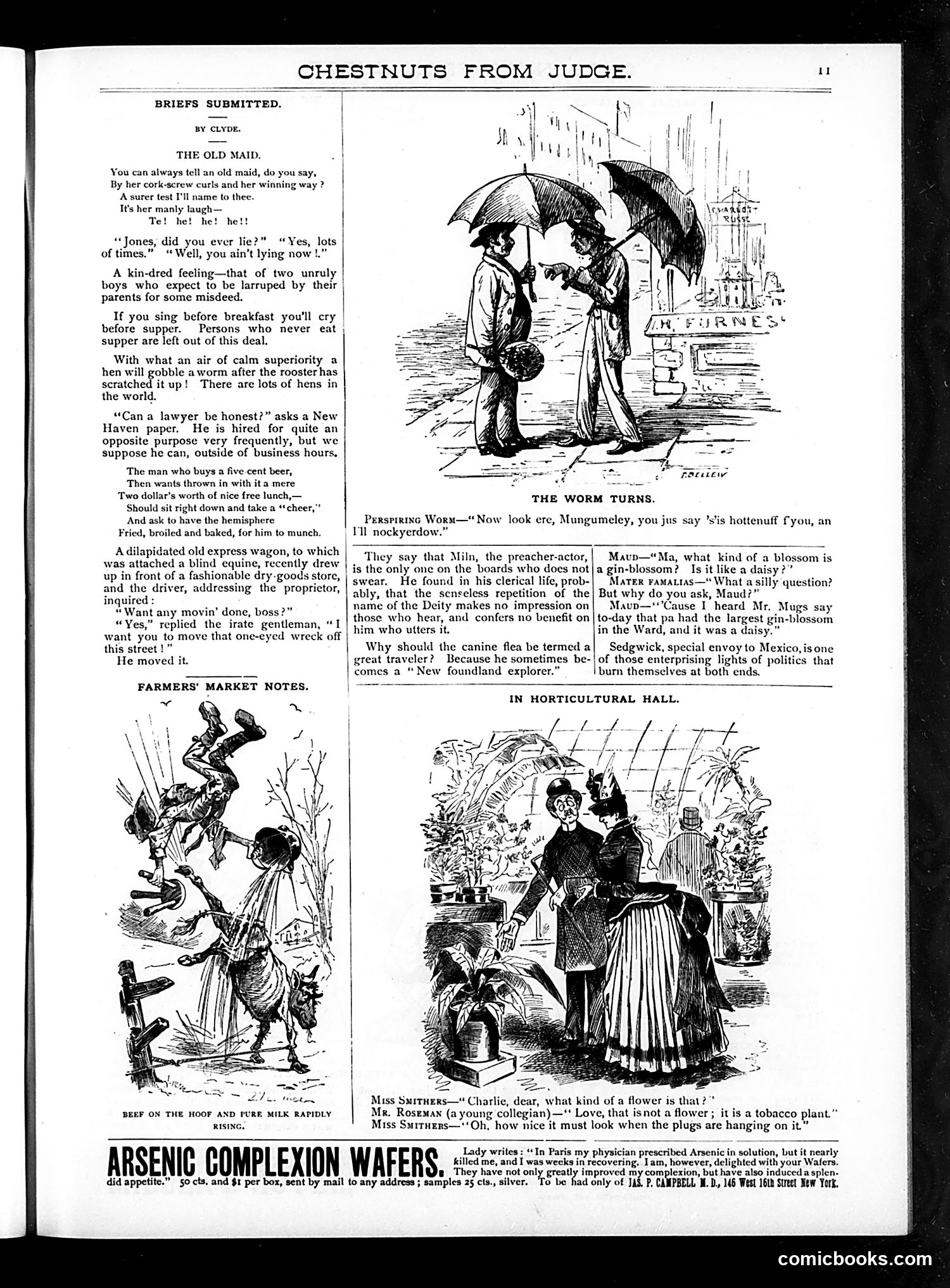
This page contains several satirical humor pieces and illustrations typical of late-19th-century American comedy journalism. **"The Old Maid"** and related brief jokes mock social conventions—old maids' mannerisms, dishonest lawyers, cheapskates seeking free lunch, and a driver with a blind horse. These are gentle social observations about recognizable types. **"The Worm Turns"** depicts two working-class men (likely dock workers or laborers based on dress) debating whether it's hot enough. The dialect suggests working-class speech patterns that Judge's middle-class readership would find amusing. **"In Horticultural Hall"** shows a flirtation where a young man calls love "a tobacco plant," and a woman makes a sexual innuendo about "plugs." This reflects period attitudes toward courtship. The bottom half advertises "Arsenic Complexion Wafers"—a real (and alarming by modern standards) beauty product containing arsenic, marketed to women seeking lighter skin. The cartoons satirize everyday social behavior and class distinctions through exaggeration and wordplay typical of Judge's satirical humor.
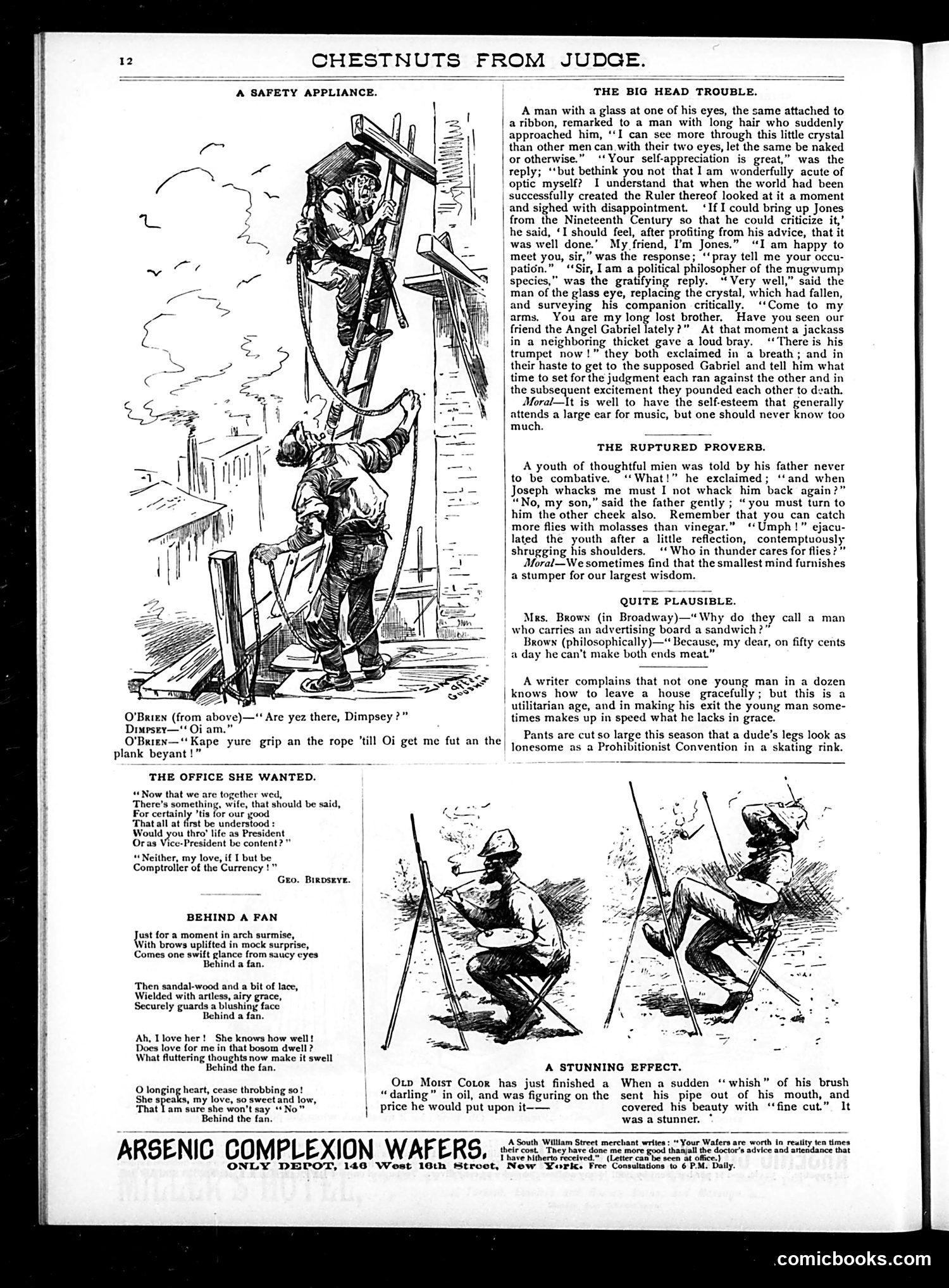
This page from *Judge* magazine contains several satirical pieces mocking intellectual pretension and social conventions of the era. **"The Big Head Trouble"**: Two self-important men—one wearing a monocle, the other claiming to be a "political philosopher"—engage in absurdly grandiose conversation, each boasting of superiority. They mistake a donkey's bray for the angel Gabriel and kill each other rushing toward it. The moral mocks oversized egos and excessive self-regard. **"The Ruptured Proverb"**: A father's traditional moral advice ("turn the other cheek," "catch more flies with molasses") proves useless to his pragmatic son, who dismissively asks "Who cares for flies?" This satirizes the gap between idealistic wisdom and modern utilitarian indifference. Other brief items mock contemporary social absurdities: sandwich-board men's poverty wages, oversized pants fashion, and a woman's ambition to be "Comptroller of the Currency" rather than First Lady. The page reflects *Judge*'s satirical focus on American vanity, class pretension, and social change during the Gilded Age.
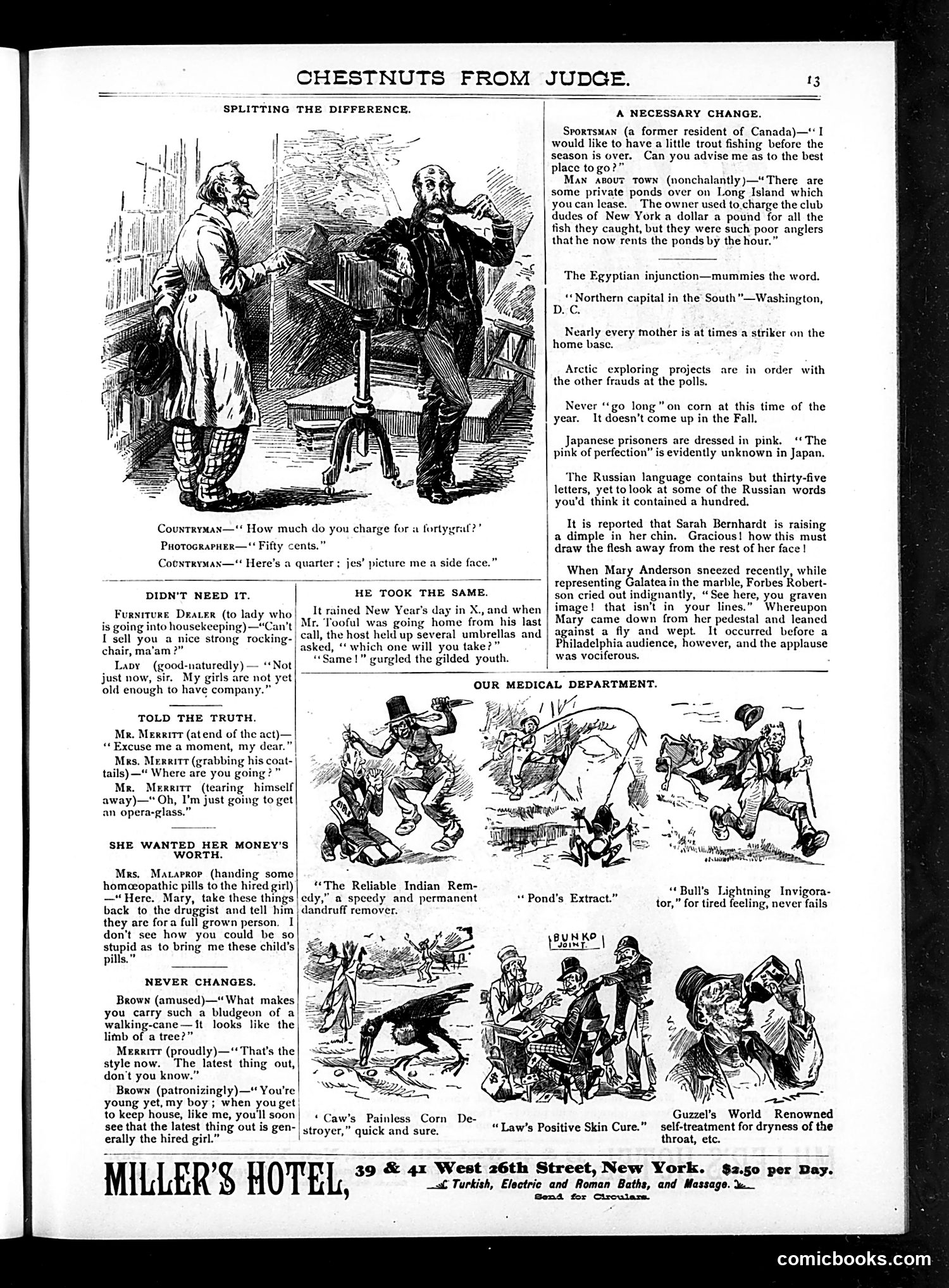
This is a humor page from Judge featuring short jokes and satirical quips typical of late 19th-century American comedy. The main cartoon, "Splitting the Difference," depicts a countryman negotiating fishing rights with a city photographer, playing on class differences and the era's tension between rural and urban life. The page's "chestnuts" (old jokes) mock contemporary figures and concerns: Sarah Bernhardt's appearance, actress Mary Anderson's theatrical performance, Russian language complexity, and Japanese fashion. Several jokes reference current events—Arctic exploration frauds, election poll corruption, and corn market prices. The "Medical Department" section parodies patent medicines and quack remedies popular at the time, with satirical product names like "The Reliable Indian Remedy" and "Bull's Lightning Invigorator." The humor relies on visual exaggeration and social observation rather than political commentary. A Miller's Hotel advertisement anchors the page's bottom. Overall, this represents Judge's satirical approach to contemporary American life and consumer culture.
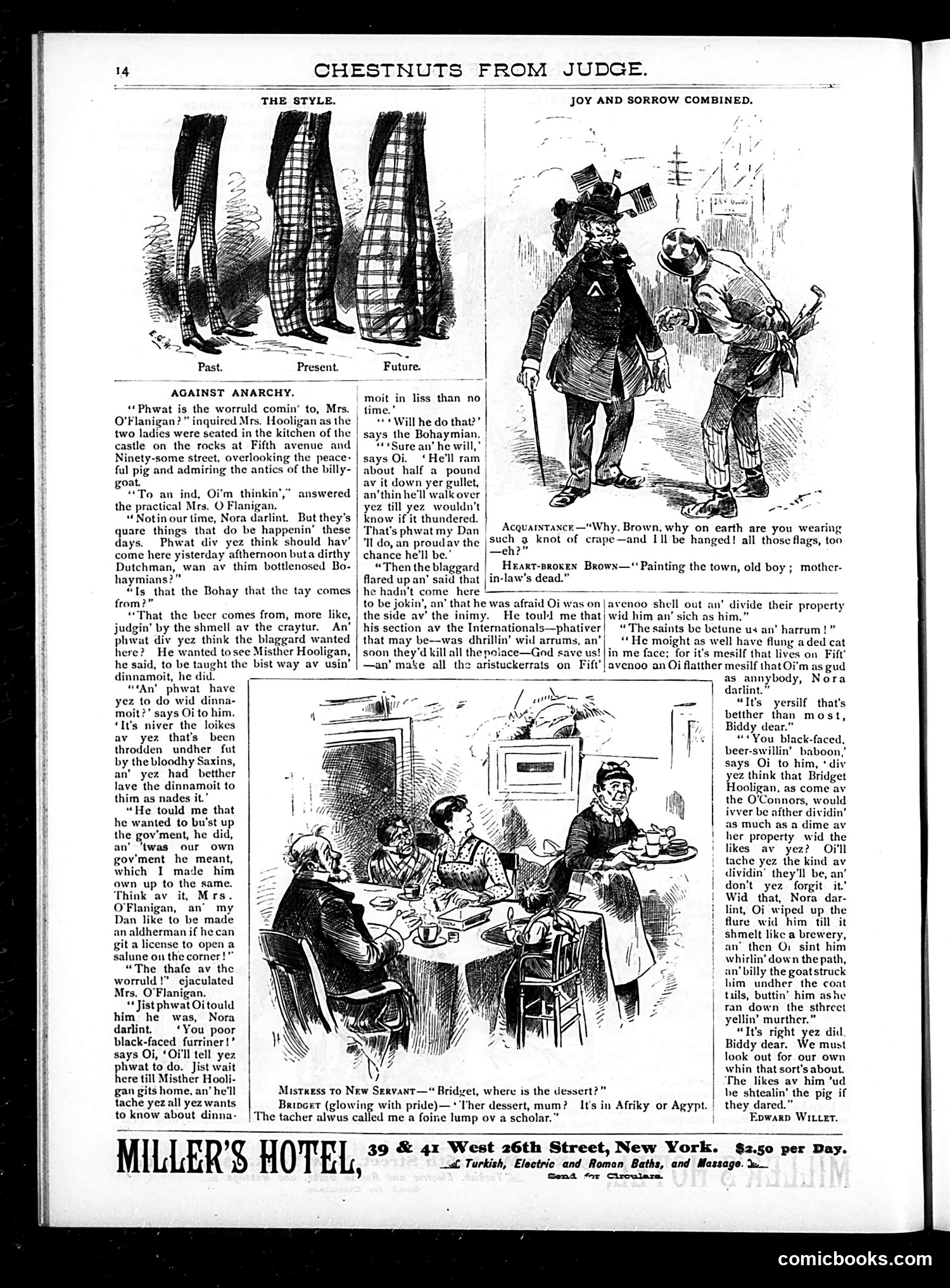
This page contains three separate comic sketches satirizing Irish-American working-class life and contemporary anxieties. **"Against Anarchy"**: Two Irish immigrant women (Mrs. O'Flanigan and Mrs. Hooligan) discuss a German anarchist who approached Mr. Hooligan seeking to learn bomb-making ("dinnamoit"). The satire mocks both the revolutionary threat of foreign anarchists and the Irish-Americans' fierce patriotism—they violently reject the anarchist and boast of their loyalty despite their working-class status. The humor plays on the stereotype that Irish immigrants are simultaneously viewed as dangerous rabble themselves, yet staunchly defend American order. **"The Style"**: Three illustrated skirts labeled Past, Present, Future show changing fashion silhouettes. **"Joy and Sorrow Combined"**: A widow wears mourning crape (black cloth) for her dead mother-in-law while also displaying celebratory flags, suggesting her conflicted emotions about the death. The magazine reflects period concerns about anarchist immigration and ethnic stereotypes while poking fun at Irish-American social aspirations.
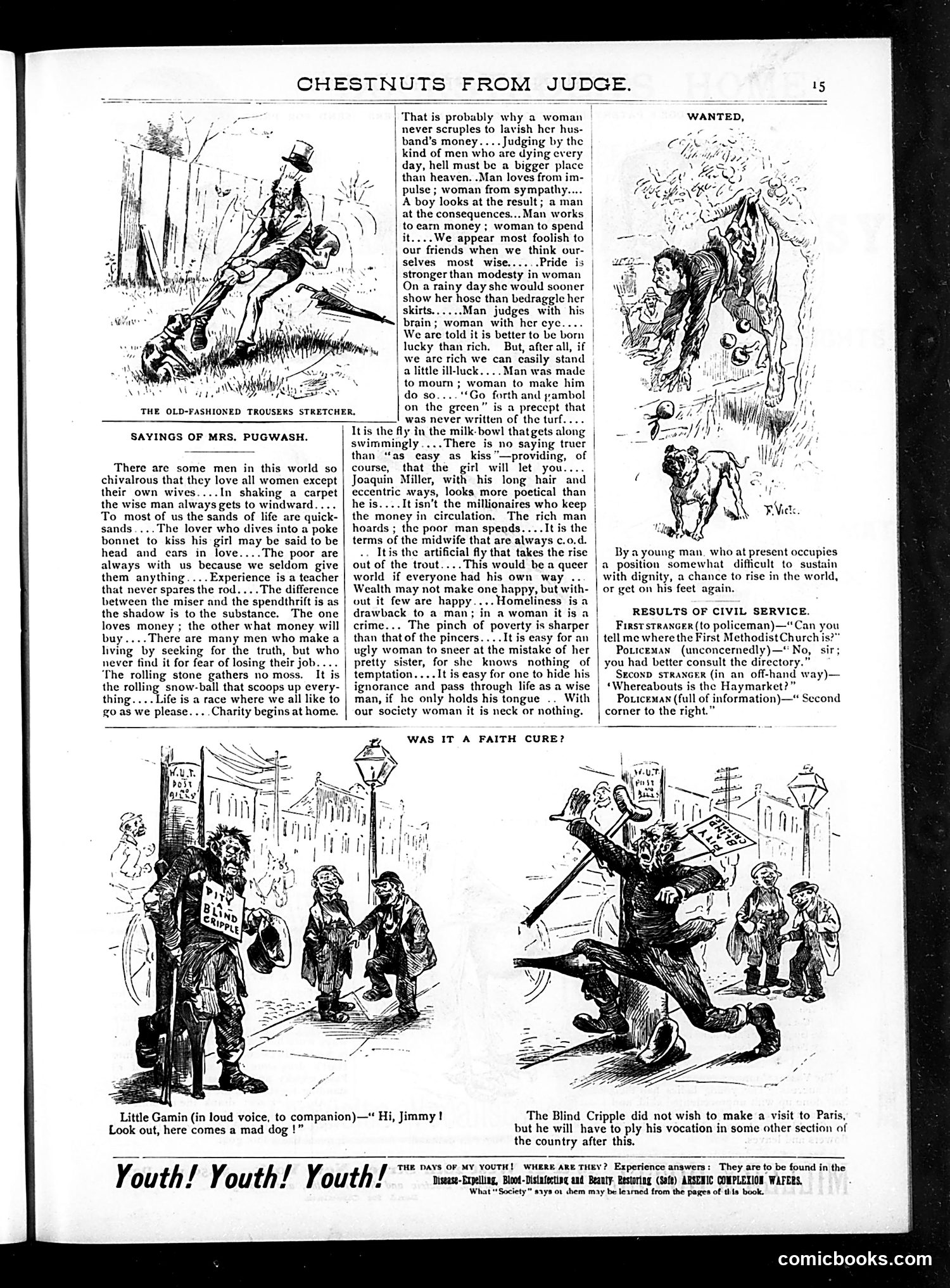
This page satirizes several social issues of its era: **"Sayings of Mrs. Pugwash"**: A long column of misogynistic aphorisms contrasting men's and women's nature—men are rational and industrious; women are frivolous spenders and emotionally driven. The satire targets these gender stereotypes themselves, mocking their absurdity through exaggeration. **"The Old-Fashioned Trousers Stretcher"**: A cartoon showing a man using an old device to stretch trousers, mocking outdated practices. **"Results of Civil Service"**: Two brief comic sketches critiquing newly-hired civil service policemen. The first refuses to help a stranger find a church, directing him to consult a directory instead. The second policeman is overly helpful about directions. The joke mocks bureaucratic incompetence and inconsistency in public service—civil service hiring, recently reformed to be merit-based rather than patronage-based, apparently produced unreliable results. **"Was It a Faith Cure?"**: A street scene where a blind cripple apparently recovered mobility, forcing him to relocate his begging operation elsewhere.
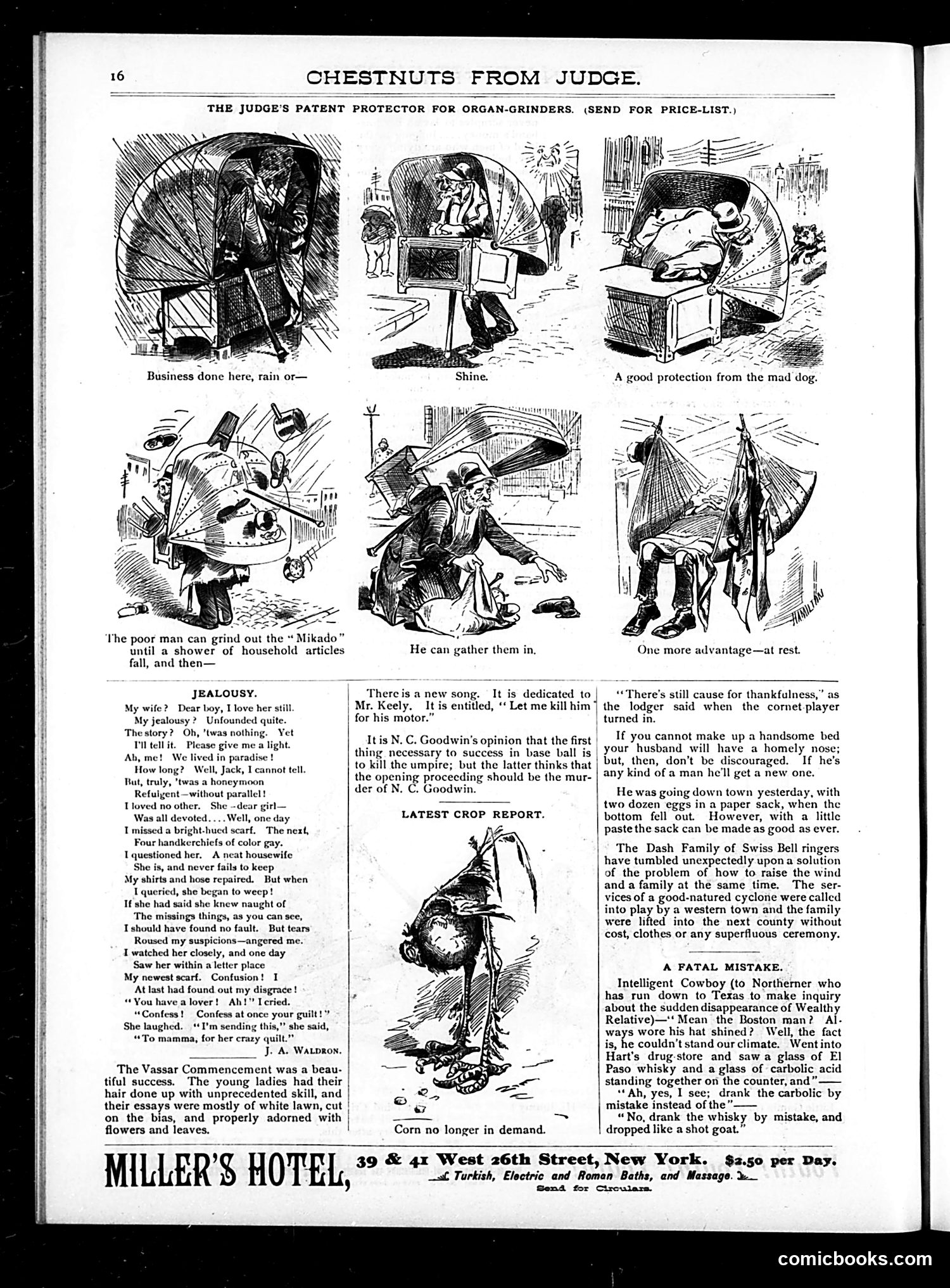
This page contains six humorous cartoons and several joke pieces typical of Judge magazine's satirical content. **The cartoons** mock a "patent protector for organ-grinders"—a device allowing street musicians to work in various weather and conditions (rain, shine, mad dogs, etc.). The satire targets both the absurdity of over-engineered solutions and the lower-class street performers themselves. **The text pieces** include: - "Jealousy": A domestic comedy where a husband suspects infidelity when his wife sends his belongings to her mother for a quilt—playing on male insecurity. - References to N.C. Goodwin (likely a baseball figure) and theater/motor-related songs. - A "Latest Crop Report" joke about corn being unmarketable. - "A Fatal Mistake": Dark humor about a Boston visitor mistaking carbolic acid for whisky in Texas. The overall tone is late-19th-century genteel humor—mocking class differences, domestic relations, and regional stereotypes. The Vassar Commencement reference and Miller's Hotel ad anchor this in Gilded Age America.
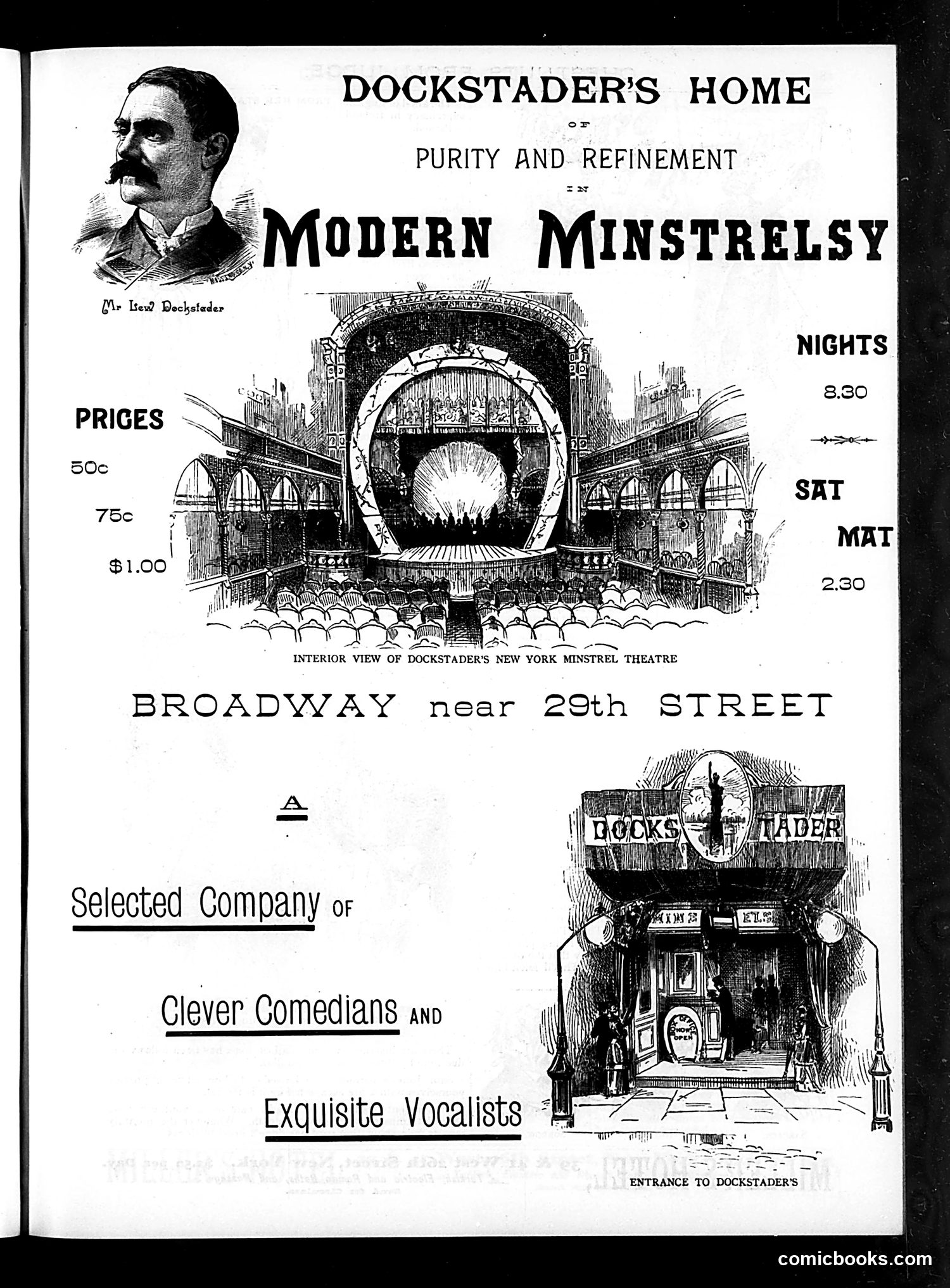
This is primarily an advertisement for Dockstader's Minstrel Theatre on Broadway near 29th Street, not a political cartoon. It promotes Lew Dockstader's minstrel show—a popular entertainment form of the era featuring comedians and vocalists. The page includes ticket prices (50¢-$1.00), show times, and architectural illustrations of the theater's interior and entrance. The advertisement emphasizes "purity and refinement," likely marketing language to attract respectable audiences to what was then considered legitimate entertainment. Minstrelsy was a dominant American theatrical form in this period, though it carried racist imagery (unclear from this particular ad whether it featured blackface performances). The engraved portrait shows Dockstader himself, a well-known performer and theater owner of the era.
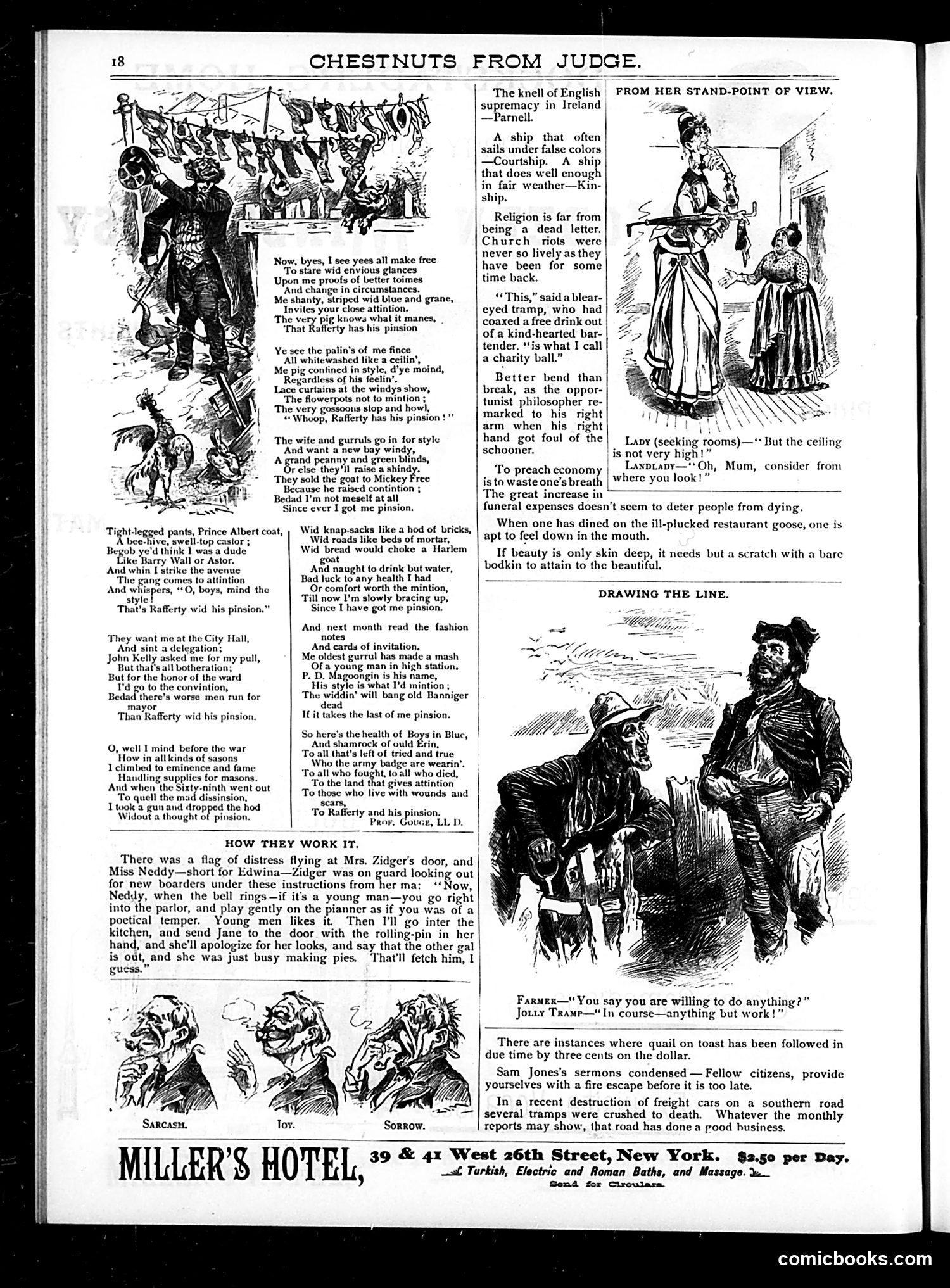
This page satirizes late 19th-century Irish-American urban life and politics. The main left illustration depicts a street politician or "ward boss" addressing constituents with exaggerated dialect ("ye see yis all make free"). The accompanying verse mocks Irish immigrants' engagement with American electoral politics and city machines. The top right illustration titled "From Her Stand-Point of View" shows a woman commenting on ceiling height in modest housing, satirizing class pretensions among working-class residents. The bottom section includes quotes about farmer-tramp relations and commentary on economic hardship, suggesting broader Depression-era or post-war economic anxiety. The three facial studies labeled "Sarcasm," "Ior," and "Sorrow" appear to be character study sketches, likely illustrating emotional types common in period illustration.
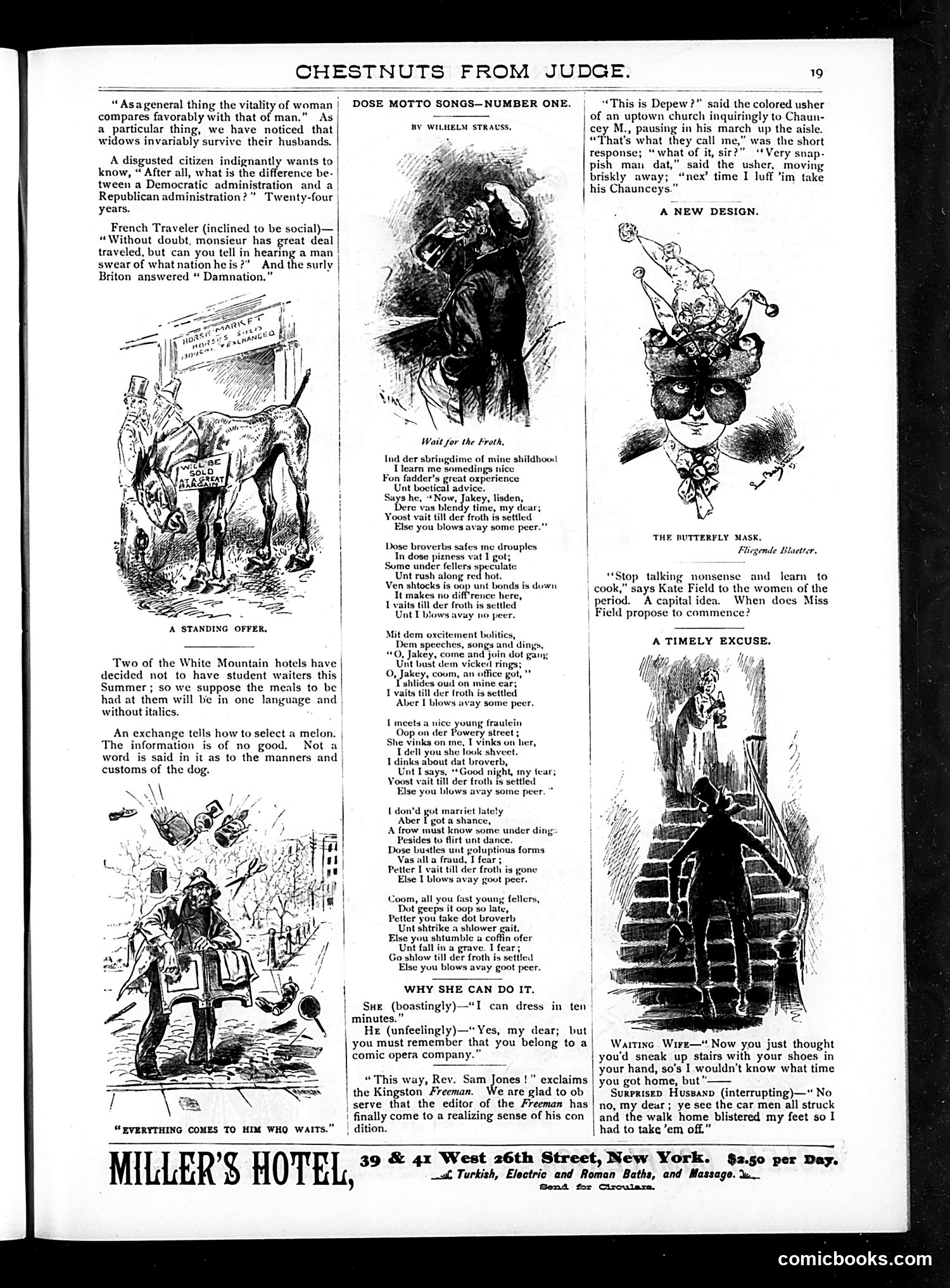
This page contains several satirical pieces typical of late-19th-century American humor: **"Dose Motto Songs—Number One"** features a heavily German-accented speaker (marked by phonetic spelling like "der," "vait," "peer") dispensing folk wisdom about waiting for "froth to settle" before acting—applied to stocks, romance, politics, and marriage. The dialect comedy was popular entertainment of the era, though the accent caricature reflects ethnic stereotyping. **"The Butterfly Mask"** illustration and accompanying text reference Kate Field, a real 19th-century women's rights advocate and journalist, whom the magazine sarcastically challenges to practice what she preaches about women learning to cook. **The remaining vignettes** mock contemporary figures like Chauncey Depew (a prominent Republican politician/railroad executive), offer commentary on hotel services, and feature domestic humor about married life. The overall tone is light satire targeting politics, gender roles, and social pretensions—characteristic of Judge's satirical approach during this period.
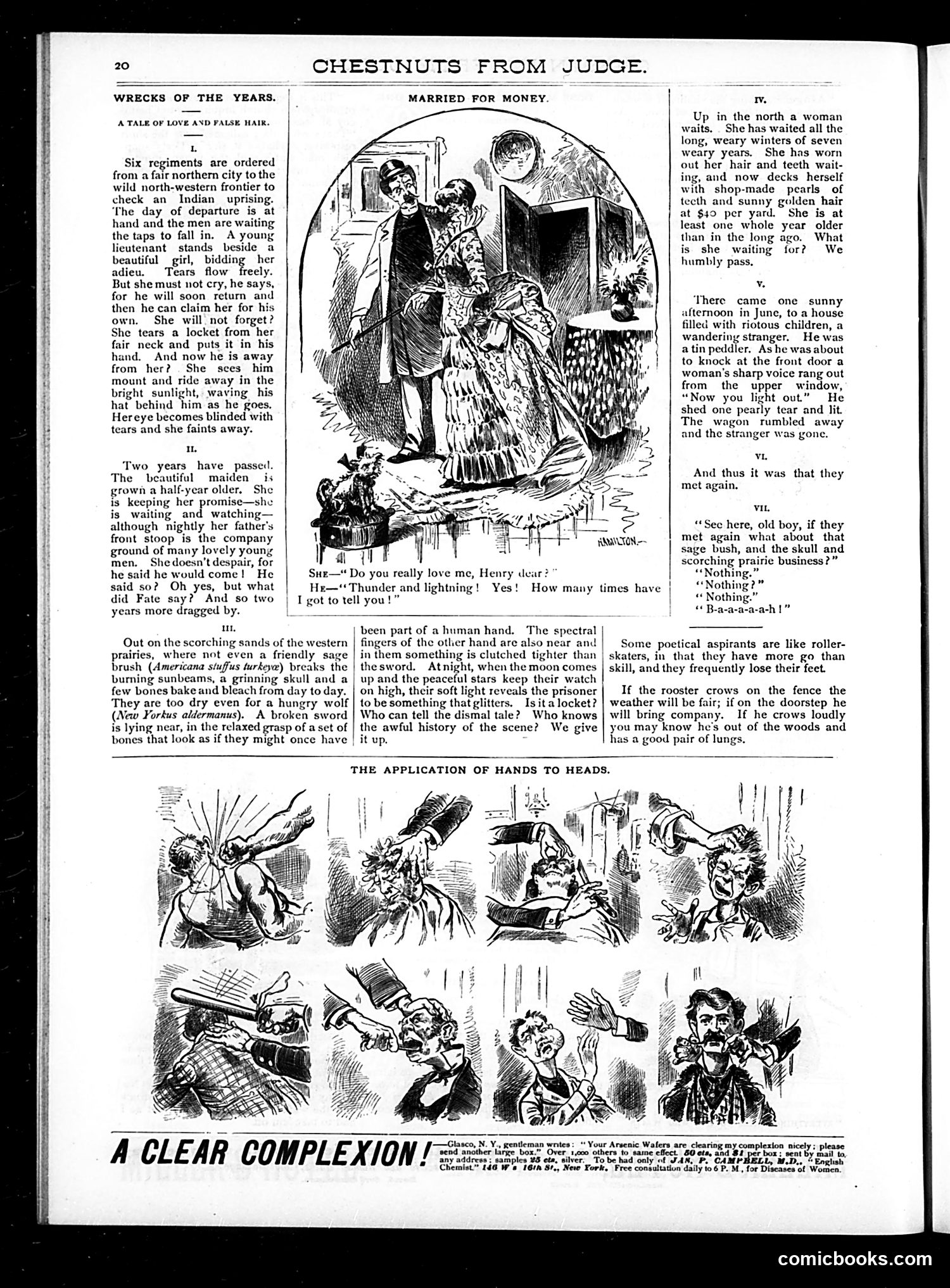
This page contains a serialized melodramatic story titled "Wrecks of the Years: A Tale of Love and False Hair," presented as satire of sentimental Victorian romance literature. **The Story's Plot:** A young officer leaves a woman with a locket, promising to return. She waits seven years faithfully, but he never comes back. The narrative then cuts to a skeleton on a prairie holding the locket, implying he died. Meanwhile, the woman—now aged and her real hair worn out—buys artificial hair and teeth ($40/yard) to maintain her appearance. A tin peddler visits her house but is chased away. The story ends ambiguously: "And thus it was that they met again"—leaving unclear whether this is romantic reunion or tragic irony. **The Satire:** Judge mocks the genre of overwrought love stories with impossible coincidences and artificial resolutions. The absurd details (her teeth literally worn out from waiting, purchased replacement parts, the unexplained skeleton) emphasize how ridiculous such narratives are. The final section spoofs poetical writing generally. The lower section, "The Application of Hands to Heads," appears to be humorous illustrations of various head-striking gestures.
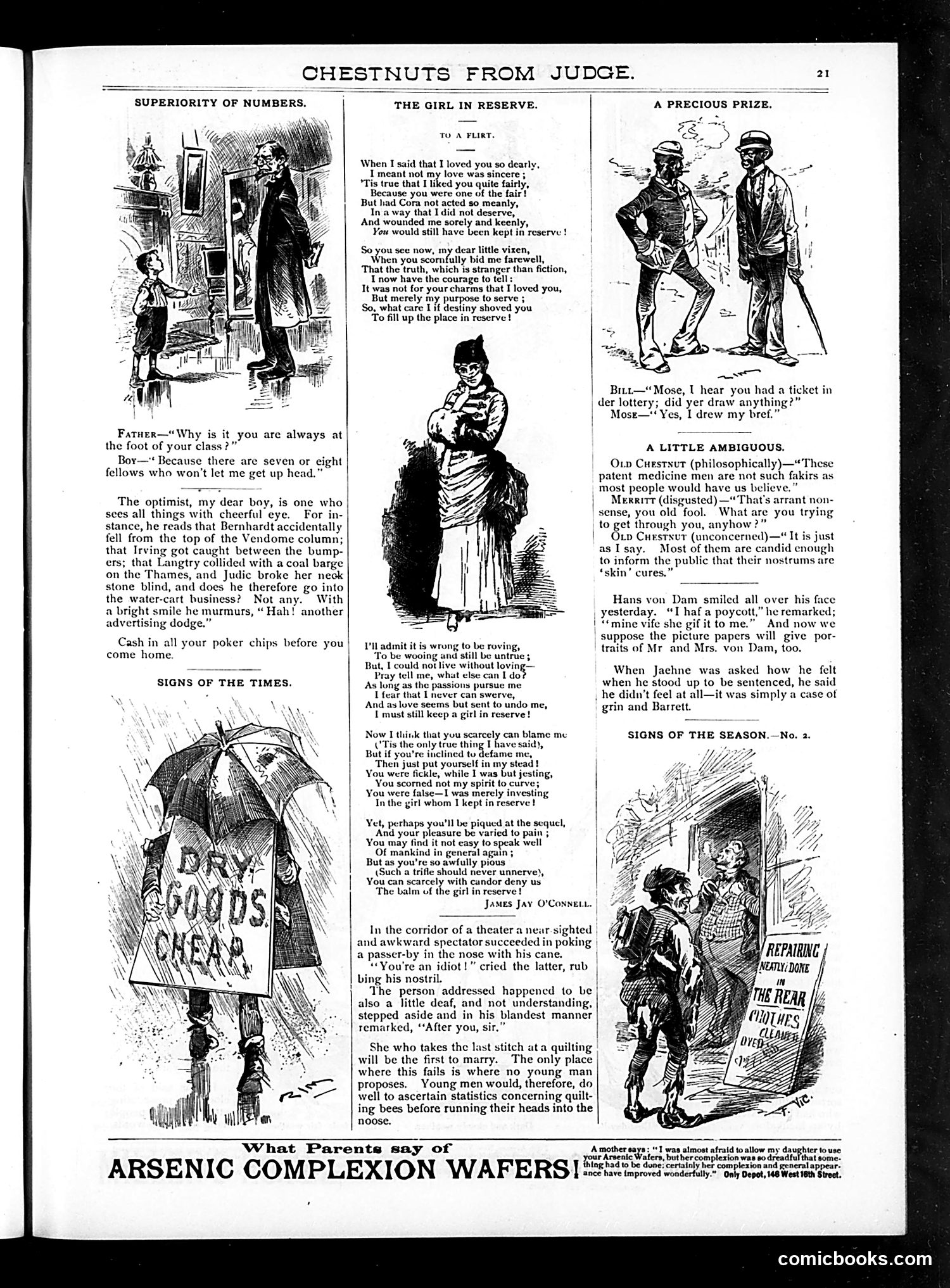
This is a collection of short satirical pieces and jokes typical of Judge magazine's humor: **"Superiority of Numbers"**: A father questions his son about being last in class; the boy explains seven or eight classmates won't let him get ahead—a joke about competitive disadvantage through sheer numbers. **"The Girl in Reserve"**: A lengthy poem satirizing male fickleness, where a flirt admits he kept this woman as a backup romantic option while pursuing others. It mocks men who juggle multiple romantic interests. **"A Precious Prize"**: A brief ethnic joke with German-accented speech ("Mose," "der lottery"), where the punchline plays on "drew" as both lottery and breathing—suggesting the prize was merely survival. **"Signs of the Times"** and other snippets: Various one-liners and observations on contemporary behavior, including patent medicine charlatans and social awkwardness. The advertisements (Arsenic Complexion Wafers) reflect the era's problematic beauty standards and dangerous cosmetics. Overall, the page represents late-19th-century American satirical humor targeting romance, class, and social pretension.
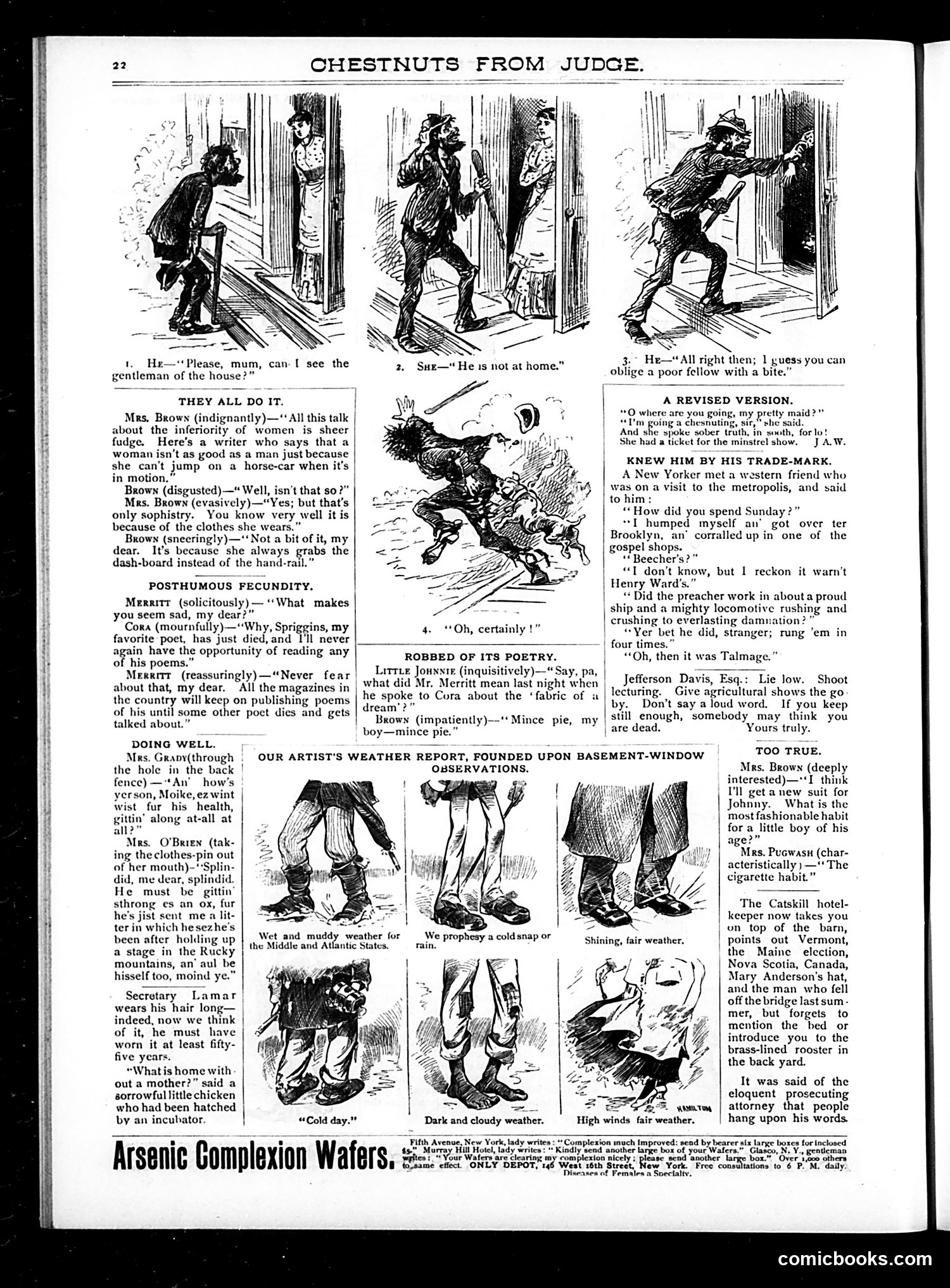
This page collects short humorous pieces typical of *Judge* magazine's satirical style. The cartoons and jokes mock contemporary social conventions: **"They All Do It"** satirizes debates about women's capabilities—a husband dismisses his wife's argument about gender equality by blaming her clothing rather than addressing her actual point. **"Posthumous Fecundity"** jokes that magazines will endlessly republish a dead poet's work, extending his relevance beyond death. **"Doing Well"** presents Irish immigrant characters whose dialect suggests her son's success (robbery in the Rocky Mountains) is actually criminal activity. **"Robbed of Its Poetry"** mocks overwrought romantic language by reducing flowery speech to mundane mince pie. **"Knew Him by His Trade-Mark"** satirizes the famous preacher Thomas Talmage's repetitive sermon style—dramatic imagery about ships and locomotives crushing toward damnation. The weather cartoon uses footwear conditions as humorous forecast indicators. These represent typical *Judge* satire: social hypocrisy, linguistic pretension, and recognizable public figures.
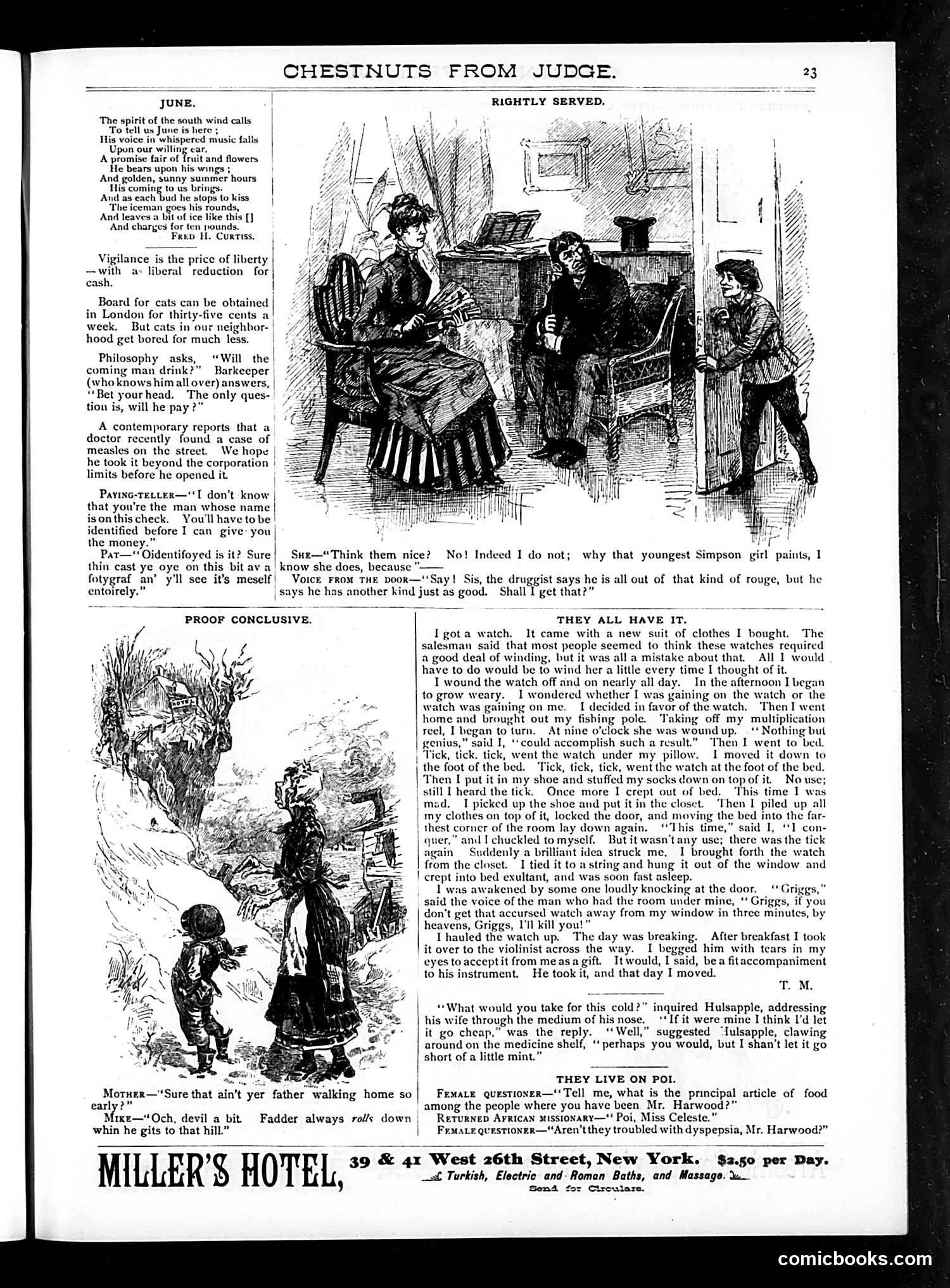
This page from Judge (a major American humor magazine) collects brief comic anecdotes and jokes—"chestnuts" meaning worn-out or recycled material. **Key content:** - **"Rightly Served"**: A domestic scene mocking women's vanity about appearance and makeup - **Various short jokes**: Satirizing common frustrations—overcharging icemen, bar owners' indifference to payment, street vendors, bank tellers, and Irish immigrants ("Pat") - **"Proof Conclusive"**: A lengthy anecdote about a faulty watch from new clothing—mocking both mechanical incompetence and consumer gullibility - **"They All Have It"**: A variation on the same theme The humor targets commercial deception, class pretension, immigrant stereotypes, and the era's skepticism toward new consumer goods and technologies. These are gentle domestic comedies typical of 1890s Judge magazine—meant for middle-class readers amused by everyday inconveniences and social observations.
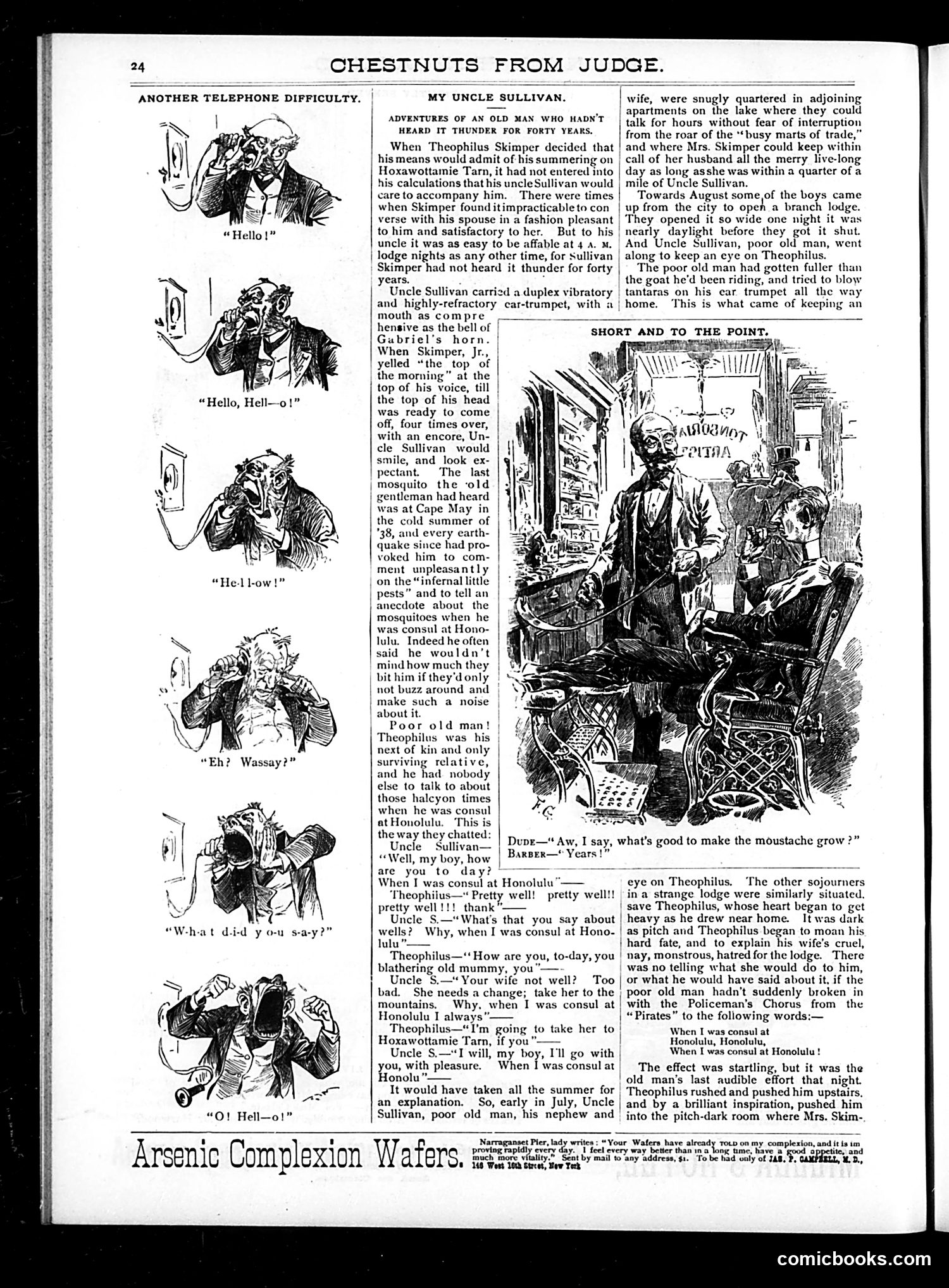
This page contains two separate humor pieces from the satirical magazine *Judge*: **"Another Telephone Difficulty"** (left): Shows a man repeatedly struggling with an early telephone, getting increasingly frantic responses ("Hello!" → "Hello, Hell—o!" → "Hell—ow!" → "Eh? Wassay?" → "What d'id y'ou say?"). The joke satirizes the primitive technology and poor audio quality of early telephones, where callers couldn't hear each other clearly. **"My Uncle Sullivan"** (main text/right): A longer story-cartoon mocking an elderly man who hasn't heard thunder in forty years and is nearly deaf, requiring a massive ear trumpet. The humor derives from his constant interruptions—he keeps launching into boring anecdotes about when "I was consul at Honolulu," making conversation impossible. The satire targets both technological frustration (poor communication devices) and the archetype of the tedious elderly relative obsessed with past glory. The advertisement at bottom for "Arsenic Complexion Wafers" is period-typical but alarming by modern standards.
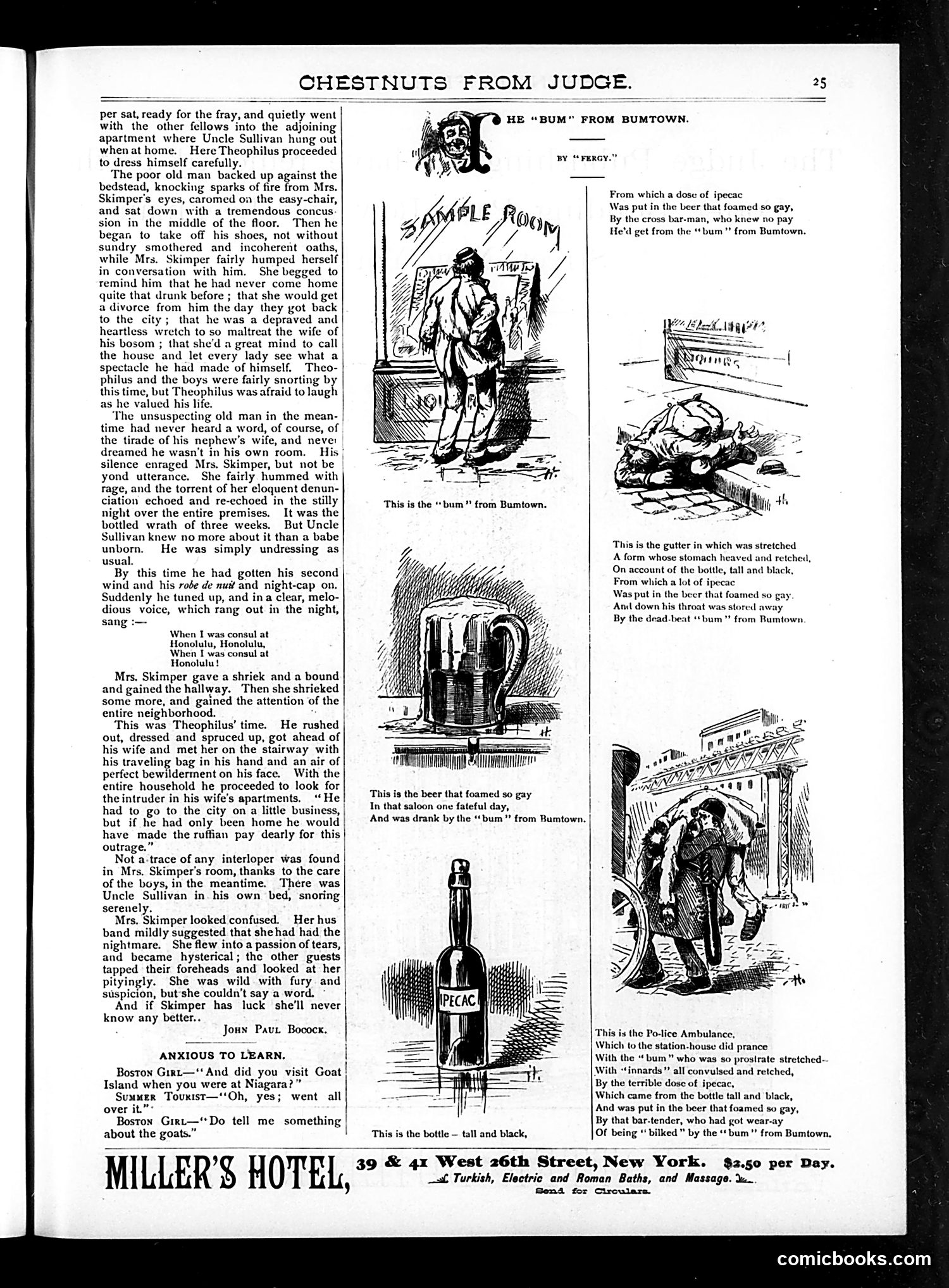
This page contains a serialized story ("Chestnuts from Judge") about a prank where young men trick a drunk Uncle Sullivan into entering Mrs. Skimper's bedroom while she sleeps, causing marital chaos when she awakes to find him undressing. The humor relies on mistaken identity, the uncle's obliviousness while intoxicated, and Mrs. Skimper's humiliation when her accusations of intrusion prove baseless. The accompanying verse "The 'Bum' from Bumtown" by "Fergy" depicts a vagrant ("bum") who receives ipecac-laced beer as punishment for not paying at a bar. The illustrations show the man becoming ill as consequence. This is working-class humor mocking both transient drunks and the rough justice of bar-tenders. Both pieces ridicule intoxication and lower-class characters through slapstick consequences—a common Judge magazine formula of the era.
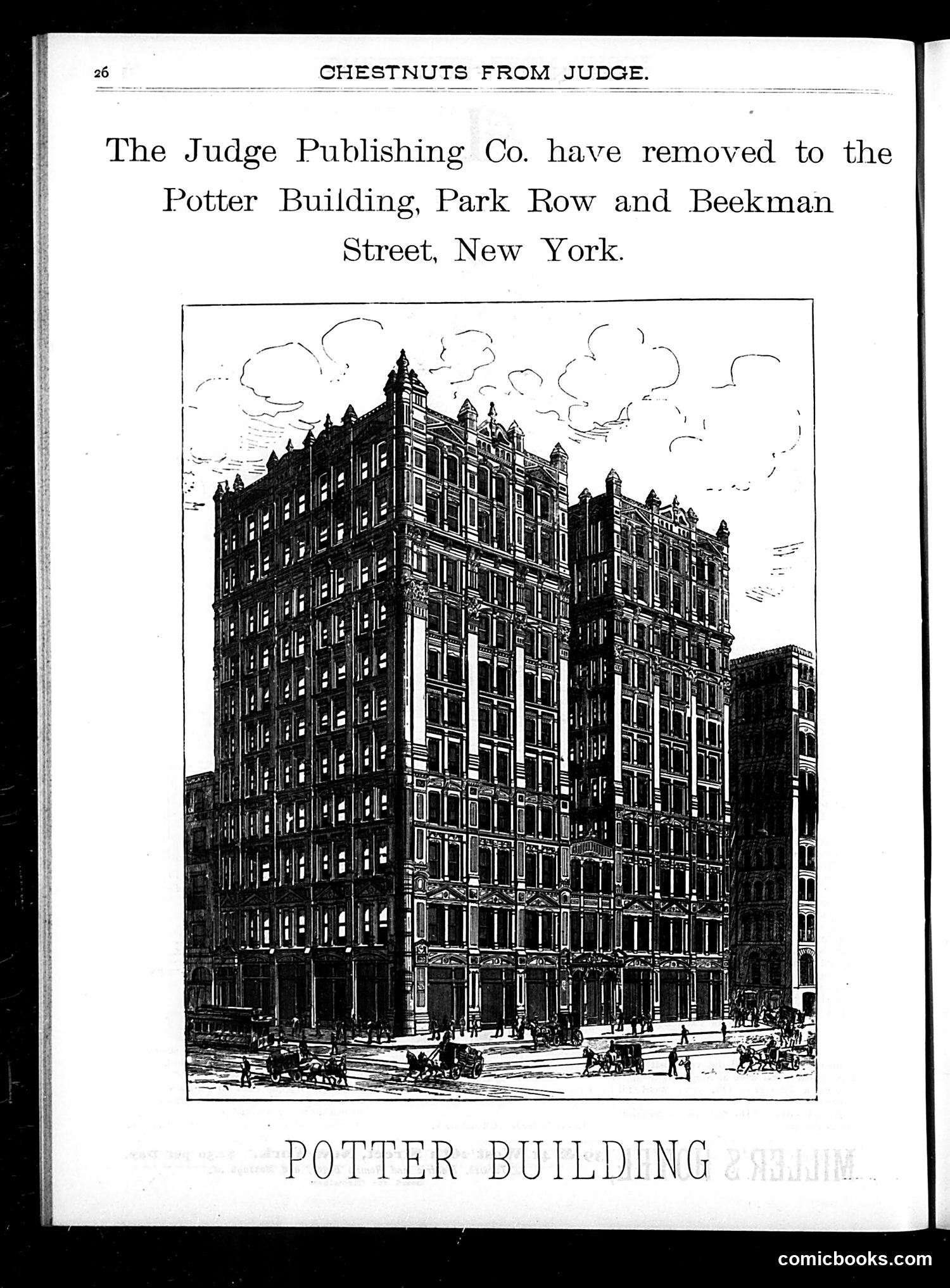
This is a straightforward advertisement rather than a political cartoon. The page announces that Judge Publishing Company has relocated to the Potter Building in New York City. The image is an architectural illustration of the Potter Building itself—a substantial multi-story office building with ornate Victorian-era design, featuring multiple windows, decorative stonework, and a prominent roofline with spires. The "Chestnuts from Judge" header refers to the magazine's content, but this particular page serves purely as a relocation notice. There is no satire, caricature, or political commentary present. It's simply promotional material informing readers of the company's new address at Park Row and Beekman Street in Manhattan.
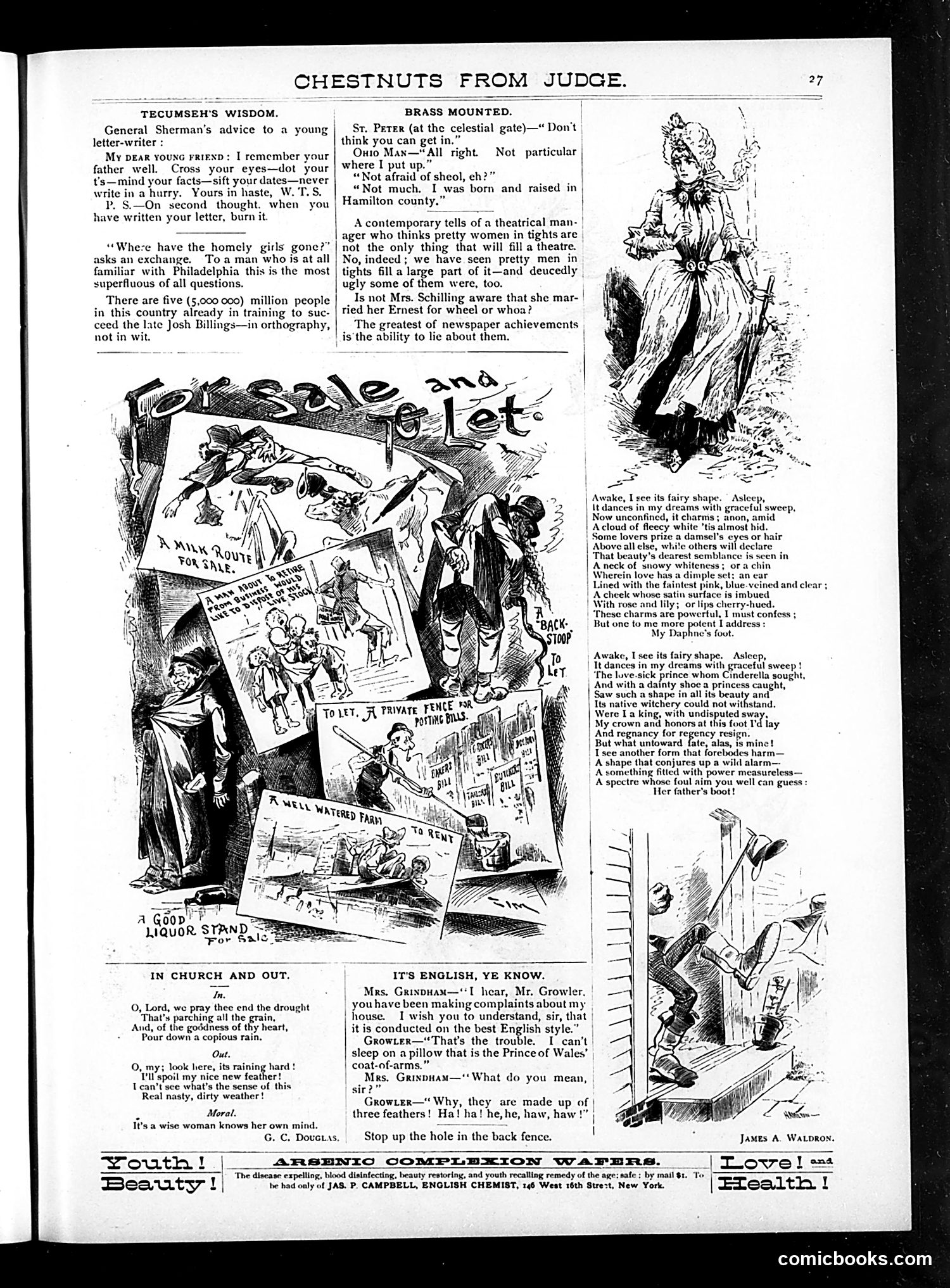
This page collects miscellaneous satirical items typical of Judge's format. Key content: **"Tecumseh's Wisdom"** parodies General William T. Sherman's advice to a young writer, humorously ending with "burn it"—suggesting his letters weren't worth preserving. **"Brass Mounted"** jokes about an Ohio man entering heaven claiming he's "not afraid of sheol" because he's from Hamilton county (implying it's as hellish as Ohio itself). **"In Church and Out"** contrasts religious piety with selfish behavior—people pray for rain during drought but complain when it ruins their clothes. **"It's English, Ye Know"** mocks pretentious English affectations: a landlady claims her house is "best English style," and a tenant complains his pillow (stuffed with Prince of Wales feathers) is uncomfortable because it has three feathers—a pun on the Prince's heraldic symbol. The page also includes romantic poetry about a lover's obsession with his beloved's foot, and typical period advertisements.
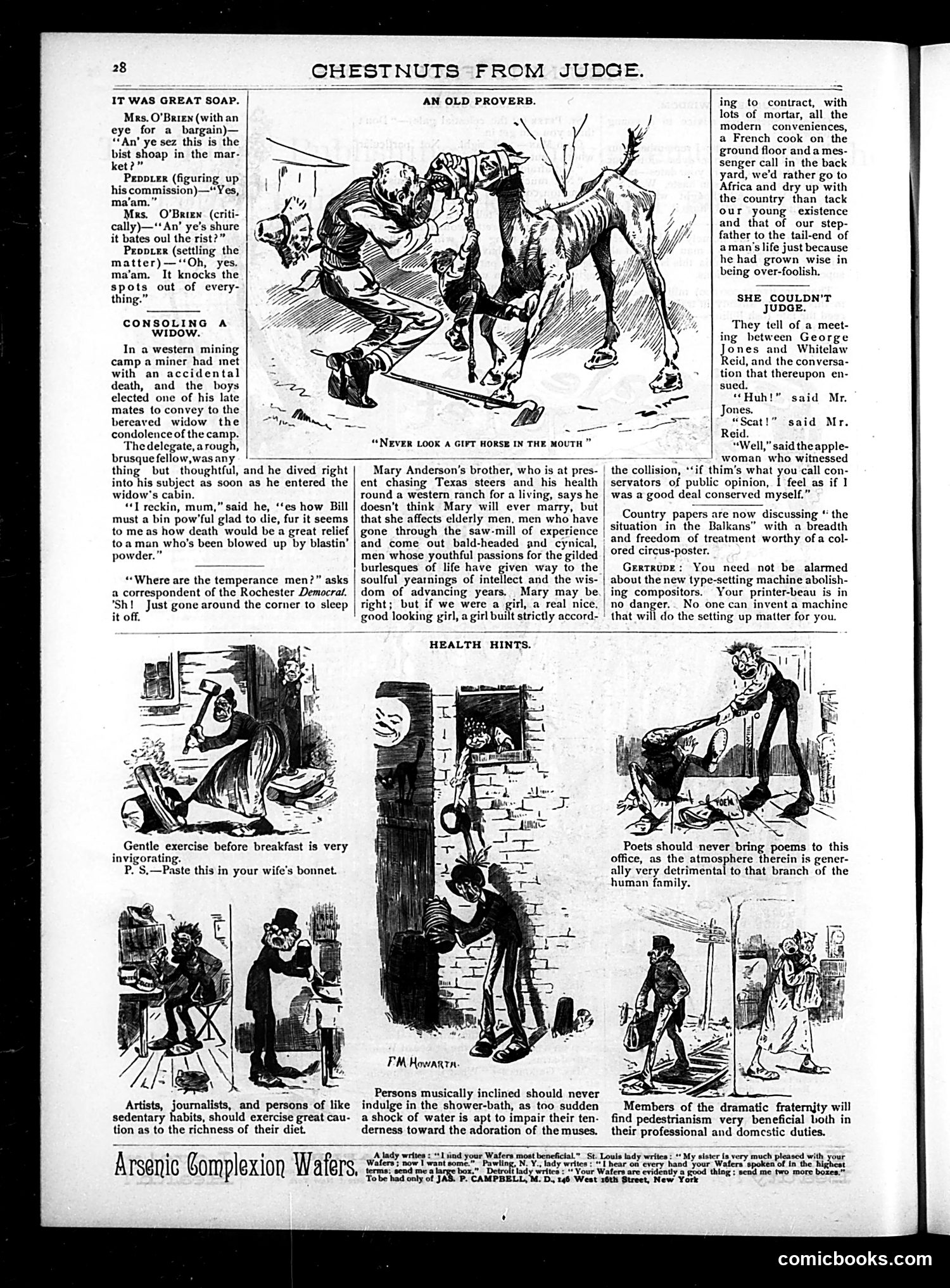
This page contains several brief satirical pieces typical of Judge magazine's humor: **"It Was Great Soap"**: A joke where Mrs. O'Brien examines a product with a merchant. The punchline mocks exaggerated sales claims—the merchant insists the soap "knocks the spots out of everything," a clichéd advertising phrase meant to emphasize superiority. **"An Old Proverb"** (illustration): Depicts the saying "Never Look a Gift Horse in the Mouth"—a man examines a horse's teeth, literal visual humor applied to the idiom. **"Consoling a Widow"**: A rough miner attempts condolences by saying the widow should be glad her husband died, since death is preferable to life in a mining camp. The dark humor satirizes insensitive condolences. **Other pieces** include anecdotes about temperance advocates, gossip about actress Mary Anderson, and brief satirical "Health Hints" mocking various professions' habits. The **Arsenic Complexion Wafers** advertisement at bottom appears genuine advertising (problematic by modern standards, featuring arsenic). Overall: light, satirical humor reflecting Victorian-era concerns and conventions.
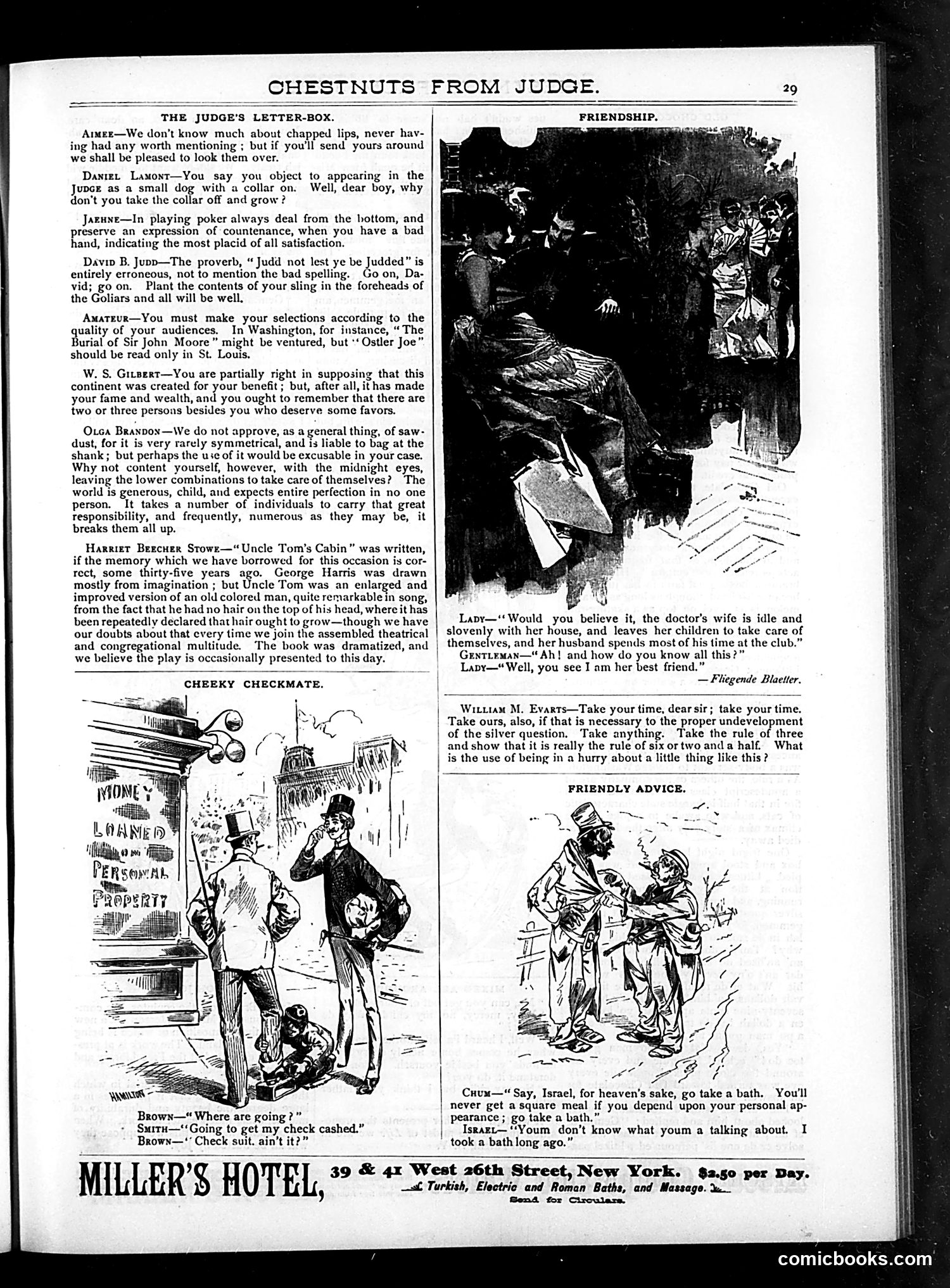
This page comprises satirical advice letters and jokes typical of Judge magazine's humor section. **The Letter-Box** offers mock responses to readers' inquiries, employing absurdist logic—e.g., advising a man objecting to being drawn as a small dog to "take the collar off and grow." The Harriet Beecher Stowe reference acknowledges "Uncle Tom's Cabin" (published ~35 years prior, placing this circa 1888) and its theatrical adaptations. **The Cartoons** satirize social behavior: "Cheeky Checkmate" jokes about a man checking his suit—a pun on "check" (bank check vs. clothing pattern). The "Friendship" cartoon mocks hypocrisy: a woman claims to be her friend's "best friend" while gossiping about her idleness and neglected children. **Bottom sections** include ethnic humor about bathing habits (targeting Jewish immigrants) and mock-earnest advice about financial matters ("the silver question"—likely referencing 1880s currency debates). The page reflects Gilded Age satirical conventions: wordplay, social critique mixed with prejudice, and commentary on contemporary public figures and issues.
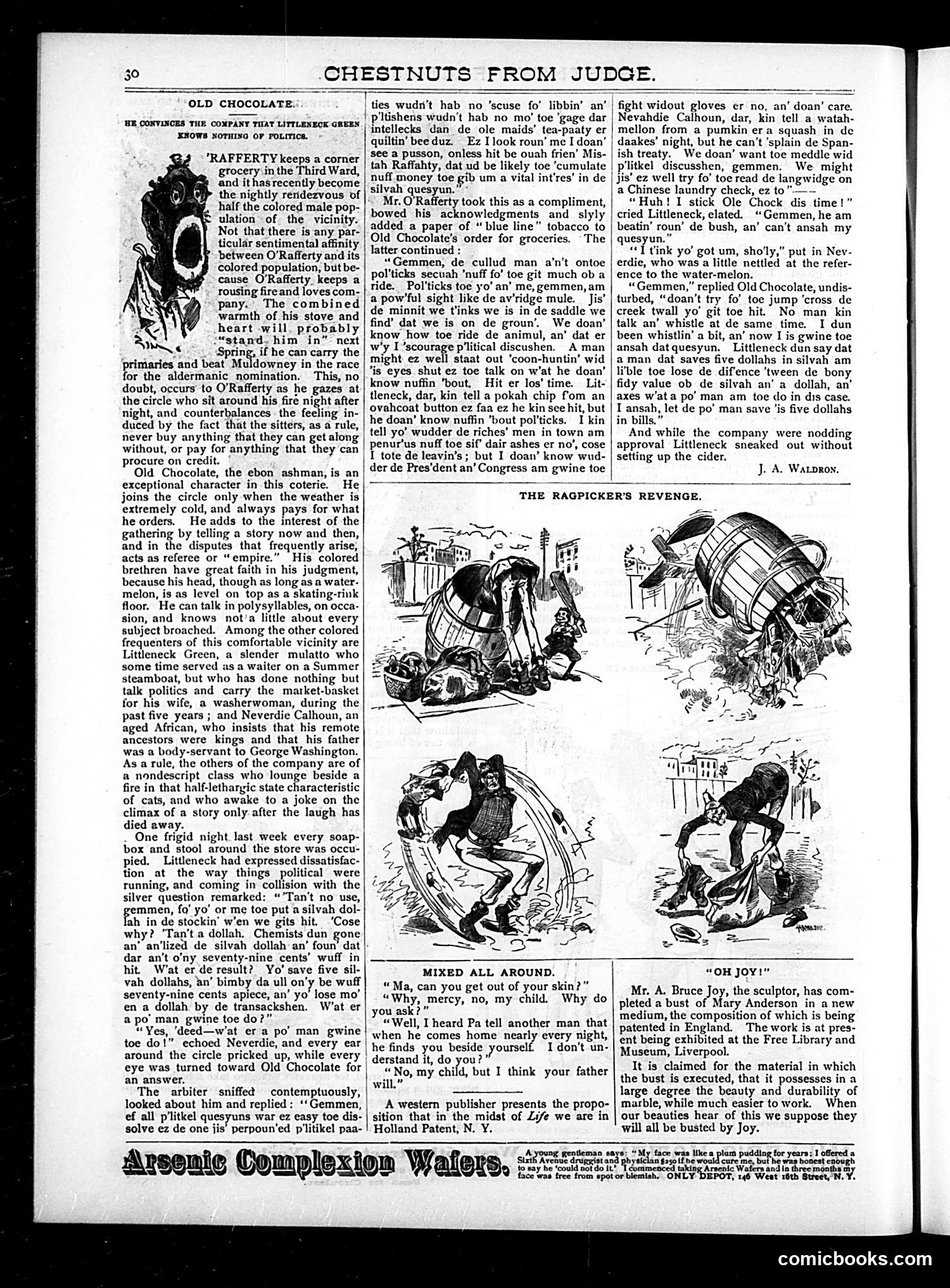
This page satirizes late-19th-century American politics through dialogue set in an Irish grocer's store frequented by Black men. The main narrative, "Old Chocolate," presents a debate about the **silver question**—a major political issue of the 1890s (likely the free silver debate preceding the 1896 election). The satire works on multiple levels: It mocks how politicians exploit working-class voters by courting them (O'Rafferty seeks their support for aldermanic nomination despite not genuinely valuing them). More pointedly, it ridicules Littleneck Green's political engagement—he parrots political arguments without understanding economic reality, suggesting working-class Black voters were seen as easily manipulated. The character "Old Chocolate" is positioned as the voice of reason, suggesting even those typically excluded from serious political discourse possess superior judgment. The heavy dialect throughout both mocks and paradoxically dignifies these characters' intelligence. This represents Judge magazine's typical approach: using caricature and ethnic stereotyping to make ostensibly progressive political points about corruption and exploitation.
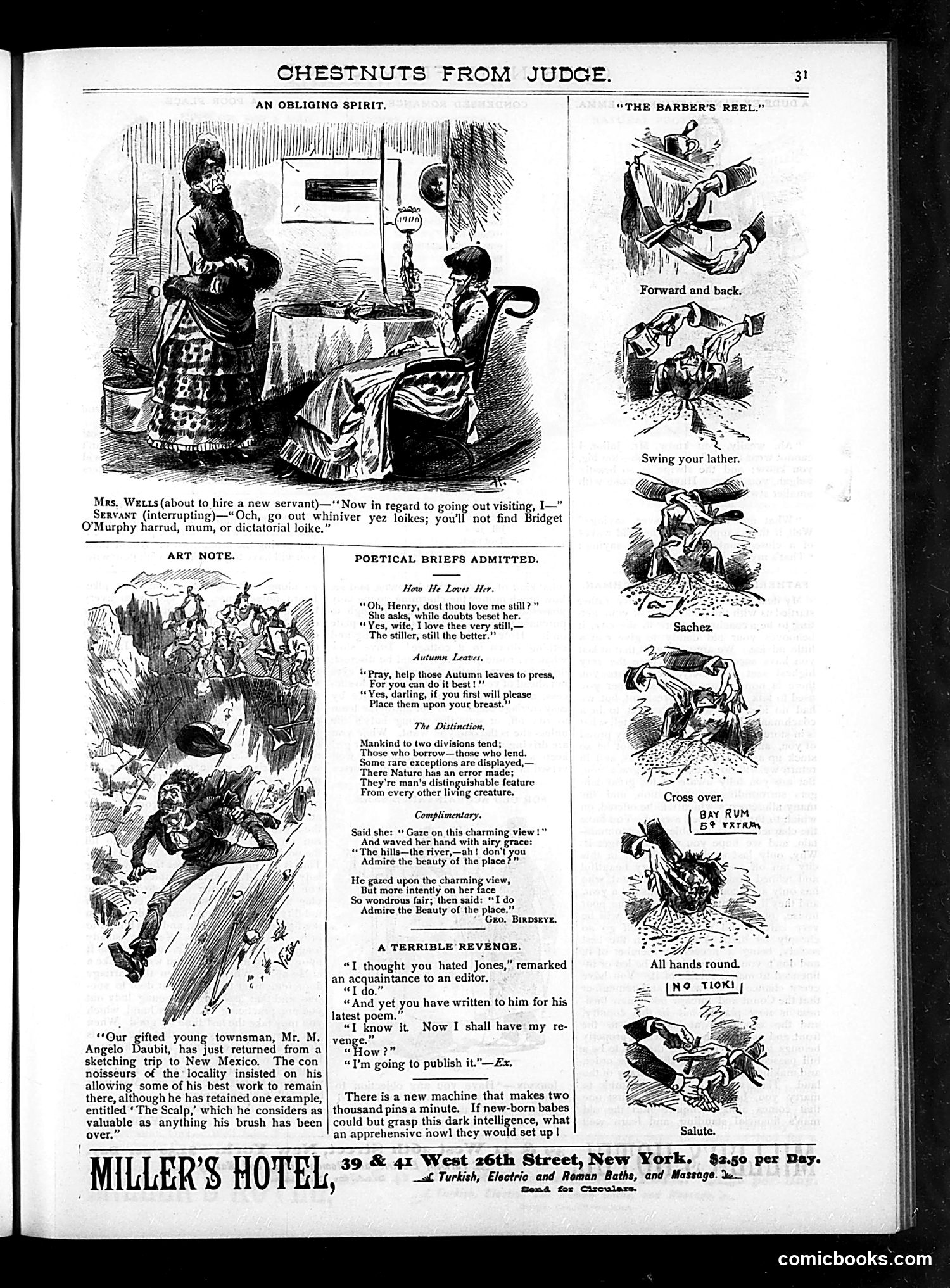
This page contains several unrelated humor pieces typical of Judge magazine's miscellaneous content. **"An Obliging Spirit"** depicts an Irish servant-hiring interview. The joke plays on ethnic stereotyping: the Irish servant (O'Murphy) claims she won't be "dictatorial" about visiting, but her broad accent and phrasing suggest working-class awkwardness—humor derived from immigrant dialect humor common to the era. **"Art Note"** satirizes pretentious art criticism through a fictional artist, M. Angelo Daubit, who supposedly created valuable work so impressive that New Mexico's "connoisseurs" demanded he leave pieces there. The title "The Scalp" suggests Western/Native American subject matter, mocking both artistic pretension and likely racist exoticization. **"A Terrible Revenge"** jokes about editorial malice: an editor agrees to publish a poem from a hated rival—as punishment, by publishing bad work publicly. The page also includes brief poems, dance instructions ("The Barber's Reel"), and advertising for Miller's Hotel. The content reflects late-19th/early-20th century American humor sensibilities: ethnic stereotyping, artistic satire, and workplace comedies.
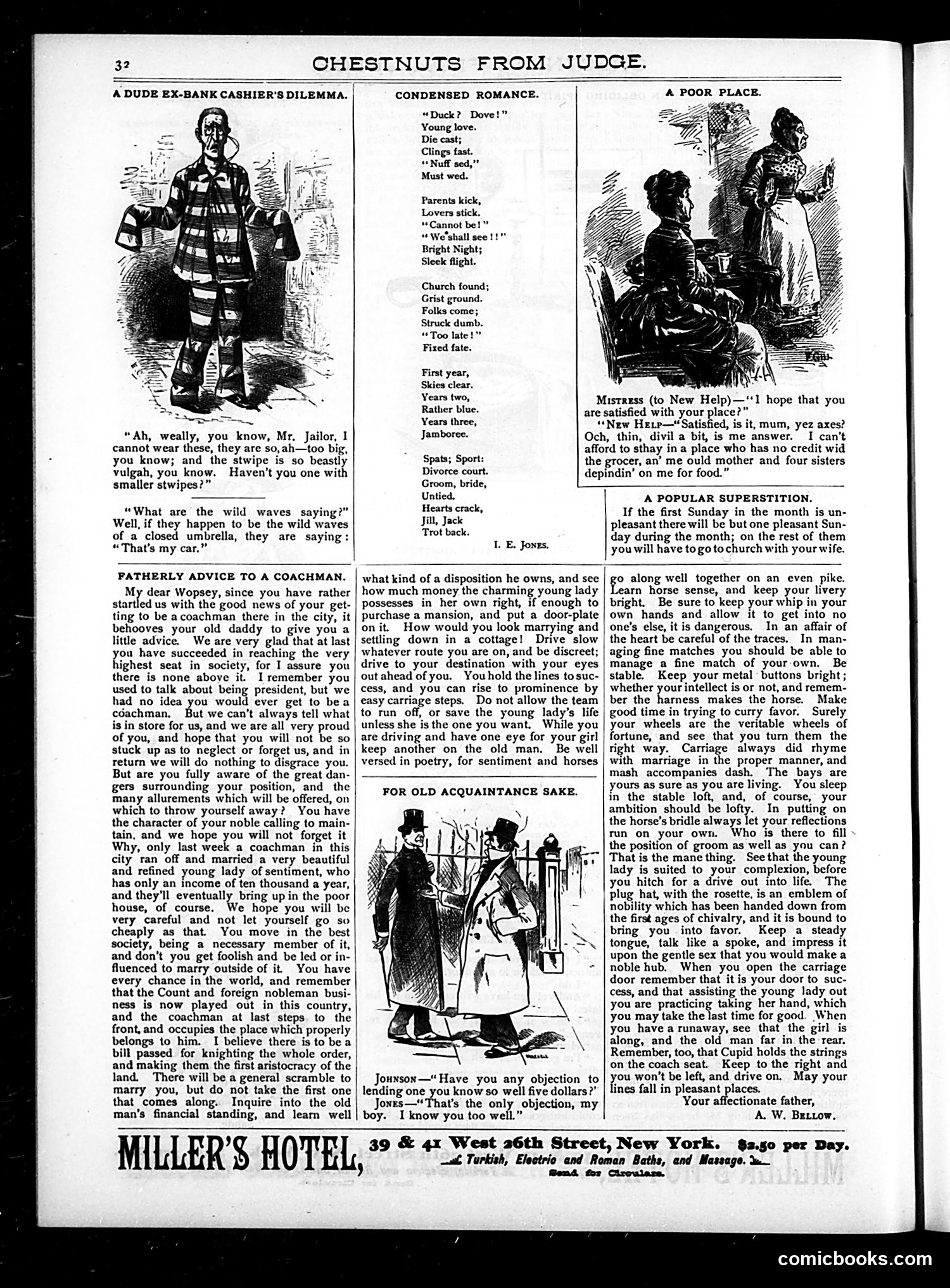
This page contains three satirical pieces mocking social pretensions and romantic naiveté: **"A Dude Ex-Bank Cashier's Dilemma"** ridicules an affected, effeminate man imprisoned for embezzlement who complains about his jail uniform's stripes as "vulgar"—mocking both his pretentiousness and his criminal downfall. **"Condensed Romance"** parodies melodramatic love stories through pithy verse, tracing a couple from courtship through inevitable divorce, reducing romantic tragedy to clichéd stages. **"Fatherly Advice to a Coachman"** satirizes both social climbing and class consciousness. A father congratulates his son on becoming a coachman—treating this servant position as society's "highest seat"—then warns against marrying wealthy women, ironically suggesting coachmen now represent an emerging "aristocracy." The humor lies in the inverted values and mock-seriousness about a servant's status. These pieces exemplify Judge's satirical approach to American social anxiety around class, aspiration, and romantic folly.
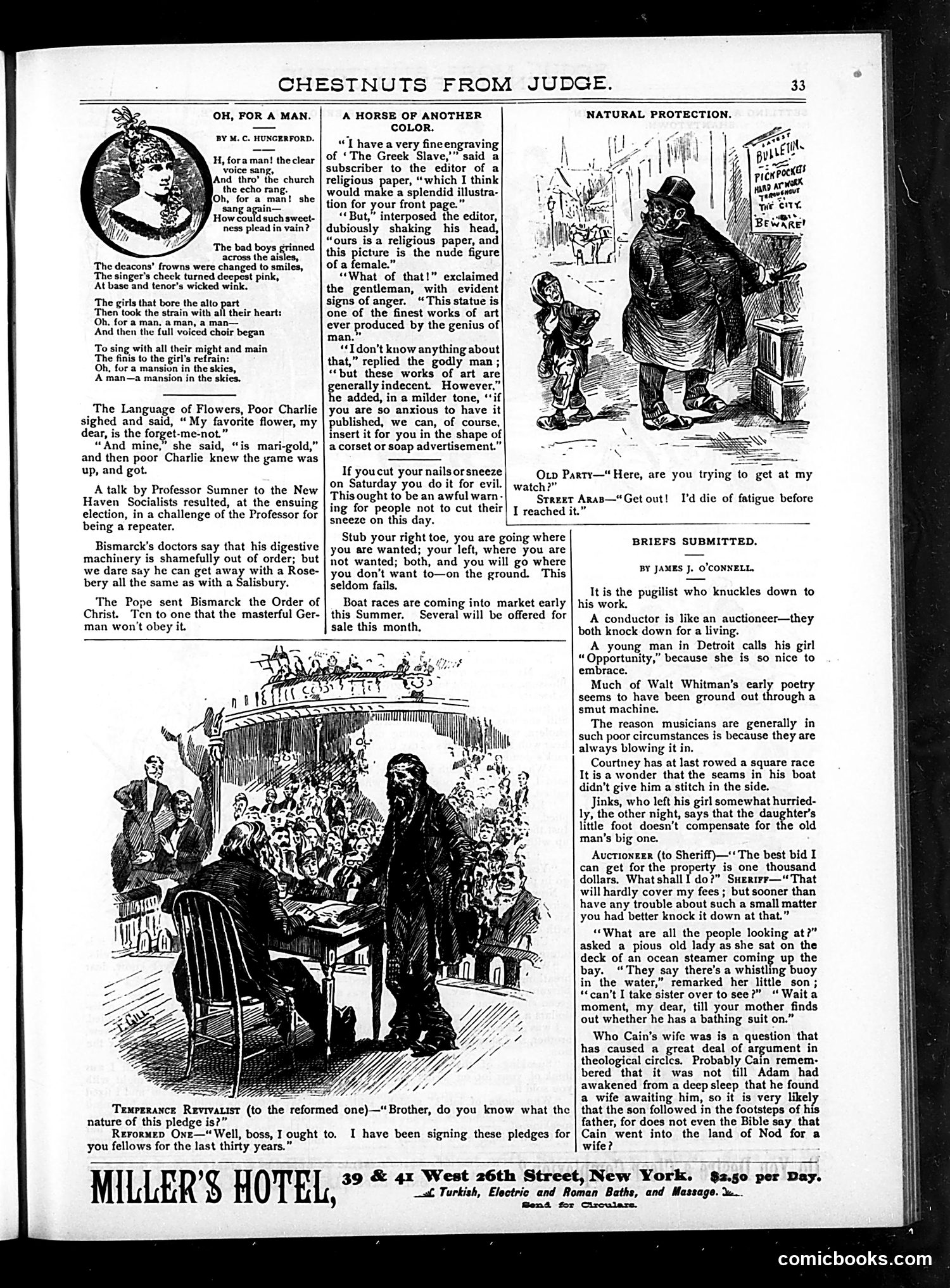
This page from Judge magazine contains multiple humorous short items and cartoons typical of 1880s American satire: **"Oh, for a Man"** is a comedic poem about a church choir where a female soloist sings "Oh, for a man!" The male choir members and congregation react with amusement and winking, creating embarrassed double entendre—the innocent religious plea becomes unintentionally suggestive. **"A Horse of Another Color"** satirizes editorial hypocrisy: a religious newspaper editor refuses to publish an engraving of "The Greek Slave" (a famous neoclassical nude sculpture) as inappropriate for a religious publication, then suggests running it as a corset or soap advertisement instead—mocking how supposedly "indecent" art becomes acceptable when commercialized. The remaining items are brief jokes about superstitions, romance, and wordplay typical of the era's humor magazines. The page demonstrates Judge's formula: mixing literary pieces with satirical commentary on contemporary social attitudes and commercial practices.
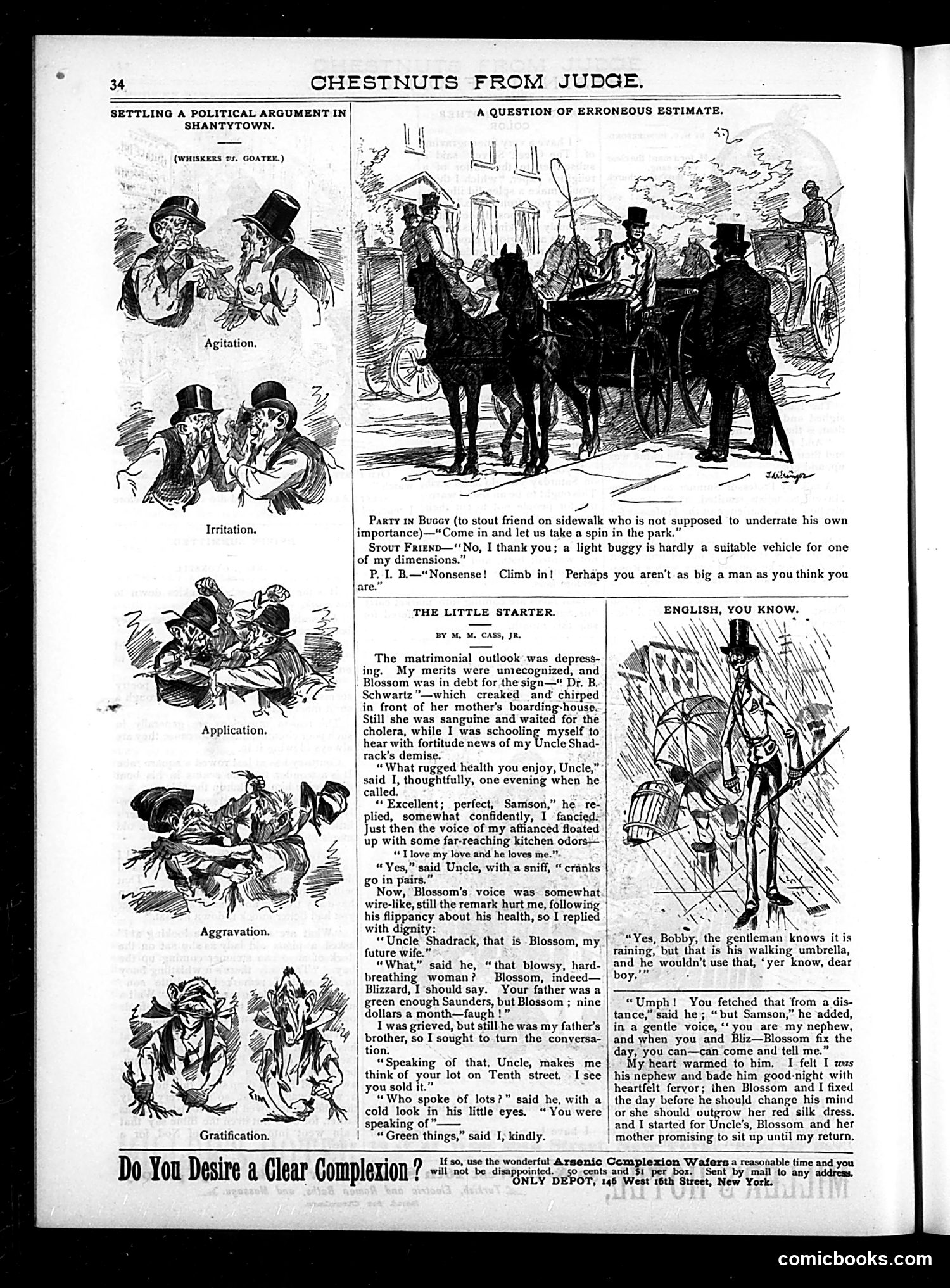
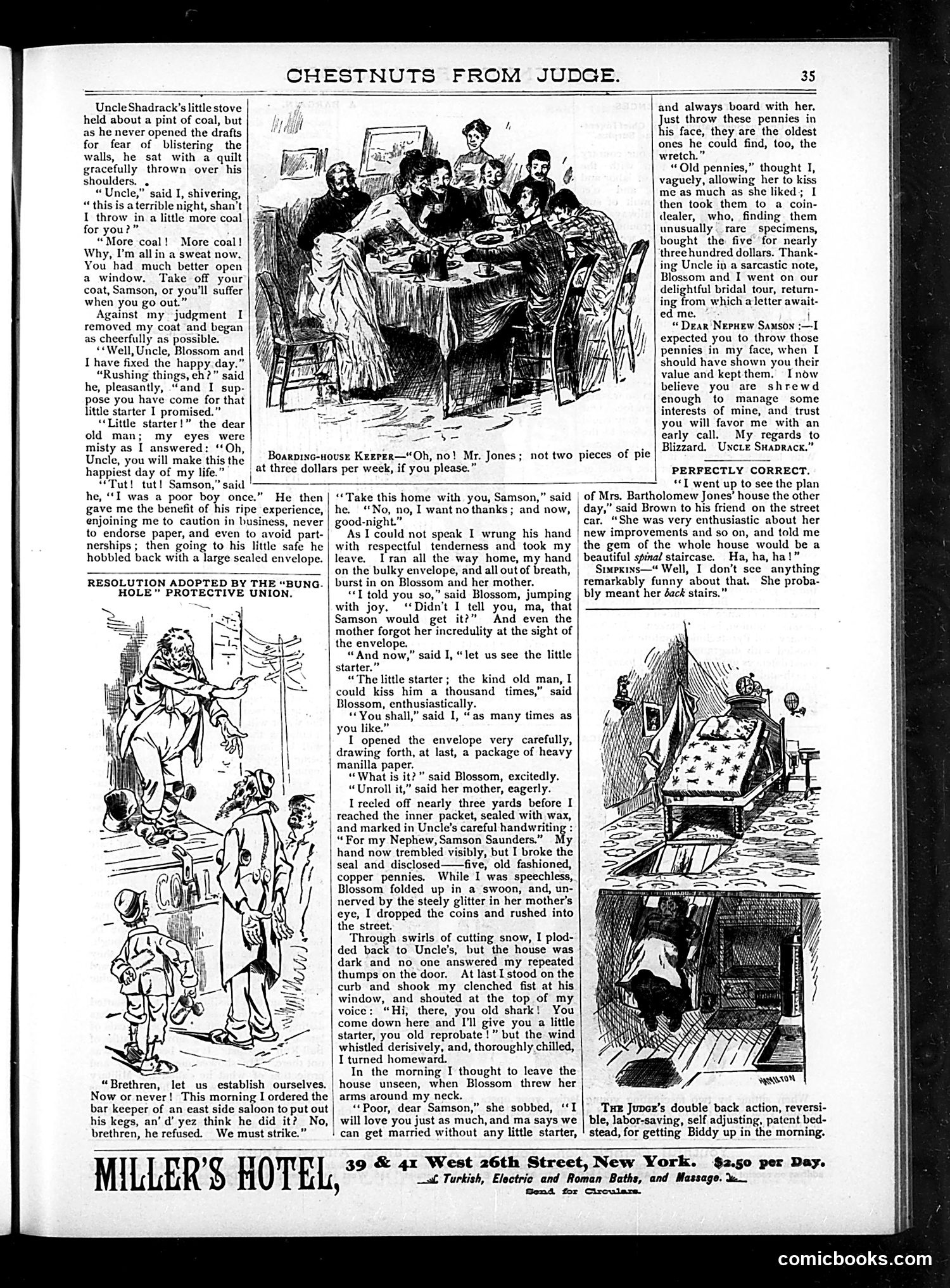
This Judge magazine page contains three separate satirical pieces: **"Settling a Political Argument in Shantytown"** (top left): Five small cartoons labeled with emotional states (Agitation, Irritation, Application, Aggravation, Gratification) depict working-class men with facial hair ("Whiskers vs. Goatee") arguing—likely political debate satire mocking lower-class political engagement, a common Judge trope. **"A Question of Erroneous Estimate"** (top right): A wealthy man condescends to an overweight friend, offering a buggy ride while implying the friend is too large for it—satirizing false courtesy masking insult. **"The Little Starter"** (main text): A comedic story about a poor young man (Samson) seeking his wealthy Uncle Shadrack's approval to marry Blossom. The uncle initially insults both the woman and the engagement but eventually relents, suggesting financial inheritance may follow—satirizing mercenary marriage practices and social climbing among struggling classes. The page exemplifies *Judge's* focus on class satire and domestic/romantic humor.
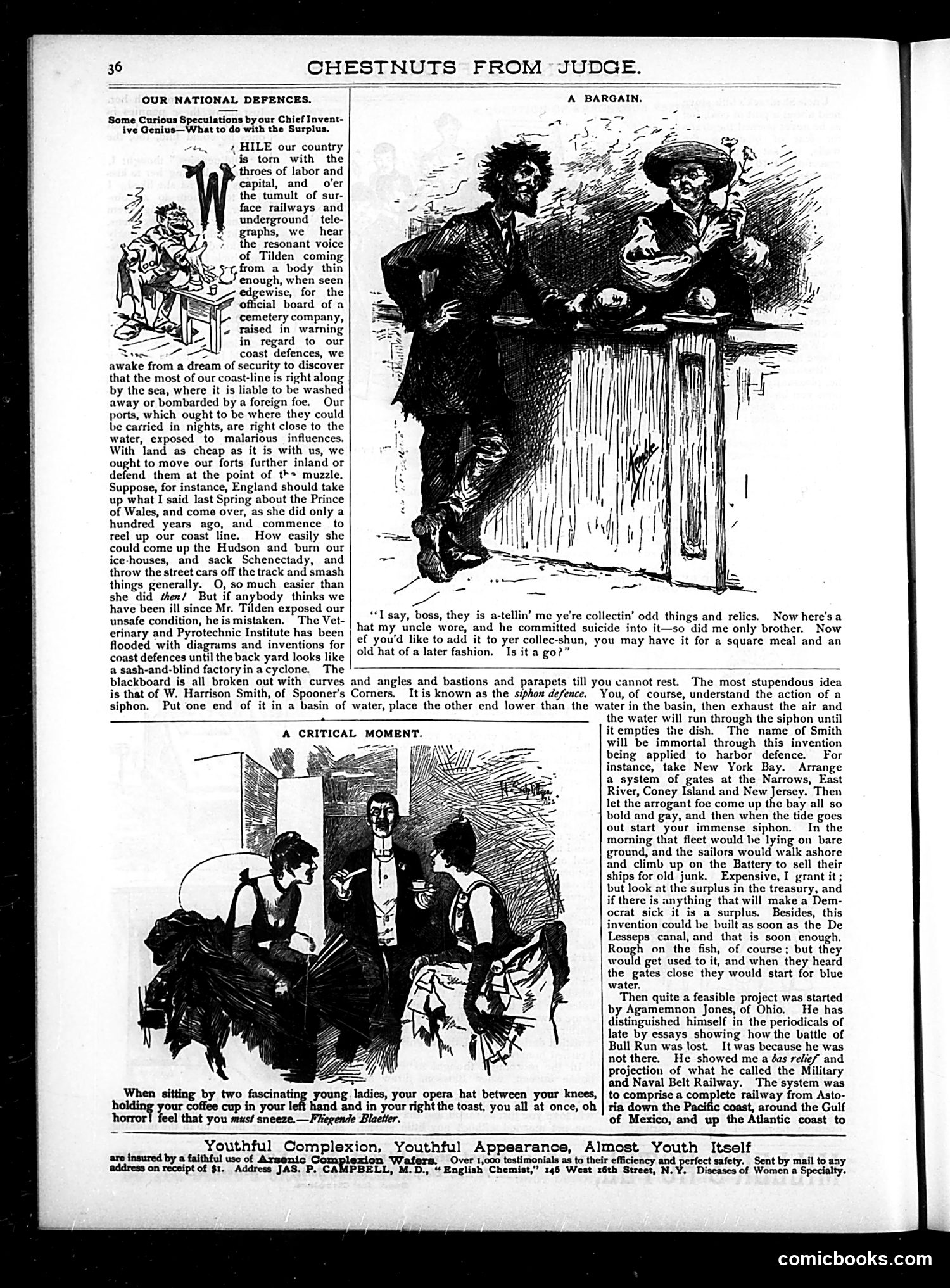
This page satirizes American coastal defense debates, likely from the 1870s-80s. The main article mocks proposals by "Chief Inventive Genius" (appearing to reference Samuel Tilden, a Democratic politician mentioned by name) for protecting U.S. coasts. The satire targets absurd defense schemes: one involves a "siphon defence" using tidal gates to strand enemy ships on bare ground—impractical and harmful to fish. Another describes "Agamemnon Jones's" proposed Military and Naval Belt Railway encircling vulnerable coastal areas. The humor lies in exposing how "inventive" but ridiculous these proposals are, while the underlying critique addresses real concerns: America's vulnerable coastline, exposed ports, and how political surplus budget debates drove wasteful military spending. The cartoons and text together mock both the grandiose inventors and politicians proposing them.
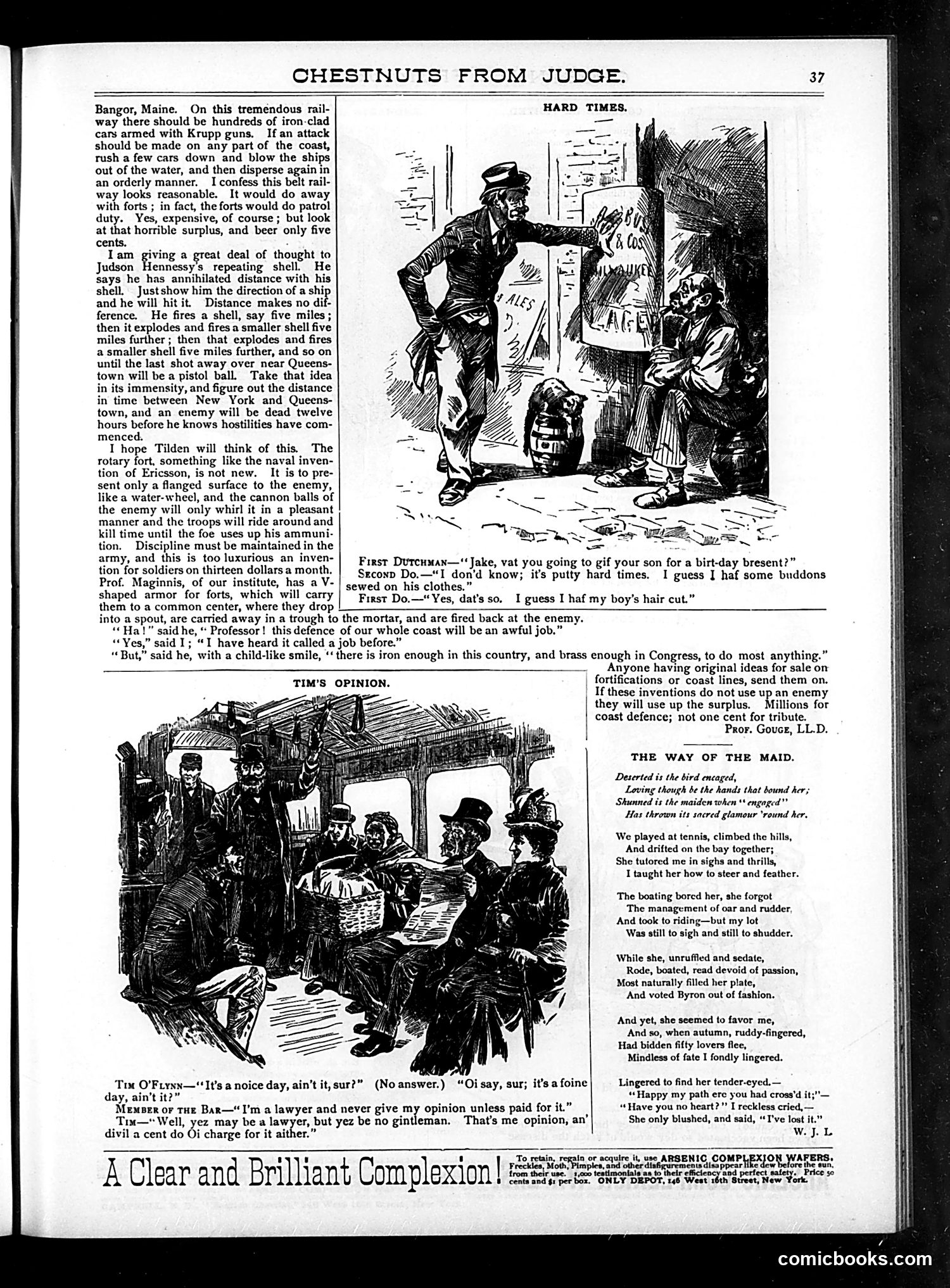
This Judge magazine page contains satirical commentary on 1870s-80s American defense policy and social customs. **"Hard Times" cartoons**: The top illustration mocks elaborate, impractical military inventions supposedly offered to defend U.S. coasts—including belt railways armed with Krupp guns and "repeating shells" that supposedly eliminate distance through cascading explosions. The satire ridicules wasteful spending on absurd military schemes while the government faces budget surplus (and cheap beer costs only five cents). A character suggests Congress has enough "brass" to fund anything, implying political incompetence. **"Tim's Opinion"**: A brief dialogue joke where an Irish workman (Tim) claims a lawyer won't give free opinions, yet offers his own unsolicited advice anyway—poking fun at working-class bluntness versus professional pretense. **"The Way of the Maid"**: A poem satirizing female inconstancy in relationships—a woman engaged to the narrator ignores him for tennis, boating, and horseback riding, indifferent to romantic attention. The poem reflects period anxieties about women's independence. The advertisements below promote patent medicines, typical of era publications.
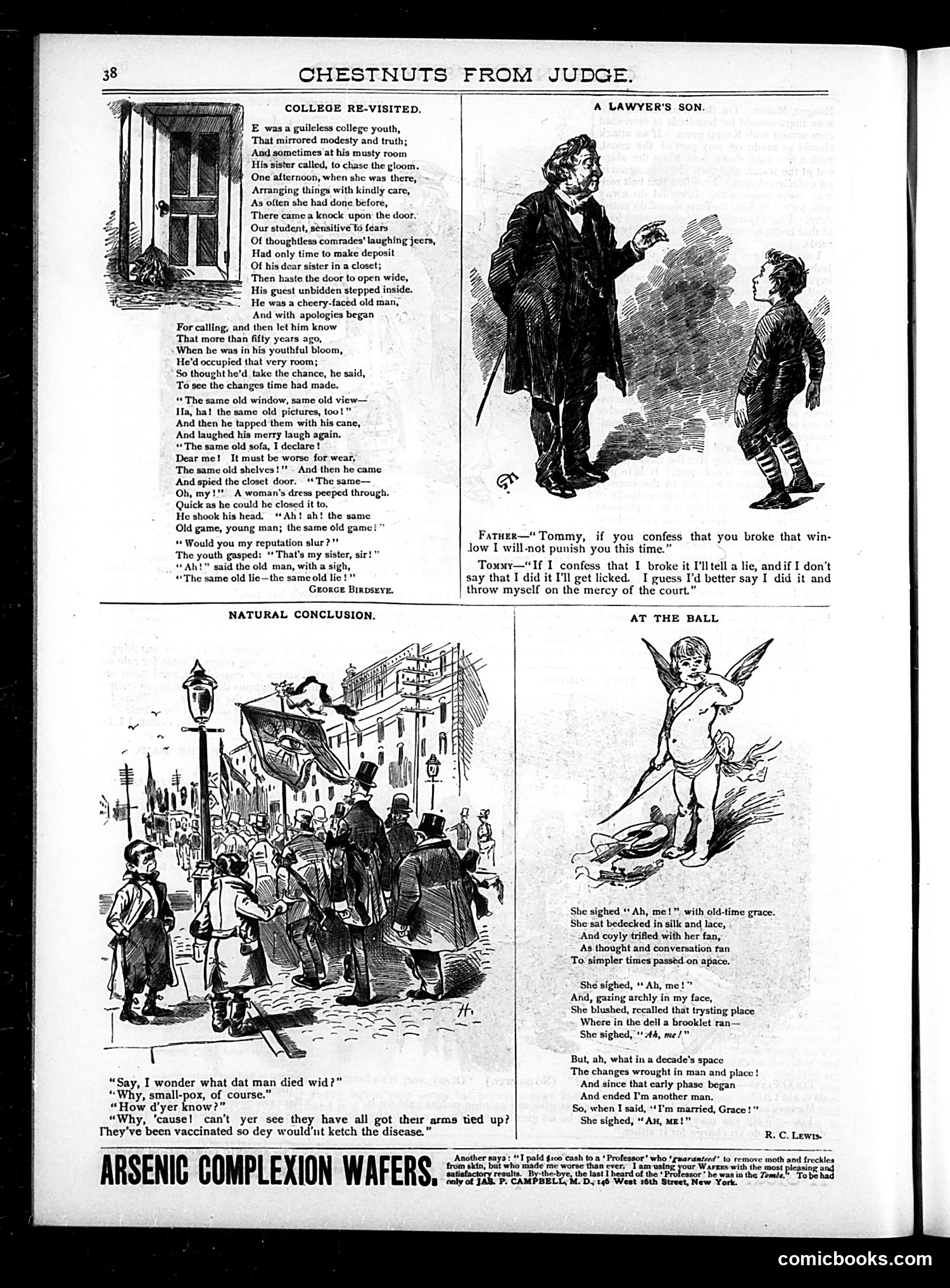
This page contains four separate humorous pieces satirizing Victorian-era social conventions: **"College Re-visited"**: A young student hides his sister in a closet when an unexpected visitor arrives, fearing scandal. The elderly visitor—a former student—discovers the dress hem, assumes illicit behavior, and dismisses the boy's protest ("That's my sister, sir!") as the "same old lie," implying such excuses were routine cover-ups a half-century prior. The joke mocks both the student's prudishness and the cynicism of older generations. **"A Lawyer's Son"**: Young Tommy uses legalistic reasoning to escape punishment, confessing to breaking a window while simultaneously threatening perjury—satirizing either the boy's precocious immorality or society's legal absurdities. **"Natural Conclusion"**: Dark humor about vaccination: observers see vaccinated corpses with tied arms and assume they died of smallpox, missing that vaccination *prevents* the disease. **"At the Ball"**: A sentimental woman sighs nostalgically about past romance, only to learn the man she loved is now married—mocking outdated romantic sentimentality. The page emphasizes hypocrisy, changing morals, and social pretense typical of Gilded Age satire.
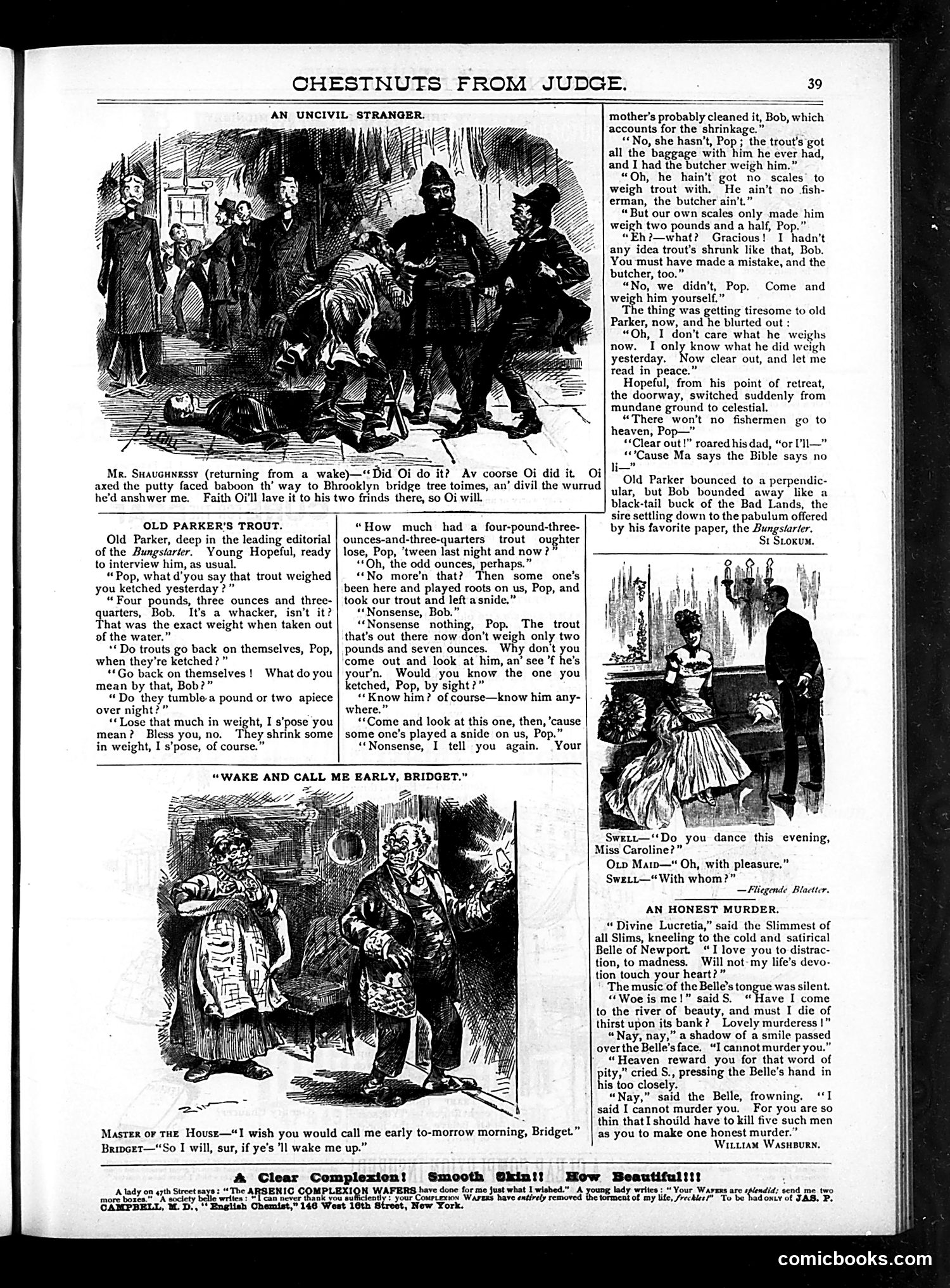
This page contains three separate humorous pieces typical of Judge magazine's satirical content: **"An Uncivil Stranger"** (top): An Irish immigrant character brags about fighting at Brooklyn Bridge, using exaggerated Irish dialect ("Oi," "divil"). The joke mocks both his violence and his incomprehensible speech. **"Old Parker's Trout"** (center): A father claims to have caught a four-pound trout, but his son proves it now weighs only two pounds seven ounces. The boy suggests someone stole it and replaced it with a fake ("played roots on us"). The humor comes from the son's literal-minded logic and the father's implausible denial. **Three brief jokes** (right): Quick gags about dancing partners, Irish servant dialect ("ye's 'll wake me up"), and a melodramatic romance parody about a lovelorn suitor. The page reflects period humor: ethnic stereotyping of Irish characters, domestic comedy, and sentimental romance mockery. These were standard Judge fare for American readers of this era.
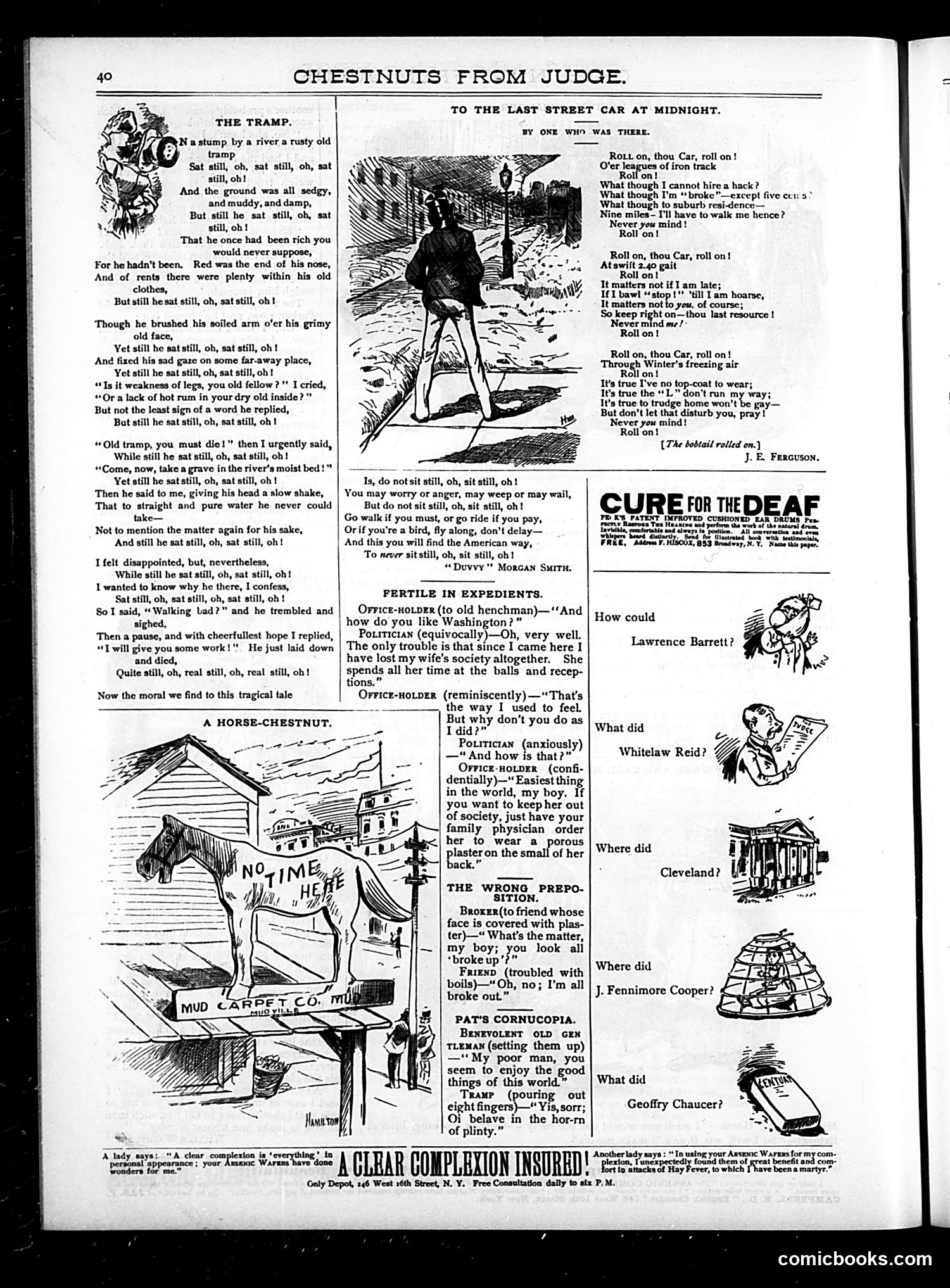
This page contains several satirical pieces from Judge magazine: **"The Tramp"** tells of a vagrant so broken he literally dies when offered work—mocking society's treatment of the poor and suggesting that some have lost all will to live or participate in productive society. **"To the Last Street Car at Midnight"** humorously portrays an exhausted commuter pleading with a departing streetcar to wait, though he's broke and will have to walk home anyway. The satire targets the frustrations of urban transit and working-class struggle in turn-of-the-century America. **"Fertile in Expedients"** jokes about a politician's solution to keeping his wife from attending society events: having a doctor prescribe a porous plaster for her back—crude medical devices were apparently prescribed liberally as "cures." **"The Wrong Preposition"** is a visual pun: a boil-covered man insists he's not "broken up" but rather broken *out*. The overall tone reflects Judge's satirical commentary on American social conditions, urban life, and period medical practices.
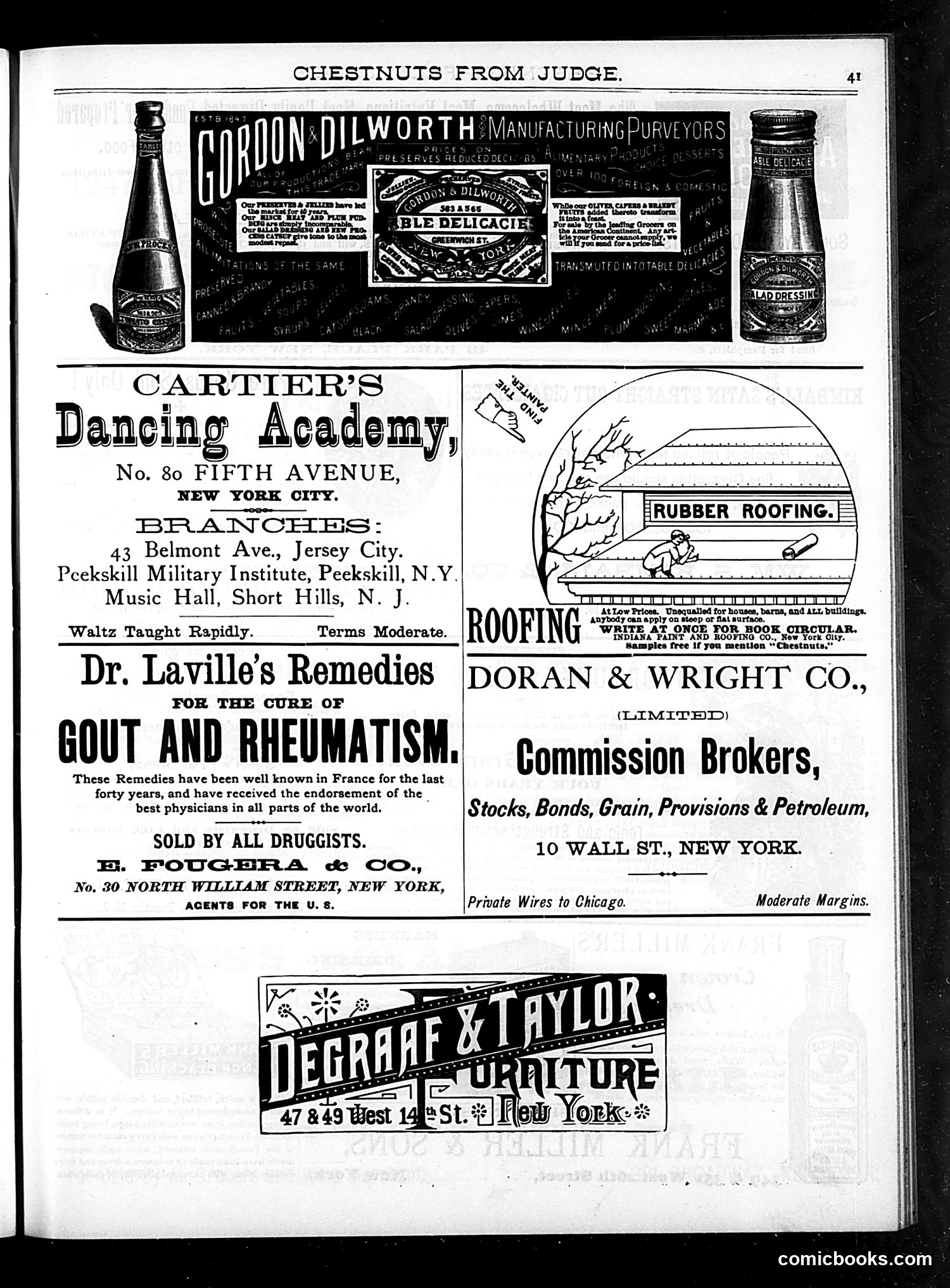
This page from *Judge* magazine is primarily **advertising**, not satirical content. It contains no discernible political cartoon or joke. The page features period advertisements for various services and products: Cartier's Dancing Academy, Dr. Laville's Remedies (for gout and rheumatism), rubber roofing materials, and financial services. At the top is an ad for Gordon & Dilworth Manufacturing products. At the bottom is a furniture store advertisement. The page's title, "Chestnuts from Judge," likely refers to old, recycled jokes or advertisements—a running feature in the magazine. However, no actual satirical content or recognizable political references appear on this particular page. It serves primarily as a commercial space rather than editorial commentary.
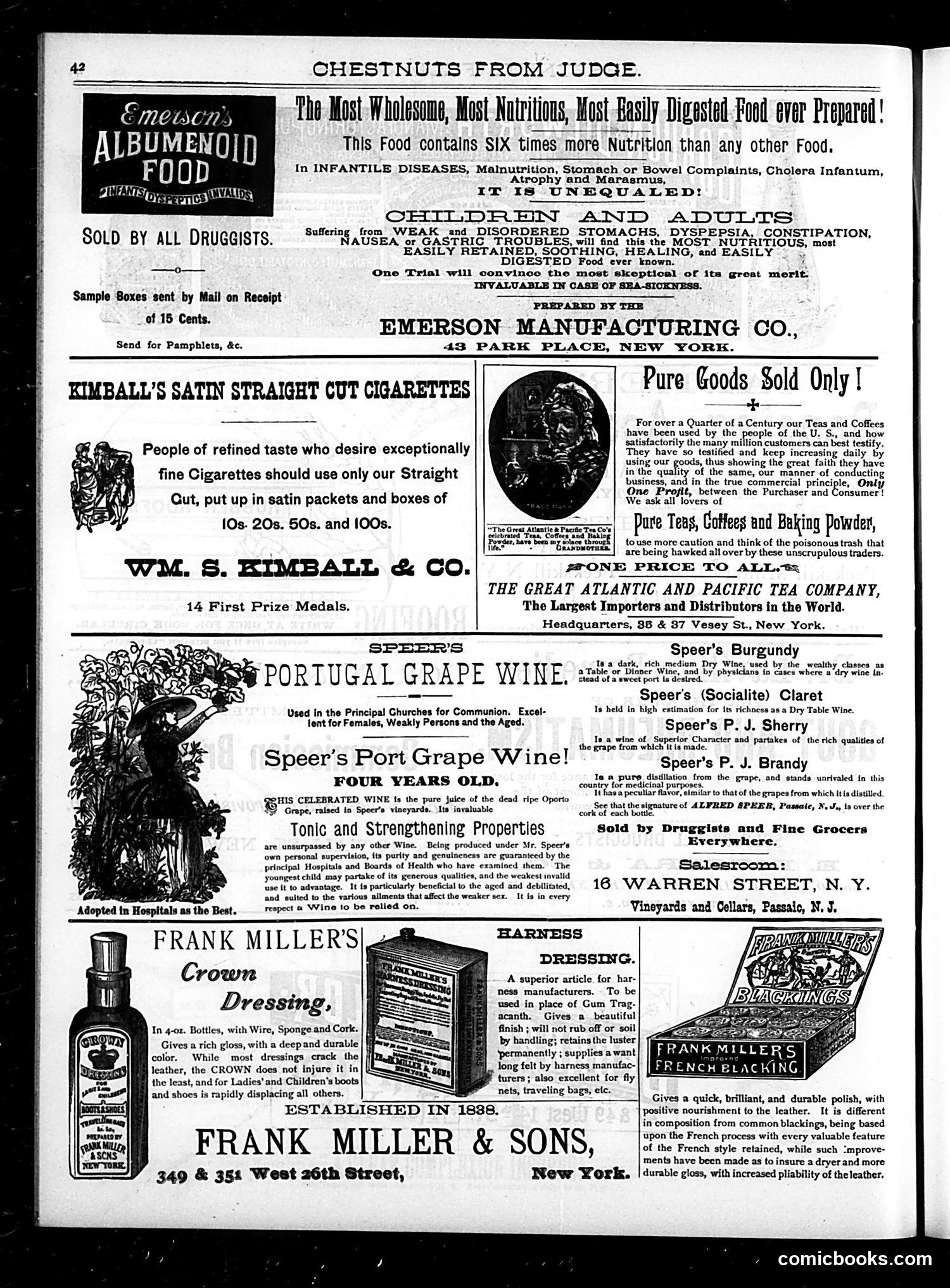
This page is primarily **advertisements**, not satirical cartoons. It represents typical late-19th-century product marketing from *Judge* magazine. The ads promote patent medicines and consumer goods with claims that would alarm modern readers: - **Emerson's Albumenoid Food** claims six times more nutrition than other foods and promises to cure infantile diseases, malnutrition, and cholera infantum—typical of unregulated medicinal food marketing of the era. - **Speer's Wine** is marketed as medicinal, suitable for "weakly persons" and the aged, with hospitals supposedly endorsing it—reflecting how alcohol was widely promoted as therapeutic before FDA regulations. - **Frank Miller's products** (shoe dressing, harness dressing, French blacking) represent standard consumer goods advertising. The common thread: exaggerated health claims without scientific evidence, and wine/medicinal products sold as cure-alls. This reflects the pre-regulation era when such marketing faced no legal restrictions.
This page is primarily **advertising**, not editorial content or political cartoons. It contains commercial advertisements from late 19th/early 20th-century New York businesses: - **Gross & Co.**: A stock brokerage on Broadway - **Beadleston & Woerz**: An ale and beer brewery - **Verrinder & Derbyshire**: A china and porcelain retailer (successor to Hadley's), emphasizing 30+ years in business - **Ross's Royal Belfast Ginger Ale**: An imported beverage distributor The page header "CHESTNUTS FROM JUDGE" suggests these ads may have appeared in *Judge* magazine, a satirical publication. However, the ads themselves contain no visible satire, caricature, or political commentary—they are straightforward period advertisements targeting middle and upper-class consumers interested in financial services, imported beverages, and luxury household goods. This appears to be a **back-of-magazine advertising section** rather than editorial content.
This page is primarily **advertisements**, not satirical cartoons. It's from *Judge* magazine's advertising section ("Chestnuts from Judge"). The ads promote various 19th-century commercial products and services now largely obsolete: - **Wine and liquor imports** (French wines, mineral water) - **Music conservatory** claiming 8,000 students and 45 European professors - **Hair and beauty products**: wigs, gray-hair dyes ("Auburnine"), fake hairpieces marketed as "Recamière coiffure," and cosmetics with names like "Turkish Rose Leaves" - **Food products**: mustard, licorice The **only illustrated content** is L. Shaw's beauty advertisement featuring a woman's profile promoting hairpieces and cosmetics—typical Victorian-era advertisements targeting wealthy women concerned with fashionable appearance. The endorsements (mineral water praised by doctors, Henry Ward Beecher) reflect 19th-century marketing tactics. No political satire is evident; this is a straightforward commercial page.
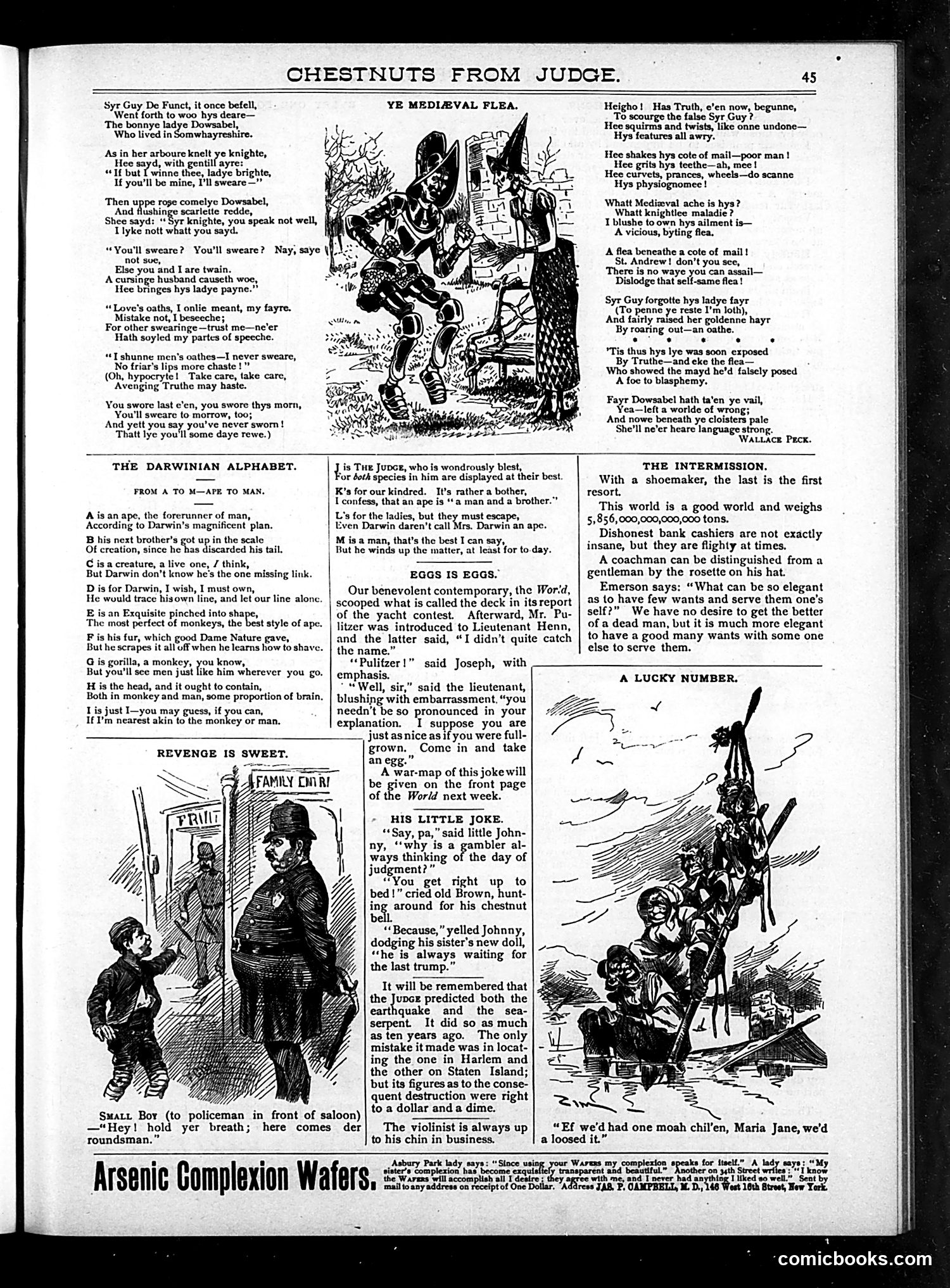
This Judge magazine page (page 45) contains several satirical pieces: **"Chestnuts from Judge"** (top left): A mock-medieval poem mocking courtly romance conventions. A knight swears oaths to win a lady, but she rejects his swearing. The joke's twist: he's actually being tormented by a flea under his armor, which causes him to curse—exposing his hypocrisy about never swearing. **"Ye Mediaeval Flea"** (center illustration): The accompanying comic drawing shows the knight writhing in discomfort from the flea, visualizing the poem's punchline. **"The Darwinian Alphabet"** (bottom left): A satirical alphabet responding to Darwin's evolution theory, mocking both Darwinism and contemporary society by finding "missing links" between apes and humans in modern types (exquisites, gorillas, etc.). **Other brief items** include puns about eggs, a short joke about a policeman, and wordplay. The page is primarily humorous commentary on contemporary topics—evolution debates were culturally contentious in this era—rather than hard political satire.
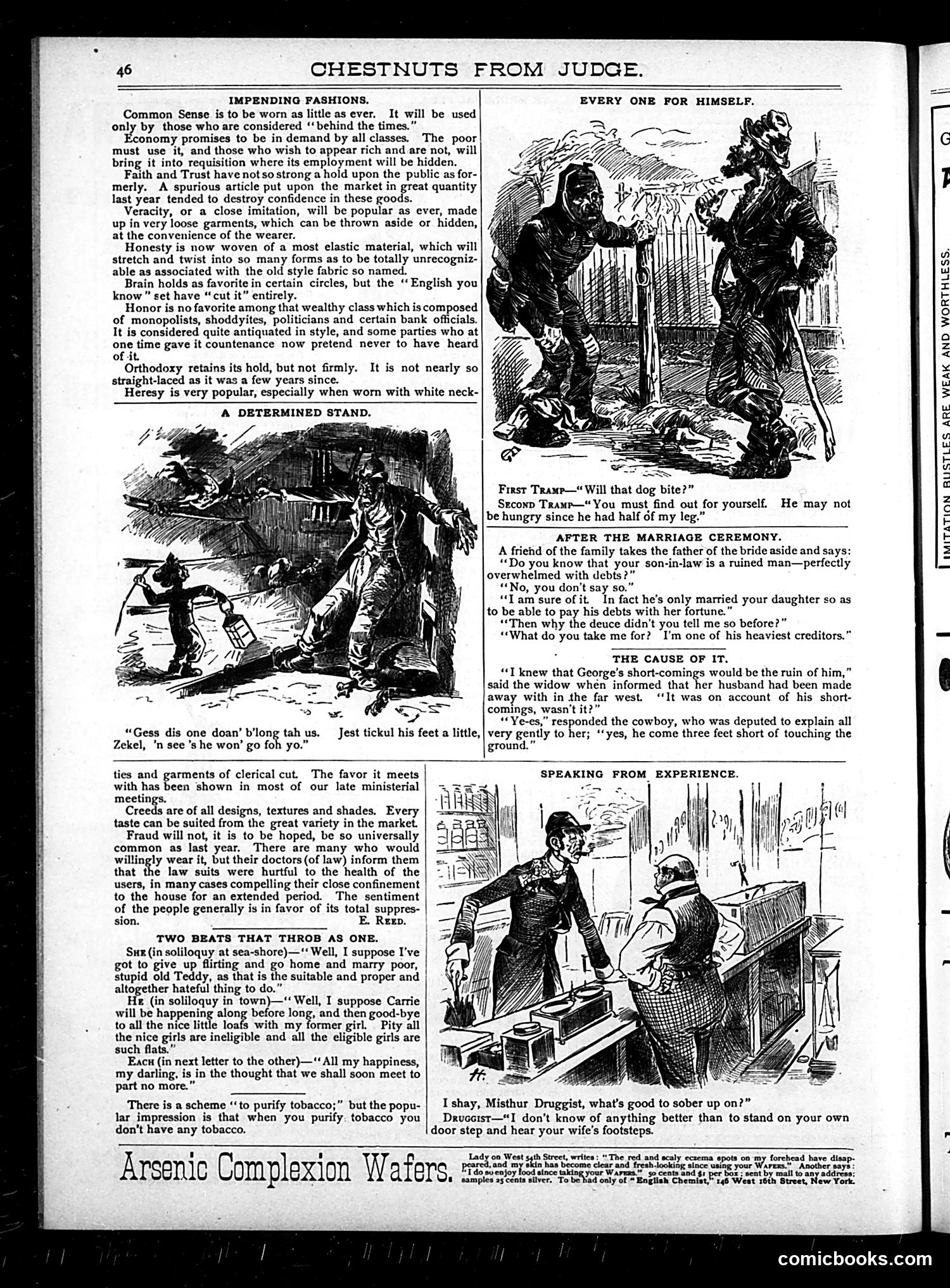
This page from *Judge* magazine presents satirical commentary on 1880s-90s American society through editorials and cartoons. **"Impending Fashions"** is a metaphorical piece mocking the decline of virtues among the wealthy and powerful. It suggests that honesty, faith, and honor are becoming "fashionable" only in appearance—elastic enough to twist into lies, and easily discarded. Common sense and brain are abandoned by the wealthy ("English you know" set). The satire targets monopolists, corrupt politicians, and bank officials for abandoning integrity. **The cartoons** depict working-class struggles: "A Determined Stand" shows someone (possibly enslaved, given the dialect) resisting; "Every One for Himself" shows tramps joking darkly about starvation; "After the Marriage Ceremony" mocks a father profiting from his daughter's dowry to pay debts to creditors—including his conversation partner. The overall message: society's wealthy and powerful classes are morally bankrupt while the poor survive through grim humor and desperation.
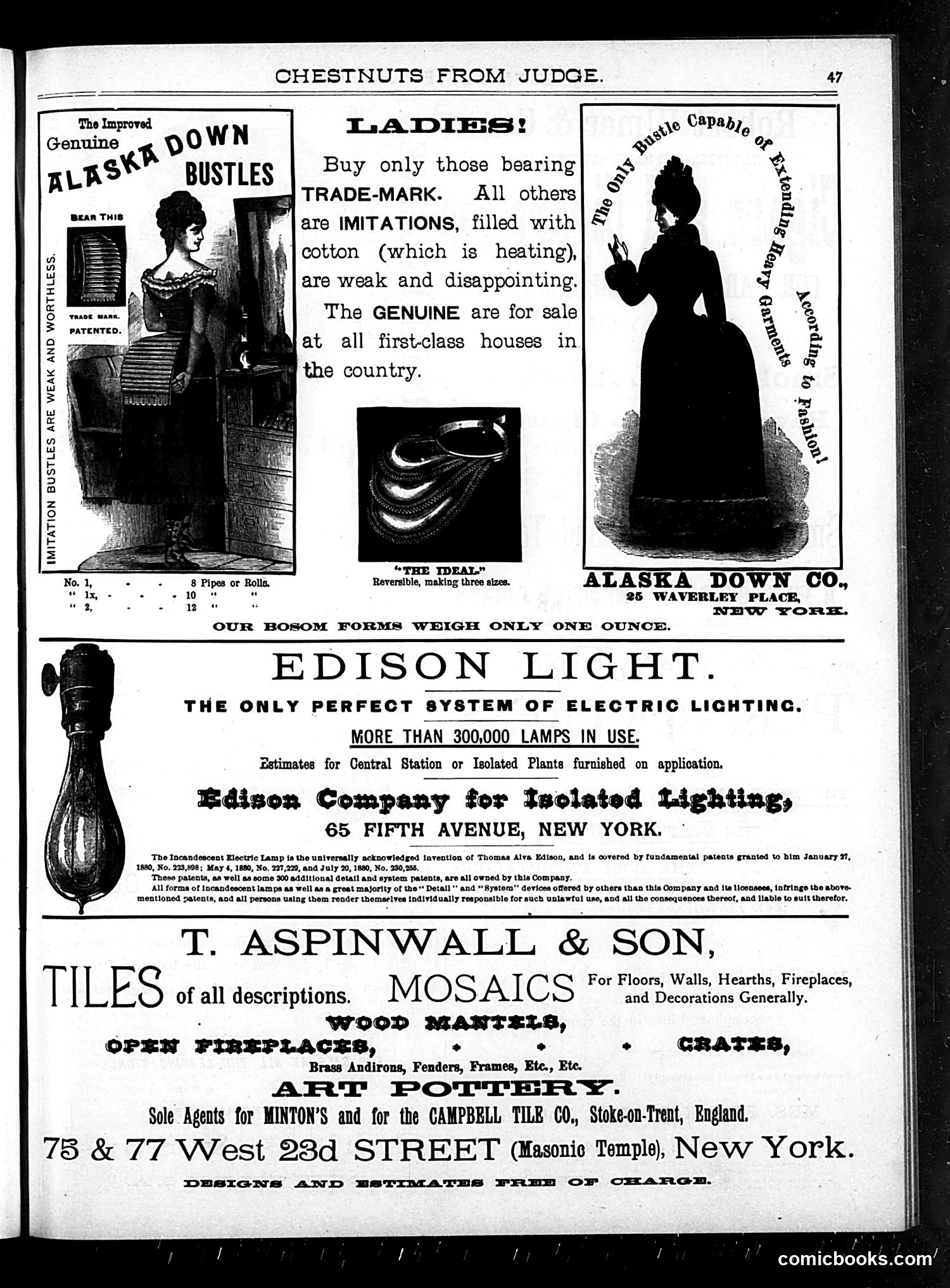
This page contains no political cartoons—it's primarily **advertisements** from late 19th-century New York businesses. The notable content includes: **Alaska Down Bustles**: An ad warning women against counterfeit bustles (the framework devices worn under skirts for shape). The ad claims imitations use cheap cotton fill that's "heating" (uncomfortable) and promotes the genuine trademarked version. **Edison Light**: A prominent advertisement for Thomas Edison's incandescent electric lighting system, claiming over 300,000 lamps in use and asserting Edison's patent dominance with aggressive legal language warning competitors about patent infringement. **T. Aspinwall & Son**: An ad for tiles, mosaics, fireplaces, and decorative home furnishings. The page reflects **consumer culture concerns of the era**: counterfeiting, new technology adoption (electric lighting was revolutionary), and the rise of branded products with trademark protection. The Edison ad's confrontational patent language reveals fierce competition in the emerging electrical industry.
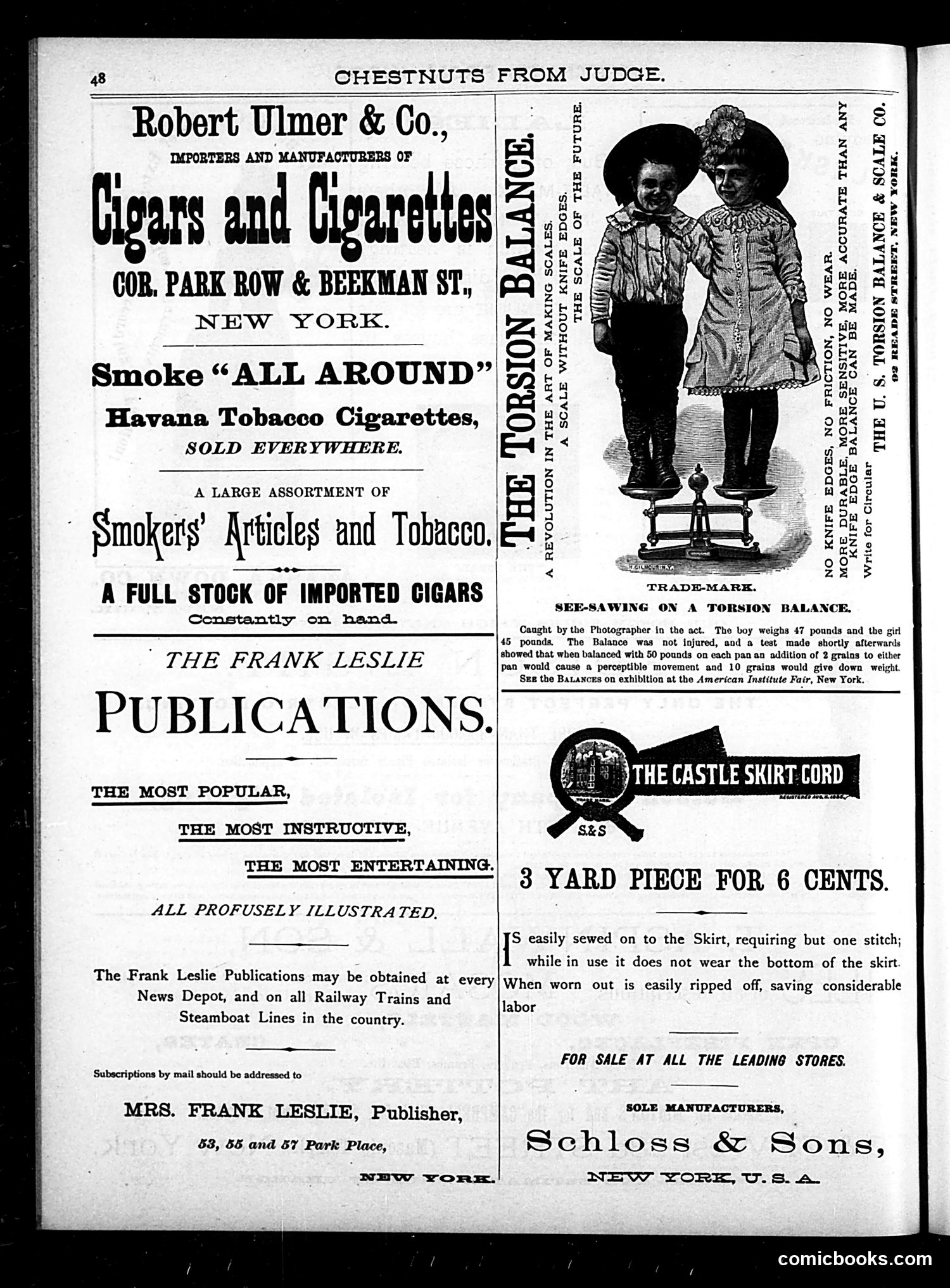
This page is primarily **advertising**, not political satire. The main content features a photograph labeled "See-Sawing on a Torsion Balance"—showing two children (a 47-pound boy and 45-pound girl) balanced on a weighing scale manufactured by the U.S. Torsion Balance & Scale Company. The image demonstrates the scale's precision: the caption notes that after balancing 50 pounds on each side, adding just 2-10 grains would cause perceptible movement, proving the device's sensitivity and accuracy. This served as product promotion, with the scales on display at the American Institute Fair in New York. The page also advertises Frank Leslie Publications, cigars, and a "Castle Skirt Cord" product—typical commercial content for Judge magazine. There is **no political cartoon or satire visible** on this particular page.
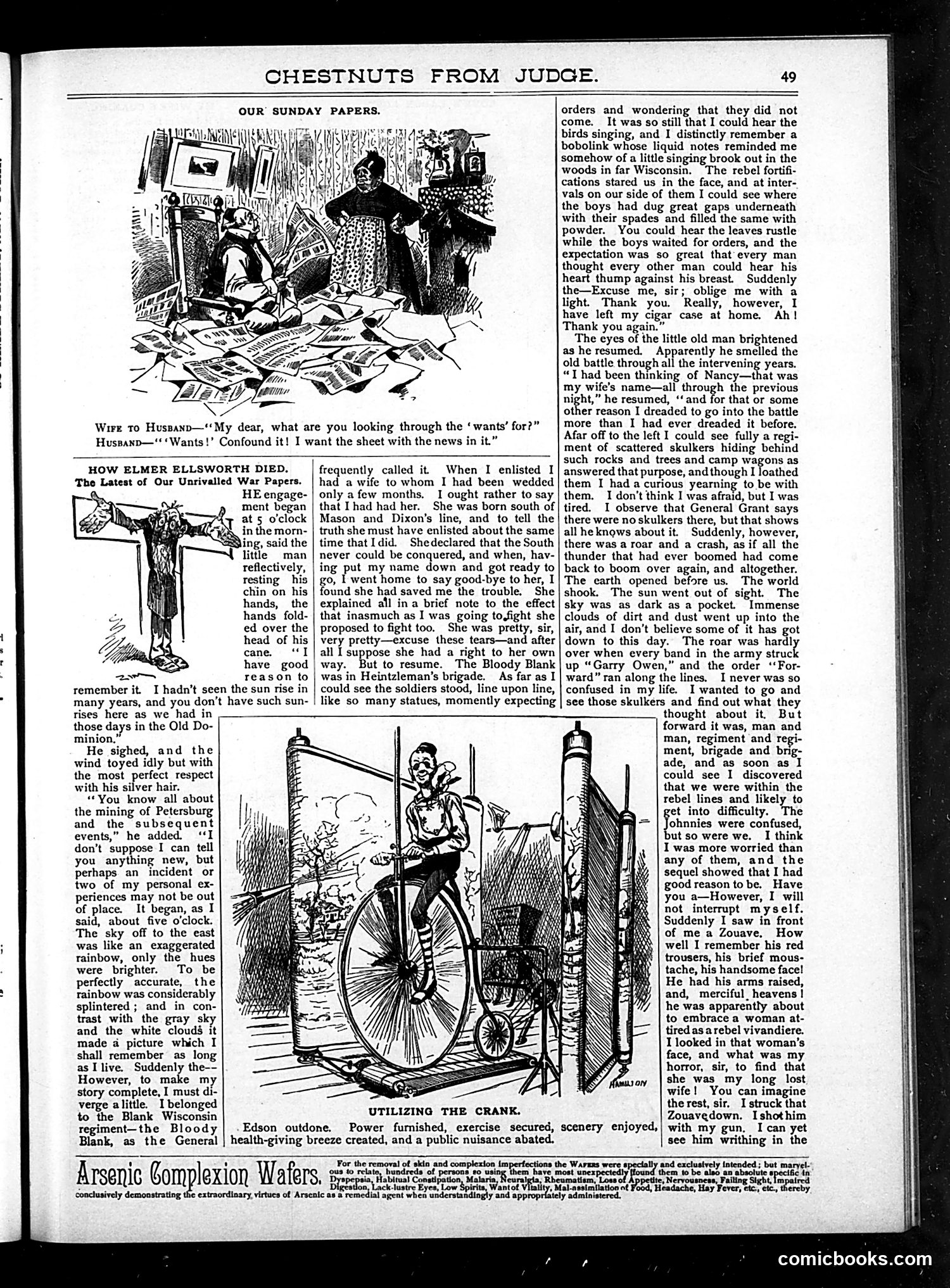
This page mocks two targets: Sunday newspapers' obsession with sensational war coverage, and Civil War veterans' tedious reminiscences. The top cartoon jokes that husbands prefer the "wants" (classified ads) section to actual news—satirizing both masculine indifference and newspapers' ad-heavy format. The main feature, "How Elmer Ellsworth Died," parodies war narratives popular in Sunday papers. An old man recounts a battle with increasingly melodramatic detail—poetic descriptions of nature, emotional digressions about his wife who left him to join the Confederate cause, references to famous generals—repeatedly interrupting himself asking for cigars and lights. The satire targets veterans who endlessly retell war stories with theatrical embellishment, and editors who publish such romanticized accounts. The joke is that the old man never actually describes Ellsworth's death; he's too busy performing sentimentality.
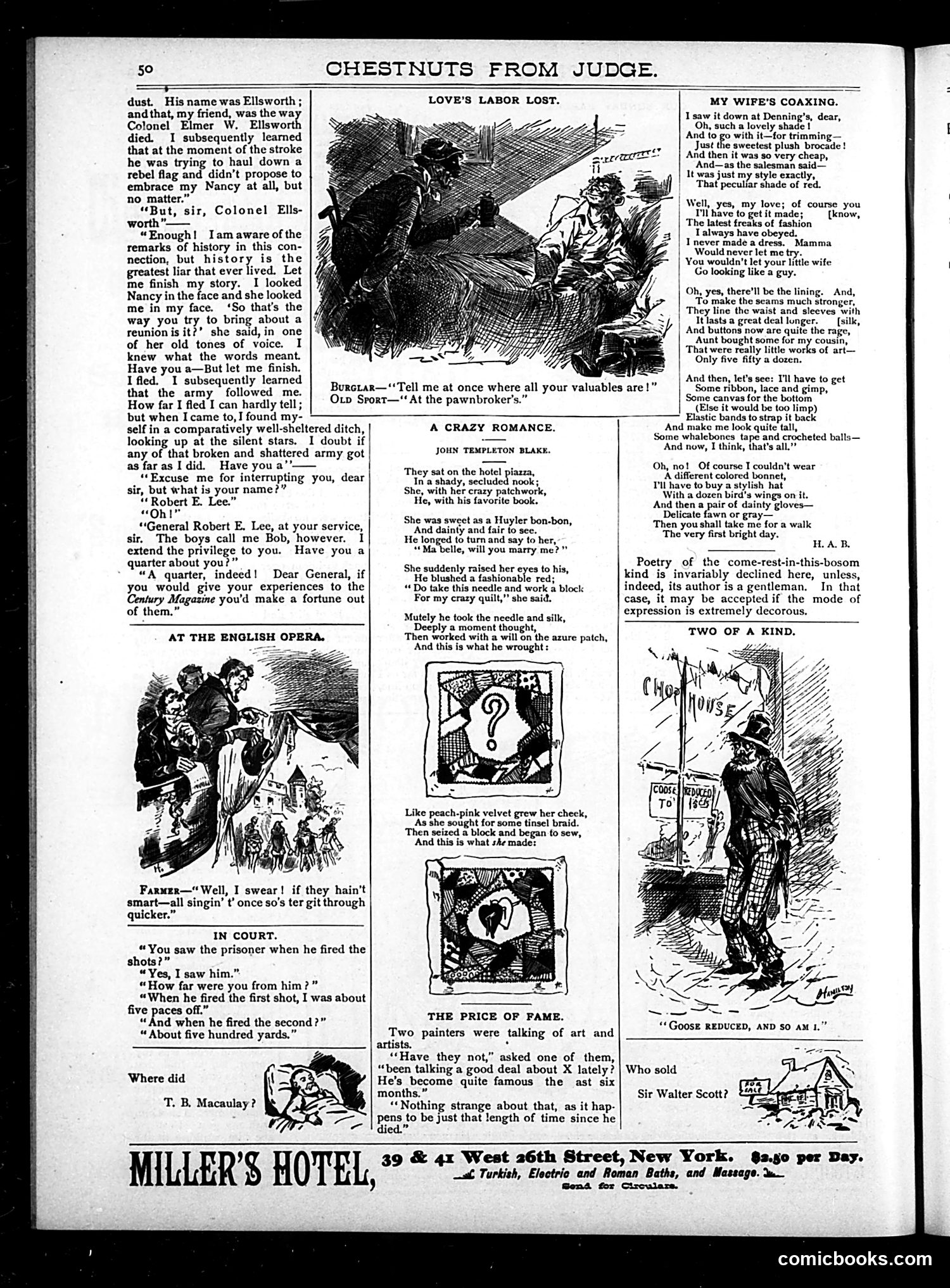
This page contains several humorous short pieces typical of 1880s-90s satirical magazines: **Main narrative**: A Civil War anecdote allegedly told by General Robert E. Lee, involving Colonel Ellsworth's death and a romantic entanglement. The joke relies on the reader recognizing Lee as a famous Confederate general reduced to begging quarters—deflating his historical stature for comedy. **"Love's Labor Lost"**: A burglar discovers his victim has already pawned everything—commentary on urban poverty or financial desperation. **"My Wife's Coaxing"**: A husband capitulates to his wife's endless shopping demands for dress materials and trim, satirizing women's consumer habits and marital dynamics. **"A Crazy Romance"**: Plays on the period's "crazy quilt" fad, using patchwork as a metaphor for romantic confusion. **Other sketches**: Include courtroom humor about witness testimony distance and commentary on opera singers' speed. The advertisements emphasize Miller's Hotel amenities. Throughout, the humor targets recognizable social types and domestic situations familiar to Judge's middle-class readers.
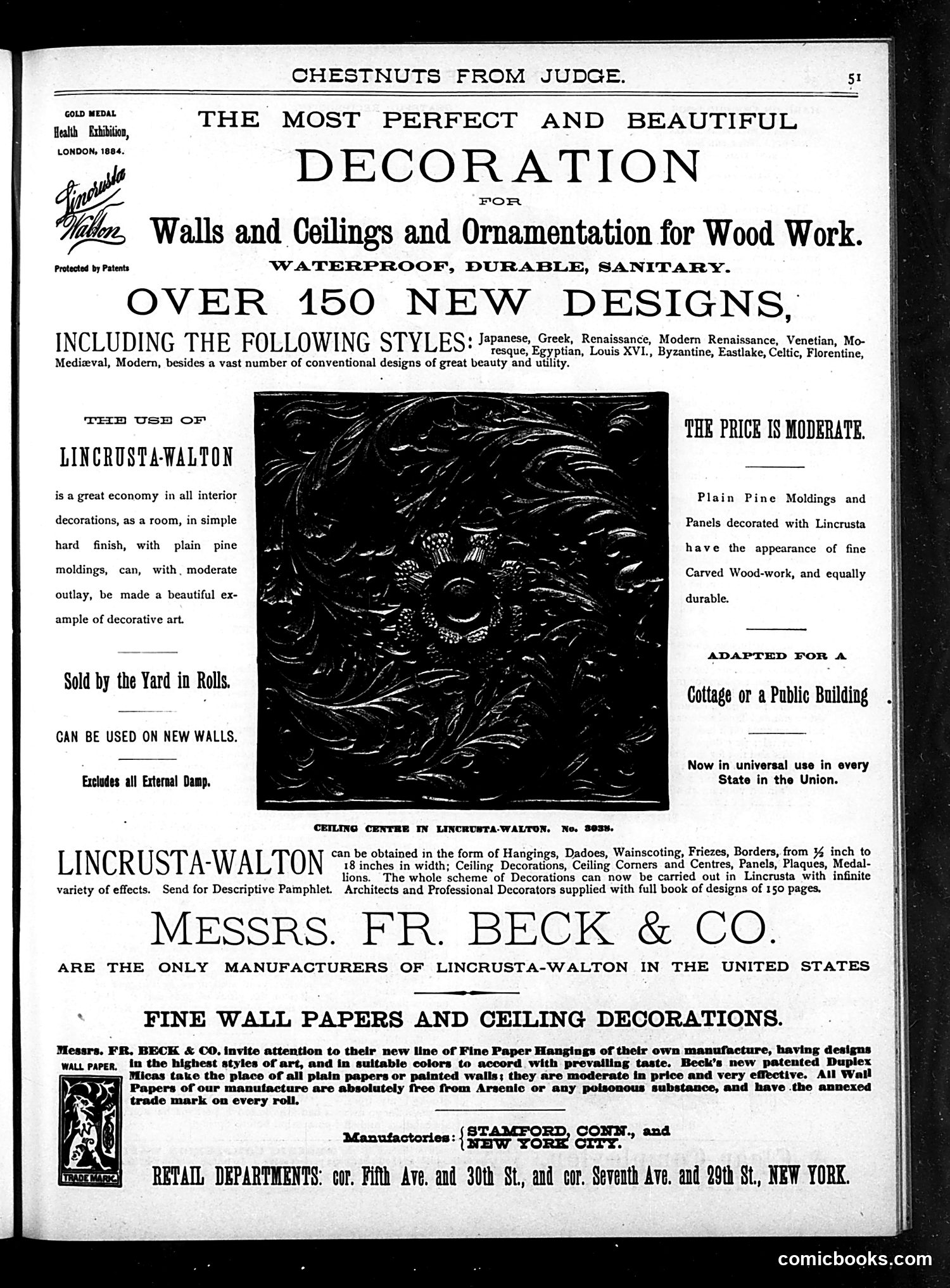
This page is **not a political cartoon or satire**—it's a full-page advertisement for Lincrusta-Walton, a decorative wall and ceiling material manufactured by Fr. Beck & Co. **What it advertises:** A waterproof, durable wall covering marketed as an economical alternative to carved wood-work or fine wall papers. It comes in 150+ design styles (Japanese, Greek, Renaissance, Byzantine, etc.) and can be applied to walls, ceilings, and woodwork in homes and public buildings. **The marketing angle:** The ad emphasizes that Lincrusta gives the appearance of expensive carved wood or fine decoration at moderate cost—appealing to middle-class consumers wanting aesthetic refinement on a budget. It also notes the material is "free from Arsenic or any poisonous substance," addressing contemporary health concerns about decorative products. **Historical context:** The ad's inclusion in *Judge* magazine suggests this was an affluent audience interested in interior design. The manufacturing locations (Stamford, Connecticut and New York City) and retail departments in Manhattan indicate an established, quality product.
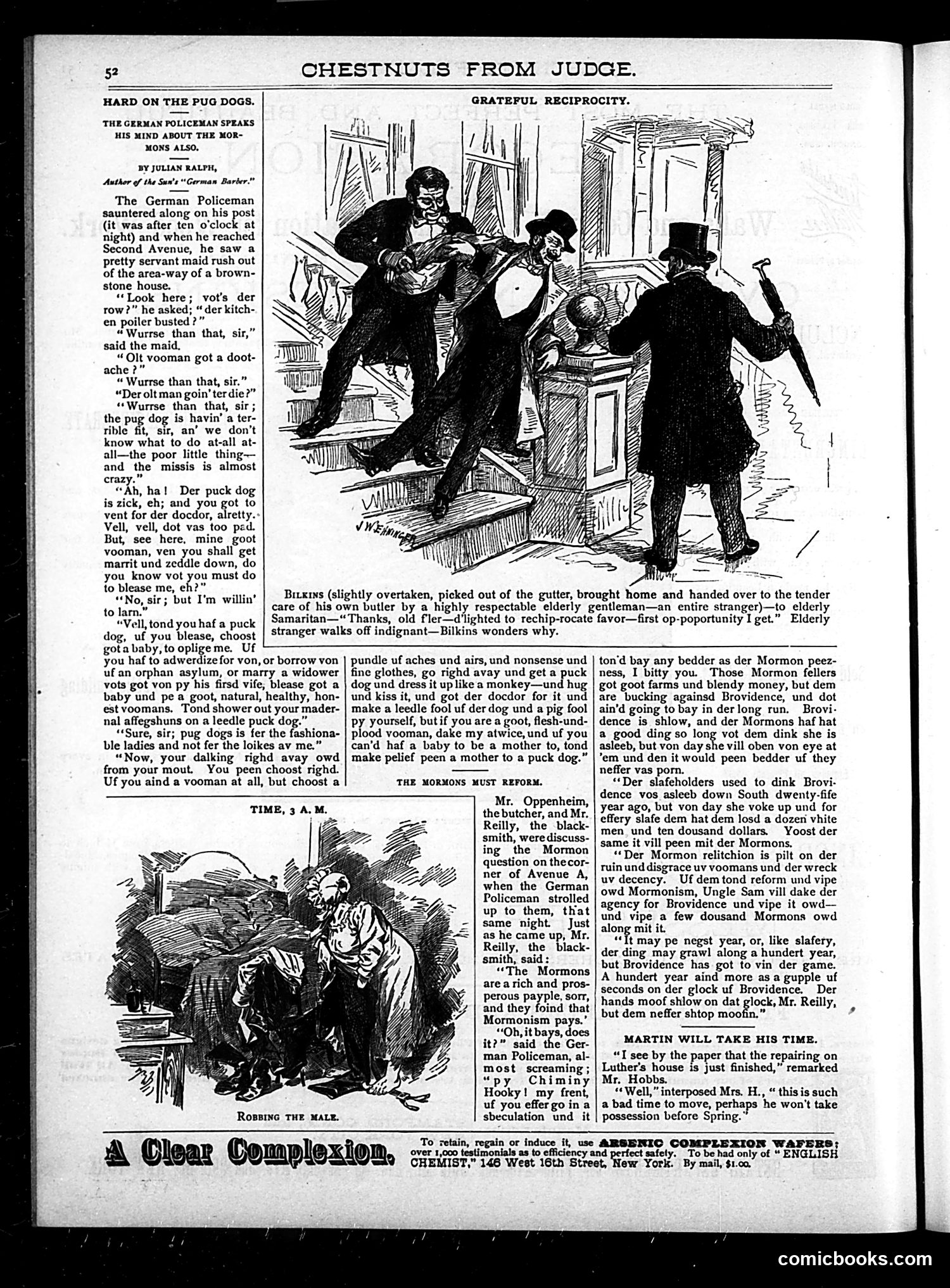
This page contains two satirical pieces featuring a German policeman character with a thick accent, likely representing immigrant perspectives on American social issues. **"Hard on the Pug Dogs"** mocks upper-class women's obsession with lap dogs. A German policeman lectures a maid that women should channel maternal instincts toward babies and meaningful pursuits rather than dressing up pug dogs "like a monkey." The satire critiques frivolous pet-ownership as a substitute for real motherhood. **"The Mormons Must Reform"** shows the same policeman lecturing about Mormon polygamy and prosperity. He argues that Providence (divine justice) will eventually punish Mormonism just as slavery was punished in the Civil War, implying moral reckoning is inevitable. Both pieces use the German immigrant as a voice of common-sense morality, contrasting working-class values against elite American decadence and religious excess. The heavy dialect humor was typical of late 19th-century American satire.
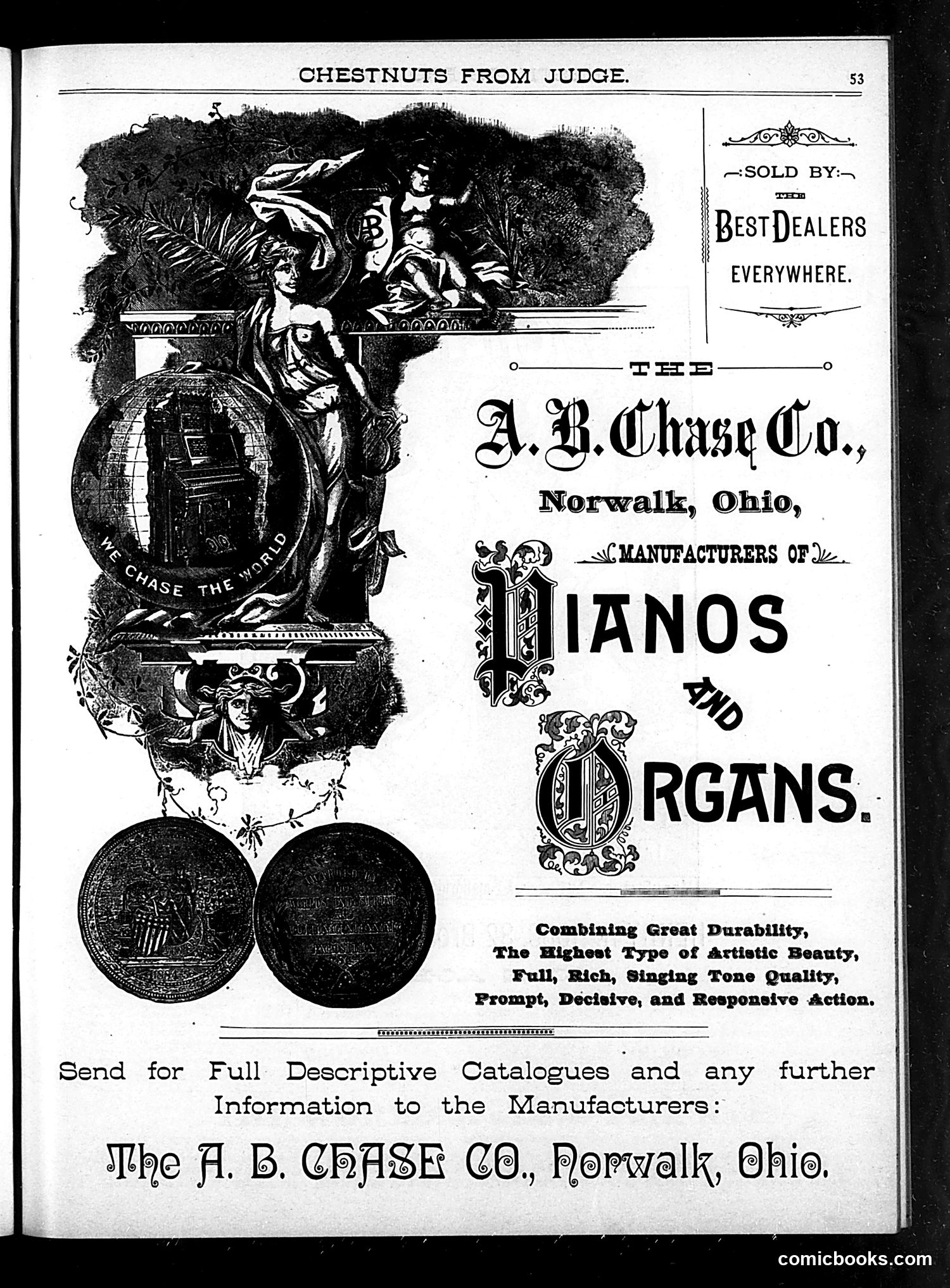
This page is primarily **advertising**, not satire or political commentary. It's a full-page advertisement for the A.B. Chase Company of Norwalk, Ohio, a piano and organ manufacturer. The elaborate decorative imagery—classical figures, a globe, and ornamental medallions—is typical Victorian-era commercial design meant to convey quality and sophistication. The phrase "Chase the World" on the globe appears to be a company slogan or brand play. The "Chestnuts from Judge" header is misleading; while this appeared in *Judge* magazine (a satirical publication), this particular page contains no satire. "Chestnuts" likely means reprinted or standard content. The ad emphasizes the pianos' and organs' "durability," "artistic beauty," and "singing tone quality"—standard marketing language of the period promoting musical instruments as both functional instruments and status symbols for middle-class homes.
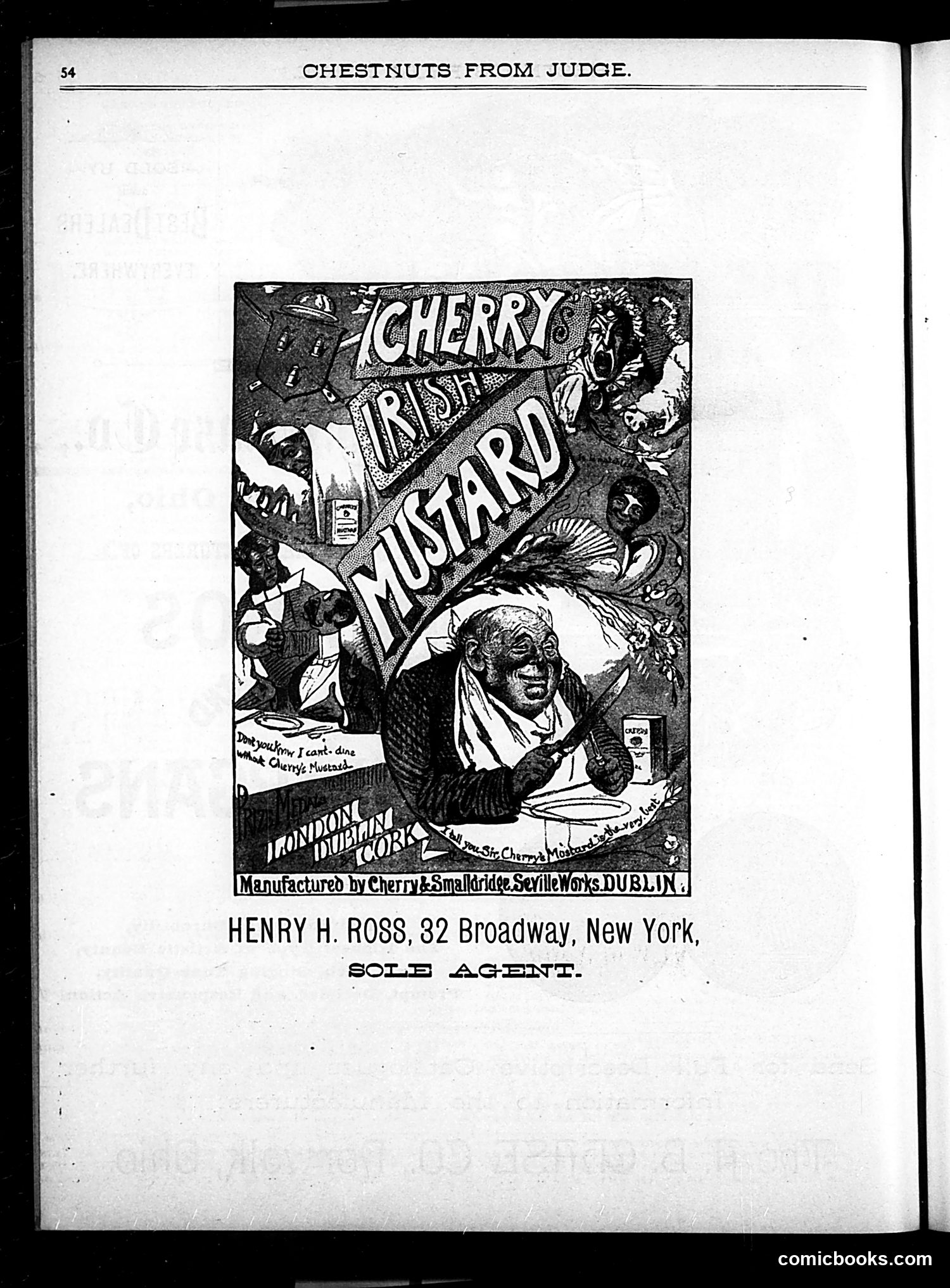
This is primarily a **product advertisement** rather than a political cartoon. The page features an ornate Victorian-era label for "Cherry Irish Mustard," manufactured by Cherry & Smallbridge of Dublin and Cork, with London distribution noted. Henry H. Ross at 82 Broadway, New York is listed as the sole American agent. The image shows caricatured figures in period dress surrounding the product name in elaborate lettering—typical 19th-century advertising design. The label includes humorous text snippets ("Do you know I can't do without Cherry's Mustard"), but these appear to be marketing testimonials rather than political satire. The page's placement in Judge magazine suggests this was a paid advertisement section, not editorial content carrying social commentary.
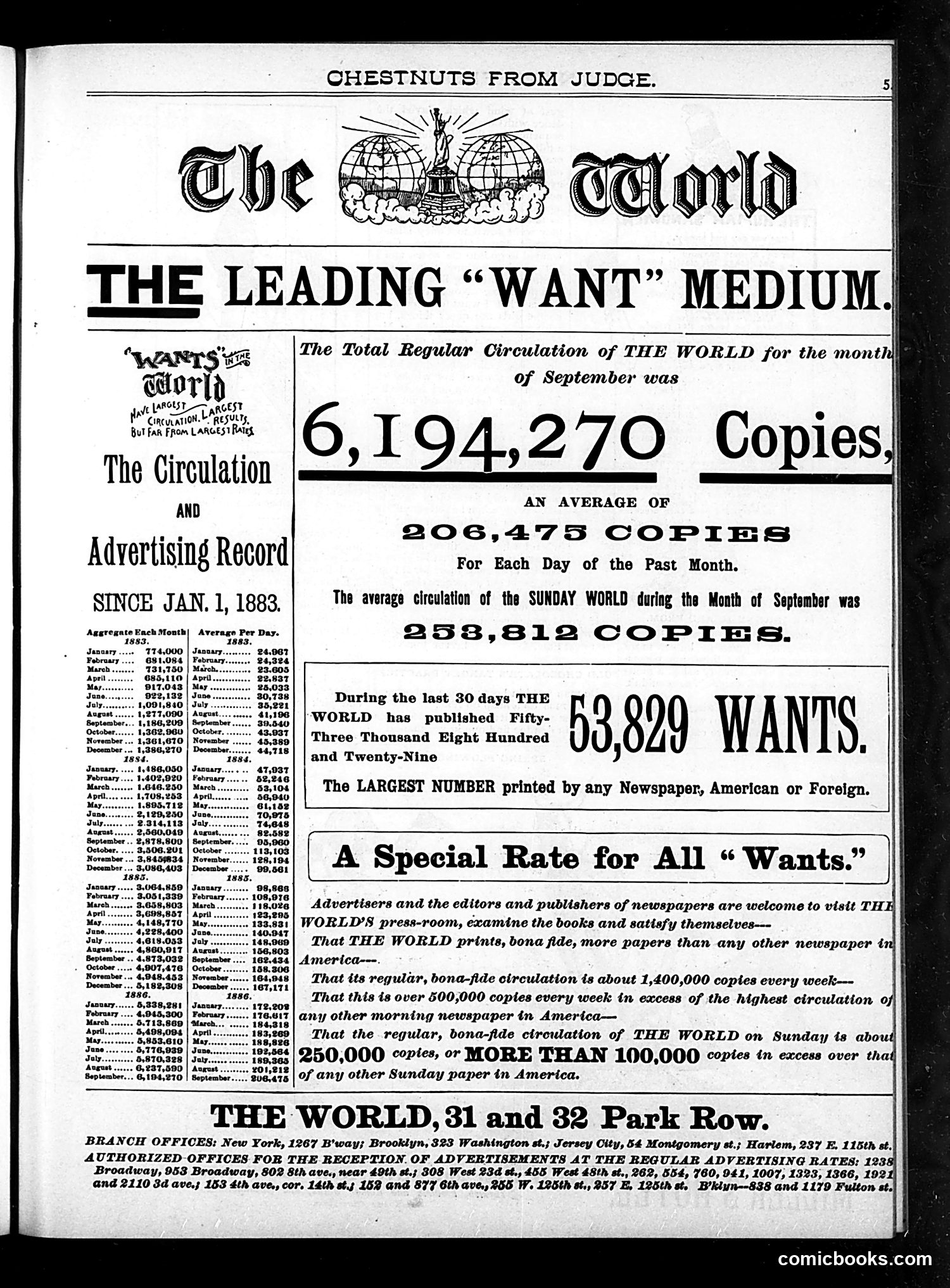
This is primarily an **advertisement**, not a cartoon. The "New York World" newspaper is boasting about its classified ads ("Want" section) circulation figures for September. The World claims 6,194,270 total copies circulated, averaging 206,475 daily copies—allegedly "the LARGEST NUMBER printed by any Newspaper, American or Foreign." It further claims 53,829 want ads published in 30 days, and that its Sunday circulation (258,812 copies) exceeds competitors by over 100,000 copies. The page invites advertisers and newspaper editors to visit their press-room to "examine the books and satisfy themselves" of these claims—a defensive posture suggesting competitors were skeptical of these inflated circulation numbers. The repetition of circulation superiority claims indicates fierce competition among New York newspapers of this era, particularly regarding advertising revenue.
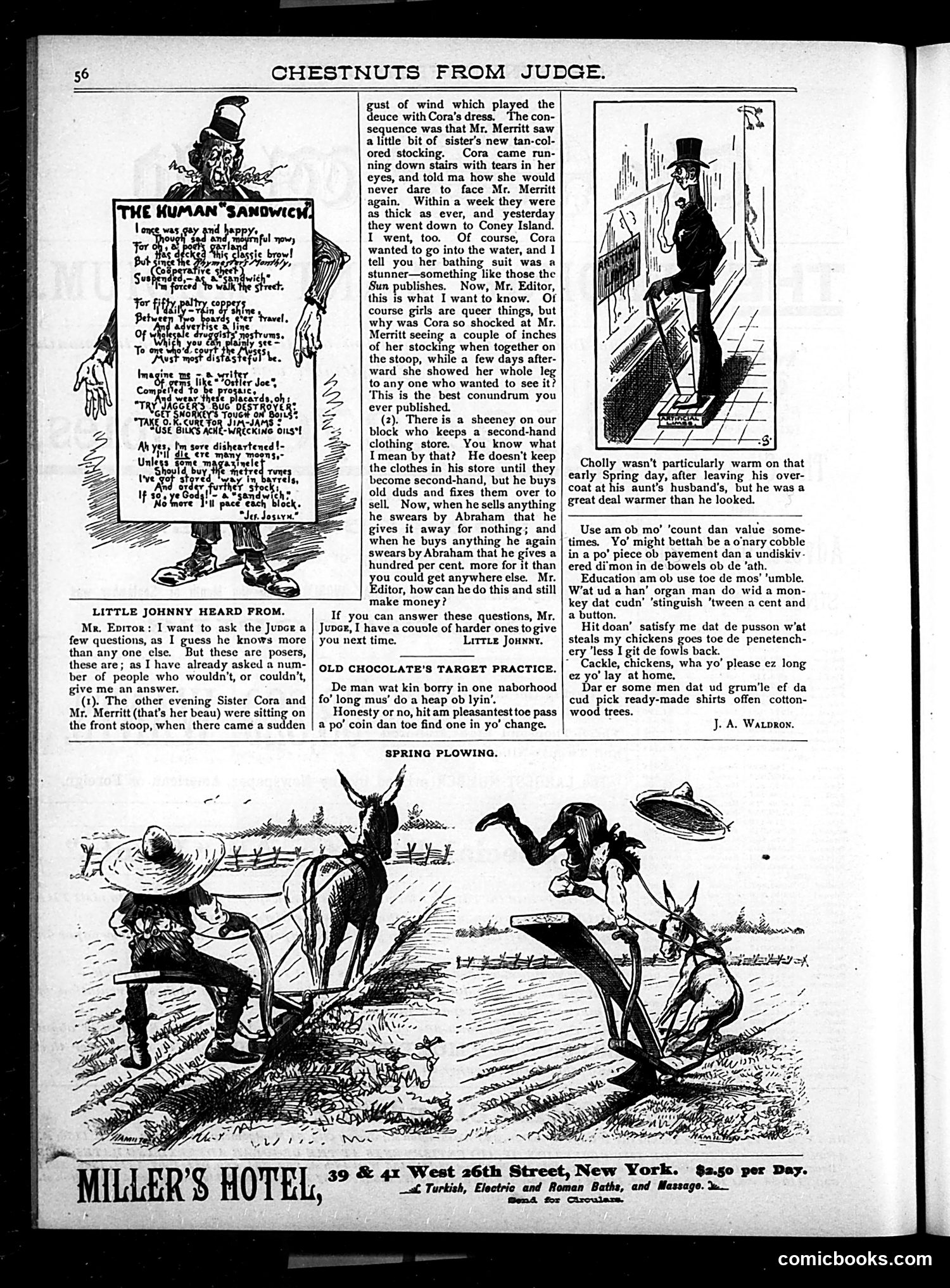
This page contains reader-submitted humor and social commentary typical of Judge magazine's "Letters" section. **"Little Johnny Heard From"** presents two puzzles exploiting period prejudices: 1. A moral contradiction about a woman's modesty—shocked when a man glimpses her stocking accidentally, yet happily displays her legs in a bathing suit days later. The humor relies on Victorian prudishness about female bodies. 2. A stereotyped Jewish merchant ("sheeney"—a derogatory term) who supposedly swears by Abraham while simultaneously lying about prices when buying and selling. This perpetuates antisemitic caricatures of Jewish businessmen as dishonest. **"Old Chocolate's Target Practice"** presents dialect-heavy aphorisms attributed to a Black character, using racial stereotypes and broken English common to the era's "plantation humor." **"Spring Plowing"** is a humorous illustration of farm laborers struggling with uncooperative animals. The page demonstrates Judge's reliance on ethnic and racial stereotypes for humor—attitudes that would be recognized as offensive today but were normalized in early-20th-century American satire.
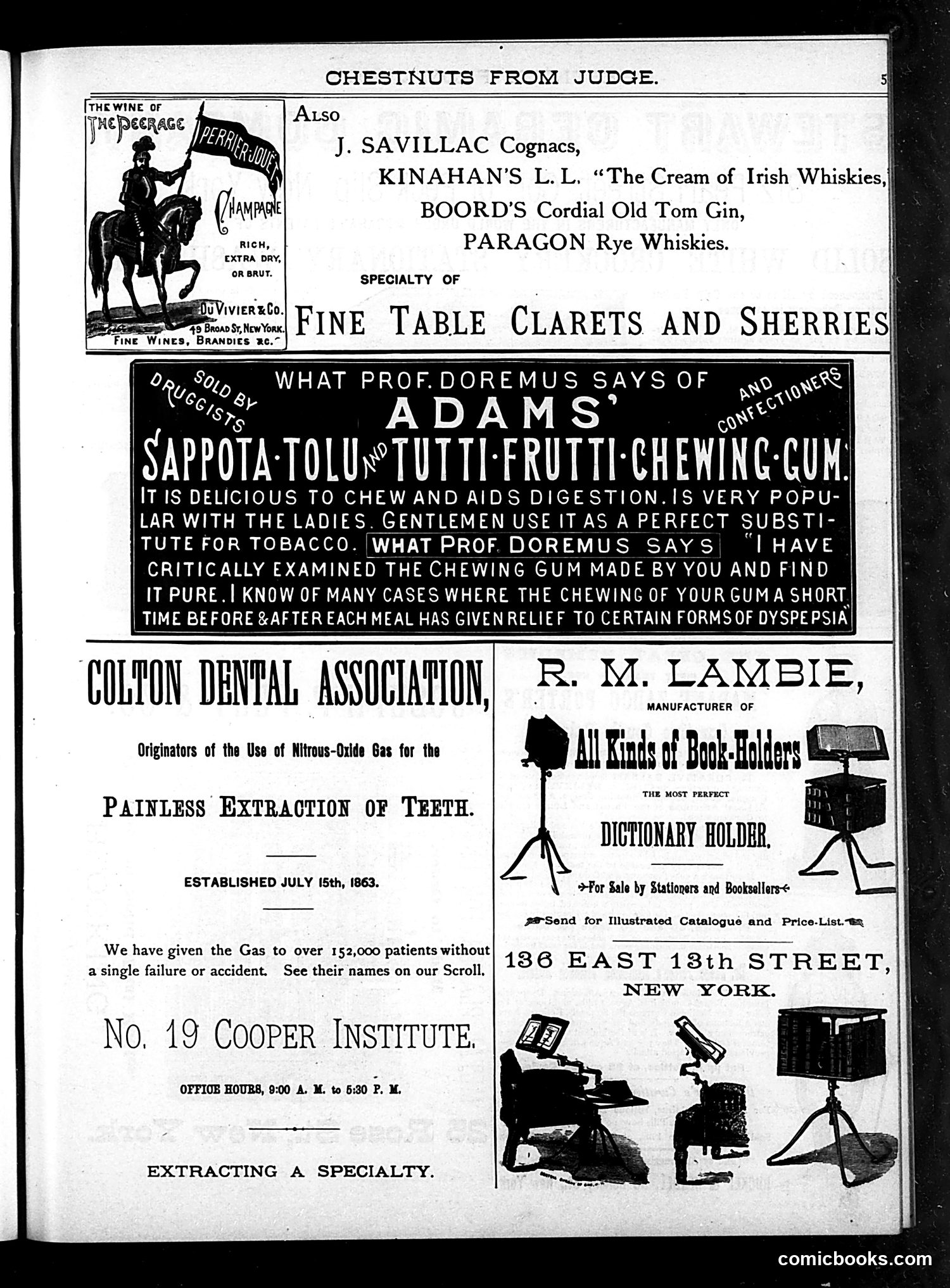
This is primarily a **advertisements page** from Judge magazine, not satirical content. "Chestnuts" was a regular feature showcasing ads. **Key advertisements:** 1. **Wines/Spirits** (top): Perrier-Jouët Champagne and other liquors—standard luxury goods advertising. 2. **Adams' Chewing Gum** (center): Uses a fake endorsement from "Prof. Doremus" claiming the gum aids digestion and helps dyspepsia. This reflects 19th-century patent medicine-style marketing—exaggerated health claims that would be illegal today. 3. **Colton Dental Association**: Advertises "painless extraction" using nitrous oxide gas ("laughing gas"), claiming 152,000 successful procedures. Represents early anesthesia adoption. 4. **R.M. Lambie** (right): Manufactures book-holders and dictionary stands—practical Victorian office equipment. The page reflects Gilded Age consumer culture: unregulated health claims, new technologies (gas anesthesia), and specialized furniture for the reading-obsessed middle class.
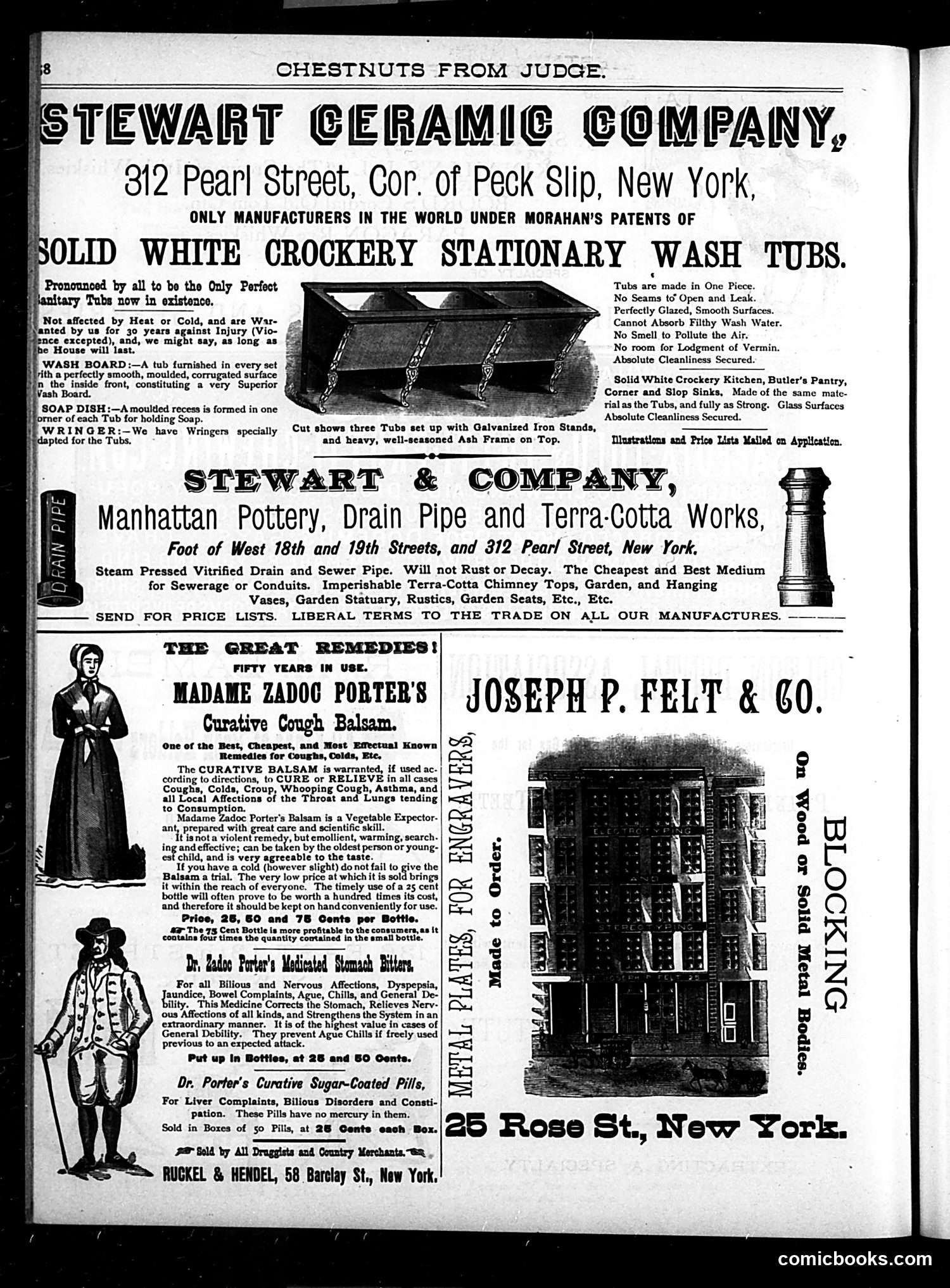
This page is primarily **advertising**, not satire or political commentary. It contains product ads for New York manufacturers from what appears to be the late 19th century: ceramic plumbing fixtures (Stewart Ceramic Company and Stewart & Company), and patent medicines ("The Great Remedies"). The ads feature period illustrations—women in Victorian dress promoting Madame Zadoc Porter's Cough Balsam and medicinal products—typical of 1800s advertising conventions. The medical claims (curing consumption, asthma, bilious affections, etc.) reflect the era's unregulated patent medicine industry, now recognized as quackery. The page heading "Chestnuts from Judge" suggests these are reprinted advertisements or product endorsements, though no actual satirical content or cartoon commentary is visible. It's simply a compilation page of commercial advertisements.
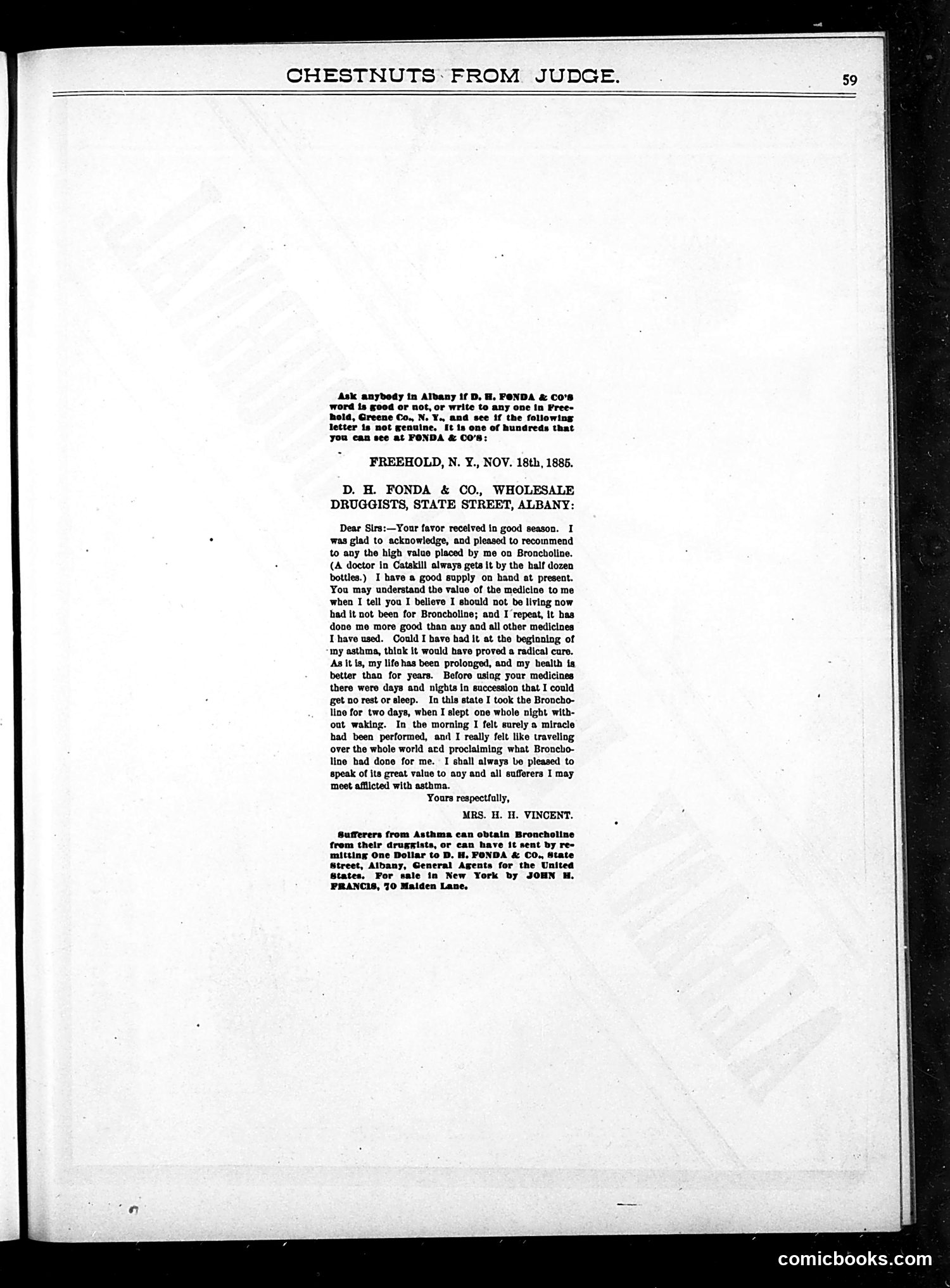
This page is **primarily advertising**, not satire or political commentary. The "Chestnuts from Judge" header is a framing device; "chestnuts" was period slang for old, recycled material. The content is a **testimonial advertisement** for "Broncholine," a patent medicine sold by D. H. Fonda & Co. of Albany, New York. Mrs. H. H. Vincent of Freehold testifies that the product cured her asthma—claiming she went from sleepless nights to full rest after two days of treatment, and that it prolonged her life. **Historical context**: This reflects 1885 America's largely unregulated patent medicine industry. Such glowing testimonials were common advertising tactics, often fabricated or exaggerated. Judge magazine apparently accepted or reprinted such ads alongside satire. The "Chestnuts" framing suggests Judge's editors may have been ironically positioning this as recycled advertising copy, but the page itself contains no visible cartoon or joke—just the ad and verification language encouraging readers to confirm the company's legitimacy.
This appears to be a title or section divider page from *Judge* magazine rather than a cartoon with satirical content. The page displays "ALBANY CHARMING JOURNAL" in large bold text running diagonally across the center, flanked by decorative geometric borders and two ornamental compass rose designs. The OCR text is largely corrupted and unreadable, suggesting scanning errors from the original document. Without legible accompanying text or visible caricatures/figures, I cannot identify specific political targets, social commentary, or the satirical point this page was intended to convey. It functions primarily as a layout or advertising page rather than delivering clear satirical messaging a modern reader could understand.
This page is primarily **advertising**, not editorial content. It displays a business card or advertisement for **Sackett, Wilhelms & Getzig**, identified as "Lithographers & Printers" located at 45-51 Rose Street, New York. The advertisement uses decorative imagery typical of early 20th-century commercial design: an ornamental border featuring a silhouetted bird on a flowering branch (top), and a winter landscape scene with sledding figures (bottom). These aesthetic elements were common in period advertising to attract attention and convey sophistication. The *Judge* magazine branding visible suggests this was a paid advertisement placed within the satirical publication, rather than editorial commentary or political satire.
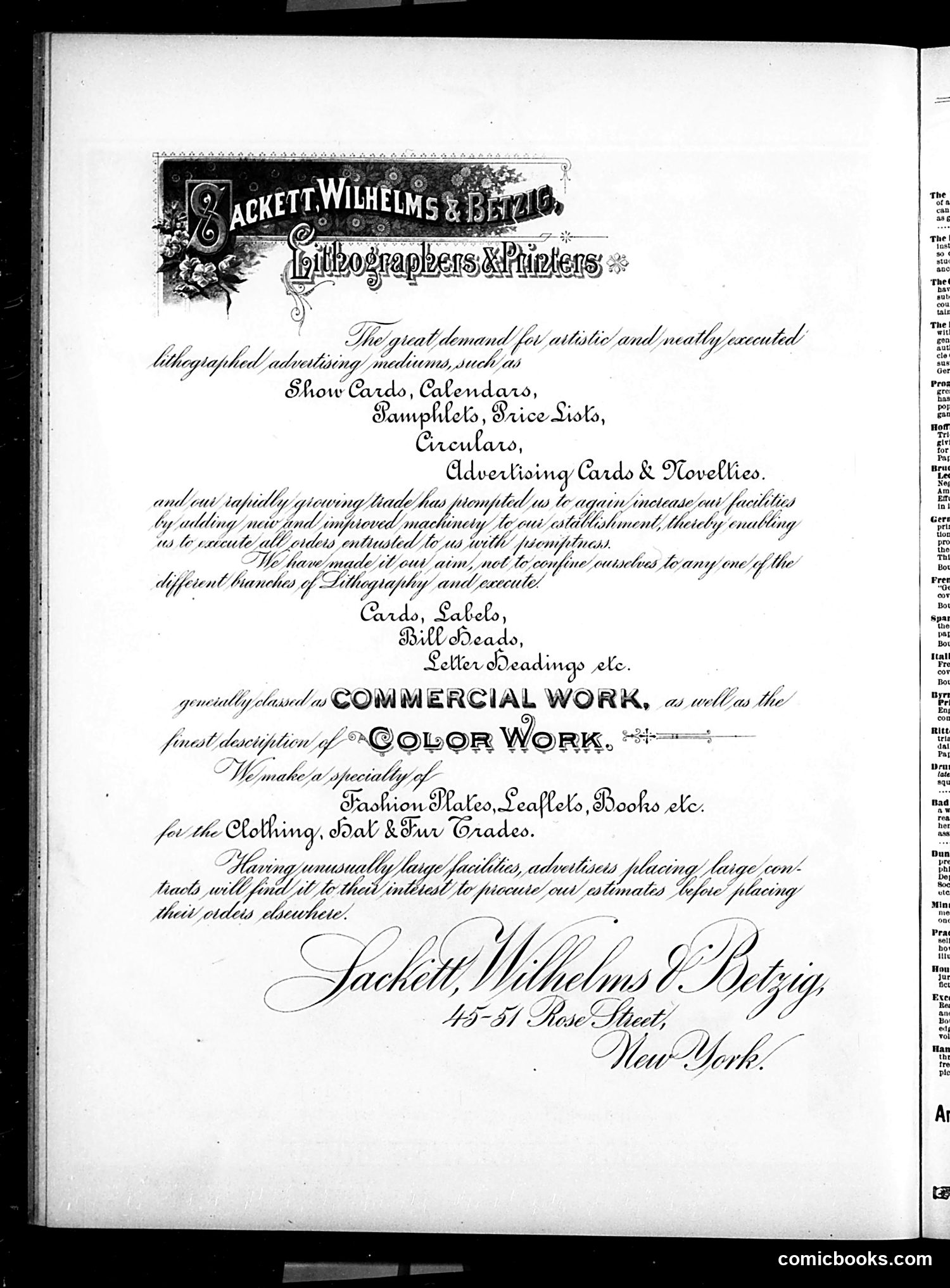
This is **not a cartoon or comic page**—it is a **title page or advertisement** for Sackett, Wilhelms & Belzig, a lithography and printing company located at 45-57 Rose Street, New York. The ornamental header announces their business, and the body text promotes their services: producing show cards, calendars, pamphlets, price lists, advertising cards, and novelties. They emphasize their "large facilities" and capability to execute orders promptly in both commercial work and color printing, with particular specialization in fashion plates, leaflets, and books for the clothing and fur trades. This appears to be a self-promotional advertisement placed within *Judge* magazine itself, showcasing printing capabilities to potential clients. There is no satire, political commentary, or humor—it is purely commercial advertising from the period's printing industry.
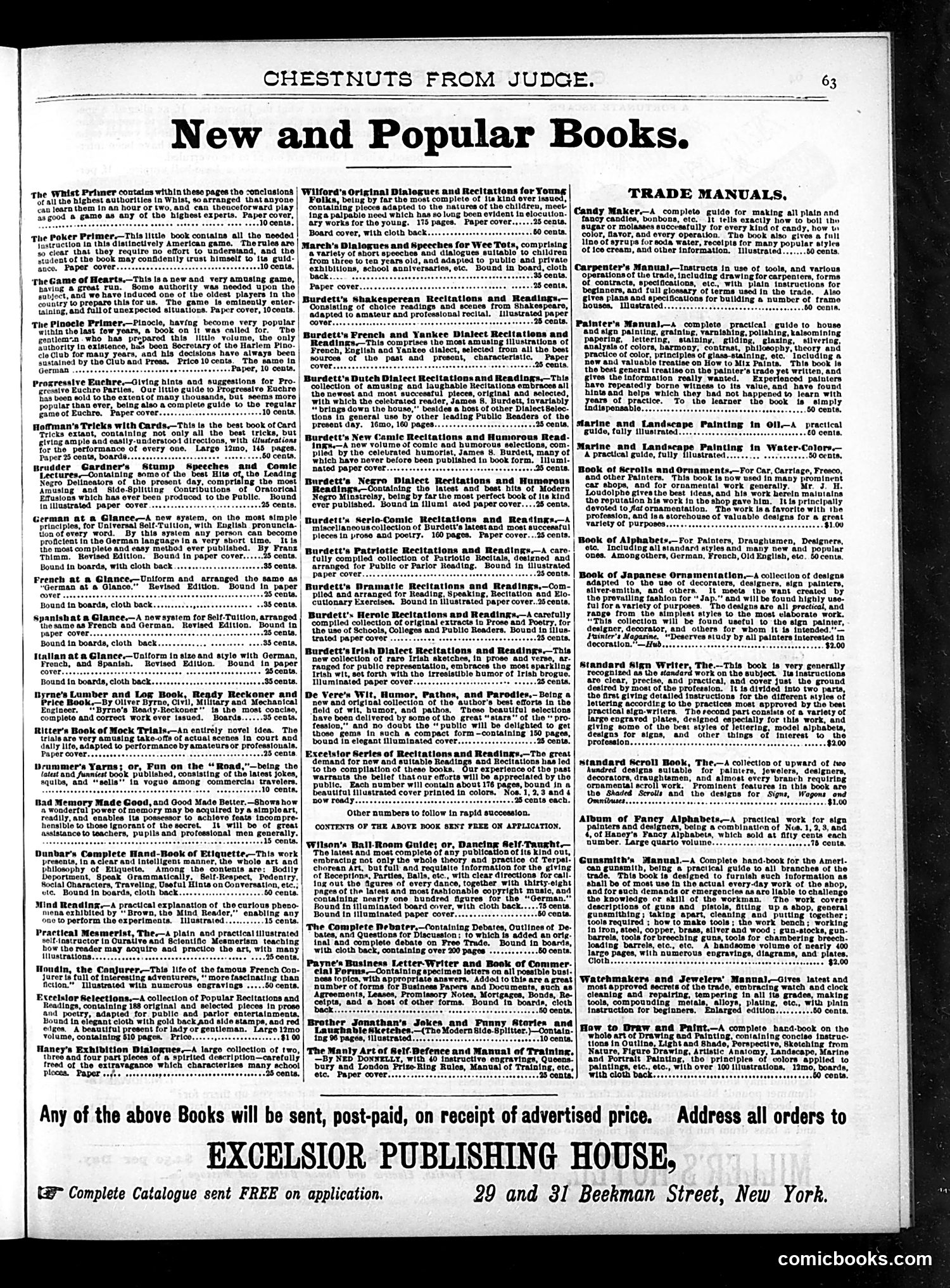
This page is primarily **advertising**, not editorial content. It consists entirely of book advertisements from the Excelsior Publishing House, listing "New and Popular Books" available for mail order. The books advertised include instructional manuals (card game primers for Whist, Poker, Euchre, Pinocle), language self-instruction books ("German at a Glance," "French at a Glance"), and entertainment collections. One notable entry is **"Brudder Gardner's Stump Speeches and Comic Lectures,"** described as "Stump Speeches" performed by "Negro Delineators"—reflecting the blackface minstrelsy tradition popular in 19th-century America. The ads emphasize practical utility and affordability (most priced 10-35 cents), targeting middle-class readers interested in self-improvement, parlor games, and amateur performance. This is a **catalogue page**, not satirical content—typical of Judge magazine's revenue model of combining editorial cartoons with commercial advertising.
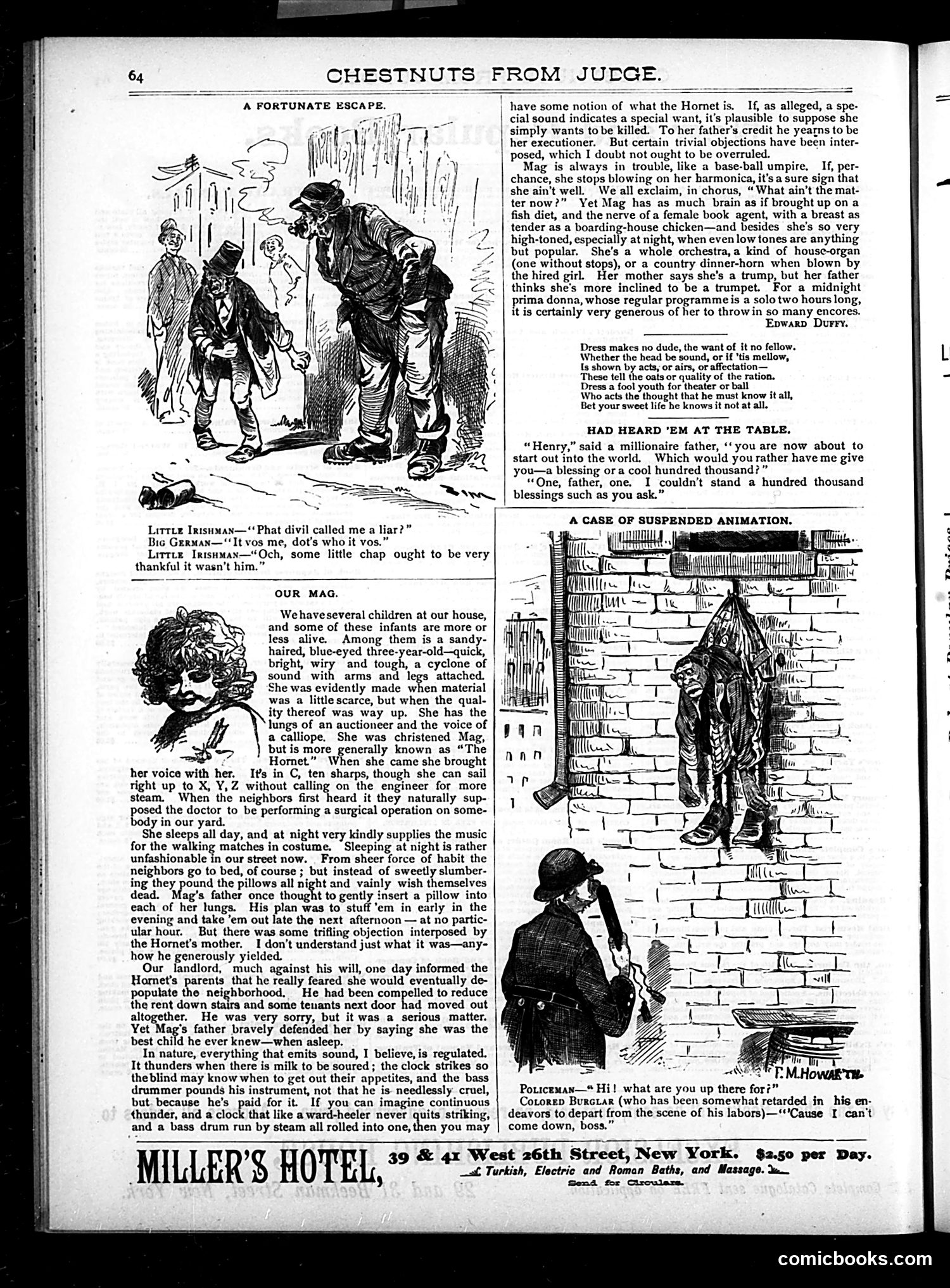
This is a humor page from *Judge* magazine featuring several satirical pieces about domestic life and social manners. **"A Fortunate Escape"** (top left illustration): A father considers killing his young daughter "Mag" because her constant loud harmonica-playing drives everyone mad. The satire mocks both the child's unbearable noise-making and the father's exasperated (but ultimately helpless) response. The piece humorously compares her to various loud instruments and describes how neighbors suffer. **"Had Heard 'Em at the Table"**: A millionaire father offers his son either a blessing or $100,000; the son chooses one blessing, unable to tolerate more of his father's verbose blessings—mocking wealthy patrons' verbose moralizing. **"Our Mag"**: An extended comic essay describing the family's three-year-old daughter as an insufferable "hornet" whose constant shrieking and noise-making torments neighbors and family alike. The humor relies on exaggerated descriptions of her vocal assault on the household. The overall theme: domestic chaos caused by an obnoxious child, presented as relatable middle-class comedy.
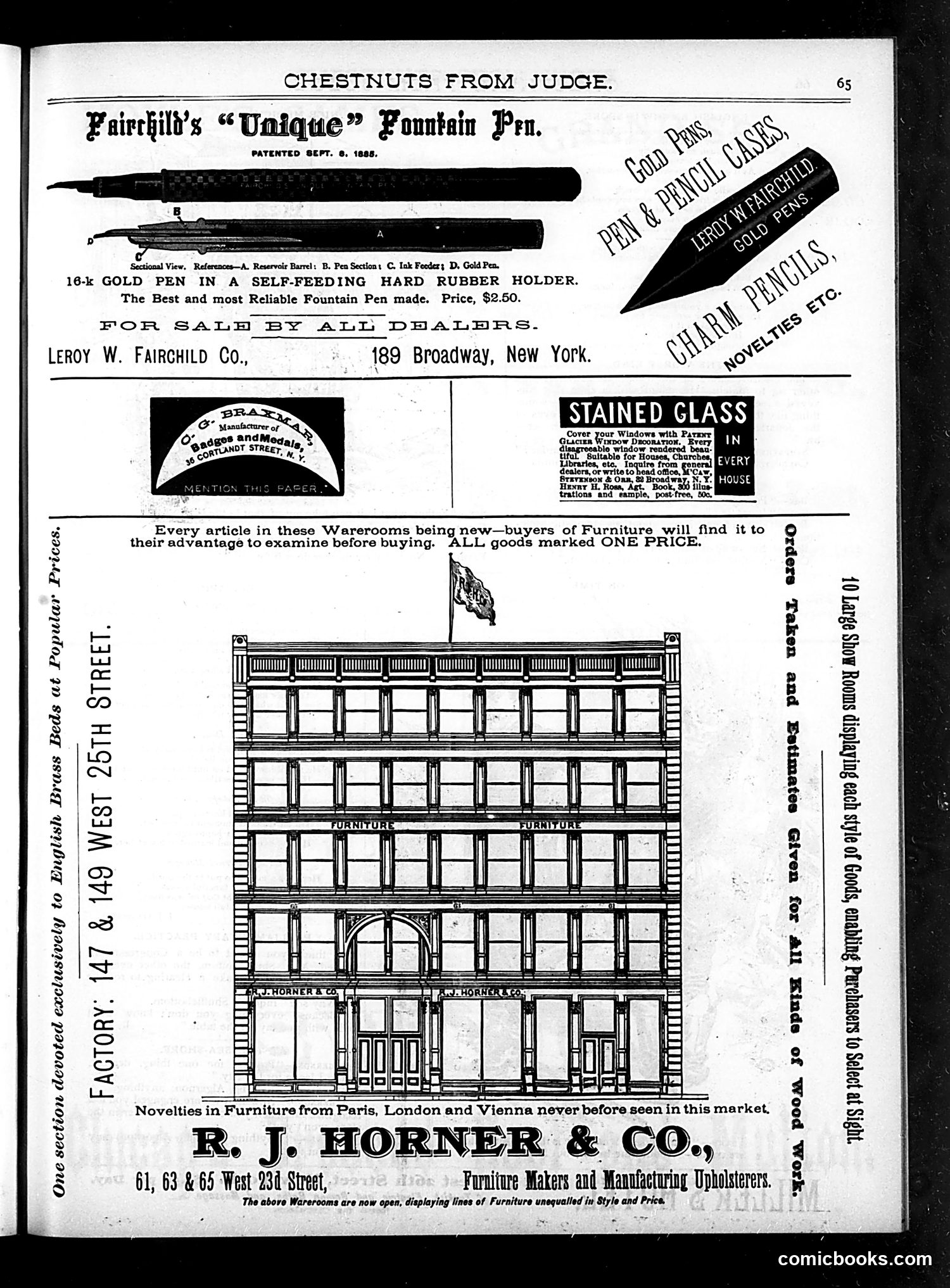
This page is **primarily advertising**, not satirical content. The "Chestnuts from Judge" header is misleading—it doesn't contain cartoons. The page features three advertisements: 1. **Fairchild's Fountain Pen** (top): A patented 1888 writing instrument with a gold nib in rubber holder, priced at $2.50, sold by Leroy W. Fairchild Co. on Broadway. 2. **Stained Glass Windows** (center): A service covering windows with decorative glass for homes, churches, and libraries. 3. **R.J. Horner & Co.** (bottom): A furniture manufacturer advertising "novelties" imported from Paris, London, and Vienna, emphasizing they display new stock at fixed prices. The page represents typical **late-19th-century magazine advertising**—products marketed to middle and upper-class consumers. The prominence of imported goods reflects the era's association of European manufactures with quality and sophistication. This reflects historical commercial practices rather than political satire.
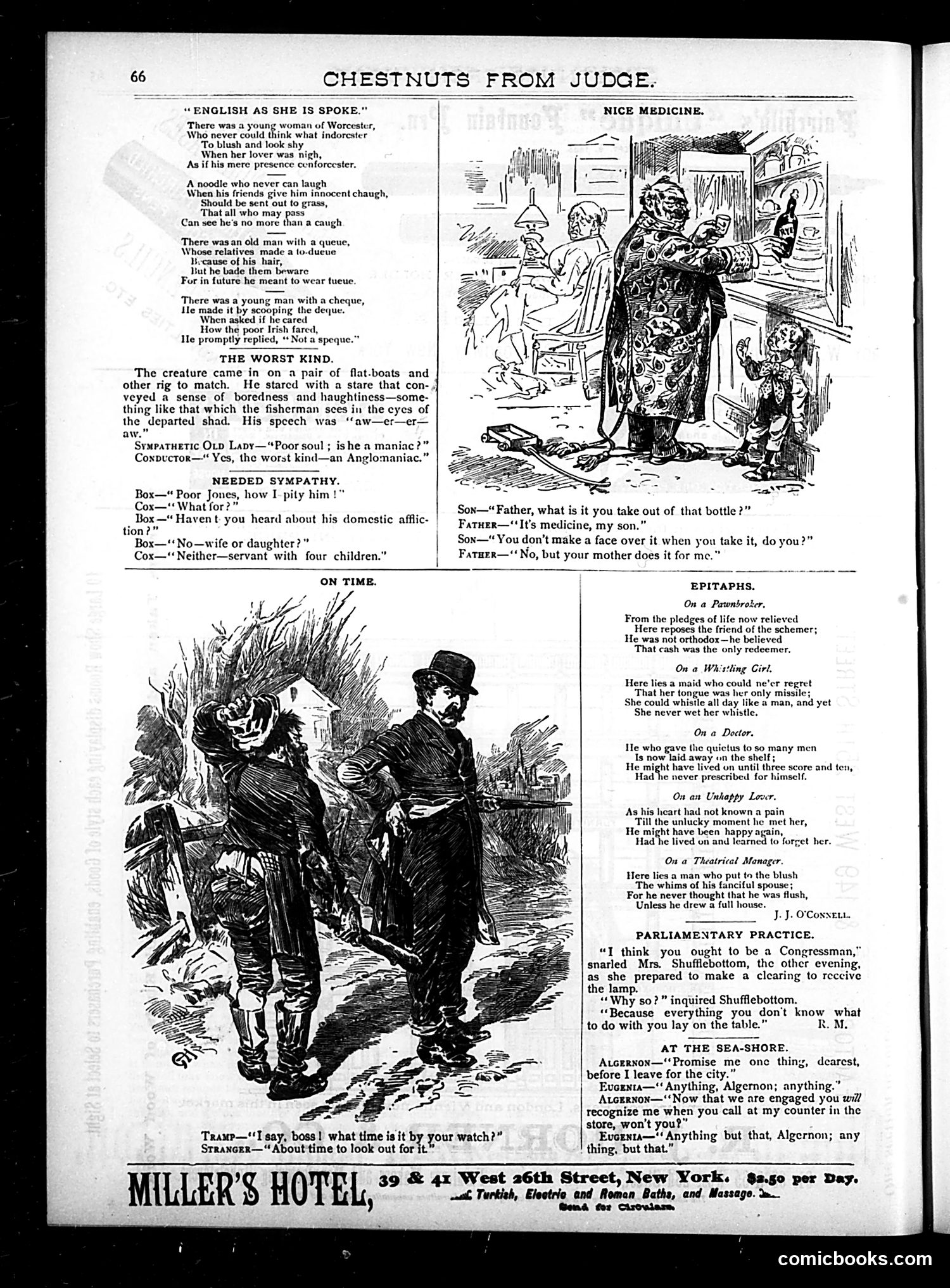
This page from *Judge* magazine (a 19th-century American satirical publication) contains several humor sections: **"English As She Is Spoke"** mocks mangled wordplay and pronunciation, a popular Victorian joke format targeting linguistic pretension. **"The Worst Kind"** satirizes "Anglomaniacs"—Americans obsessed with imitating English manners and speech, portrayed as insufferably snobbish and boring. **Various short jokes** target domestic life (servants, wives, doctors) and social types common to the era. **"On Time"** and **"Nice Medicine"** cartoons use simple visual humor about punctuality and a father taking medicine his wife administers to avoid his grimacing. **The epitaphs** humorously mock character types: greedy pawnbrokers, whistling girls, incompetent doctors, theatrical managers obsessed with box-office success—satirizing middle-class social types and human folly. **"Parliamentary Practice"** jokes about Congressional ignorance through marital banter. The page emphasizes Victorian-era preoccupations: class anxiety, linguistic pretension, and gentle domestic mockery.
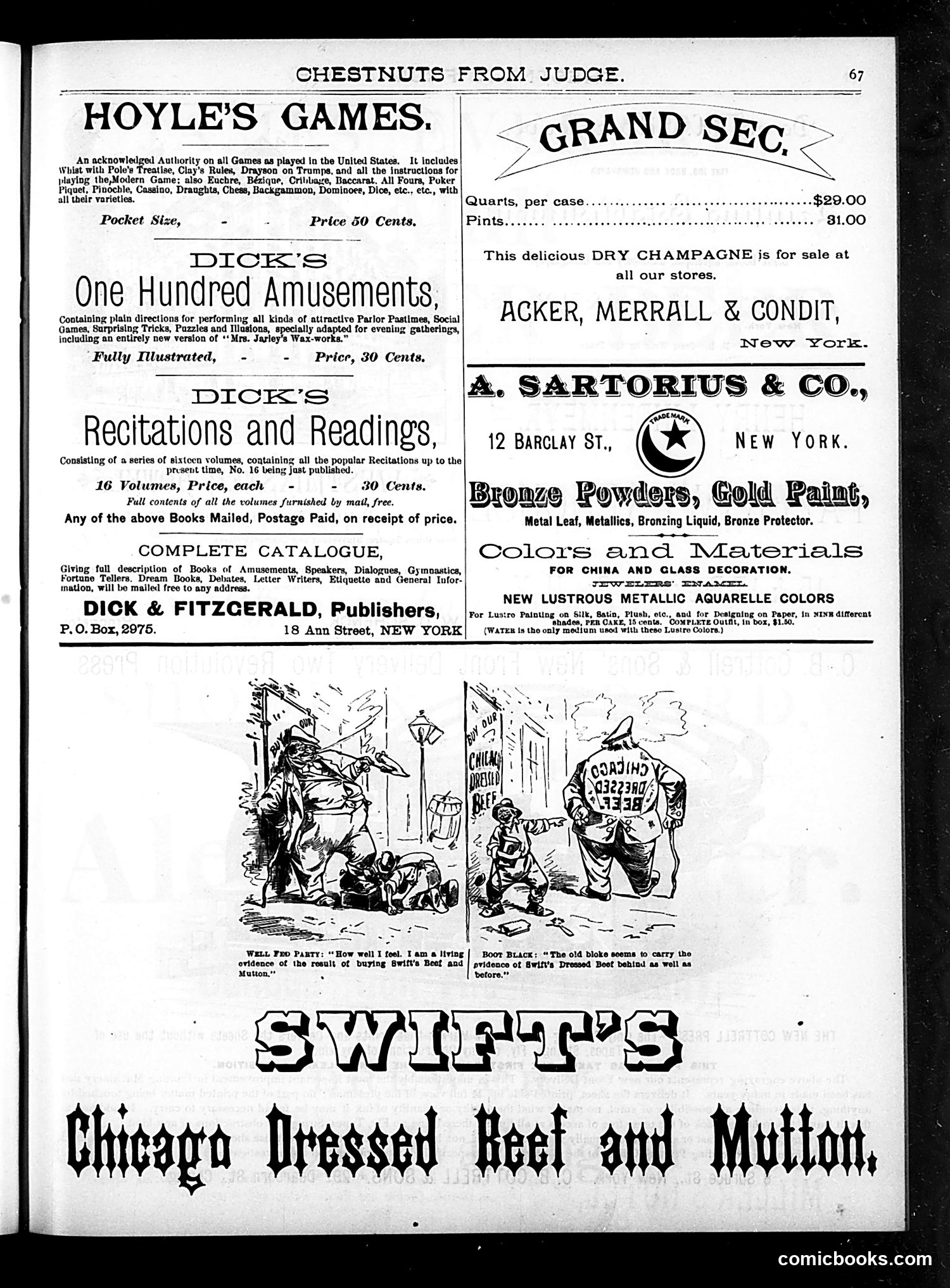
This page is primarily **advertising**, with two small satirical cartoons at the bottom serving as promotional content for Swift's Chicago Dressed Beef and Mutton. ## The Cartoons Both cartoons use the same joke structure: ordinary people—a well-dressed gentleman and a boot black (street shoe-shiner)—attribute their robust health and vigor to consuming Swift's meat products. The cartoons play on the late-19th-century advertising trope of testimonials from satisfied customers. The humor is gentle: the characters claim Swift's meat makes them so healthy and energetic that they practically "glow" with vitality. The boot black's comment about carrying "providence" behind him as well as before appears to reference an impressive physique from the nutritious diet. This represents early **product placement advertising disguised as editorial humor**—a common Judge practice where advertisements were formatted to look like satirical content, blurring the line between journalism and marketing. The rest of the page contains standard publisher advertisements for books on games, amusements, and recitations.
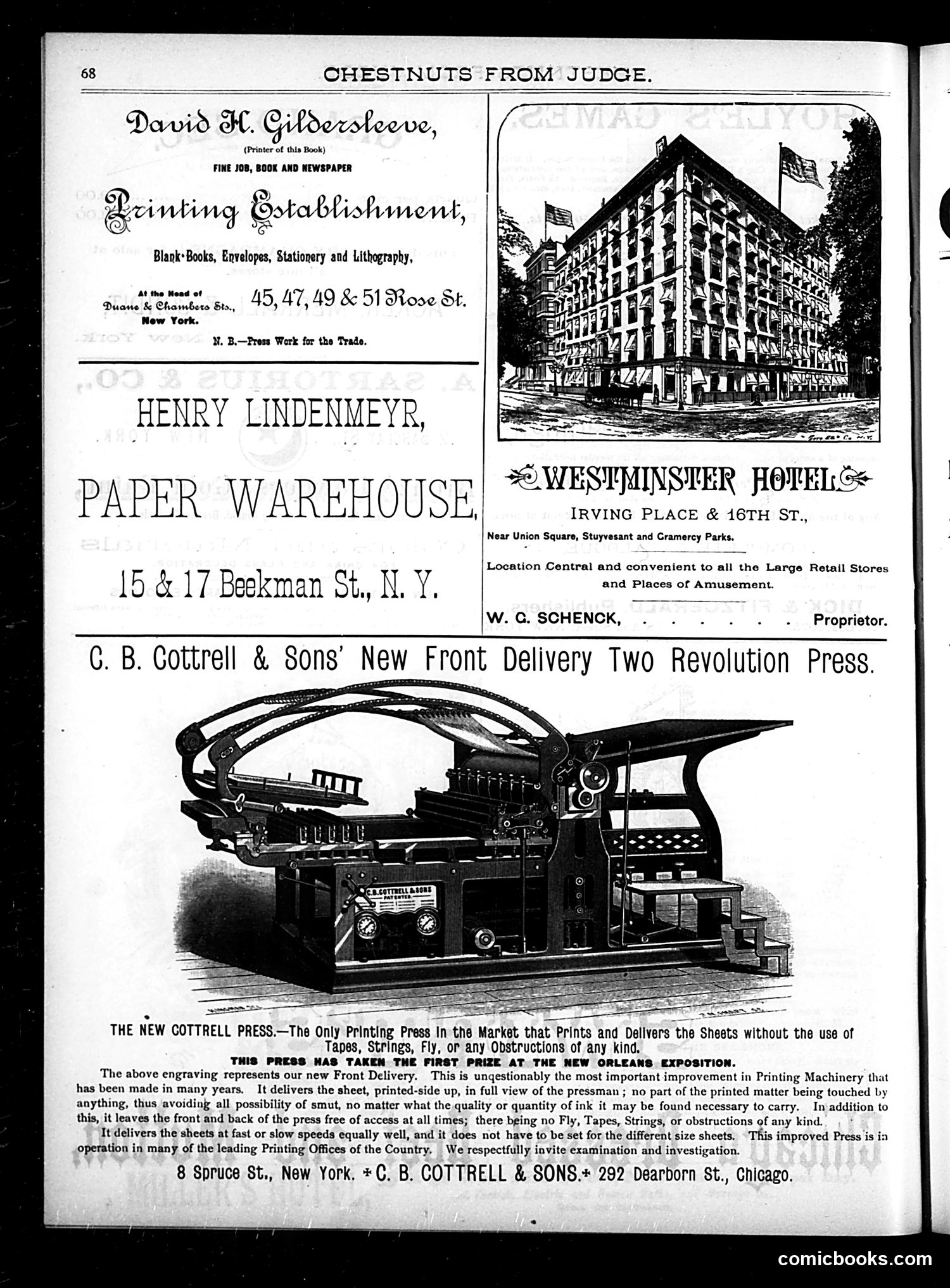
This is not a cartoon page but rather a **advertisements section** from Judge magazine. The page features commercial ads for printing and publishing businesses operating in late 19th-century New York and Chicago. The advertisements promote: - David H. Gildersleeve's printing establishment (fine job, book, and newspaper work) - Henry Lindenmeyer's paper warehouse - Westminster Hotel (near Union Square) - C.B. Cottrell & Sons' printing press machinery The featured illustration shows the "Cottrell Press," a new printing technology that claimed to print and deliver sheets without tape, strings, or obstructions—innovations highlighted as winning first prize at the New Orleans Exposition. The text emphasizes the press's advantages: sheets emerged printed-side up, untouched by operators, preventing smudging ("smut"). There is **no political satire or cartoon content** on this page—it consists entirely of period business advertising aimed at the printing industry.
This page is primarily **advertising, not editorial content**. It contains two separate brewery advertisements from the late 19th or early 20th century: 1. **James Everard** - advertising "Canada Malt Lager Beer" with brewery locations at 132nd-134th Streets and 5th-Madison Avenues in New York City 2. **Shook & Everard** - advertising "Ales and Porter" with "Canada Malt Ale a Specialty," located at 667-679 Washington Street The page appears in a section titled "Chestnuts from Judge," suggesting these are reprinted ads or recurring advertisements. The "chestnut" reference likely means these were familiar, recurring advertisements readers would recognize. There is **no visible cartoon or satire** on this page—it's purely commercial advertising for breweries, typical of period magazine content where ads helped finance publication.
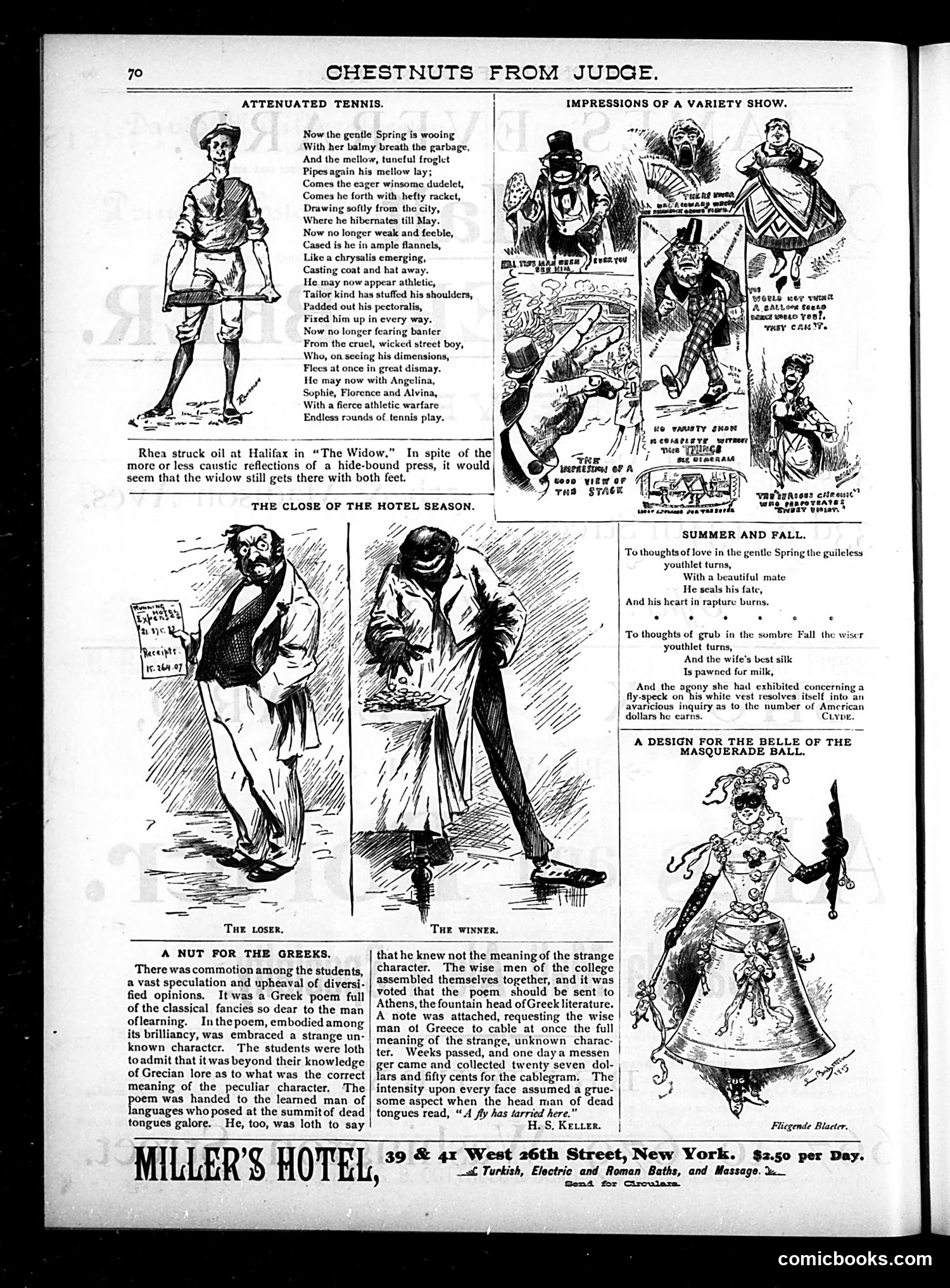
This page from the satirical magazine **Judge** contains several humorous sketches mocking social pretensions and seasonal rituals of late 19th-century America. **"Attenuated Tennis"** ridicules the "dudelet" who emerges each spring transformed by tailors' padding into an athletic specimen—previously a weak city dweller, now confidently approaching society women (Angelina, Sophie, Florence, Alvina) for tennis matches. **"Impressions of a Variety Show"** appears to satirize theatrical performances, likely referencing an actress named Rhea in a production called "The Widow." **"The Close of Hotel Season"** depicts two men—one dejected (the loser) and one triumphant (the winner)—suggesting seasonal gambling or romantic competition. **"Summer and Fall"** contrasts youthful spring romance with autumn's harsh reality: wives' silk dresses pawned for milk as husbands' financial situations deteriorate. **"A Nut for the Greeks"** mocks academic pretension through a story where scholars cannot identify a Greek character and must cable Athens—only to receive a absurd response: "A fly has 'arried here." The humor targets class anxieties, romantic delusions, and intellectual pomposity.
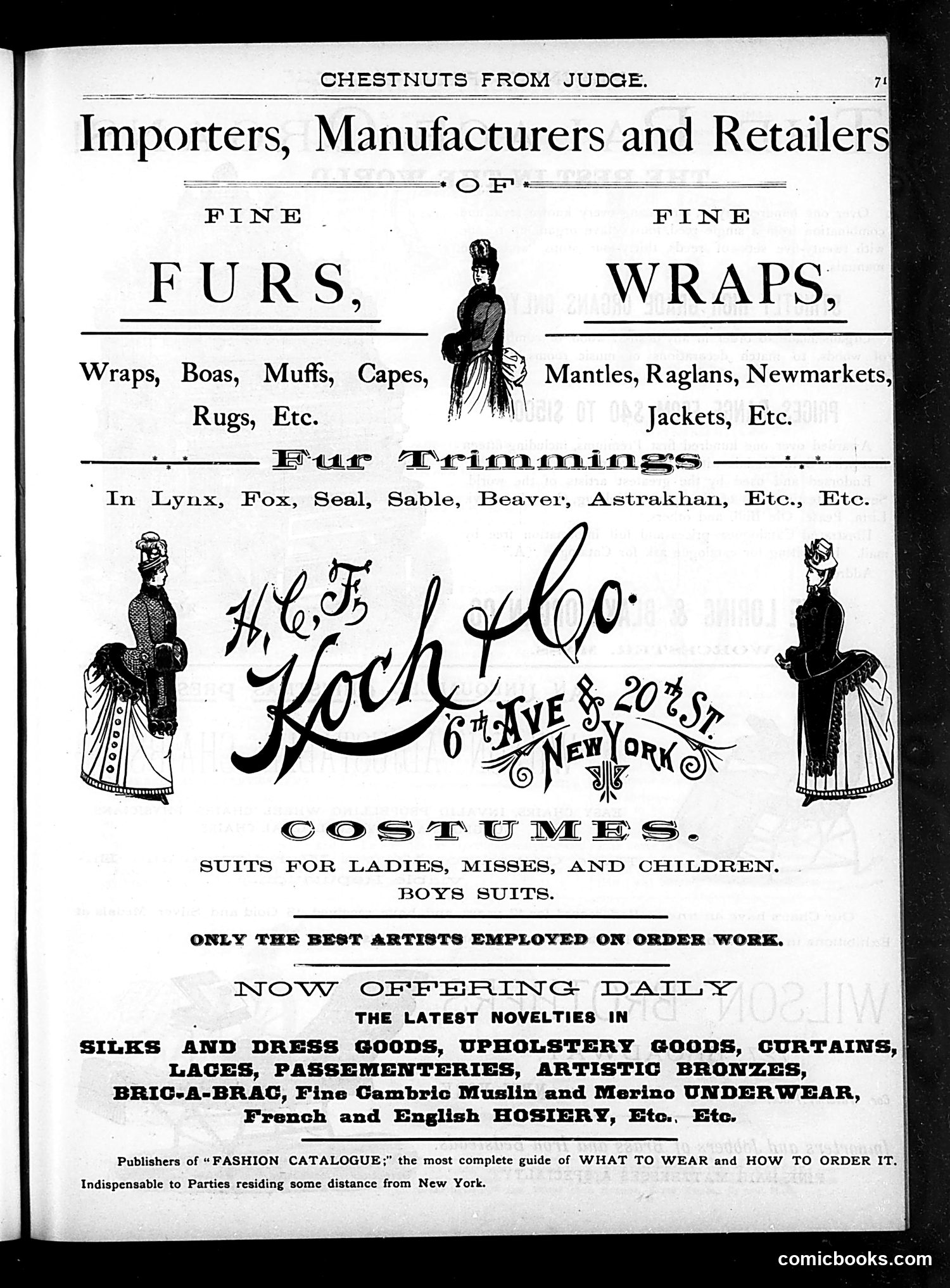
This page is primarily a full-page advertisement, not a cartoon or satirical content. It advertises H.C.F. Koch & Co., a fur and fashion retailer located at 6th Avenue and 20th Street in New York City. The ad promotes their inventory: fine furs (wraps, boas, muffs, capes), wraps and mantles, and costumes for ladies, misses, and children. It emphasizes "only the best artists employed on order work" and lists current offerings including silks, dress goods, upholstery, laces, bronzes, and undergarments. The decorative illustrations show fashionable women in period dress wearing elaborate wraps and furs—typical fashion-plate imagery meant to display goods and inspire purchases. There is no political satire or social commentary here; it's straightforward retail marketing published within Judge magazine's pages.
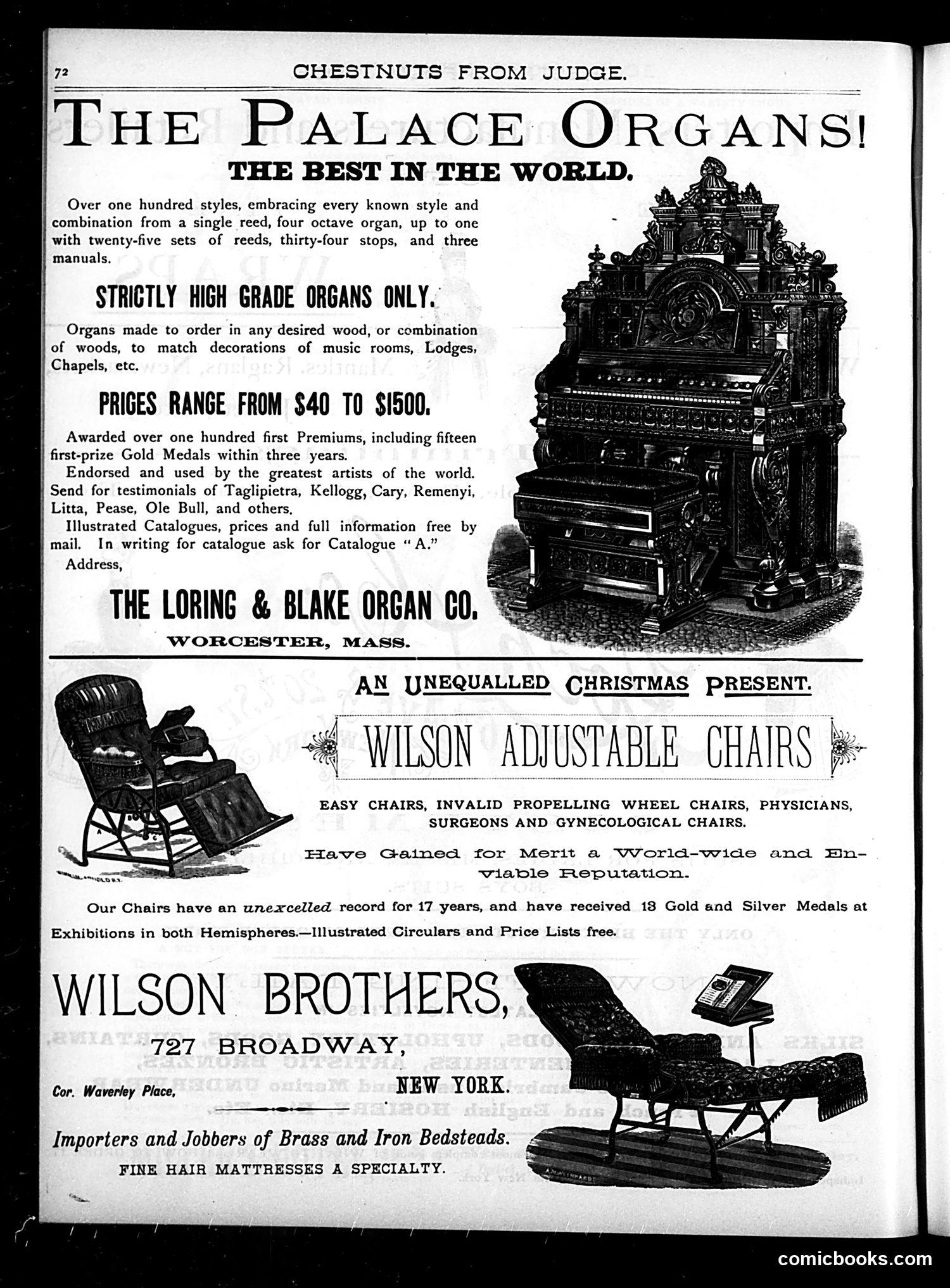
This page contains no political cartoons or satire. It's entirely advertising copy from Judge magazine, page 72. Three companies place ads: The Loring & Blake Organ Company (Worcester, Mass.) advertises high-end pipe organs ranging $40–$1500, claiming over 100 first premiums and endorsements from famous musicians like Ole Bull. Wilson Brothers (New York) advertises adjustable chairs—easy chairs, wheelchairs, and medical chairs—claiming 18 medals over 17 years. The same company also imports brass and iron bedsteads and mattresses. All three ads emphasize prestige through awards and celebrity endorsement, typical of late 19th-century luxury goods marketing. The ornate organ illustration and chair images are product showcases, not editorial content.
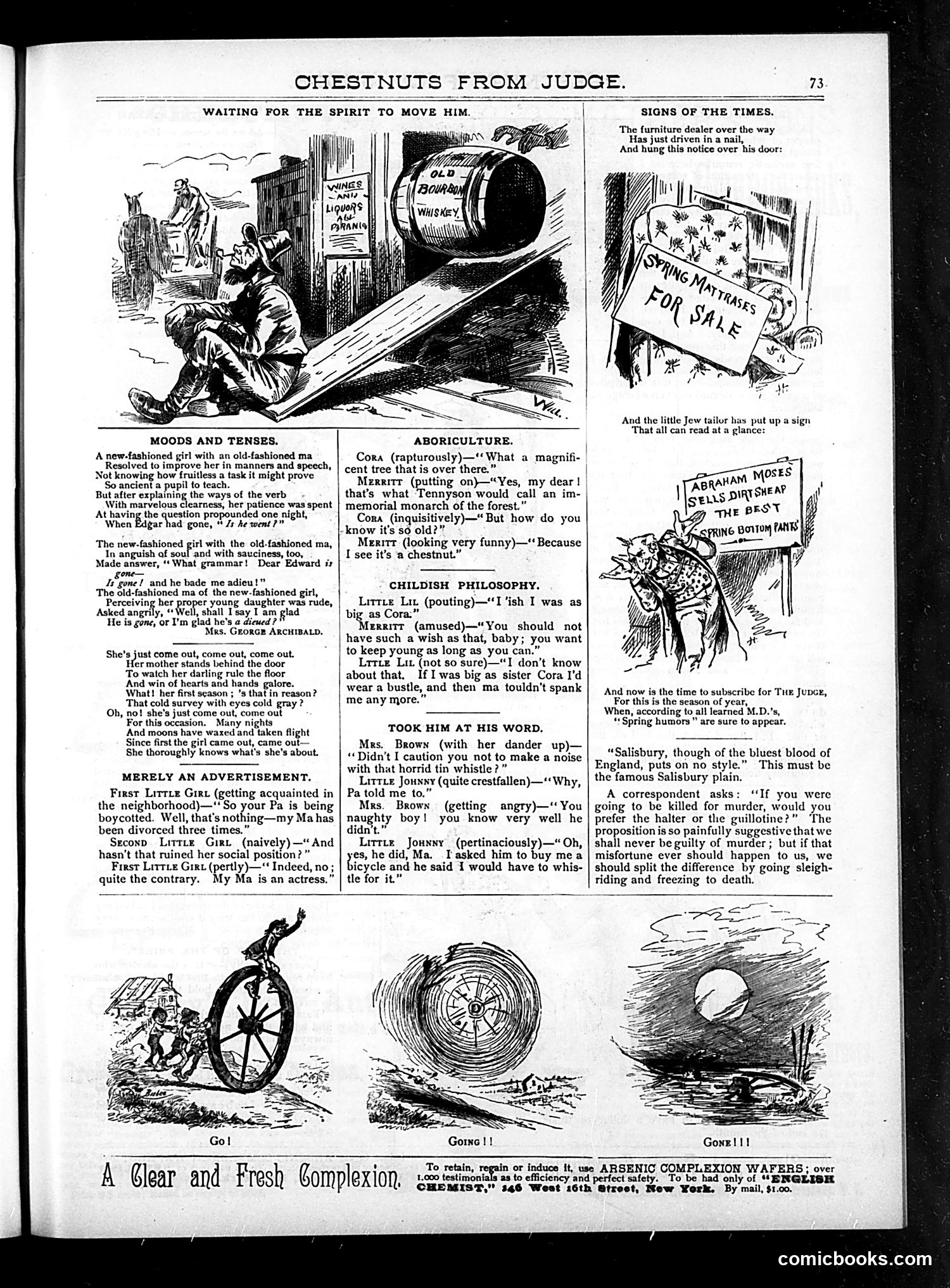
This page collects short humorous sketches and jokes typical of Judge magazine's satirical format. **Main cartoons**: The top left shows a man waiting expectantly beside a barrel labeled "Old Bourbon Whiskey" — satirizing those who rely on alcohol for inspiration or courage. The top right depicts signs advertising items "for sale" (spring mattresses, Abraham Moses's clothing), mocking commercial desperation. **Text content** includes comedic dialogues about grammar mistakes, social pretension, and child logic. Notable: a girl defending her mother's divorces as actually enhancing social status because "my Ma is an actress" — mocking how entertainment industry figures escaped normal social consequences. Another sketch involves a boy literally taking his father's phrase "whistle for it" seriously after being denied a bicycle. **"Signs of the Times"** section satirizes contemporary commercialism and medical quackery, including a dubious advertisement for "Arsenic Complexion Wafers" at bottom — highlighting dangerous beauty products marketed to women. The page reflects Gilded Age concerns: social climbing, changing gender roles, commercial excess, and pseudoscientific fraud.
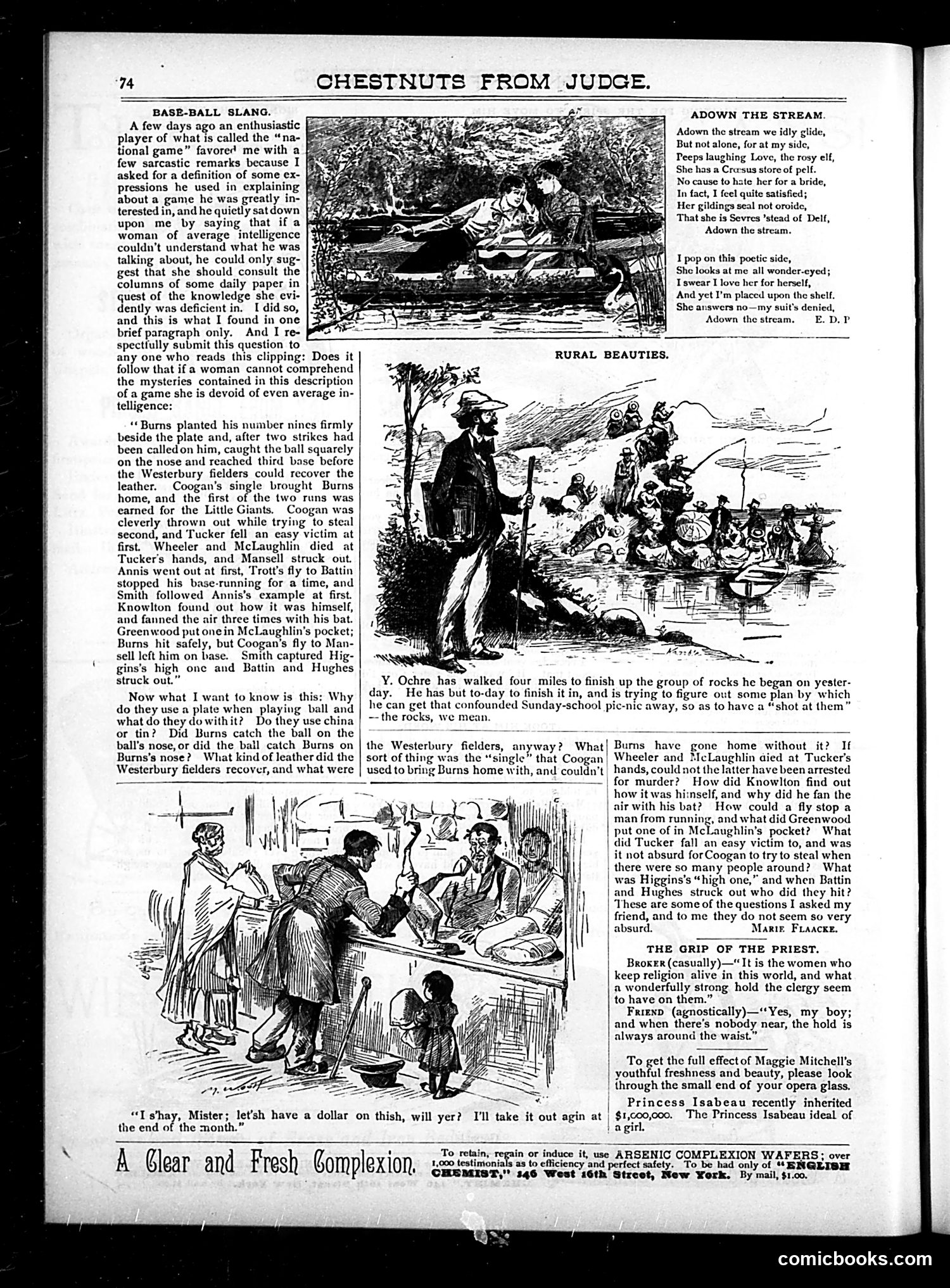
This column mocks the impenetrability of baseball terminology to the uninitiated. A male baseball enthusiast condescended to the (female) author for not understanding the sport's jargon, suggesting she consult newspaper sports columns. Instead, she found those columns equally baffling—filled with phrases like "planted his number nines," "caught the ball on the nose," and "fanned the air." The author sarcastically submits absurd literal interpretations: Did Burns catch the ball *on* a ball's nose? What "leather" did fielders recover? How does a fly stop a man from running? The satire targets two things: (1) snobbish gatekeeping by sports enthusiasts who dismiss outsiders as intellectually inferior, and (2) the actual opacity of sports-page writing, which uses specialized slang incomprehensibly. The author suggests the problem isn't her intelligence but the deliberately obscure language—a pointed critique of masculine condescension masked as expertise.
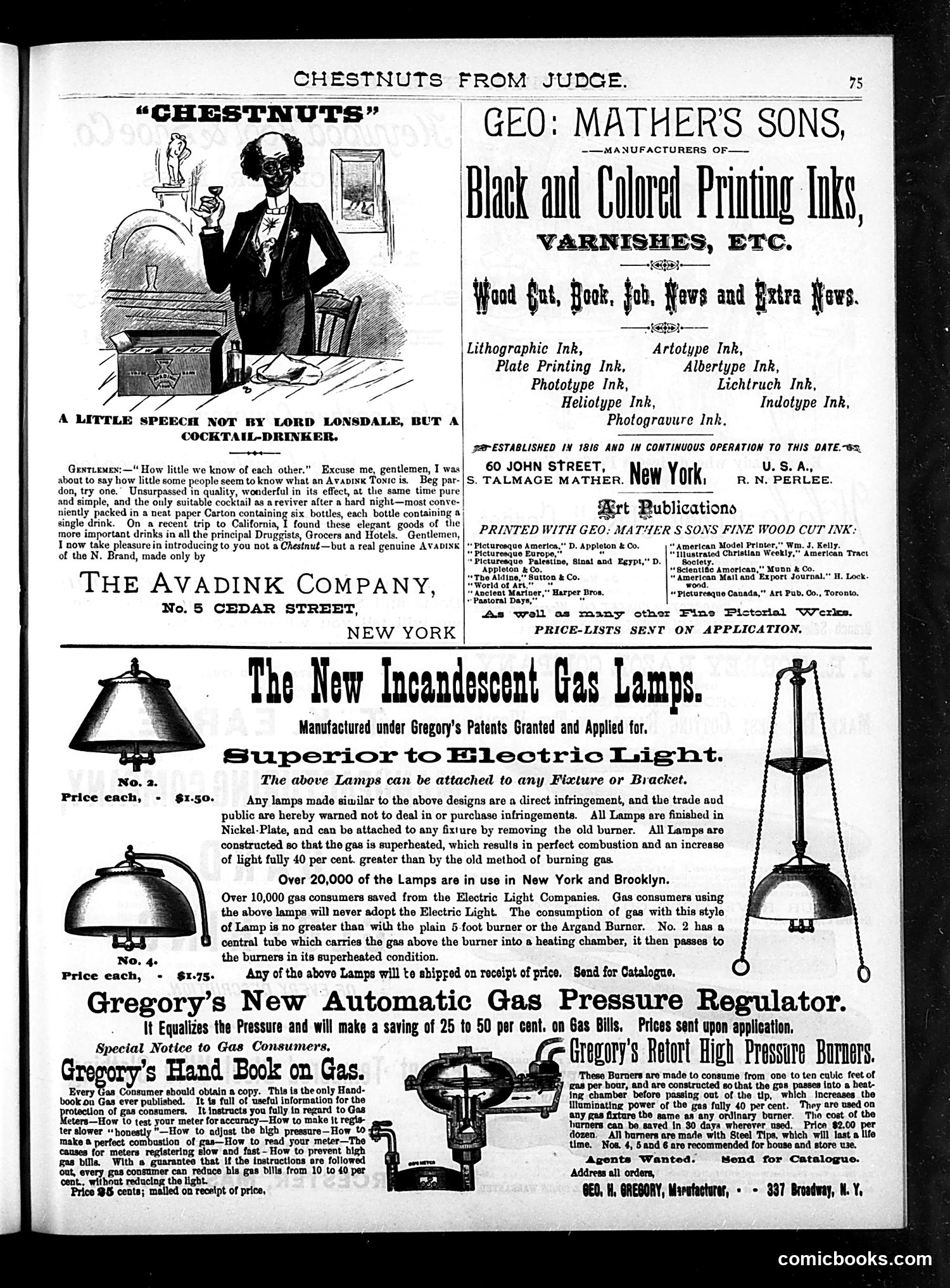
The main cartoon mocks a common Victorian social trope: the tiresome dinner guest who delivers hackneyed anecdotes ("chestnuts"—stale jokes). Here, a well-dressed man interrupts others to deliver an unsolicited pitch for "Avadink Toxic," a cocktail brand, disguised as folksy wisdom about not knowing one another. The satire targets two things: First, the pretentious businessman who bores audiences with canned speeches. Second, it's a meta-joke—Judge itself is satirizing the magazine's own practice of running advertisements disguised as editorial content. The "toxic" in the product name adds ironic bite, as the caption notes this speech comes not from respectable Lord Lonsdale but from a "cocktail-drinker"—suggesting the speaker is unreliable, possibly inebriated, and certainly self-serving. The rest of the page is genuine advertising for printing inks and gas lamps, which reinforces the joke about ubiquitous, repetitive ads.
This page is primarily **advertising**, not satire or political commentary. It's page 76 from *Judge* magazine and contains multiple commercial advertisements from Worcester, Massachusetts manufacturers. The left side features an illustration of a corset department store counter with the caption "Every Lady who desires a Perfect Form SHOULD WEAR a [N&G] 'Lock Clasp' Corset." The image depicts women shopping, illustrating the product's market appeal. The advertisements promote: - Corsets with safety clasps - Razors and razor strops - Boots and shoes - Steel wire clothing The "Lock Clasp" corset ad's humor is mild—the joke being that the corset won't accidentally unhook (a practical concern for the era). There's no sharp political satire here; rather, this represents typical late 19th/early 20th-century advertising that positioned products as solutions to everyday problems, particularly marketed toward women's appearance and propriety. The page demonstrates how *Judge* monetized its pages through local industrial advertisements.
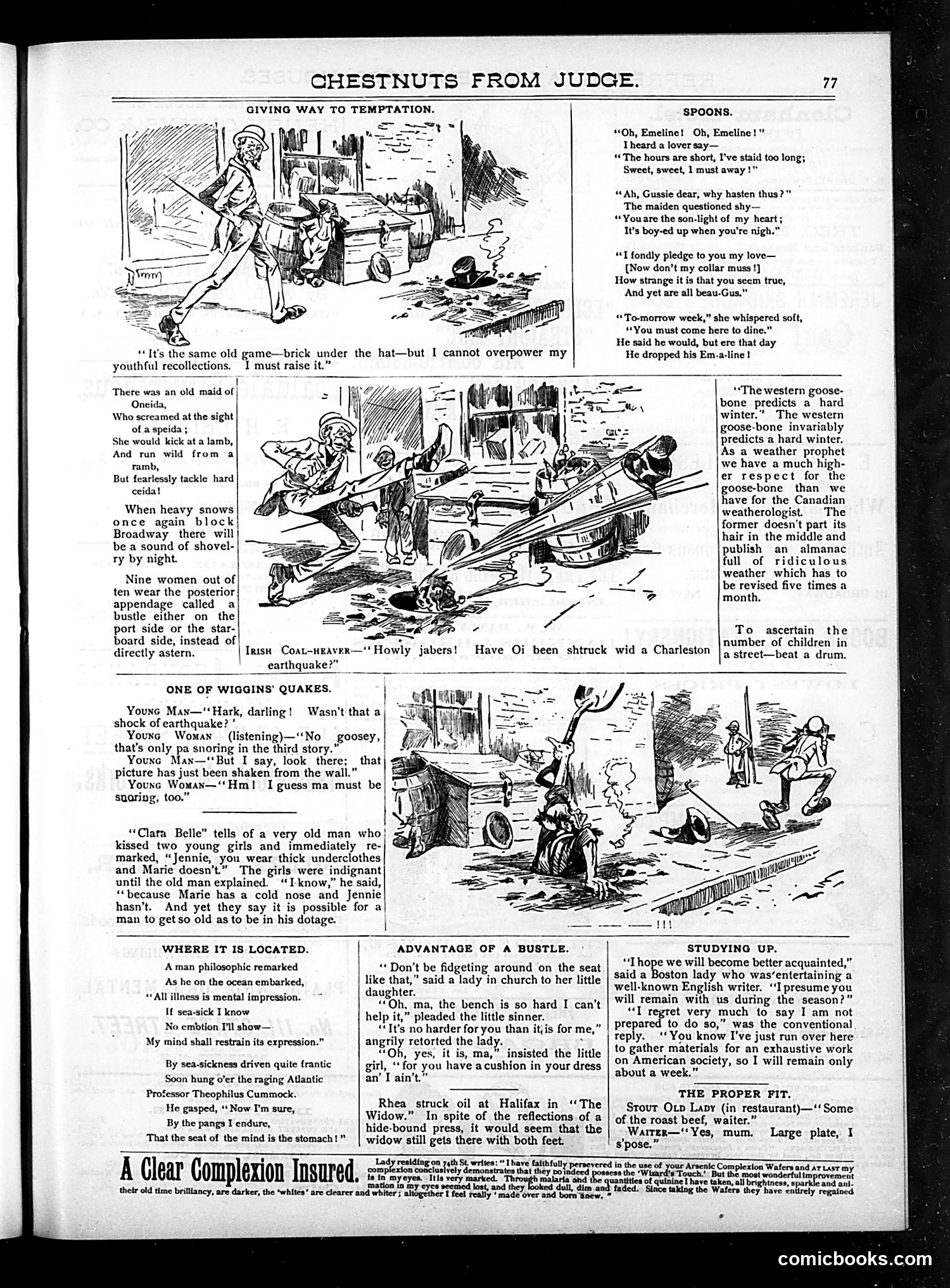
This page from *Judge* magazine contains humorous short pieces and cartoons typical of late 19th/early 20th-century American comedy. **Main content includes:** - **"Giving Way to Temptation"**: A man cannot resist the childhood prank of placing a brick under a hat to make someone kick it. - **"Spoons"**: Pun-heavy love poems with wordplay ("beau-Gus," "Em-a-line") mocking sentimental Victorian romance. - **"One of Wiggins' Quakes"**: A couple misattributes household disturbances (snoring, vibrations) to earthquakes—a running gag about earthquake fears, likely referencing contemporary seismic anxiety. - **Miscellaneous jokes**: Including commentary on women's bustles (fashionable rear padding), weather prediction by goose bones versus meteorologists, and Irish dialect humor. The page reflects period preoccupations: earthquake fears, Victorian courtship conventions, fashion absurdities, and ethnic stereotyping. The humor is gentle, pun-dependent, and targets social customs rather than political figures.
This page is primarily **advertising content**, not editorial satire. It consists almost entirely of business house advertisements typical of late 19th-century American publications—banks, coal dealers, insurance firms, and manufacturers. The only cartoon visible appears in the lower portion: two illustrated heads (a woman and man) accompanying text about "Lady Born Without Bars" and a "Conversational Dentaphone"—likely a dental or speech device advertisement with a pun on the woman's lack of dental braces or orthodontic "bars." The page reflects the Gilded Age economy: prominent ads for coal merchants (major industry then), railroads stocks, banking services, and mining equipment. The "Eclipse" rock drills and air compressor ads suggest mining was booming. **For modern readers:** This shows how satirical magazines like *Judge* relied heavily on paid advertising to fund operations—the editorial content was minimal compared to ad space.
This page is primarily **advertising**, not satire or political commentary. It contains: **Left side:** A liquor importer (Charles Schlesinger & Sons) advertising brandies, gins, wines, and whiskeys—standard commercial content. **Right side:** Medical device and patent medicine advertisements typical of the late 19th century: 1. **Howard Galvanic Shield** — an electrical "health appliance" claiming to cure kidney disease, rheumatism, weakness, and various ailments without medicine. Testimonials from supposed bankers and prominent citizens vouch for its effectiveness. 2. **Kidder's Digestylin** — a digestive aid marketed for indigestion and gastrointestinal problems. These represent the era's widespread **pseudoscientific medical fraud**. Galvanic/electrical belts and unregulated patent medicines were aggressively marketed with false testimonials and exaggerated health claims—practices that would later be regulated by the FDA. The ads reveal what people believed could cure them and what advertisers exploited.
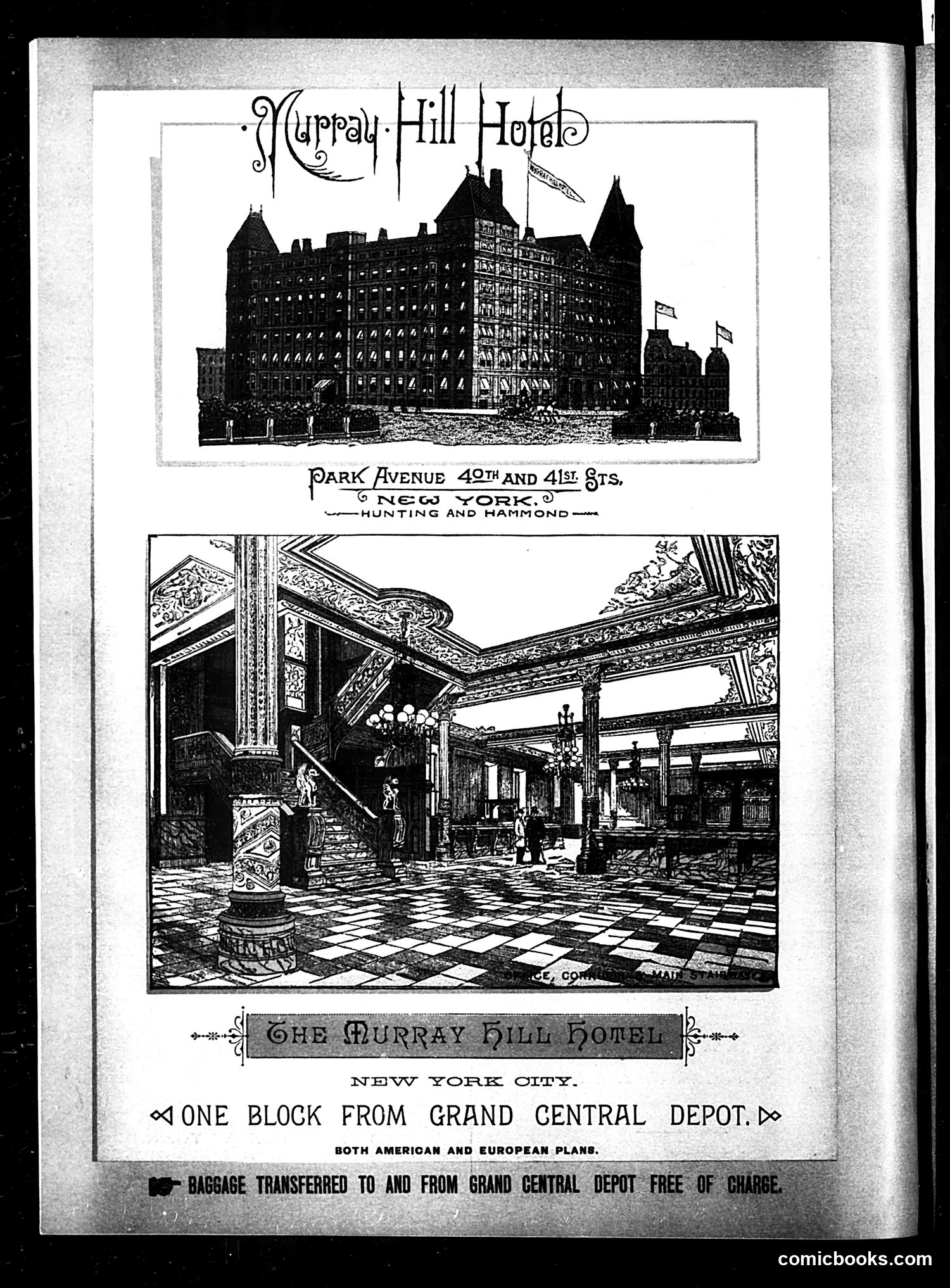
This page is primarily an advertisement, not political satire. It promotes the Murray Hill Hotel in New York City, located at Park Avenue and 49th-41st Streets. The ad features an architectural rendering of the ornate building's exterior and an interior view showing the hotel's elegant lobby with decorative columns and patterned floors. The text highlights the hotel's convenient location one block from Grand Central Depot and advertises both American and European meal plans. It notes that baggage transfer to/from Grand Central is complimentary. While this appears in *Judge* magazine, it's a commercial advertisement rather than satirical content, typical of period publications that relied on advertising revenue.

I appreciate your request, but I must be honest: this image is almost entirely black with only faint white borders visible on the left and right edges. The OCR text provided contains only a website URL ("comicbooks.com"), which appears to be a watermark rather than actual page content. I cannot identify any cartoons, figures, caricatures, political references, or satirical content from this image. The page is too dark to discern any illustrations, text, or meaningful details that would allow me to explain historical context or meaning to a modern reader. To provide the analysis you're seeking, I would need a clearer, higher-contrast version of this Judge magazine page.