
Judge, 1888 · page 26 of 87
Judge — 1888 — page 26: what you’re looking at
What you’re looking at
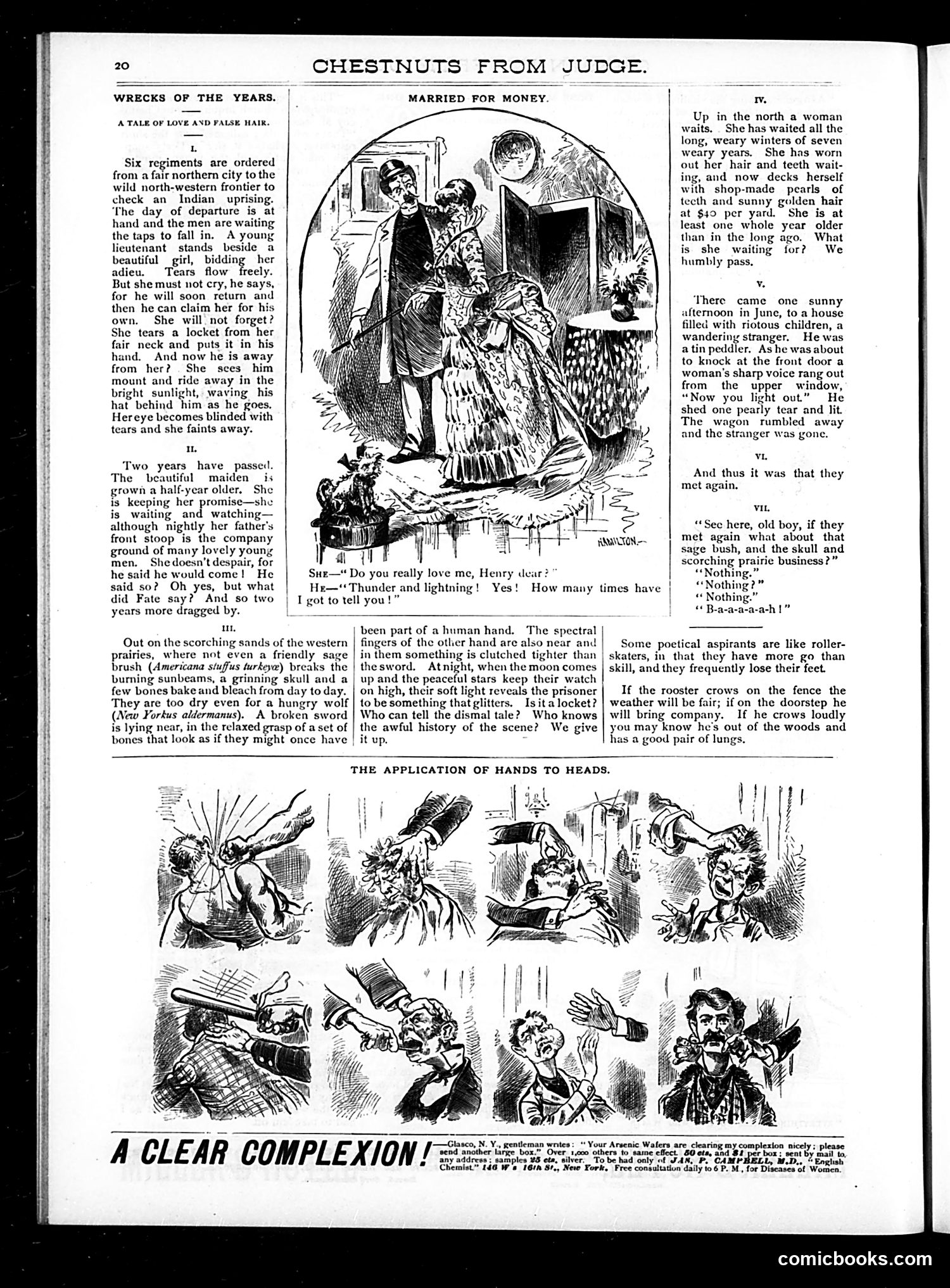
This page contains a serialized melodramatic story titled "Wrecks of the Years: A Tale of Love and False Hair," presented as satire of sentimental Victorian romance literature. **The Story's Plot:** A young officer leaves a woman with a locket, promising to return. She waits seven years faithfully, but he never comes back. The narrative then cuts to a skeleton on a prairie holding the locket, implying he died. Meanwhile, the woman—now aged and her real hair worn out—buys artificial hair and teeth ($40/yard) to maintain her appearance. A tin peddler visits her house but is chased away. The story ends ambiguously: "And thus it was that they met again"—leaving unclear whether this is romantic reunion or tragic irony. **The Satire:** Judge mocks the genre of overwrought love stories with impossible coincidences and artificial resolutions. The absurd details (her teeth literally worn out from waiting, purchased replacement parts, the unexplained skeleton) emphasize how ridiculous such narratives are. The final section spoofs poetical writing generally. The lower section, "The Application of Hands to Heads," appears to be humorous illustrations of various head-striking gestures.
📄 Transcribed text from this page (OCR, searchable)
Machine-transcribed from the original scan — historical spelling and the odd misread are preserved.
20 WRECKS OF THE YEARS. A TALE OF LOVE AND FALSE HAIR. L Six regiments are ordered from a fair northern city to the wild north-western frontier to check an Indian uprising. ‘The day of departure is at hand and the men are waiting the taps to fall in. A young lieutenant stands beside a beautiful girl, bidding her adieu. Tears flow freely. But she must not cry, he says, for he will soon return and then he can claim her for his own. She will not forget? She tears a locket from her fair neck and puts it in his hand. And now he is away from her? She sees. him mount and ride away in the bright sunlight, waving his hat behind him as he goes. Hereye becomes blinded with tears and she faints away. Two years have passed. The beautiful maiden is grown a half-year older, She is keeping her promise—she is waiting and watching— although nightly her father's front stoop is the company ground of many lovely young men. Shedoesn't despair, for he said he would come! He said so? Oh yes, but what | did Fate say? And so two years more dragged by. He— MARRIED FOR MONEY. “Do you really love me, Henry dear? “Thunder and lightning ! j 1 got to tell you!” Yes! mm Out on the scorching sands of the western prairies, where not even a friendly sage brush (Americana stuffus turkey) breaks the burning sunbeams, a grinning skull and a few bones bake and bleach from day to day. They are too dry even for a hungry wolf (Naw Yorkus aldermanus). A broken sword is lying near, in the relaxed grasp of a set of bones that look as if they might once have been part of a human hand. The spectral fingers of the other hand are also near and in them something is clutched tighter than thesword. Atnight, when the moon comes up and the peaceful stars keep their watch on high, their soft light reveals the prisoner to be something that glitters. Is ita locket? Who can tell the dismal tale? Who knows the awful history of the scene? We give it up. How many times have | CHESTNUTS FROM JUDGE. Up in the north a woman waits. She has waited all the long, weary winters of seven weary years. She has worn out her hair and teeth wait- ing, and now decks herself with shop-made pearls of tecth and sunny golden hair at $40 per yard. She is at least one whole year older than in the long ago. What is she waiting for? We humbly pass. v. ‘There came one sunny afternoon in June, to a house filled with riotous children, a wandering stranger. He was atin peddier, As he was about to knock at the front door a woman's sharp voice rang out from the upper window, “Now you light out” He shed one pearly tear and lit. The wagon rumbled away and the stranger was gone. VL. And thus it was that they met again. vit. “Sec here, old boy, if they met again what about that sage bush, and the skull and scorching prairie business?” “Nothing.” “Nothing?” “ Nothin, ach 1” Some poetical aspirants are like roller- skaters, in that they have more go than skill, and they frequently lose their feet. If the rooster crows on the fence the weather will be fair; ifn the doorstep he will bring company. If he crows loudly you may know he’s out of the woods and has a good pair of lungs. THE APPLICATION OF HANDS TO HEADS. A CLEAR COMPLEXION! send ani |—Glasco, N. Y., gentleman writes: ~ Your Arsenic Walers are clea tex late bon.” Over, soo others to ame eicce BO st: thd Bi per how sent By samples ¥S eta, silver To be bad only of SAR, Pe CAM W 2 161A B1., New York, Free consultation daily to P. M., for Diacases ot please 50 ots, and $4 box sent by it HELL, AD. teat iy comicbooks.com