
Judge, 1888 · page 56 of 87
Judge — 1888 — page 56: what you’re looking at
What you’re looking at
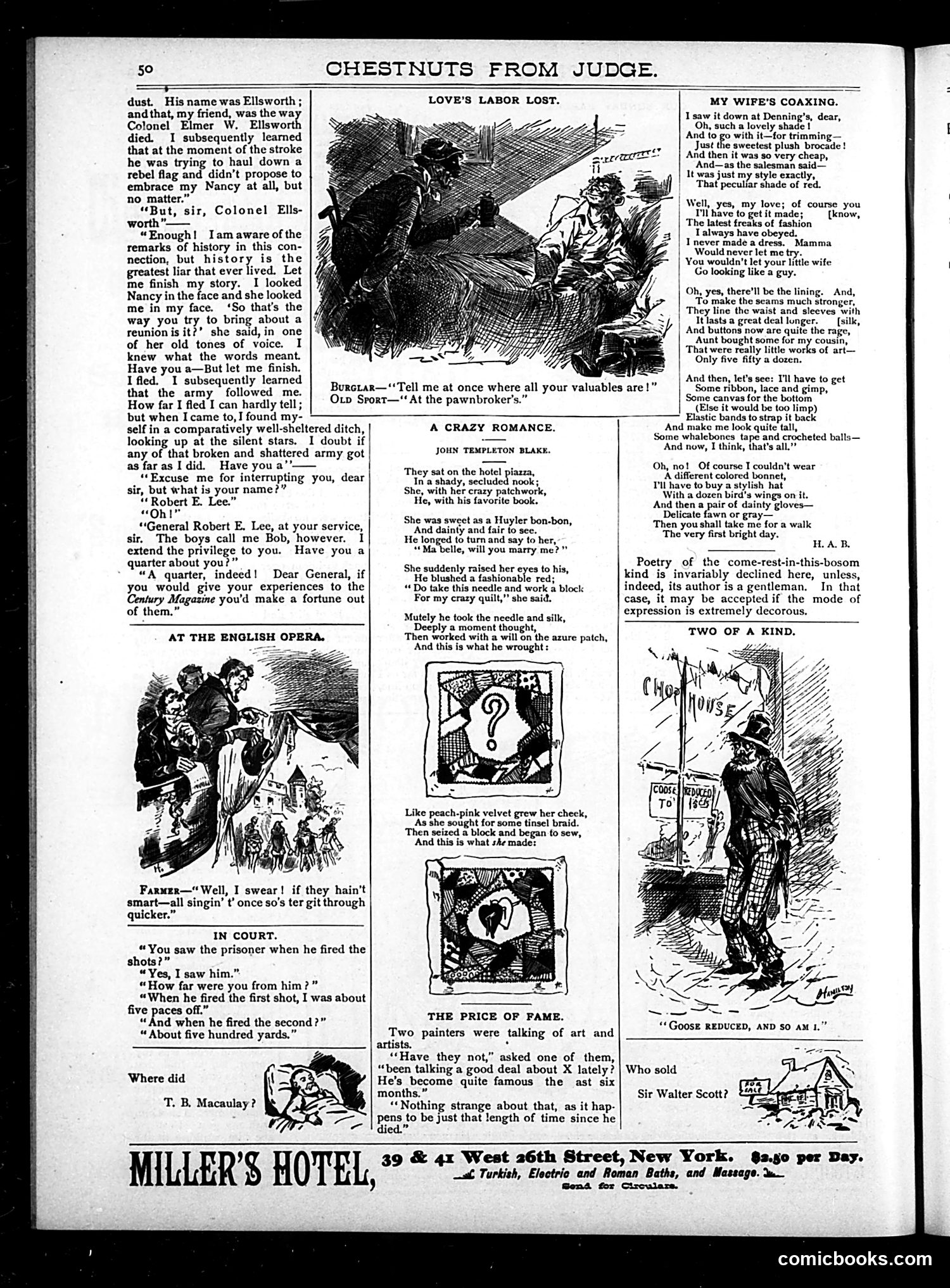
This page contains several humorous short pieces typical of 1880s-90s satirical magazines: **Main narrative**: A Civil War anecdote allegedly told by General Robert E. Lee, involving Colonel Ellsworth's death and a romantic entanglement. The joke relies on the reader recognizing Lee as a famous Confederate general reduced to begging quarters—deflating his historical stature for comedy. **"Love's Labor Lost"**: A burglar discovers his victim has already pawned everything—commentary on urban poverty or financial desperation. **"My Wife's Coaxing"**: A husband capitulates to his wife's endless shopping demands for dress materials and trim, satirizing women's consumer habits and marital dynamics. **"A Crazy Romance"**: Plays on the period's "crazy quilt" fad, using patchwork as a metaphor for romantic confusion. **Other sketches**: Include courtroom humor about witness testimony distance and commentary on opera singers' speed. The advertisements emphasize Miller's Hotel amenities. Throughout, the humor targets recognizable social types and domestic situations familiar to Judge's middle-class readers.
📄 Transcribed text from this page (OCR, searchable)
Machine-transcribed from the original scan — historical spelling and the odd misread are preserved.
5° CHESTNUTS FROM JUDGE. ¥ dust. His name was Ellsworth ; and that, my friend, was the wa: Colonel Elmer W. Ellswoi died. I subsequently learned that at the moment of the stroke he was trying to haul down a rebel flag and didn’t propose to embrace my Nancy at all, but no matter.” “But, sir, Colonel Ells- worth ”— “Enough! Iam aware of the remarks of history in this con- nection, but history is the greatest liar that ever lived. Let me finish my story. I looked Nancy in the face and she looked me in my face. ‘So that's the way you try to bring about a reunion is it?’ she said, in one of her old tones of voice. I knew what the words meant. Have you a—But let me finish. I fied. I subsequently learned that the army followed me. How far I fled I can hardly tell ; LOVE’S LABOR LOST. Burctrar—‘‘Tell me at once where all your valuables are!” Op Srort—‘‘ At the pawnbroker’s. MY WIFE'S COAXING. I saw it down at Denning’s, dear, Oh, such a lovely shade ! And fo go with it—for trimming — Just the sweetest plush brocade! And then it was so very cheap, ‘And—as the salesman said— It was just my style exactly, That peculiar shade of red. | Well, yes, my love; of course you Tilhave to get it made; [know, ‘The latest freaks of fashion Talways have obeyed. Inever made adress. Mamma Would never let me try. You wouldn't let your Ii Go looking like a guy. Oh, yes, there'll be the lining. And, To make the seams much stronger, They line the waist and sleeves with It lasts a great deal longer. [silk, And buttons now are quite the rage, ‘Aunt bought some for my cousin, That were really little works of art— Only five fifty a dozen. And then, let's see: I'll have to get Some ribbon, lace and gimp, Some canvas for the bottom (Else it would be too limp) but when I came to, found my- self in a comparatively well-sheltered ditch, looking up at the silent stars. I doubt if any of that broken and shattered army got as faras I did. Have you a’’—— “Excuse me for interrupting you, dear sir, but what is your name?” “Robert E. Lee.” “Oh!” “General Robert E. Lee, at your service, sir. The boys call me Bob, however. I extend the privilege to you. Have you a quarter about you?” “A quarter, indeed! Dear General, if you would give your experiences to the Century Magazine you'd make a fortune out of them.” AT THE ENGLISH OPERA. Faruer— Well, I swear! if they hain't smart—all singin’ t’ once so’s ter git through quicker.” IN COURT. “You saw the prisoner when he fired the shots?” “Yes, I saw him.” “ How far were you from him?” “When he fired the first shot, I was about five paces off.” “And when he fired the second?” “ About five hundred yards,” Where did T. B, Macaulay? MILLER’S HOTEL, A CRAZY ROMANCE. JOHN TEMPLETON BLAKE. ‘They sat on the hotel piazza, Ina shady, secluded nook; She, with her crazy patchwork, He, with his favorite book. She was sweet as a Huyler bon-bon, And dainty and fair to see. He longed to turn and say to her, “ le, will you marry me?" She suddenly raised her eyes to his, He blushed a fashionable red; “Do take this needle and work a block For my crazy quilt,” she said. Mutely he took the needle and silk, Deeply a moment thought, Then worked with a will on the azure patch, And this is what he wrought : Like peach-pink velvet grew her cheek, As she sought for some tinsel braid. Then seized a block and began to sew, ‘And this is what she made: THE PRICE OF FAME. Two painters were talking of art and artists. 9 “‘Have they not,” asked one of them, “been talking a good deal about X lately? He’s become quite famous the ast six months.” “Nothing strange about that, as it hap- pens to be just that length of time since he died.” Elastic bands to strap it back And make me look quite tall, Some whalebones tape and crocheted balls— And now, I think, that's all.” Oh, no! Of course I couldn't wear A different colored bonnet, T'll have to buy a stylish hat With a dozen bird's wings on it. And then a pair of dainty gloves— Delicate fawn or gray— ‘Then you shall take me for a walk The very first bright day. HA. B, Poetry of the come-rest-in-this-bosom kind is invariably declined here, unless, indeed, its author is a gentleman. In that case, it may be accepted if the mode of expression is extremely decorous. TWO OF A KIND. Who sold Sir Walter Scott? 39 & 4x West 26th Street, New York. §3.s0 per Day. —at Turkish, Electric and Roman Baths, and Massage. w Bend for Circulars. comicbooks.com