
Judge, 1888 · page 36 of 87
Judge — 1888 — page 36: what you’re looking at
What you’re looking at
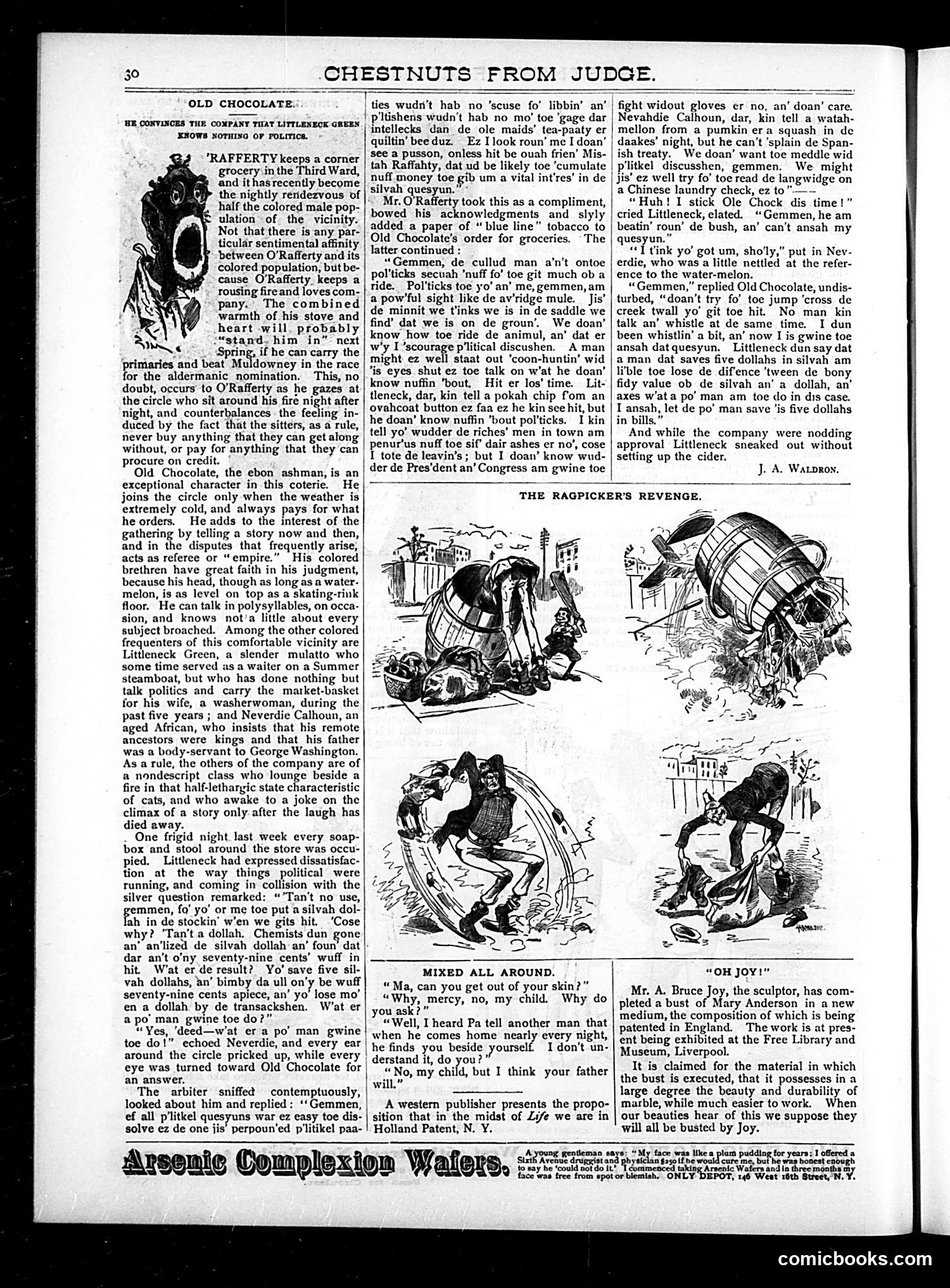
This page satirizes late-19th-century American politics through dialogue set in an Irish grocer's store frequented by Black men. The main narrative, "Old Chocolate," presents a debate about the **silver question**—a major political issue of the 1890s (likely the free silver debate preceding the 1896 election). The satire works on multiple levels: It mocks how politicians exploit working-class voters by courting them (O'Rafferty seeks their support for aldermanic nomination despite not genuinely valuing them). More pointedly, it ridicules Littleneck Green's political engagement—he parrots political arguments without understanding economic reality, suggesting working-class Black voters were seen as easily manipulated. The character "Old Chocolate" is positioned as the voice of reason, suggesting even those typically excluded from serious political discourse possess superior judgment. The heavy dialect throughout both mocks and paradoxically dignifies these characters' intelligence. This represents Judge magazine's typical approach: using caricature and ethnic stereotyping to make ostensibly progressive political points about corruption and exploitation.
📄 Transcribed text from this page (OCR, searchable)
Machine-transcribed from the original scan — historical spelling and the odd misread are preserved.
CHESTNUTS FROM JUDGE. a = = OLD CHOCOLATE. WE CONVINCES THE COMPANY TIAT LITTLENECK GREEN KNOWS NOTHING OF POLITICS. "RAFFERTY keeps a corner gtocery:in the Third Ward, and it hasrecently become the nightly rendezvous of half the colored male pop- ulation of the vicinity. Not that there is any par- ticular sentimental affinity between O’Rafferty and its colored population, but be- cause O’Rafferty keeps a rousing fireand loves com- pany. The combined warmth of his stove and heart will. probably i“stand. him in” next £ ‘Spring, if he can carry the ‘primaries and beat Muldowney in the race for the aldermanic nomination. This, no doubt, occurs’ to O’Rafferty as he at the circle who sit around his fire night after night, and counterbalances the feeling in- duced by the fact that the sitters, as a rule, never buy anything that they can get along without, or pay for anything that they can procure on credit. Old Chocolate, the ebon ashman, is an exceptional character in this coterie, He joins the circle only when the weather is extremely cold, and always pays for what he orders, He adds to the interest of the gathering by telling a story now and then, and in the disputes that frequently arise, acts as referee or “empire.” His colored brethren have great faith in his judgment, because his head, though as long as a water- melon, is as level on top as a skating-rink floor. ‘He can talk in polysyllables, on occa- sion, and knows not’a little about every subject broached. Among the other colored frequenters of this comfortable vicinity are Littleneck Green, a slender mulatto who some time served as a waiter on a Summer steamboat, but who has done nothing but talk politics and carry the market-basket for his wife, a washerwoman, during the past five years ; and Neverdie Calhoun, an aged African, who insists that his remote ancestors were kings and that his father was a body-servant to George Washington. As a tule, the others of the company are of a nondescript class who lounge beside a fire in that half-lethargic state characteristic of cats, and who awake to a joke on the climax of a story only after the laugh has died away. _ One frigid night last week ev box and stool around the store pied. Littleneck had expressed dissatisfac- tion at the way things political were running, and coming in collision with the silver question remarked: “’Tan't no use, femmen, fa’ yo’ or me toe put a silvah dol- fah in de stockin wien we gits hit. ’Cose why? 'Tan’ta dollah, Chemists dun gone an’ an'lized de silvah dollah an’ foun’ dat dar an’t o’ny seventy-nine cents’ wuff in hit. W’at er de result? Yo’ save five sil- vah dollahs, an’ bimby da ull on'y be wuff seventy-nine cents apiece, an’ yo’ lose mo’ en a dollah by de transackshen. W’at er a po’ man gwine toe do?” “Yes, ‘deed—w’at er a po’ man gwine toe do!” echoed Neverdie, and every ear | around the circle pricked up, while every | eye was turned toward Old Chocolate for | an answer. The arbiter sniffed contemptuously, | looked about him and replied: ‘‘Gemmen, | ef all p'litkel quesyuns war ez easy toe dis- solve ez de one jis’ perpoun’ed p'litikel paa- ties wudn't hab no ’scuse fo’ libbin’ an’ | intellecks dan de ole maids’ tea-paaty er quiltin’ bee duz. Ez I look roun’ me I doan’ see a pusson, onless hit be ouah frien’ Mis- | tah Raffahty, dat ud be likely toe ’cumulate | nuff money toe gib um a vital int’res’ in de silvah quesyun.” ” Mr. O'Rafferty took this as a compliment, bowed his acknowledgments and slyly added a paper of “blue line” tobacco to Old Chocolate’s order for groceries. ‘The latter continued : “Gemmen, de cullud man a’n’t ontoe pol'ticks sectiah ‘nuff fo’ toe git much ob a ride. Pol'ticks toe yo’ an’ me, gemmen, am a pow’ful sight like de av’ridge mule. _Jis’ de minnit we t'inks we is in de saddle we find’ dat we is on de groun’. We doan’ know how toe ride de animul, an’ dat er w’y I ’scourage p'litical discushen. A man might ez well staat out ‘coon-huntin’ wid ‘is eyes shut ez toe talk on w’at he doan’ know nuffin "bout, Hit er los’ time. _Lit- tleneck, dar, kin tell a pokah chip fom an ovahcoat button ez faa ez he kin see hit, but he doan’ know nuffin ’bout pol’ticks. I kin tell yo’ wudder de riches’ men in town am penur'us nuff toe sif’ dair ashes er no’, cose I tote de leavin’s ; but I doan’ know wud- der de Pres’dent an’ Congress am gwine toe | cried Littleneck, elated. fight widout gloves er no, an’ doan’ care. | p'ltishens wudn't hab no mo’ toe ‘gage dar | Nevahdie Calhoun, dar, kin tell a watah- mellon from a pumkin’er a squash in de daakes’ night, but he can’t 'splain de Span- ish treaty. We doan’ want toe meddle wid pllitkel discusshen, gemmen. We. might jis’ ez well try fo’ toe read de langwidge on a Chinese laundry check, ez to”. “Huh! 1 stick Ole Chock dis time!” “Gemmen, he am beatin’ roun’ de bush, an’ can’t ansah my quesyun. “1 tink yo’ got um, sho'ly,” put in Nev- erdie, who was a little nettled at the refer- ence to the water-melon. “Gemmen,” replied Old Chocolate, undis- turbed, “doan’t try fo’ toe jump ’cross de creek twall yo’ git toe hit. No man kin talk an’ whistle at de same time. I dun been whistlin’ a bit, an’ now I is gwine toe ansah dat quesyun. Littleneck dun say dat aman dat saves five dollahs in silvah am litble toe lose de difence tween de bony fidy value ob de silvah an’ a dollah, an’ axes w’at a po’ man am toe do in dis case. T ansah, let de po’ man save ‘is five dollahs in bills.” And while the company were nodding approval Littleneck sneaked out without setting up the cider. J. A. Warpron, THE RAGPICKER’S REVENGE. MIXED ALL AROUND. “ Ma, can you get out of your skin?” “Why, mercy, no, my child. Why do ou ask?” “Well, I heard Pa tell another man that when he comes home nearly every night, he finds you beside yoursel I don’t un- derstand it, do vou 2” “No, my child, but I think your father will.” A western publisher presents the propo- sition that in the midst of Life we are in Holland Patent, N. Y. “OH JOY!” Mr. A. Bruce Joy, the sculptor, has com- pleted a bust of Mary Anderson in a new medium, the composition of which is being patented in England. The work is at pres- ent being exhibited at the Free Library and Museum, Liverpool. It is claimed for the material in which the bust is executed, that it possesses in a large degree the beauty and durability of marble, while much easier to work. When our beauties hear of this we suppose they will all be busted by Joy. Arsenic Complexion Wafers, A ther Sint® Avenue druggist an to say he ‘could not do it! face was free from spot or blemish. ONLY 2 *My face Uke a pl pad. for years; 1 tere thee reg ree:iret commenced taking Arsenic Wafers and in three months m EPOT, 146 West 16th Street, comicbooks.com