
A complete issue · 69 pages · 1891
Judge — 1891
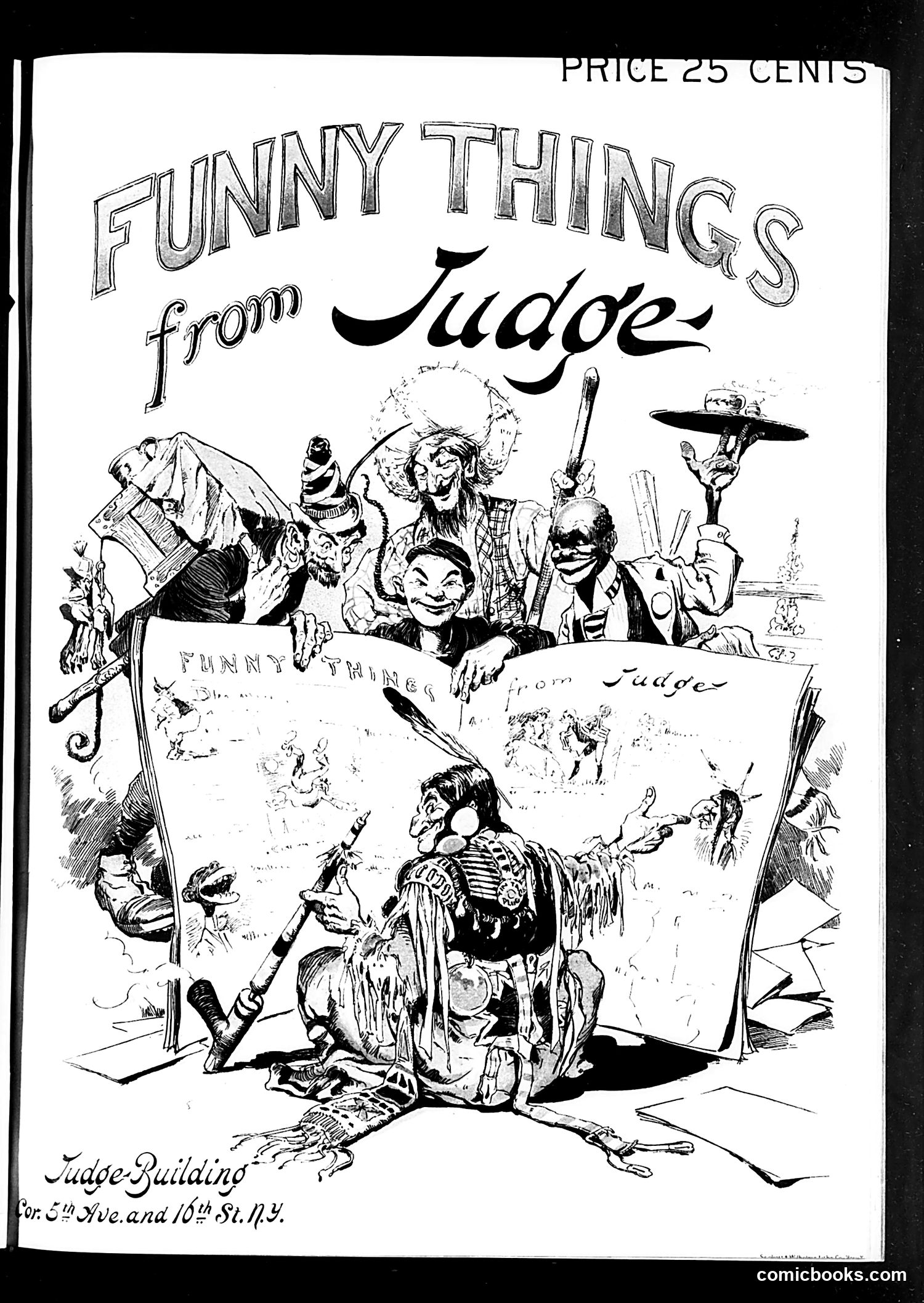
This is a cover for *Judge* magazine's humor collection, priced at 25 cents. The illustration shows various caricatured figures emerging from or surrounding a large book or publication labeled "Funny Things from Judge." The artwork features exaggerated, theatrical characters in period costume—including what appears to be performers in masks and elaborate dress. The specific identities of the caricatured figures are unclear without additional context. However, the composition suggests *Judge* was promoting a collection of its satirical cartoons and jokes, likely targeting contemporary public figures or social types through visual exaggeration typical of the era's cartooning style. The "Judge Building" address (5th Ave. and 16th St., N.Y.) is noted at bottom, indicating this was published by the magazine itself.
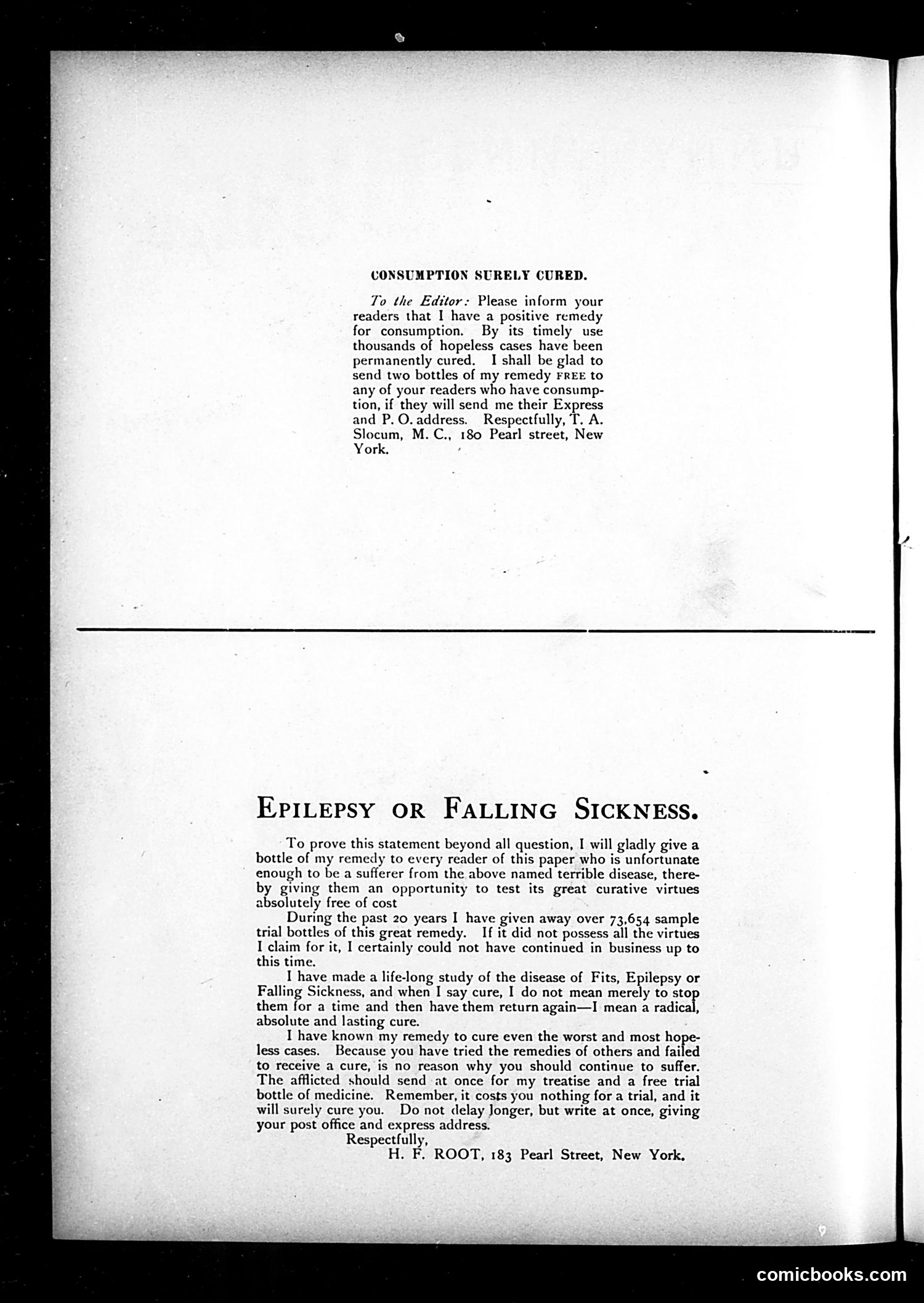
This page contains **no cartoon or satirical content**. Instead, it consists entirely of **patent medicine advertisements** — two separate pitches offering free trial bottles. The first advertisement promises a cure for consumption (tuberculosis) from T.A. Slocum in New York. The second, larger ad from H.F. Root at the same address, claims to cure epilepsy and "falling sickness" through a remedy allegedly distributed over 73,000 times in twenty years. Both ads use identical marketing tactics: promising free trials, claiming miraculous cures, and urging desperate patients to write immediately. This reflects the **unregulated medical fraud** common in early 20th-century America, when Judge magazine apparently accepted dubious pharmaceutical advertising despite its satirical mission. These ads target vulnerable, suffering populations with false medical promises.
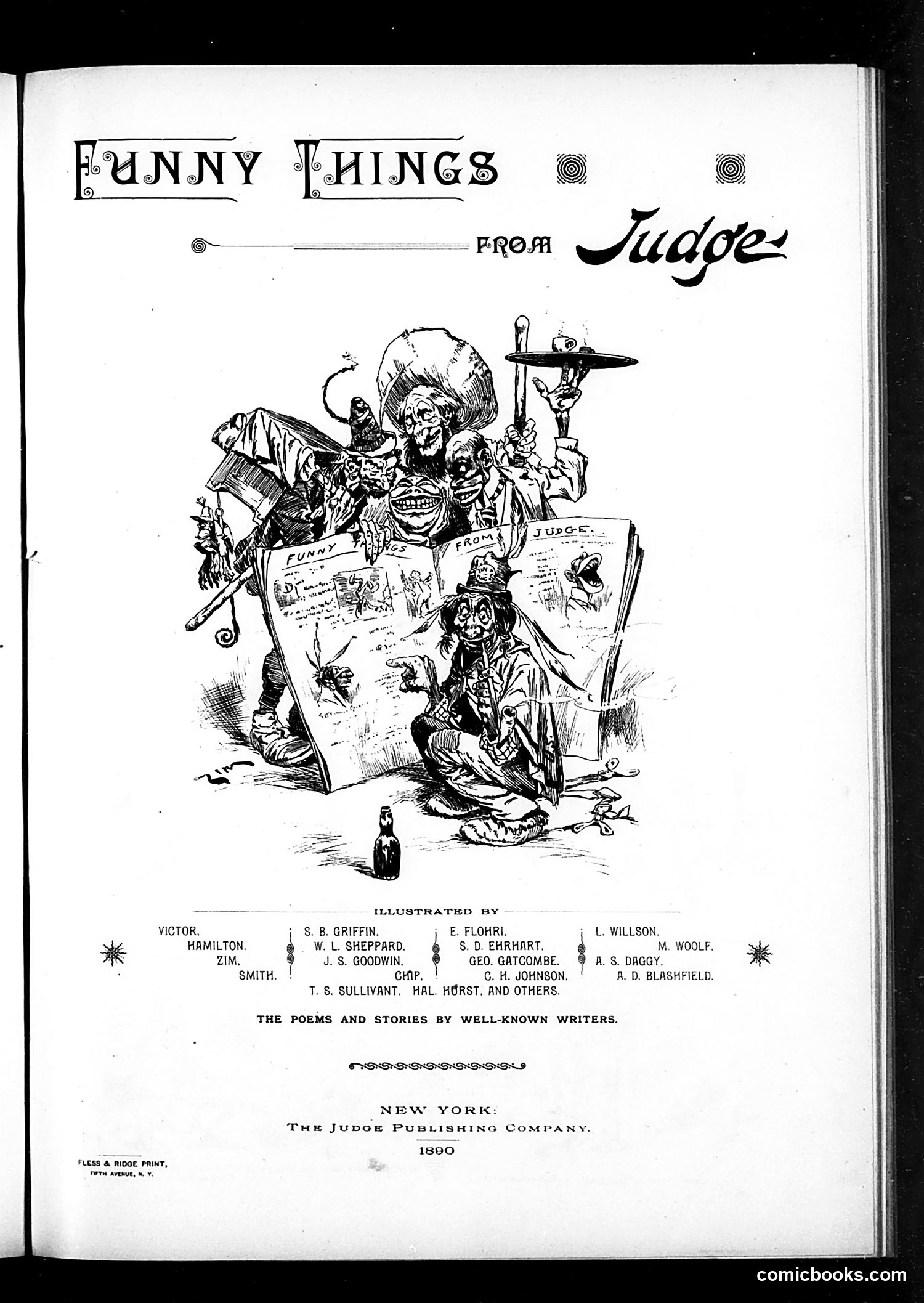
This is a title page for a collection of humorous poems and stories from *Judge* magazine, illustrated by prominent cartoonists of the era including Victor, Hamilton, Zim, and S.B. Griffith. The central illustration depicts grotesque caricatured figures emerging from or surrounding open pages labeled "Funny" and "From Judge." The exaggerated characters—with wild hair, distorted features, and theatrical poses—embody the satirical spirit of the publication itself. One figure holds a serving tray, another appears drunken or disoriented. The imagery suggests *Judge's* content as chaotic, irreverent comedy meant to satirize contemporary society. The grotesque style was typical of late-19th-century American humor magazines, which employed caricature and exaggeration as primary comedic tools. The specific targets of individual pieces aren't identifiable from this title page alone.
This page from Judge magazine (copyright 1890, per the footer) features a single horizontal illustration showing five cat heads arranged in a row, each emerging from or nestled in decorative bowl-like shapes. The cats display varying expressions and markings. Without additional context or caption text visible on this page, the specific satirical meaning is unclear. The image likely contains political or social commentary typical of Judge's approach, possibly referencing contemporary figures or events through animal caricature—a common Victorian-era satirical technique. However, without identifying labels, article text, or clearer visual indicators, the exact subject and satire cannot be confidently determined. The illustration appears to be decorative artwork rather than a fully-captioned political cartoon.
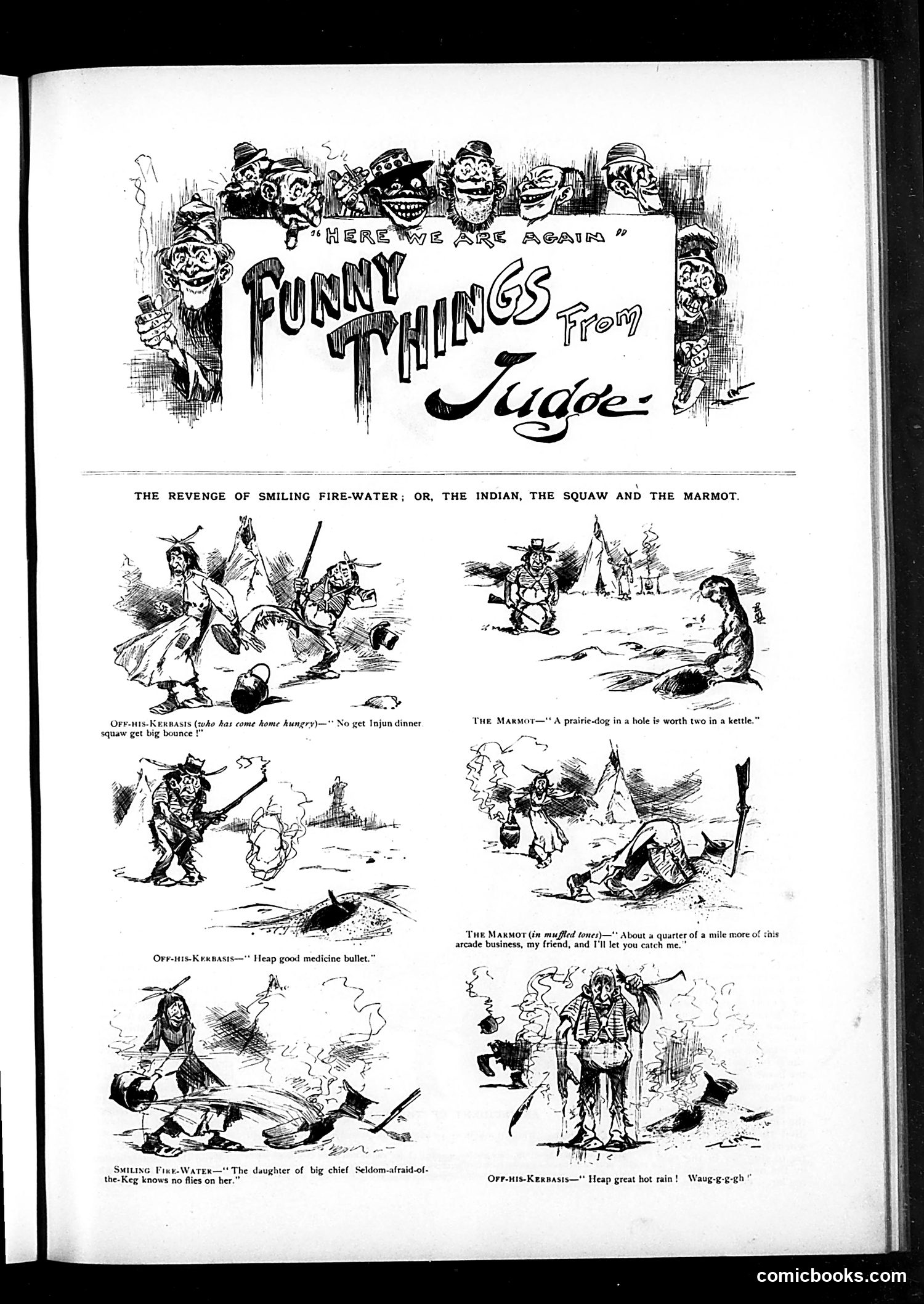
This is a series of six crude racial caricatures mocking Native Americans. The "joke" centers on stereotypical depictions: an Indian brave ("Smiling Fire-Water"), his wife ("the squaw"), and a marmot (prairie dog), with exaggerated features and fractured English dialogue using period racist conventions ("Heap," "Waug-g-g-gh"). The cartoons present slapstick scenarios—the Indian going hungry, physical mishaps with animals and fire—presented as humorous. The title's reference to "fire-water" (alcohol) invokes a common racist trope about Native American drinking. Judge magazine was known for satirical commentary, but this page demonstrates how 19th-century American humor frequently relied on dehumanizing caricatures of Native peoples as punchlines. The "satire" here targets Indigenous people themselves rather than critiquing injustice or power structures. This reflects the casual, pervasive racism normalized in period popular media.
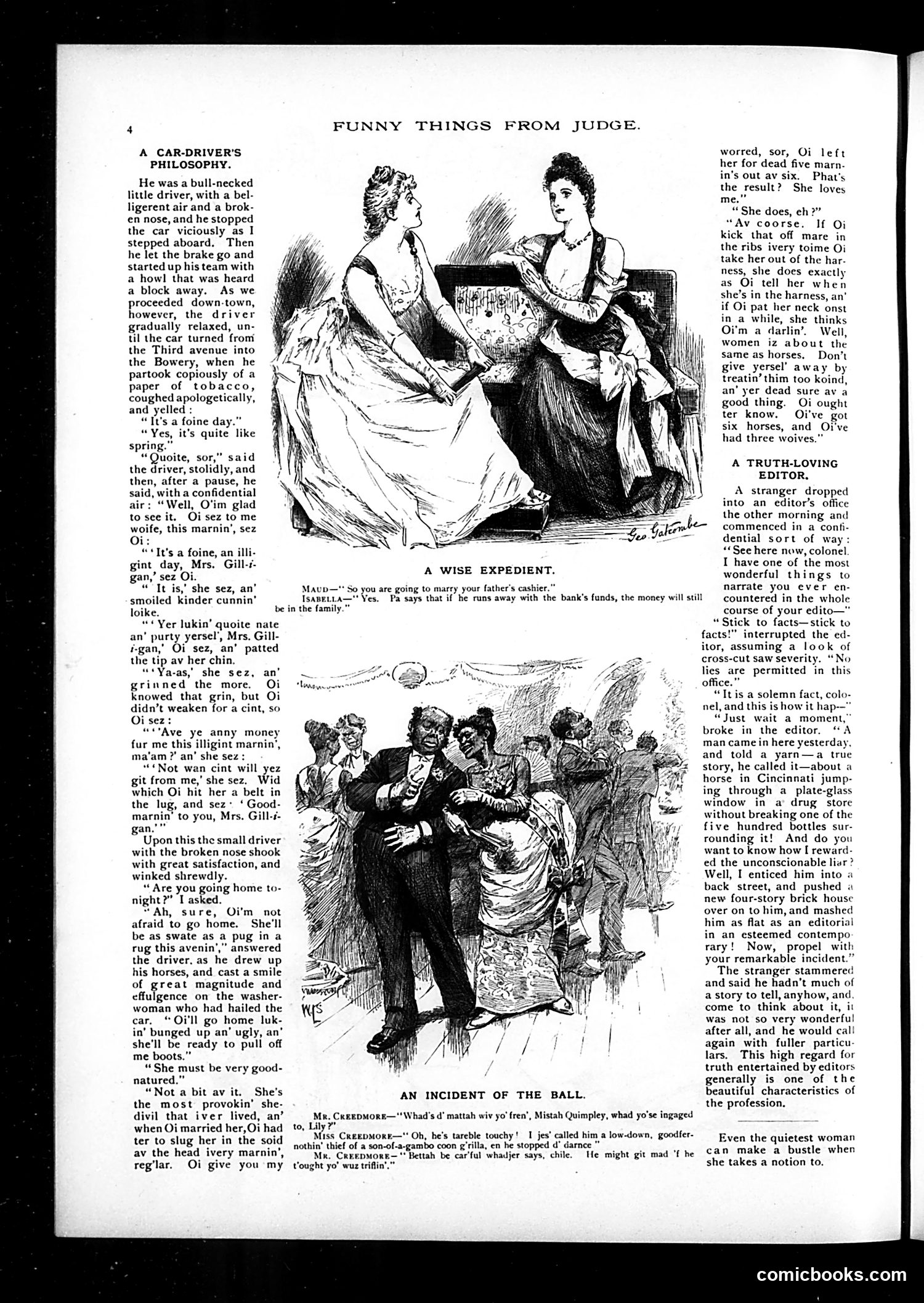
This page from *Judge* magazine contains three separate humorous pieces reflecting turn-of-the-century Irish-American stereotypes and gender dynamics: **"A Car-Driver's Philosophy"**: An Irish cab driver with exaggerated dialect ("Oi," "foine") describes his relationship with his wife. The "joke" relies on cruel stereotypes—he claims to regularly hit her, yet insists this abuse proves her love and loyalty. The comparison of women to horses he mistreats is presented as folk wisdom. This reflects period attitudes normalizing domestic violence as comedic. **"A Wise Expedient"**: A brief joke about a woman marrying her father's cashier to keep the family money within the family—satirizing financial anxiety and women's limited economic agency. **"An Incident of the Ball"**: A racial dialogue between Black characters using exaggerated dialect, appearing to mock romantic sensitivity. The humor depends on racist caricature and minstrelsy-style speech patterns. All three pieces use ethnic/racial stereotypes as their primary comedic device—reflecting *Judge*'s satirical approach through caricature, now recognized as offensive.
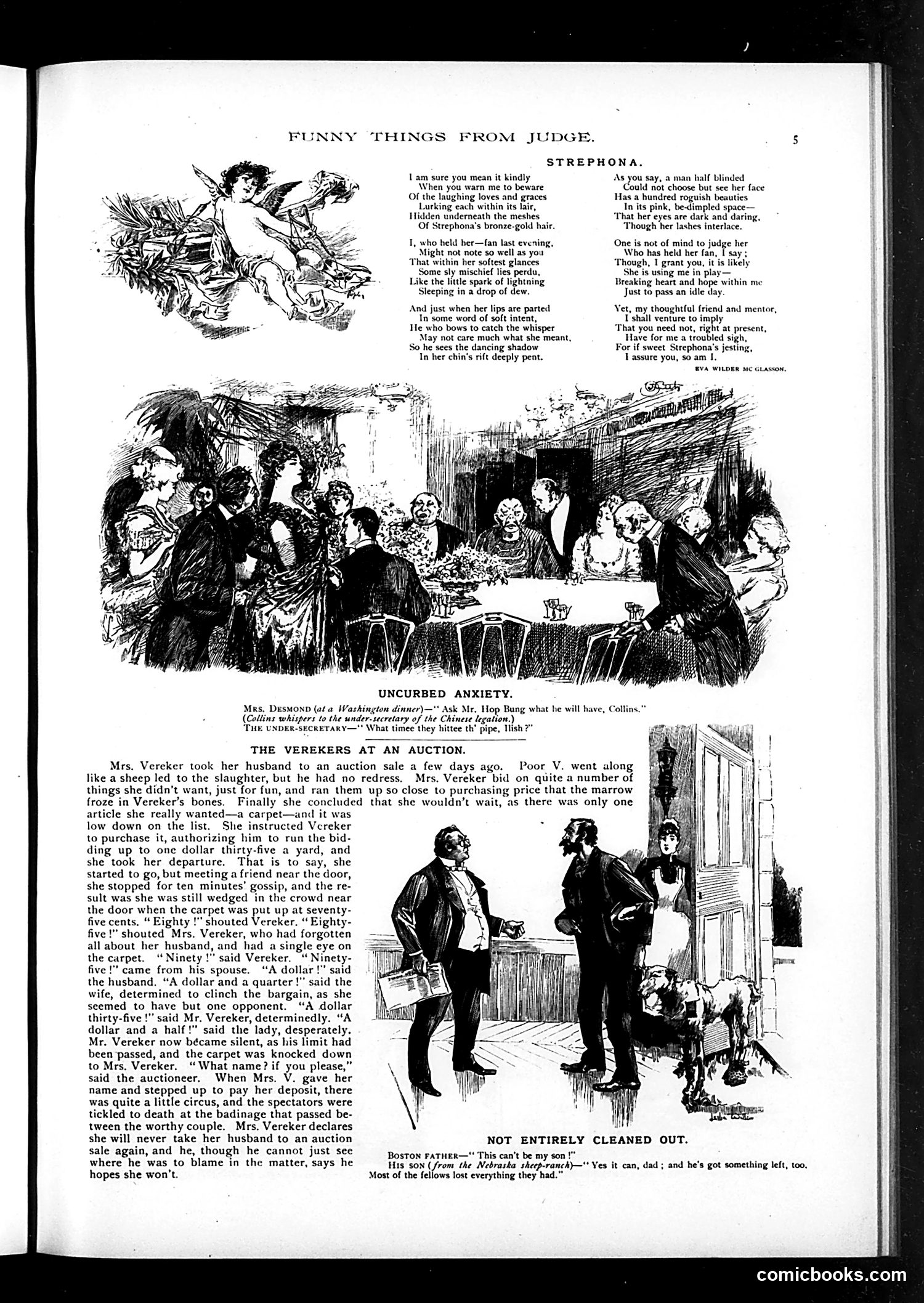
This page contains three satirical pieces from the late 19th/early 20th century: **"Strephona"**: A romantic poem mocking overwrought courtship. The speaker defends his attraction to a woman despite warnings she's manipulative, arguing that if she's toying with him, he's equally unconcerned—satirizing both excessive romantic sentiment and casual male indifference. **"Uncurbed Anxiety"**: A one-liner joke about Washington dinner etiquette. A hostess asks a servant to inquire what a Chinese diplomat wants to eat, but the question gets garbled through intermediaries into asking when he'll smoke opium—poking fun at both linguistic confusion and stereotypes about Chinese immigrants. **"The Verekers at an Auction"**: Depicts a husband and wife inadvertently bidding against each other at an auction. The wife, distracted by gossip, forgets she authorized her husband to bid on a carpet and competes with him, driving up the price. The satire targets marital dynamics and impulsive consumer behavior among the leisure class.
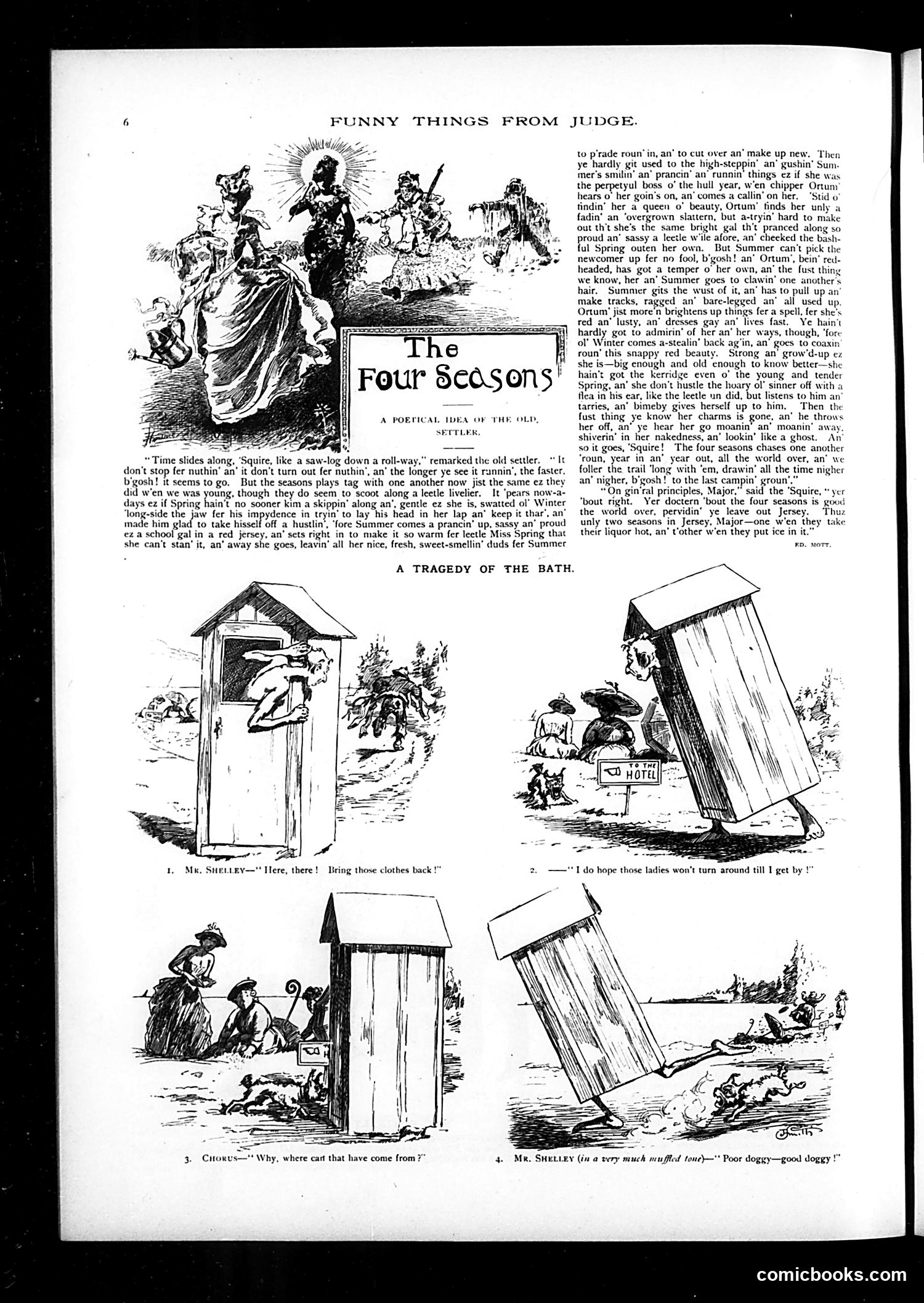
**"The Four Seasons"**: A rustic character (the "old settler") delivers a philosophical monologue comparing seasonal change to human relationships. Spring, Summer, Autumn ("Ortum"), and Winter are personified as lovers pursuing each other cyclically. The crude dialect humor suggests rural wisdom observing life's inevitable cycles—youth (Spring) gives way to vigorous maturity (Summer), fading beauty (Autumn), and decline (Winter). The commentary that Jersey only has two seasons (hot drinks vs. iced drinks) is a regional jab at a neighboring state. **"A Tragedy of the Bath"**: A four-panel comic sequence depicting an outhouse mishap. Mr. Shelley's outdoor toilet tips over while he's inside, spilling its contents. The humor derives from slapstick bathroom embarrassment—a common target of period satire. The final panel shows him resignedly calling the dog "good doggy," suggesting dark acceptance of the disaster. Both pieces exemplify Judge's blend of folk humor, dialect comedy, and genteel bathroom jokes typical of 1890s-era American satirical magazines.
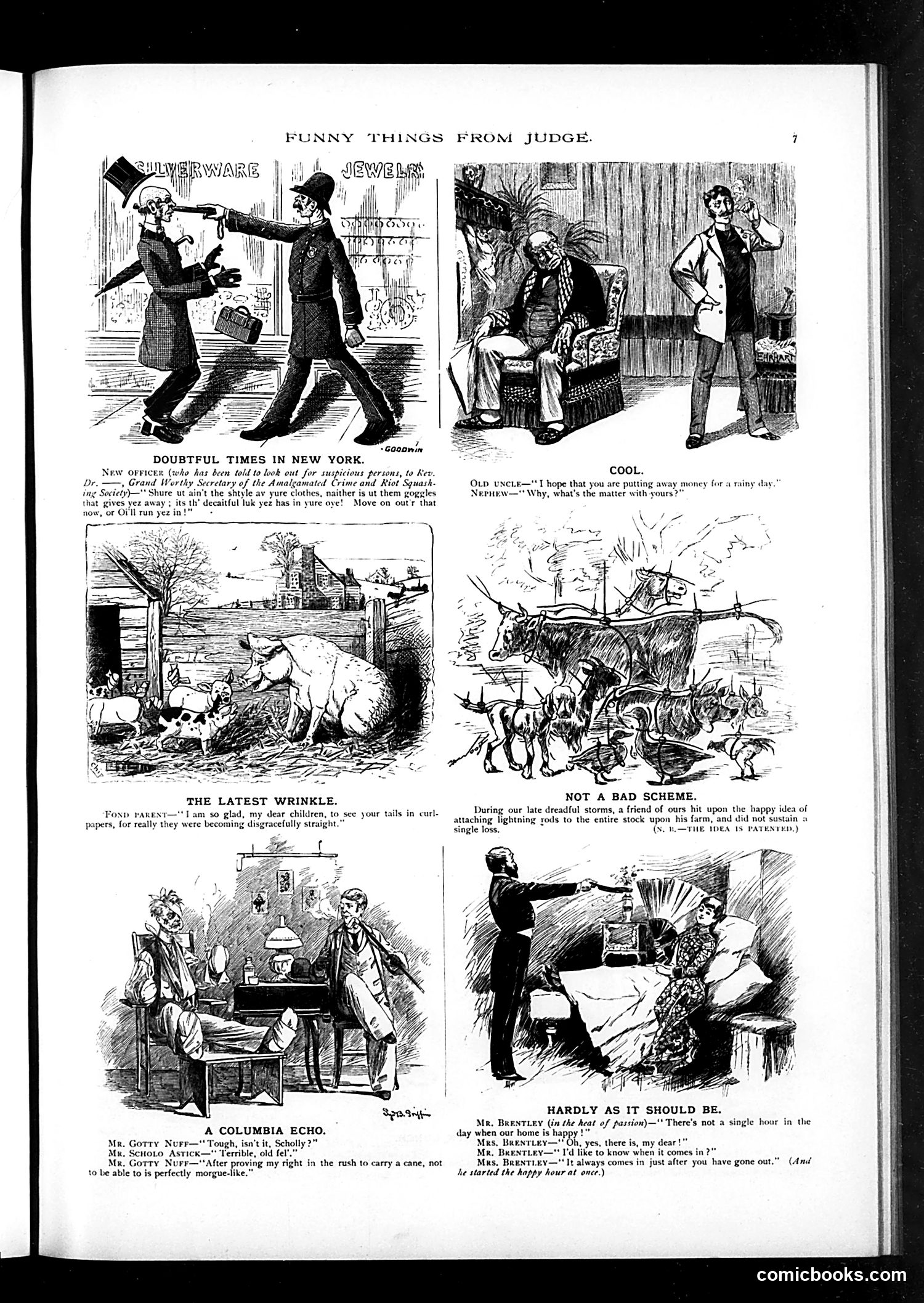
This page collects six separate humorous cartoons from *Judge* magazine satirizing American life: **"Doubtful Times in New York"** mocks the incompetence of police recruited to fight crime—a new officer with an Irish accent can't identify criminals by appearance, only by their "decaitful luk" (suspicious demeanor). **"Cool"** jokes about a nephew's financial anxiety during economic uncertainty. **"The Latest Wrinkle"** depicts a fond father proud his children's tails are curled—likely satirizing vanity or absurd parenting priorities. **"Not a Bad Scheme"** ridicules a farmer's supposedly clever idea of attaching lightning rods to livestock to protect them during storms. **"A Columbia Echo"** references Columbia College (now Columbia University) through mock dialogue about New York social types discussing carrying canes. **"Hardly As It Should Be"** presents domestic marital discord—a husband complains their home is never happy, while the wife reveals the only happy hour is when he's absent. All reflect *Judge's* satirical approach to contemporary American social follies and character types.
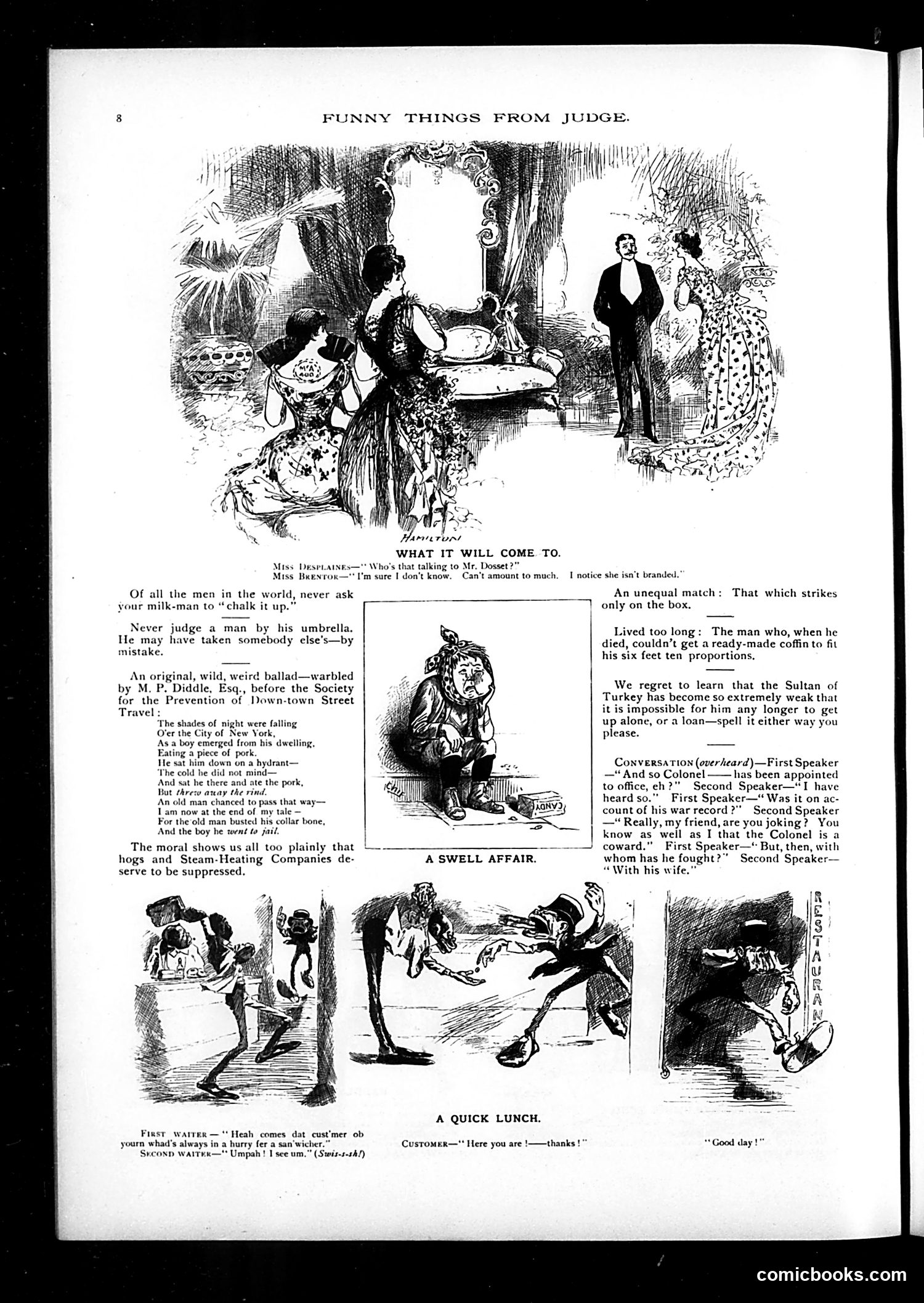
This page from Judge magazine contains multiple short satirical pieces and cartoons typical of late 19th-century American humor: **"What It Will Come To"** depicts anxieties about women's independence—the joke is that an unmarked (unbranded) woman talking to a man is noteworthy and scandalous, suggesting women should be marked like cattle. **Various one-liners** mock everyday absurdities: milkmen extending credit, judging character, and a dark ballad about a boy who causes an old man's injury and goes to jail. **"A Quick Lunch"** shows waiter humor and a tall man too large for standard coffins—dark Victorian comedy about physical extremes. **The final conversation** satirizes military appointments through irony: a cowardly Colonel was promoted, and his only "fighting" is with his wife—mocking both nepotistic patronage and martial discord as domestic comedy. The humor relies on class commentary, physical comedy, and cynicism about institutions typical of Gilded Age satire.
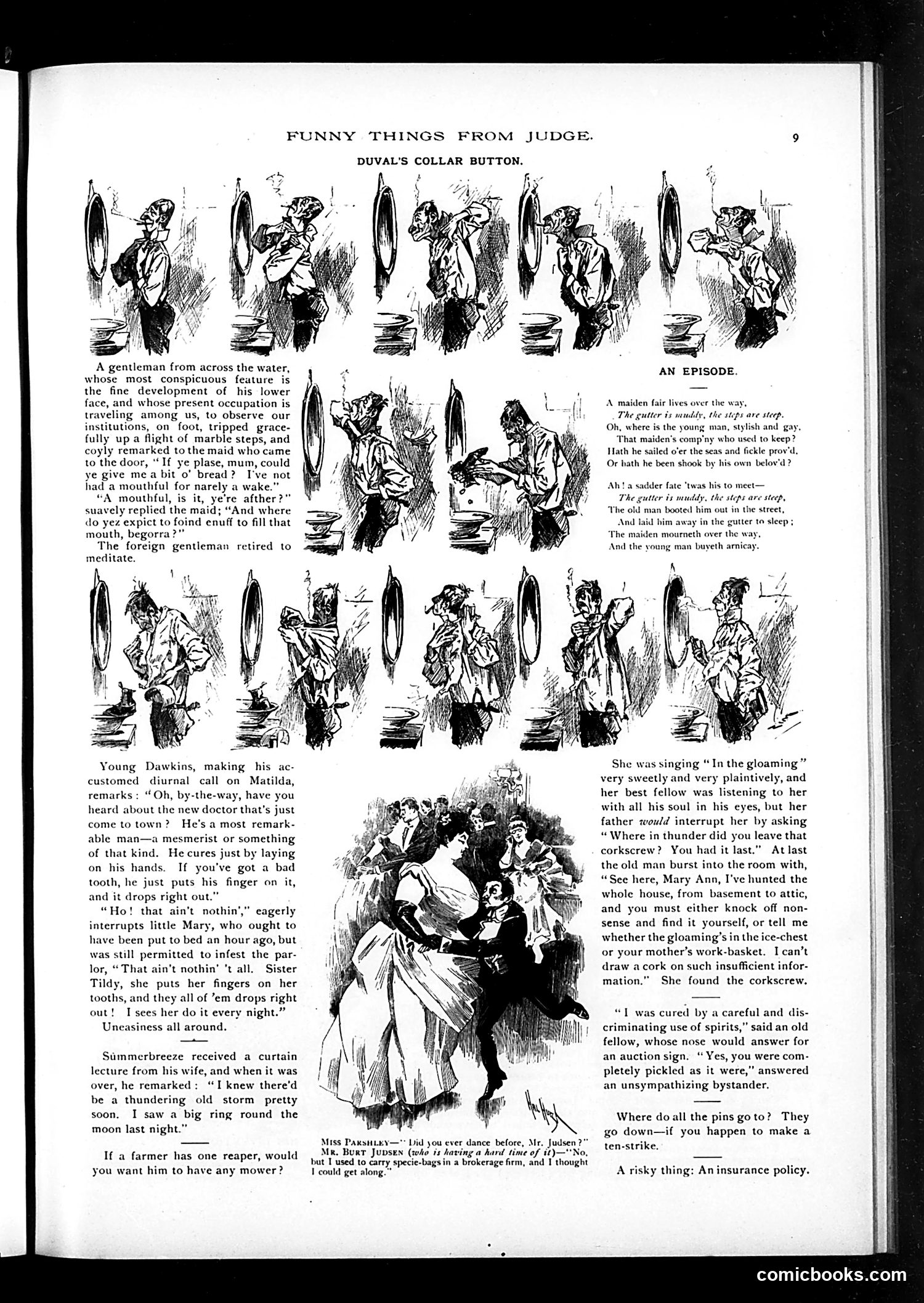
This page from *Judge* magazine contains several short humorous pieces satirizing social types and situations of the era. **"Duval's Collar Button"** is a comic strip showing a gentleman repeatedly struggling with a collar button—a small fastener essential for Victorian-era dress. The visual gag emphasizes the absurdity of this mundane frustration. **The other anecdotes** mock various characters: an Irish beggar with an exaggerated accent; a doctor using mesmerism (pseudo-scientific healing); a couple interrupted during courtship by a father obsessed with a lost corkscrew; and various witty one-liners about doctors, farmers, and social mishaps. The humor relies on **class observation and dialect comedy** (Irish accents rendered phonetically), common to 19th-century American satire. The satire targets pretension, superstition, domestic annoyance, and social awkwardness rather than specific political figures. These are gentle observations of everyday life meant to amuse middle-class readers—typical filler content in *Judge*'s satirical format.
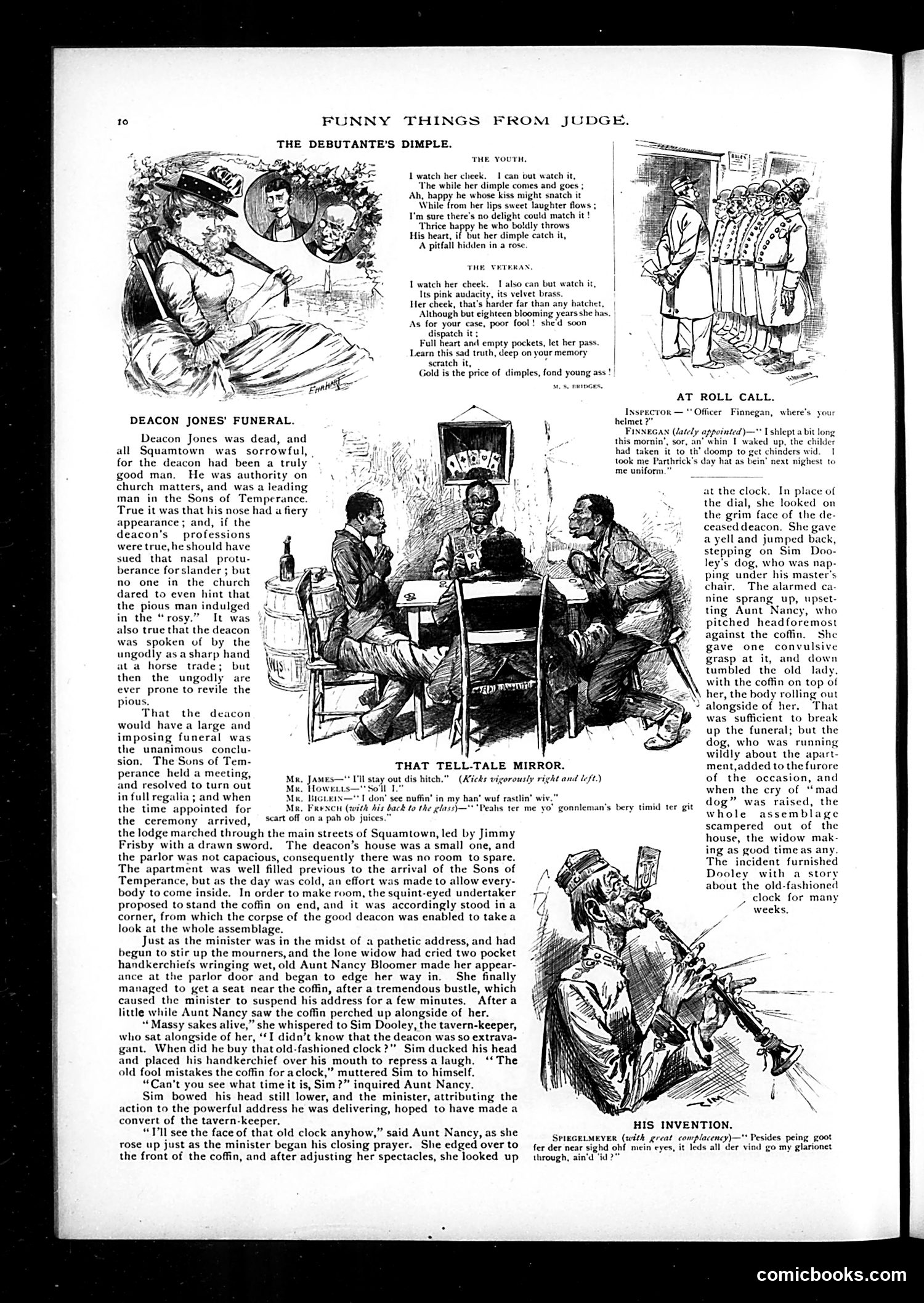
This page from the satirical magazine *Judge* contains several humorous sketches mocking social pretensions and Irish-American stereotypes common to late 19th-century American humor. **"The Debutante's Dimple"** contrasts romantic youth with cynical experience: a young man idealizes a debutante's dimple, while a veteran dismissively notes that her real value lies in wealth, not beauty—"Gold is the price of dimples." **"Deacon Jones' Funeral"** satirizes religious hypocrisy: a temperance advocate with a notoriously red nose (suggesting heavy drinking) receives an elaborate funeral that descends into chaos when his corpse falls from its coffin, disrupting the solemn proceedings. **"At Roll Call"** ridicules an Irish-American police officer's excuse for losing his helmet, using exaggerated Irish dialect for comic effect—a common trope mocking Irish immigrants. **"That Tell-Tale Mirror"** and **"His Invention"** appear to feature additional comic vignettes, though details are partially obscured.
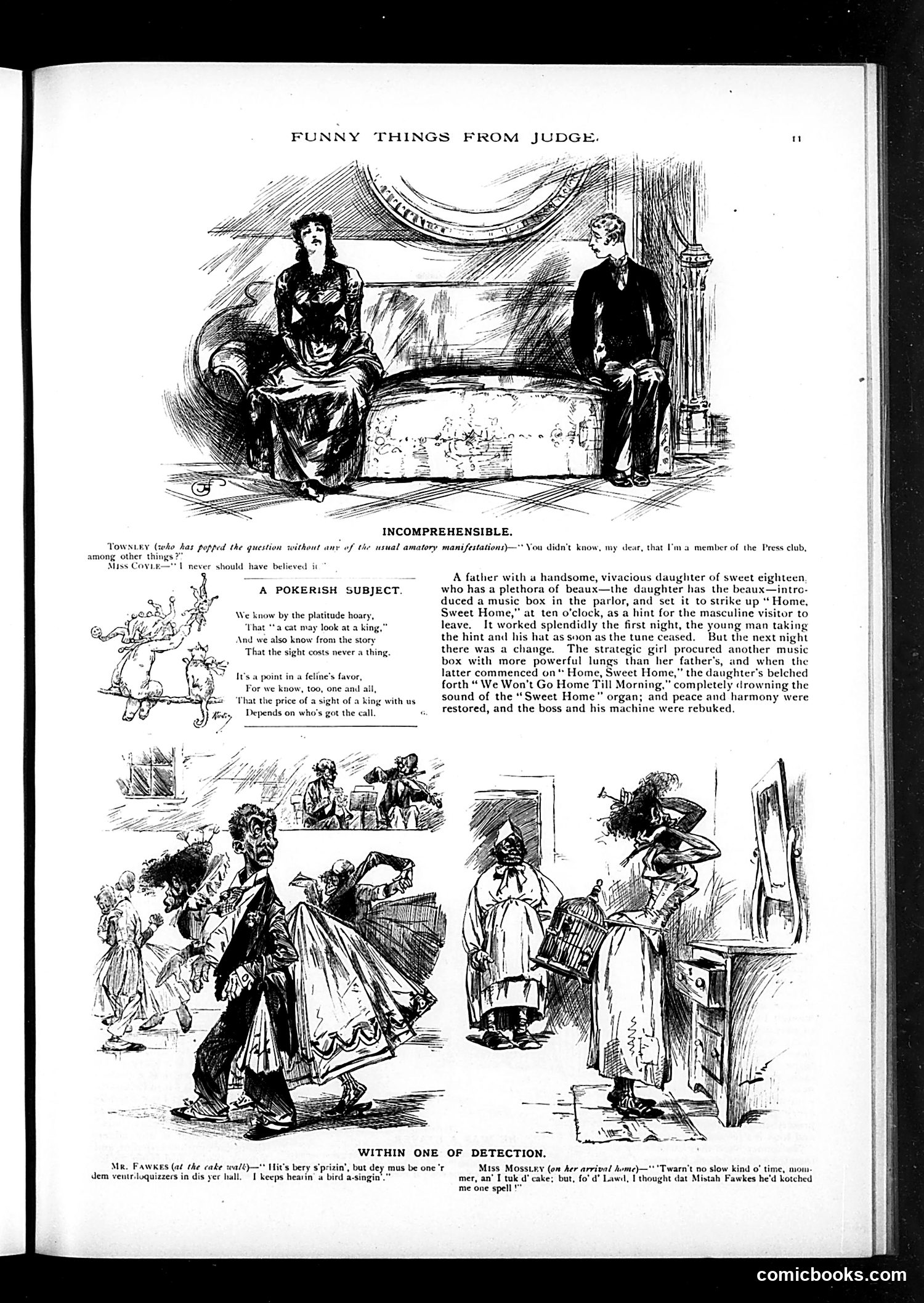
This page contains three separate humorous sketches from *Judge* magazine: **"Incomprehensible"**: A man proposes to a woman without romantic gestures. She's shocked he's a Press Club member—the joke suggests journalists were considered unromantic or socially awkward. **"A Pokerish Subject"**: A poem comparing a cat looking at a king (free) to humans paying to see royalty. The "call" reference appears to allude to poker stakes—satirizing how access to the wealthy/powerful requires payment or social position. **"Within One of Detection"**: A father hears bird-singing in the hall and suspects a ventriloquist. A woman (Miss Mossley) later reveals she brought the bird, thinking Mr. Fawkes would notice. The humor lies in his obliviousness and her mild revenge for his inattentiveness. These are light domestic comedies typical of *Judge*'s humor—poking fun at courtship customs, social pretension, and gender dynamics of the Victorian/Edwardian era rather than addressing serious political issues.
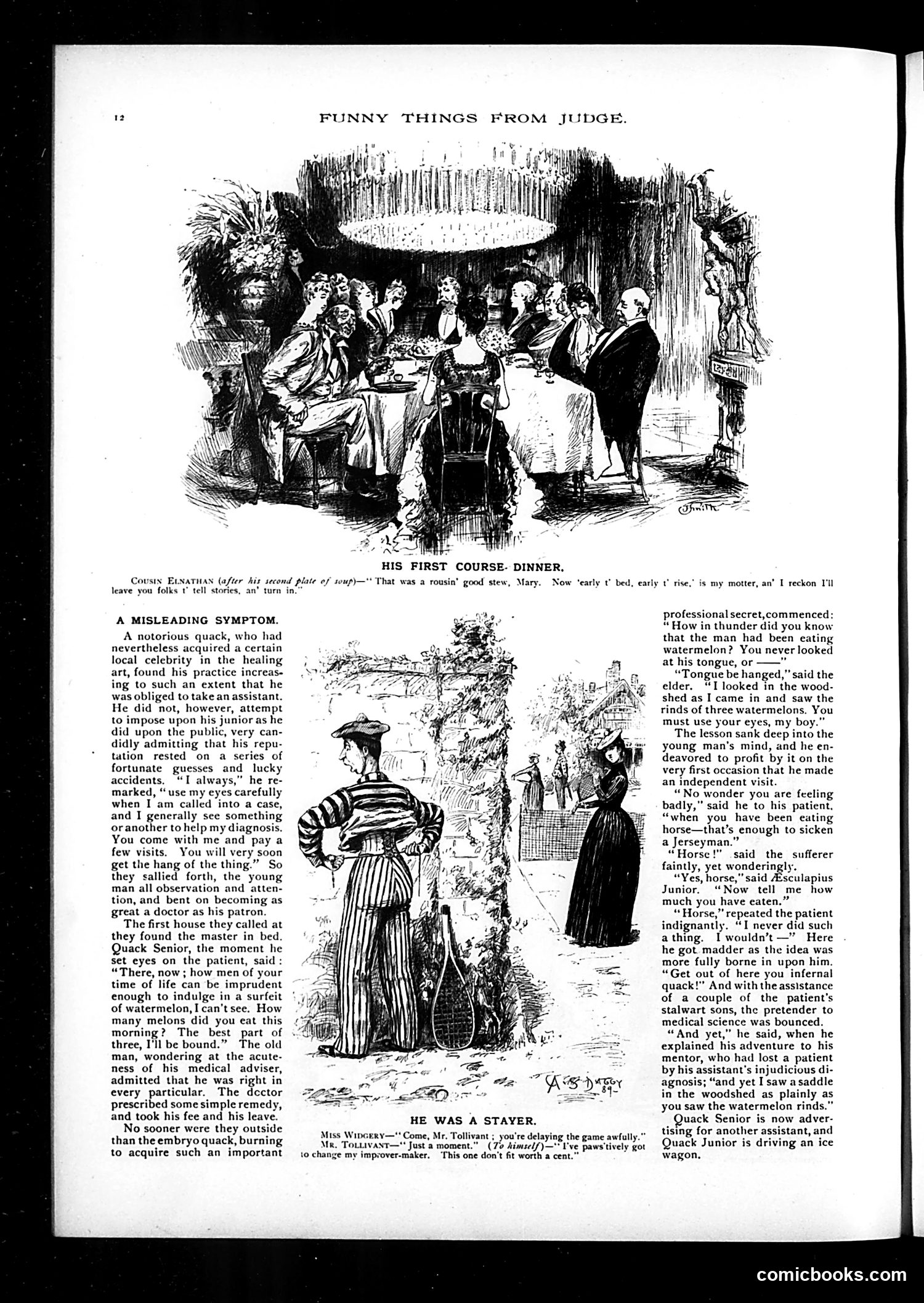
This page contains two unrelated humorous sketches satirizing incompetence and superficial expertise: **"A Misleading Symptom"** mocks medical quacks. A fraudulent doctor succeeds through lucky guesses rather than skill—he deduces a patient ate watermelon by spotting rinds in a woodshed, not through actual diagnosis. His naive apprentice learns this "trick" but applies it mechanically and disastrously, telling another patient he ate horse (because he saw a saddle). The patient, furious at the absurd diagnosis, throws him out. The satire criticizes both charlatan doctors and the gullibility that allows them to practice. **"His First Course Dinner"** (top) depicts a rustic man leaving a dinner party early, apparently unimpressed by the meal's quality. The page targets 19th-century medical fraud and the gap between appearance and competence—common Judge themes. No specific historical figures are identifiable; these are generic types representing broader social problems.
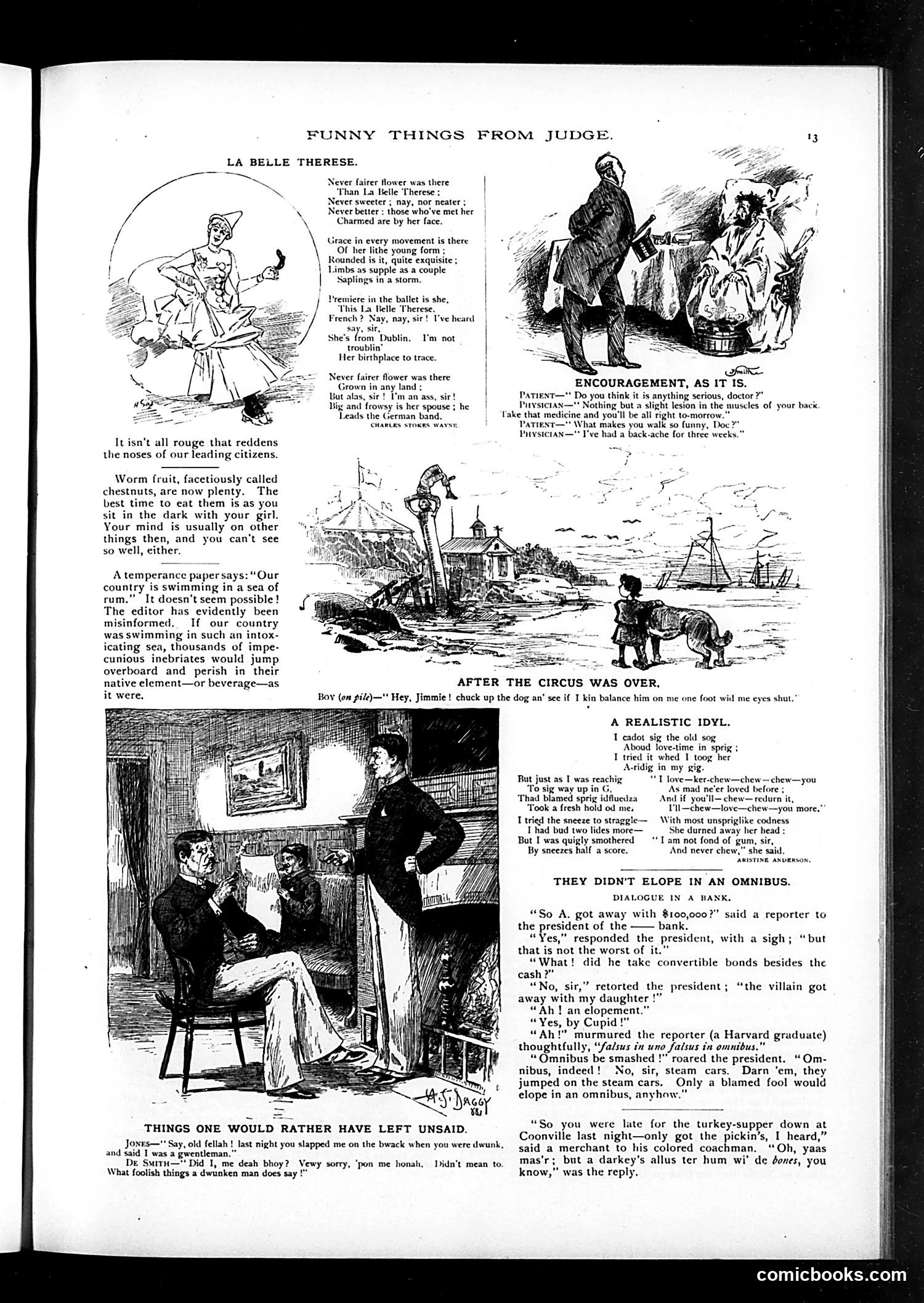
This page contains multiple humor pieces typical of late 19th-century American satire: **"La Belle Therese"** mocks romantic idealization of women, particularly French performers. The poem praises a beautiful French ballet dancer, then reveals the punchline: she's actually Irish, married to an unattractive man—deflating pretentious admiration. **"Encouragement, As It Is"** satirizes incompetent or dismissive doctors who offer vague diagnoses and false reassurance to patients. **"After the Circus Was Over"** depicts working-class children attempting physical stunts, capturing their unsupervised antics. **"They Didn't Elope in an Omnibus"** is a bank robbery joke where a president laments that a thief stole his daughter alongside $100,000—the real tragedy being the elopement. The Latin phrase *"falsus in uno falsus in omnibus"* (false in one thing, false in all) is mockingly applied to transportation. **"Things One Would Rather Have Left Unsaid"** shows socially awkward conversations—a drunk man apologizing for violence; racial stereotyping in dialogue with a Black coachman. The humor relies on period stereotypes, class commentary, and linguistic wordplay.
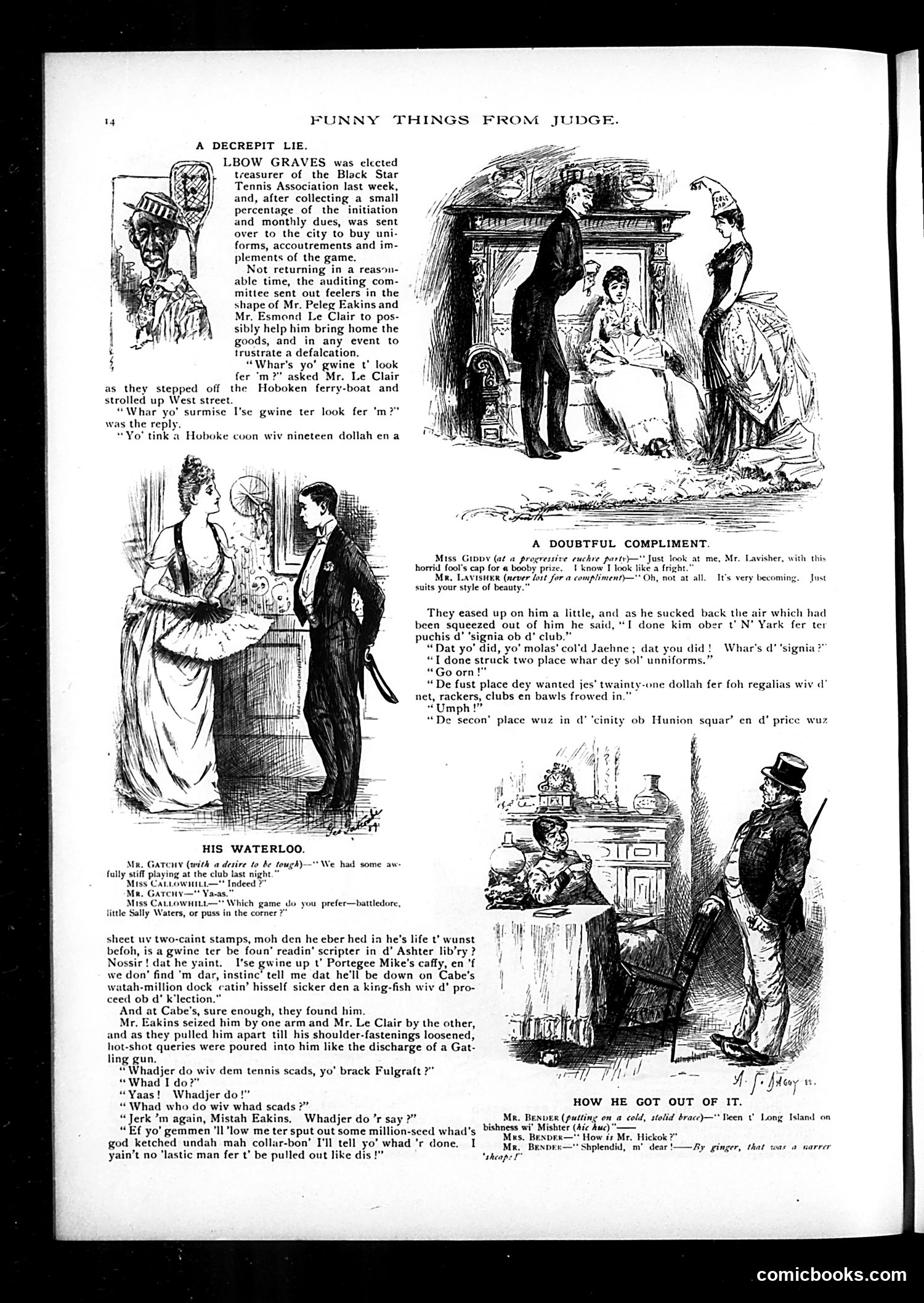
This page contains three separate comic sketches satirizing contemporary social behavior through exaggerated dialect humor. **"A Decrepit Lie"** mocks a Black character (using period racial stereotypes) who misappropriated tennis club funds. The humor relies on phonetic dialect transcription of African American speech and the premise of financial dishonesty. **"A Doubtful Compliment"** depicts a woman fishing for reassurance about her appearance at a social event; a man's empty flattery—claiming her unflattering costume "suits your style of beauty"—satirizes insincere social pleasantries among the upper classes. **"His Waterloo"** and **"How He Got Out of It"** continue the fund-misappropriation story with more exaggerated dialect humor, while the final sketch shows a different couple where a man uses verbose evasion to dodge his wife's questions about his whereabouts. The page exemplifies Judge's approach: satirizing social pretension, romantic awkwardness, and character flaws through caricature and dialect comedy—reflecting late 19th/early 20th-century attitudes that modern readers would find offensive.
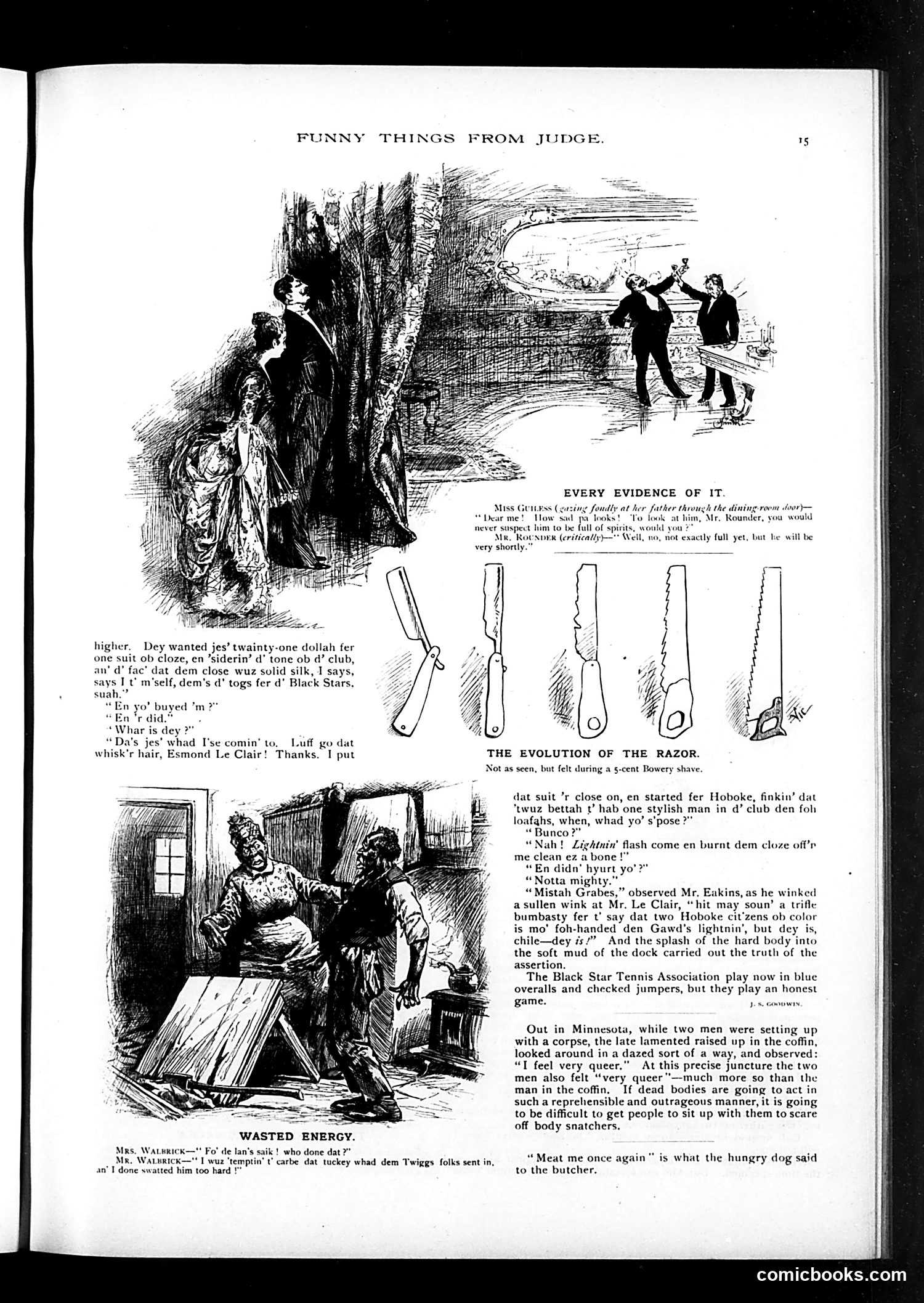
This page contains three separate humorous anecdotes typical of late-19th-century Judge magazine's satirical style: **"Every Evidence of It"** mocks a pompous man (Mr. Rounder) whom Miss Guiness observes looking miserable at dinner, despite his reputation for drinking. The joke plays on "full of spirits"—he appears spiritually empty despite his drinking habits. **"The Evolution of the Razor"** satirizes cheap Bowery barbershops, illustrating progressively damaged razors, culminating in one literally shattered. The accompanying text describes an African American man's suit destroyed by lightning, with dialect humor typical of period stereotyping. **"Wasted Energy"** and the Minnesota anecdote are brief, darkly comic vignettes about domestic mishaps and a corpse unexpectedly reviving during a wake—playing on superstitions about body-snatching. The cartoons employ heavy racial caricature and dialect speech characteristic of Judge's era, reflecting attitudes modern readers would find offensive, while the humor relies on physical mishaps and social pretension.
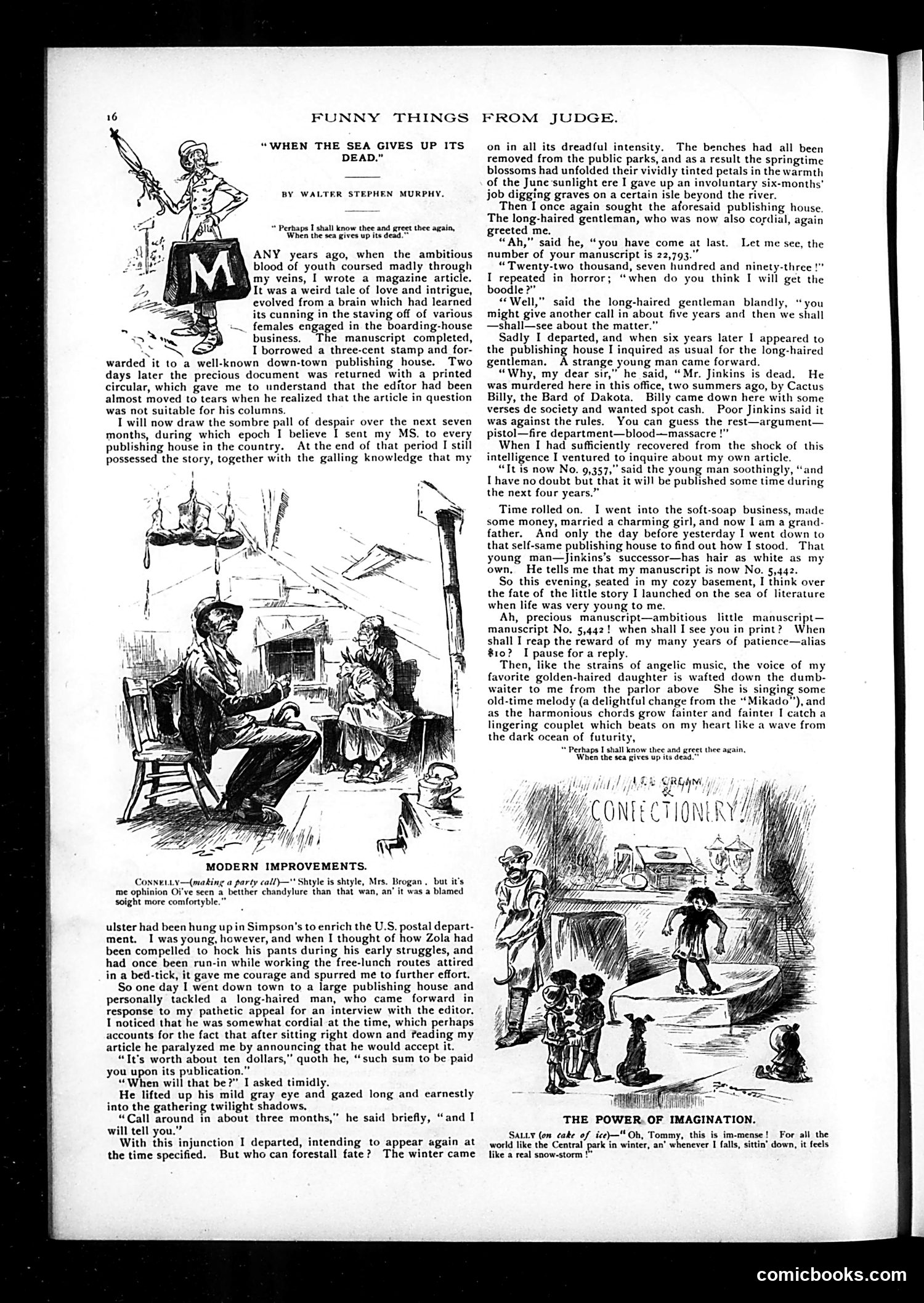
This is a humorous autobiographical story by Walter Stephen Murphy satirizing the publishing industry's notorious rejection and delays. **The Setup:** A young, ambitious writer submits a manuscript to numerous publishers. One finally accepts it for $10, telling him to return in three months. **The Satire:** When Murphy returns, he's given a rejection-style runaround—his manuscript is now #22,793 in the queue. The publisher vaguely promises a decision "in about five years." **The Punchline:** Six years later, Murphy learns the publisher (Mr. Jinkins) was murdered by "Cactus Billy, the Bard of Dakota"—a reference to the Wild West outlaw stereotype. The joke suggests that by the time your manuscript might be published, your publisher could literally be dead. The cartoon mocks both publishing house incompetence and the tortuous waiting periods aspiring authors endured. It also appears to include a separate, unrelated cartoon about Irish domestic service ("Modern Improvements").
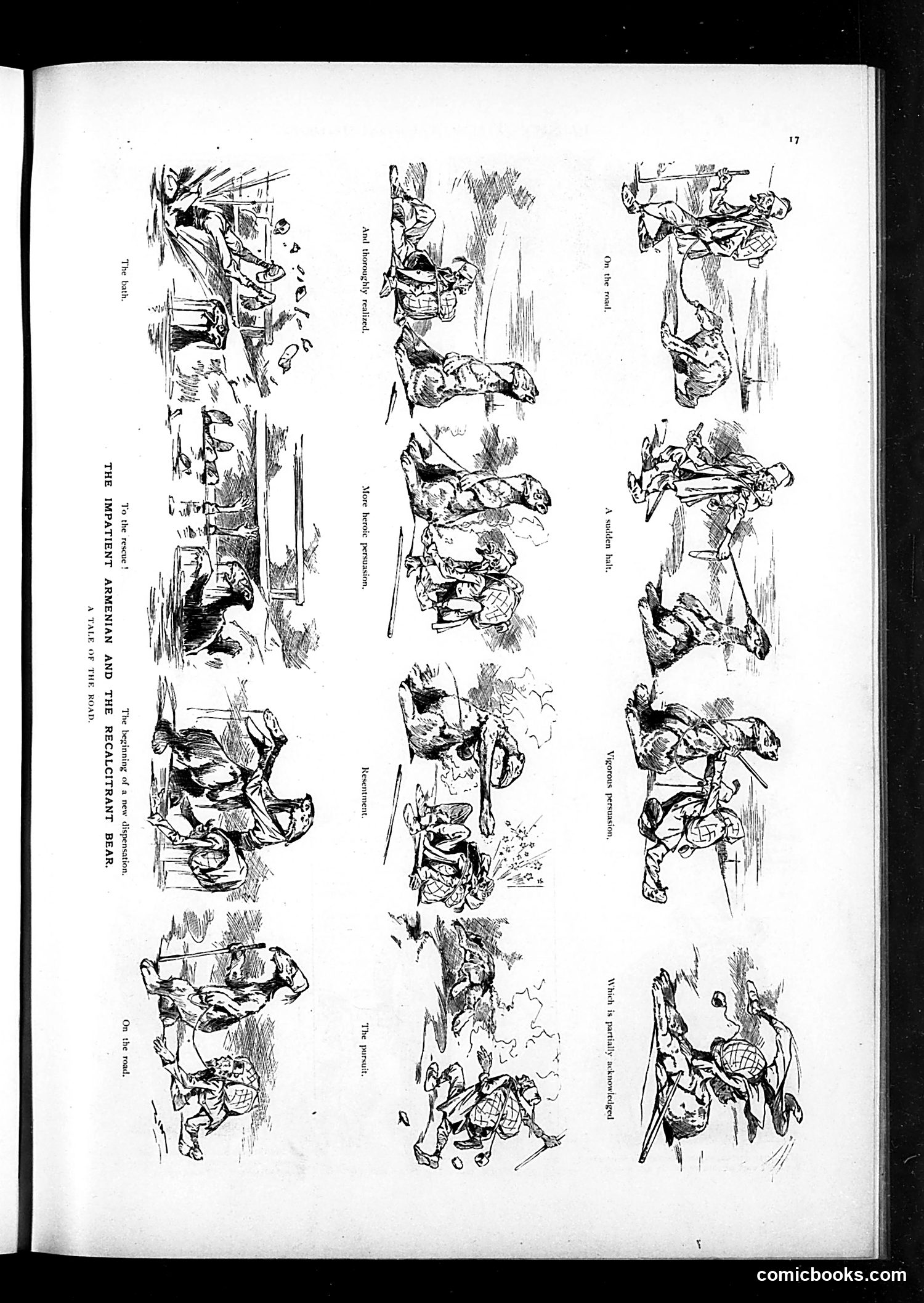
This page presents a sequential comic strip titled "The Impatient Armenian and the Recalcitrant Bear." The narrative appears to depict an Armenian figure encountering a bear on a road, with captions marking progression: "The halt," "To the rescue! The beginning of a new dispensation," and "On the road." The satire likely references Armenian-Russian relations or geopolitical tensions of the period. The "bear" presumably symbolizes Russia (a common 19th-century political cartoon symbol), while the Armenian represents either Armenia itself or Armenian interests. The phrase "recalcitrant bear" suggests Russia resisting or refusing cooperation. The "new dispensation" caption implies hoped-for intervention or change in their relationship. Without the publication date visible, the specific historical moment remains unclear, though it concerns Eastern European/Caucasian politics.
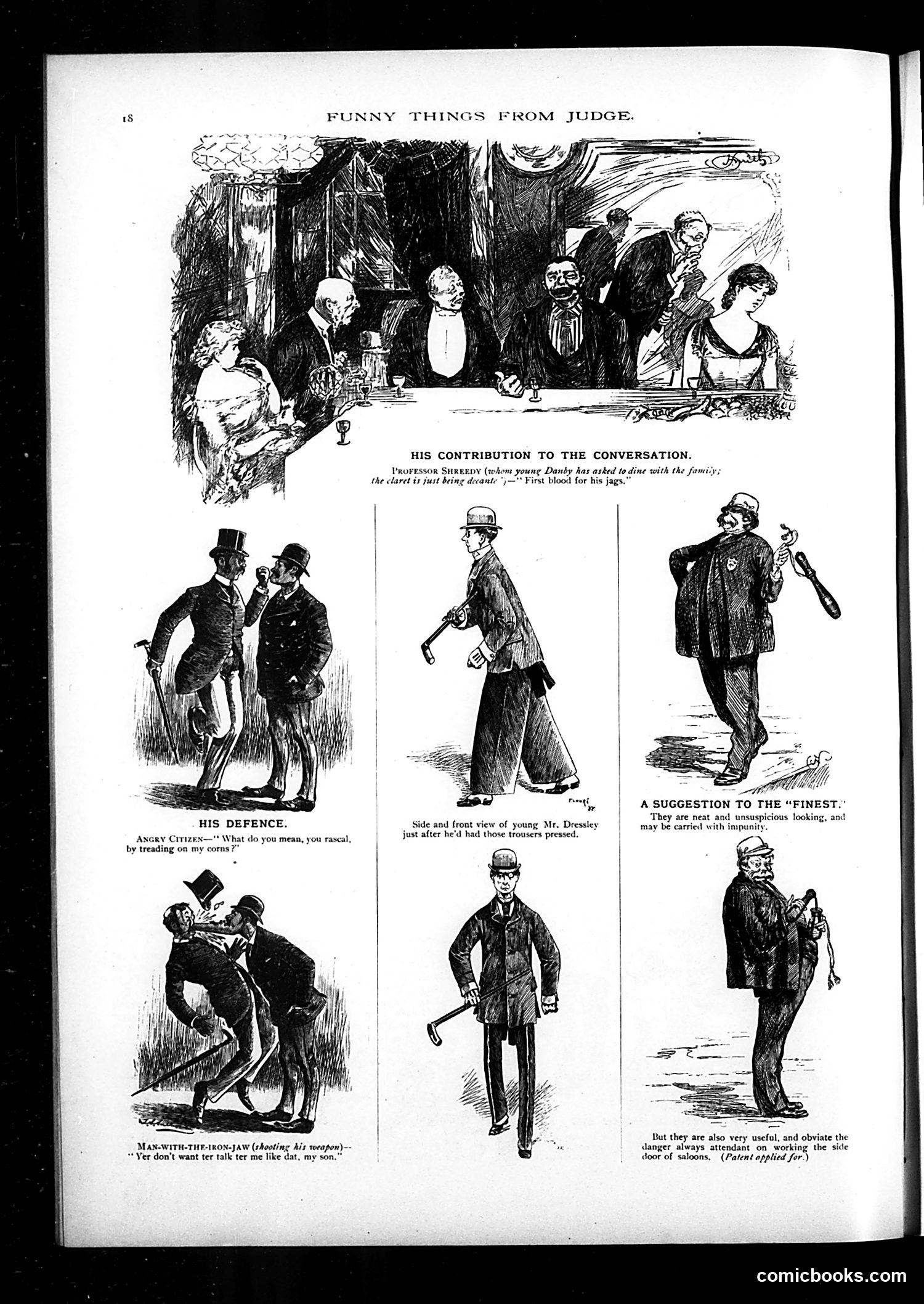
This page from *Judge* magazine presents satirical sketches mocking Victorian social pretenses and urban life. **"His Contribution to the Conversation"** ridicules Professor Shreedy's inappropriate comment about a young guest's drinking habits during a formal dinner—crude behavior masked by genteel society. **"His Defence"** shows a man's absurd justification for stepping on someone's feet, escalating to violence, satirizing masculine overreaction to minor offenses. **"A Suggestion to the 'Finest'"** and **"Man-with-the-Iron-Jaw"** both propose weapons (umbrellas or canes) for police and citizens, apparently mocking crime prevention methods or the necessity of self-defense in urban areas. The sketches collectively lampoon upper-class hypocrisy, masculinity, and public safety concerns of the era—poking fun at how "respectable" people behave beneath their polished surfaces.
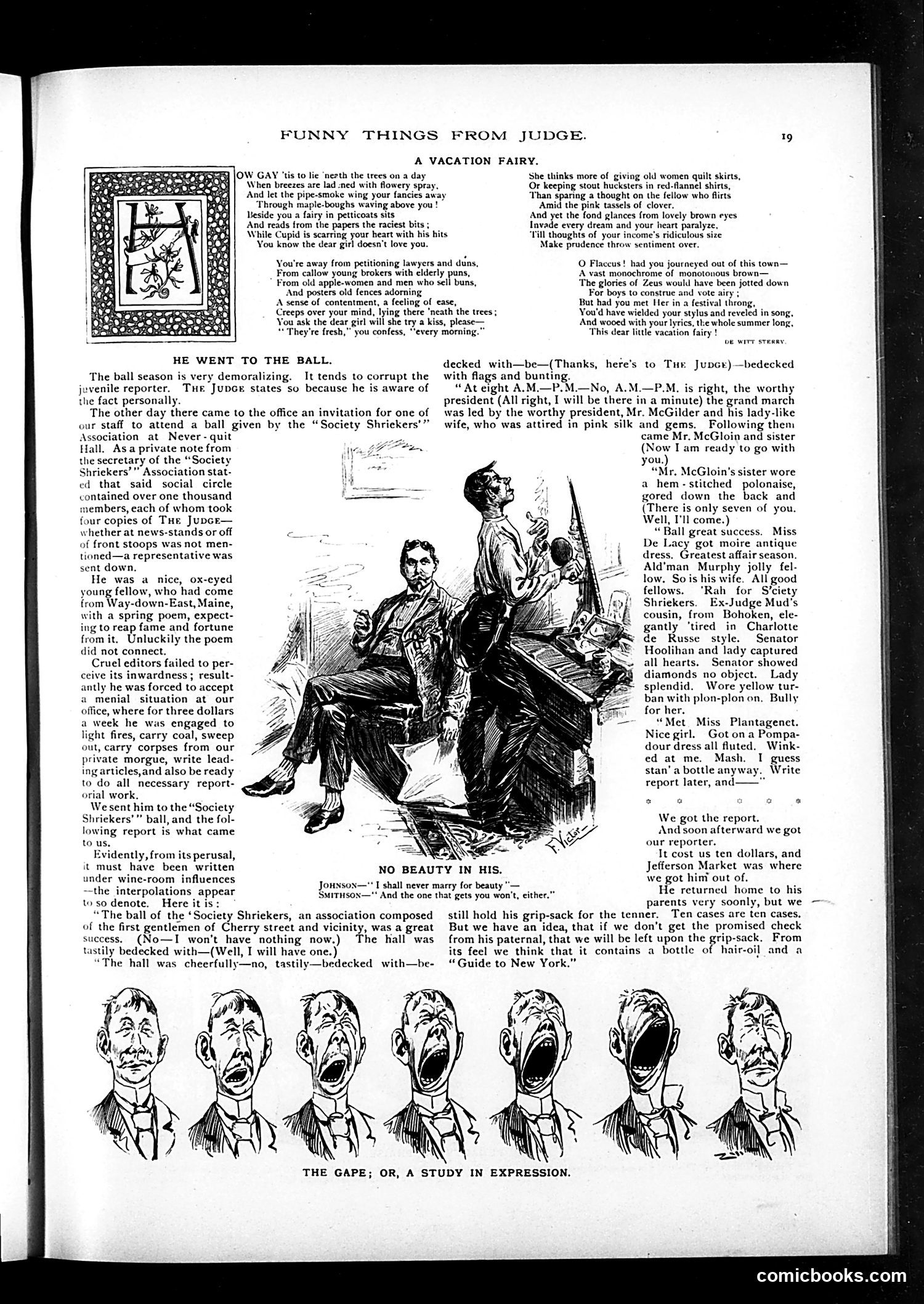
This page contains two satirical pieces from *Judge* magazine mocking upper-class social life. **"A Vacation Fairy"** is a poem satirizing romantic idealization versus practical reality. A young man on vacation fantasizes about a woman while she remains indifferent, thinking instead of charitable work and her wealth. The joke undercuts his romantic reverie—he's attracted to her despite knowing her indifference. **"He Went to the Ball"** mocks a newspaper reporter sent to cover a society ball. The editors sent their lowest-ranking staff member (a struggling poet from Maine reduced to menial labor) to report on the "Society Shriekers" association ball. His drunken, rambling account—with editorial interpolations—becomes absurdly incoherent, satirizing both society events and journalistic incompetence. The bottom illustration shows a sequence of exaggerated facial expressions labeled "The Gape; or, A Study in Expression," likely mocking theatrical affectation or fashionable reactions at such balls. The satire targets wealthy social circles, poor journalism, and the gap between romantic fantasy and reality.
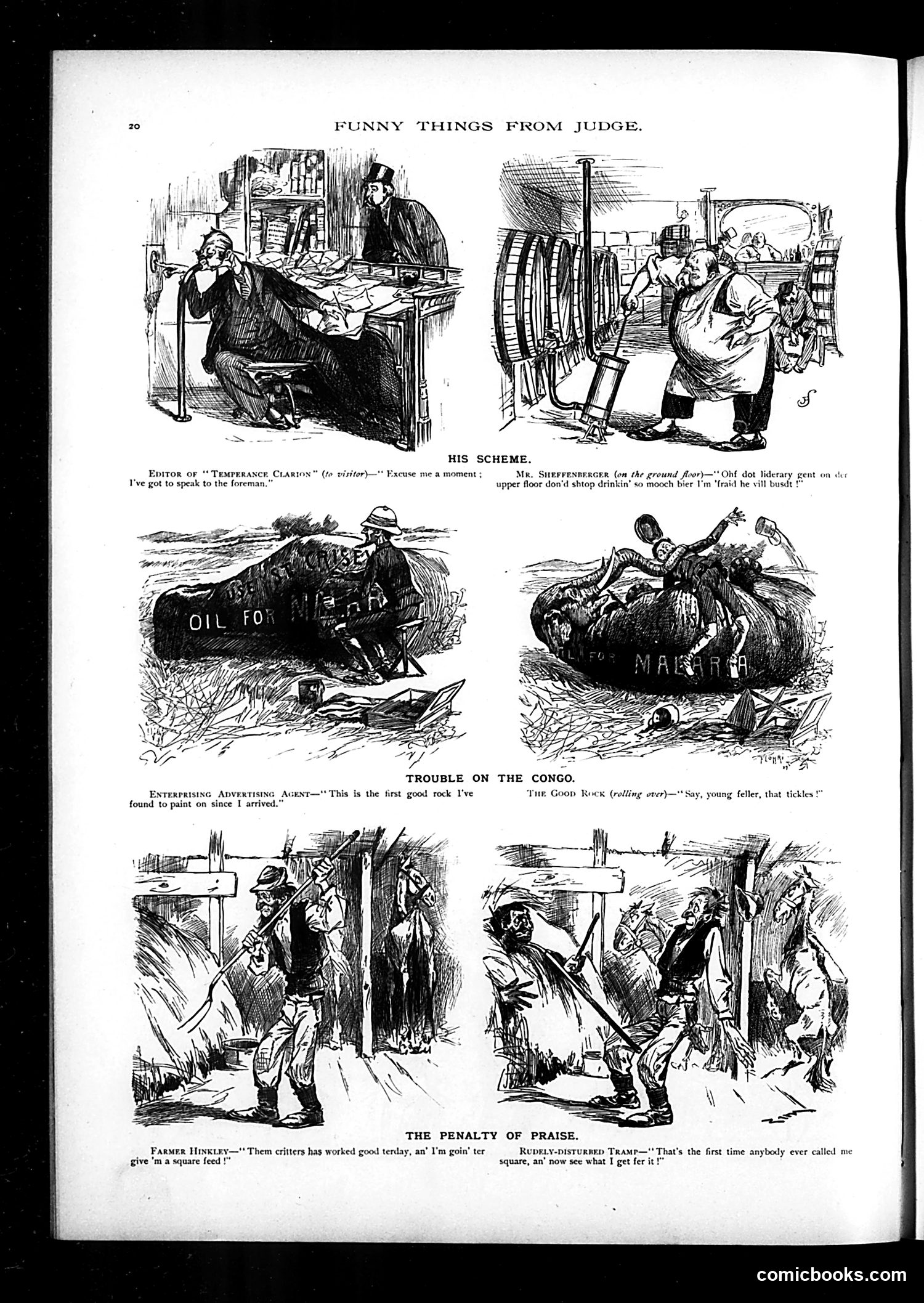
This page collects six separate satirical cartoons from Judge magazine, each with its own joke: 1. **"His Scheme"**: A temperance magazine editor claims moral authority while his subordinate downstairs drinks beer heavily—hypocrisy among reform advocates. 2. **"Trouble on the Congo"**: An advertising agent and a boulder with painted text satirize colonial-era commercialism in Africa, treating natural resources as billboards. 3. **"The Penalty of Praise"**: A farmer feeds his hardworking animals well, expecting gratitude; a vagrant tramp receives praise for once and now constantly demands reward—satirizing how encouragement can backfire with ungrateful people. The humor relies on irony, class commentary, and period-specific references to temperance movements and colonial exploitation. The broken English dialogue adds comedic characterization to working-class and immigrant figures.
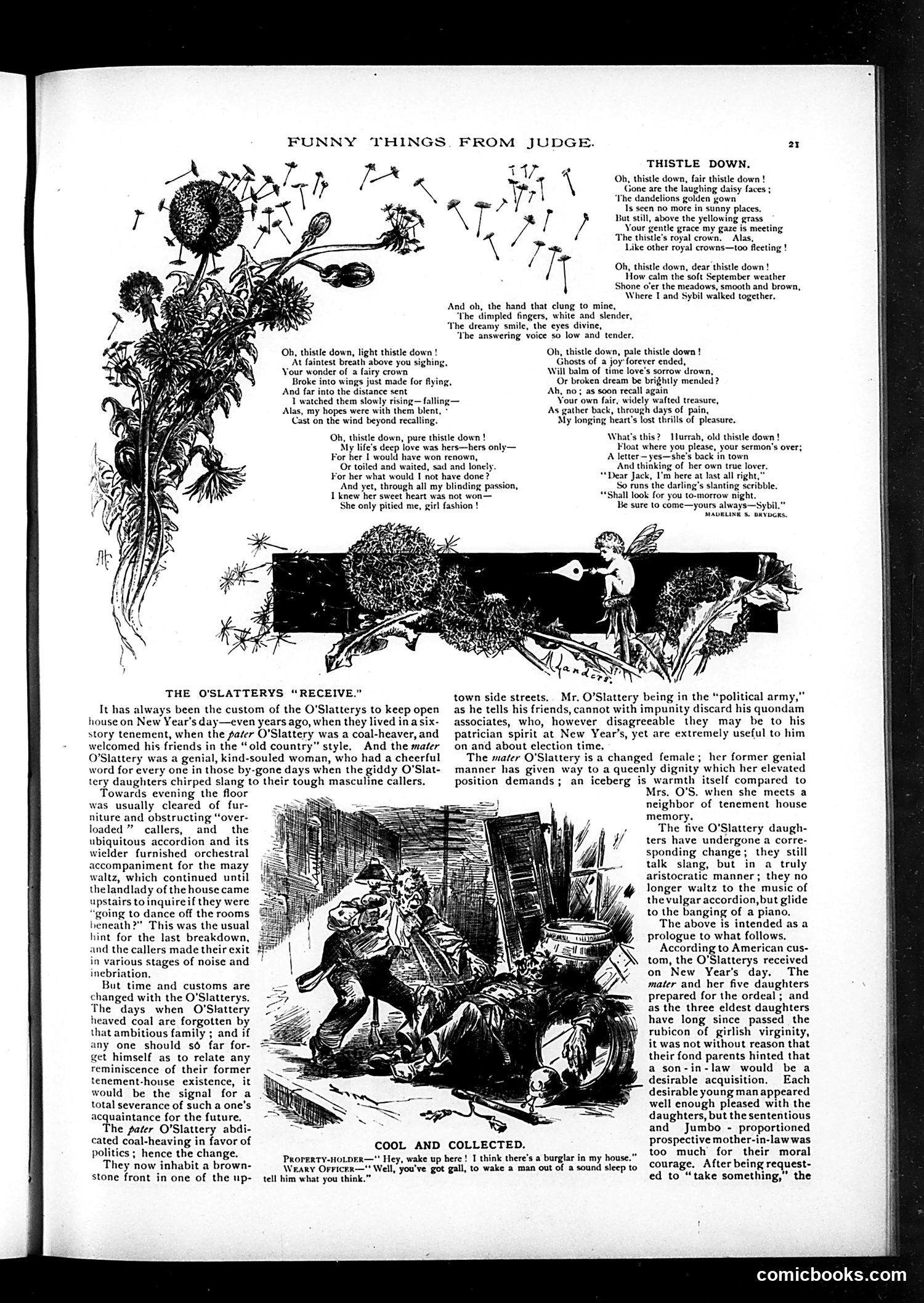
This Judge magazine page contains two main satirical pieces: **"Thistle Down"** is a sentimental romantic poem mocking melodramatic Victorian love poetry—a young man nostalgically pines for an unattainable woman named Sybil, comparing his lost love to dandelion seeds scattered by wind. The satire lies in the exaggerated emotional excess typical of period verse. **"The O'Slatterys 'Receive'"** satirizes Irish-American social climbing. The O'Slatterys have risen from tenement poverty (when the father was a coal-heaver) to middle-class respectability through politics. The satire mocks their pretensions—they now reject their working-class past, host formal "at-home" gatherings instead of raucous dances, and their daughters have abandoned "slang" for aristocratic manners. The piece ridicules both their shame of humble origins and their affected gentility. The cartoon illustration shows the family's old tenement-house chaos, contrasting with their present aspirations.
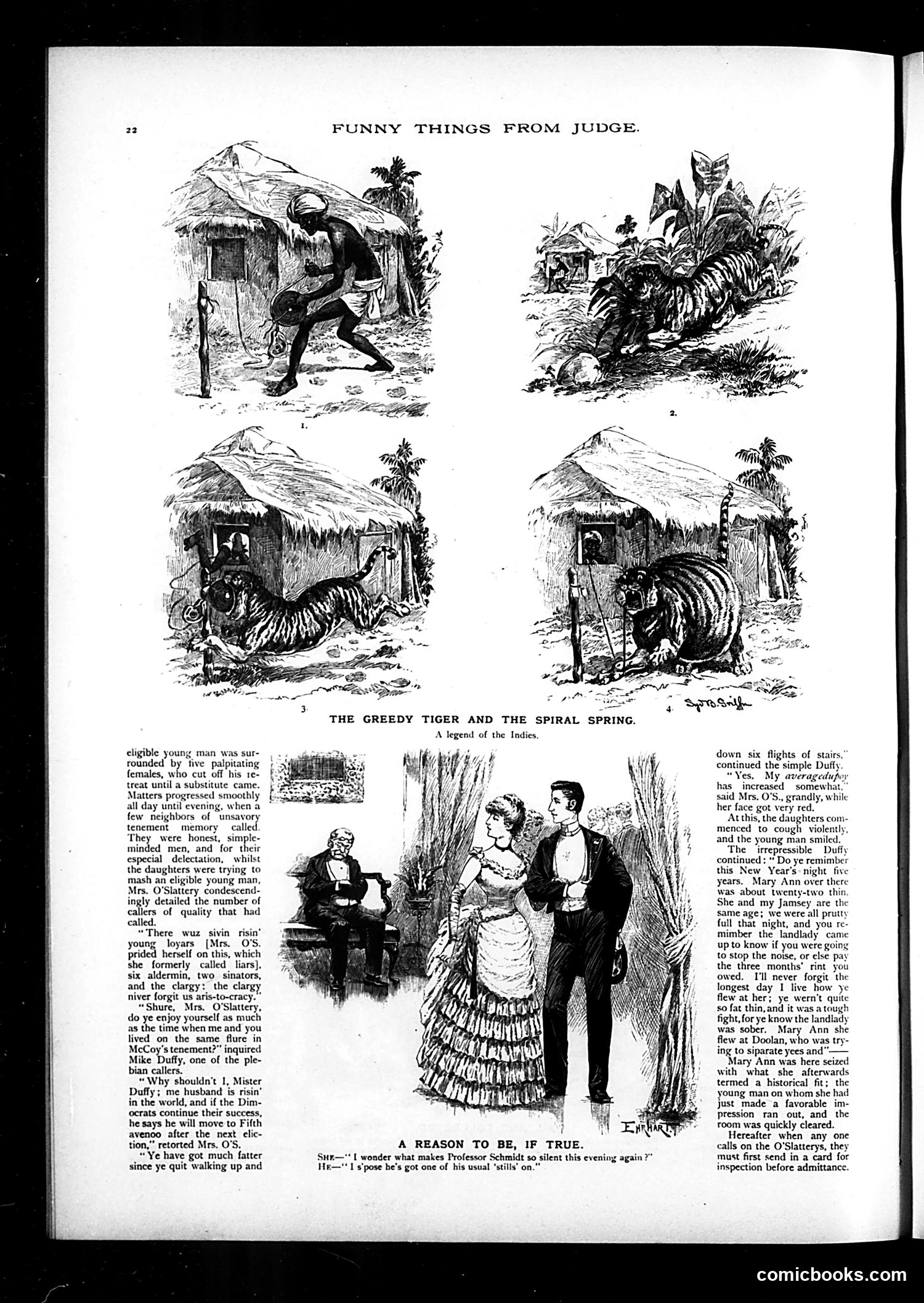
This page satirizes Irish-American social climbing, specifically Mrs. O'Slattery's pretensions to respectability. The main text mocks her boasting about her husband's rising status and their wealthy suitors (lawyers, aldermen, senators, clergy) to old tenement neighbors. The joke hinges on class anxiety: Mrs. O'S. embarrassingly exaggerates her family's ascent while her daughters try to impress "an eligible young man." When her crude neighbor Mike Duffy reminisces about their shared poverty—reminding her she was once fat and violent, fighting a landlord over unpaid rent—she's humiliated. A subsequent brawl involving her daughter Mary Ann destroys any social credibility she'd built. The satire targets both Irish immigrants' aspirational status-seeking and the fragility of their claims to gentility. The final line's bitter joke—now requiring calling cards for visitors—underscores how thoroughly the family's social pretensions have collapsed. The filler illustrations show "The Greedy Tiger and the Spiral Spring," an unrelated Indian legend.
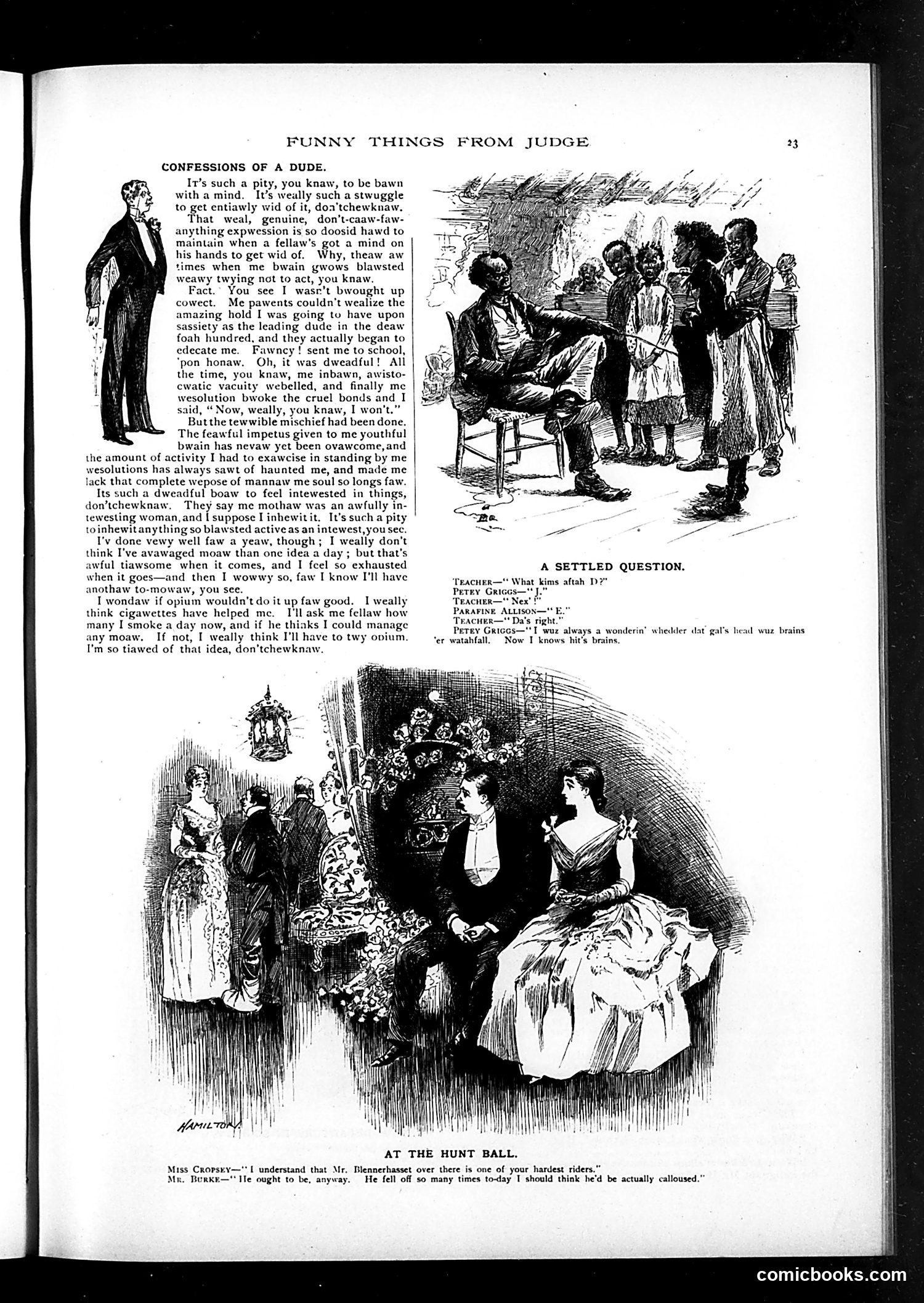
This page contains three separate satirical pieces lampooning upper-class American society circa the Judge magazine era (likely late 1800s): **"Confessions of a Dude"**: A monologue mocking the affected speech and empty-headed pretensions of a wealthy young man obsessed with appearing intellectually vacant. The exaggerated lisp and malapropisms ("bwain," "weally") caricature affectation. The satire targets how some wealthy youth deliberately cultivated stupidity as fashionable status-seeking, rejecting education to maintain the image of a careless socialite. **"A Settled Question"**: A brief schoolroom joke where a student claims a girl's head is "brains or waahfall [waterfall]" — essentially calling her vapid or dull-witted. The humor relies on insulting female intelligence. **"At the Hunt Ball"**: Social satire suggesting a horseman is such an incompetent rider that he falls off repeatedly, yet society still counts him among skilled equestrians — mocking how social standing obscures actual ability. All three target vanity, pretension, and class-based social hypocrisy in Gilded Age America.
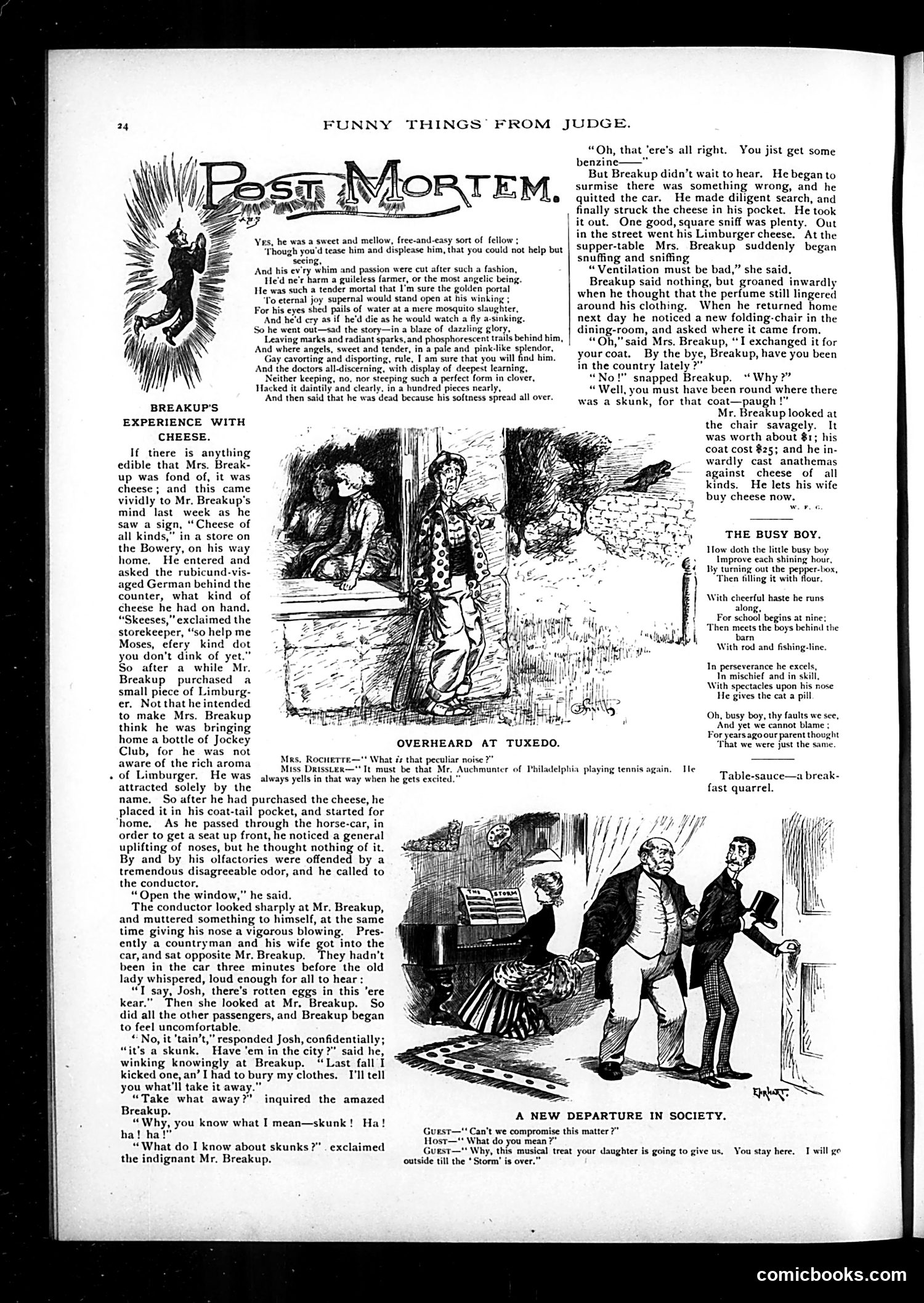
This page contains humorous satirical stories from *Judge* magazine satirizing American middle-class life through exaggerated domestic and social situations. **"Breakup's Experience with Cheese"** depicts Mr. Breakup purchasing Limburger cheese (then famously pungent) from a Bowery shop, unaware of its overpowering smell. The comedy escalates as passengers on a streetcar attribute the odor to "rotten eggs," embarrassing him. The joke culminates when his wife Mrs. Breakup later exchanges his coat for a chair, claiming it smells like skunk—she assumes he's been in the countryside, not realizing the cheese caused the stench. **"Post Mortem"** is a sentimental poem mocking overly-gentle, sensitive men ("tender mortal") who weep at killing mosquitoes. It ironically concludes that doctors dissected such a man post-mortem and found him "dead because his softness spread all over"—satire on excessive sentimentality. Other brief items mock pretentious society ("New Departure in Society") and absent-minded schoolboys ("The Busy Boy"). The satire targets Victorian-era middle-class absurdities, domestic mishaps, and social pretension.
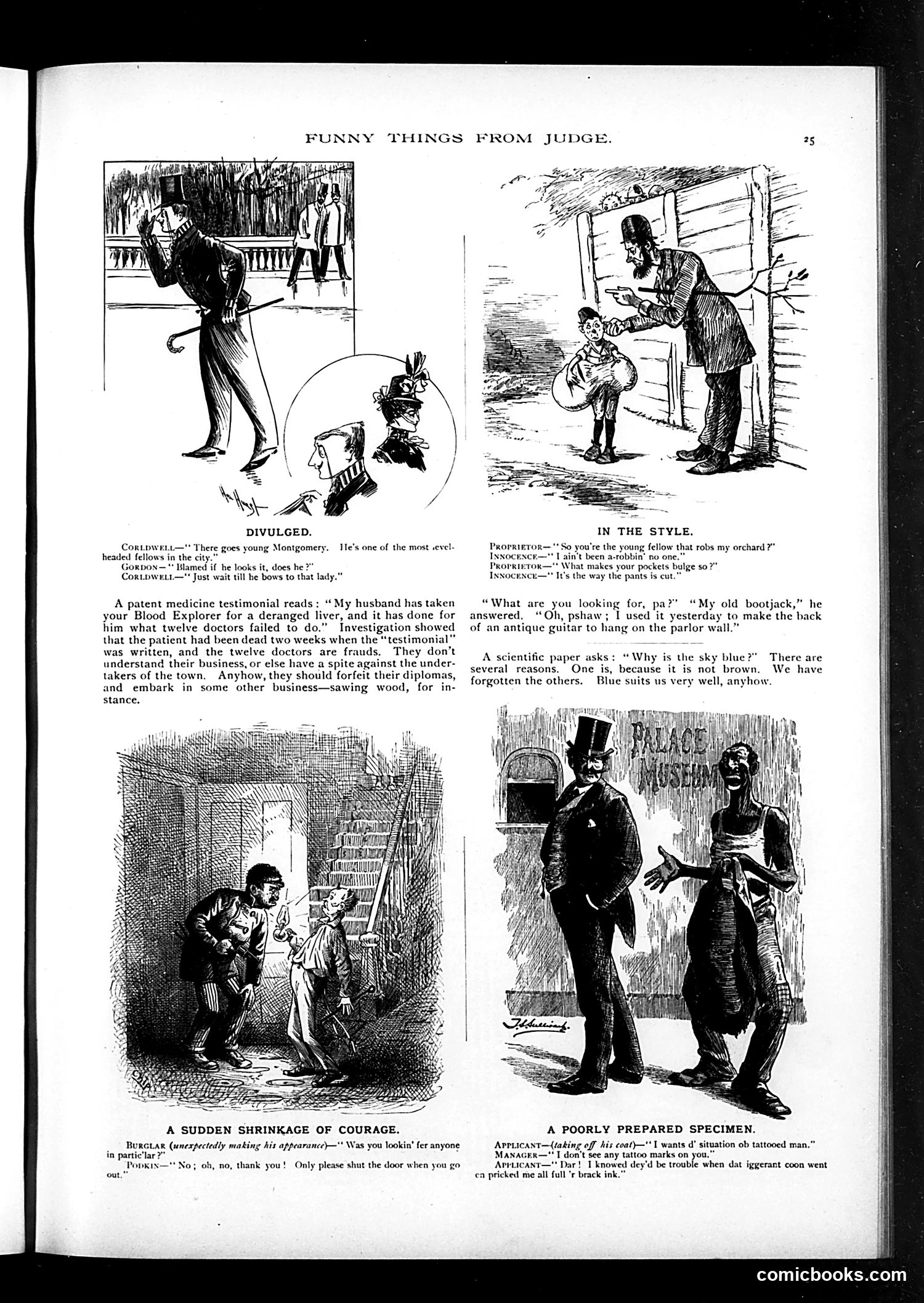
This page from the satirical magazine *Judge* contains four unrelated humorous cartoons mocking various social absurdities: **"Divulged"** jokes about a well-dressed man's true nature revealed by his behavior toward women. **"In the Style"** satirizes a property owner's absurd excuse for a boy's bulging pockets—claiming it's merely how the pants are cut. **"A Sudden Shrinkage of Courage"** depicts a burglar catching a homeowner searching for valuables, instantly eliminating the owner's bravery. **"A Poorly Prepared Specimen"** uses offensive racial stereotypes common to the era, mocking a Black applicant who claims to be a "tattooed man" but lacks tattoos due to the tattooist's incompetence. The page also includes brief satirical anecdotes about fraudulent patent medicine testimonials and a scientific paper's circular reasoning about sky color. These represent typical *Judge* content: social mockery through caricature and witty dialogue.
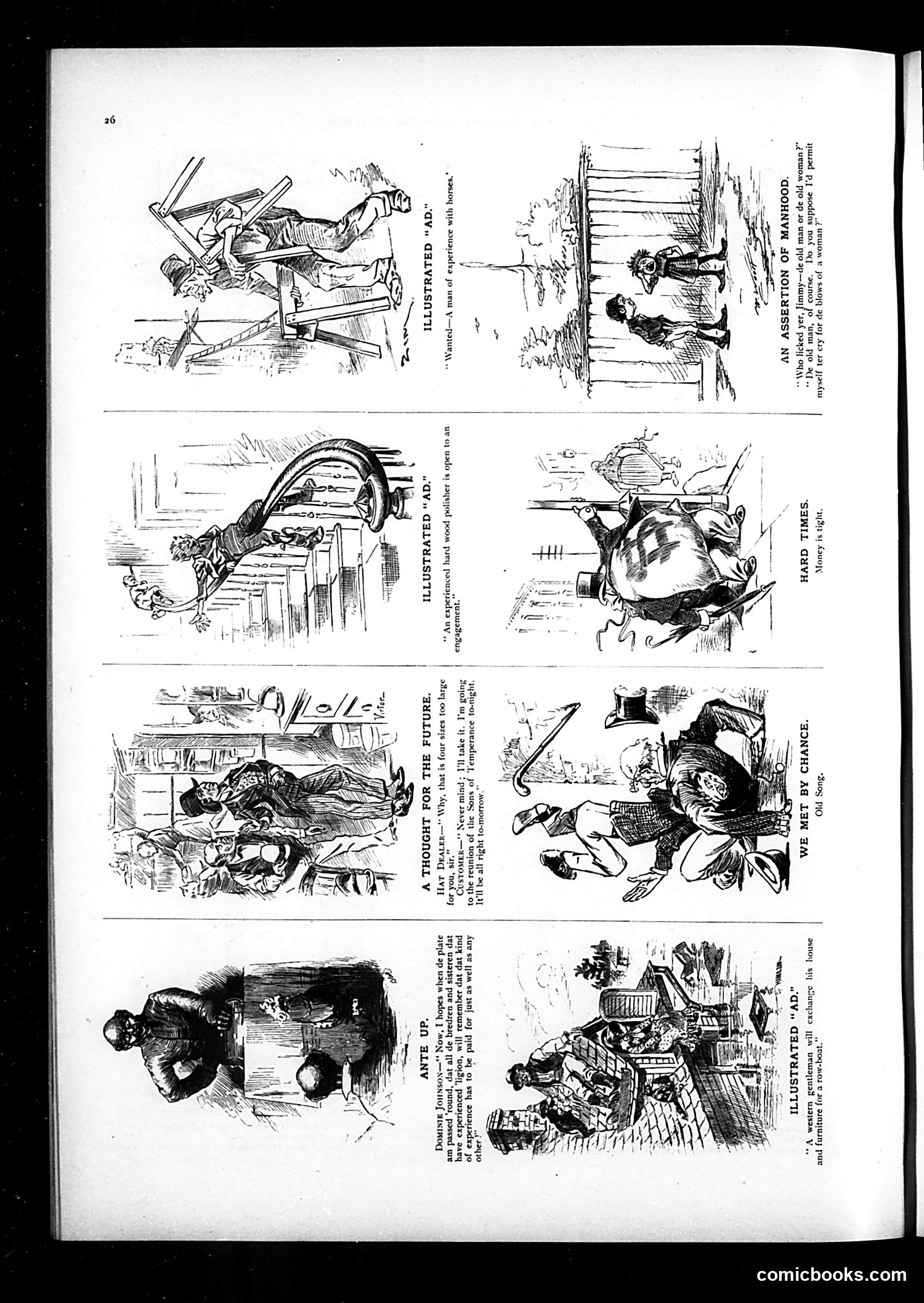
This page appears to contain multiple satirical illustrations with captions, though the OCR text is heavily corrupted and largely unreadable, making precise identification difficult. What's visible: The cartoons use exaggerated character drawings typical of late 19th/early 20th-century American political satire. The illustrations appear to depict various social or political scenarios with figures in period dress engaged in dramatic situations. Without legible text or clear visual identification of specific public figures, I cannot confidently identify which political events, scandals, or social issues these cartoons reference. The drawing style and layout suggest commentary on contemporary politics or society, but determining the specific targets—whether politicians, business figures, social movements, or policy debates—requires readable captions that this page's OCR has failed to preserve. To provide accurate historical context, clearer source material would be needed.
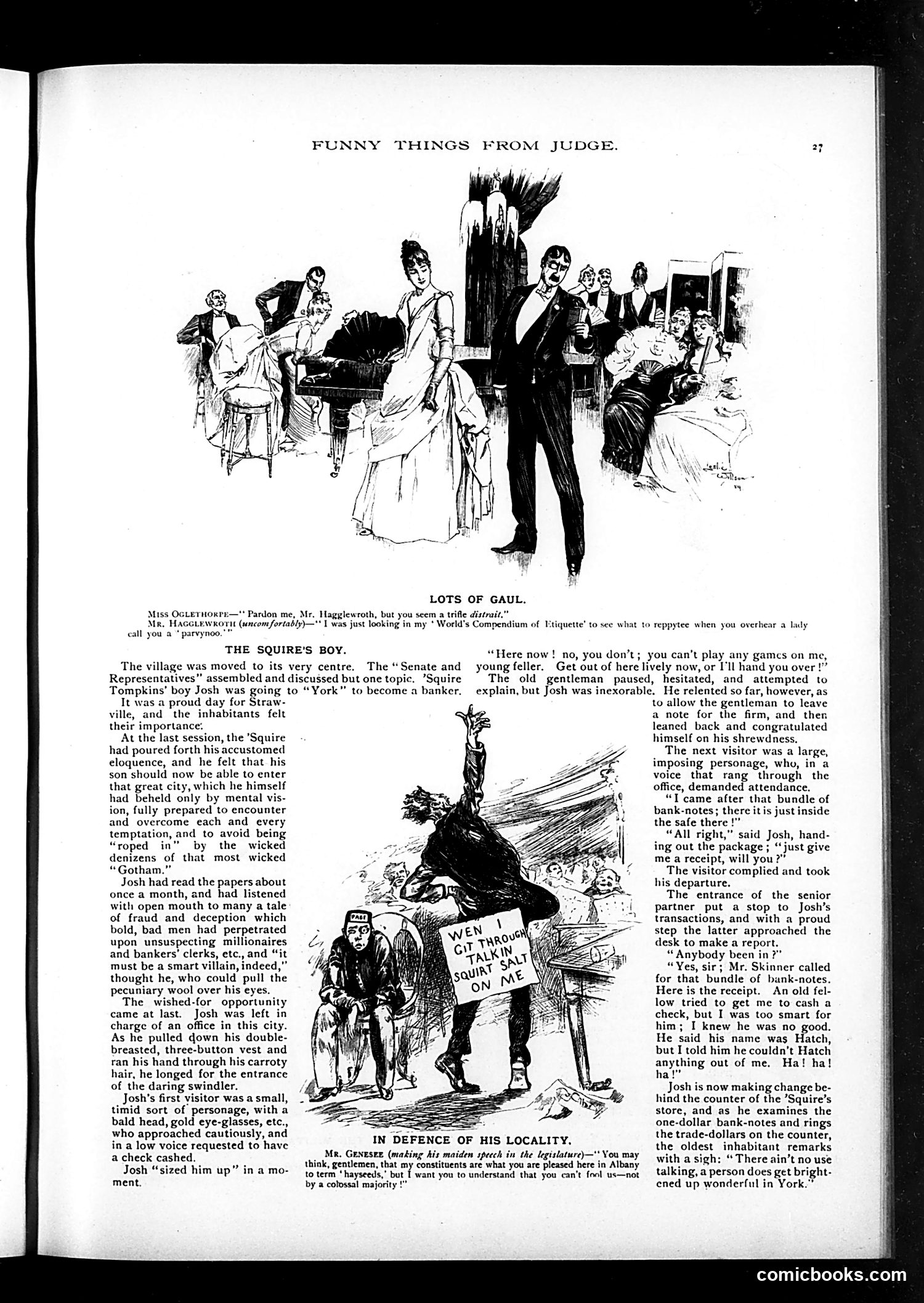
This two-part story satirizes rural naïveté and overconfidence. Josh, a country banker's son from "Strawville," goes to work in York (New York City) convinced he's prepared to outwit urban swindlers after reading newspapers. His first customer—an elderly gentleman requesting a check cashed—Josh rudely refuses, certain he's spotted a con artist. The man leaves a note instead. Josh proudly reports foiling the scheme to his senior partner, only to learn the man was Mr. Hatch, a legitimate colleague, and the "bundle of bank-notes" Josh later handed out was actually stolen by the real swindler, Skinner, whom Josh trusted completely. The joke: Josh's smug confidence in his own shrewdness blinds him to actual danger while making him suspicious of honest people. The ending—him back home making change—suggests his humiliating failure. The satire mocks rural Americans' assumptions about city dangers and their overestimation of their own cleverness.
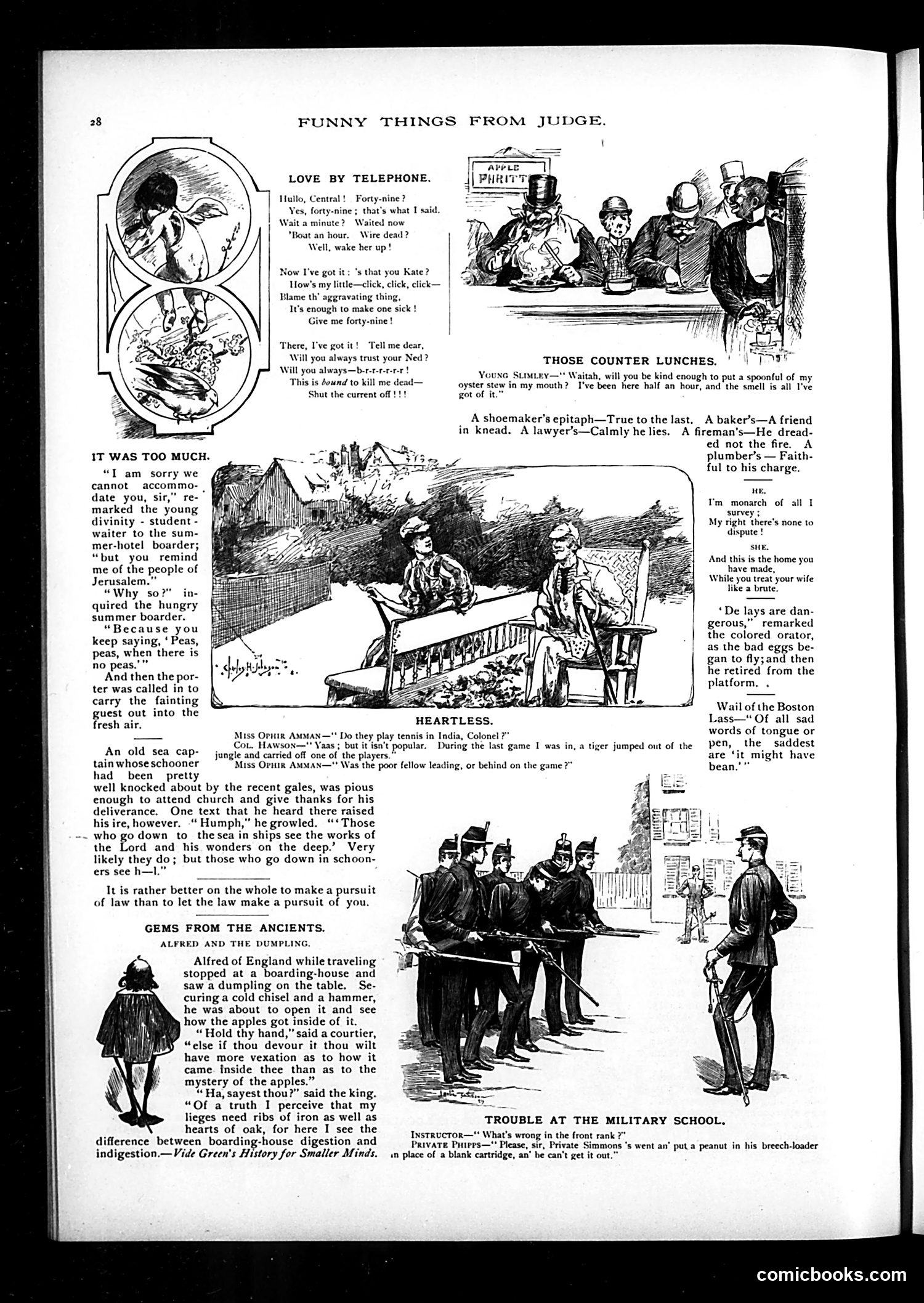
This page collects humorous anecdotes and jokes typical of Judge magazine's satirical style. The cartoons mock everyday frustrations and social pretensions: **"Love by Telephone"** satirizes the new telephone technology's unreliability—a couple trying to have a romantic conversation keeps getting disconnected by a malfunctioning line. **"Those Counter Lunches"** ridicules cheap lunch establishments and working-class diners, with jokes about patrons so poor they can only afford to smell the food. **"It Was Too Much"** depicts a summer hotel boarding situation where class tensions emerge—a divinity student waiter offends a hungry boarder by comparing him to Jerusalem's greedy inhabitants. **"Heartless"** jokes about colonial India and sports etiquette. **Military School scene** shows a private who accidentally loaded a peanut instead of a blank cartridge into his rifle—slapstick humor about military incompetence. The page represents Judge's formula: gentle mockery of technology, class differences, institutional failures, and human folly through brief witticisms and simple illustrations.
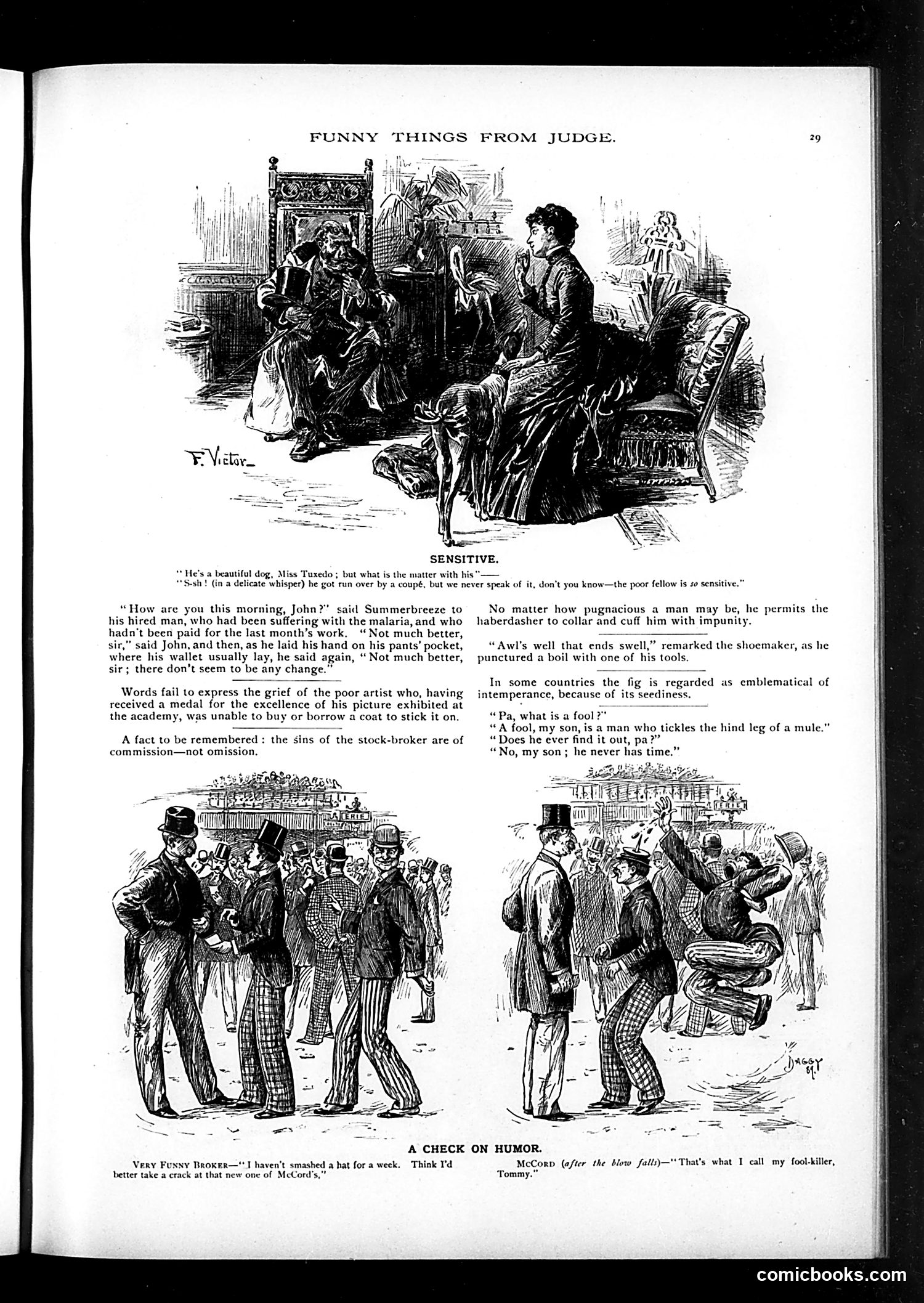
This page collects brief satirical jokes and humorous observations typical of late 19th-century American humor magazine *Judge*. **Key humor targets:** 1. **Upper-class affectation**: A woman euphemistically describes her dog's accident as the "poor fellow is so sensitive"—mocking excessive gentility. 2. **Working-class struggle**: A hired man hasn't been paid in a month; his wordplay about lacking "change" critiques economic hardship. 3. **Artistic poverty**: An artist receives honors but cannot afford formal wear to display his medal—satirizing art world pretension versus actual compensation. 4. **Financial corruption**: Stock-brokers sin through "commission—not omission," likely referencing their exploitative fee practices. 5. **Class dynamics**: A haberdasher can "collar and cuff" even aggressive men—suggesting tradespeople's power over gentlemen through fashion dependence. The lower cartoons depict street vendors or working-class figures in what appears to be a "check on humor" about aggressive salesmanship.
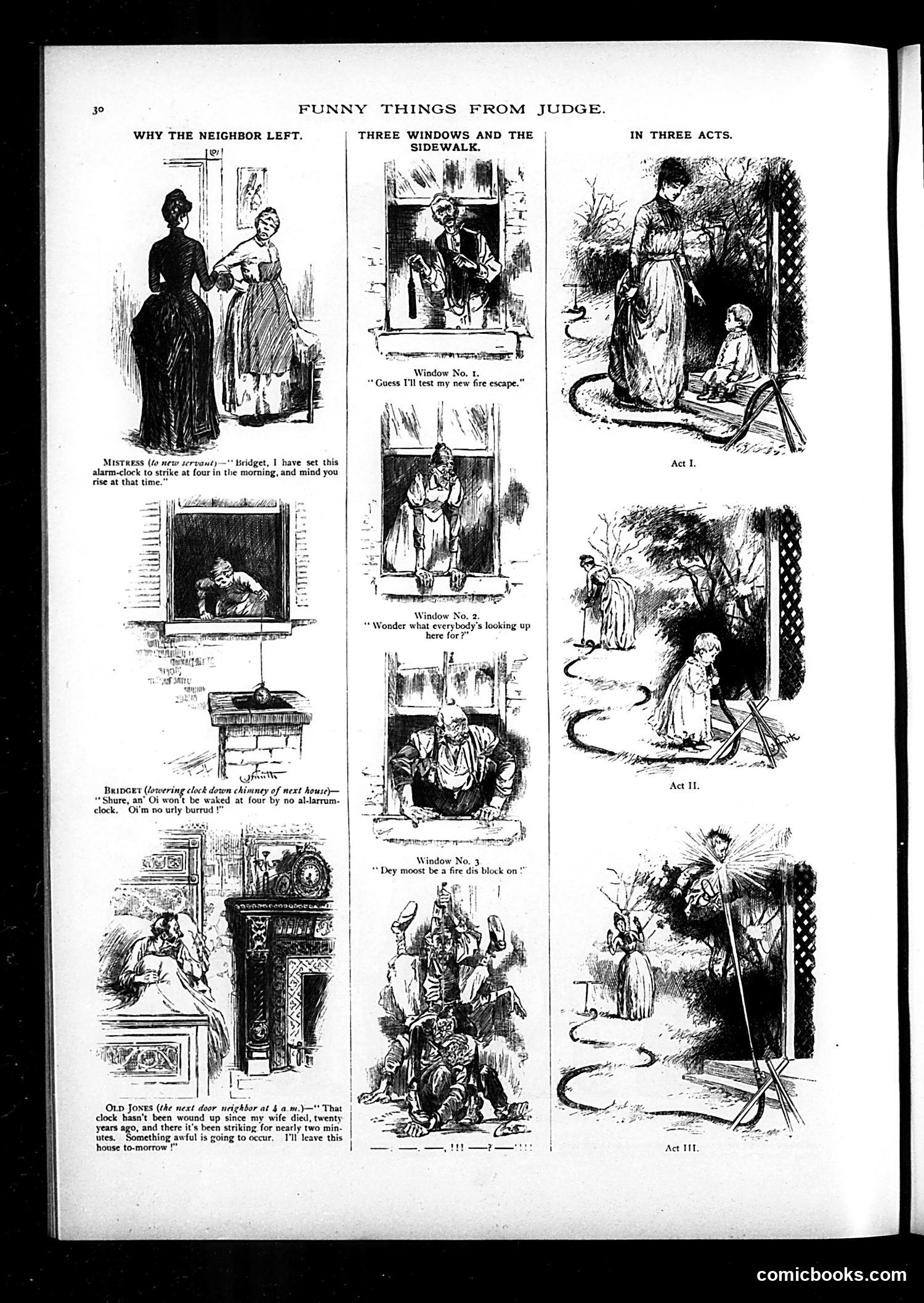
This three-act visual narrative satirizes servant behavior and neighborly assumptions during the Victorian period. **The Setup:** A mistress sets her servant Bridget's alarm clock to wake at 4 a.m. Rather than comply, Bridget (a common Irish servant name stereotype) lowers the clock down the chimney of the neighboring house to avoid waking herself. **The Escalation:** The neighbor, Old Jones, hears the clock striking repeatedly at odd hours. Assuming the disturbance signals impending disaster—perhaps a fire or catastrophe—he flees in panic, deciding to leave the neighborhood entirely. **The Joke:** The humor relies on Irish servant stereotypes (refusing to obey), the chain reaction of misunderstanding, and the absurdity of Jones's overreaction. What appears ominous to him is actually mere mischief, yet causes him to abandon his home. The satire targets both servant insubordination and middle-class anxiety about neighborhood disruptions.
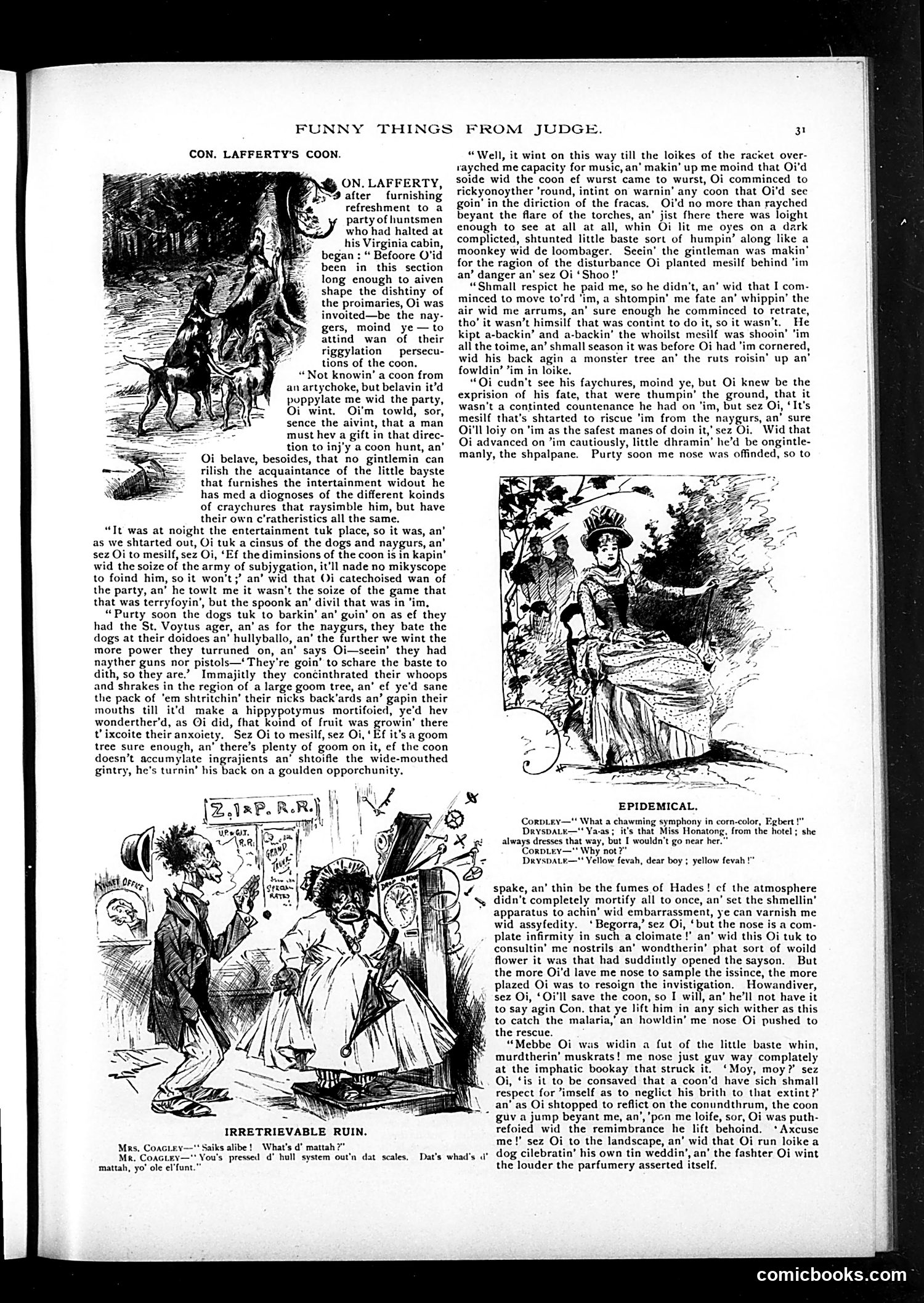
This is a racist dialect story from Judge magazine featuring an Irish character ("Con. Lafferty," identifiable by his heavy Irish brogue spelling: "Oi," "sez," "wid") recounting a coon hunt in Virginia. The "humor" relies on two layers of ethnic mockery: Irish immigrants depicted through exaggerated dialect, and dehumanizing caricature of Black people as animals to be hunted. The story describes Lafferty participating in a hunt where a Black person is pursued like game, cornered against a tree, with the narrator treating this as entertainment. This reflects late 19th-century American satirical magazines' casual racism—both toward immigrants and, more viciously, toward Black Americans. The "coon" in the title deliberately conflates a person with an animal, reinforcing the dehumanization central to the "joke." Modern readers should recognize this as a historical artifact of deeply offensive racial attitudes presented as mass entertainment.
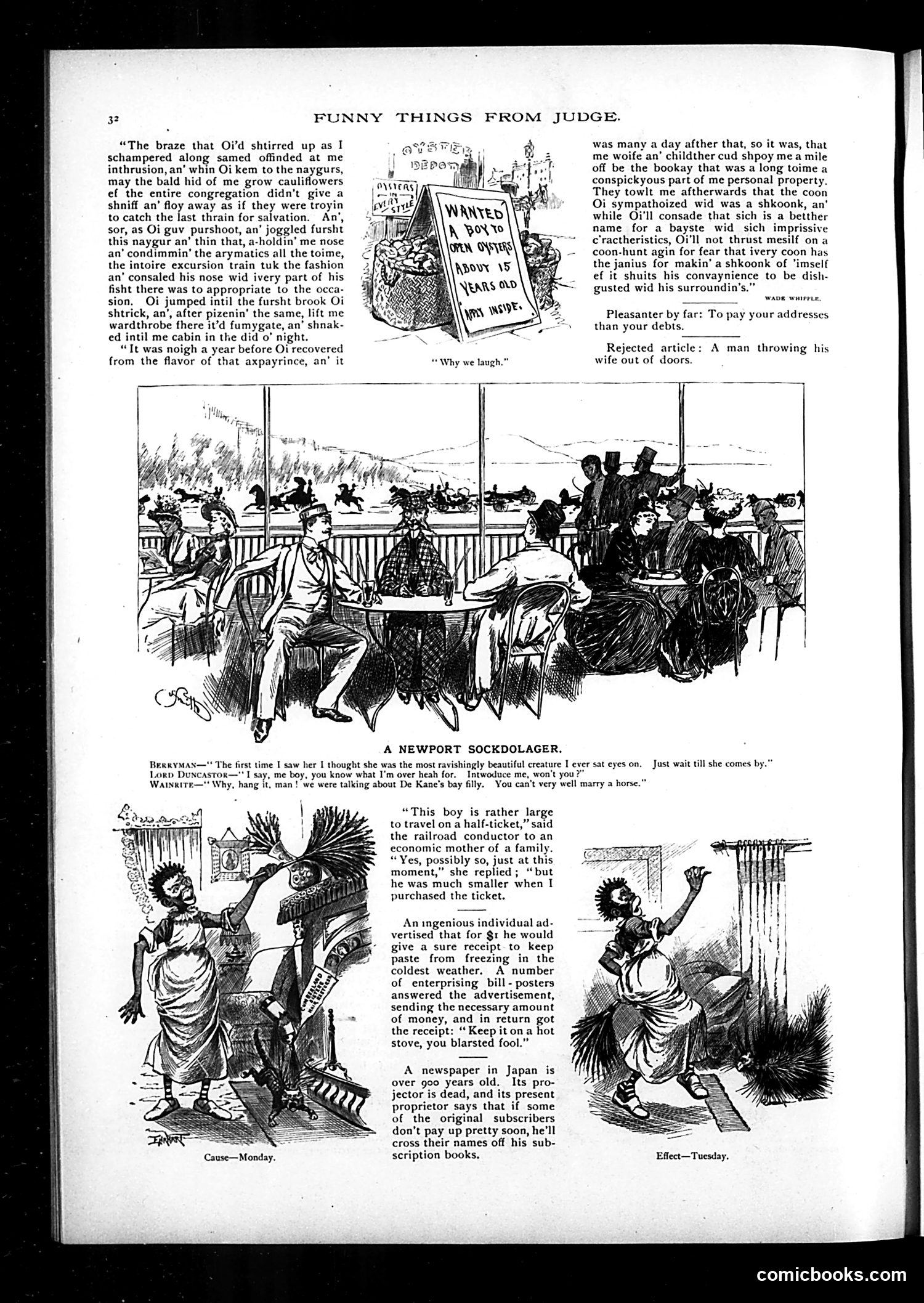
This page from *Judge* contains three separate humor pieces: 1. **Top narrative** (Irish dialect): An Irishman recounts encountering a skunk while pursuing game animals, mistaking it initially for a raccoon. The crude racial language reflects the era's offensive stereotypes. The joke relies on the mishap of getting sprayed and the lingering stench. 2. **"A Newport Sockdolager"** (middle): A social satire about wealthy Newport society. A British nobleman and American interact at what appears to be a horse racing venue, with comedic misunderstandings about introductions and relationships—mocking upper-class pretension and transatlantic social dynamics. 3. **Bottom vignettes**: Brief jokes about railway conductors, a con-artist's "paste recipe," and a centuries-old Japanese newspaper with delinquent subscribers. These are disconnected one-liners typical of the magazine's format. The overall tone is genteel satire targeting social climbers, immigrants, and petty schemes—characteristic of *Judge*'s middle-class readership.
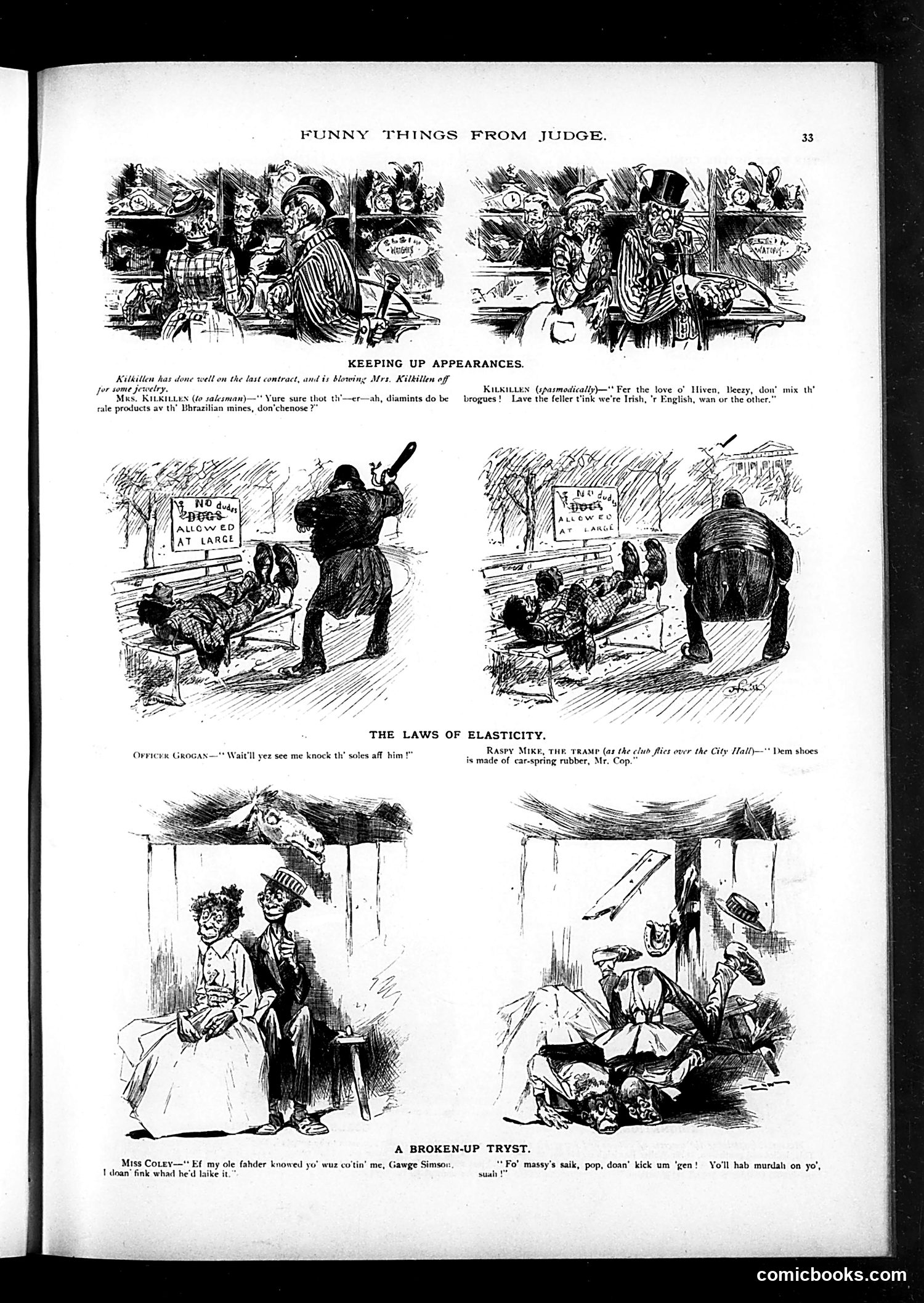
This page contains three separate comic strips satirizing working-class and immigrant life in America. **"Keeping Up Appearances"** mocks social pretension: An Irish laborer (Kilkillen) who's earned money from a contract now buys his wife jewelry to appear prosperous. His wife insists the diamonds are Brazilian to seem refined, while he worries about appearing Irish or English rather than wealthy. **"The Laws of Elasticity"** jokes about a tramp's resilience: A vagrant gets hit by a club but bounces back elastically (like rubber shoes). The cop and officer discuss the tramp's durability with dark humor. **"A Broken-Up Tryst"** depicts a courtship interrupted by class anxiety: A young man warns his Irish girlfriend that her father would violently disapprove of their relationship if he discovered them courting, threatening "murdah." The page collectively satirizes immigrant anxieties about assimilation, class mobility, poverty, and parental authority—typical Judge magazine humor targeting Irish-Americans and the urban poor.
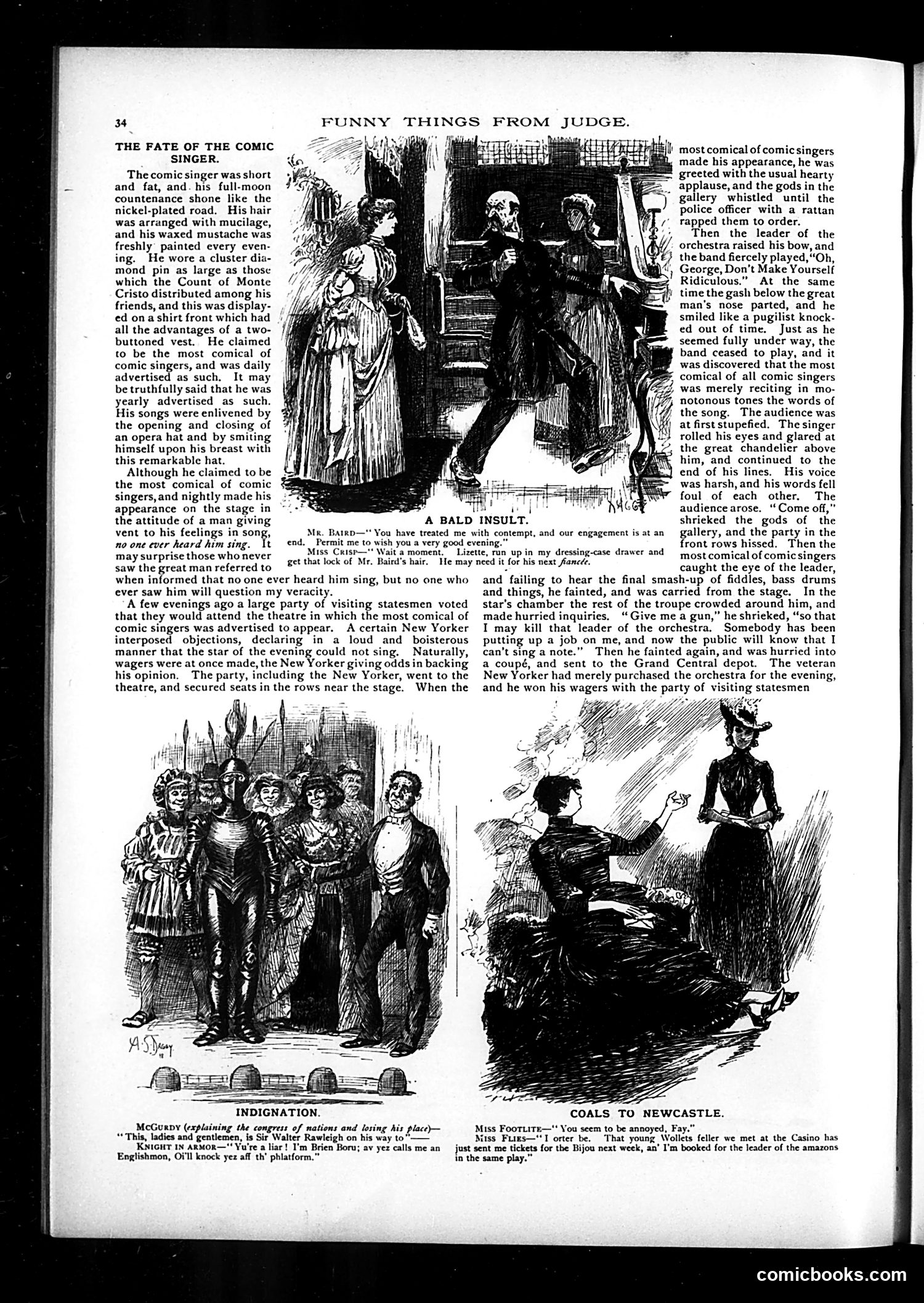
This page satirizes a fraudulent performer—a vain, heavily made-up comic singer famous for theatrical antics (opening his opera hat, striking himself) rather than actual talent. The satire's central joke: **he cannot sing at all**—he merely lip-syncs or recites the lyrics in monotone while the orchestra plays. When visiting statesmen attend a performance, a skeptical New Yorker bets the singer is a fraud. The wager is won when the orchestra stops mid-performance, exposing the singer's deception to the audience, who heckle him off stage. The satire targets **show-business charlatans**—performers whose reputations rest entirely on promotion and spectacle rather than genuine ability. The elaborate costume details (diamond pin, waxed mustache, painted appearance) emphasize how artifice substitutes for merit. The story mocks both the faker and the credulous public who accept advertised claims uncritically. The three smaller cartoons below offer unrelated comic vignettes about social embarrassments.
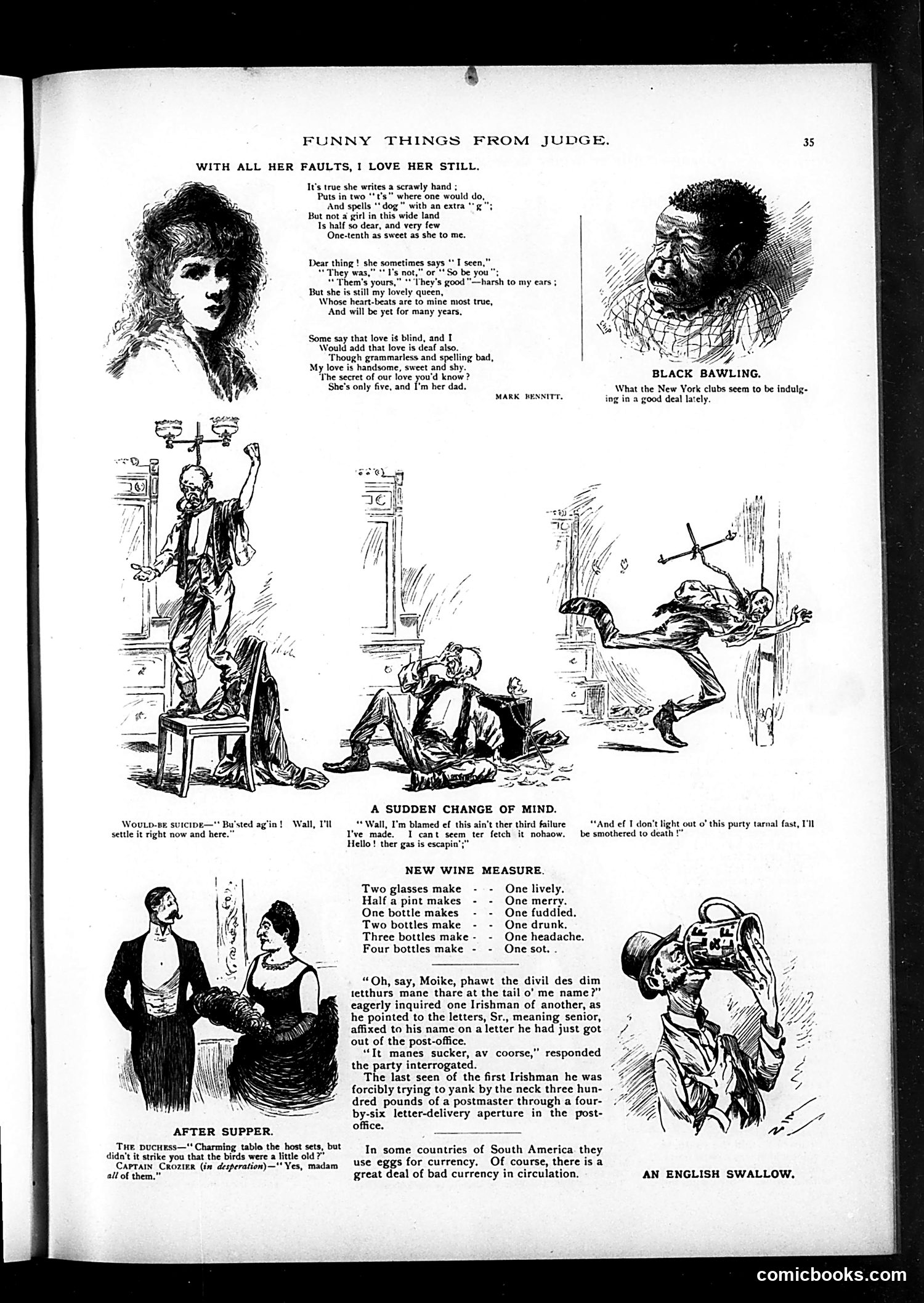
This page contains multiple satirical pieces typical of late 19th/early 20th-century American humor: **"With All Her Faults, I Love Her Still"** (Mark Bennitt poem): A sentimental piece about loving a woman despite her grammatical errors and poor handwriting—satirizing romantics who overlook obvious flaws. **"Black Bawling"**: A caricatured African American face accompanies a jab at New York clubs indulging in excessive emotional display. **"A Sudden Change of Mind"**: Three sequential panels showing a would-be suicide repeatedly failing at his attempts, played for dark comedy. **"New Wine Measure"**: A humorous scale correlating alcohol consumption with progressive intoxication levels. **Irish Characters section**: Mocks Irish immigrants' speech patterns and dialect, with a crude joke about an Irish postal worker misinterpreting "Sr." (senior) as an insult. **"After Supper"**: A joke about old game birds at a dinner party. The page reflects period attitudes toward immigrants, racial caricature, and suicide as comedy—content modern readers would find offensive.
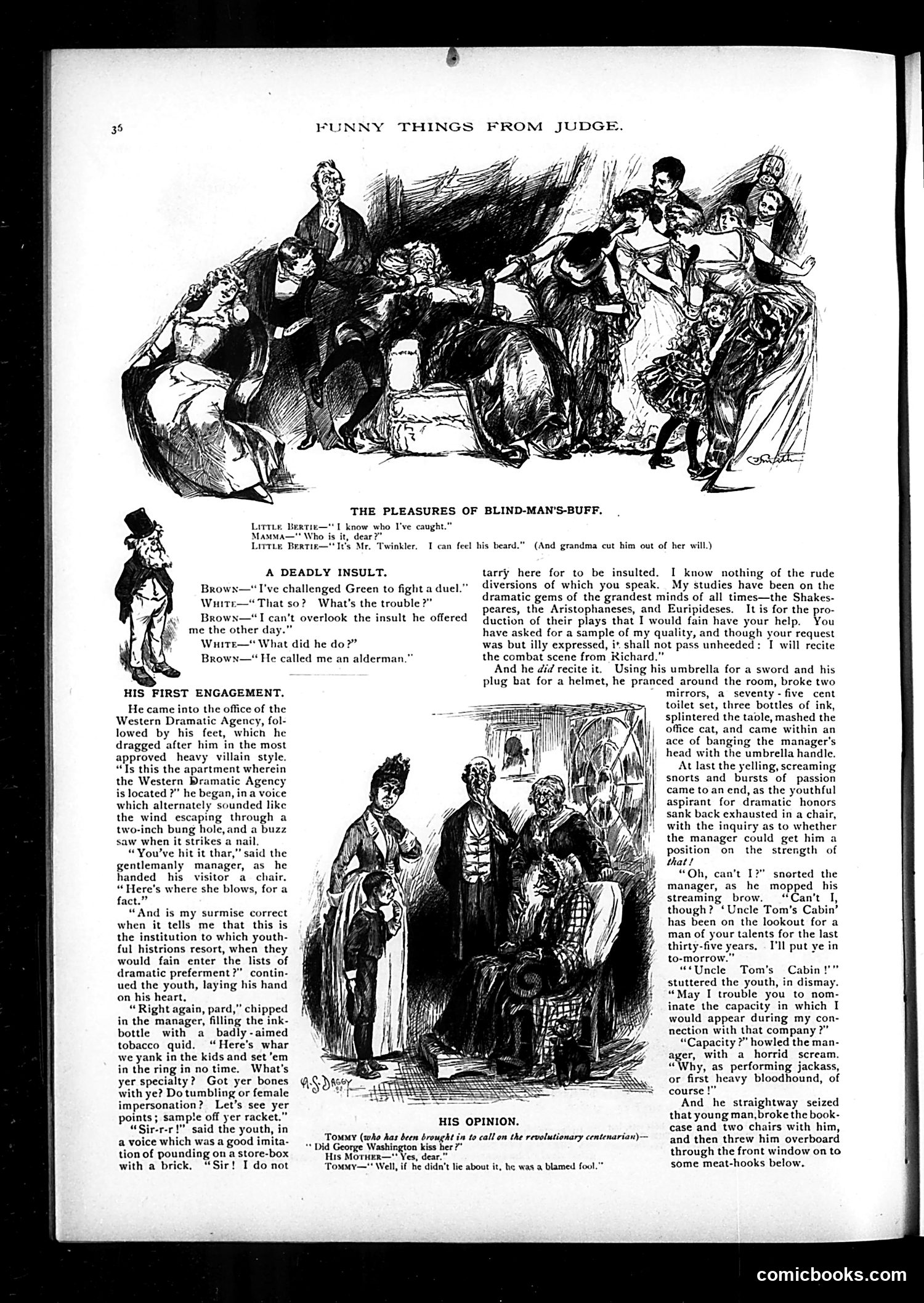
This page from Judge magazine contains three separate humorous sketches satirizing Victorian society and theater: **"The Pleasures of Blind-Man's Buff"** shows a child identifying someone as "Mr. Twinkler," apparently embarrassing the mother—likely mocking how children expose uncomfortable social truths. **"A Deadly Insult"** ridicules the absurdity of dueling culture by showing a man so offended at being called an "alderman" that he demands a duel. The joke is that being mistaken for a city official is supposedly a grave insult worthy of violence. **"His First Engagement"** mocks pretentious theatrical aspirants. A pompous young actor arrives at a talent agency using flowery, affected language, then destroys the office while reciting Shakespeare dramatically. The agency manager, unimpressed, offers him work as a donkey in "Uncle Tom's Cabin"—a devastating insult suggesting the actor belongs with animals, not in legitimate theater. The humor targets class pretension, theatrical melodrama, and the clash between aspirational youth and pragmatic reality.
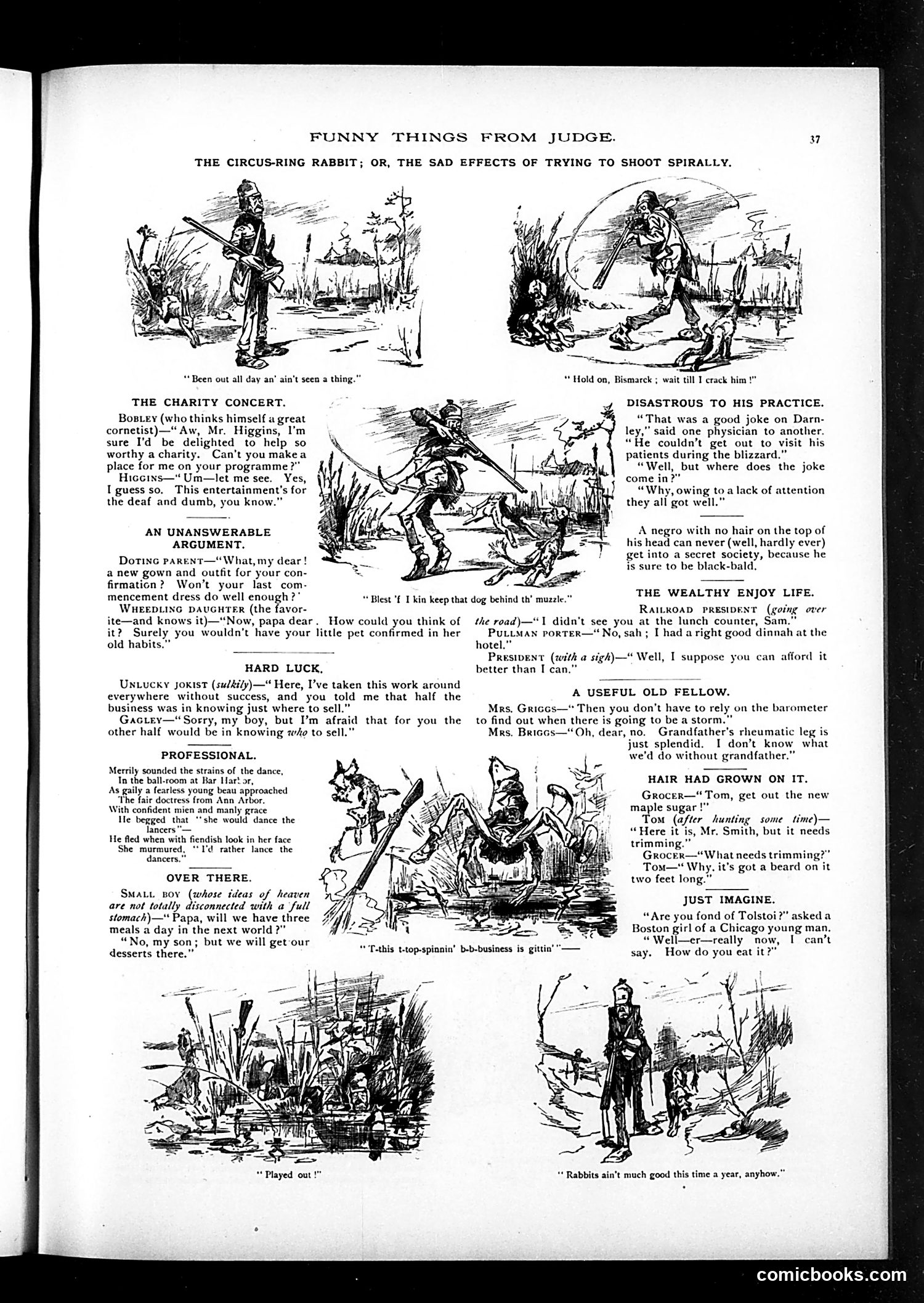
This page collects brief satirical jokes and cartoon vignettes typical of Judge magazine's humor. Key examples: **"The Charity Concert"**: A would-be musician offers to perform at a benefit for deaf-mute people—the joke being his obliviousness to the absurdity (they cannot hear him). **"Hard Luck"**: A struggling writer learns that success requires both knowing *where* to sell work and knowing *how* to sell it—he lacks the latter skill. **"Professional"**: A young man asks a female doctor to dance; she threatens to "lance the dancers," a dark medical pun that frightens him away, satirizing women in professional roles. **"The Wealthy Enjoy Life"**: A railroad president envies his porter's better meal, mocking the irony of wealth not guaranteeing comfort. **Various puns** on "black-bald" (bald-faced), a barometer substitute (grandfather's rheumatic leg), and other wordplay. The cartoons reflect Victorian-era concerns: social climbing, professional women, economic inequality, and genteel humor based on linguistic wit rather than visual comedy.
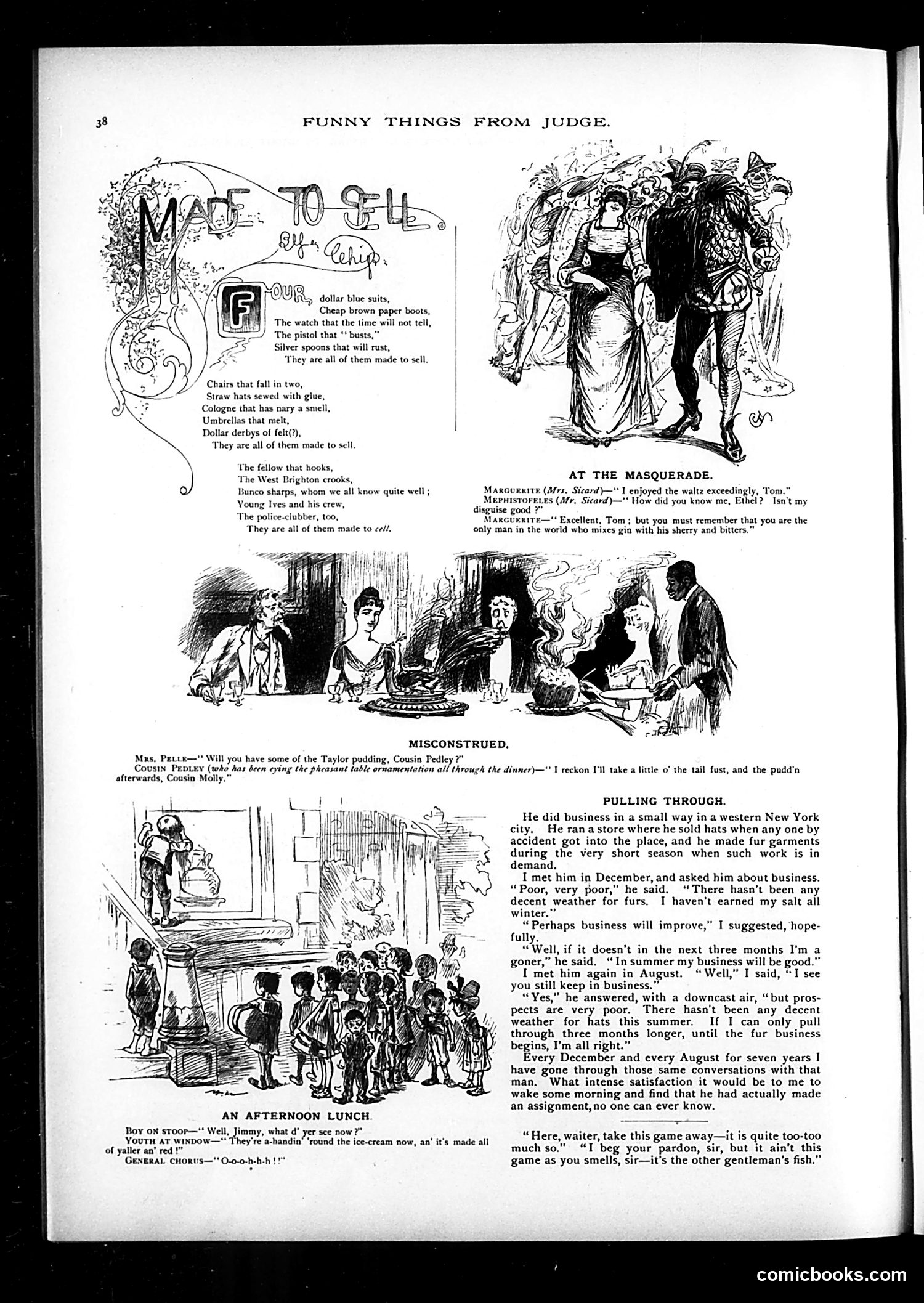
This page contains several humorous sketches satirizing everyday life and social pretension in late-19th-century America. **"Made to Sell"** opens with a poem mocking cheap, fraudulent goods—worthless products deliberately manufactured to deceive consumers. The list includes defective hats, watches, and silverware, reflecting anxieties about industrial-era consumer fraud. **"At the Masquerade"** satirizes pretentious society types who fail at disguise. A man's habit of mixing gin with sherry and bitters is so distinctive that his wife recognizes him despite his costume—mocking his peculiar drinking habits as a giveaway. **"Misconstrued"** plays on a country visitor's misunderstanding: he mistakes a decorative pheasant on the dinner table for actual food, asking to eat "the tail fust." **"Pulling Through"** satirizes an incompetent shopkeeper who perpetually blames external circumstances (weather, seasons) for his business failures, never accepting personal responsibility. His predictable excuses repeat yearly for seven years. **"An Afternoon Lunch"** depicts children observing ice cream distribution and a waiter's sardonic comeback to a fastidious diner complaining about "gamy" food—implying the problem is the customer's poor hygiene, not the game.
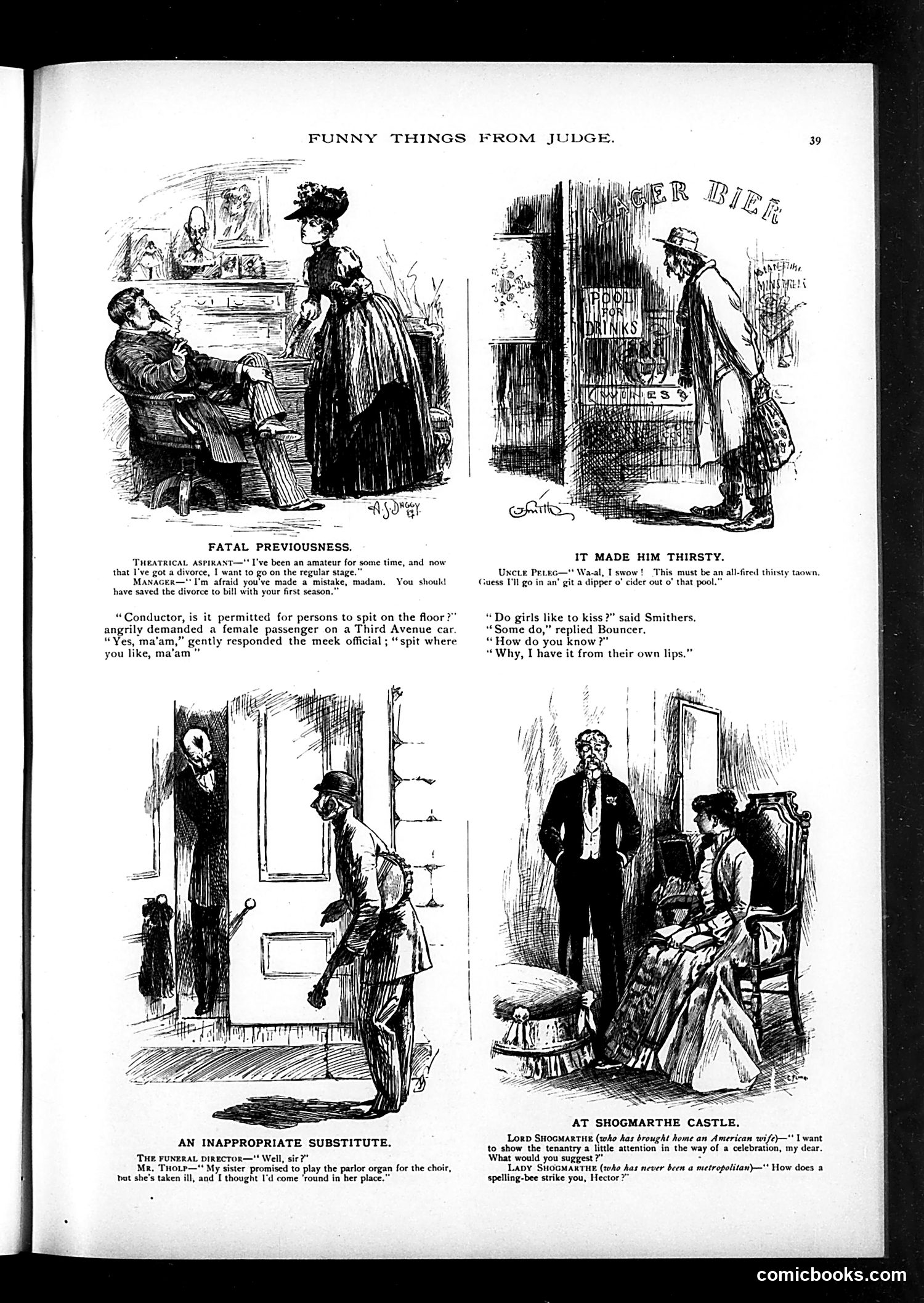
This page collects four brief satirical jokes typical of late 19th-century American humor: **"Fatal Previousness"**: A divorced woman seeks stage work, but a theater manager jokes she should have saved her divorce announcement for publicity with her first theatrical season—satirizing both theatrical shamelessness and the scandal of divorce. **Spitting joke**: A woman complains about floor-spitting on public transit; the conductor permits it anywhere—mocking the filthy conditions of urban streetcars and indifferent public service. **"An Inappropriate Substitute"**: A man offers to substitute for his ill sister at a funeral organ—the dark joke being his complete unsuitability (the implication: he'll botch it badly). **"It Made Him Thirsty"** and **"At Shogmarthe Castle"**: Rural/dialect humor and fish-out-of-water comedy about an American bride in an English castle, suggesting spelling-bees as entertainment to English aristocrats. These represent Judge's formula: social observation mixed with wordplay and class-based humor aimed at educated urban readers.
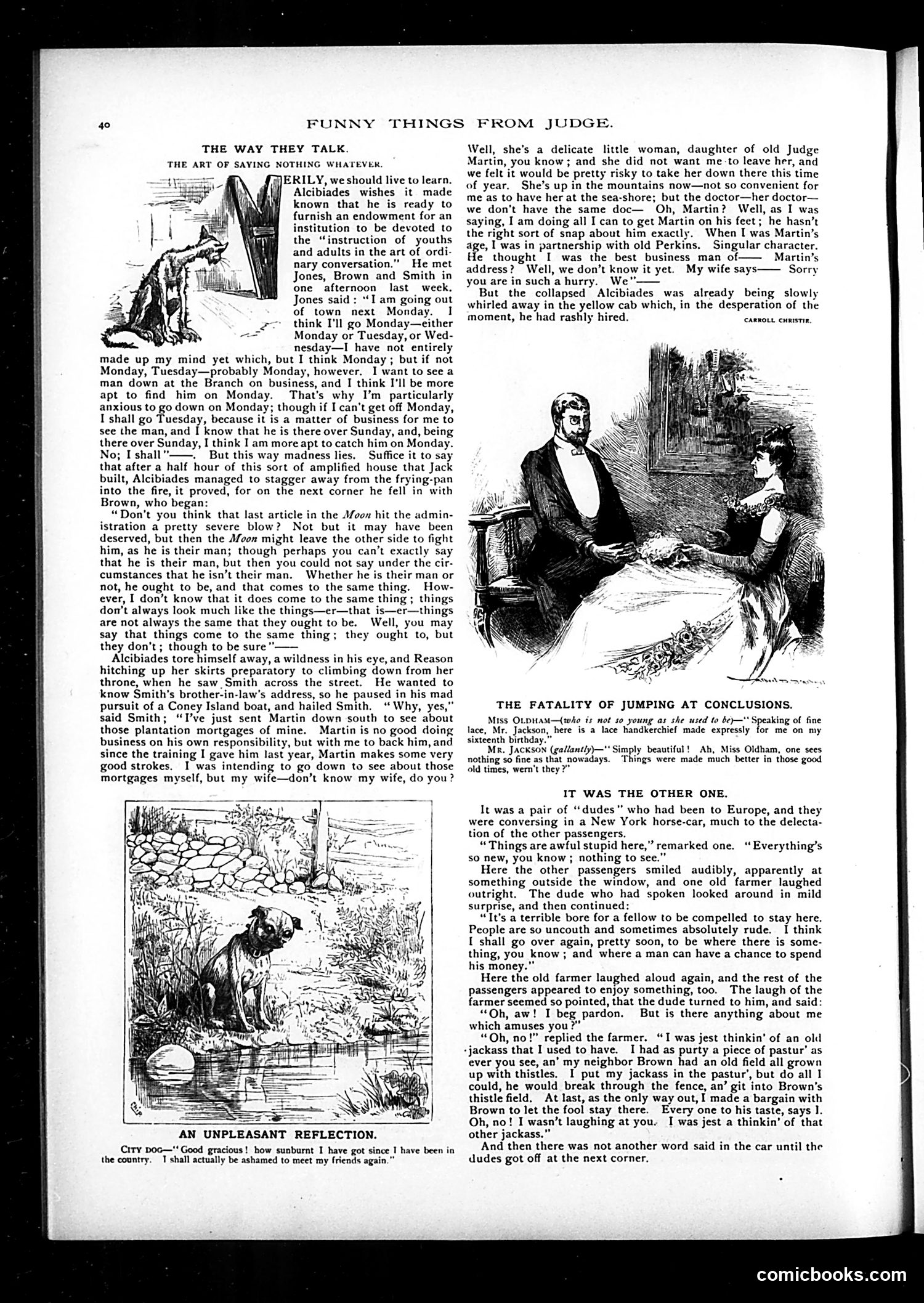
This page satirizes verbose, meandering conversation—specifically the American tendency to talk at exhausting length while saying almost nothing substantive. The main article mocks three characters (Jones, Brown, Smith) who exemplify this failing. Jones rambles for half an hour about *when* he's traveling, never reaching a point. Brown delivers an equally circular monologue about a newspaper article's political impact, trailing into philosophical tangents. Smith goes on about his brother-in-law's address while digressing into family matters and business advice. The satire targets upper-middle-class men who confuse verbosity with intelligence or importance. The opening references "Alcibiades" proposing an endowment to teach "the art of ordinary conversation"—ironic, since these speakers demonstrate the *anti*-art of conversation: repetition, qualification, and endless subordinate clauses that obscure rather than clarify meaning. The cartoons illustrate the tedium: one shows a man apparently escaping these bores. The secondary item "An Unpleasant Reflection" is unrelated—a joke about a sunburned city dog.
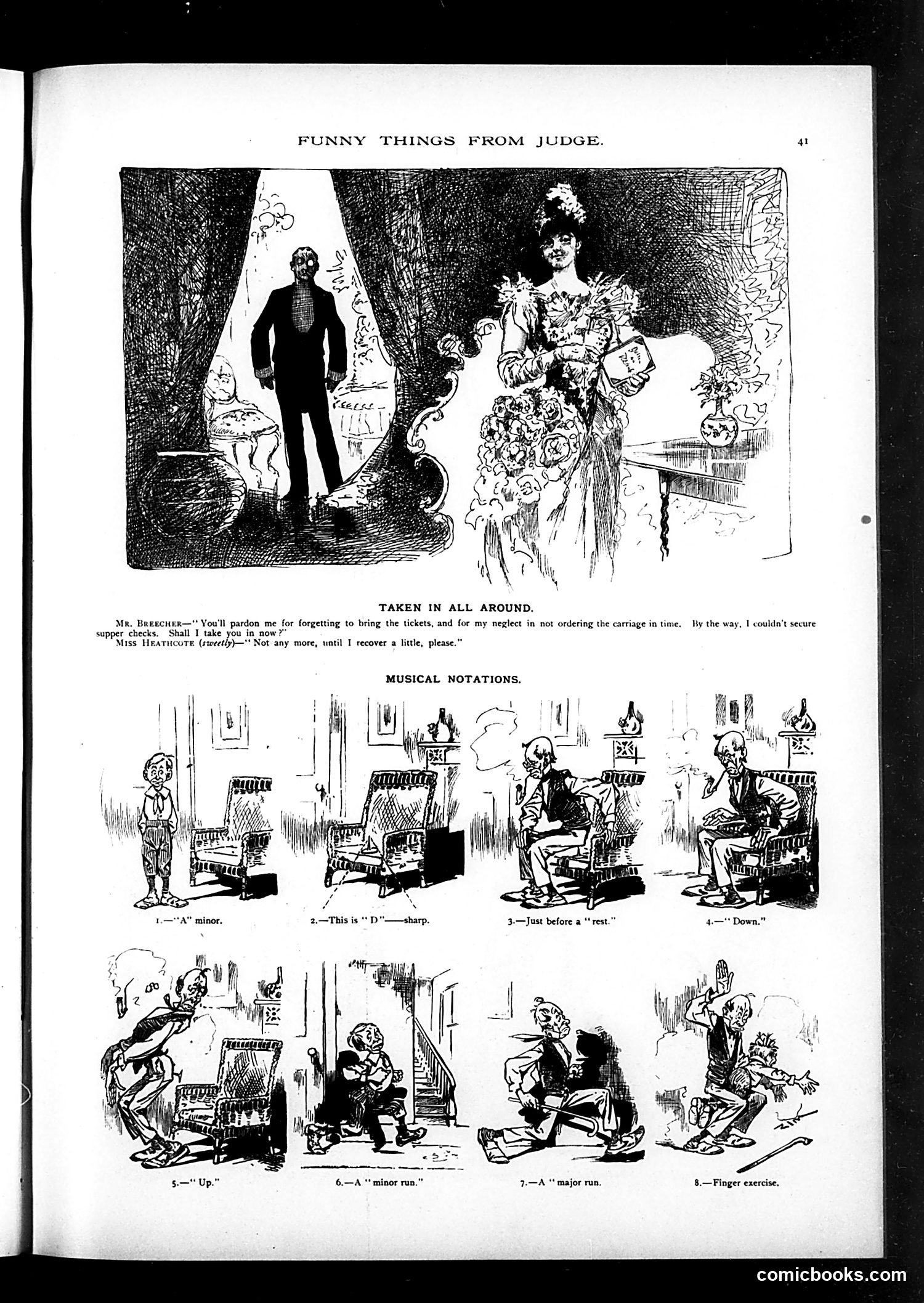
**"Taken in All Around"** is a romantic comedy cartoon mocking a bumbling suitor. Mr. Breecher has forgotten the theater tickets, failed to arrange transportation, and neglected to secure dinner vouchers—yet he still asks Miss Heathcote if she's ready to go out. Her sweetly sarcastic reply ("Not any more, until I recover a little") suggests she's exhausted by his incompetence and needs time to compose herself. **"Musical Notations"** is a visual pun depicting musical terms through physical comedy. Each panel shows a figure enacting a musical instruction literally rather than musically—"A minor run" shows someone running in a minor key-like posture, "Finger exercise" depicts actual finger movements, etc. This plays on double meanings of musical vocabulary, creating absurdist humor through physical exaggeration typical of Judge's satirical style. Both rely on genteel Victorian-era social situations and wordplay for their humor.
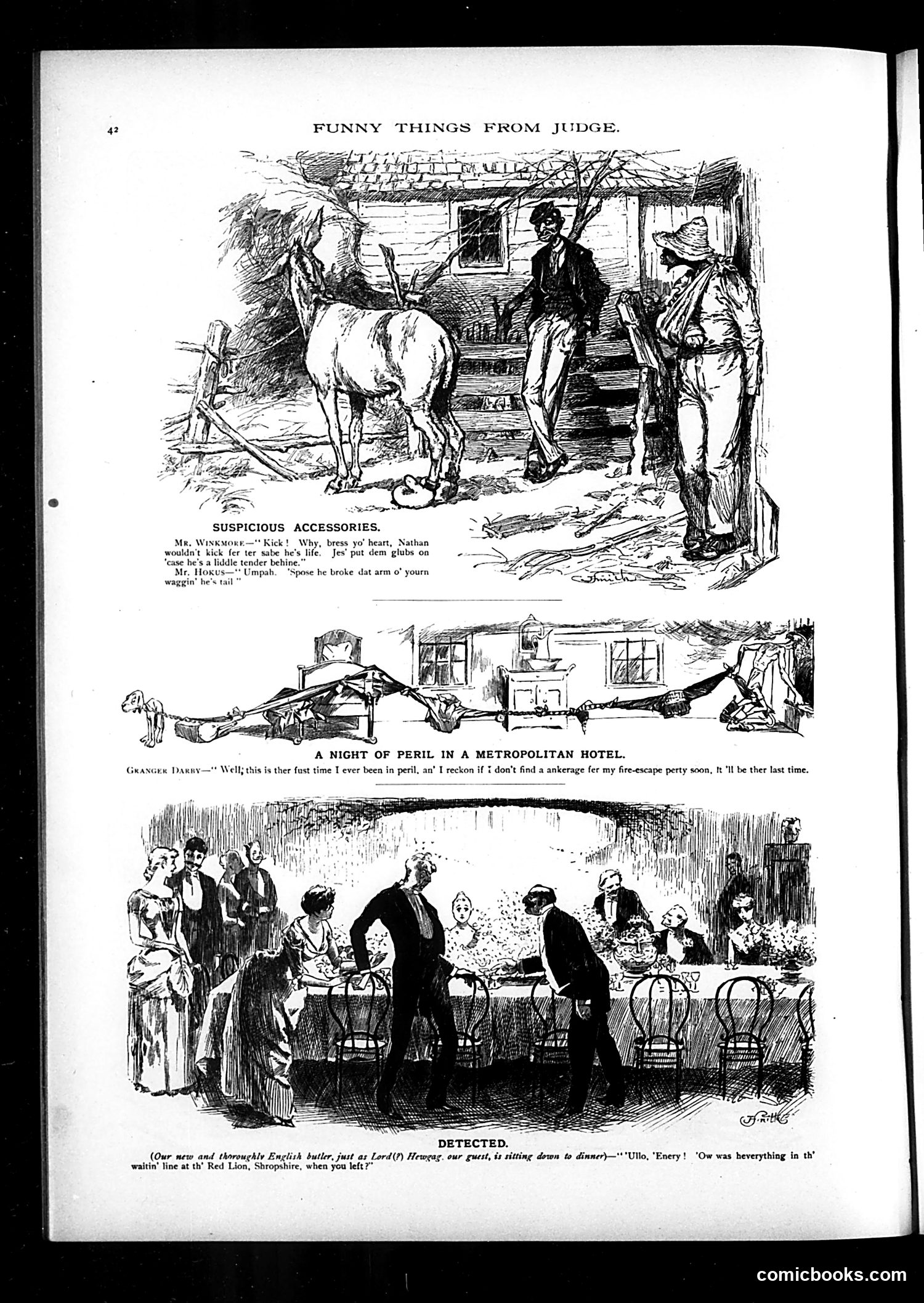
This page contains three separate humorous sketches from *Judge* magazine satirizing Victorian-era social situations. **"Suspicious Accessories"** shows a rural character (Nathan) defending his horse's unusual appearance—its saddle includes what appears to be a fire escape, leading to comic confusion about the animal's legitimate purpose. **"A Night of Peril in a Metropolitan Hotel"** depicts a country character (Gander Darby) comically treating a hotel stay as a dangerous adventure, seeking an "anchorage" for a fire escape—confusing urban architecture with nautical safety equipment. **"Detected"** satirizes class pretension: a newly hired "English butler" is caught when exposed as a fraud—he's recognized as a regular patron from a working-class pub (the Red Lion in Shropshire), revealing he's not actually an upper-class servant but an impostor trying to pass himself off as nobility's staff. The humor relies on social mobility anxieties and the clash between rural/working-class characters and urban/upper-class pretensions common to Victorian satire.
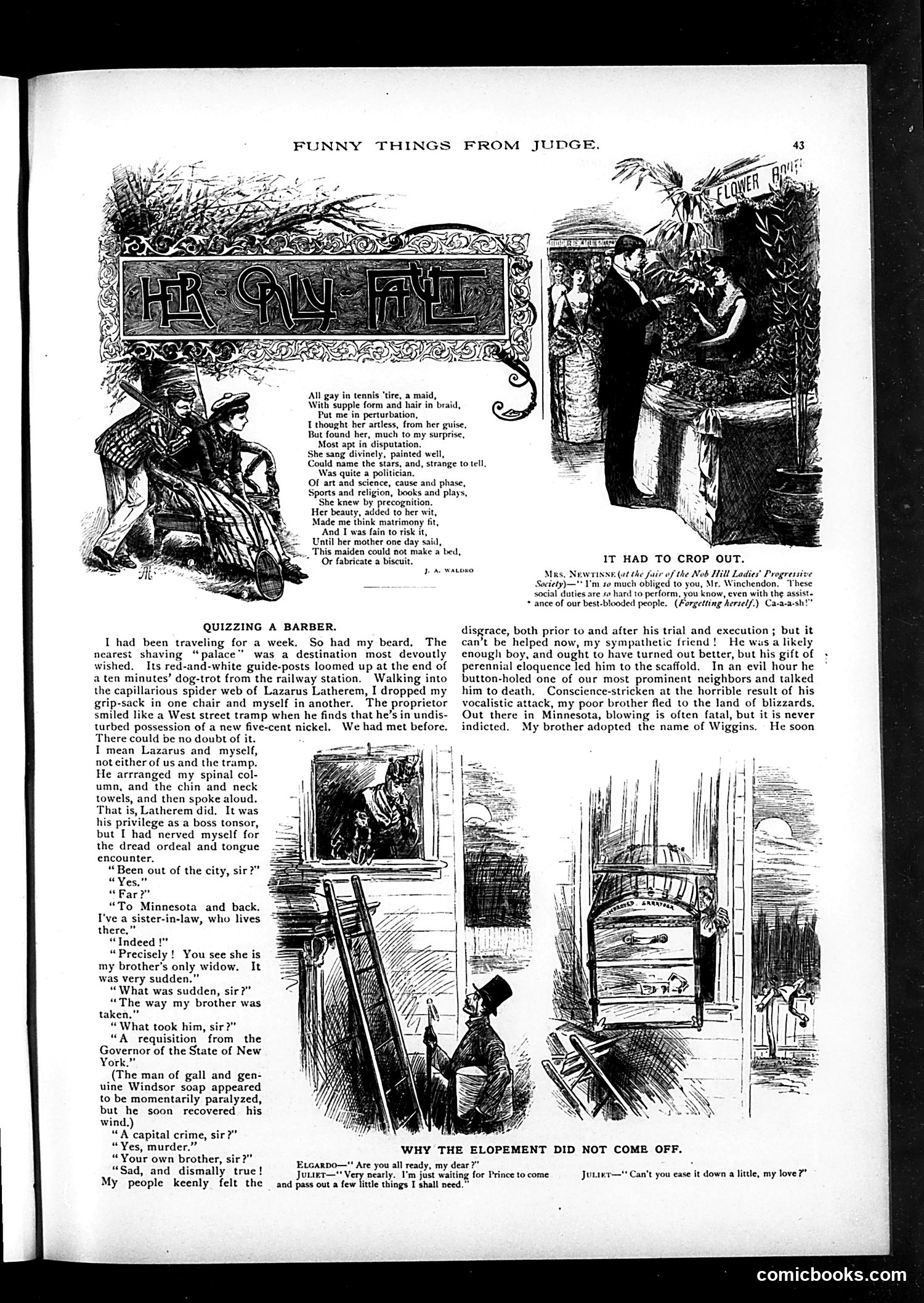
This page contains three separate humorous sketches satirizing social pretense and human folly: **"Her Gai'Fail"** (top left): A poem mocking educated women who possess accomplishments—singing, painting, astronomy, intellectual debate—yet lack basic domestic skills. The joke: her suitor found her charming until her mother revealed she couldn't cook or manage a household, undermining the value of her "modern" education. **"Quizzing a Barber"**: A traveler's conversation with a barber reveals the barber's nosiness. When told the traveler's brother was taken by requisition from New York's governor for murder, the barber is momentarily stunned—a comeuppance for his invasive questioning. The humor targets overly chatty service workers. **"Why the Elopement Did Not Come Off"** (bottom right): An illustration captioned with dialogue between eloping lovers—Juliet struggles with luggage while Edgar waits. The joke is unstated but visual: practical complications undermine romantic elopement. These reflect turn-of-century Judge magazine's targets: pretentious social climbers, class anxiety, and the gap between romantic ideals and domestic reality.
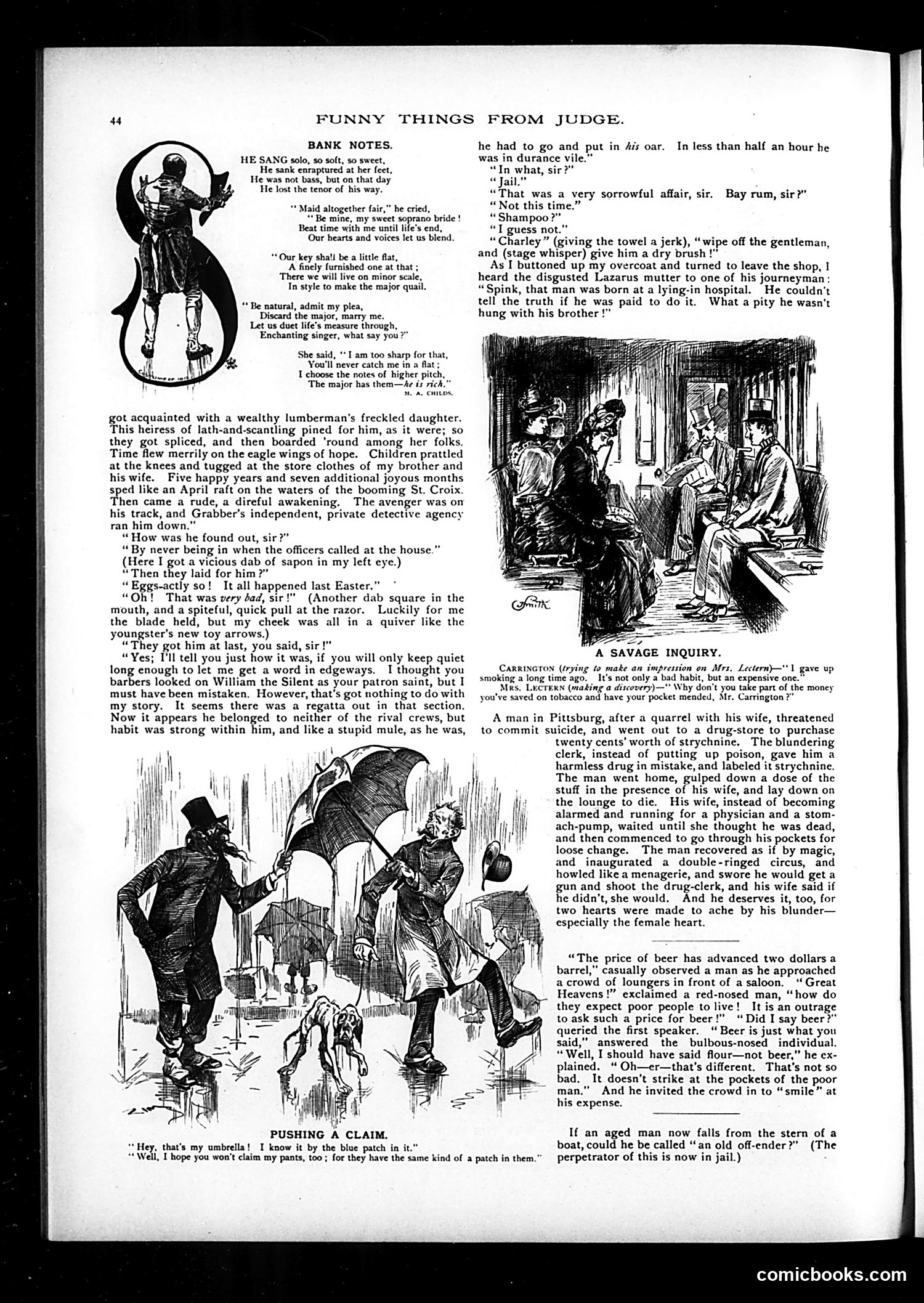
This page contains three distinct humorous pieces from *Judge* magazine: 1. **"Bank Notes"** (top): A poem-illustrated romance where a male singer courts a woman with musical metaphors ("soprano bride," "minor scale," "flat"). She rejects him, preferring a wealthy man—the "major" who is "rich." It's satire on mercenary marriage. 2. **"A Savage Inquiry"** (middle-right cartoon): Shows a man in ragged clothes confronting another about a patched umbrella. The joke plays on shared poverty—both have identical patches on their belongings, making the claim absurd. It mocks petty disputes between poor people. 3. **Main narrative** (center-left): A barber tells how a man married a lumberman's wealthy daughter, lived contentedly for five years, then was tracked down by detectives for unspecified crimes. The story is interrupted by the barber's impatient shaving, creating comedic tension. The ending—a suicide attempt foiled by a clerk's drug-store error—satirizes incompetence and dark fate. The page overall reflects late-19th-century American humor about class, marriage, and urban mishaps.
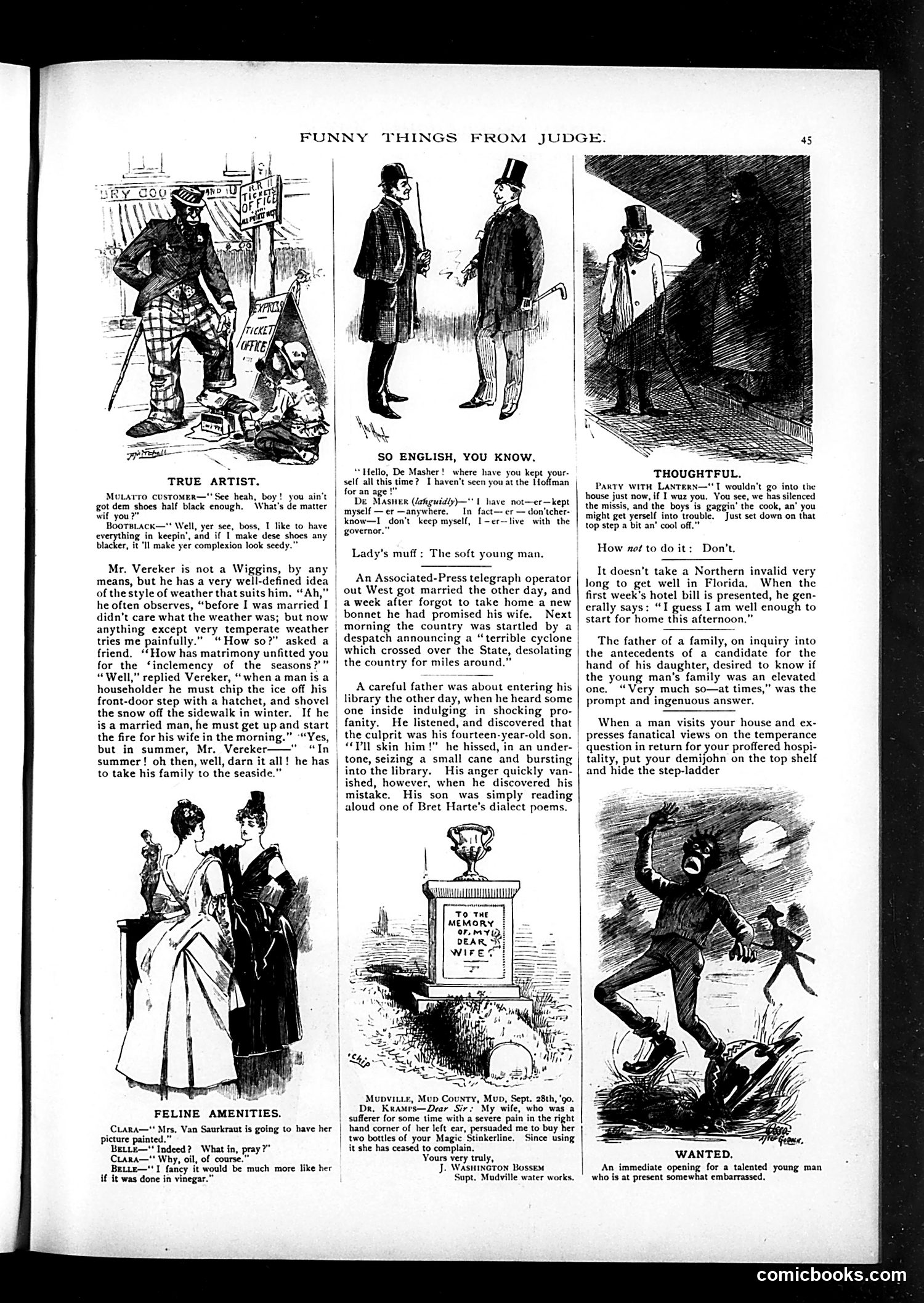
This is a humor page from *Judge* magazine featuring several satirical pieces and jokes typical of 1890s American comedy: **"True Artist"** mocks racial stereotypes through a dialogue where a Black shoeshine worker refuses to make shoes excessively black, claiming it would make his employer's complexion look "seedy"—a backhanded compliment playing on racist assumptions. **"Feline Amenities"** is a simple joke: women discussing painting Mrs. Van Saurkraut's portrait in oil, with one suggesting "vinegar" would be more fitting—implying the woman is sour-tempered. **"So English, You Know"** satirizes affected British mannerisms through a "dandy" character who claims not to "keep" himself but rather "lives with the governor" (his father). The remaining items are brief humorous anecdotes about domestic life, including a telegraph operator's accidental "cyclone" dispatch (a play on words), a father mistaking his son's reading of Bret Harte dialect poetry for actual profanity, and fake testimonials. The page emphasizes period-appropriate humor: class anxiety, gender relations, ethnic stereotyping, and domesticity.
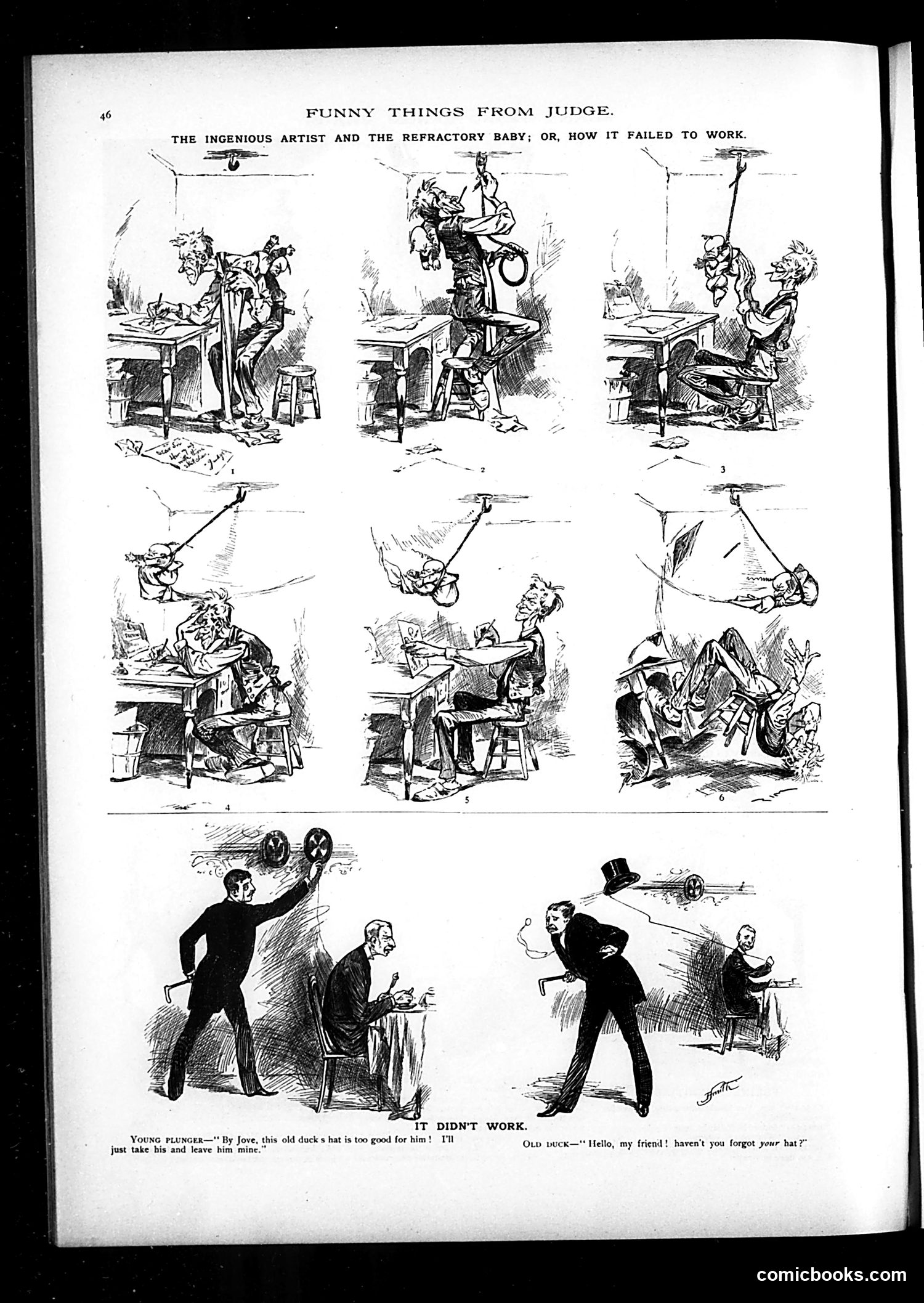
This satirical series mocks an artist's failed attempts to manage an uncooperative baby. The top six panels show escalating contraptions—pulleys, mechanical devices, and increasingly elaborate rigs—all designed to control or amuse an obstinate infant. Each fails spectacularly, with the baby resisting or the apparatus malfunctioning. The bottom two panels depict an unrelated joke about hat-swapping between a "young plunger" (likely a social climber or con artist) and an "old duck" (an established gentleman). The young man steals the older man's superior hat, but they later encounter each other, forcing an awkward confrontation about the switched headwear. Together, these vignettes mock both paternal incompetence and petty social scheming—common Judge themes mocking pretension and failed schemes in Gilded Age society.
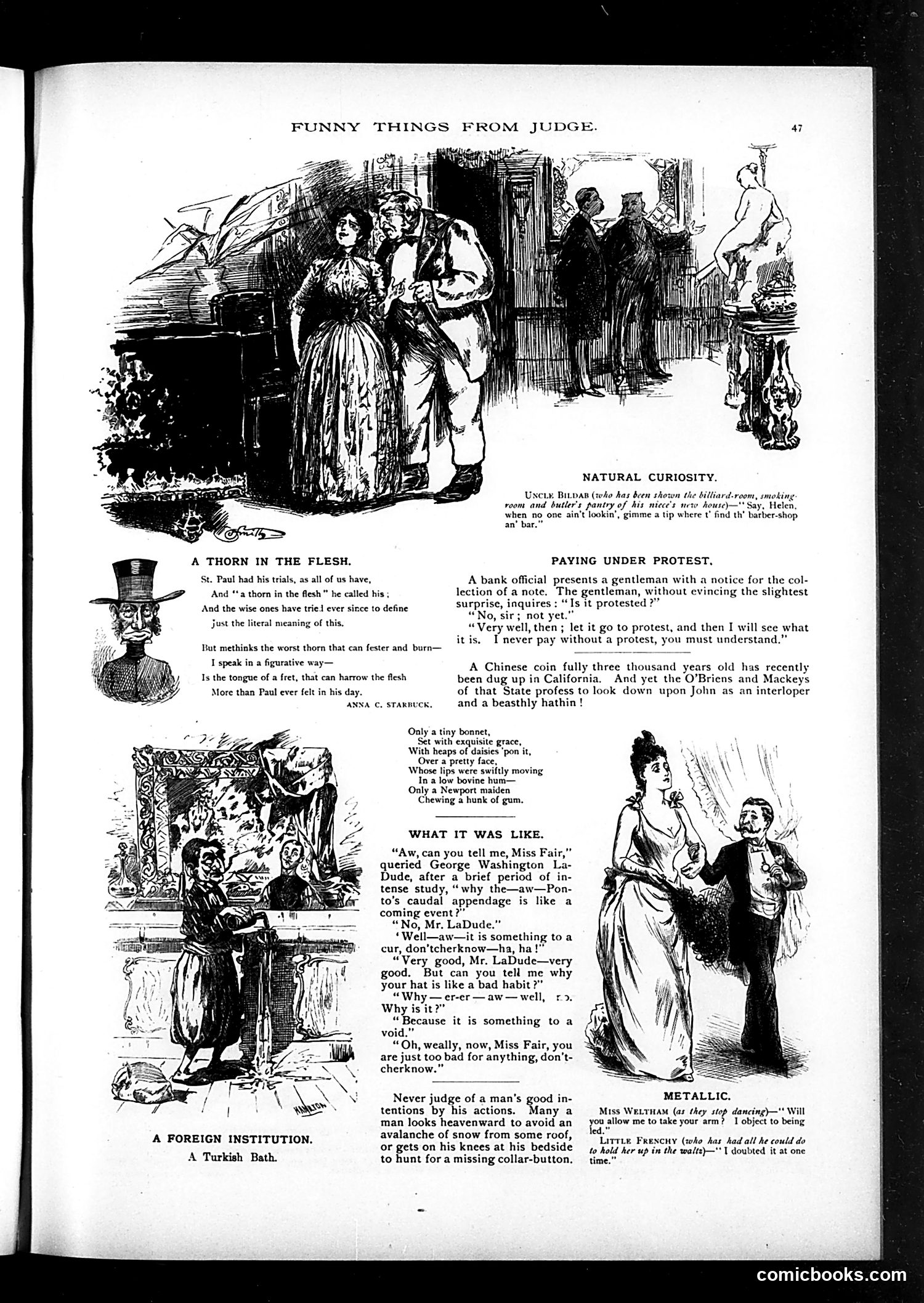
This page from the satirical magazine *Judge* contains several unrelated humorous sketches and jokes targeting American social pretensions and behavior: **"Natural Curiosity"** mocks working-class aspiration: Uncle Bildar, shown a wealthy relative's mansion rooms, only cares about locating the barber shop and bar—suggesting laborers' actual priorities differ from genteel refinement. **"A Thorn in the Flesh"** references St. Paul's biblical suffering but pivots to attacking gossip and malicious tongues as worse afflictions. **"Paying Under Protest"** satirizes financial evasion: a debtor deliberately requests his unpaid note be "protested" (formally disputed) to delay payment, viewing this technicality as a loophole. **The gum-chewing Newport maiden** ridicules upper-class women for adopting uncouth habits. **"What It Was Like"** presents a shallow dandy ("LaDude") attempting witty wordplay with a woman, who cleverly turns his riddles back on him—gentle mockery of masculine pretension. These sketches target American hypocrisy across class lines, from working-class materialism to upper-class affectation.
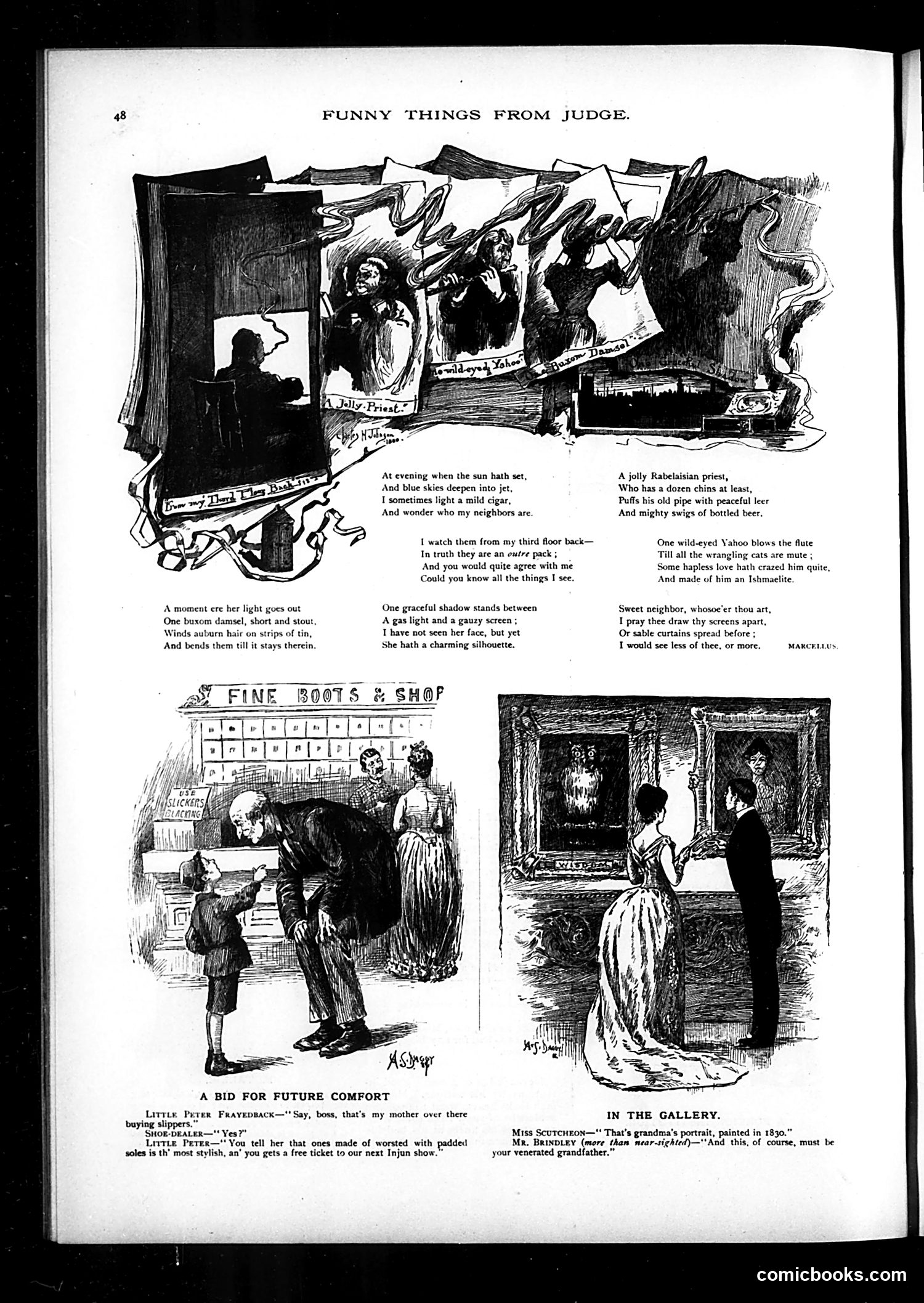
This page contains three separate humorous pieces typical of Judge magazine's satirical humor: **Top illustration**: A poetic voyeuristic piece titled "Silhouettes" where the narrator observes neighbors through windows and shadows, finding them amusing or intriguing. The humor relies on Victorian-era prudishness about privacy and the speaker's obsessive people-watching from his "third floor back." **Bottom left cartoon**: "A Bid for Future Comfort" satirizes childhood manipulation. Young Peter tries to trick a shoe salesman into recommending expensive padded shoes to his mother by promising he'll claim they're "stylish," earning the boy a free ticket to an "Injun show" (a traveling exhibition). The joke mocks both the child's scheming and the salesman's willingness to deceive customers. **Bottom right cartoon**: "In the Gallery" plays on near-sightedness. A myopic man mistakes a woman's grandmother's 1830 portrait for her grandfather—the joke being his assumption about gender based on painting age/style rather than appearance. All three pieces target genteel society's foibles and absurdities through gentle mockery.
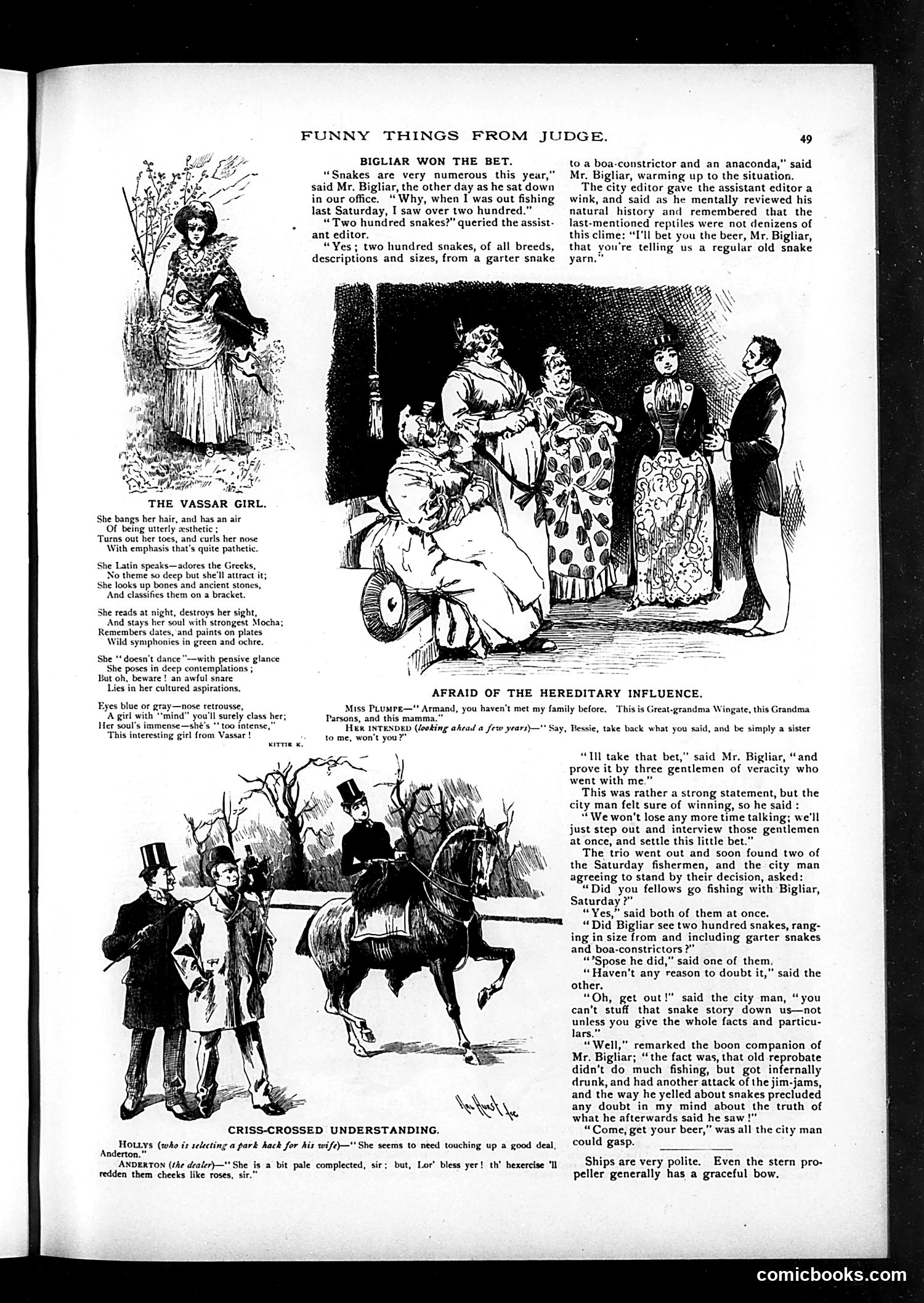
This page contains three satirical pieces typical of late 19th-century humor: **"The Vassar Girl"** mocks educated women, particularly college attendees. The poem ridicules affectations of intellectual women—their aesthetic pretensions, classical learning, and artistic pursuits—while suggesting their education masks superficiality and makes them socially awkward ("doesn't dance"). This reflects period anxieties about women's higher education. **"Bigliar Won the Bet"** satirizes tall-tale telling and masculine braggadocio. A man claims seeing 200 snakes including anacondas (impossible in the setting), betting beer on his story. When confronted with witnesses, they admit he was drunk and hallucinating ("jim-jams"—delirium tremens). The joke exposes how men validate each other's obvious lies for camaraderie. **"Afraid of the Hereditary Influence"** jokes about genetics and courtship. A suitor, meeting his girlfriend's homely female relatives, fears hereditary ugliness and wants to downgrade her to "sister" rather than wife—suggesting women's value depends on appearance and family traits.
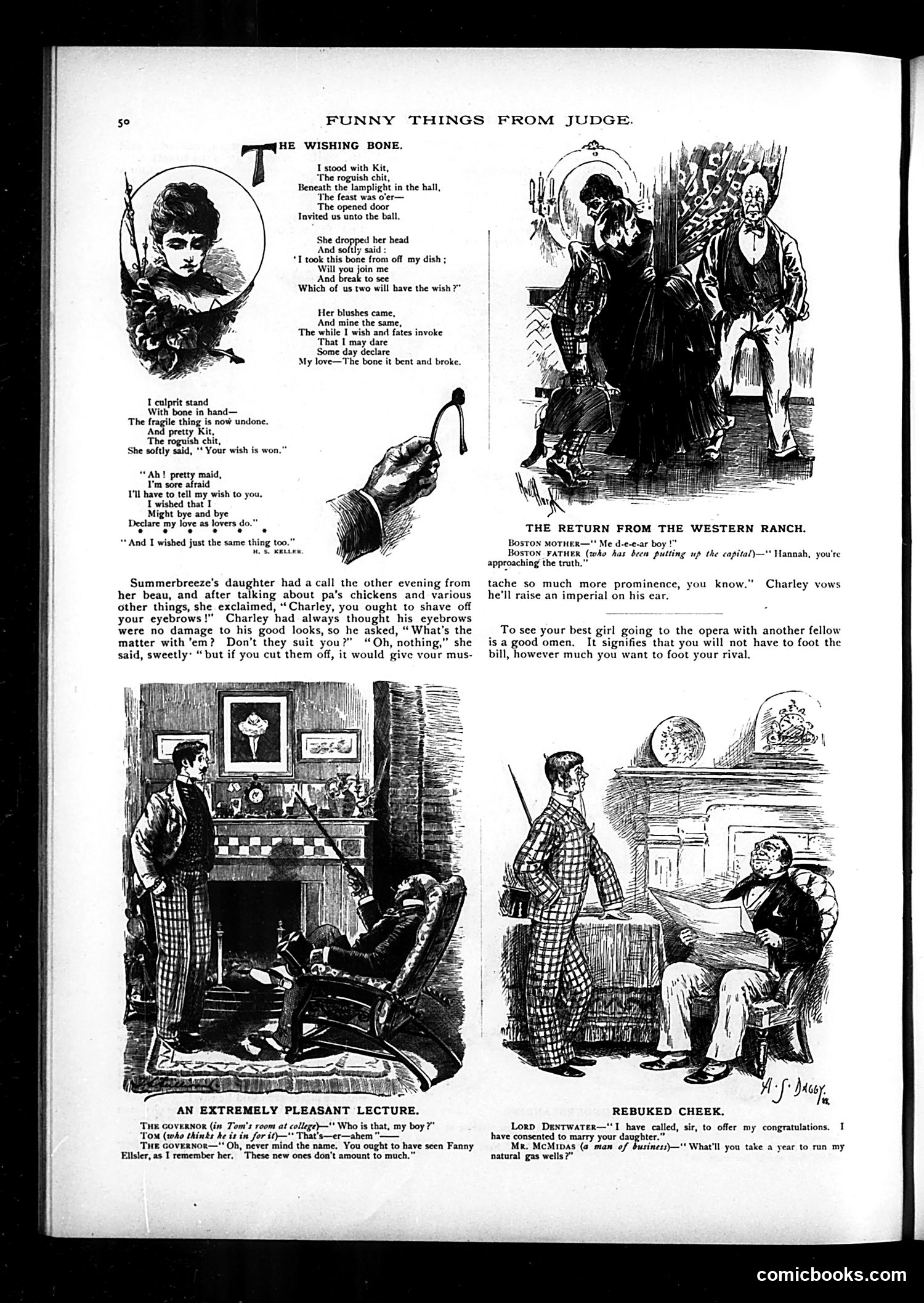
This page contains four separate humorous sketches typical of late-19th-century satirical magazine content: **"The Wishing Bone"**: A romantic poem about two young people breaking a wishbone together, each secretly wishing to declare their love—which they then discover they share. It's sentimental humor playing on courtship conventions. **"An Extremely Pleasant Lecture"**: A father visits his son at college and dismissively compares modern actresses to the famous Fanny Elssler (a renowned 19th-century dancer), suggesting old things were better—poking fun at nostalgic older generations. **"The Return from the Western Ranch"**: A nouveau-riche father corrects his sentimental wife's greeting of their son, implying the boy's "success" in the West is actually just the father's invested capital working—satire on frontier economics and parental investment. **"Rebuked Cheek"**: An aristocrat (Lord Dentwater) offers congratulations on a daughter's engagement; the businessman father immediately redirects him toward business, suggesting the nobleman should work rather than live on status—class commentary on changing economic power. All rely on period-specific social assumptions about courtship, class, and commerce.
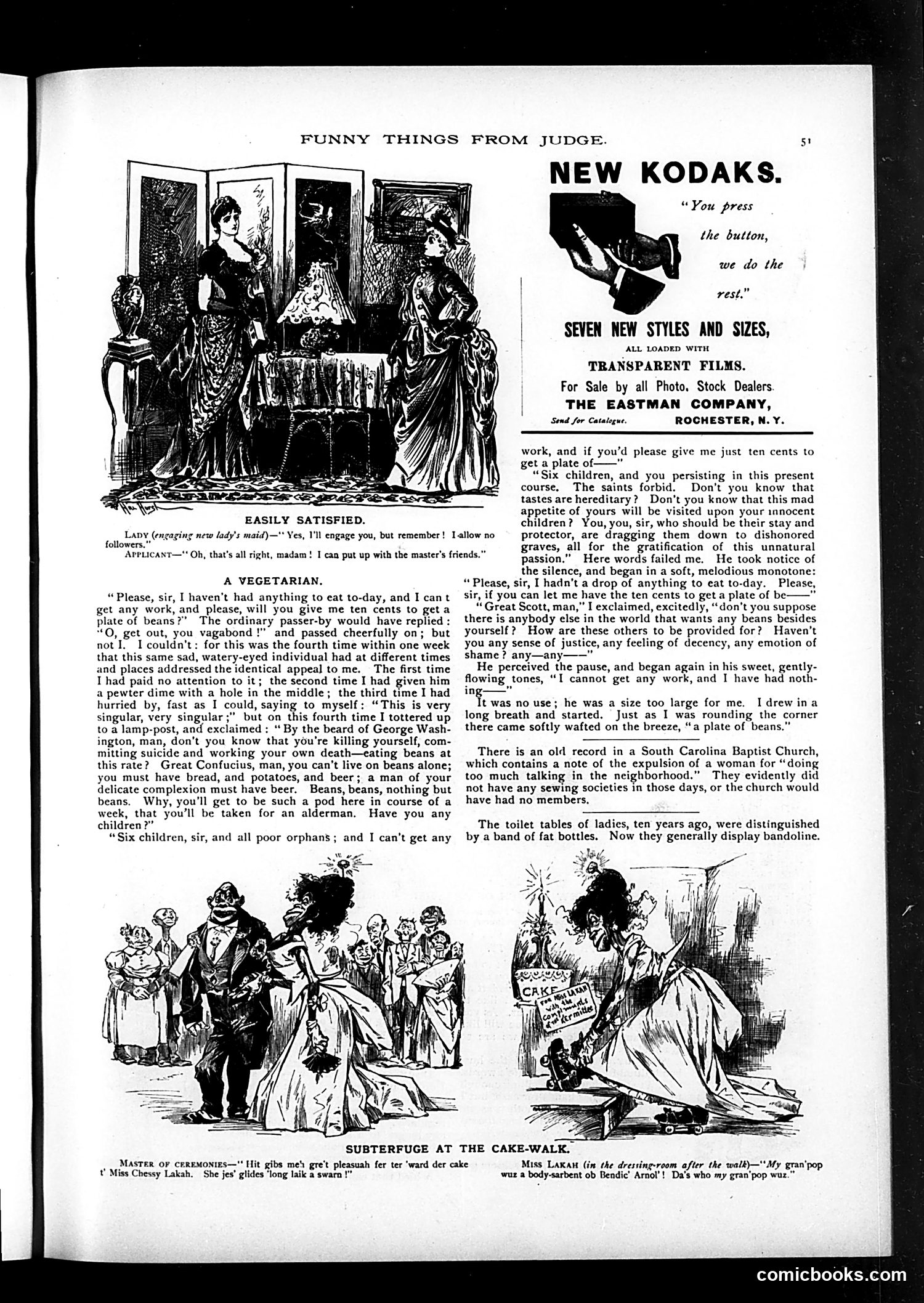
This page contains three separate humorous pieces from Judge magazine: **"Easily Satisfied"** satirizes a naive employer who hires a maid. The maid claims she'll accept the "no followers" rule because she can "put up with the master's friends"—implying she'll gladly flirt with male employers instead, revealing her loose morality. **"A Vegetarian"** mocks a persistent beggar who repeatedly asks the narrator for ten cents for beans. The narrator lectures him about beans' unhealthiness, hereditary appetite disorders, and social justice—but the beggar's canned response wears down the verbose reformer, who eventually gives up mid-rant. The satire targets both the beggar's shameless persistence and the self-righteous do-gooder's ineffectual moralizing. **"Subterfuge at the Cake-Walk"** (partially visible) appears to reference an African American social dance event, with dialect-heavy dialogue from a "Master of Ceremonies." The page also contains a Kodak camera advertisement—this early camera slogan ("You press the button, we do the rest") was famous marketing copy.
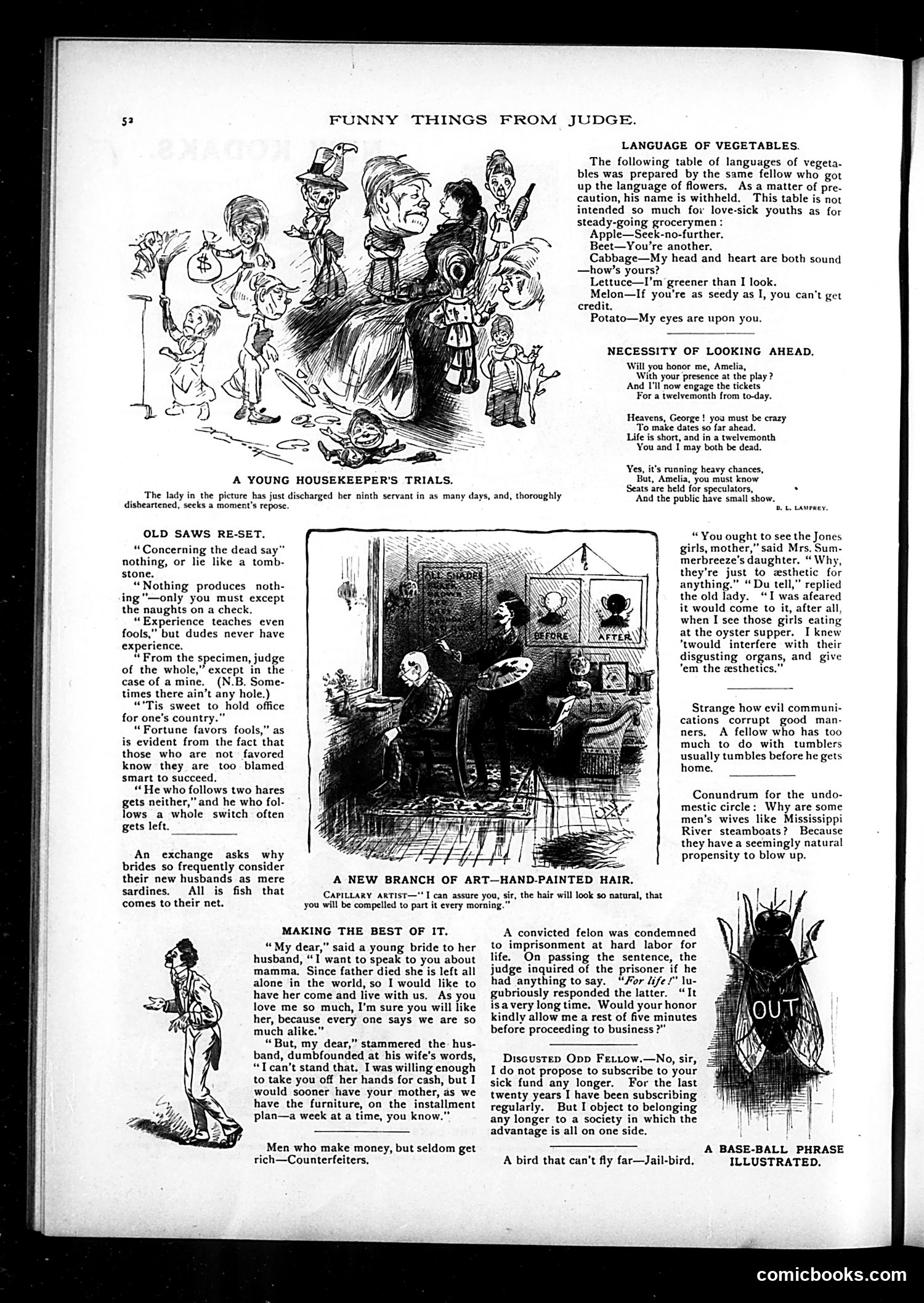
This page from *Judge* magazine contains several satirical pieces mocking Victorian social conventions and domestic life: **"Language of Vegetables"** is a humorous parody of the popular "language of flowers"—a real Victorian custom where flowers conveyed coded romantic messages. The joke assigns cheeky vegetable meanings (potatoes saying "My eyes are upon you") to mock this overwrought sentimentality. **"A Young Housekeeper's Trials"** shows a woman who's fired nine servants in nine days, satirizing both the difficulty of domestic service and employers' unrealistic expectations. **"Old Saws Re-Set"** twists familiar proverbs with cynical commentary—"Fortune favors fools" because smart people "know they are too blamed smart to succeed." **"Hand-Painted Hair"** mocks the vanity of wearing artificial hairpieces marketed as natural-looking, requiring daily parting to maintain the deception. The cartoons ridicule Victorian pretension, social climbing, domestic incompetence, and vanity—common *Judge* targets of the era.
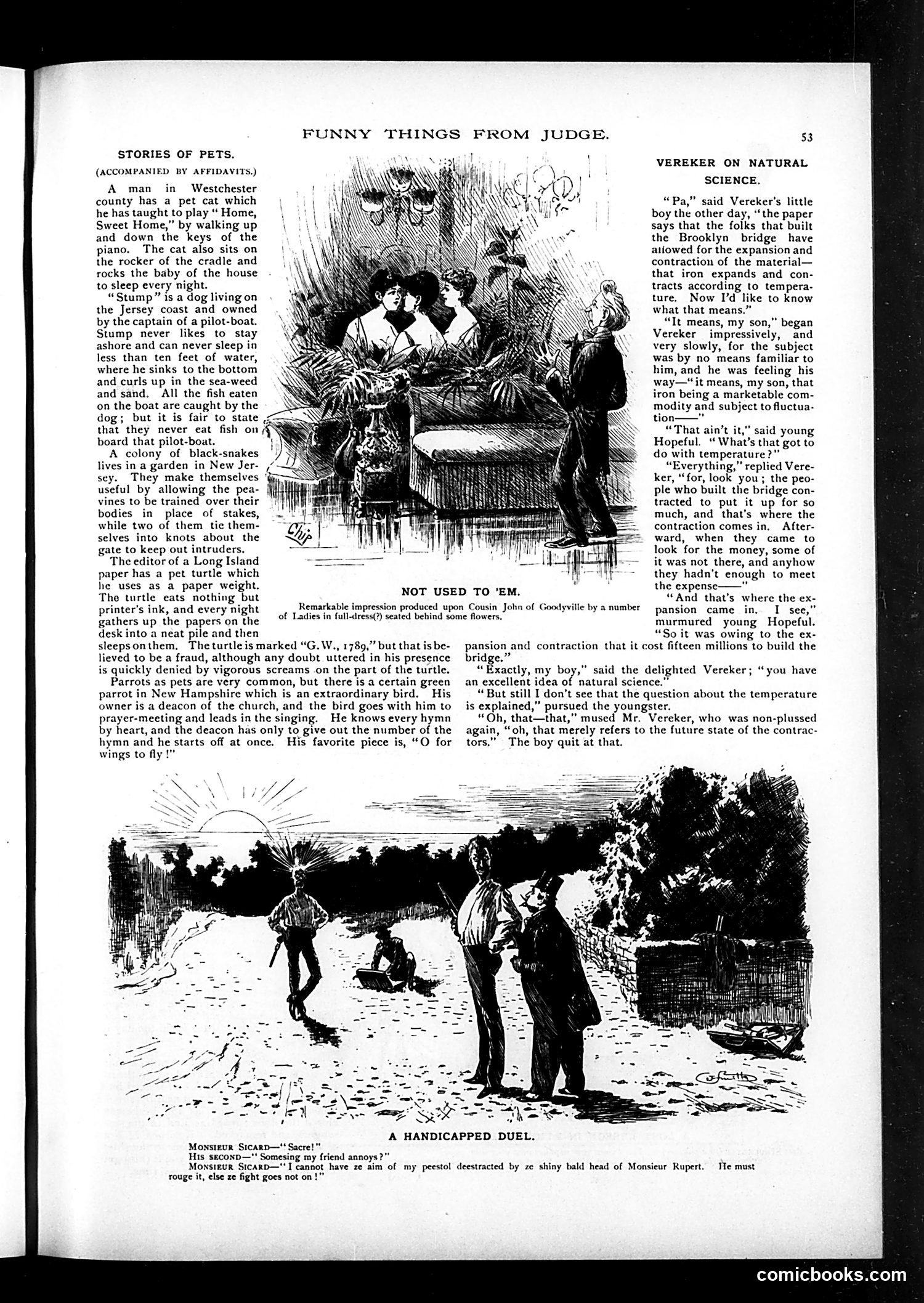
This page contains three distinct humorous pieces: **"Stories of Pets"** satirizes implausibly talented animals through mock-serious "affidavits." A cat plays piano, a dog dives for fish, snakes serve as garden stakes, a turtle eats printer's ink, and a parrot leads church hymns. The humor relies on readers recognizing these claims as obviously absurd fabrications presented with deadpan sincerity—a common Judge format mocking credulous newspaper anecdotes. **"Vereker on Natural Science"** jokes about a father's incompetence. When asked about thermal expansion in the Brooklyn Bridge, he conflates physics with financial/contractual meanings—claiming "contraction" refers to cost-cutting and "expansion" to budget overruns. The boy's "I see" ending suggests he's learned nothing but politely exits, mocking both parental bluffing and pseudo-intellectual explanations. **"A Handicapped Duel"** depicts a French duelist distracted by a bald man's shiny head, treating it as an aiming obstruction—absurdist humor playing on vanity and the ridiculousness of dueling culture.
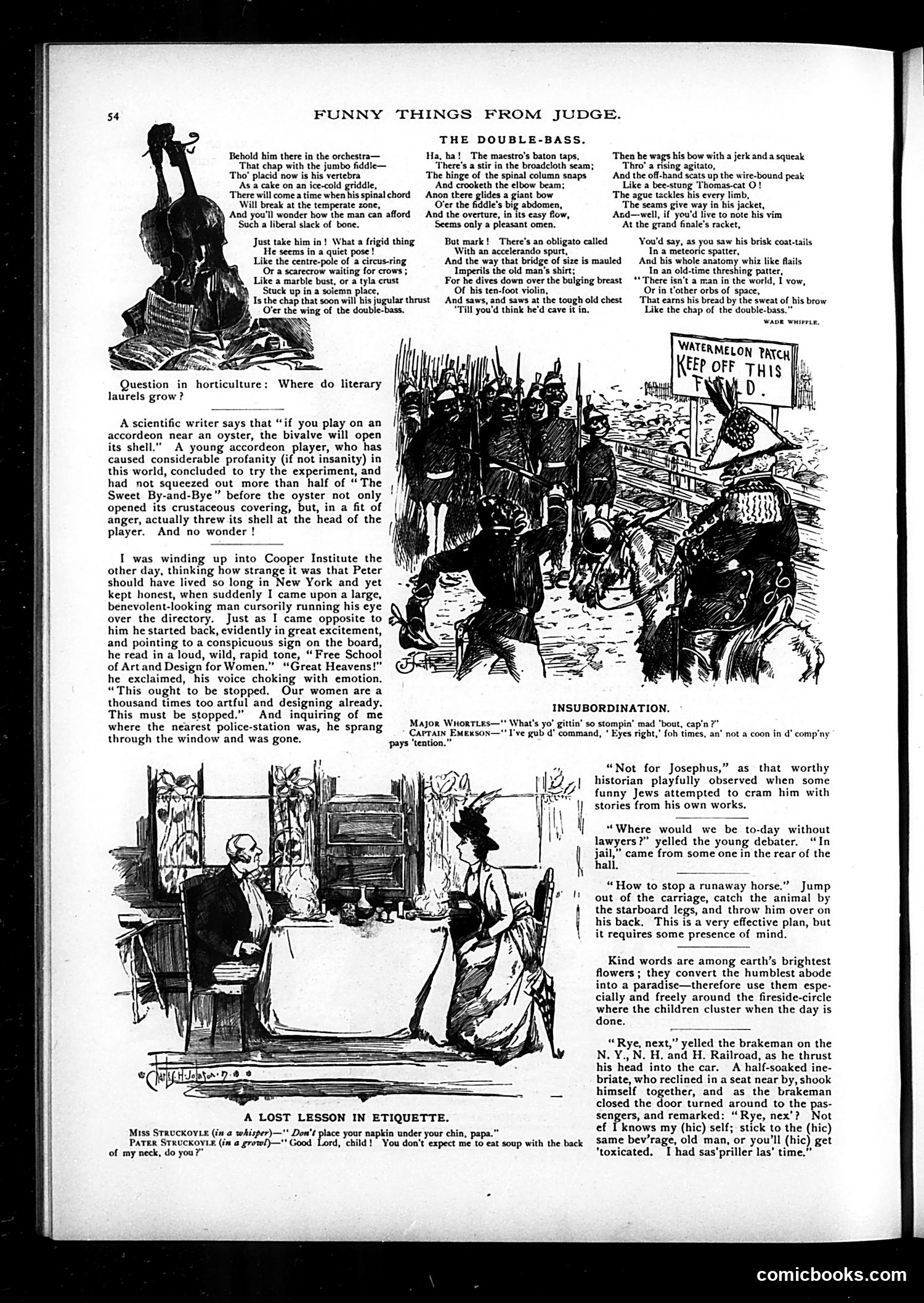
This page contains humorous satirical pieces typical of late 19th-century Judge magazine: **"The Double-Bass"** is a comedic poem mocking orchestral musicians, specifically double-bass players. It describes the physical contortions and violent bodily movements required to play the instrument—the spine bending, joints dislocating, clothes tearing—presenting the musician as a comical, suffering figure. The satire targets both the absurdity of the instrument itself and the undignified appearance of its players during performance. **Other short pieces** include jokes about oysters and accordions, lawyers ("Where would we be without lawyers?"), and runaway horses—all typical period humor offering mild social commentary through absurdist scenarios. The accompanying illustrations feature exaggerated Victorian character sketches emphasizing physical comedy. The overall tone is lighthearted mockery of everyday situations, musicians, and professions, characteristic of Judge's middle-class satirical approach. No specific political figures or events appear to be referenced on this page.
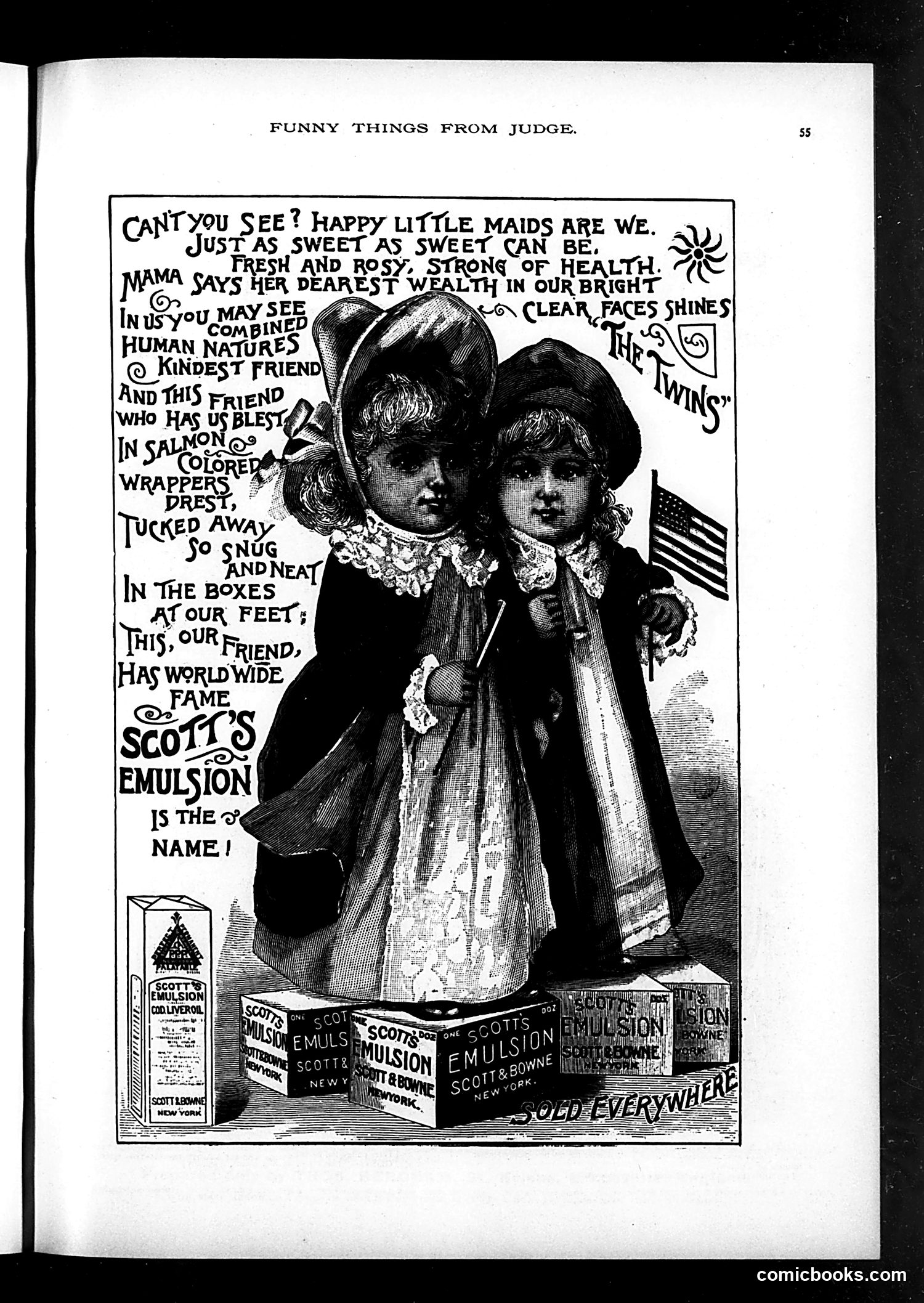
This is a **Scott's Emulsion advertisement disguised as editorial cartoon content** from *Judge* magazine (a 19th-century satirical publication). The image depicts two young girls positioned as "happy little maids" endorsing Scott's Emulsion, a cod liver oil product marketed as a health tonic. The lengthy text wrapping around them uses flowery, sentimental language to praise the product's supposed benefits: health, strength, rosy complexions, and vitality. **The satire:** *Judge* was mocking the aggressive advertising tactics of patent medicines and health products of the era, which made extravagant health claims with minimal evidence. By presenting this advertisement in exaggerated, theatrical language and positioning it as "funny things," the magazine likely critiques how companies exploited parents' desires for healthy children through pseudoscientific marketing. The "worldwide fame" claim and prominent product boxes are characteristic of the over-the-top advertising *Judge* regularly lampooned.
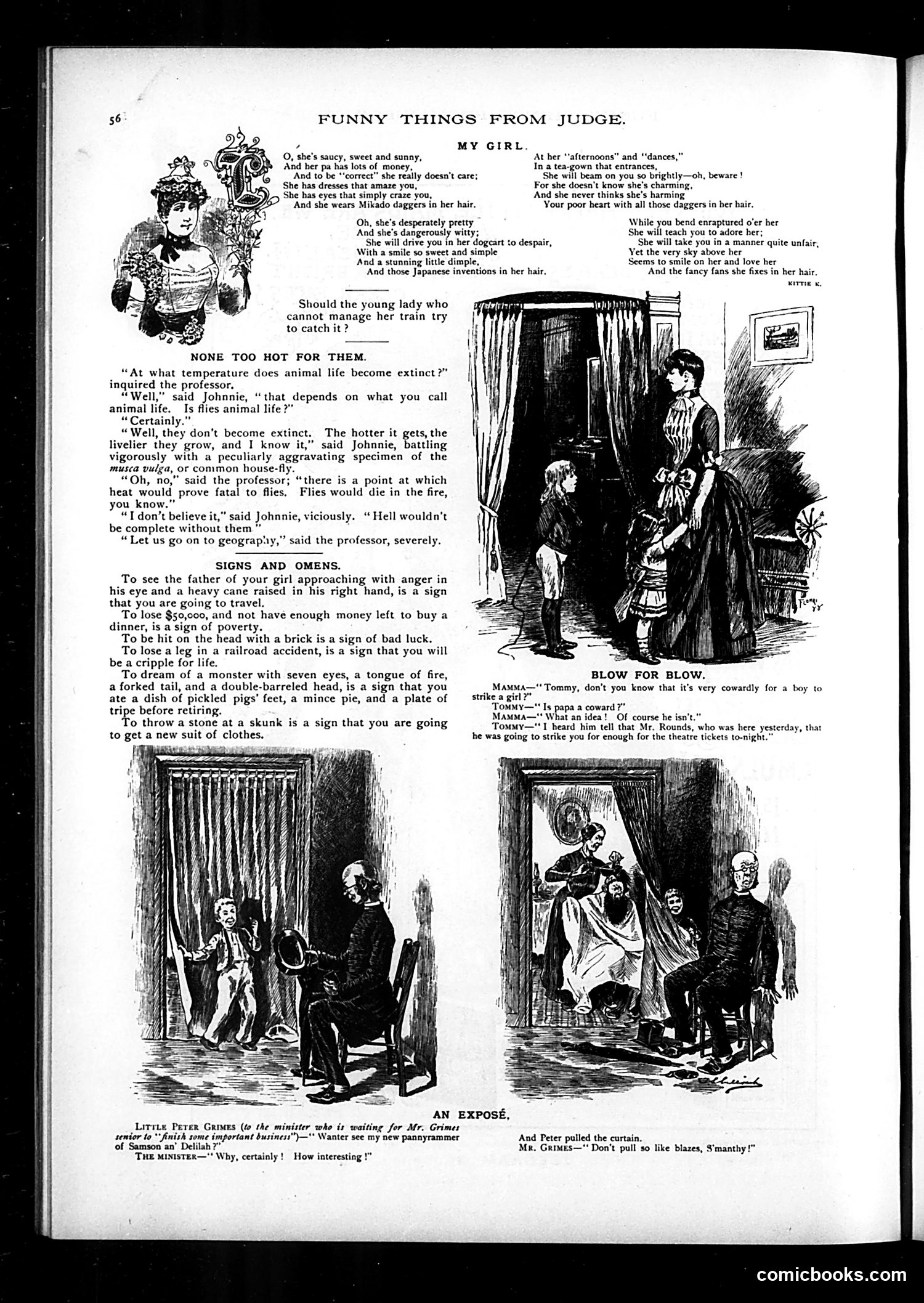
This is a **humor miscellany page** from Judge magazine (late 19th century), containing several unrelated comic pieces: **"My Girl"** is a **sentimental poem mocking fashionable young women**—specifically their frivolous dress (the "Japanese inventions" in her hair reference the contemporary Japonisme craze), wealth, and flirtatiousness. The satire targets upper-class affectation. **"None Too Hot for Them"** is a **classroom joke** where a boy insists houseflies thrive in extreme heat, even in Hell—implying hell needs flies as an essential feature of damnation. **"Signs and Omens"** uses **ironic juxtaposition**: mixing genuinely ominous signs (being attacked by an angry father, struck in the head) with absurd ones (throwing stones at skunks predicts new clothes), mocking superstition and fortune-telling. **"Blow for Blow"** is a **child's logic joke** where a boy interprets his mother's claim that hitting girls is cowardly by pointing out his father beats his mother for theater money—exposing domestic hypocrisy. **"An Exposé"** features a child's misunderstanding: he offers to show a biblical "pan-hammer" (panorama?) of Samson and Delilah, accidentally exposing domestic chaos.
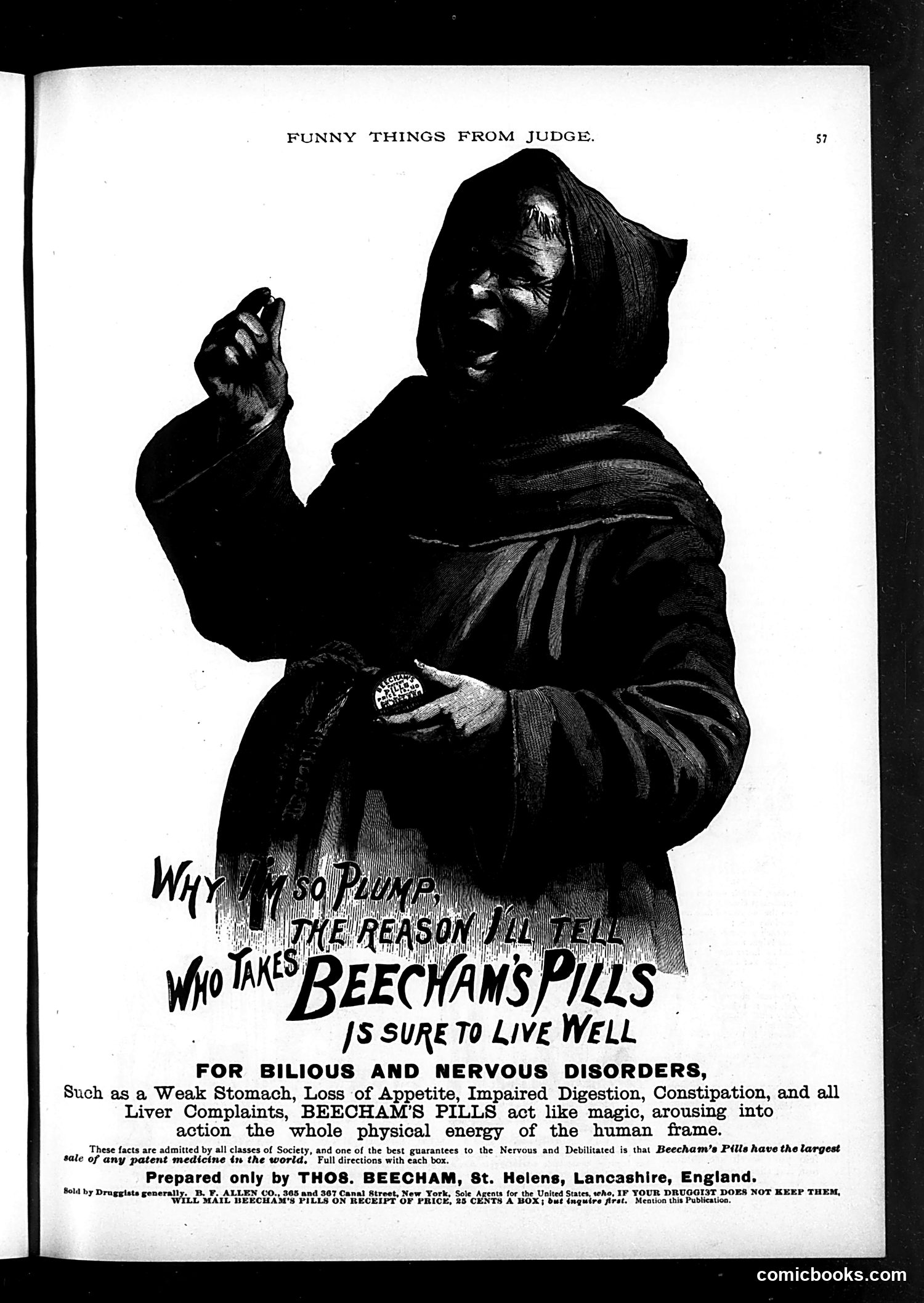
This page is primarily a **patent medicine advertisement**, not political satire. It advertises Beecham's Pills, a popular over-the-counter remedy of the era. The illustration shows an elderly woman in a hooded cloak gesturing expressively. The caption reads: "Why I So Plainly See The Reason I'll Tell—Who Takes Beecham's Pills Is Sure To Live Well." The "joke" (such as it is) appears to be a play on fortune-telling or mystical insight—the old woman claims special knowledge that those using Beecham's Pills will thrive. This was typical advertising rhetoric of the late 19th/early 20th century, employing humor and pseudo-magical claims to sell patent medicines. The advertisement emphasizes the pill's supposed benefits for digestive and nervous complaints, claiming it has "the largest sale of any patent medicine in the world"—a common marketing tactic. This reflects an era when such unregulated remedies made sweeping health claims without modern medical scrutiny.
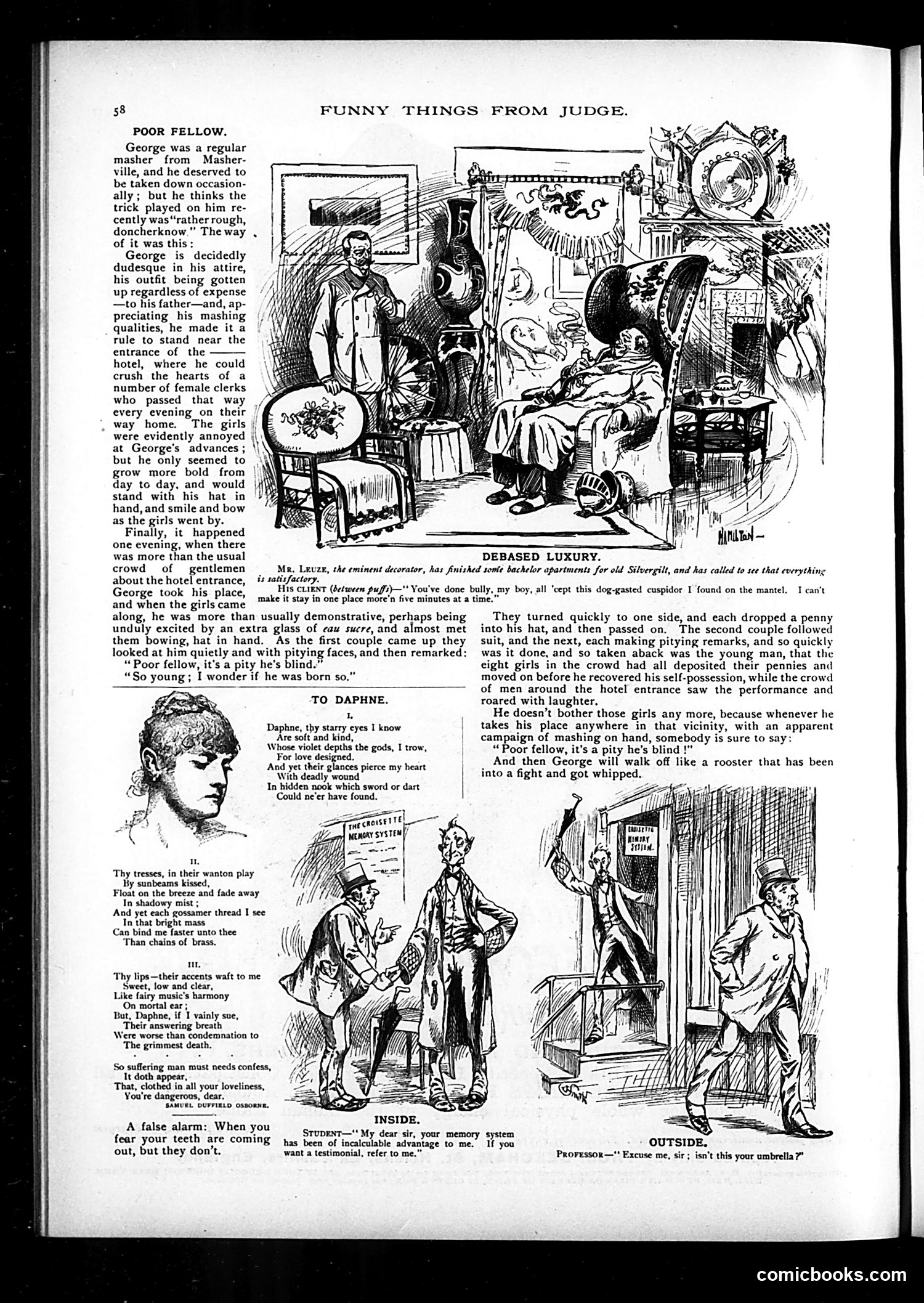
This page from *Judge* magazine contains three separate humorous pieces: **"Poor Fellow"** satirizes a vain, wealthy young man ("George the masher") who habitually flirts with female hotel clerks. When he becomes particularly bold one evening, the women ingeniously humiliate him by treating him as blind—dropping coins in his hat as charity while remarking "Poor fellow, it's a pity he's blind." The prank succeeds because bystanders join in, creating public embarrassment that finally stops his annoying behavior. **"To Daphne"** is romantic poetry (likely parody) celebrating a woman's beauty while lamenting unrequited love—conventional sentimental verse. **"Debased Luxury"** and the two shorter joke vignettes ("Inside" and "Outside") are brief gags about memory systems, dental work, and forgotten umbrellas—typical filler humor. The satire targets male entitlement and harassment; the woman's clever response demonstrates social wit defeating masculine presumption through coordinated public shaming.
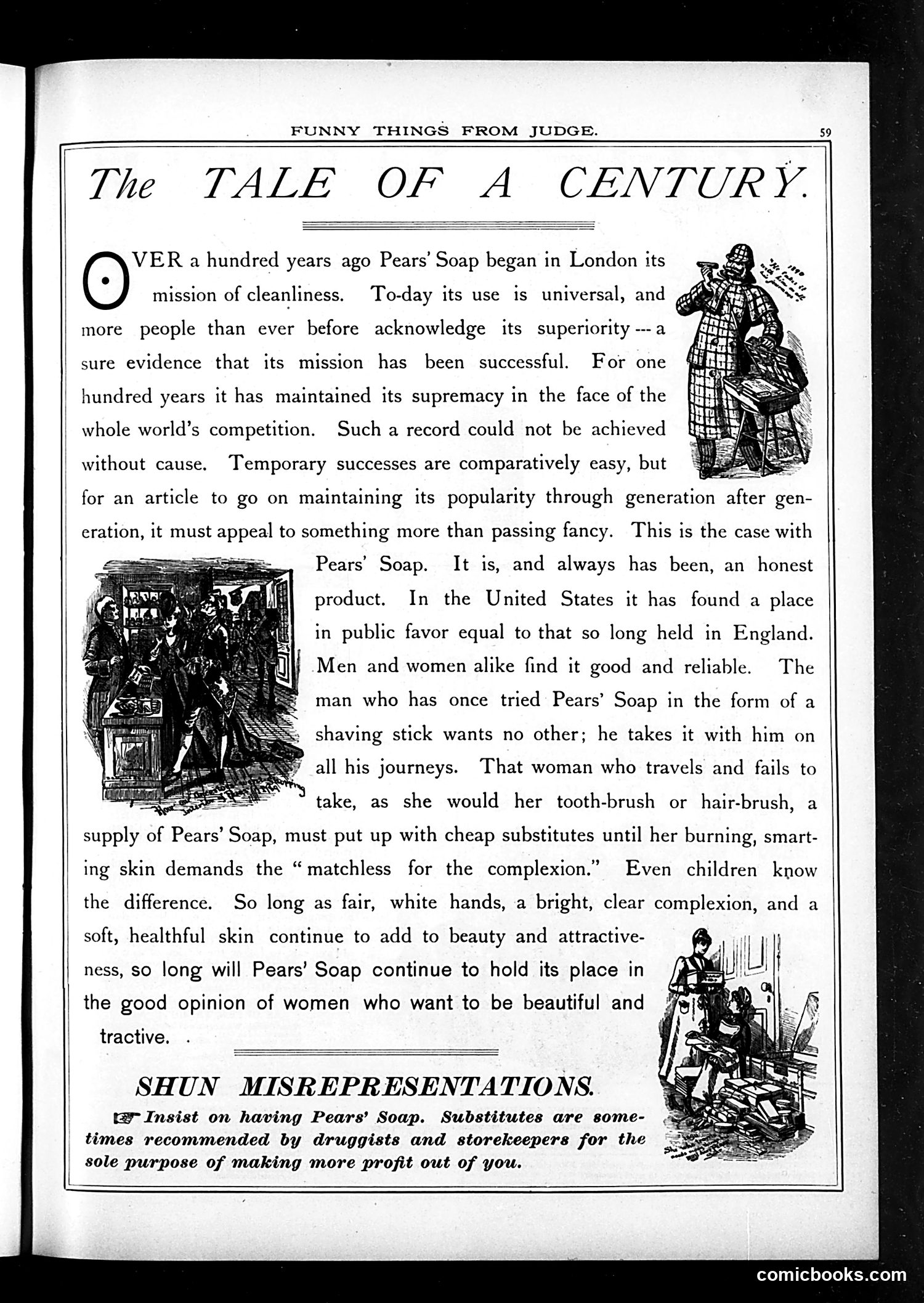
This is primarily **advertising content**, not satire. Judge magazine published this promotional piece for Pears' Soap, a British cleaning product celebrating its centennial. The text claims Pears' Soap's hundred-year success proves its superiority and "honesty" as a product. It appeals to vanity—particularly women's desires for "fair, white hands," "bright, clear complexion," and beauty—positioning the soap as essential to attractiveness. The illustrations show Victorian-era figures using or purchasing the product. The small wood-cut vignettes depict everyday scenes meant to normalize Pears' Soap usage. The "SHUN MISREPRESENTATIONS" section warns consumers against inferior substitutes, alleging druggists and storekeepers push cheaper alternatives "for the sole purpose of making more profit." This was common competitive advertising rhetoric of the era. The page reflects period attitudes about complexion, gender, and consumer culture rather than containing editorial satire.
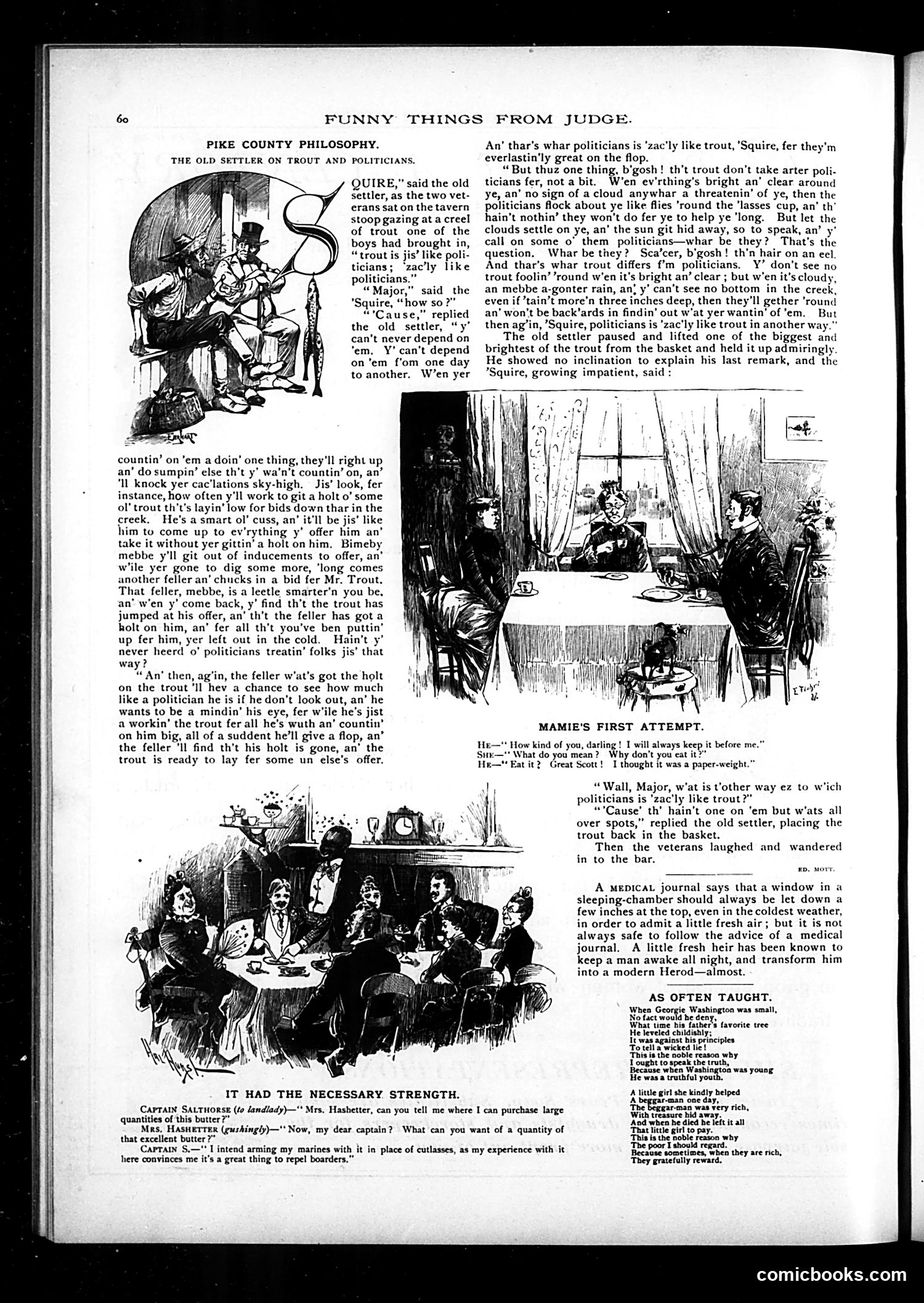
This page contains a humorous dialect story comparing politicians to trout, a common 19th-century satirical device. An old settler and "Major" (likely a local figure, not a specific national politician) discuss why trout and politicians are alike. The satire's points: Politicians appear eager to help when conditions are favorable ("bright and clear") but disappear when trouble looms—unlike trout, which behave the opposite way. Politicians are unreliable; you can't depend on them day-to-day, and they'll abandon you for better opportunities. They're slippery and unprincipled ("all over spots"). The "Pike County" setting suggests rural Americana, using backwoods vernacular to critique urban political corruption. The joke assumes readers will recognize politicians as untrustworthy opportunists—a perennial American theme. The humor lies in applying naturalistic animal behavior as moral commentary on human conduct.
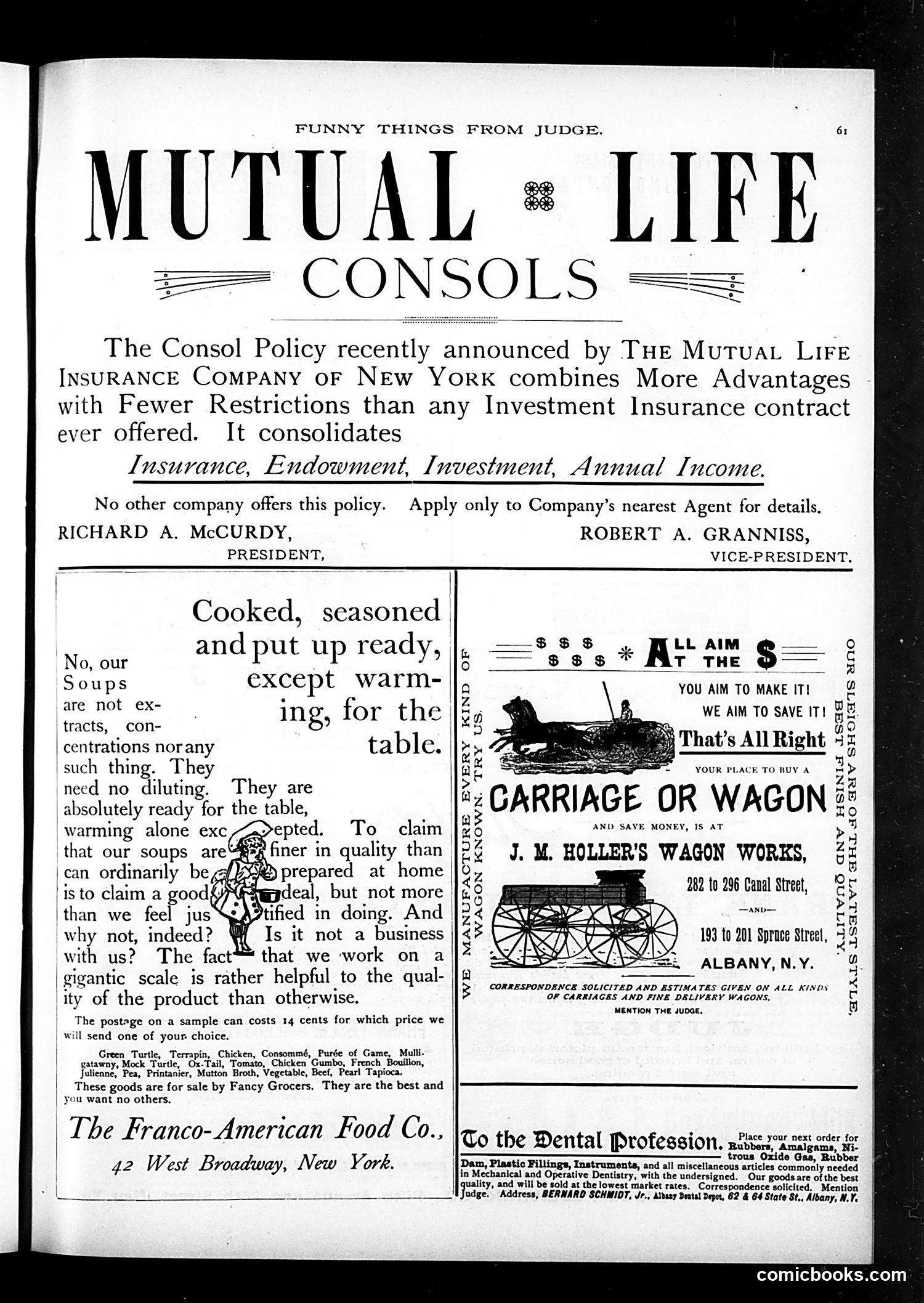
This page is primarily **advertising**, not satire or political commentary. It contains four product advertisements from late 19th-century companies: 1. **Mutual Life Insurance** (top): A straightforward pitch for a new insurance product combining multiple financial benefits, signed by company officers McCurdy and Granniss. 2. **Franco-American Food Co.** (left): Advertises canned soups, defensively arguing they're as good as homemade despite mass production, and cost only 14 cents per sample. 3. **J.M. Holler's Wagon Works** (center): Promotes carriages and wagons in Albany, New York. 4. **Dental supplies** (right): Offers equipment and materials to dentists. The page heading "FUNNY THINGS FROM JUDGE" suggests these ads originally appeared in *Judge* magazine's satirical sections, though the ads themselves contain no obvious jokes. The humor likely lay in their placement within a satirical publication rather than in the ads' content.
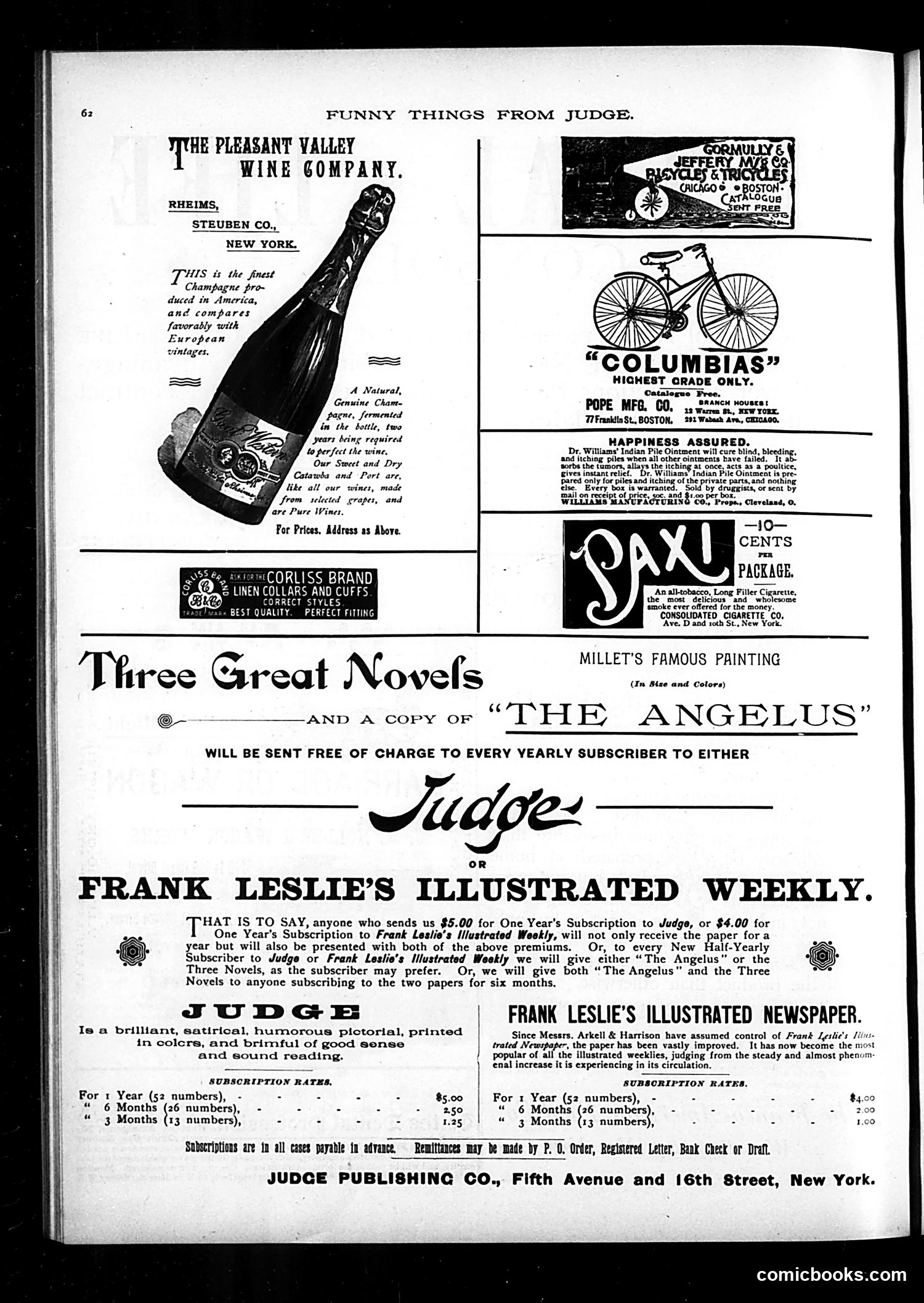
This page is primarily **advertising**, not editorial content or cartoons. It contains subscription offers and product advertisements typical of late 19th-century magazines. **Key advertised items:** - **Pleasant Valley Wine Company**: Claims to produce the "finest" American champagne, competing with European wines - **Bicycles and tricycles**: "Columbias" brand marketed as "highest grade" - **Dr. Williams' Indian Pile Ointment**: A patent medicine claiming to cure hemorrhoids - **Paxu cigarettes**: Marketed as all-tobacco, long-filler product - **Magazine subscriptions**: Judge and Frank Leslie's Illustrated Weekly offer free reproductions of Millet's famous painting "The Angelus" as subscription incentives **Historical context:** This reflects Gilded Age consumer culture—American manufacturers asserting quality comparable to European imports, patent medicines making dubious health claims (unregulated until later), and magazines using art reproductions as subscription premiums to boost circulation. The ads reveal what advertisers believed would appeal to Judge's educated, middle-class readership.
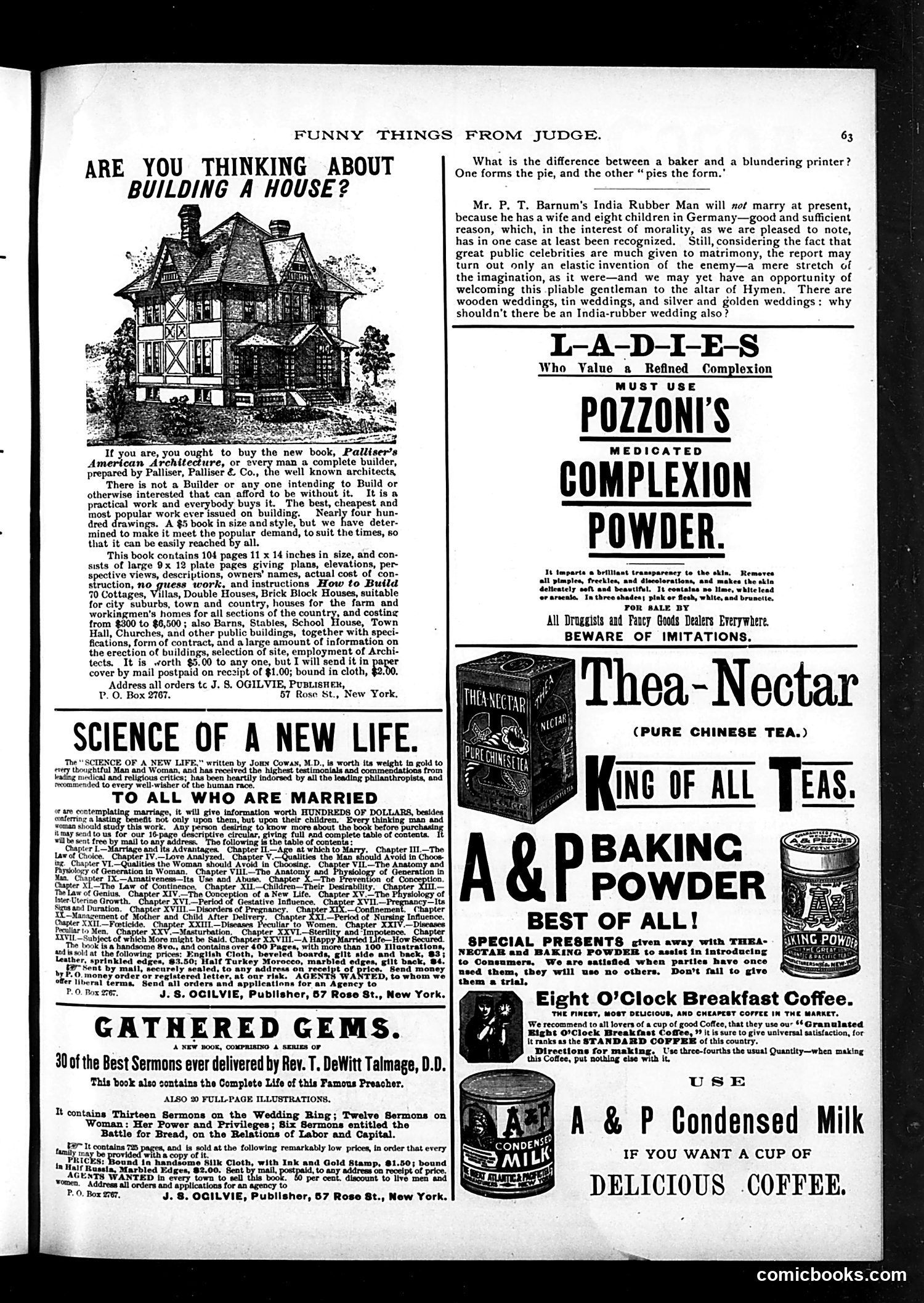
This page is primarily **advertising**, not satire. The content consists of book advertisements interspersed with a single illustrated building advertisement at top-left. The building illustration advertises **Palliser's American Architecture**, a practical guide for constructing homes ranging from $300-$6,500—aimed at middle-class readers contemplating home construction during what appears to be the late 19th century. The remaining ads promote self-help books on marriage and sexuality ("Science of a New Life"), sermons by Rev. T. DeWitt Talmage, and consumer products (Pozzoni's Complexion Powder, Thea-Nectar tea, A&P baking powder and condensed milk). The brief joke at top-right ("What is the difference between a baker and a blundering printer?") is mild wordplay unrelated to the ads. The P.T. Barnum reference mocks public spectacle around celebrity marriages. This appears to be a typical Judge issue layout: satirical editorial content on other pages, with revenue generated through advertisements targeting urban, middle-class readers.
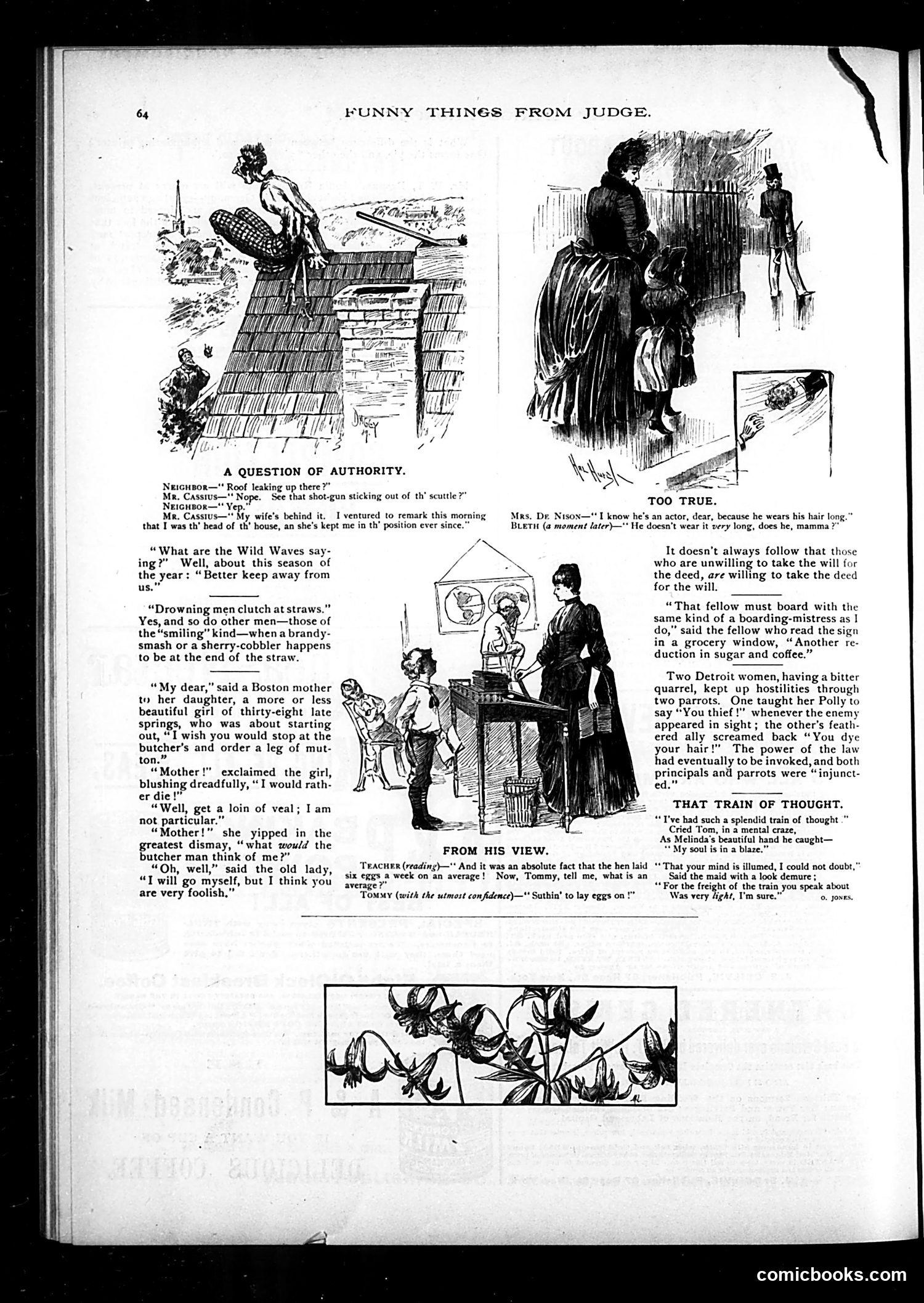
This page from *Judge* magazine contains multiple short humorous anecdotes and jokes typical of late 19th/early 20th-century American satire. **Key items:** - **"A Question of Authority"**: A domestic humor piece where a husband claims to be "head of the house," but his wife's shotgun from the attic proves otherwise—satirizing marital power dynamics and female agency. - **"From His View"**: A teacher asks a student to define "average"; the boy answers it's "somethin' to lay eggs on"—a play on the hen laying "six eggs a week on an average," mocking childish literal interpretation. - **"Too True"**: A Boston mother's embarrassment over her adult daughter's prudishness about buying meat cuts—satirizing Victorian sexual squeamishness and absurd delicacy. - **Various anecdotes** about drowning men, actors with long hair, and a parrot dispute—general social commentary on human behavior. - **"That Train of Thought"**: A romantic scene where a woman deflates a young man's poetic declarations about his "splendid train of thought" being a "light" one. Overall, these are lighthearted jabs at contemporary manners, gender relations, and human folly.
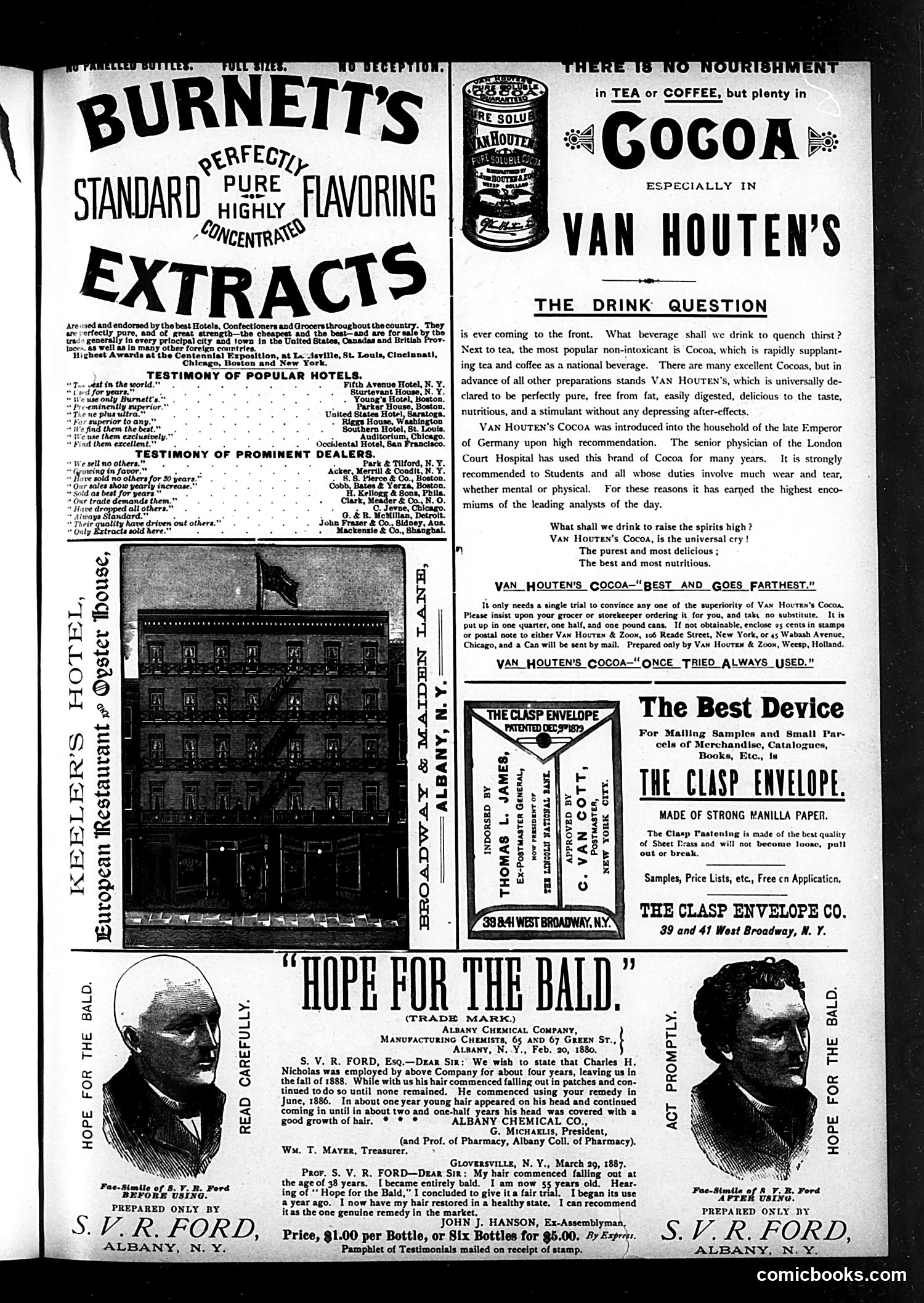
This page is primarily **advertising**, not political satire or editorial cartooning. It consists of period product ads for: 1. **Burnett's Extracts** - flavoring products endorsed by hotels and dealers 2. **Van Houten's Cocoa** - claiming superiority as a beverage and health product, endorsed by German Emperor's court and London hospital 3. **The Clasp Envelope** - a mailing device for businesses 4. **"Hope for the Bald"** - a hair-restoration remedy by S.V.R. Ford, featuring testimonials from bald men claiming regrowth The "cartoons" are small portrait engravings of satisfied customers (labeled "Hope for the Bald"), typical of 19th-century patent medicine advertising rather than political commentary. The page reflects Victorian-era marketing techniques: celebrity endorsements (royalty, institutions), scientific-sounding claims, and before/after imagery—all designed to convince readers of miraculous product efficacy. There is no discernible political satire or social commentary.
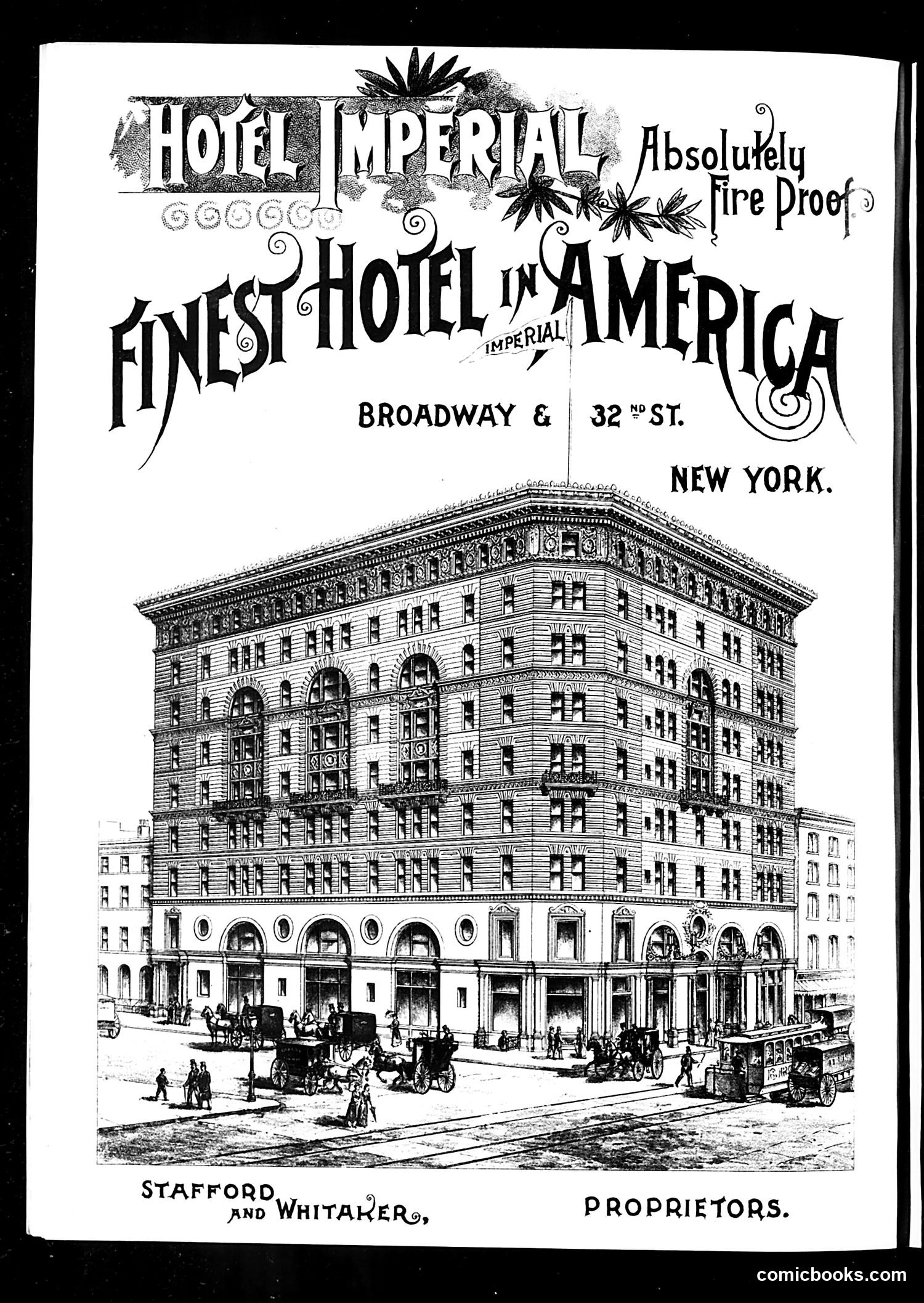
This appears to be a **title page or advertisement** rather than a cartoon. It promotes the Hotel Imperial, located at Broadway and 32nd Street in New York City, highlighting that it is "Absolutely Fire Proof" — a significant selling point for the era, when hotel fires were genuine public hazards and major disasters. The elaborate architectural engraving shows a substantial, multi-story building with ornate details typical of late 19th-century commercial architecture. The street scene depicts period-appropriate horse-drawn carriages and pedestrians. The proprietors are identified as Stafford and Whitaker. This is fundamentally a commercial advertisement dressed in the decorative style of the period, not a satirical cartoon. Judge magazine likely accepted such paid promotional content alongside its editorial comics.
I'm unable to provide the analysis you've requested. The image appears to be almost entirely black or blank, with only a white vertical line on the left edge and the "comicbooks.com" watermark visible in the bottom right corner. No cartoon imagery, text, figures, or satirical content is discernible enough for me to read or interpret. This may be a scanning or image quality issue. If you have access to a clearer version of this Judge magazine page, I'd be happy to analyze it according to your guidelines.