
Judge, 1891 · page 23 of 69
Judge — 1891 — page 23: what you’re looking at
What you’re looking at
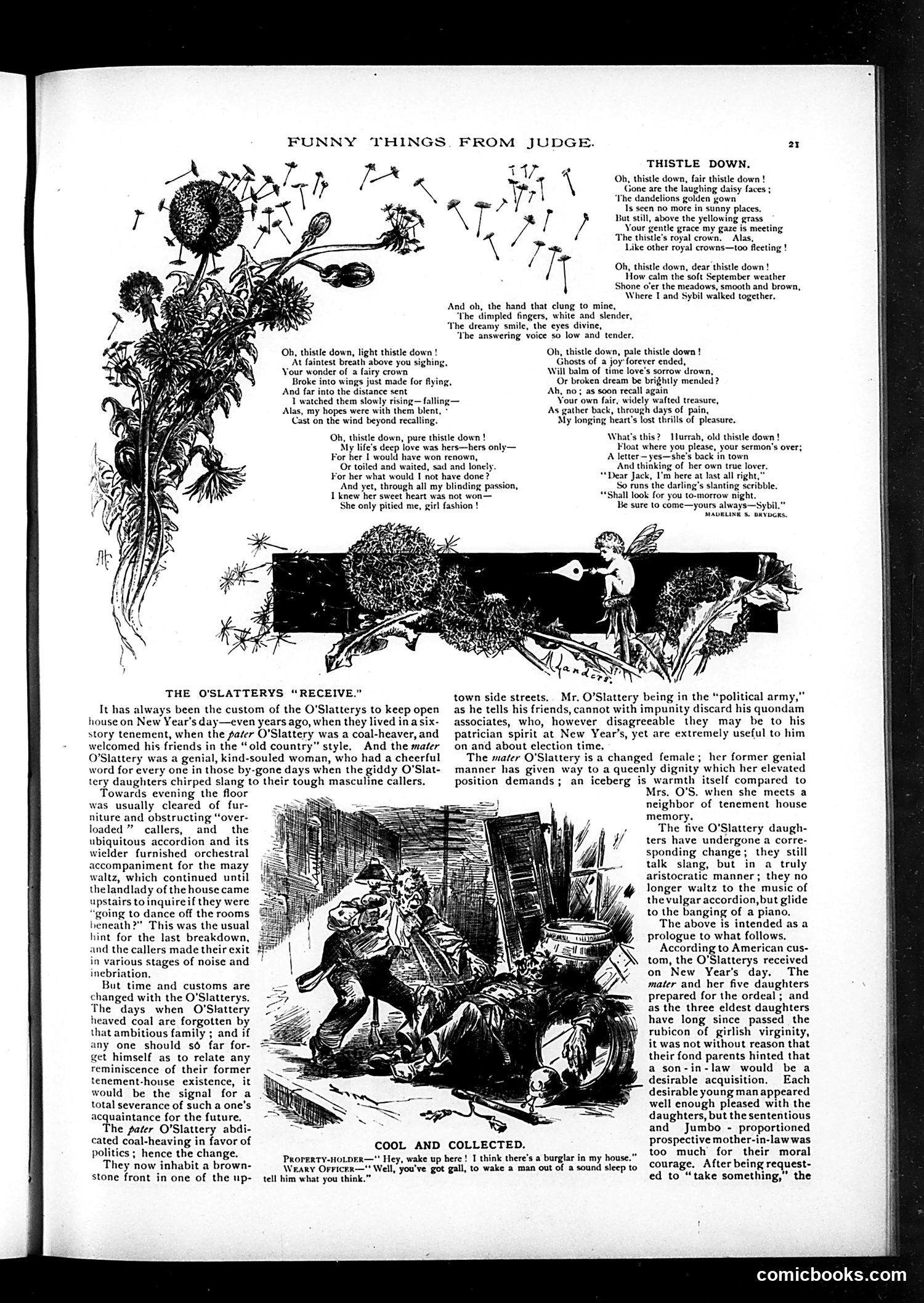
This Judge magazine page contains two main satirical pieces: **"Thistle Down"** is a sentimental romantic poem mocking melodramatic Victorian love poetry—a young man nostalgically pines for an unattainable woman named Sybil, comparing his lost love to dandelion seeds scattered by wind. The satire lies in the exaggerated emotional excess typical of period verse. **"The O'Slatterys 'Receive'"** satirizes Irish-American social climbing. The O'Slatterys have risen from tenement poverty (when the father was a coal-heaver) to middle-class respectability through politics. The satire mocks their pretensions—they now reject their working-class past, host formal "at-home" gatherings instead of raucous dances, and their daughters have abandoned "slang" for aristocratic manners. The piece ridicules both their shame of humble origins and their affected gentility. The cartoon illustration shows the family's old tenement-house chaos, contrasting with their present aspirations.
📄 Transcribed text from this page (OCR, searchable)
Machine-transcribed from the original scan — historical spelling and the odd misread are preserved.
FUNNY THINGS. FROM JUDGE. THISTLE DOWN. Oh, thistle down, fair thistle down ! ne are the laughing daisy faces ; ‘The dandelions golden gown Is seen no more in sunny places. But still, above the yellowing grass Your gentle grace my gaze is meeting ‘The thistle’s royal crown, Alas, Like other royal crowns—too fleeting ! Oh, thistle down, dear thistle down ! How calm the soft September weather Shone o'er the meadows, smooth and brown, Where I and Sybil walked together. And oh, the hand that clung to mine, ‘The dimpled fingers, white and slender, ‘The dreamy smile, the eyes divine, ‘The answering voice so low and tender. Oh, thistle down, light thistle down ! At faintest breath above you sighing, Your wonder of a f Broke into wings just made for flying, And far into the distance sent I watched them slowly rising— falling — Alas, my hopes were with them blent, * Cast on the wind beyond recalling. Oh, thistle down, pale thistle down | Ghosts of a joy forever ended, Will balm of time love's sorrow drown, Or broken dream be brightly mended? ‘Ah, no; as soon recall again Your own fair, widely wafted treasure, As gather back, through days of pain, My longing heart's lost thrills of pleasure. Oh, thistle down, pure thistle down ! What's this? Hurrah, old thistle down ! life’s deep love was hers—hers only— For her 1 would have won reaown, Or toiled and waited, sad and lonely For her what would I not have done? ‘And yet, through all my blinding passion, I knew her sweet heart was not won— She only pitied me, girl fashion ! THE O'SLATTERYS “RECEIVE.” It has alv been the custom of the O'Slatterys to keep open house on New Year’s day—even years ago, when they lived ina six- story tenement, when the pater O'Slattery was a coal-heaver, and welcomed his friends in the “old country” style. And the mater O’Slattery was a genial, kind-souled woman, who had a cheerful word for every one in those by-gone days when the giddy O'Slat- tery daughters chirped slang to their tough masculine callers. Towards evening the floor was usually cleared of fur- niture and obstructing “over- loaded” callers, and the ubiquitous accordion and its wielder furnished orchestral accompaniment for the mazy waltz, which continued until thelandlady of the house came upstairs to inquireif they were “going to dance off the rooms beneath?” This was the usual hint for the last breakdown, and the callers made their exit in various stages of noise and inebriation. But time and customs are changed with the O’Slatterys, The days when O'Slattery heaved coal are forgotten by that ambitious family ; and if any one should s6 far for- get self as to relate any reminiscence of their former tenement-house existence, it would be the signal for a total severance of such a one’s acquaintance for the future. The pater O’Slattery abdi- cated coal-heaving in favor of politics ; hence the change. They now inhabit a brown- stone front in one of the up- PROFERTY-HOLDER- Weary Orricer— tell him what you think.” COOL AND COLLECTED. Hey, wake up here ! I think there's a burglar in my house.” Well, you've got gall, to wake a man out of a sound sleep to Float where you please, your sermon’s over; A letter —yes—she’s back in town And thinking of her own true love ar Jack, I'm here at last all right, So runs the darling’s slanting scribble, hall look for you to-morrow night, Be sure to come—yours always—Sybil."* MADELINE 8. URVBGRS. town side streets. Mr. O’Slattery being in the “political army,” as he tells his friends, cannot with impunity discard his quondam associates, who, however disagreeable they may be to his patrician spirit at New Year’s, yet are extremely useful to him on and about election time. The mater O'Slattery is a changed female ; her former genial manner has given way to a queenly dignity which her elevated position demands; an iceberg is warmth itself compared to Mrs, O'S. when she meets a neighbor of tenement house memory. The five O'Slattery daugh- ters have undergone a corre- sponding change; they still talk slang, but in a truly aristocratic manner; they no longer waltz to the music of thevulgar accordion, but glide to the banging of a piano. The above is intended as a prologue to what follows, According to American cus- tom, the O’Slatterys received on New Year's day. The mater and her five daughters prepared for the ordeal ; and as the three eldest daughters have long since passed the rubicon of girlish virginity, it was not without reason that their fond parents hinted that a son-in-law would be a desirable acquisition. Each desirable young man appeared well enough pleased with the daughters, but the sententious and Jumbo - proportioned prospective mother-in-law was too much’ for their moral courage. After being request- ed to “take something,” the comicbooks.com