
Judge, 1891 · page 46 of 69
Judge — 1891 — page 46: what you’re looking at
What you’re looking at
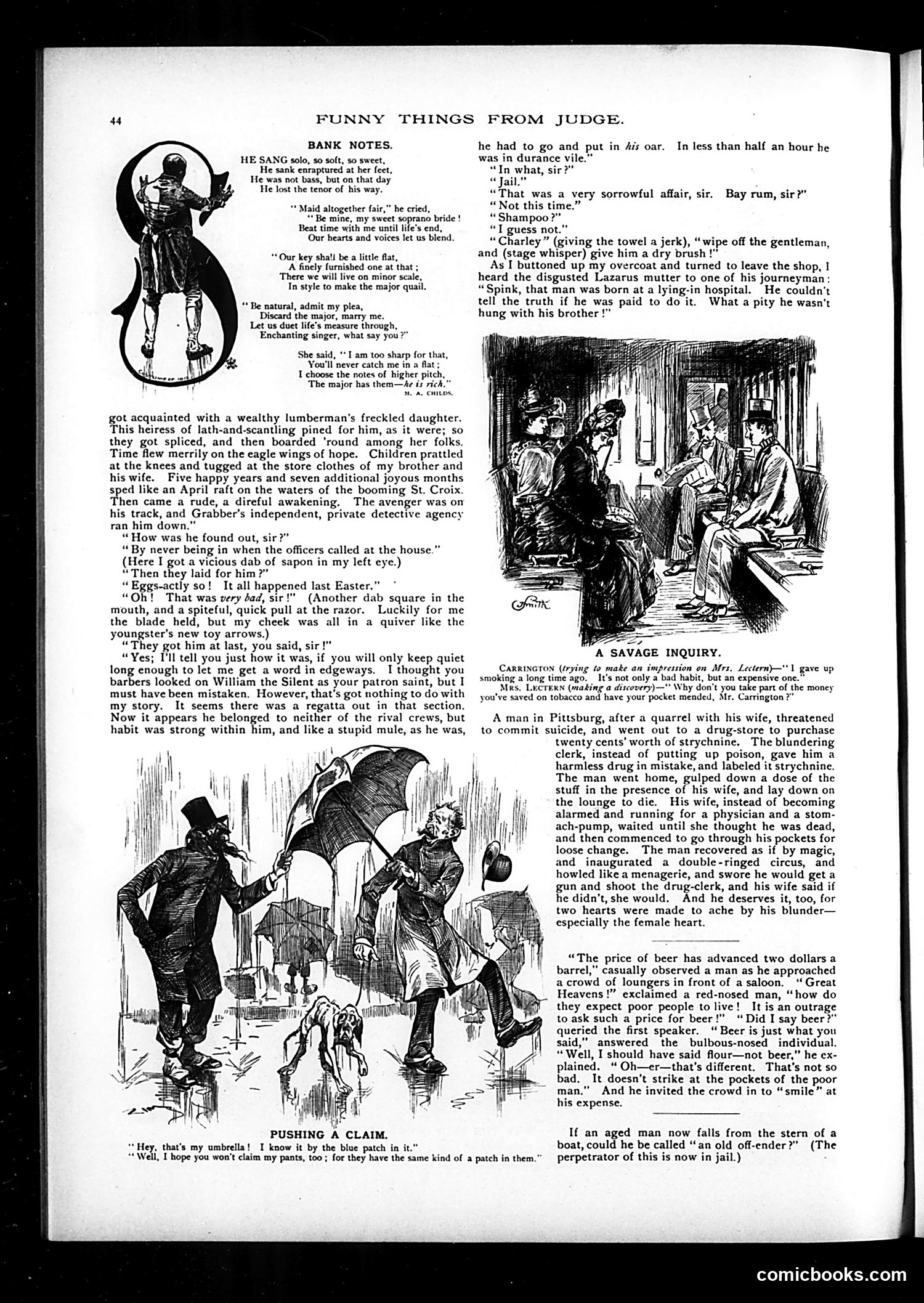
This page contains three distinct humorous pieces from *Judge* magazine: 1. **"Bank Notes"** (top): A poem-illustrated romance where a male singer courts a woman with musical metaphors ("soprano bride," "minor scale," "flat"). She rejects him, preferring a wealthy man—the "major" who is "rich." It's satire on mercenary marriage. 2. **"A Savage Inquiry"** (middle-right cartoon): Shows a man in ragged clothes confronting another about a patched umbrella. The joke plays on shared poverty—both have identical patches on their belongings, making the claim absurd. It mocks petty disputes between poor people. 3. **Main narrative** (center-left): A barber tells how a man married a lumberman's wealthy daughter, lived contentedly for five years, then was tracked down by detectives for unspecified crimes. The story is interrupted by the barber's impatient shaving, creating comedic tension. The ending—a suicide attempt foiled by a clerk's drug-store error—satirizes incompetence and dark fate. The page overall reflects late-19th-century American humor about class, marriage, and urban mishaps.
📄 Transcribed text from this page (OCR, searchable)
Machine-transcribed from the original scan — historical spelling and the odd misread are preserved.
FUNNY BANK NOTES. HE SANG solo, so soft, so sweet, He sank enraptured at her feet, He was not bass, but on that day He lost the tenor of his way. “* Maid altogether fair,” he cried, ** Be mine, my sweet soprano bride ! Beat time with me until life's end, ‘Our hearts and voices let us blend, “Our key shall be a little flat, A finely furnished one at that ; There we will live on minor scale, In style to make the major quail. “* Be natural, admit my plea, Discard the major, marry me. Let us duet life's measure through, Enchanting singer, what say you?” She said, “I am too sharp for that, You'll never catch me in a flat ; I choose the notes of higher pit. ‘The major has them—he is rich. Mt. A. CHILDS got acquainted with a wealthy lumberman’s freckled daughter. This heiress of lath-and-scantling pined for him, as it were; so they got spliced, and then boarded ‘round among her folks. Time flew merrily on the eagle wings of hope. Children prattled at the knees and tugged at the store clothes of my brother and his wife. Five happy years and seven additional joyous months sped like an April raft on the waters of the booming St. Croix. hen came a rude, a direful awakening, The avenger was on his track, and Grabber’s independent, private detective agency ran him down.” “How was he found out, sir?” “ By never being in when the officers called at the house.” (Here I got a vicious dab of sapon in my left eye.) “Then they laid for him ?” “ Eggs-actly so! Itall happened last Easter.” “Oh! That was very dad, sir!” (Another dab square in the mouth, and a spiteful, quick pull at the razor. Luckily for me the blade held, but my cheek was all in a quiver like the youngster’s new toy arrows.) “They got him at last, you said, sir!” “Yes; I'll tell you just how it was, if you will only keep quiet long enough to let me get a word in edgeways. I thought you barbers looked on William the Silent as your patron saint, but I must have been mistaken. However, that’s got nothing to do with my story. It seems there was a regatta out in that section. Now it appears he belonged to neither of the rival crews, but habit was strong within him, and like a stupid mule, as he was, PUSHING A CLAIM. oe Bod that's my umbrella! I know it by the blue patch in it.” Wel 1, I hope you won't claim my pants, too ; for they have the same kind of a patch in them.” THINGS FROM JUDGE. he had to go and put in Ais oar. was in durance vile.” “In what, sir?” “That was a very sorrowful affair, sir. “Not this time.” “Shampoo?” “T guess not.” “Charley” (giving the towel a jerk), “wipe off the gentleman, and (stage whisper) give him a dry brush !” As I buttoned up my overcoat and turned to leave the shop, I heard the disgusted Lazarus mutter to one of his journeyman: “Spink, that man was born at a lying-in hospital. He couldn't tell the truth if he was paid to do it. What a pity he wasn't hung with his brother !” In less than half an hour he Bay rum, sir?” "A SAVAGE INQUIRY. CARRINGTON (trying fo make an impression on Mrs. Lectern)—""1 gave up smoking a long time ago. It’s not only a bad habit, but an expensive one.” Mrs. LecrERN (making a discovery)—" Why don't you take part of the money you've saved on tobacco and have your pocket mended, Mr, Carrington ?” A man in Pittsburg, after a quarrel with his wife, threatened to commit suicide, and went out to a drug-store to purchase twenty cents’ worth of strychnine. The blundering clerk, instead of putting up poison, gave him a harmless drug in mistake, and labeled it strychnine. The man went home, gulped down a dose of the stuff in the presence of his wife, and lay down on the lounge to die. His wife, instead of becoming alarmed and running for a physician and a stom- ach-pump, waited until she thought he was dead, and then commenced to go through his pockets for loose change. The man recovered as if by magic, and inaugurated a double-ringed circus, and howled like a menagerie, and swore he would get a gun and shoot the drug-clerk, and his wife said if he didn’t, she would. nd he deserves it, too, for two hearts were made to ache by his blunder— especially the female heart. “The price of beer has advanced two dollars a barrel," casually observed a man as he approached a crowd of loungers in front of a saloon. ‘Great Heavens !” exclaimed a red-nosed man, “how do they expect poor people to live! It is an outrage to ask such a price for beer!" “Did I say beer?” queried the first speaker. “Beer is just what you said,” answered the bulbous-nosed individual. “Well, I should have said flour—not beer,” he ex- plained. “ Oh—er—that'’s different. That's not so bad. It doesn’t strike at the pockets of the poor man.” And he invited the crowd in to “smile” at his expense. If an aged man now falls from the stern of a boat, could he be called “an old off-ender?” (The perpetrator of this is now in jail.) comicbooks.com