
Judge, 1891 · page 18 of 69
Judge — 1891 — page 18: what you’re looking at
What you’re looking at
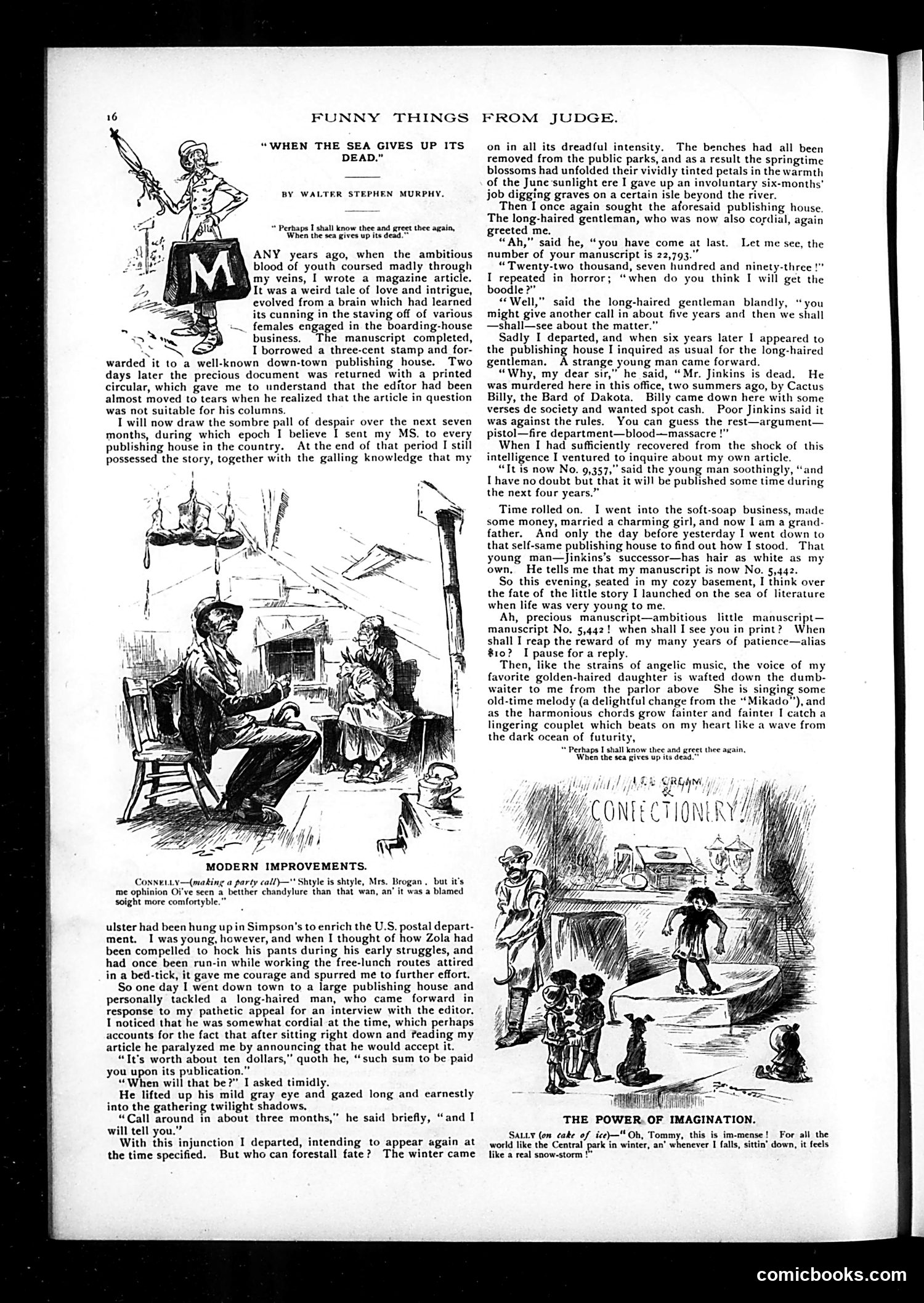
This is a humorous autobiographical story by Walter Stephen Murphy satirizing the publishing industry's notorious rejection and delays. **The Setup:** A young, ambitious writer submits a manuscript to numerous publishers. One finally accepts it for $10, telling him to return in three months. **The Satire:** When Murphy returns, he's given a rejection-style runaround—his manuscript is now #22,793 in the queue. The publisher vaguely promises a decision "in about five years." **The Punchline:** Six years later, Murphy learns the publisher (Mr. Jinkins) was murdered by "Cactus Billy, the Bard of Dakota"—a reference to the Wild West outlaw stereotype. The joke suggests that by the time your manuscript might be published, your publisher could literally be dead. The cartoon mocks both publishing house incompetence and the tortuous waiting periods aspiring authors endured. It also appears to include a separate, unrelated cartoon about Irish domestic service ("Modern Improvements").
📄 Transcribed text from this page (OCR, searchable)
Machine-transcribed from the original scan — historical spelling and the odd misread are preserved.
FUNNY THINGS “WHEN THE SEA GIVES UP ITS DEAD.” BY WALTER STEPHEN MURPHY. ~ Perhaps I shall know thee and greet thee again, ‘When the sea gives up its dead.” ANY years ago, when the ambitious blood of youth coursed madly through bmy veins, I wrote a magazine article. y It was a weird tale of love and intrigue, evolved from a brain which had learned its cunning in the staving off of various females engaged in the boarding-house business. The manuscript completed, " I borrowed a three-cent stamp and for- warded it to a well-known down-town publishing house. Two days later the precious document was returned with a printed circular, which gave me to understand that the editor had been almost moved to tears when he realized that the article in question was not suitable for his columns. I will now draw the sombre pall of despair over the next seven months, during which epoch I believe I sent my MS. to every publishing house in the country. At the end of that period I stiil possessed the story, together with the galling knowledge that my MODERN IMPROVEMENTS. ¥iLyY—(making a party call)—" Shtyle is shtyle, Mrs. Brogan . but it's me ophinion Oi've seen a betther chandylure than that wan, an’ it was a blamed soight more comfortyble.”* ulster had been hung up in Simpson's to enrich the U.S. postal depart- ment. I was young, however, and when I thought of how Zola had been compelled to hock his pants during his early struggles, and had once been run-in while working the free-lunch routes attired in a bed-tick, it gave me courage and spurred me to further effort. So one day I went down town to a large publishing house and personally tackled a long-haired man, who came forward in response to my pathetic appeal for an interview with the editor. I noticed that he was somewhat cordial at the time, which perhaps accounts for the fact that after sitting right down and feading my article he paralyzed me by announcing that he would accept it. “It's worth about ten dollars,” quoth he, “such sum to be paid you upon its publication.” “When will that be?” I asked timidly. He lifted up his mild gray eye and gazed long and earnestly into the gathering twilight shadows, “Call around in about three months,” he said briefly, “and I will tell you.” With this injunction I departed, intending to appear again at the time specified. But who can forestall fate? The winter came FROM JUDGE. on in all its dreadful intensity, The benches had all been removed from the public parks, and as a result the springtime blossoms had unfolded their vividly tinted petals in the warmth of the June ‘sunlight ere I gave up an involuntary six-months’ job digging graves on a certain isle beyond the river. Then I once again sought the aforesaid publishing house. The long-haired gentleman, who was now also cordial, again greeted me. “Ah,” said he, “you have come at last. Let me see, the number of your manuscript is 22,793.” “Twenty-two thousand, seven hundred and ninety-three !" I repeated in horror; “when do you think I will get the boodle?” “Well,” said the long-haired gentleman blandly, “you might give another call in about five years and then we shall —shall—see about the matter.” Sadly I departed, and when six years later 1 appeared to the pentane house I inquired as usual for the long-haired gentleman, strange young man came forward. “Why, my dear sir,” he said, “Mr. Jinkins is dead. He was murdered here in this office, two summers ago, by Cactus Billy, the Bard of Dakota. Billy came down here with some verses de society and wanted spot cash. Poor Jinkins said it was against the rules. You can guess the rest—argument— pistol—fire department—blood—massacre !” When I had sufficiently recovered from the shock of this intelligence I ventured to inquire about my own article. “Tt is now No. 9,357,” said the young man soothingly, “and I have no doubt but that it will be published some time during the next four years.” Time rolled on. I went into the soft-soap business, made some money, married a charming girl, and now I am a grand- father. And only the day before yesterday I went down to that self-same publishing house to find out how I stood. That young man—Jinkins’s successor—has hair as white as my own, He tells me that my manuscript is now No. 5,442. So this evening, seated in my cozy basement, I think over the fate of the little story I launched on the sea of literature when life was very young to me. Ah, precious manuscript—ambitious little manuscript— manuscript No. 5,442! when shall I see you in print?) When shall I reap the reward of my many years of patience—alias $10? I pause for a reply. Then, like the strains of angelic music, the voice of my favorite golden-haired daughter is wafted down the dumb- waiter to me from the parlor above She is singing some old-time melody (a delightful change from the “‘Mikado™), and as the harmonious chords grow fainter and lingering couplet which beats on my heart like a w the dark ocean of futurity, ™ Perhaps I shall know thee and greet thee again, ‘When the sea gives up its dead.” IMAGINATION. SALLY (on ¢ake of ice)—" Oh, Tommy, this is im-mense! For all the world like the Central park in winter, an’ whenever I falls, sittin’ down, it feels like a real snow-storm !" comicbooks.com