
Judge, 1891 · page 6 of 69
Judge — 1891 — page 6: what you’re looking at
What you’re looking at
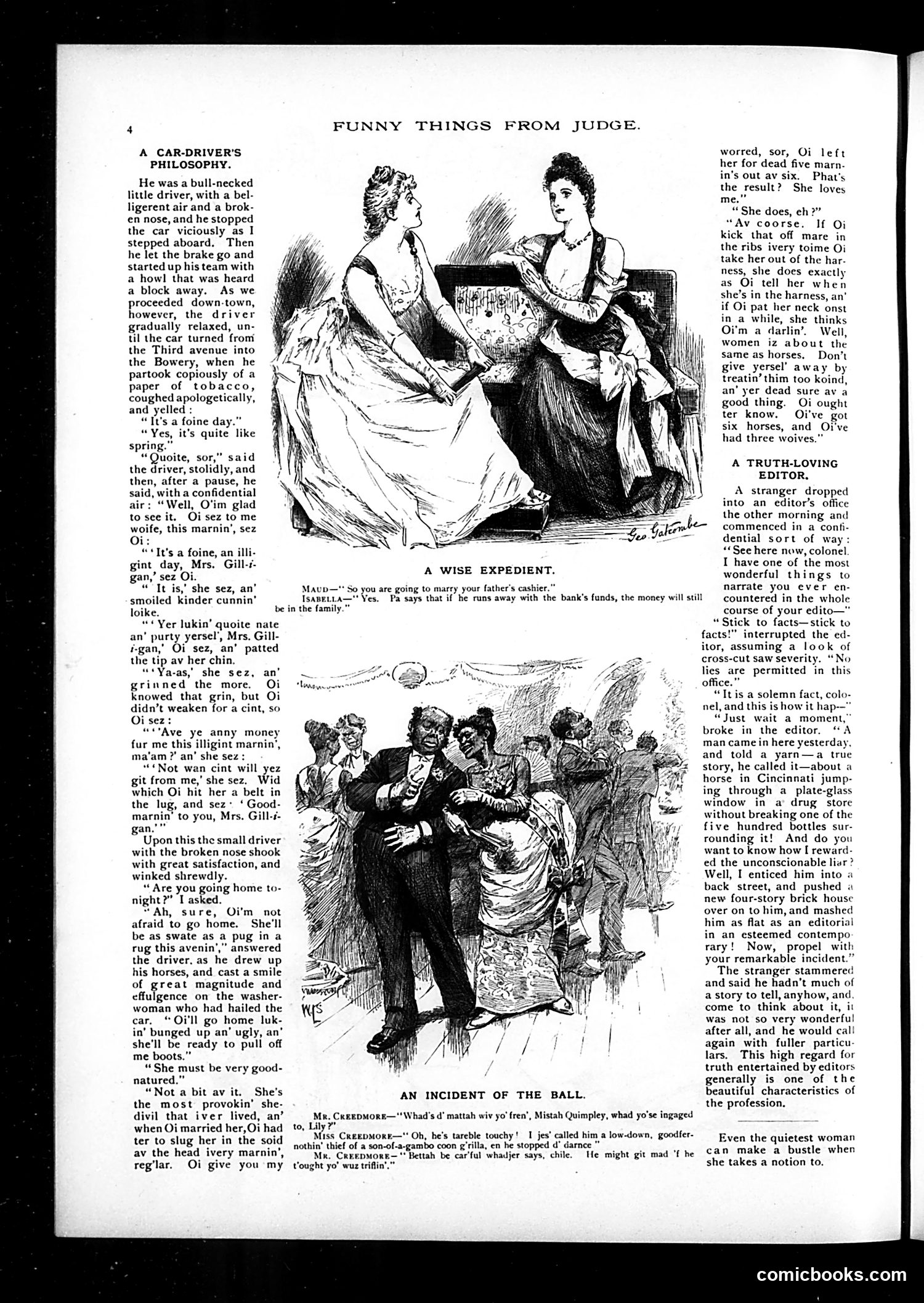
This page from *Judge* magazine contains three separate humorous pieces reflecting turn-of-the-century Irish-American stereotypes and gender dynamics: **"A Car-Driver's Philosophy"**: An Irish cab driver with exaggerated dialect ("Oi," "foine") describes his relationship with his wife. The "joke" relies on cruel stereotypes—he claims to regularly hit her, yet insists this abuse proves her love and loyalty. The comparison of women to horses he mistreats is presented as folk wisdom. This reflects period attitudes normalizing domestic violence as comedic. **"A Wise Expedient"**: A brief joke about a woman marrying her father's cashier to keep the family money within the family—satirizing financial anxiety and women's limited economic agency. **"An Incident of the Ball"**: A racial dialogue between Black characters using exaggerated dialect, appearing to mock romantic sensitivity. The humor depends on racist caricature and minstrelsy-style speech patterns. All three pieces use ethnic/racial stereotypes as their primary comedic device—reflecting *Judge*'s satirical approach through caricature, now recognized as offensive.
📄 Transcribed text from this page (OCR, searchable)
Machine-transcribed from the original scan — historical spelling and the odd misread are preserved.
A CAR-DRIVER'S PHILOSOPHY. He was a bull-necked little driver, with a bel- ligerent air and a brok- en nose, and he stopped the car viciously as I stepped aboard. Then he let the brake go and started up his team with a howl that was heard a block away. As we proceeded down-town, however, the driver gradually relaxed, un- til the car turned from the Third avenue into the Bowery, when he partook copiously of a paper of tobacco, coughed apologetically, and yelled : “Tt’s a foine day.” “Yes, it's quite like spring.” “Quoite, sor,” said the driver, stolidly, and then, after a pause, he said, with a confidential air; “Well, O'im glad to sce it. Oi sez to me woife, this marnin’, sez “<Tt's a foine, an illi- gint day, Mrs, Gill-s. gan,’ sez Oi. "Tt is, she sez, an’ smoiled kinder cunnin’ FUNNY THINGS FROM JUDGE. A WISE EXPEDIENT. Maup—"* So you are going to marry your father’s cashier.” Isanetta—" Ves. loike, be in the family.” ‘Yer lukin’ quoite nate an’ purty yersel’, Mrs, Gill- t-gan,’ Oi sez, an’ patted the tip av her chin. “*Ya-as,’ she sez, an’ grinned the more. Oi knowed that grin, but Oi didn’t weaken for a cint, so Oi sez: “Ave ye anny mon fur me this illigint marnin’, ma'am ?' an’ she sez: “Not wan cint will yez git from me,’ she sez. Wid which Oi hit her a belt in the lug, and sez* ‘ Good- marnin’ to you, Mrs. Gill-#- an." Upon this the small driver with the broken nose shook with great satisfaction, and winked shrewdly. “ Are you going home to- night?” I asked. “Ah, sure, Oi'm not afraid to go home. She'll be as swate as a pug in a rug this avenin’,” answered the driver, as he drew up his horses, and cast a smile of great magnitude and effulgence on the washer- woman who had hailed the car, “Oi'll go home luk- in’ bunged up an’ ugly, an’ she'll be ready to pull off me boots.” “She must be very good- natured.” “Not a bit av it. She's the most provokin’ she- divil that iver lived, an’ when Oi married her,Oi had ter to slug her in the soid av the head ivery marnin’, reg'lar. Oi give you my AN INCIDENT OF THE BALL. Pa says that if he runs away with the bank's funds, the money will still Mr, Cxeepmors—"Whad's d’ mattah wiv yo' fren’, Mistah Quimpley, whad yo'se ingaged to, Lily?” Miss Creepmoxe—"' Oh, he's tareble touchy! nothin’ thief of a son-of. Mx. CrEepMon Vought yo" wuz triftin’, ambo coon g'rilla, en he stop, Bettah be car'ful whadjer says, chile, I jes’ called him a low-down, goodfer- d’ darnce " He might git mad 'f he worred, sor, Oi left her for dead five marn- in’s out av six. Phat's the result? She loves me.” “She does, eh ?” “Av coorse. If Qi kick that off mare in the ribs ivery toime Oi take her out of the har- ness, she does exactly as Oi tell her when she’s in the harness, an’ if Oi pat her neck onst in a while, she thinks Oi'm a darlin’, Well, women iz about the same as horses, Don’t give yersel’ away by treatin’ thim too koind, an’ yer dead sure av a good thing. Oi ought ter know. Oi've got six horses, and Oi've had three woives.” A TRUTH-LOVING EDITOR, A stranger dropped into an editor’s office the other morning and commenced in a confi- dential sort of way: “See here now, colonel I have one of the most wonderful things to narrate you ever en- countered in the whole course of your edito—” “Stick to facts—stick to facts!" interrupted the ed- itor, assuming a look of cross-cut saw severity. “No lies are permitted in this office.” “Ttis a solemn fact, colo- nel, and this is how it hap--" “Just wait a moment,” broke in the editor. ‘ man came in here yesterd. and told a yarn—a true story, he called it—about a horse in Cincinnati jump- ing through a plate-glass window in a’ drug. store without breaking one of the five hundred bottles sur- rounding it! And do you want to know how [ reward- ed the unconscionable liar ? Well, I enticed him into a back street, and pushed a new four-story brick house over on to him, and mashed him as flat as an editorial in an esteemed contempo rary! Now, propel with your remarkable incident.” The stranger stammered and said he hadn't much of a story to tell, anyhow, and. come to think about it, it was not so very wonderful after all, and he would cal! again with fuller particu lars. This high regard for truth entertained by editors generally is one of the beautiful characteristics of the profession. Even the quietest woman can make a bustle when she takes a notion to. comicbooks.com