
Judge, 1891 · page 42 of 69
Judge — 1891 — page 42: what you’re looking at
What you’re looking at
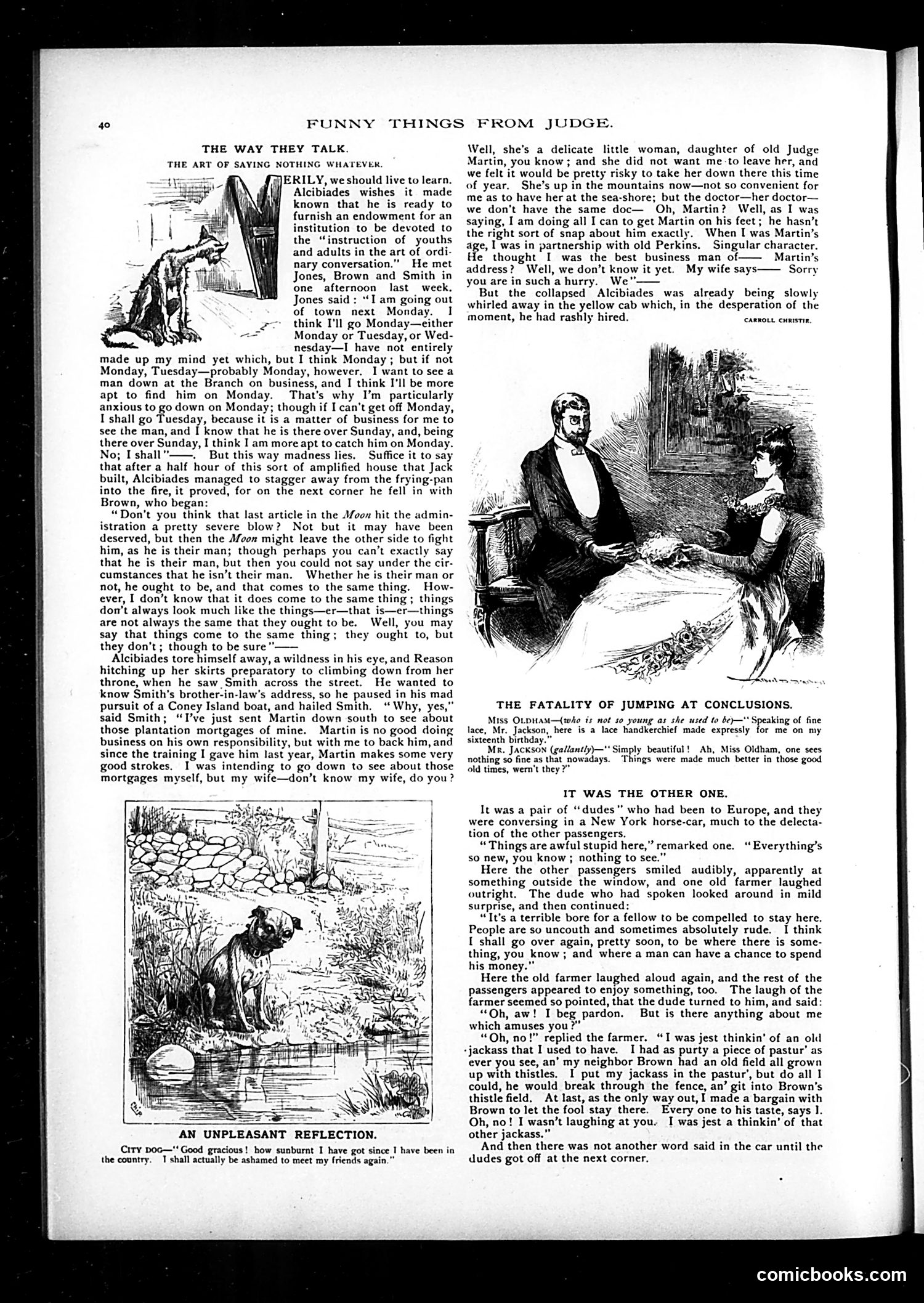
This page satirizes verbose, meandering conversation—specifically the American tendency to talk at exhausting length while saying almost nothing substantive. The main article mocks three characters (Jones, Brown, Smith) who exemplify this failing. Jones rambles for half an hour about *when* he's traveling, never reaching a point. Brown delivers an equally circular monologue about a newspaper article's political impact, trailing into philosophical tangents. Smith goes on about his brother-in-law's address while digressing into family matters and business advice. The satire targets upper-middle-class men who confuse verbosity with intelligence or importance. The opening references "Alcibiades" proposing an endowment to teach "the art of ordinary conversation"—ironic, since these speakers demonstrate the *anti*-art of conversation: repetition, qualification, and endless subordinate clauses that obscure rather than clarify meaning. The cartoons illustrate the tedium: one shows a man apparently escaping these bores. The secondary item "An Unpleasant Reflection" is unrelated—a joke about a sunburned city dog.
📄 Transcribed text from this page (OCR, searchable)
Machine-transcribed from the original scan — historical spelling and the odd misread are preserved.
FUNNY THE WAY THEY TALK. THE ART OF SAYING NOTHING WHATEVER. ERILY, we should live to learn, Alcibiades wishes it made known that he is ready to furnish an endowment for an institution to be devoted to the “instruction of youths and adults in the art of ordi- nary conversation.” He met Jones, Brown and Smith in one afternoon last week. Jones said: “I am going out of town next Monday. I think I'll go Monday—either Monday or Tuesday, or Wed- nesday—I have not entirely made up my mind yet which, but I think Monday ; but if not Monday, Tuesday—probably Monday, however. I want to see a man down at the Branch on business, and I think I'll be more apt to find him on Monday. That's why I’m particularly anxious to go down on Monday; though if I can't get off Monday, I shall go Tuesday, because it is a matter of business for me to see the man, and [ know that he is there over Sunday, and, being there over Sunday, I think I am more apt to catch him on Monday. No; I shall"——. But this way madness lies. Suffice it to say that after a half hour of this sort of amplified house that Jack built, Alcibiades managed to stagger away from the frying-pan into the fire, it proved, for on the next corner he fell in with Brown, who began: “Don't you think that last article in the Moon hit the admin- istration a pretty severe blow? Not but it may have been deserved, but then the Afoon might leave the other side to fight him, as he is their man; though perhaps you can’t exactly that he is their man, but then you could not say under the cir- cumstances that he isn’t their man. Whether he is their man or not, he ought to be, and that comes to the same thing. How- ever, I don’t know that it does come to the same thing ; things don’t always look much like the things—er—that is—er—things are not always the same that they ought to be. Well, you may say that things come to the same thing; they ought to, but they don't; though to be sure ""—— Alcibiades tore himself away, a wildness in his eye, and Reason hitching up her skirts preparatory to climbing down from her throne, when he saw Smith across the street. He wanted to know Smith's brother-in-law's address, so he paused in his mad pursuit of a Coney Island boat, and hailed Smith. “Why, yes,” said Smith; “I’ve just sent Martin down south to see about those plantation mortgages of mine. Martin is no good doing business on his own responsibility, but with me to back him, and since the training I gave him last year, Martin makes some very good strokes. I was intending to go down to see about those mortgages myself, but my wife—don’t know my wife, do you? 1 | | AN UNPLEASANT REFLECTION. TY DOG—"* Good gracious! how sunburnt I have got since | have been in the country. T shall actually be ashamed to meet my friends again.”” + jackass that I used to have. THINGS FROM JUDGE. Well, she’s a delicate little woman, daughter of old Judge Martin, you know; and she did not want me-to leave her, and we felt it would be pretty risky to take her down there this time of year. She’s up in the mountains now—not so convenient for me as to have her at the sea-shore; but the doctor—her doctor— we don’t have the same doc— Oh, Martin? Well, as I was saying, I am doing all I can to get Martin on his feet; he hasn’t the right sort of snap about him exactly. When I was Martin’s age, I was in partnership with old Perkins. Singular character. He thought I was the best business man of—— Martin’ address? Well, we don’t know it yet. My wife says— Sorry you are in such 'a hurry. We"—— But the collapsed Alcibiades was already being slowly whirled away in the yellow cab which, in the desperation of the moment, he had rashly hired. CARNOLL CHRISTIE. THE FATALITY OF JUMPING AT CONCLUSIONS. Miss Oupitast—{wohe ir mot 10 young ar. she used to be)—" Speaking of fine lace, Mr. Jackson, here is a lace handkerchief made expressly for me on my sixteenth birthday. (gallantly)—"' Simply beautiful! Ah, Miss Oldham, one sees Mr. Jacksos nothing so fine as that nowadays. Things were made much better in those good old times, wern't they?” IT WAS THE OTHER ONE. It was a pair of “dudes” who had been to Europe, and they were conversing in a New York horse-car, much to the delecta- tion of the other passengers. “Things are awful stupid here,” remarked one. ‘Everything’s so new, you know; nothing to see.” Here the other passengers smiled audibly, apparently at something outside the window, and one old farmer laughed outright. The dude who had spoken looked around in mild surprise, and then continued: “It's a terrible bore for a fellow to be compelled to stay here. People are so uncouth and sometimes absolutely rude. 1 think I shall go over again, pretty soon, to be where there is some- thing, you know ; and where a man can have a chance to spend his money.” Here the old farmer laughed aloud again, and the rest of the passengers appeared to enjoy something, too. The laugh of the farmer seemed so pointed, that the dude turned to him, and said: “Oh, aw! I beg pardon. But is there anything about me which amuses you ?” “Oh, no!” replied the farmer. “I was jest thinkin’ of an old I had as purty a piece of pastur’ as ever you see, an’ my neighbor Brown had an old field all grown up with thistles. I put my jackass in the pastur’, but do all I could, he would break through the fence, an’ git into Brown's thistle field, At last, as the only way out, I made a bargain with Brown to let the fool stay there. Every one to his taste, says 1. Oh, no! I wasn’t laughing at you. I was jest a thinkin’ of that other jackass.” And then there was not another word said in the car until the dudes got off at the next corner. comicbooks.com