
Judge, 1891 · page 36 of 69
Judge — 1891 — page 36: what you’re looking at
What you’re looking at
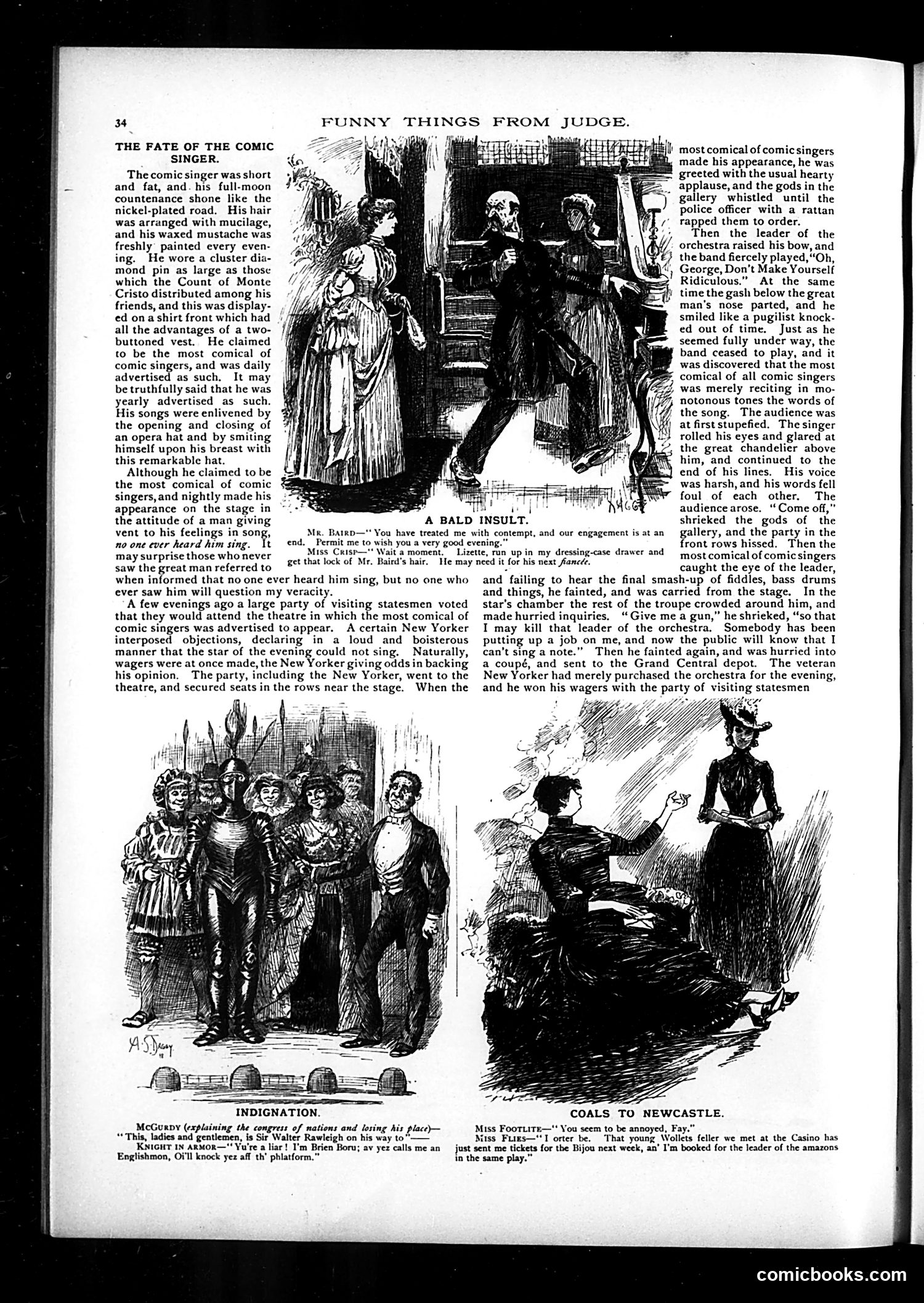
This page satirizes a fraudulent performer—a vain, heavily made-up comic singer famous for theatrical antics (opening his opera hat, striking himself) rather than actual talent. The satire's central joke: **he cannot sing at all**—he merely lip-syncs or recites the lyrics in monotone while the orchestra plays. When visiting statesmen attend a performance, a skeptical New Yorker bets the singer is a fraud. The wager is won when the orchestra stops mid-performance, exposing the singer's deception to the audience, who heckle him off stage. The satire targets **show-business charlatans**—performers whose reputations rest entirely on promotion and spectacle rather than genuine ability. The elaborate costume details (diamond pin, waxed mustache, painted appearance) emphasize how artifice substitutes for merit. The story mocks both the faker and the credulous public who accept advertised claims uncritically. The three smaller cartoons below offer unrelated comic vignettes about social embarrassments.
📄 Transcribed text from this page (OCR, searchable)
Machine-transcribed from the original scan — historical spelling and the odd misread are preserved.
34 THE FATE OF THE COMIC SINGER. The comic singer was short and fat, and. his full-moon countenance shone like the nickel-plated road. His hair was arranged with mucilage, and his waxed mustache was freshly’ painted every even- ing. He wore a cluster dia- mond pin as large as those which the Count of Monte Cristo distributed among his friends, and this was display- ed ona shirt front which had all the advantages of a two- buttoned vest. He claimed to be the most comical of comic singers, and was daily advertised as such. It may be truthfully said that he was yearly advertised as such. His songs were enlivened by the opening and closing of an opera hat and by smiting himself upon his breast with this remarkable hat. Although he claimed to be the most comical of comic singers, and nightly made his appearance on the stage in the attitude of a man giving vent to his feelings in song, no one ever heard him sing. It may surprise those who never saw the great man referred to when informed that no one ever heard him sing, but no one who ever saw him will question my veracity. A few evenings ago a large party of visiting statesmen voted that they would attend the theatre in which the most comical of comic singers was advertised to appear. A certain New Yorker interposed objections, declaring in a loud and boisterous manner that the star of the evening could not sing. Naturally, wagers were at once made, the New Yorker giving odds in backing his opinion. The party, including the New Yorker, went to the theatre, and secured seats in the rows near the stage. When the end. Miss Cxisp—'* Wait a moment. INDIGNATION. McGurpy (explaining the congress of nations and losing his place)— “This, ladies and gentlemen, is Sir Walter Rawleigh on his way to”. KNIGHT IN ARMOR—"* Yu're a liar ! I'm Brien Boru; av yez calls me an Englishmon, Oi'll knock yez aff th’ phlatform.” Tat je] A BALD INSULT. Mx. Barrp—"' You have treated me with contempt, and our engagement is at an Permit me to wish you a very good evening.” Lizette, run up in my dressing-case drawer and get that lock of Mr. Baird’s hair. Ie may need it for his next flancée. FUNNY THINGS FROM JUDGE. most comical of comic singers , made his appearance, he was greeted with the usual hearty applause, and the gods in the gallery whistled until the police officer with a rattan rapped them to order. Then the leader of the orchestra raised his bow, and the band fiercely played,“Oh, George, Don’t Make Yourself Ridiculous.” At the same time the gash below the great man’s nose parted, and he smiled like a pugilist knock- ed out of time. Just as he seemed fully under way, the band ceased to play, and it was discovered that the most comical of all comic singers was merely reciting in mo- notonous tones the words of f the song. The audience was at first stupefied. The singer rolled his eyes and glared at , the great chandelier above ¢ him, and continued to the end of his lines. His voice was harsh, and his words fell foul of each other, The audience arose. ‘Come off,” shrieked the gods of the gallery, and the party in the front rows hissed. Then the most comical of comic singers caught the eye of the leader, and failing to hear the final smash-up of fiddles, bass drums and things, he fainted, and was carried from the stage. In the star's chamber the rest of the troupe crowded around him, and made hurried inquiries. “Give me a gun,” he shrieked, “so that I may kill that leader of the orchestra. Somebody has been putting up a job on me, and now the public will know that I can’t sing a note.” Then he fainted again, and was hurried into a coupé, and sent to the Grand Central depot. The veteran New Yorker had merely purchased the orchestra for the evening, and he won his wagers with the party of visiting statesmen ed COALS TO NEWCASTLE. Miss Foottite—"' You seem to be annoyed, Fay.” Miss Furs—“I orter be. That young Wollets feller we met at the Casino has just sent me tickets for the Bijou next week, an’ I'm booked for the leader of the amazons in the same play.” comicbooks.com