
Judge, 1891 · page 56 of 69
Judge — 1891 — page 56: what you’re looking at
What you’re looking at
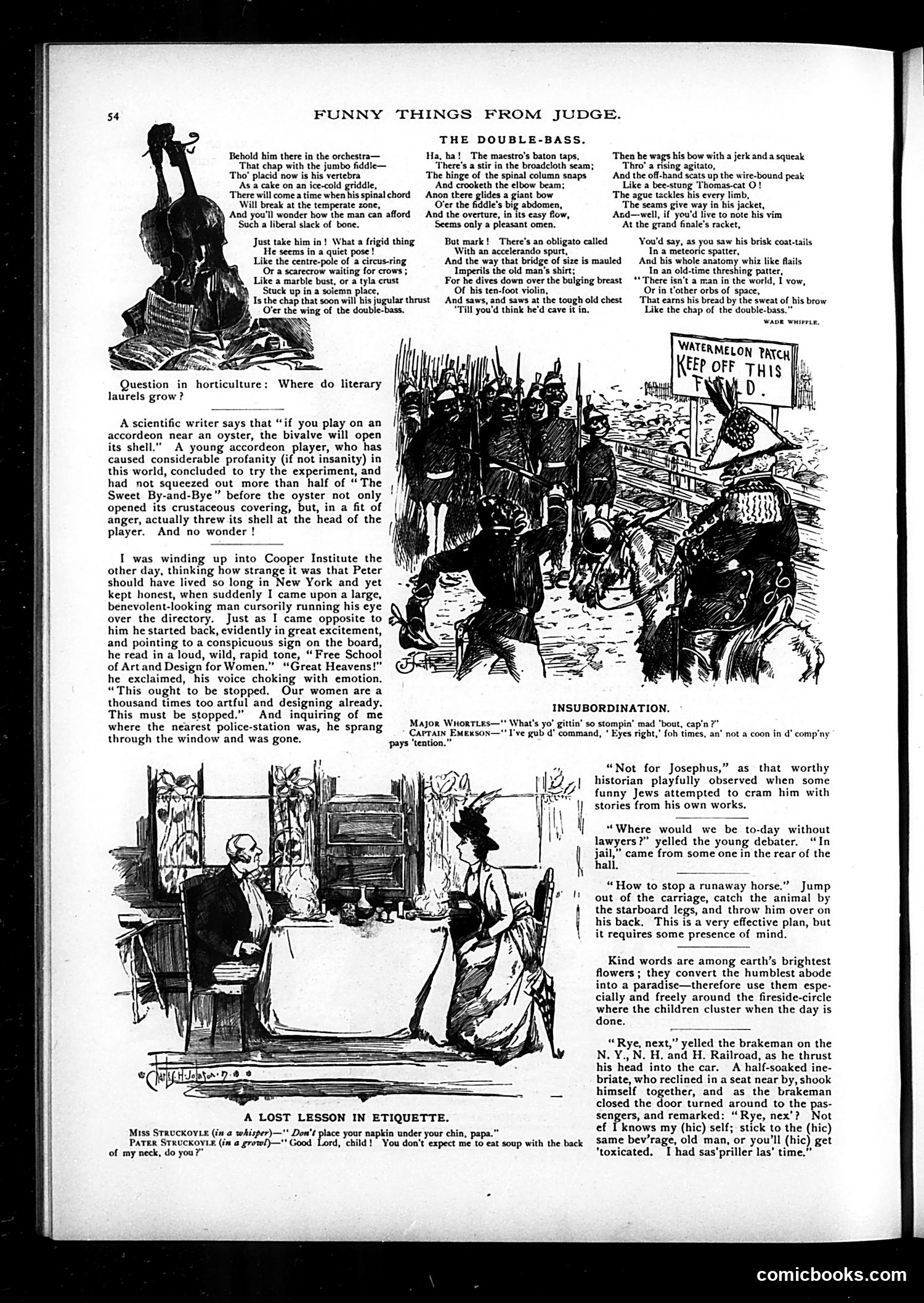
This page contains humorous satirical pieces typical of late 19th-century Judge magazine: **"The Double-Bass"** is a comedic poem mocking orchestral musicians, specifically double-bass players. It describes the physical contortions and violent bodily movements required to play the instrument—the spine bending, joints dislocating, clothes tearing—presenting the musician as a comical, suffering figure. The satire targets both the absurdity of the instrument itself and the undignified appearance of its players during performance. **Other short pieces** include jokes about oysters and accordions, lawyers ("Where would we be without lawyers?"), and runaway horses—all typical period humor offering mild social commentary through absurdist scenarios. The accompanying illustrations feature exaggerated Victorian character sketches emphasizing physical comedy. The overall tone is lighthearted mockery of everyday situations, musicians, and professions, characteristic of Judge's middle-class satirical approach. No specific political figures or events appear to be referenced on this page.
📄 Transcribed text from this page (OCR, searchable)
Machine-transcribed from the original scan — historical spelling and the odd misread are preserved.
FUNNY THINGS FROM JUDGE. THE DOUBLE-BASS. Behold him there in the orchestra— Ha, ha! The maestro’s baton taps, ‘Then he wags his bow with a jerk and a squeak ‘That chap with the jumbo fiddle— ‘There's a stir in the broadcloth seam; ‘Thro’ a rising agitato, Tho’ placid now is his vertebra ‘The hinge of the spinal column snaps’ And the off-hand scats up the wire-bound peak As a cake on an ice-cold griddle, ‘And crooketh the elbow beam; Like a bee-stung Thomas-cat O! There will come a time when his spinal chord Anon tkere glides a giant bow The ague tackles his every limb, Will break at the temperate zone, O'er the fiddle’s big abdomen, ‘The seams give way in his jacket, ‘And you'll wonder how the man can afford And the overture, in its easy flow, And—well, if you'd live to note his vim Such a liberal slack of bone. Seems only a pleasant omen, At the grand finale’s racket, Just take him in! What a frigid thing But mark! There's an obligato called You'd say, as you saw his brisk coat-tails He seems in a quiet pose With an accelerando spurt, In a meteoric spatter, Like the centre-pole of a circus-ring And the way that bridge of size is mauled And his whole anatomy whiz like flails Or a scarecrow waiting for crows ; Imperils the old man’s shirt; In an old-time threshing patter, Like a marble bust, or a tyla crust For he dives down over the bulging breast‘ There isn’t a man in the world, I vow, Stuck up in a Of his ten-foot violin, Or in t’other orbs of space, Is the chap that soon will his jugular thrust And saws, and saws at the tough old chest ‘That earns his bread by the sweat of his brow O’er the wing of the double-bass. *Till you'd think he'd cave it in. Like the chap of the double-bass. WN WADE WHUrrER, D Question in horticulture: Where do literary laurels grow ? A scientific writer says that “if you play on an accordeon near an oyster, the bivalve will open its shell.” A young accordeon player, who has caused considerable profanity (if not insanity) in this world, concluded to try the experiment, and had not squeezed out more than half of “The Sweet By-and-Bye” before the oyster not only opened its crustaceous covering, but, in a fit of anger, actually threw its shell at the head of the player. And no wonder ! I was winding up into Cooper Institute the other day, thinking how strange it was that Peter should have lived so long in New York and yet kept honest, when suddenly I came upon a large, benevolent-looking man cursorily running his eye over the directory. Just as I came opposite to him he started back, evidently in great excitement, and pointing to a conspicuous sign on the board, he read in a loud, wild, rapid tone, “Free School of Artand Design for Women.” “Great Heavens!” he exclaimed, his voice choking with emotion. “This ought to be stopped. Our women are a thousand times too artful and designing already. INSU DGRDINA TON. his must be stopped.” And inquiring of me Scesstati Major WHorTLEs—"' What's yo" gittin’ so stompin’ mad "bout, cap'n ?” Ww spran , : npin’ mad "bout, cap'n?" Ls, ee tase aan Ewes); ne sprans Carzain,Bucensox—" I've gub d! command, "Eyes right,” fh times, a nota coon ind compiny d pays ‘tention.” “Not for Josephus,” as that worthy historian playfully observed when some funny Jews attempted to cram him with stories from his own works. “Where would we be to-day without lawyers ?” yelled the young debater. “In jail,” came from some one in the rear of the hall. “How to stop a runaway horse.” Jump out of the carriage, catch the animal by the starboard legs, and throw him over on his back. This is a very effective plan, but it requires some presence of mind. Kind words are among earth’s brightest flowers ; they convert the humblest abode into a paradise—therefore use them espe- cially and freely around the fireside-circle where the children cluster when the day is done. “Rye, next,” yelled the brakeman on the N. Y., N. H. and H. Railroad, as he thrust his head into the car. A half-soaked ine- briate, who reclined in a seat near by, shook himself together, and as the brakeman closed the door turned around to the pas- A LOST LESSON IN ETIQUETTE. sengers, and remarked: “Rye, nex’? Not Miss StRUcKoYLE (in a whisper)—"* Don't place your napkin under your chin, papa.” ef I knows my (hic) self;: stick to the (hic) PATER STRUCKOYLE (in @ growl)—"' Good Lord, child! You don't expect me to eat soup with the back Same bev’rage, old man, or you'll (hic) get of my neck, do you?" "toxicated. I had sas'priller las’ time.” comicbooks.com