
A complete issue · 126 pages · 1922
Photoplay Magazine Cover

This is the cover of **Photoplay** magazine from May, priced at 25 cents. It features a portrait of a woman with striking red-orange curled hair adorned with blue flowers, against a soft blue background. The cover identifies her as **Betty Compson** and prominently asks "WHO IS POLA NEGRI?" suggesting the issue contains information about this performer. The artwork is credited to J. Knowles Hare. The masthead describes Photoplay as "The World's Leading Moving Picture Magazine," indicating this publication focused on cinema and entertainment industry news during the silent film era.
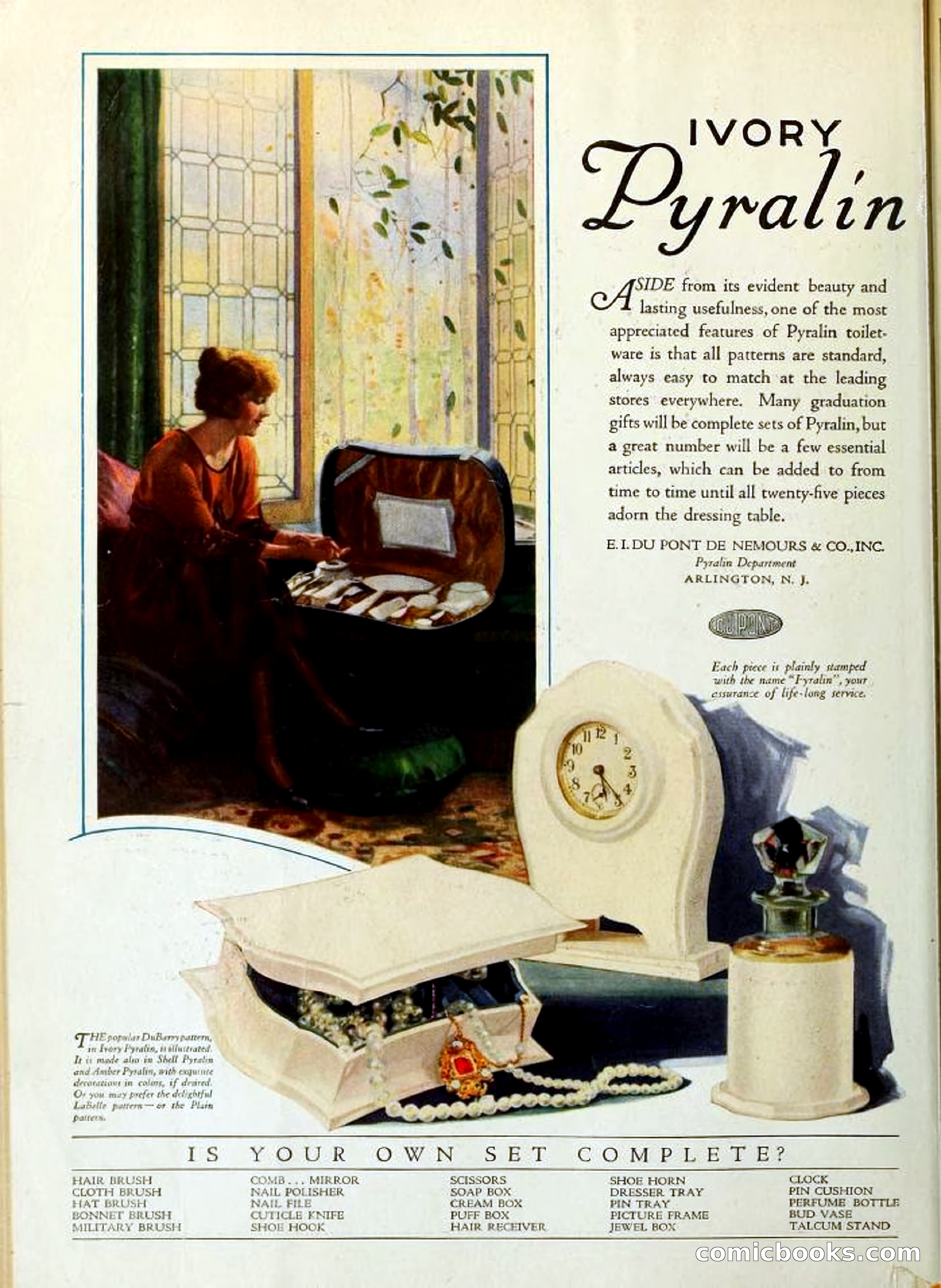
# Description of Page This is a **full-page advertisement**, not fiction content or a story illustration. The ad promotes **Ivory Pyralin** toilet ware, manufactured by E.I. du Pont de Nemours & Co., Inc. The page features an illustration of a woman at a dressing table examining various toiletry items displayed in an open case. The advertisement emphasizes that Pyralin patterns are standardized and easy to match, making them suitable as graduation gifts. A list at the bottom inventories twenty-five different items (hair brushes, combs, mirrors, scissors, soap boxes, clocks, etc.) that buyers could collect to complete their "own set." The text stresses each piece bears the "Pyralin" name, guaranteeing quality.
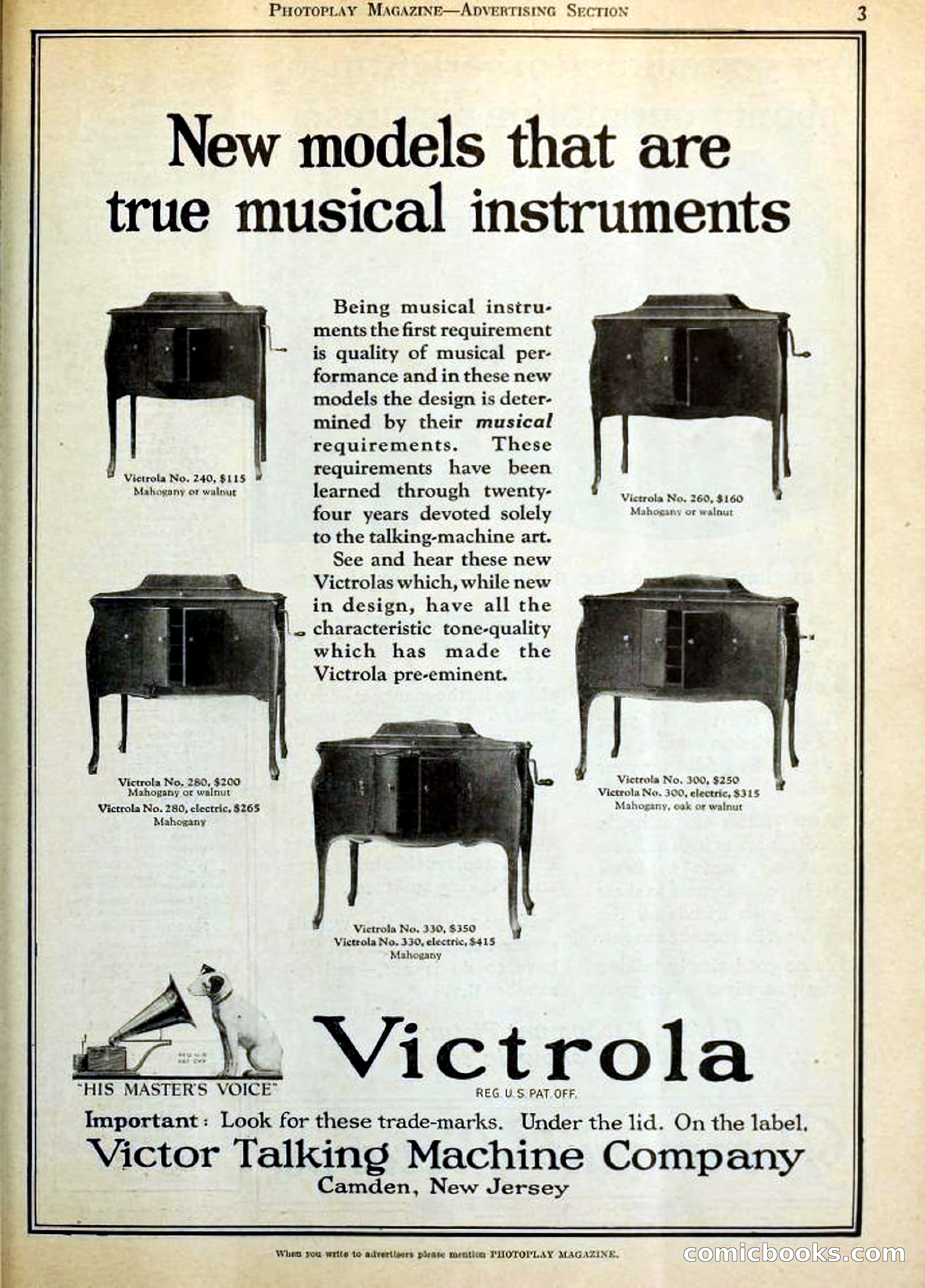
This is an advertising page from *Photoplay Magazine*'s advertising section. It displays five cabinet-style phonographs (gramophones) from the Victrola brand, ranging in price from $115 to $415, with options for mahogany, walnut, oak, and electric models. The ad emphasizes that these new Victrola models are "true musical instruments" designed according to musical performance requirements developed through twenty-four years of research. The copy highlights the machines' superior tone quality and characteristic sound. At the bottom, the Victor Talking Machine Company of Camden, New Jersey identifies itself as the manufacturer, marked by the recognizable "His Master's Voice" logo.
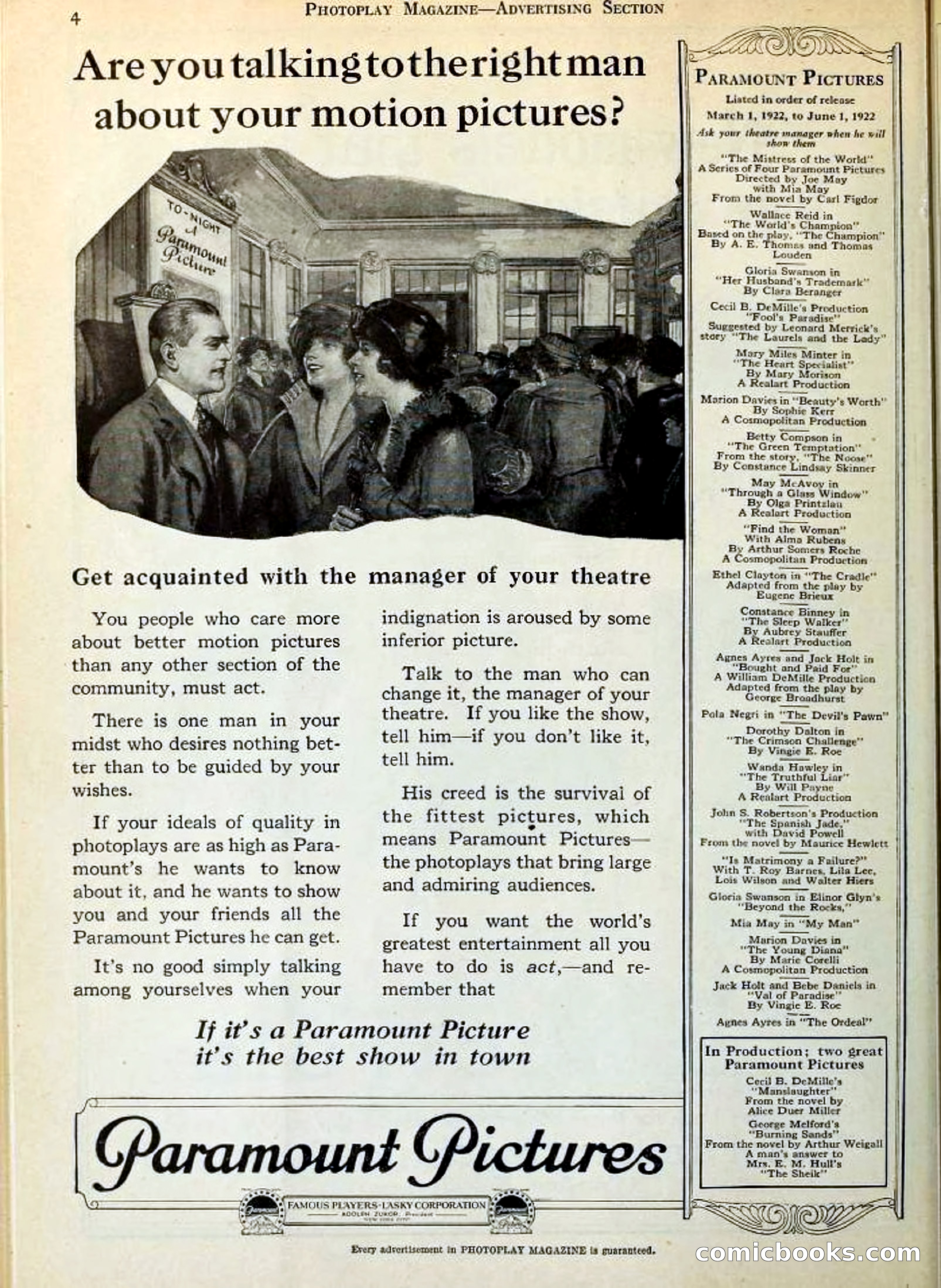
# Page Description This is an advertising section from *Photoplay Magazine* (page 4), not a pulp fiction magazine. The page is dominated by a Paramount Pictures advertisement encouraging theater patrons to speak with their local theater manager about film quality. The ad features a scene showing a man and woman in conversation, with text urging readers to "act" and demand the best motion pictures. A right-hand column lists Paramount films in release from March to June 1922, including titles featuring actors like Gloria Swanson, Wallace Reid, and Marion Davies. The page is entirely promotional material for Paramount's movie offerings.
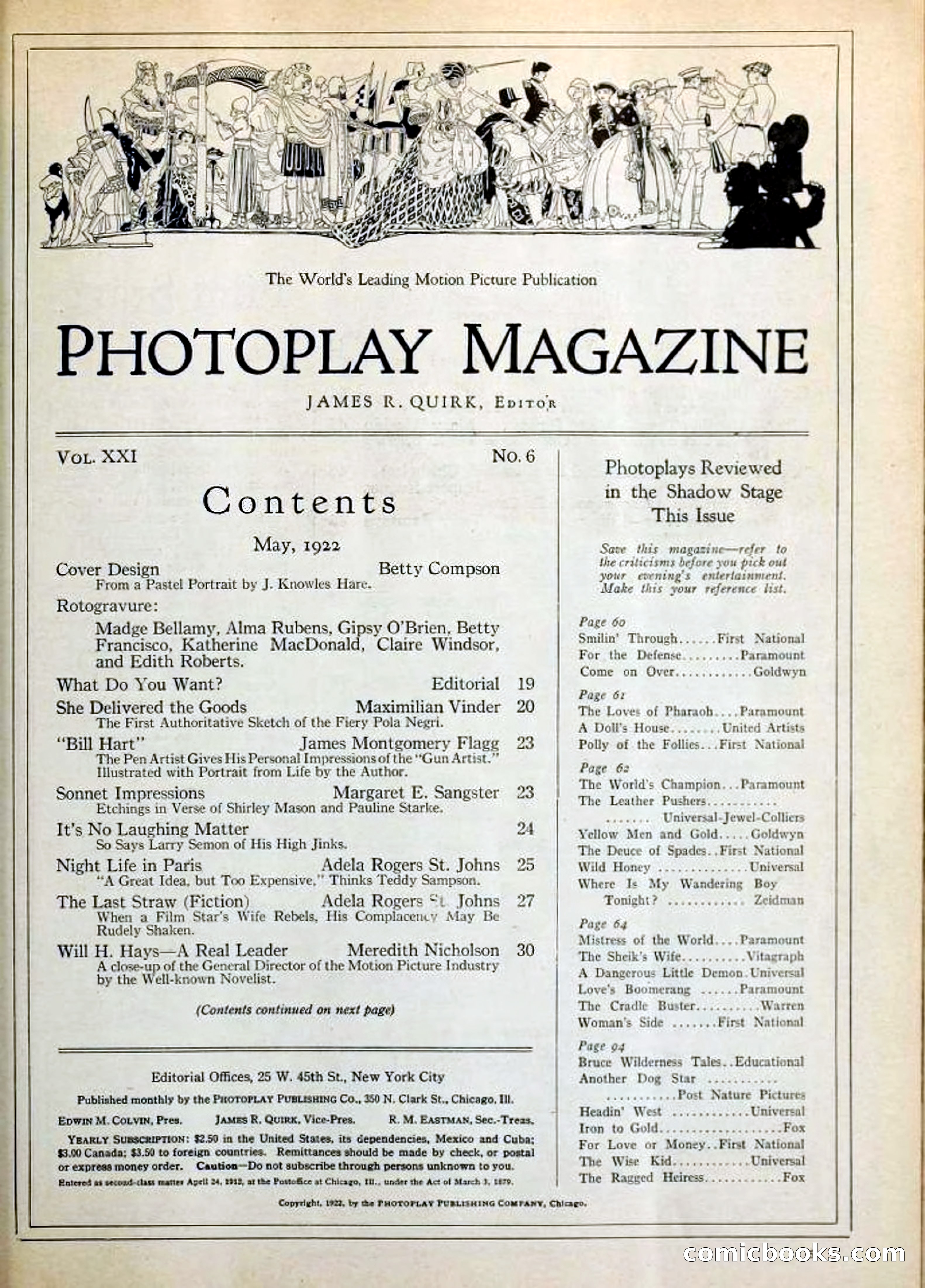
# Photoplay Magazine Contents Page, May 1922 This is a table of contents page from *Photoplay Magazine*, Vol. XXI, No. 6 (May 1922), edited by James R. Quirk. The page lists articles about motion pictures and film industry topics, including pieces on Betty Compson, Will H. Hays, and various film reviews. It also advertises reviews of specific photoplay films that appear later in the issue, organized by page number. The right column lists upcoming films from studios like Paramount, First National, Universal, and others. This is a publication dedicated to cinema and entertainment news, not pulp fiction in the traditional sense.
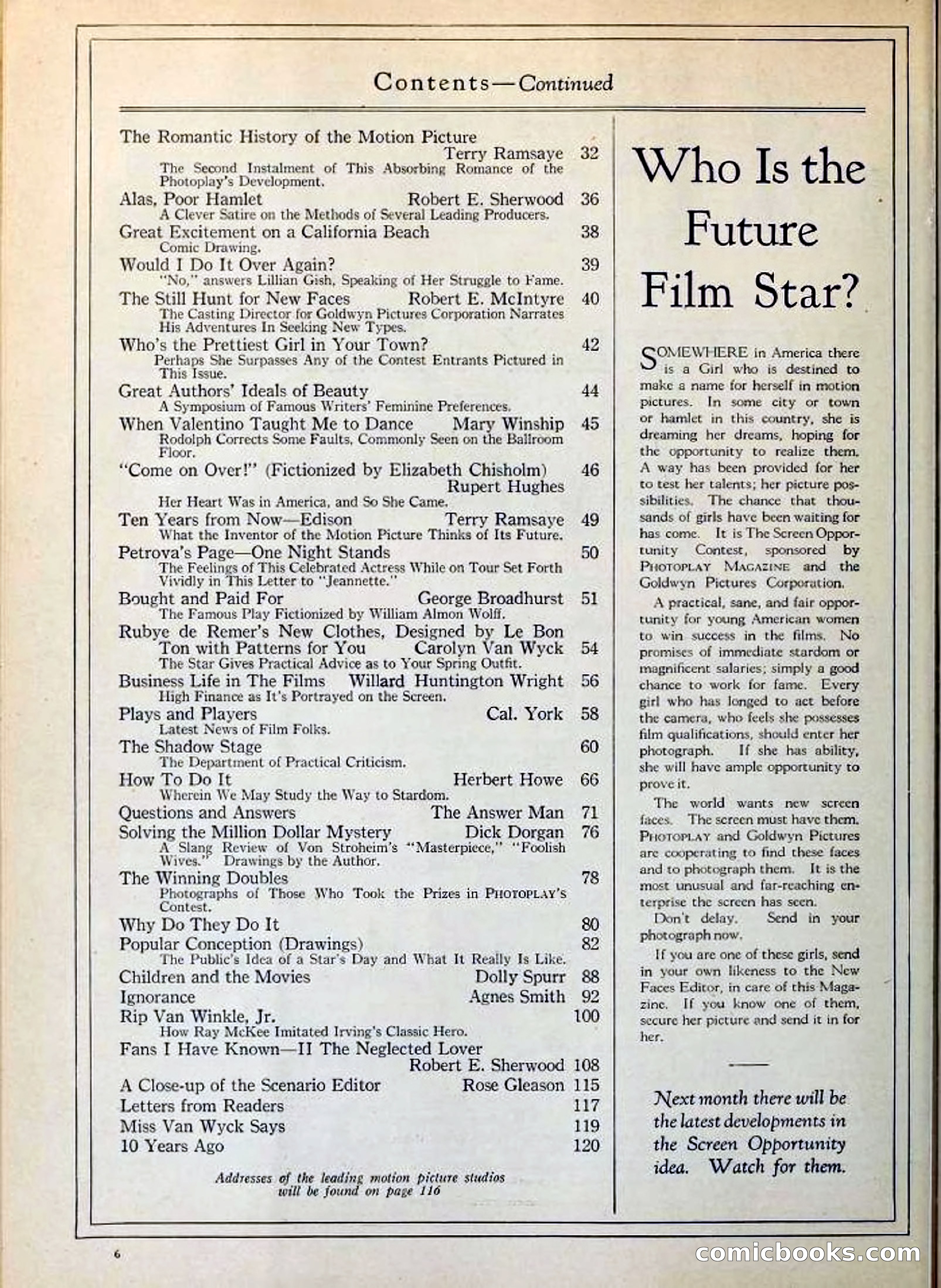
# Contents Page from Photoplay Magazine This is a contents page (page 6) from what appears to be **Photoplay Magazine**, a motion picture publication. The left column lists article titles and page numbers covering film industry topics—including pieces on motion picture history, casting directors, beauty standards, and film business practices. The right side features a prominent advertisement titled "Who Is the Future Film Star?" announcing a "Screen Opportunity Contest" sponsored by Photoplay Magazine and Goldwyn Pictures Corporation, inviting young American women to submit photographs for a chance to enter the film industry. The page is formatted as a typical contents listing with organizational structure typical of early-20th-century magazine layouts.
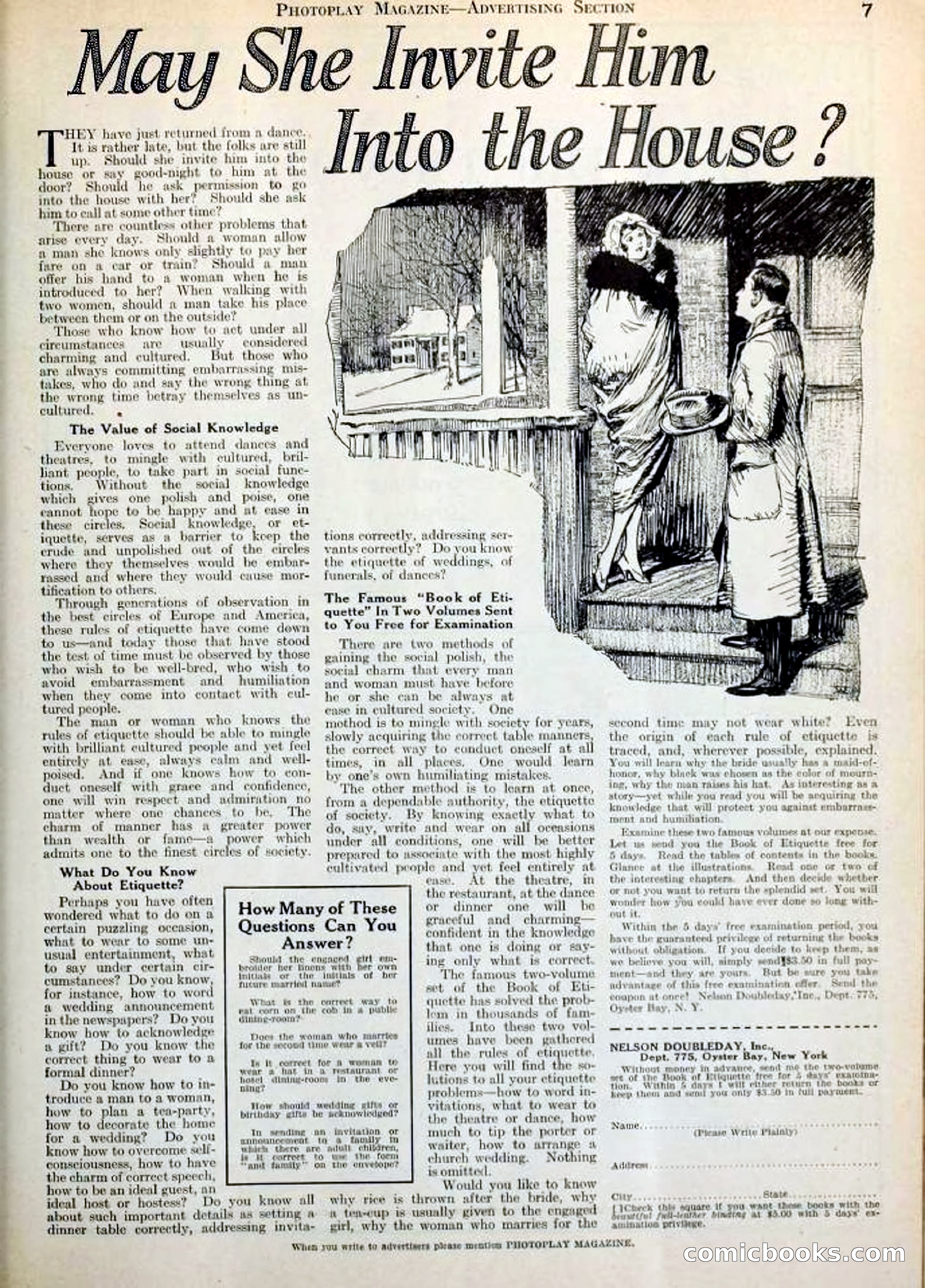
# Analysis of Page 7 from Photoplay Magazine This is an **advertising section** of Photoplay Magazine featuring an advertisement for a book on etiquette. The page includes an illustration depicting a woman and man at a house doorway, apparently addressing social protocol questions. The main advertised product is "The Famous 'Book of Etiquette' In Two Volumes Sent to You Free for Examination" from Nelson Doubleday, Inc. The text addresses social etiquette dilemmas such as inviting dates into one's home and proper conduct in cultivated society. The advertisement promises readers can examine the two-volume etiquette guide free for five days before deciding to purchase, emphasizing how such knowledge helps one navigate upper-class social circles with confidence and grace.
This is an advertising page from *Photoplay Magazine*'s advertising section. The full-page advertisement, titled "How Did They Do It?", makes a meta-argument for the value of advertising itself. It begins by asking readers to imagine life without modern conveniences, then argues that advertising has been essential to human progress and development—making the world "better housed, better fed, better dressed." The ad concludes by urging readers to pay attention to the advertisements throughout the publication, claiming they serve as "an authentic and essential guide to the markets of the world" and will "prove invaluable to you." The page is essentially an advertisement promoting the importance of reading advertisements.
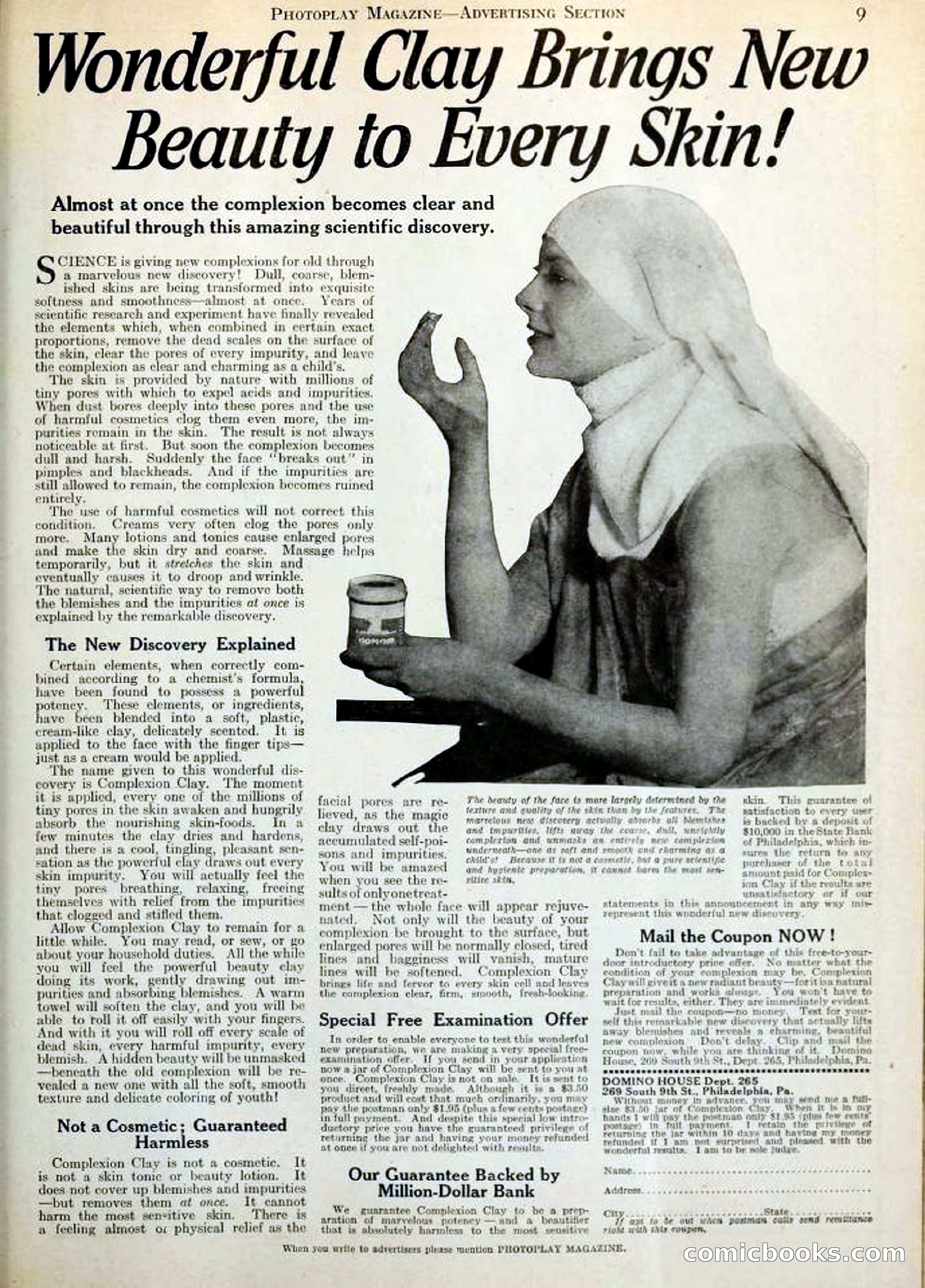
# Advertisement Page for Complexion Clay This is an advertising section from *Photoplay Magazine*. The page promotes "Complexion Clay," a skincare product marketed as a scientific discovery that allegedly removes dead skin and impurities to improve complexion. The advertisement claims the clay works by unclogging facial pores and eliminating blemishes through a chemist's formula. The page includes testimonial-style text asserting the product is "not a cosmetic" but rather a guaranteed treatment, backed by a "Million-Dollar Bank" guarantee. A coupon for a free examination offer appears at the bottom. The illustration shows a woman's profile displaying the product jar.
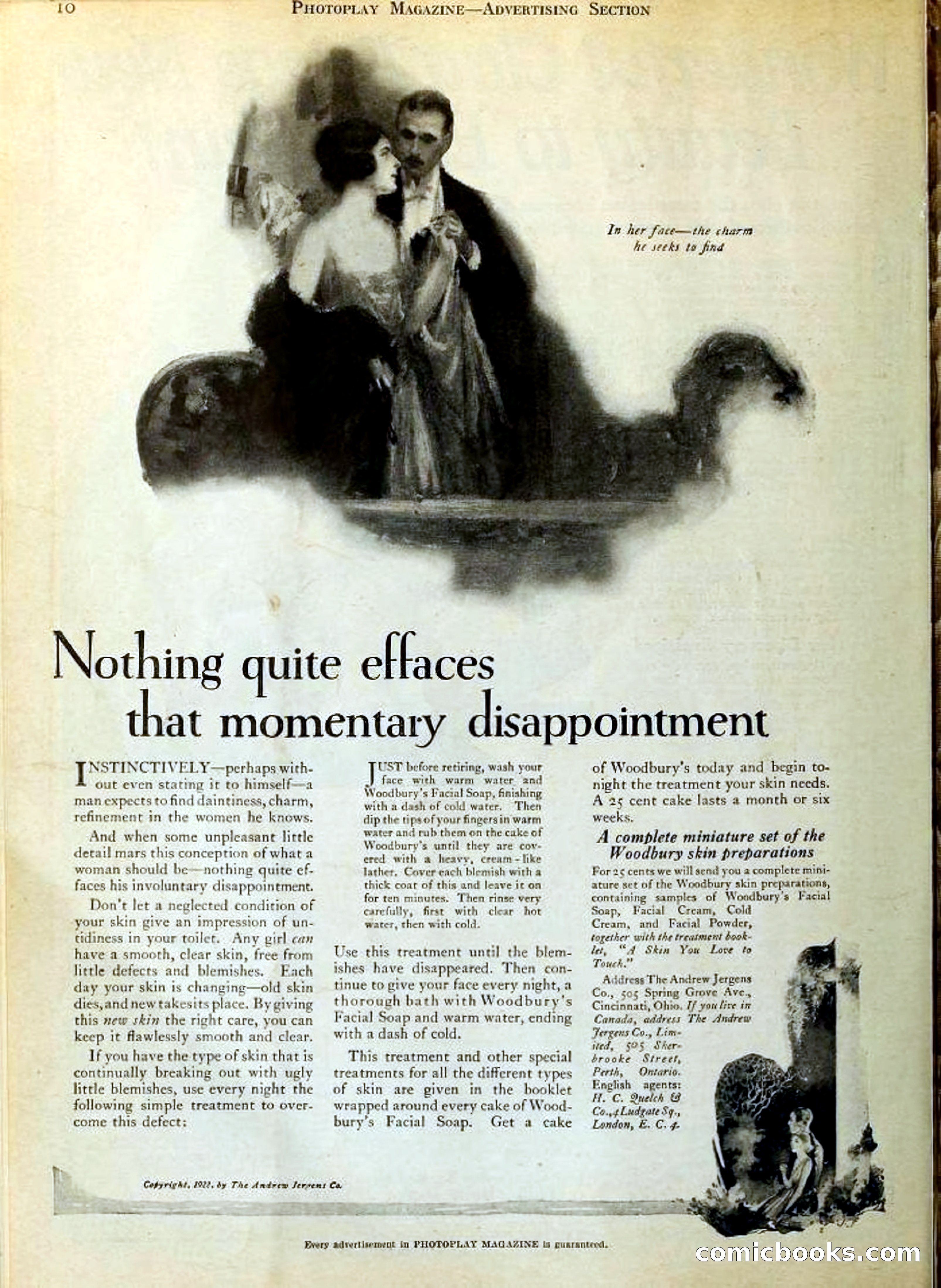
# Page Analysis This is an **advertising page** from Photoplay Magazine's advertising section (page 10). The page contains a full-page advertisement for Woodbury's Facial Soap. It features a romantic illustration of a couple in a gondola with the caption "In her face—the charm he seeks to find," and the headline "Nothing quite effaces that momentary disappointment." The ad text recommends a multi-step nighttime facial treatment using Woodbury's products to address skin blemishes and maintain smooth, clear skin. It promotes a complete miniature set of Woodbury's products available for 25 cents. The layout combines illustration, large display type, and body copy typical of early-20th-century beauty product advertising.
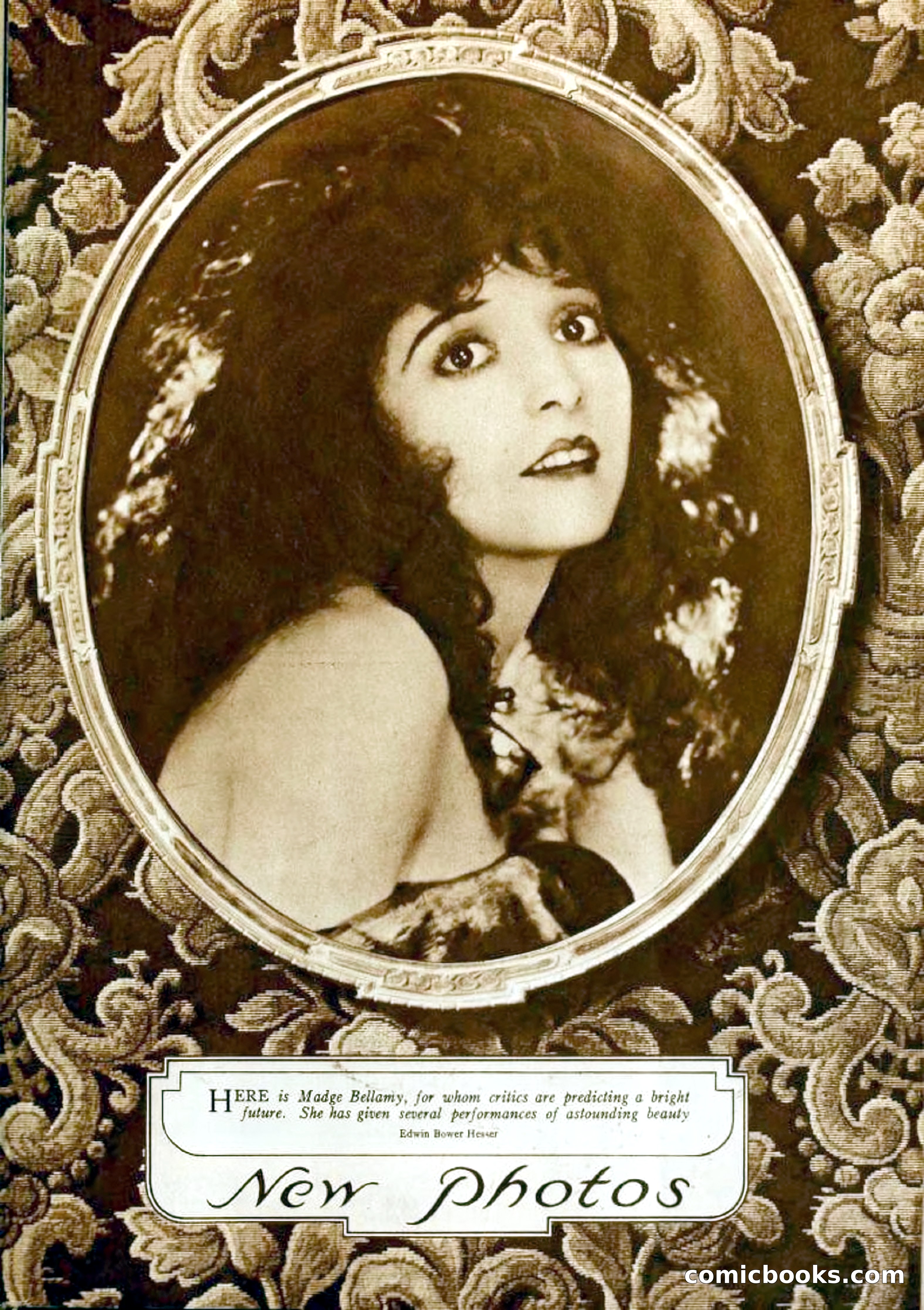
# Analysis of This Page This is a promotional page titled "New Photos" from an early-20th-century pulp magazine. It features a sepia-toned portrait photograph of a woman named Madge Bellamy, framed in an ornate oval mat against a decorative floral background. The accompanying text, attributed to Edwin Bower Hesser, states: "HERE is Madge Bellamy, for whom critics are predicting a bright future. She has given several performances of astounding beauty." The page appears designed to showcase a performer or actress to readers, likely as part of the magazine's entertainment or celebrity coverage section rather than as story content.
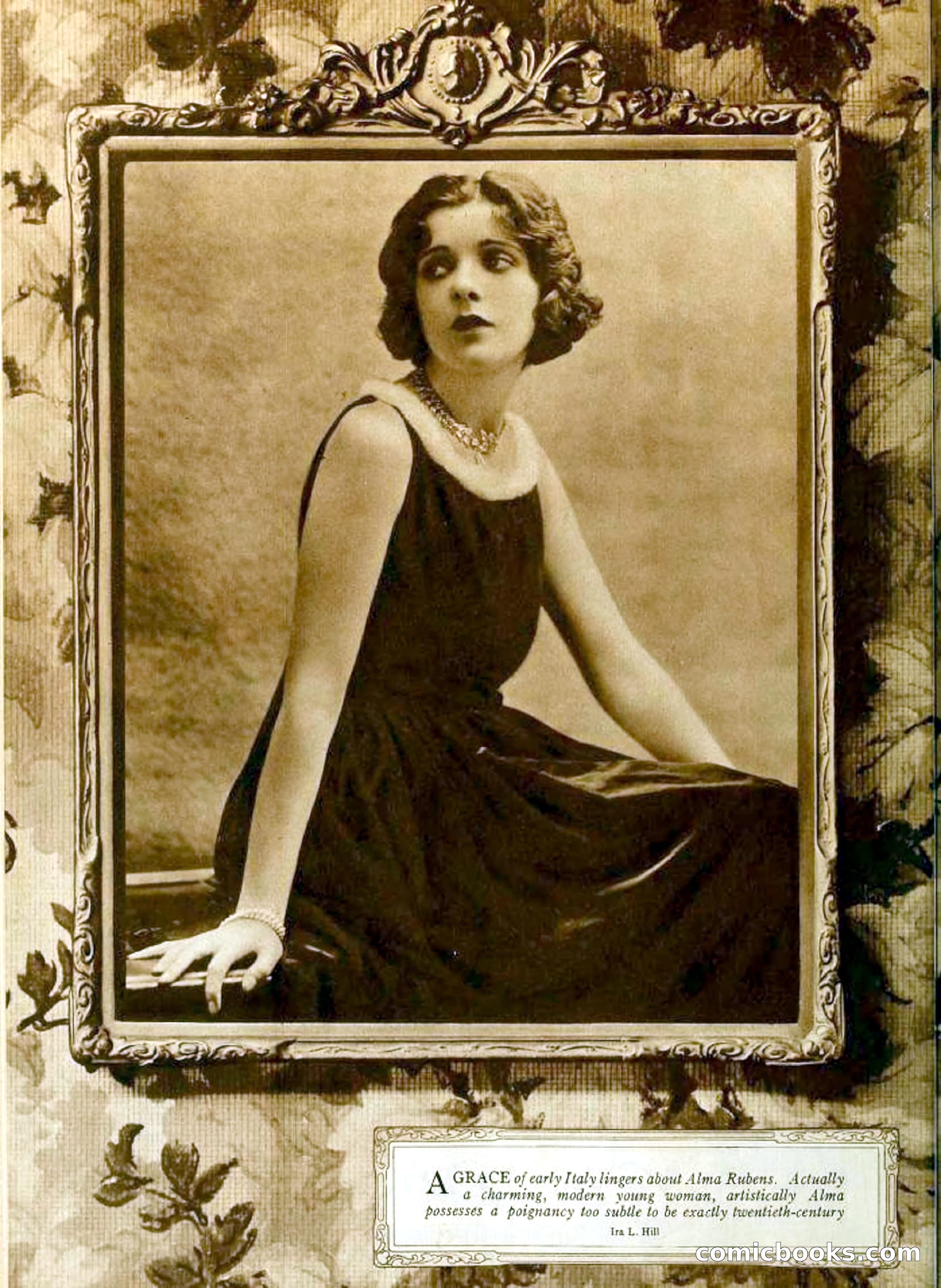
# Page Description This is an interior illustration page from an early 20th-century pulp magazine, featuring a portrait photograph of a woman in an elegant black sleeveless dress with a pearl necklace, set within an ornate decorative frame. Below the portrait is a caption crediting the illustration to "Ira L. Hill" that reads: "A grace of early Italy lingers about Alma Rubens. Actually a charming, modern young woman, artistically Alma possesses a poignancy too subtle to be exactly twentieth-century." The page appears designed to introduce or promote a character or story involving someone named Alma Rubens, presented with classical artistic styling typical of pulp magazine illustration pages of that era.
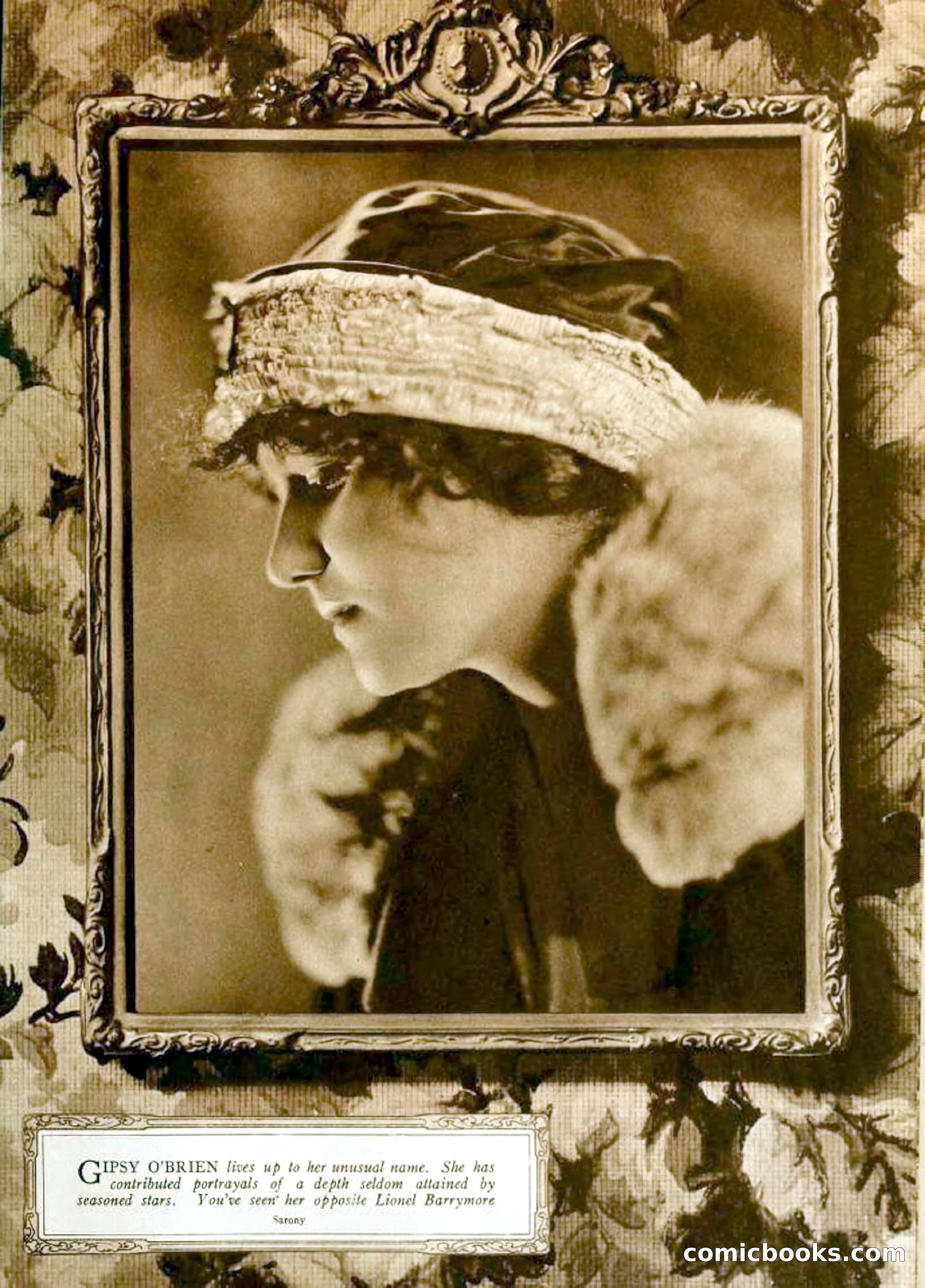
# Page Analysis This is an illustrated page from an early-20th-century pulp magazine, featuring a profile portrait photograph of a woman wearing a decorative headband. The image is framed in an ornate border typical of the era. The caption beneath identifies the subject as "Gipsy O'Brien" and states she "lives up to her unusual name" and has "contributed portrayals of a depth seldom attained by seasoned stars." The text references her appearing "opposite Lionel Barrymore," suggesting this relates to theatrical or film performance. The page appears to be a cast or performer profile rather than fiction prose or advertisement, likely introducing readers to an actress or performer featured in contemporary productions.
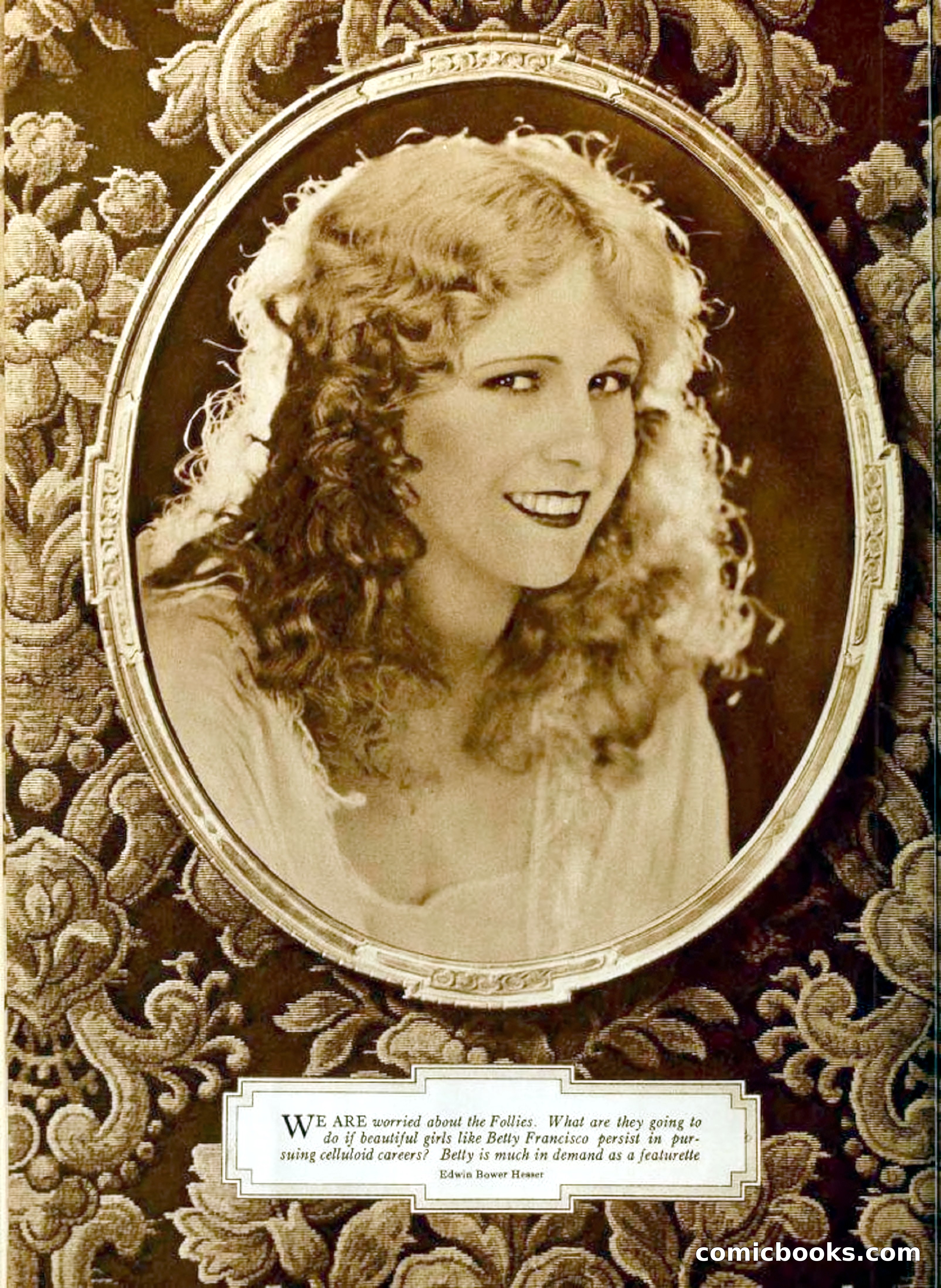
# Analysis This page is an illustrated portrait photograph mounted on decorative floral background, typical of early 20th-century magazine styling. Below the oval-framed portrait is a captioned quote attributed to "Edwin Bower Hessler" expressing concern about beautiful chorus girls like "Betty Francisco" pursuing celluloid (film) careers, noting she is "much in demand as a featurette." The text appears to be commentary on entertainment industry trends rather than fiction prose. This is likely a promotional or editorial page rather than a story page, showcasing a performer or public figure from the silent film era.
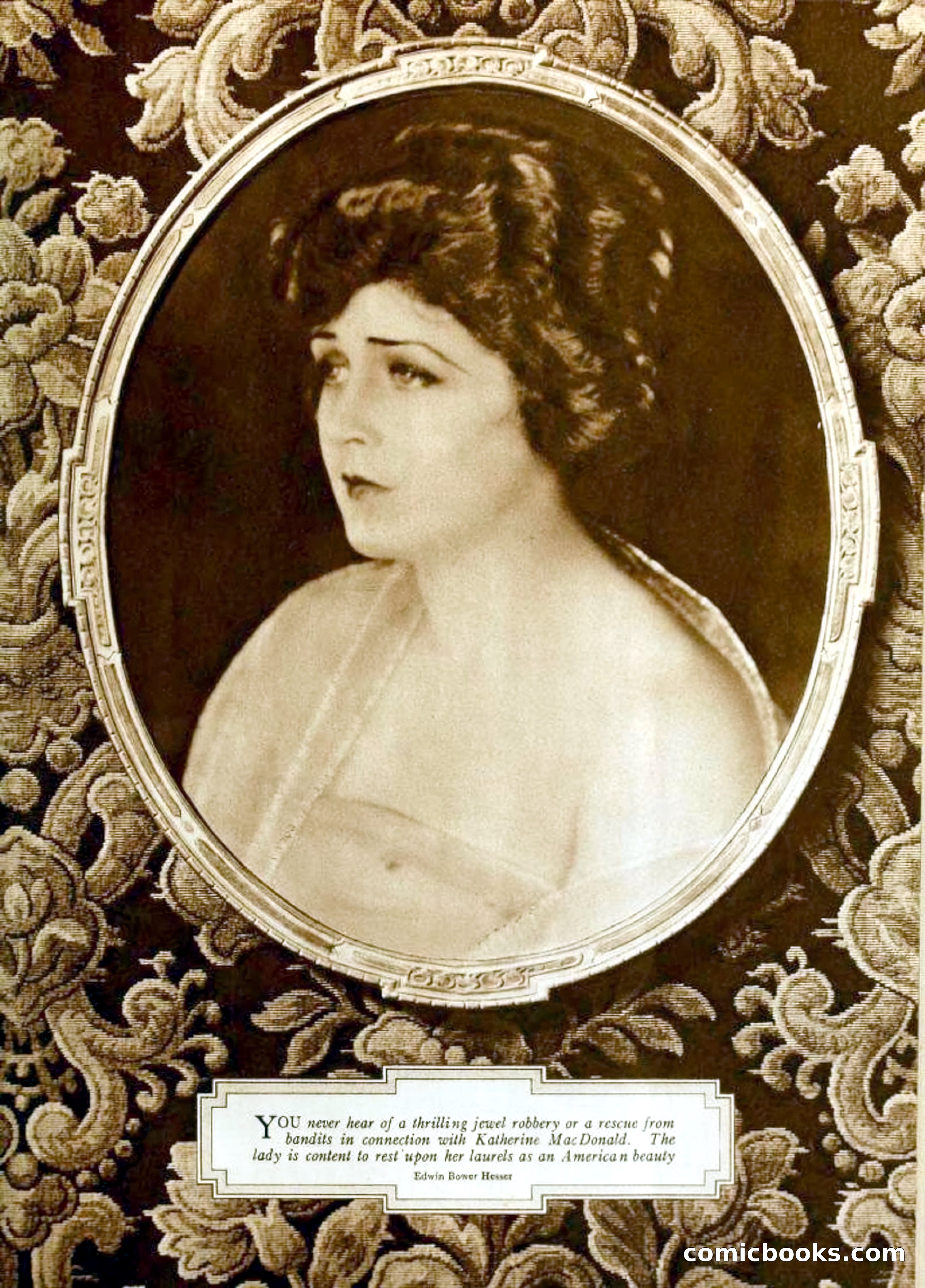
This is an illustration page from an early-20th-century pulp magazine, featuring an oval-framed portrait photograph of a woman in profile with styled hair typical of the 1910s-1920s era. Below the portrait is a quote attributed to Edwin Bower Hesser stating: "You never hear of a thrilling jewel robbery or a rescue from bandits in connection with Katherine MacDonald. The lady is content to rest upon her laurels as an American beauty." The ornate decorative border surrounding the portrait suggests this is likely a promotional or biographical page about an actress or entertainer named Katherine MacDonald, though the specific magazine and context remain unclear from the visible elements.
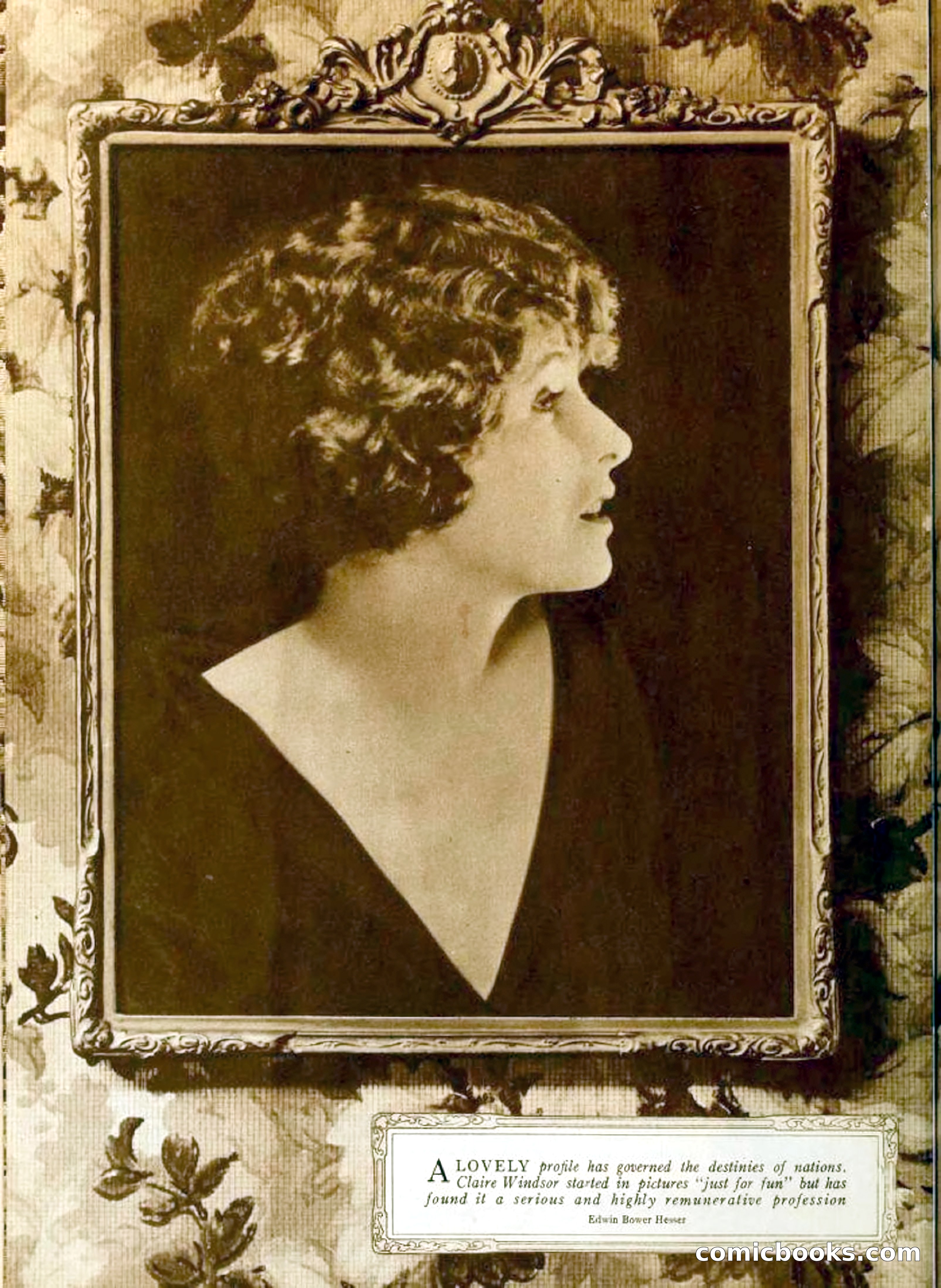
# Page Analysis This is an illustrated portrait page from an early-20th-century pulp magazine featuring a profile photograph of a woman with short, curled hair in a dark dress, framed by an ornate decorative border. Below the portrait is a caption attributing a quote to Edwin Bower Hesser that reads: "A LOVELY profile has governed the destinies of nations. Claire Windsor started in pictures 'just for fun' but has found it a serious and highly remunerative profession." The page appears to be a feature or spotlight on the actress Claire Windsor, presented in the magazine's typical illustrative style of the era.
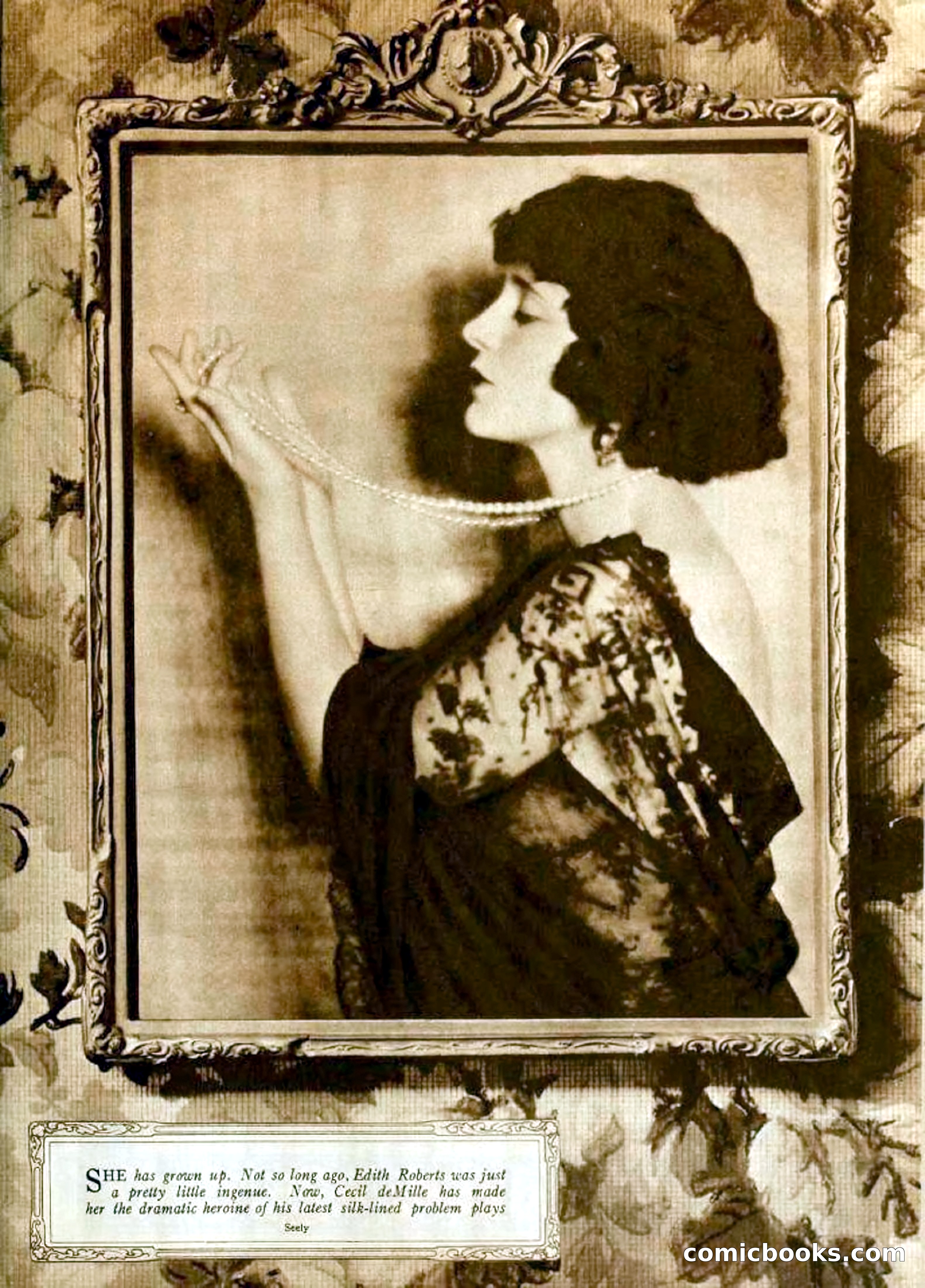
# Page Content Description This is an illustrated page from an early-20th-century pulp magazine featuring a sepia-toned portrait photograph of a woman in profile, framed with ornate decorative borders. She wears a pearl necklace and an embroidered or patterned dark garment. The caption beneath reads: "SHE has grown up. Not so long ago, Edith Roberts was just a pretty little ingenue. Now, Cecil deMille has made her the dramatic heroine of his latest silk-lined problem plays —Sedy." The page appears to be a promotional or editorial piece about actress Edith Roberts and her career development, specifically referencing Cecil B. DeMille's involvement in her dramatic roles. The worn, aged appearance suggests this dates from the silent film era.
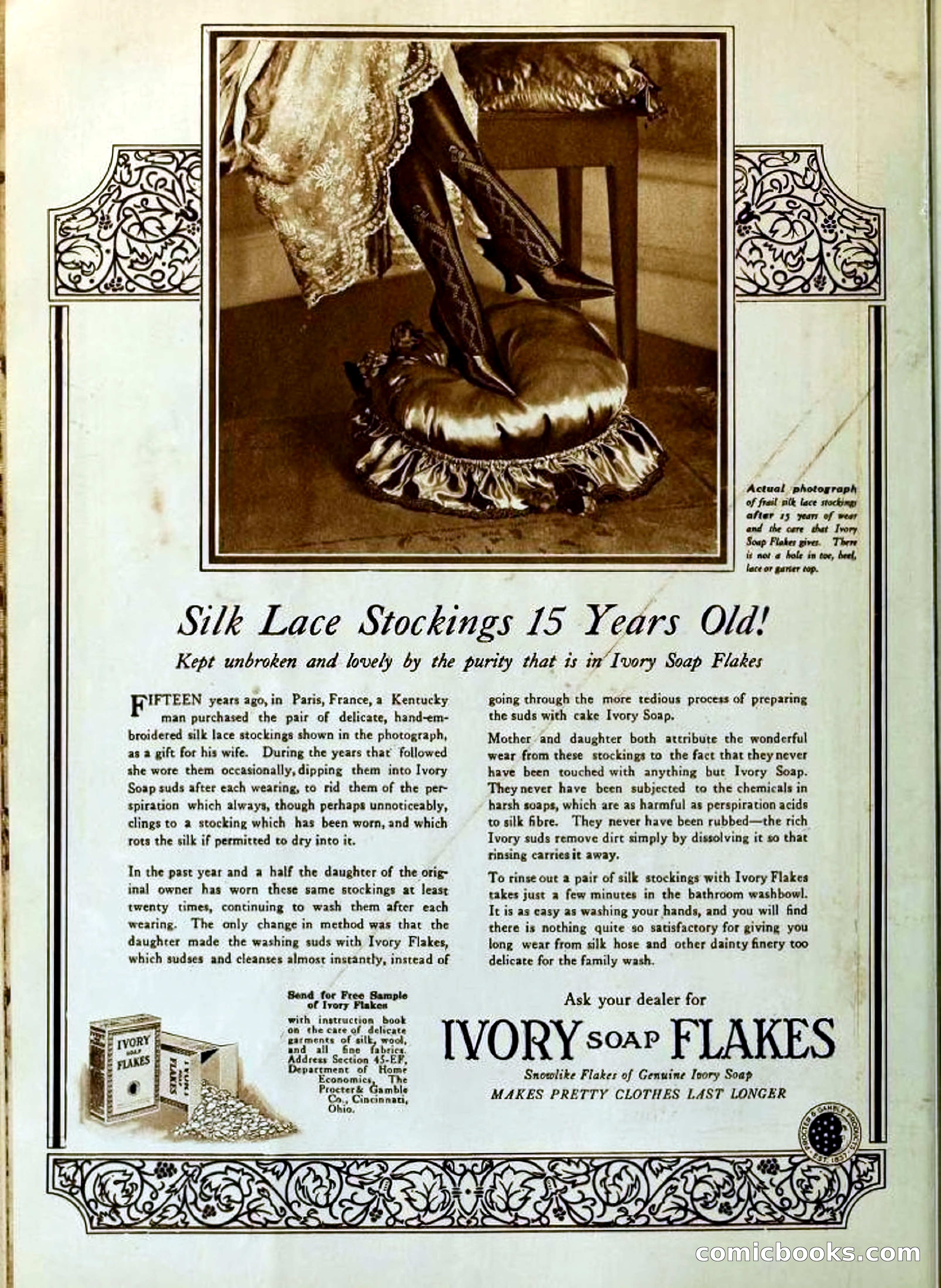
# Analysis This is a **full-page advertisement**, not pulp fiction content. The page features a photograph of delicate silk lace stockings being worn, along with ornamental decorative borders typical of early 20th-century magazine design. The advertisement promotes Ivory Soap Flakes, claiming the product can clean and preserve fine silk garments without damage. The text describes how a Kentucky man's gift of silk stockings to his wife has remained in excellent condition for fifteen years through careful washing with Ivory Soap Flakes. The ad emphasizes that the soap flakes are gentle enough for delicate fabrics, removing dirt without harsh chemicals or rubbing that might damage silk fibers.
# Page Analysis This is a text-only editorial page from *Photoplay* magazine (Vol. XXI, May 1922, No. 6). The article, titled "What Do You Want?", discusses the motion picture industry's dependence on audience preferences. The editorial encourages readers to communicate their opinions about films directly to theater managers and exhibitors, arguing that moviegoers should actively shape what gets produced and shown. It emphasizes that motion pictures are a public necessity deserving of audience scrutiny, and invites readers to send feedback to *Photoplay* so editors can report audience preferences to producers. The piece advocates for reader participation in determining entertainment standards.
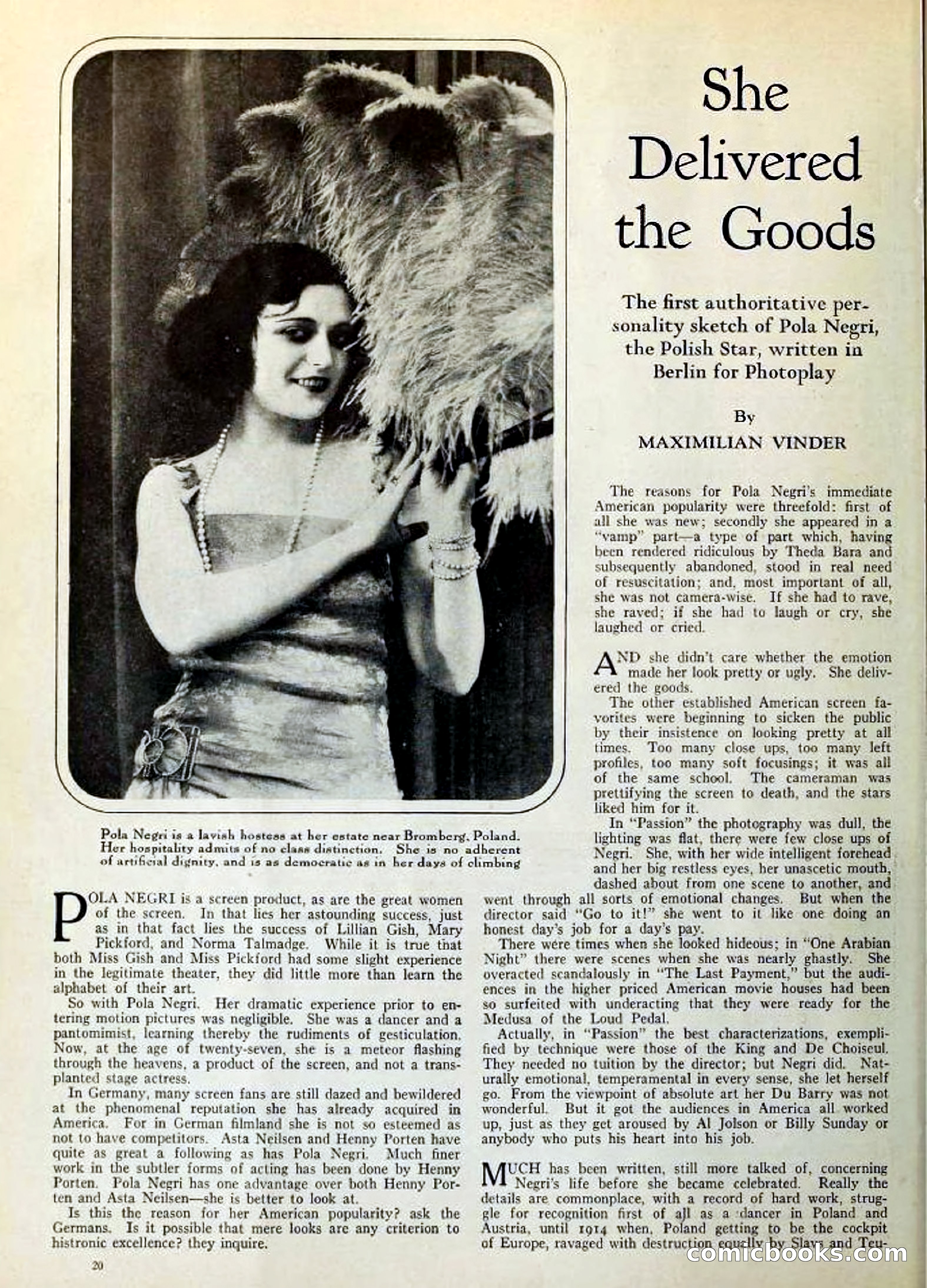
# Page Content Analysis This is an editorial/article page from a pulp magazine featuring a biographical sketch titled "She Delivered the Goods," written by Maximilian Vinder. The page includes a black-and-white photograph of Pola Negri, described as a Polish film star, positioned as a lavish hostess at her Polish estate. The text analyzes Negri's success in American cinema, attributing it to three factors: her novelty, her appearance in "vamp" roles (a type previously abandoned), and crucially, her lack of camera-consciousness—she prioritized authentic emotional performance over photogenic appearance. The article contrasts her approach with established American actresses who obsessed over looking pretty on screen, suggesting Negri's willingness to be unflattering when the role demanded it set her apart.
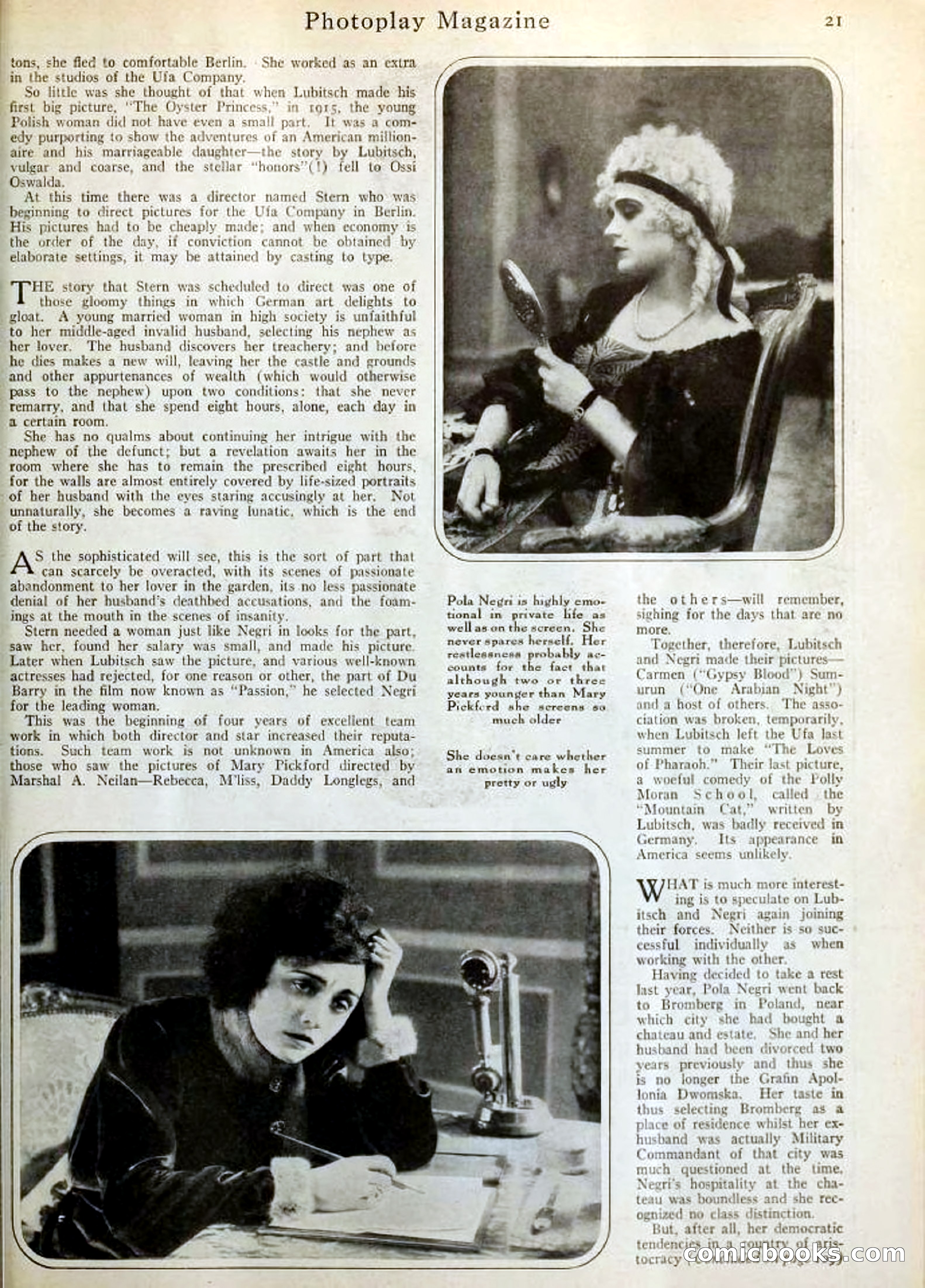
# Page 21 of Photoplay Magazine This is a text and illustration page from an early 20th-century film magazine. The prose discusses director Stern's production of a German film about an unfaithful noblewoman whose husband, upon discovering her infidelity, leaves her his estate conditionally—she must never remarry and spend eight hours daily alone in a room lined with life-sized portraits of him. The story ends with her descent into madness. Two black-and-white photographs show what appears to be the actress Pola Negri in costume and at a vanity, illustrating the film being discussed.
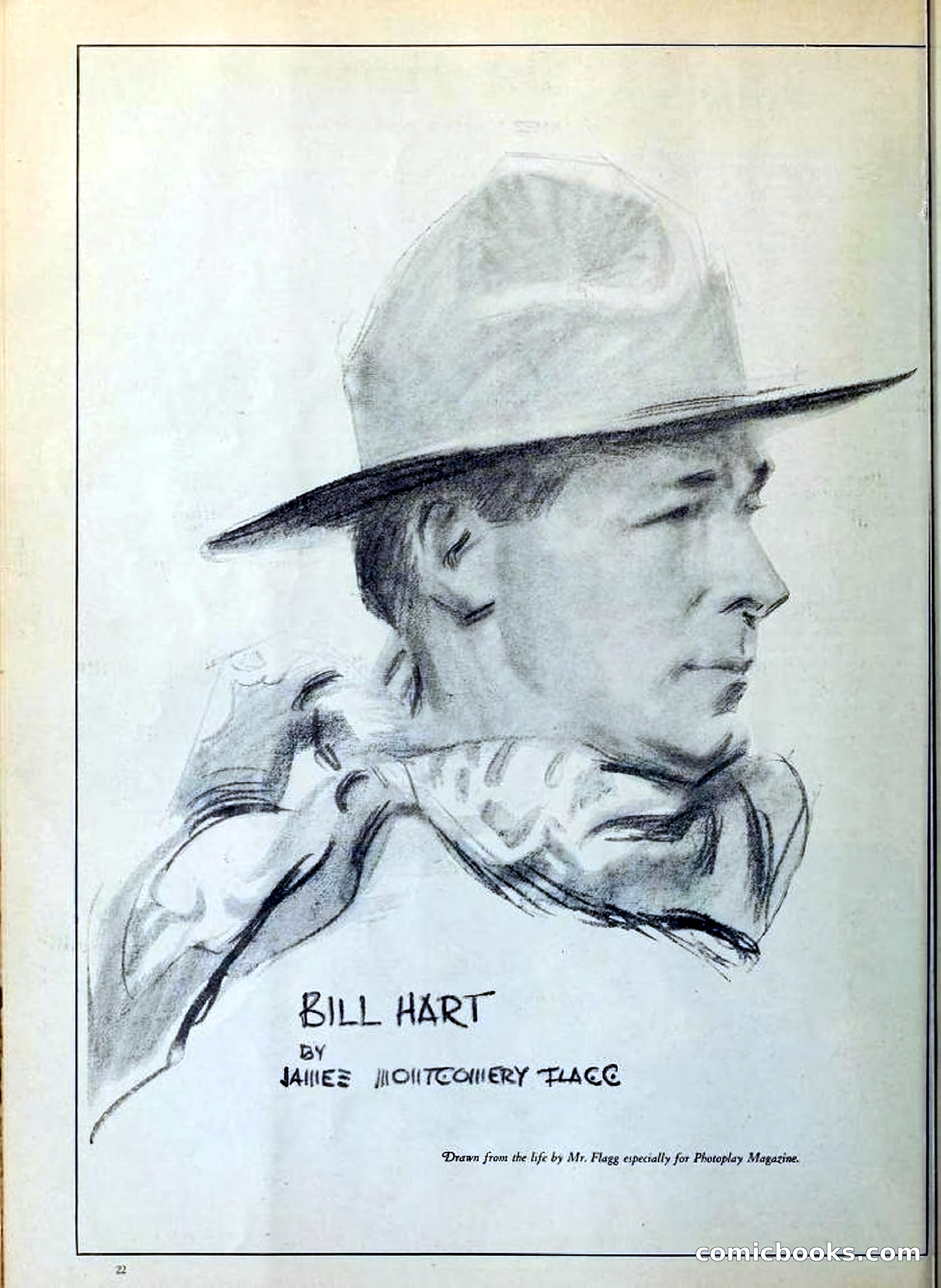
# Page Analysis This is an illustration page from a pulp magazine, featuring a profile sketch portrait of a man wearing a wide-brimmed hat and what appears to be period clothing with a neckerchief. The drawing is credited to "BILL HART BY JAMES MONTGOMERY FLAGG" and includes a note at the bottom stating it was "Drawn from the life by Mr. Flagg especially for Photoplay Magazine." The page number 22 appears at the bottom. This appears to be a celebrity portrait illustration rather than story content, likely from an early-20th-century entertainment or film magazine, given the Photoplay Magazine reference.
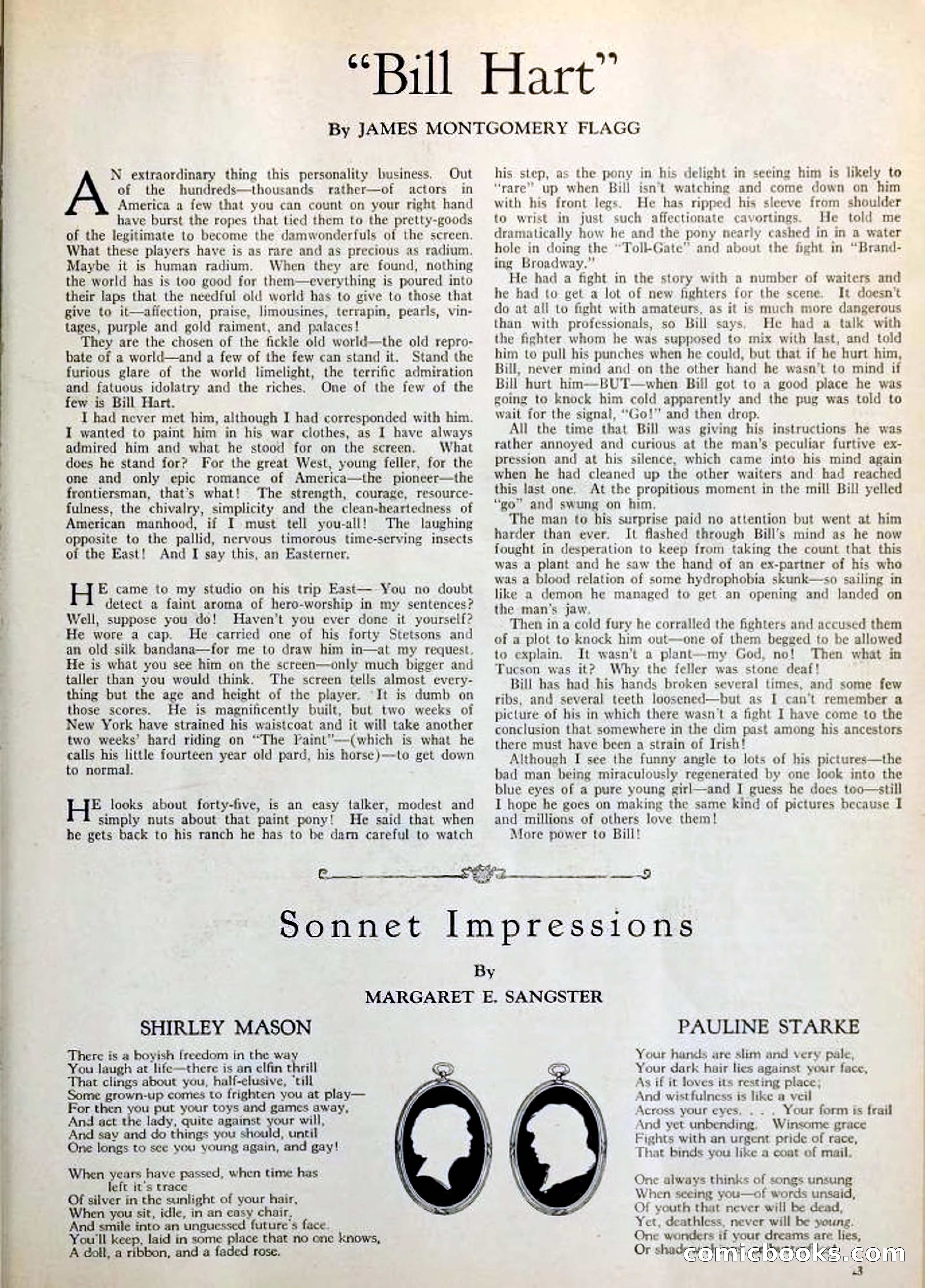
# Page Content Description This is a text-only interior magazine page containing two literary works. The upper portion features "Bill Hart," an essay or article by James Montgomery Flagg discussing an extraordinary personality in American cinema—apparently someone Flagg admired for embodying frontier qualities and epic romance. The lower section presents "Sonnet Impressions," a poetry piece by Margaret E. Sangster featuring two sonnets titled "Shirley Mason" and "Pauline Starke," with silhouette portraits of two profile faces between them. The sonnets appear to be romantic or sentimental verses about young women. The page uses decorative typography and line breaks typical of early-20th-century magazine design.
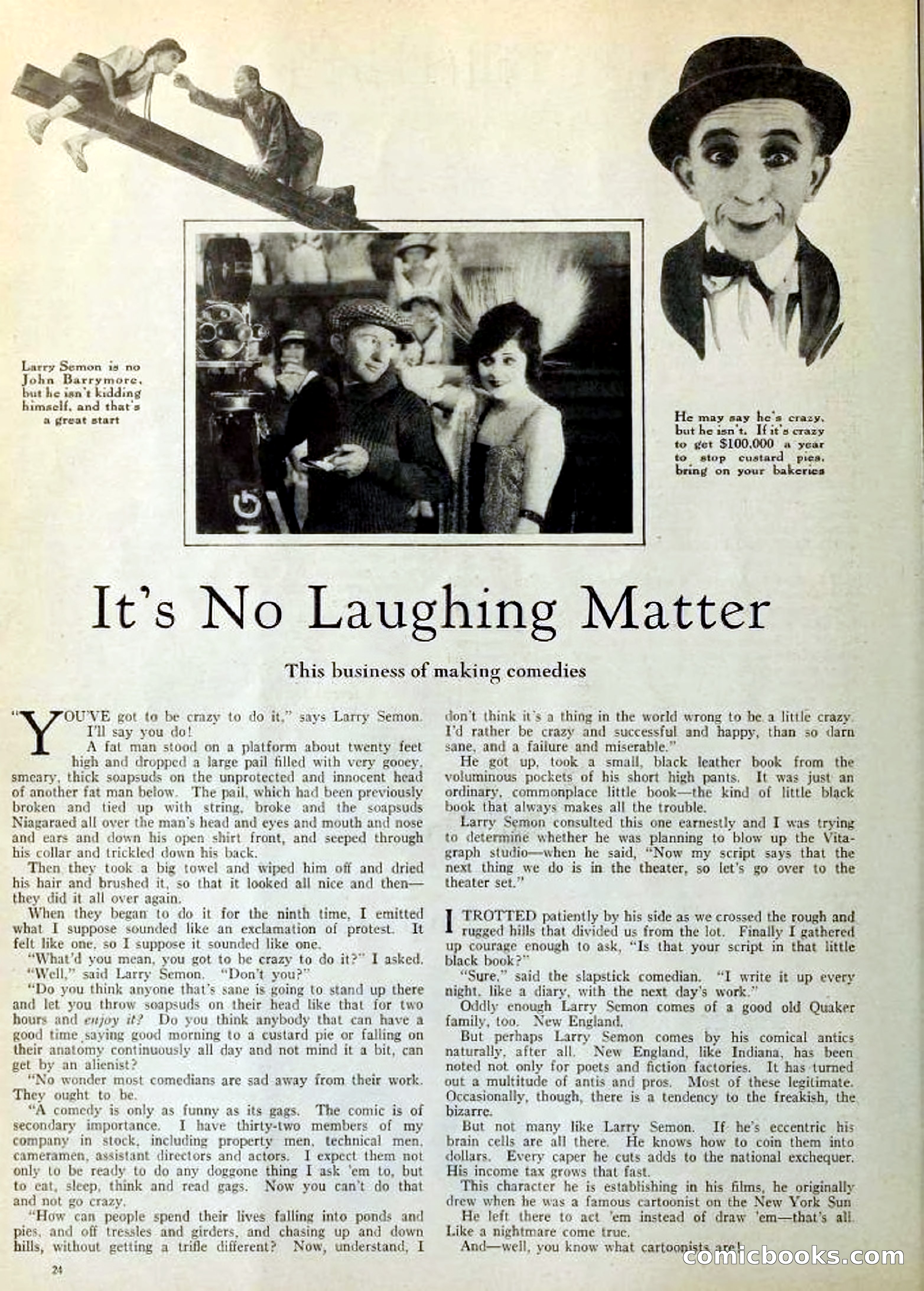
# Description of Page This is an article page titled "It's No Laughing Matter: This business of making comedies" that discusses silent film comedian Larry Semon and the production of comedic films. The page contains three images: a still from a film showing people on a movie set, a scene of Semon appearing to interact with camera equipment and actors, and a portrait illustration of Semon's face. The text describes the physical dangers and chaos involved in making comedy films, including an anecdote about Semon dropping a pail on an actor from a twenty-foot platform, and discusses Semon's background as a cartoonist for the New York Sun before becoming a film comedian.
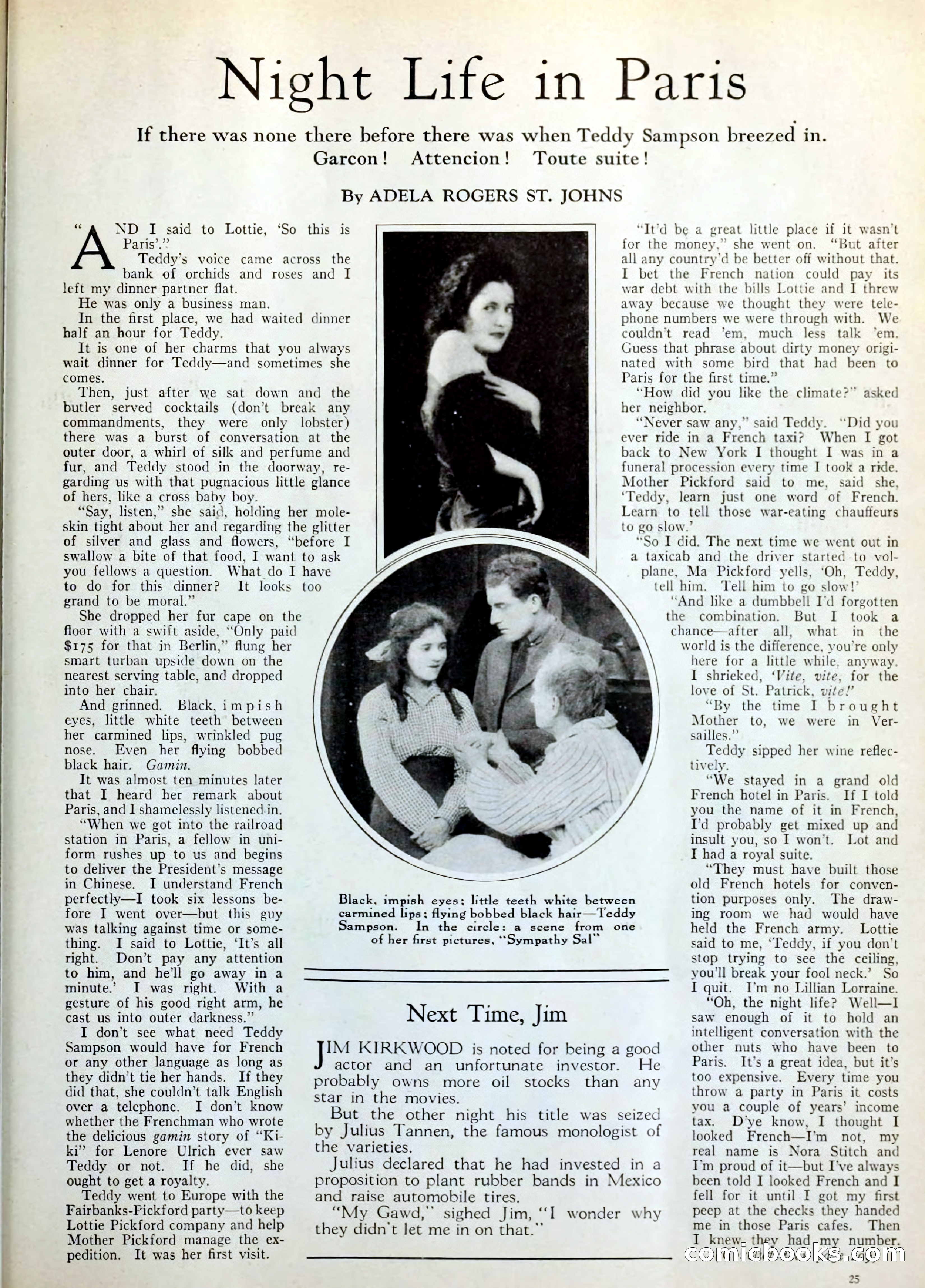
# Page Analysis This is a story prose page titled "Night Life in Paris" by Adela Rogers St. Johns. The visible text recounts a dinner party anecdote where the narrator's companion Teddy Sampson, described as having "black, impish eyes; little white teeth" and other striking features, causes a stir at an elegant Parisian restaurant. The page includes two photographs: one portrait of a woman at top, and below it a circular photograph showing what appears to be a scene from one of Teddy's films titled "Sympathy Sal." The narrative discusses Teddy's experiences in Paris and includes a sidebar beginning a new section titled "Next Time, Jim" about actor Jim Kirkwood.
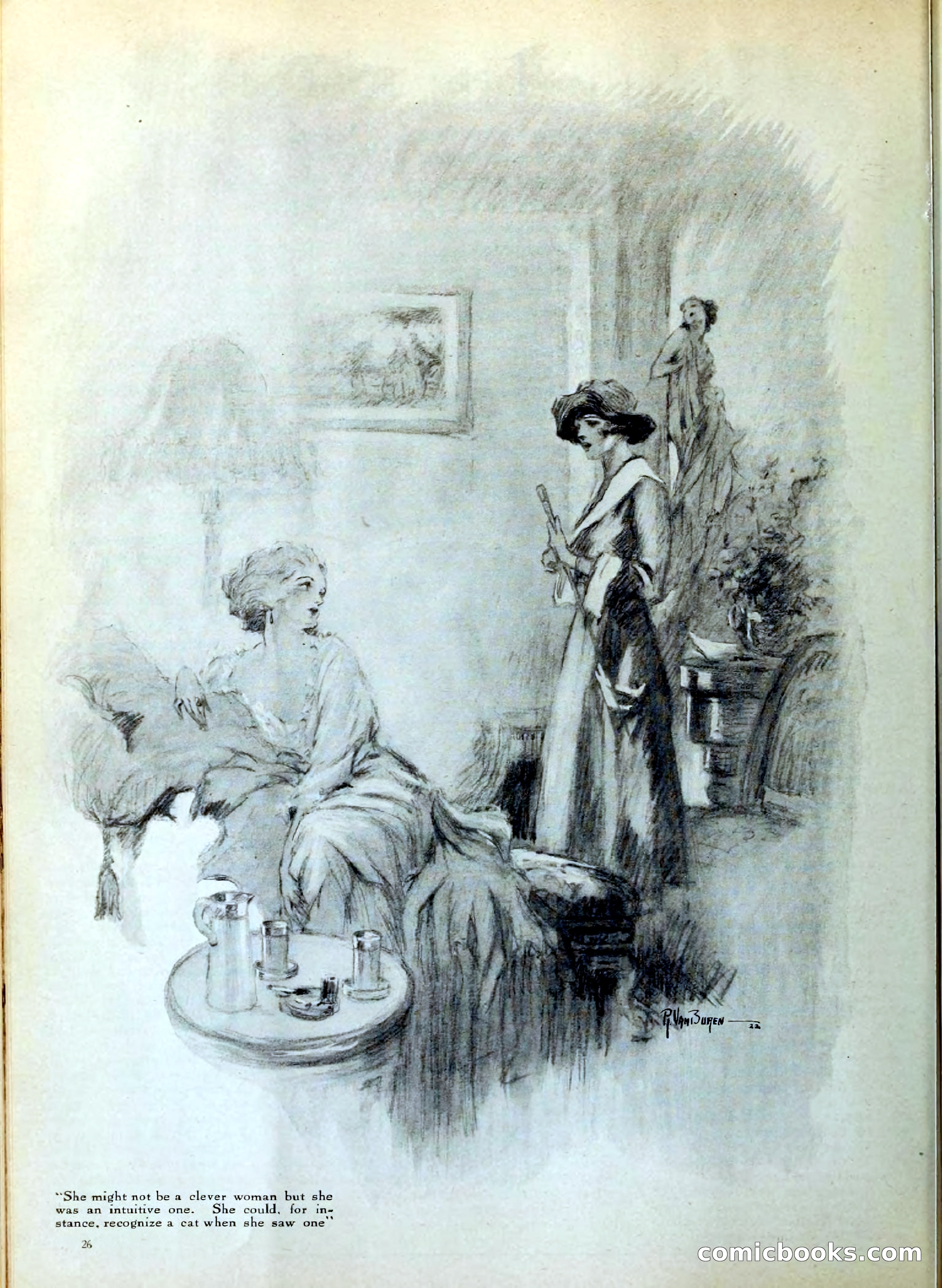
# Page Analysis This is an **interior story illustration** from an early-20th-century pulp magazine, rendered in pencil and ink. The sketch depicts a domestic interior scene with a seated woman in the foreground and two figures standing in a doorway or hallway in the background. The visible text beneath the illustration reads: "She might not be a clever woman but she was an intuitive one. She could, for instance, recognize a cat when she saw one." The quote appears to be character description from the story, suggesting a narrative focused on a woman whose intuition is her defining quality, even if she lacks intellectual cleverness. The domestic setting and intimate scale suggest this may be a romantic or literary fiction piece rather than science fiction or crime fiction.
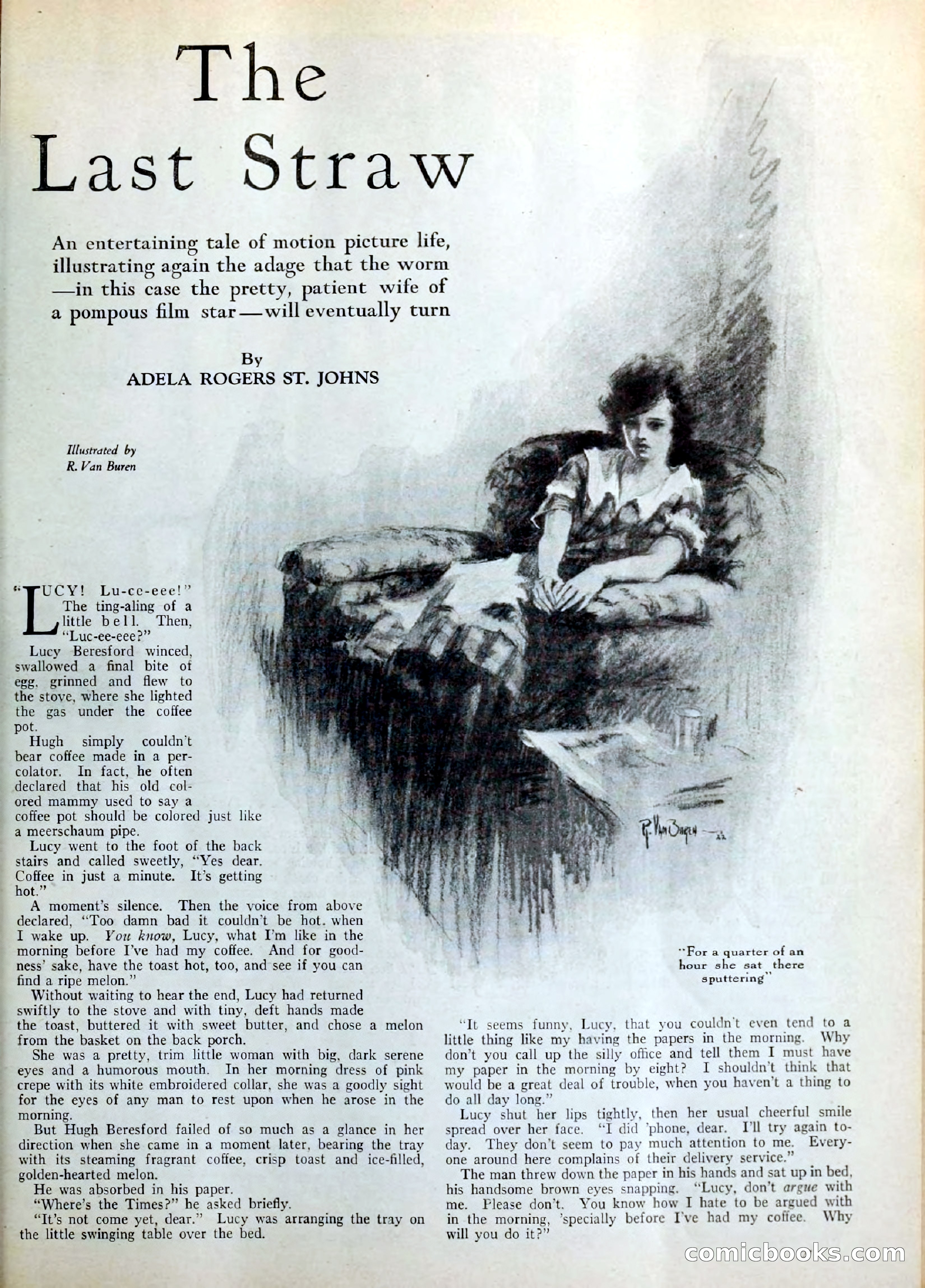
# Page Content Description This is a story page from an early-20th-century pulp magazine featuring "The Last Straw" by Adela Rogers St. Johns, illustrated by R. Van Baren. The page contains both prose narrative and a sketch illustration of a woman in period dress sitting on what appears to be a bed or couch. The visible story text describes a domestic scene involving characters named Lucy Beresford and Hugh, depicting a moment of marital tension involving coffee-making and newspaper complaints. The narrative focuses on their morning interaction, with Hugh criticizing Lucy's ability to make coffee and manage household tasks, while Lucy attempts to please him despite his complaints.
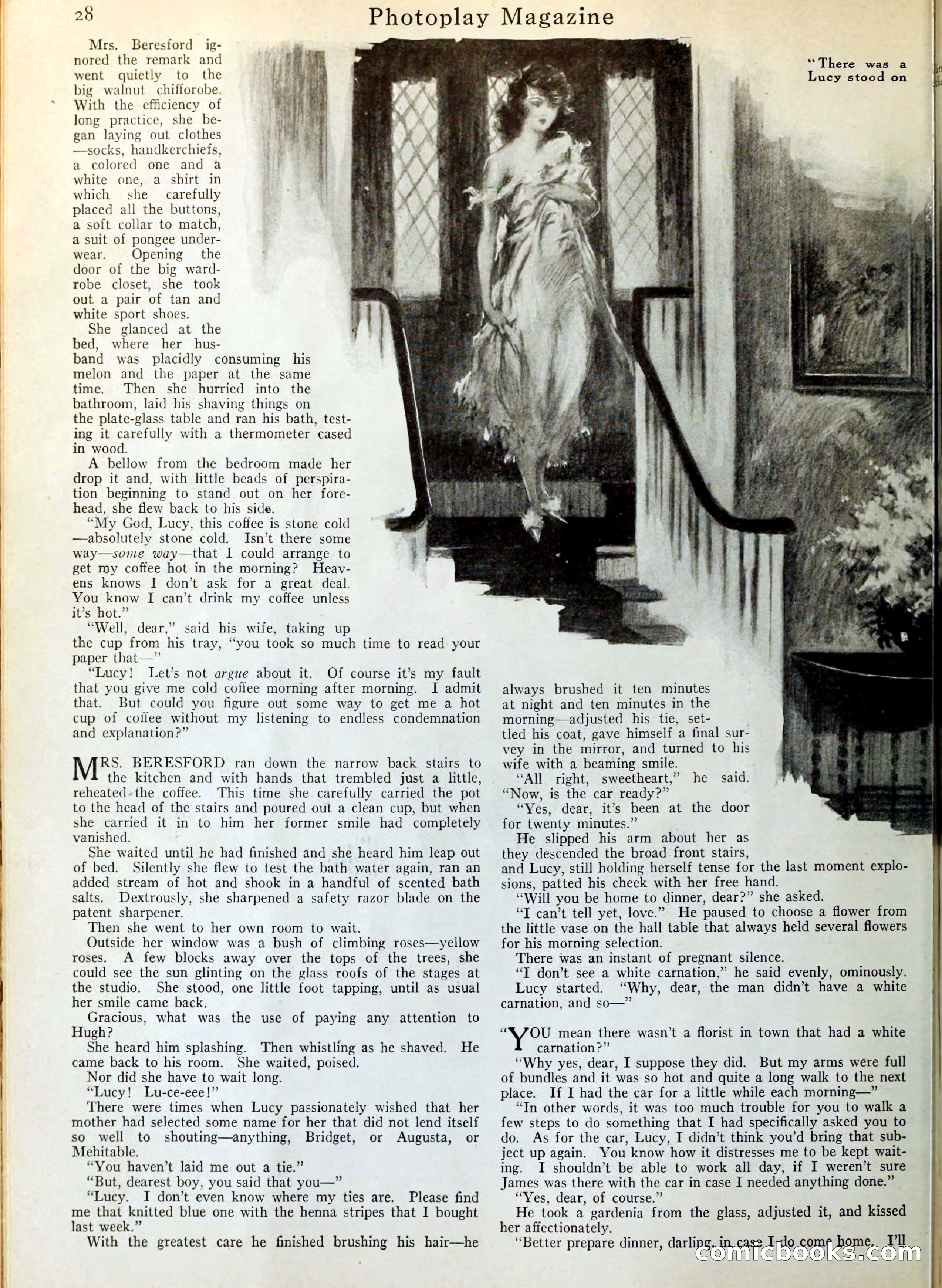
# Page 28 from Photoplay Magazine This is a story page containing prose fiction alongside a black-and-white illustration. The illustration depicts a woman in 1920s attire standing in a bedroom doorway, appearing tense or anxious. The visible text concerns a domestic dispute between a married couple named Lucy and her husband. Lucy has been unable to get her husband hot coffee in the morning, and he complains about it. The narrative follows Lucy's efforts to prepare the coffee while her husband shaves and prepares for the day. The couple discusses whether Lucy can arrange for hot coffee without listening to his complaints, and mentions an errand involving a car and flowers.
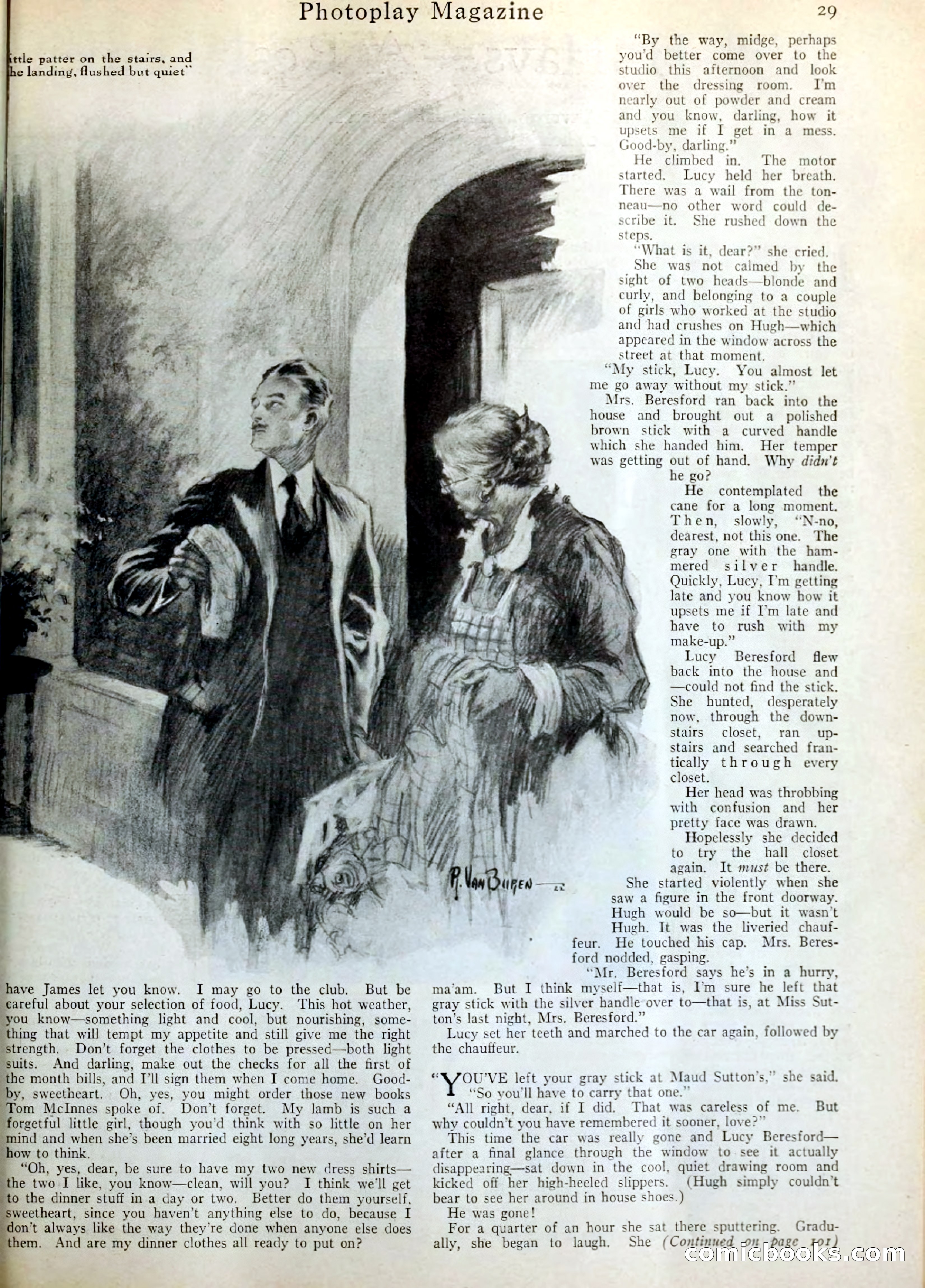
# Page 29 of Photoplay Magazine This page contains story prose accompanied by a black-and-white illustration. The illustration depicts two figures in what appears to be a doorway or entryway—a man in a suit and a woman in period clothing (appears early 20th century). The visible text describes a scene where a character named Lucy has left a location and forgotten a walking stick. Mrs. Beresford retrieves it, and Lucy returns to the car. The narrative involves some social drama concerning Hugh and characters at a studio, with dialogue about forgotten items and evening appointments. The story appears to be a romantic or domestic drama, though the full context and title remain unclear from this page alone.
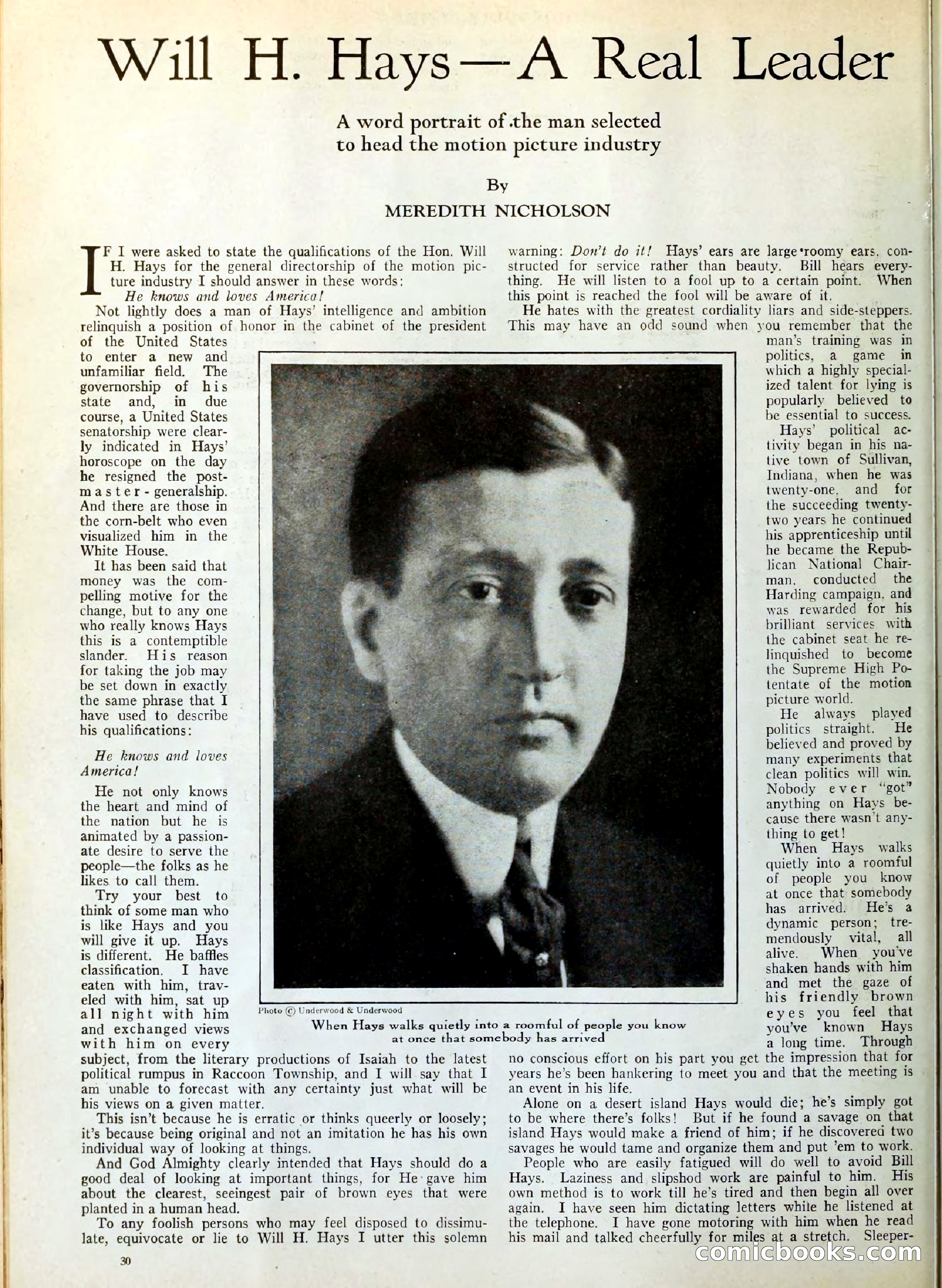
# Page Analysis This is a **biographical article page** from an early-20th-century publication, featuring a formal portrait photograph of Will H. Hays in the center. The article, titled "Will H. Hays—A Real Leader" and written by Meredith Nicholson, provides a word portrait of Hays as someone selected to head the motion picture industry. The text discusses Hays' qualifications, his intelligence and ambition, his political background (including involvement with the Republican National Committee and the Harding campaign), and his character traits. The piece emphasizes his patriotism, his direct approach to politics, and his leadership qualities as suitable for leading the film industry.
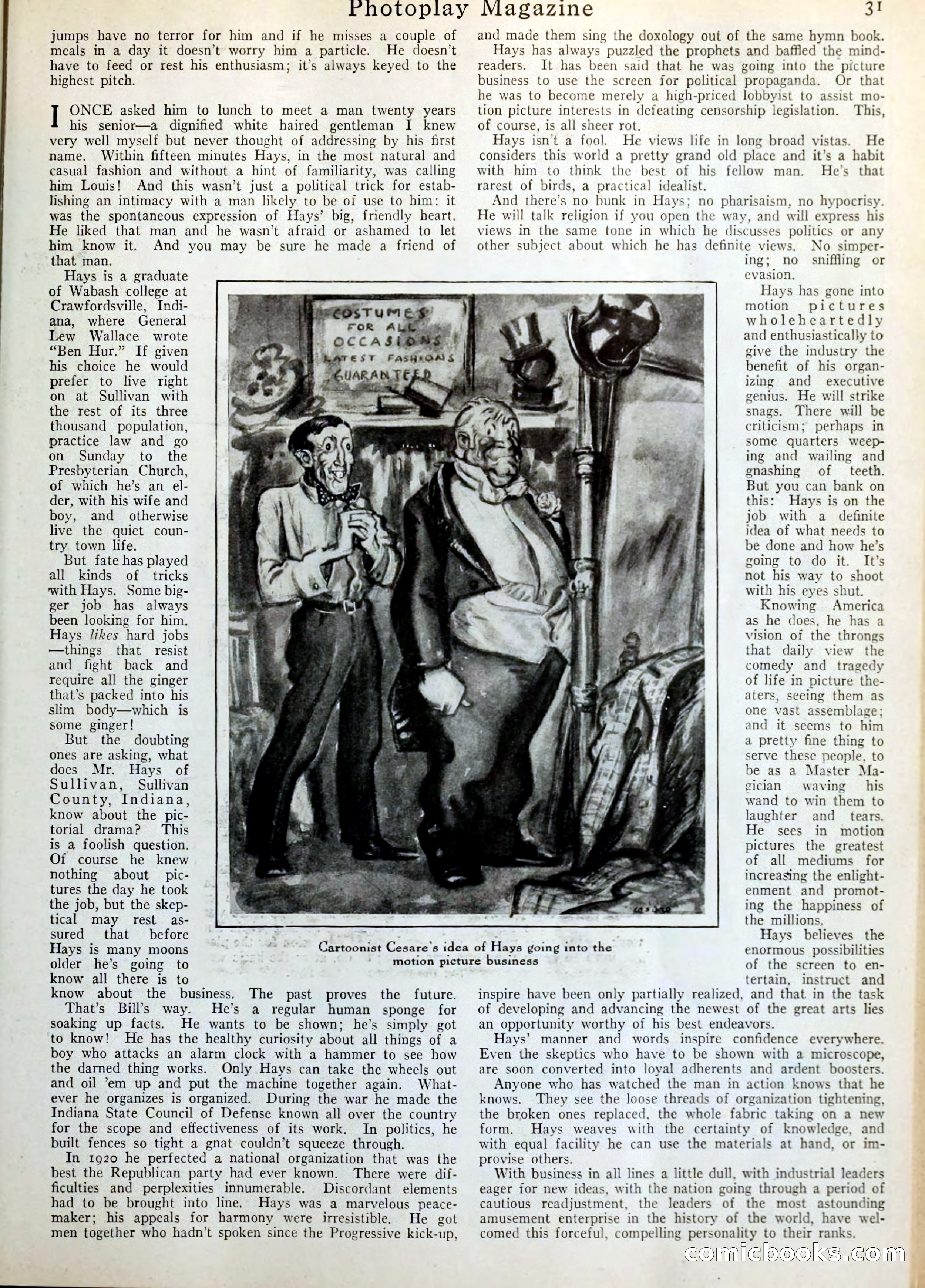
# Page Analysis This is a text page from *Photoplay Magazine* (page 31) featuring an article about film director and producer Will S. Hart (or similar figure). The page includes a black-and-white illustration depicting what appears to be a costume or wardrobe department scene, with a sign reading "COSTUMES FOR ALL OCCASIONS GUARANTEED." The article discusses the subject's background, work ethic, and approach to filmmaking. It emphasizes his practical knowledge of the motion picture industry and his ability to organize people and projects effectively. The text also mentions his work during wartime and his involvement in Republican Party organization. The visible content is primarily biographical prose with one embedded illustration, typical of entertainment journalism from this era.
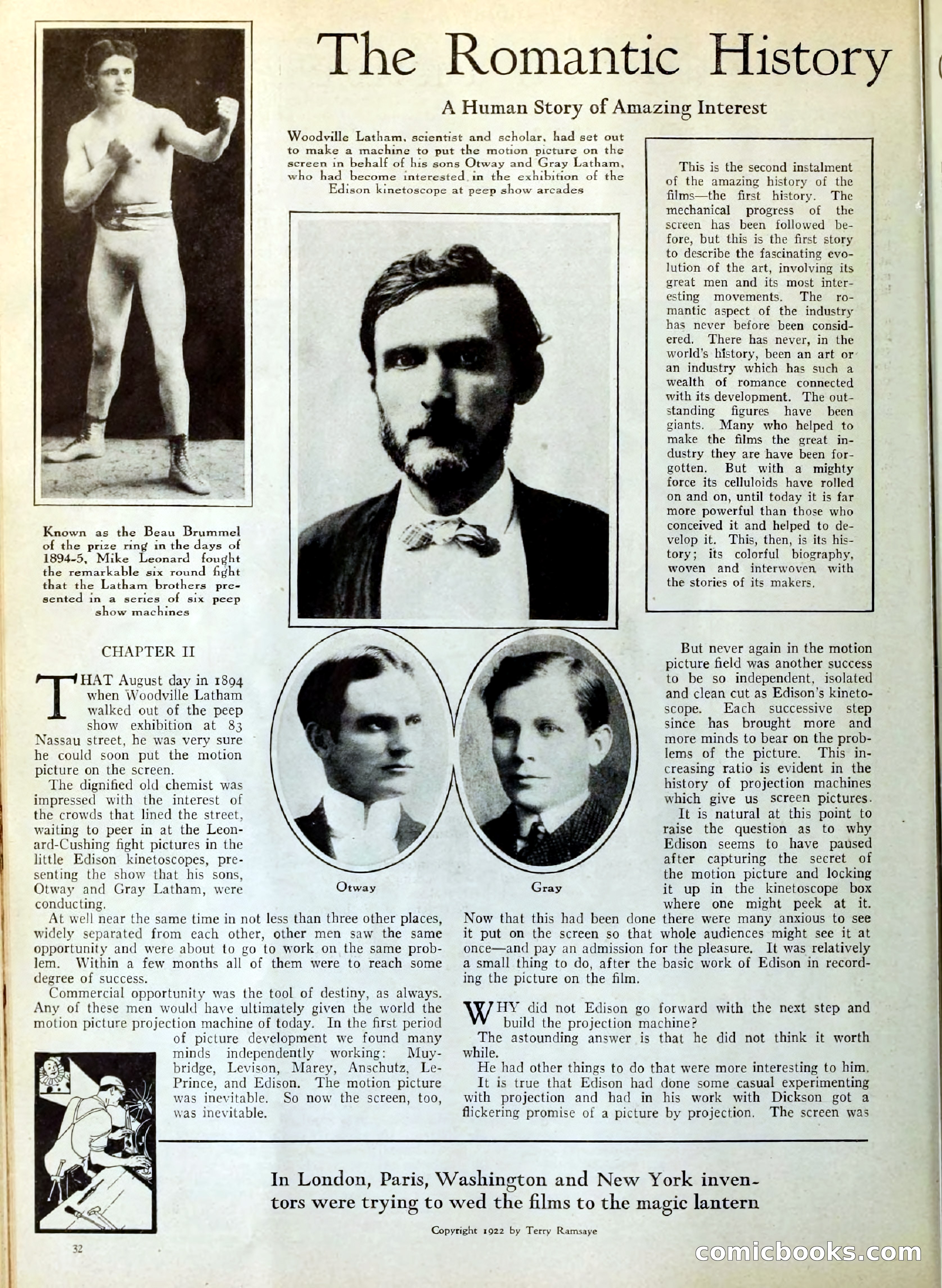
# "The Romantic History" - Chapter II This is a story text page with period photographs and illustrations. The visible content describes how Woodville Latham attempted to project motion pictures on a screen in 1894, building on Edison's kinetoscope technology. The page details the early history of motion picture projection, explaining how Latham and others (including his sons Otway and Gray, pictured here) worked to advance the technology. The text notes that Edison himself did not pursue projection further, considering it unworthy of his time, leaving the field open for other inventors in London, Paris, Washington, and New York to develop the technology. The page combines narrative prose with portrait photographs of key figures in this history.
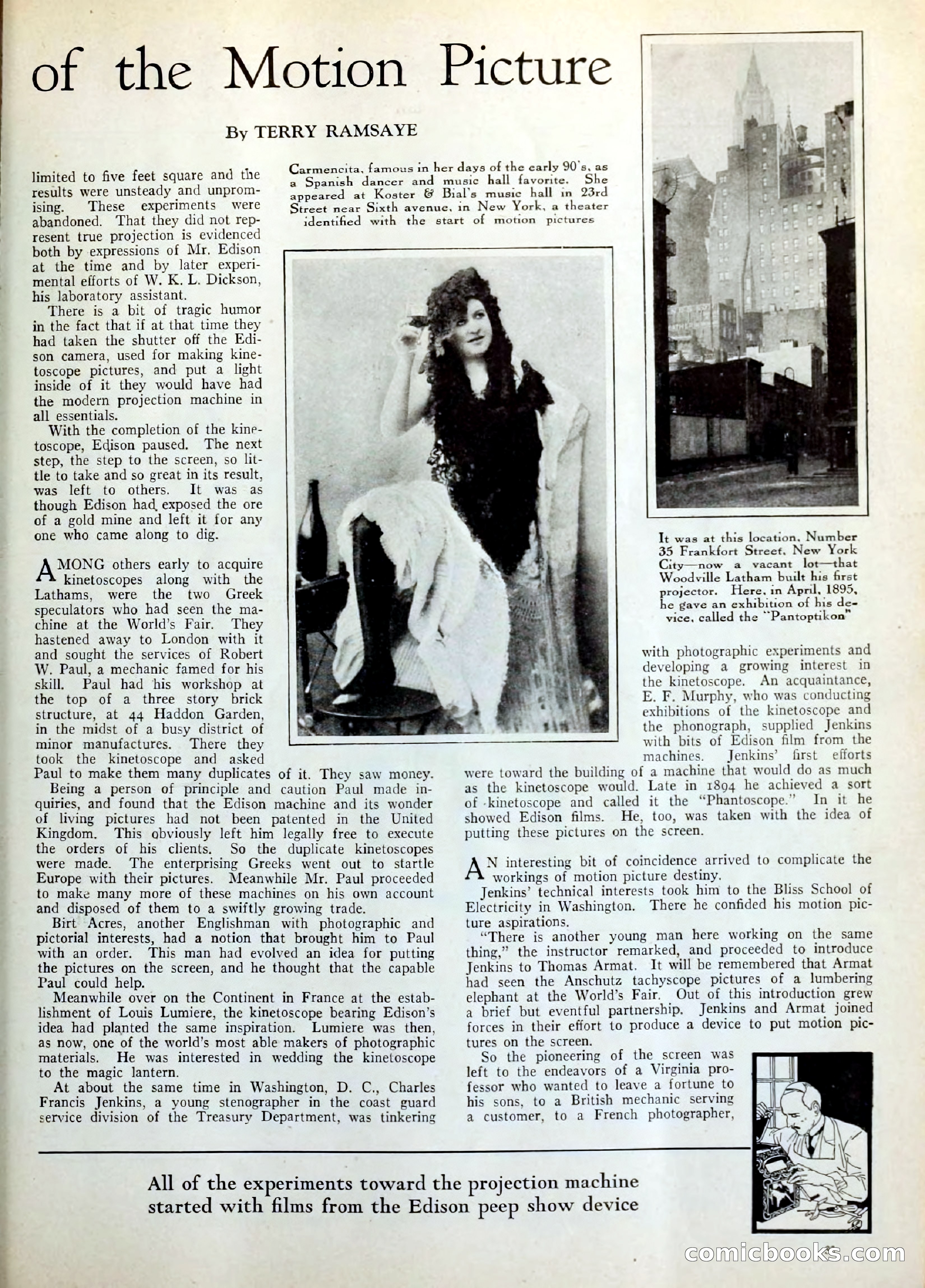
# Analysis of This Page This is an **interior story page** from a pulp magazine, containing illustrated prose text by Terry Ramsaye about the early history of motion picture projection technology. The page features three photographs: a portrait of a woman (identified as Carmencita, a Spanish dancer from the 1890s), a street scene showing New York City buildings, and a small illustration of a man working at machinery. The text discusses Thomas Edison's kinetoscope invention and the early experimenters who developed projection machines, including figures like Robert W. Paul and Charles Francis Jenkins. It describes how these pioneers worked to transition from peepshow devices to screen projection, establishing the foundations of cinema technology in the 1890s.
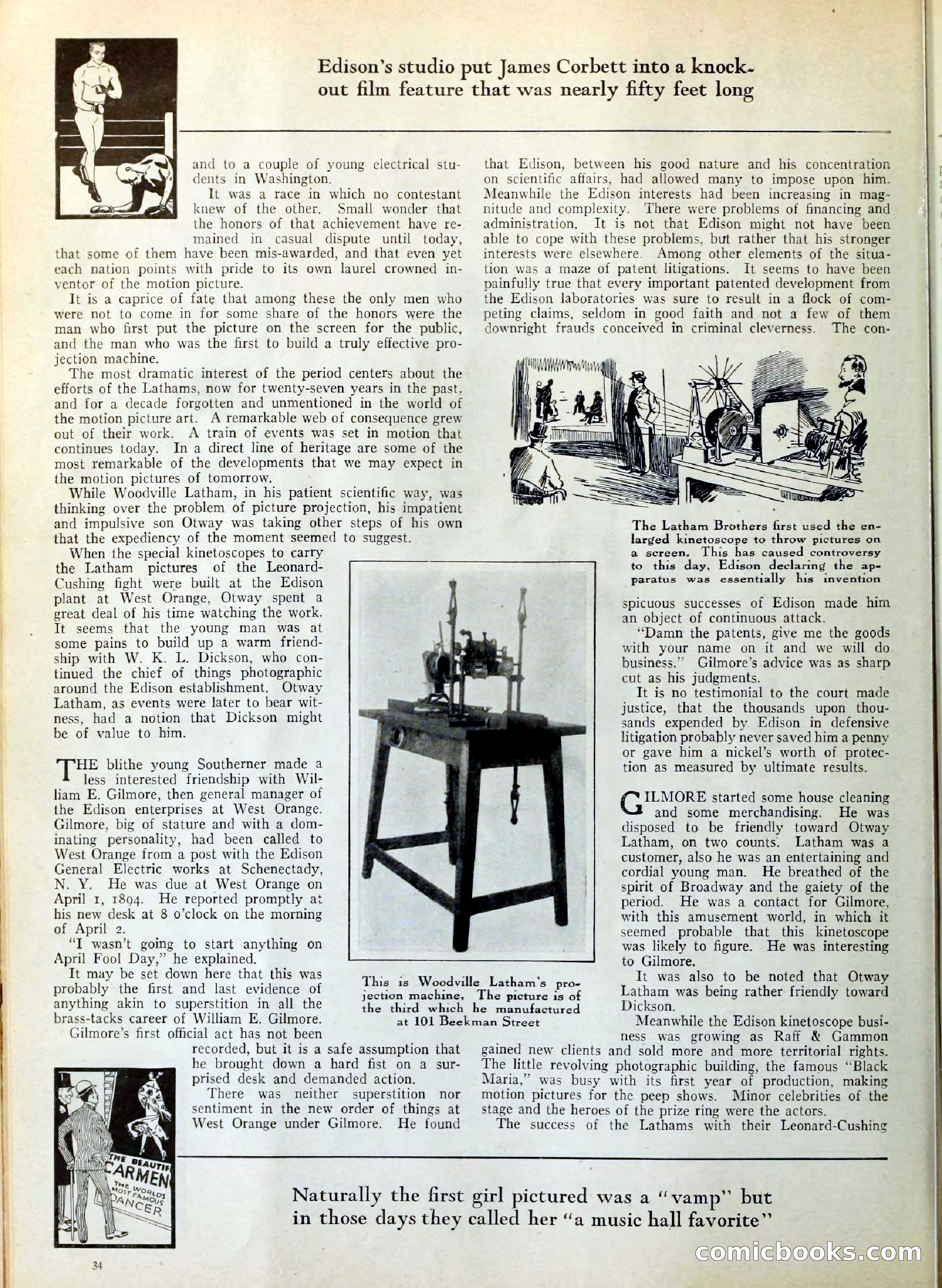
# Page Analysis This is a text-heavy article page (page 34) with two embedded photographs and illustrations. The prose discusses the early history of motion picture technology and the Latham Brothers' contributions to film projection, specifically their work with the kinetoscope and the Leonard-Cushing fight filmed at Edison's studio. The text also covers William E. Gilmore's role at Edison enterprises and mentions conflicts between Edison and various inventors over patent claims and competing technologies. Two photographs show Woodville Latham's projection machine and what appears to be early film equipment. Small illustrations of boxers and a "Scarab" poster appear in the margins.
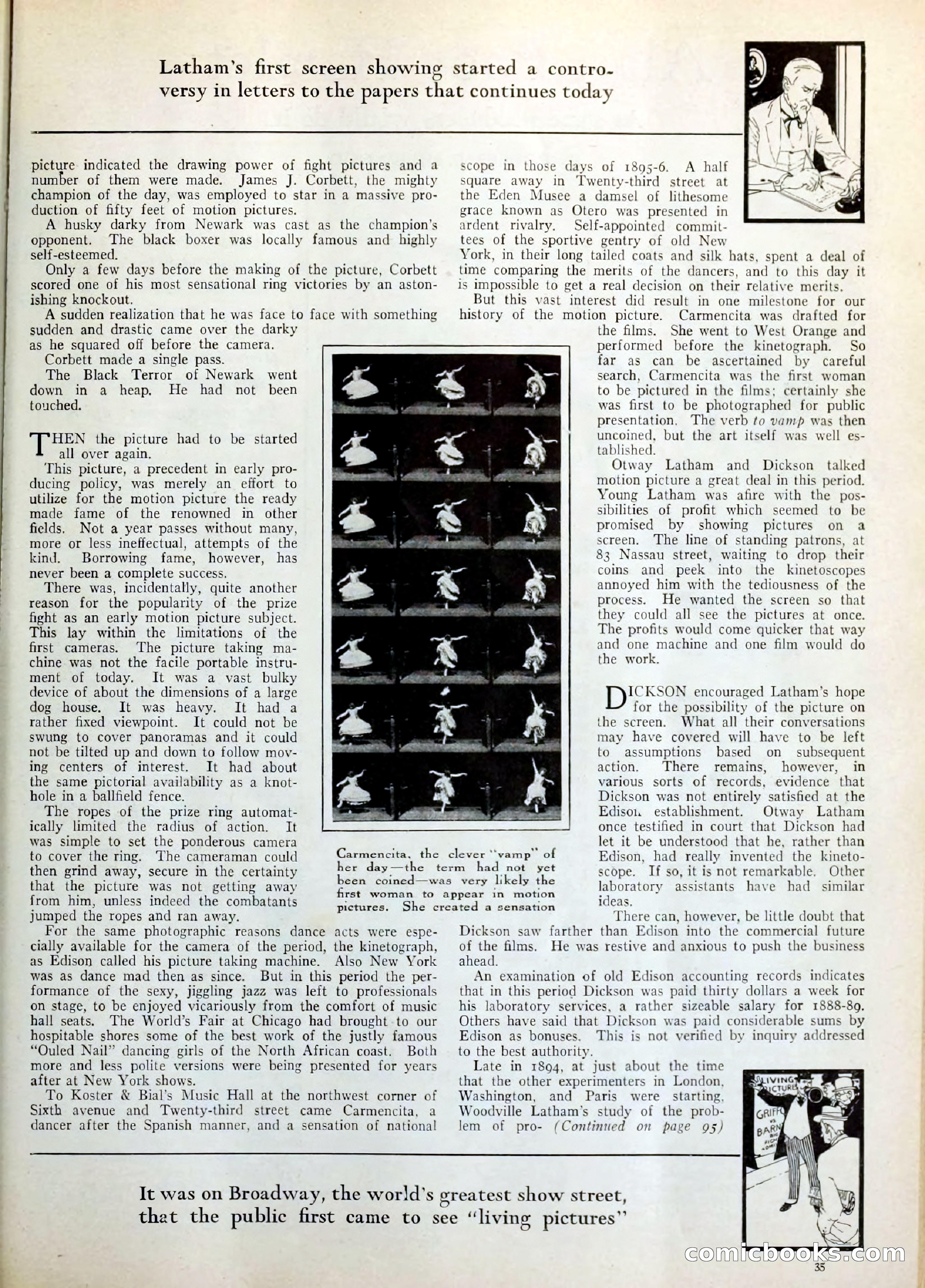
# Page Analysis This is a **text-heavy story page with embedded illustrations** from what appears to be an early cinema history article. The prose describes the making of early motion pictures, specifically focusing on a film featuring a boxer named Corbett and a dancer called Carmenita. The page includes a **filmstrip-style sequence of images** showing repeated poses of a figure in motion, likely demonstrating early cinematography techniques. Two smaller photographs appear in the margins showing what appear to be period figures. The text discusses the technical and commercial challenges of early film production, the role of Thomas Edison and others in developing motion picture technology, and how such pictures were first shown to the public on Broadway. The narrative traces the pioneering efforts to create and exhibit "living pictures."
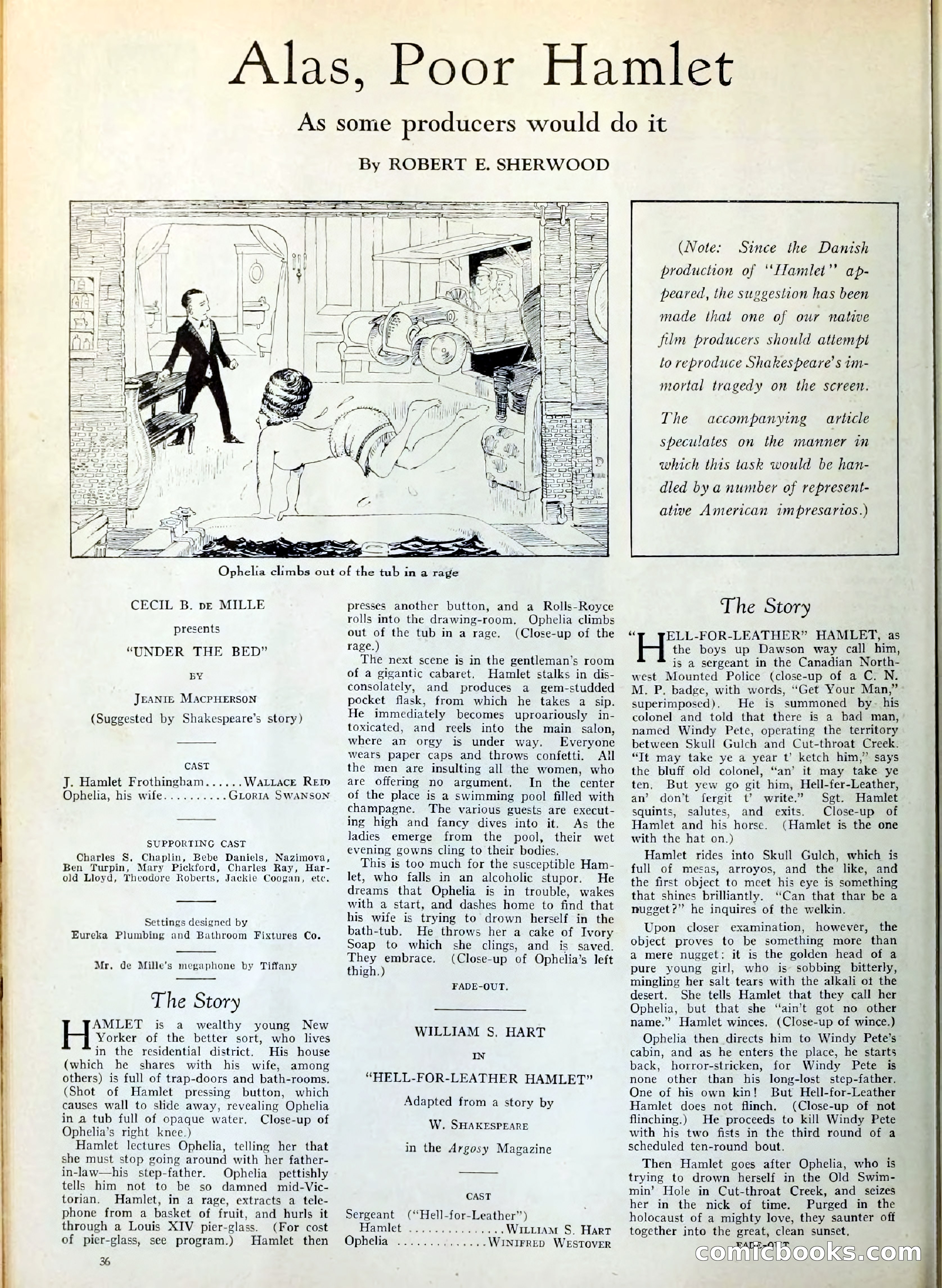
# Page Analysis This is an interior story page from a pulp magazine featuring both illustration and prose text. The page presents "Alas, Poor Hamlet: As Some Producers Would Do It" by Robert E. Sherwood, which satirically reimagines Shakespeare's *Hamlet* as a modern American film scenario. The illustration depicts a comedic domestic scene with a man in formal attire and a woman in a bathtub, captioned "Ophelia climbs out of the tub in a rage." The accompanying text describes how this version transforms the classic tragedy into contemporary farce, with characters like "Hell-for-Leather" Hamlet and references to slapstick humor involving bathtubs, confetti, and a swimming pool. The page includes cast information and credits to various illustrators and contributors.
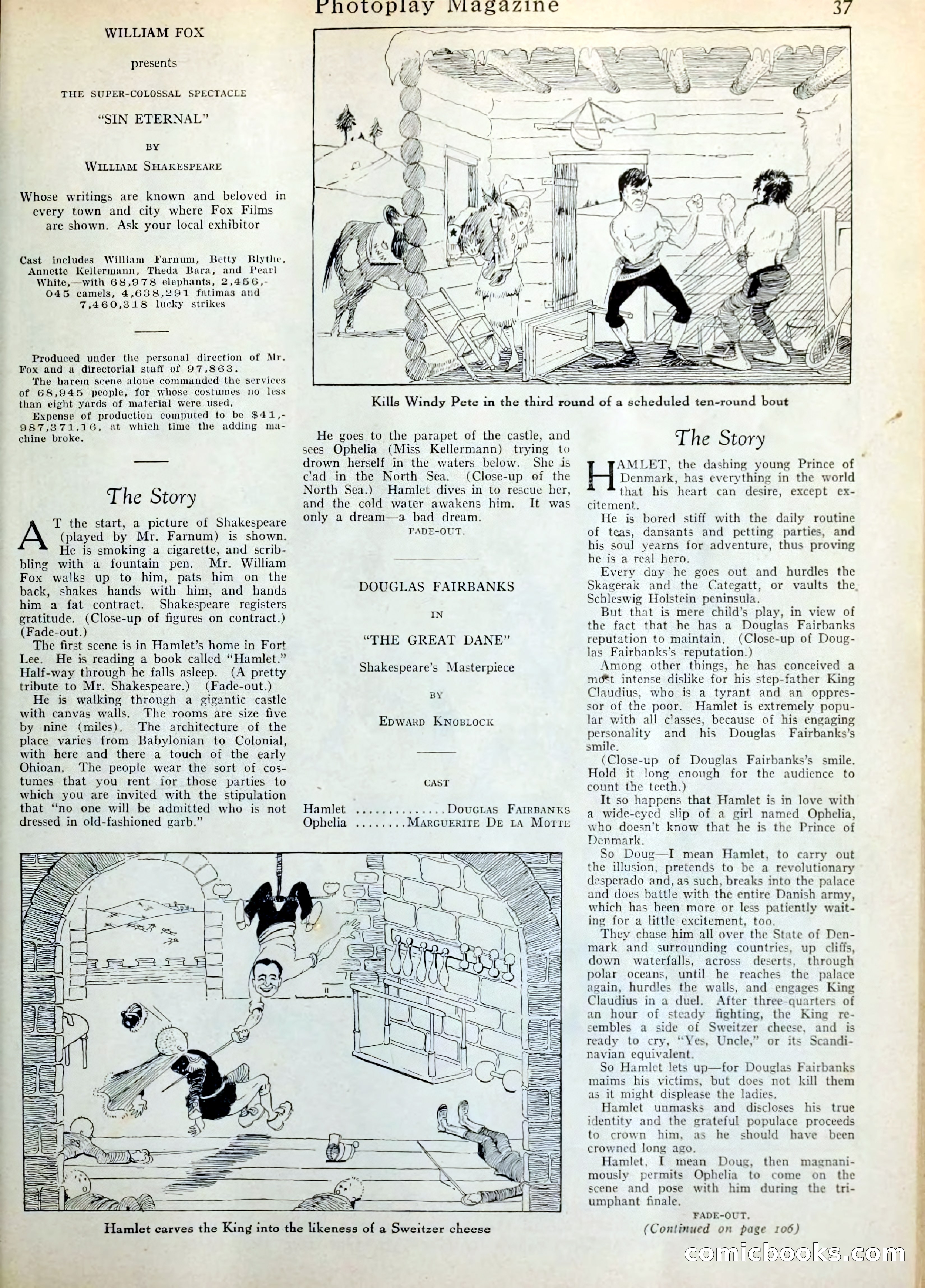
# Page 37 of Photoplay Magazine This page contains article text and illustrations promoting William Fox's film adaptation of Shakespeare's "Sin Eternal" and Douglas Fairbanks's film "The Great Dane." The main text describes the plot of "The Great Dane," which appears to involve Hamlet and a character named Douglas Fairbanks pursuing adventures across Denmark, including scenes with waterfalls and deserts. Two illustrations accompany the articles: one showing a boxing match scene labeled "Killa Windy Pete in the third round of a scheduled ten-round bout," and another below depicting what appears to be an action sequence labeled "Hamlet carves the King into the likeness of a Switzer cheese."
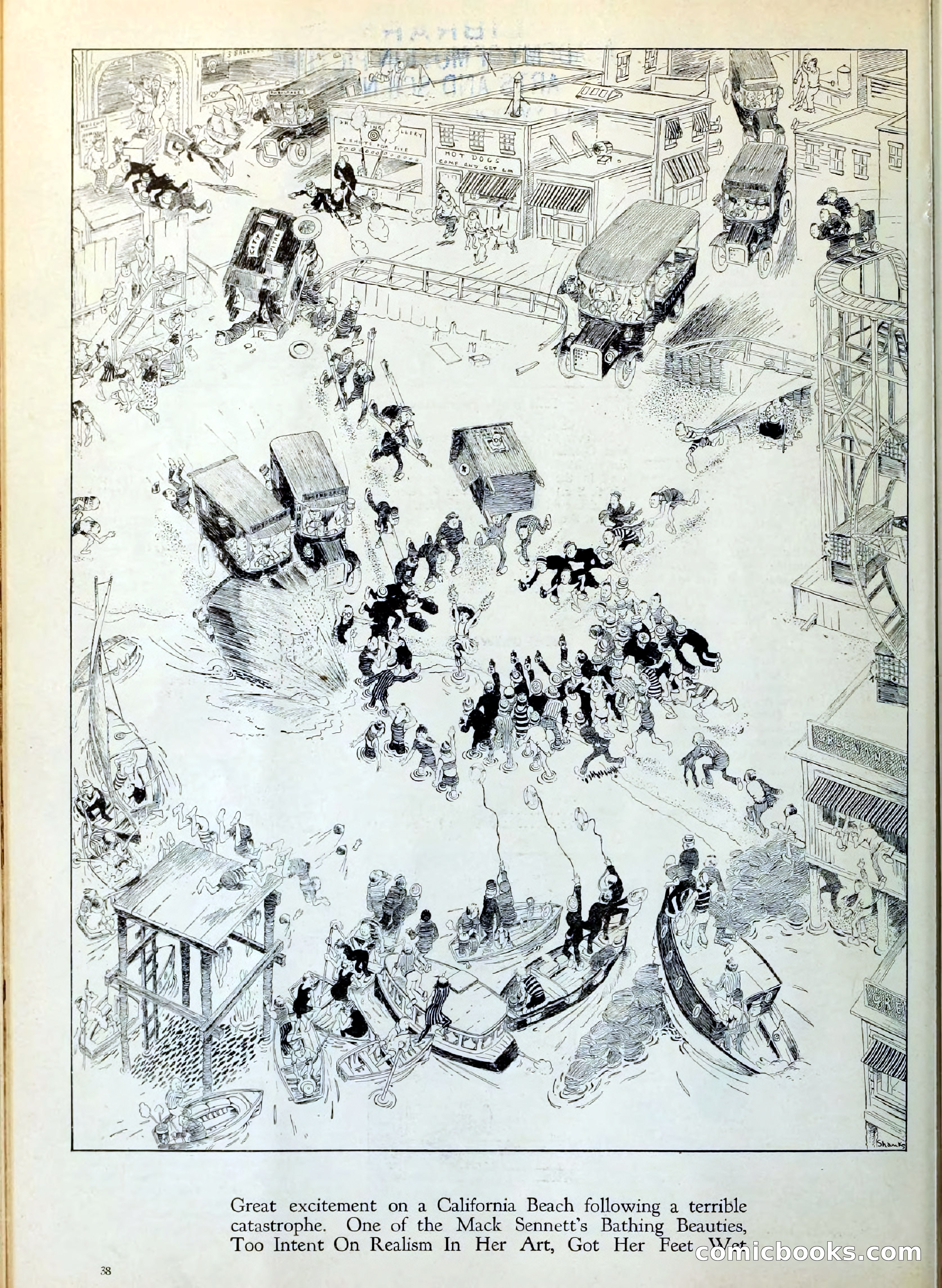
# Page Description This is an illustration page from an early-20th-century pulp magazine. The black-and-white drawing depicts a chaotic beach scene with numerous people, vehicles, and boats. The caption reads: "Great excitement on a California Beach following a terrible catastrophe. One of the Mack Sennett's Bathing Beauties, Too Intent On Realism In Her Art, Got Her Feet—Wet." The illustration appears to be a humorous scene showing the aftermath of some incident involving a Mack Sennett bathing beauty (likely referencing the famous silent film director's comedies). The detailed sketch shows crowds, trucks, and watercraft, rendered in a comedic style typical of pulp magazine illustrations from this era.
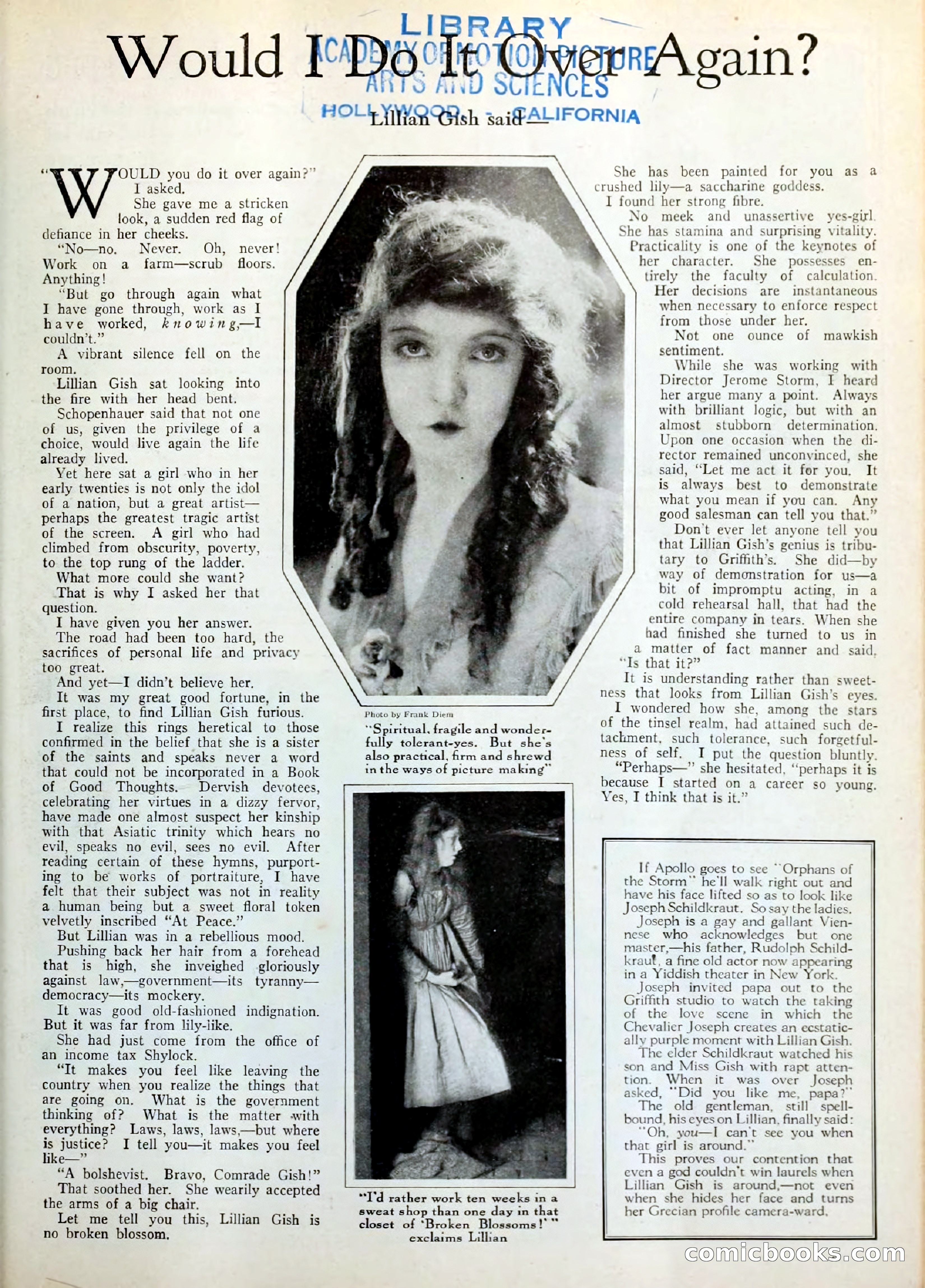
# Page Analysis This is an interior magazine page featuring an article titled "Would I Do It Over Again?" The page contains two photographs of a woman (identified as Lillian Gish in the text) along with prose text discussing her career and character. The left column presents a narrative account of a conversation about whether Gish would repeat her life choices, touching on her sacrifices and her rise from obscurity to becoming a major film artist. The right column provides character analysis, describing her as possessing "strong fibre," decisiveness, and practicality. The page appears to be from a fan magazine or similar publication focused on the film industry and Hollywood personalities of the early 20th century.
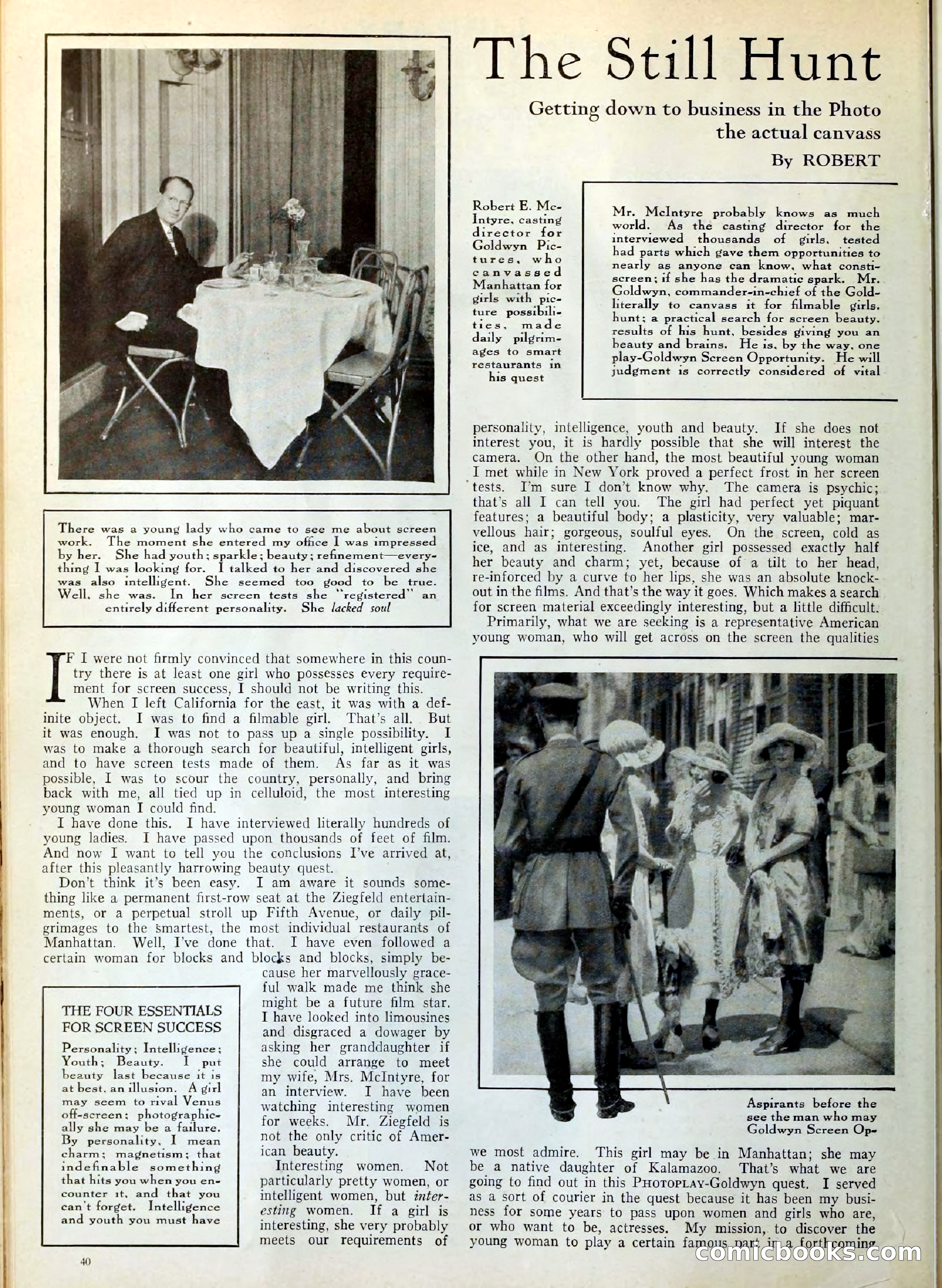
This page is an article titled "The Still Hunt" by Robert, discussing the casting process for finding screen actresses. The piece features two photographs: one showing Robert E. McIntyre (identified as a casting director for Goldwyn Pictures) conducting what appears to be an interview with a young woman, and another showing a group of female aspirants awaiting auditions. The article describes McIntyre's extensive search across Manhattan for girls with "picture possibilities," emphasizing that successful screen actresses require personality, intelligence, youth, and beauty. The text outlines the practical challenges of identifying talent and includes a sidebar listing "Four Essentials for Screen Success."
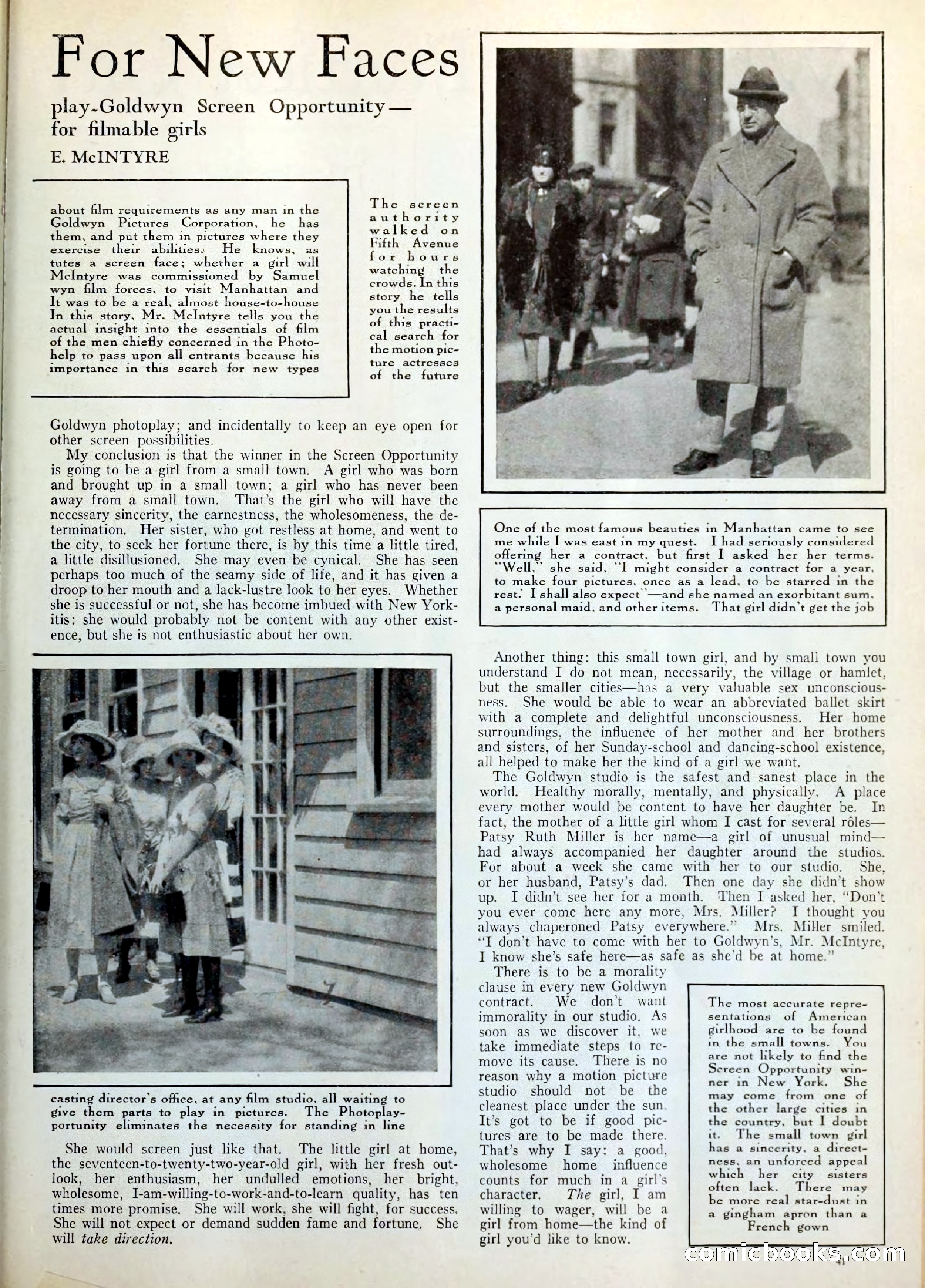
# Page Description This is an article page from a pulp magazine titled "For New Faces: A Goldwyn Screen Opportunity—for filmable girls" by E. McIntyre. The text discusses Goldwyn Pictures Corporation's search for new film talent, explaining the qualities casting directors seek in potential actresses. The page includes three black-and-white photographs: one showing a man in a coat and hat on a city street, one depicting a young girl in casual clothing near a building, and one showing the interior of a casting director's office with people waiting. The article emphasizes that small-town girls with natural sincerity and wholesomeness are ideal candidates for screen success.
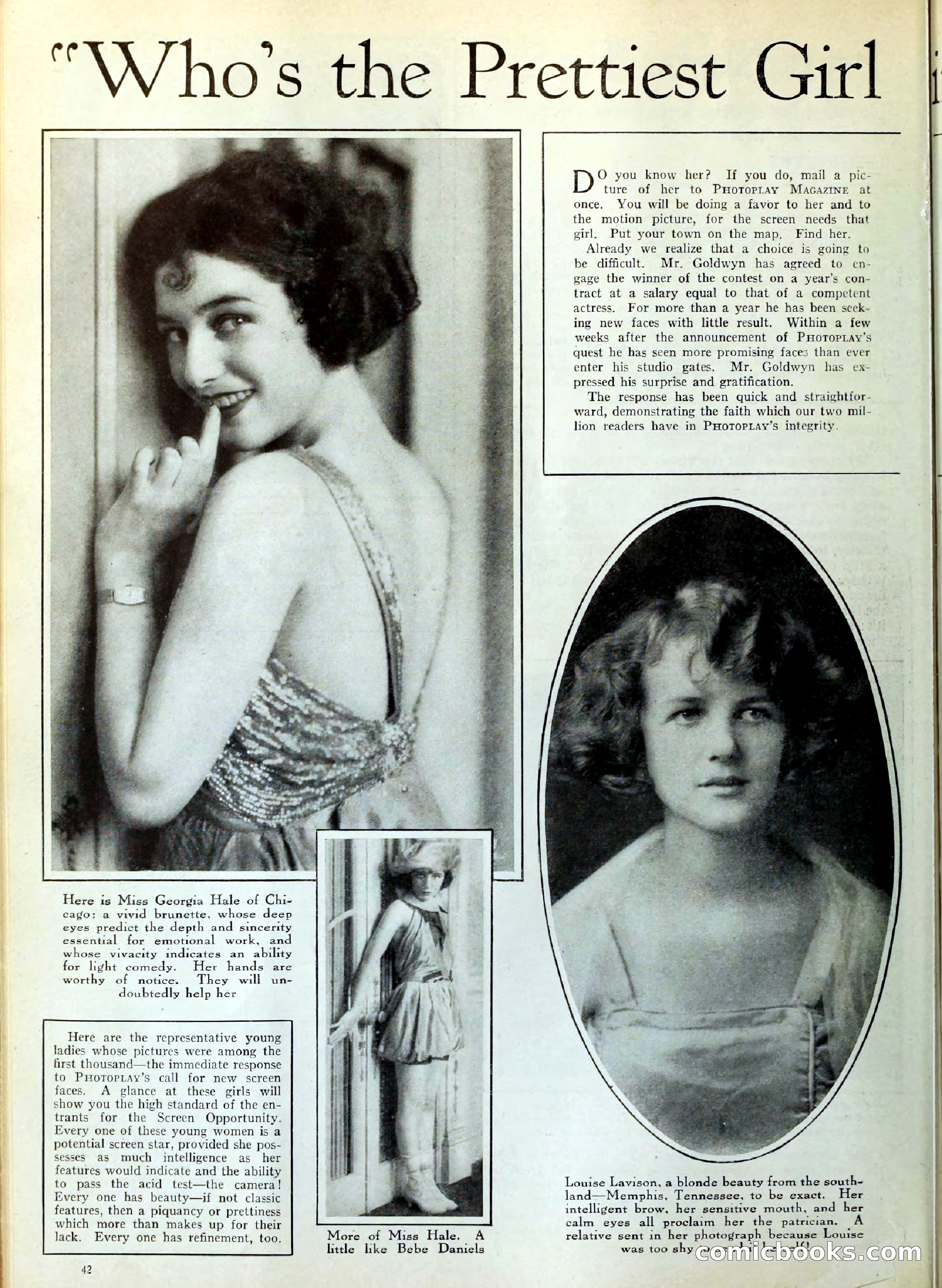
# Page Description This is a feature article page titled "Who's the Prettiest Girl" from what appears to be *Photoplay Magazine*. The page showcases photographs of young women and describes a contest where readers can nominate candidates for a film contract. The text explains that Mr. Goldwyn has agreed to offer a year-long contract to the contest winner. The page displays three photographs: a large portrait of Miss Georgia Hale of Chicago (described as a "vivid brunette"), a smaller image labeled "More of Miss Hale. A little like Bebe Daniels," and an oval-framed portrait of Louise Lavison, identified as "a blonde beauty from the south-land—Memphis, Tennessee." The article invites readers to submit photographs of prospective actresses.
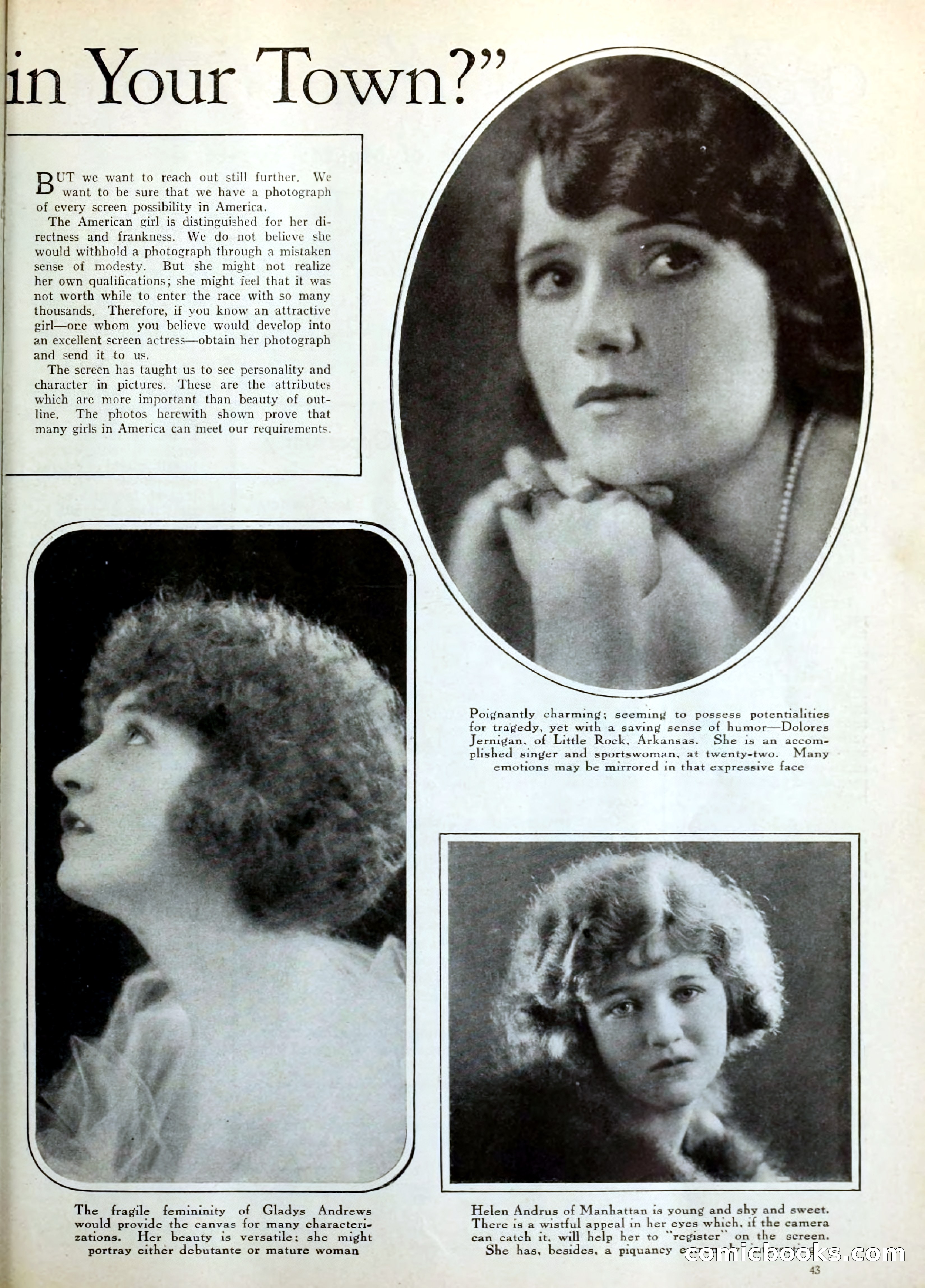
This page appears to be a talent recruitment advertisement from an early-20th-century publication. The headline "in Your Town?" is partially visible at the top. The text describes a search for attractive young women suitable for screen acting, emphasizing that the publication seeks photographs of girls who could develop into excellent screen actresses. Three portrait photographs of women are displayed: Gladys Andrews (described as having "fragile femininity"), Dolores Jernigan of Little Rock, Arkansas (noted as an accomplished singer and sportswoman at twenty-two), and Helen Andrus of Manhattan (characterized as "young and shy and sweet"). The text prioritizes personality and character over physical beauty as screening criteria.
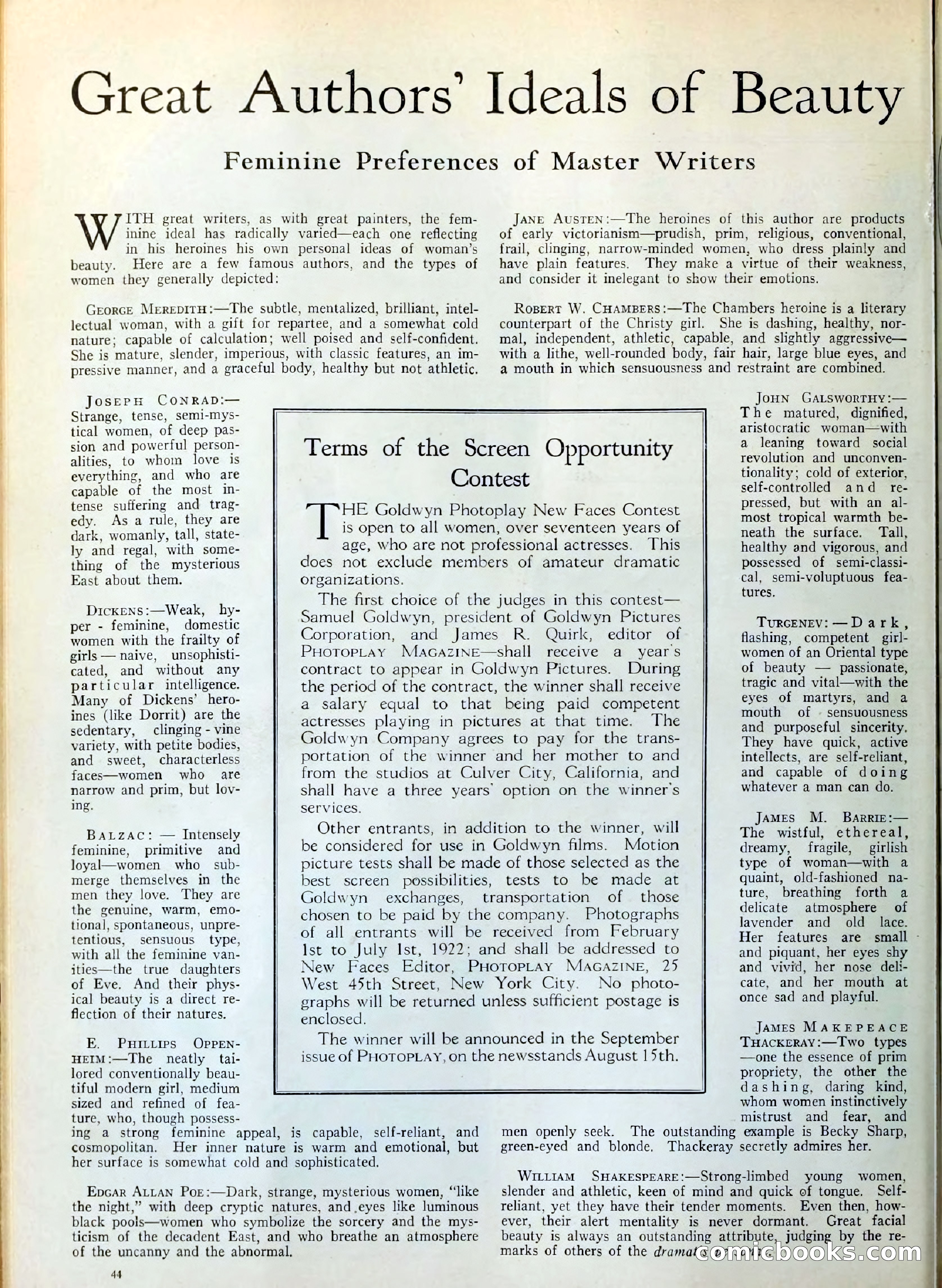
# Page Description This is a text-only page from an early-1920s magazine featuring two articles: 1. **"Great Authors' Ideals of Beauty"** — A survey describing how famous writers (Jane Austen, George Meredith, Joseph Conrad, Charles Dickens, Balzac, and others) portrayed feminine beauty in their heroines, noting how their ideals reflected their individual aesthetic and literary philosophies. 2. **"Terms of the Screen Opportunity Contest"** — Contest rules for the Goldwyn Photoplay New Faces Contest, open to all women under nineteen years old. The winner receives a year's contract with Goldwyn Pictures, transportation, and salary. Submission deadline and judging details are provided. The page contains no illustrations, only formatted text columns typical of pulp magazine layouts.
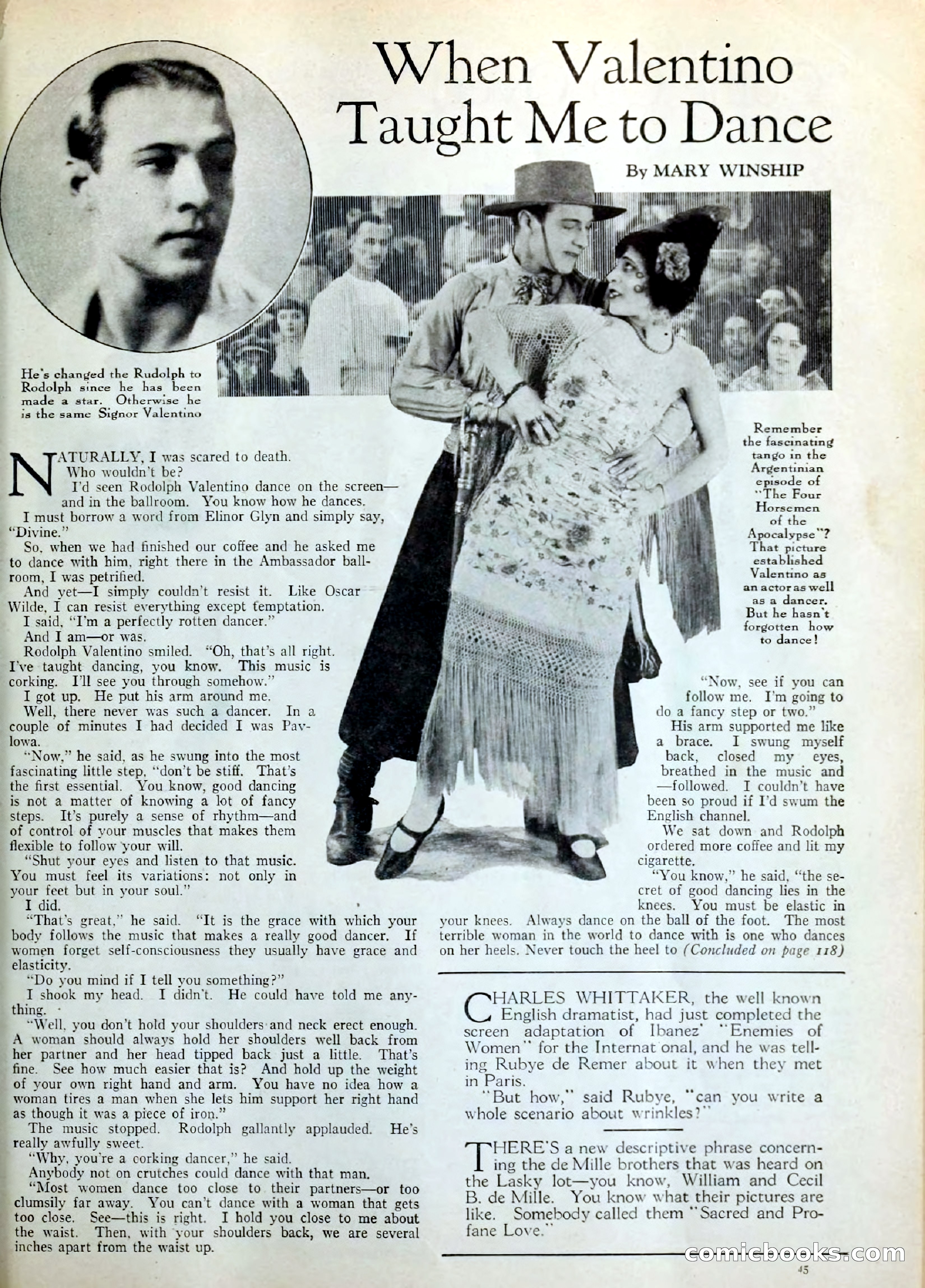
# Page Content Description This is a story page from an early-20th-century pulp magazine featuring "When Valentino Taught Me to Dance" by Mary Winship. The page contains prose narrative text in multiple columns alongside a photograph showing a man in a cowboy hat dancing with a woman in a patterned dress, with onlookers in the background. The story recounts the narrator's experience being taught to dance by Rudolph Valentino at the Ambassador ballroom. It includes Valentino's advice about dancing technique—emphasizing rhythm, control, proper posture, and the importance of the knees in dancing. The narrative describes their interaction and his instruction in considerable detail about proper dancing form.
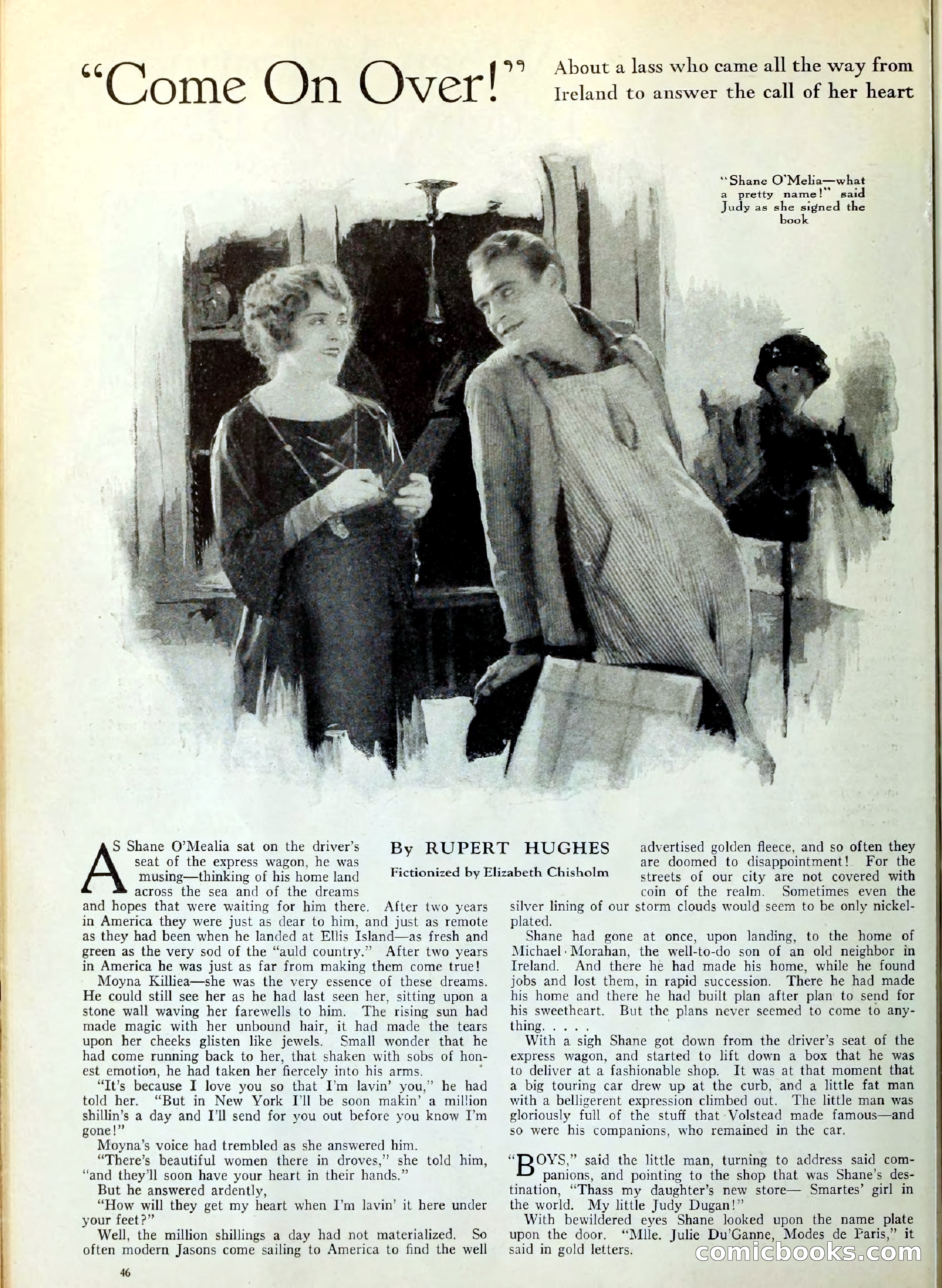
# Page Description This is a story illustration and prose page from an early-20th-century pulp magazine. The black-and-white illustration depicts what appears to be a dramatic scene at a doorway or entrance, with a woman and man in the foreground and another figure visible in the background. The story, titled **"Come On Over!"** and credited to author Rupert Hughes (fictionized by Elizabeth Chisholm), concerns an Irish woman named Shane O'Mealia who traveled to America seeking her sweetheart. The visible prose describes Shane's arrival in Ellis Island and her subsequent visit to locate a man named Michael Morahan in Ireland, with plot complications involving touring cars and a fashionable shop. The narrative focuses on romantic and immigrant-themed drama typical of pulp fiction of this era.
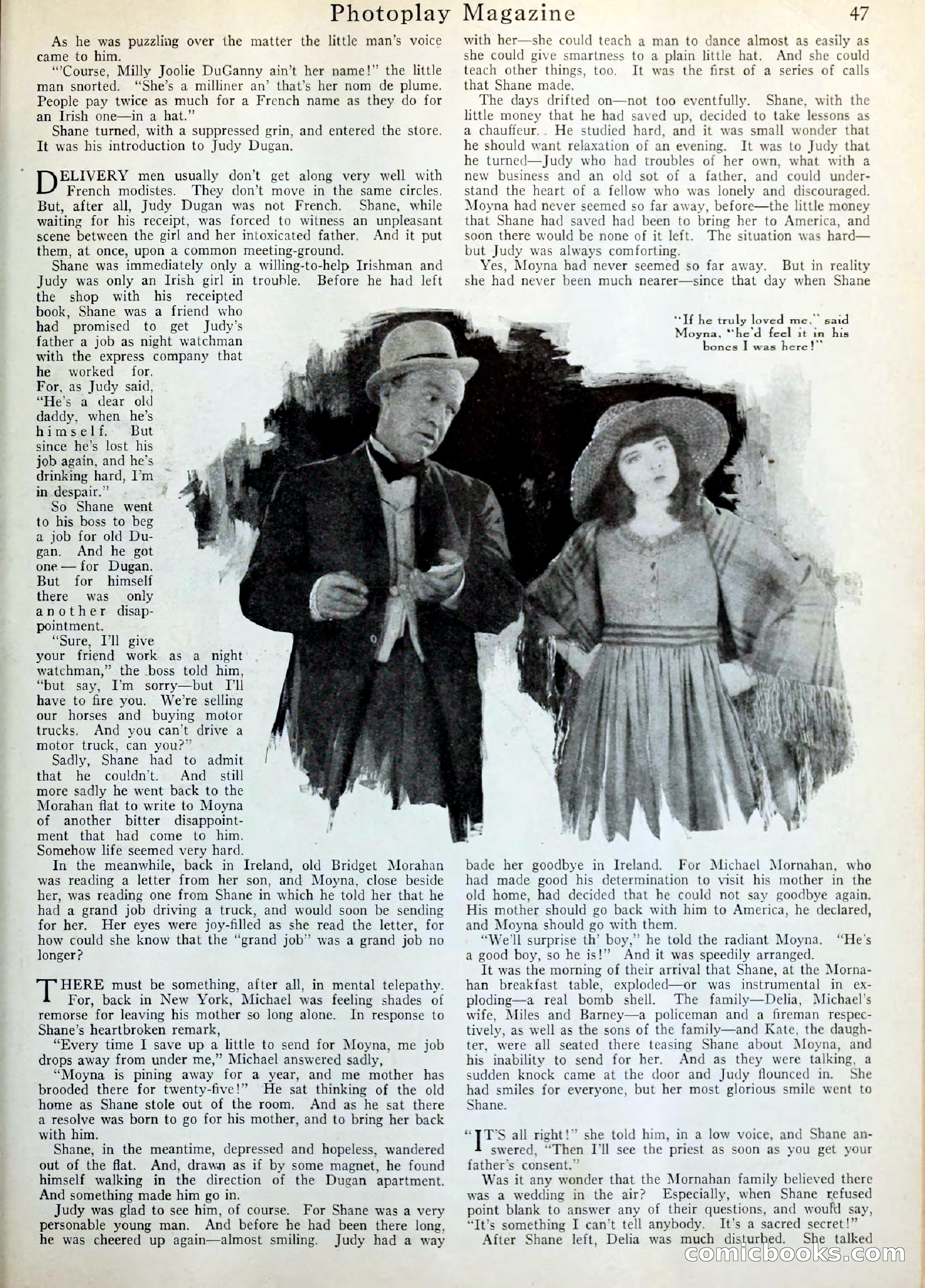
# Photoplay Magazine, Page 47 This page contains story prose with an accompanying photograph. The text describes a working-class Irish character named Shane navigating romantic disappointment and employment struggles in what appears to be early-20th-century America. The narrative involves Shane's failed attempt to secure employment for his friend's father through an express company, his correspondence with a woman named Moyna back in Ireland, and his apparent romantic interest in a woman named Judy Dugan. The photograph shows two figures—an older man and a younger woman wearing a hat—though their specific identities in relation to the story are unclear from the image alone.
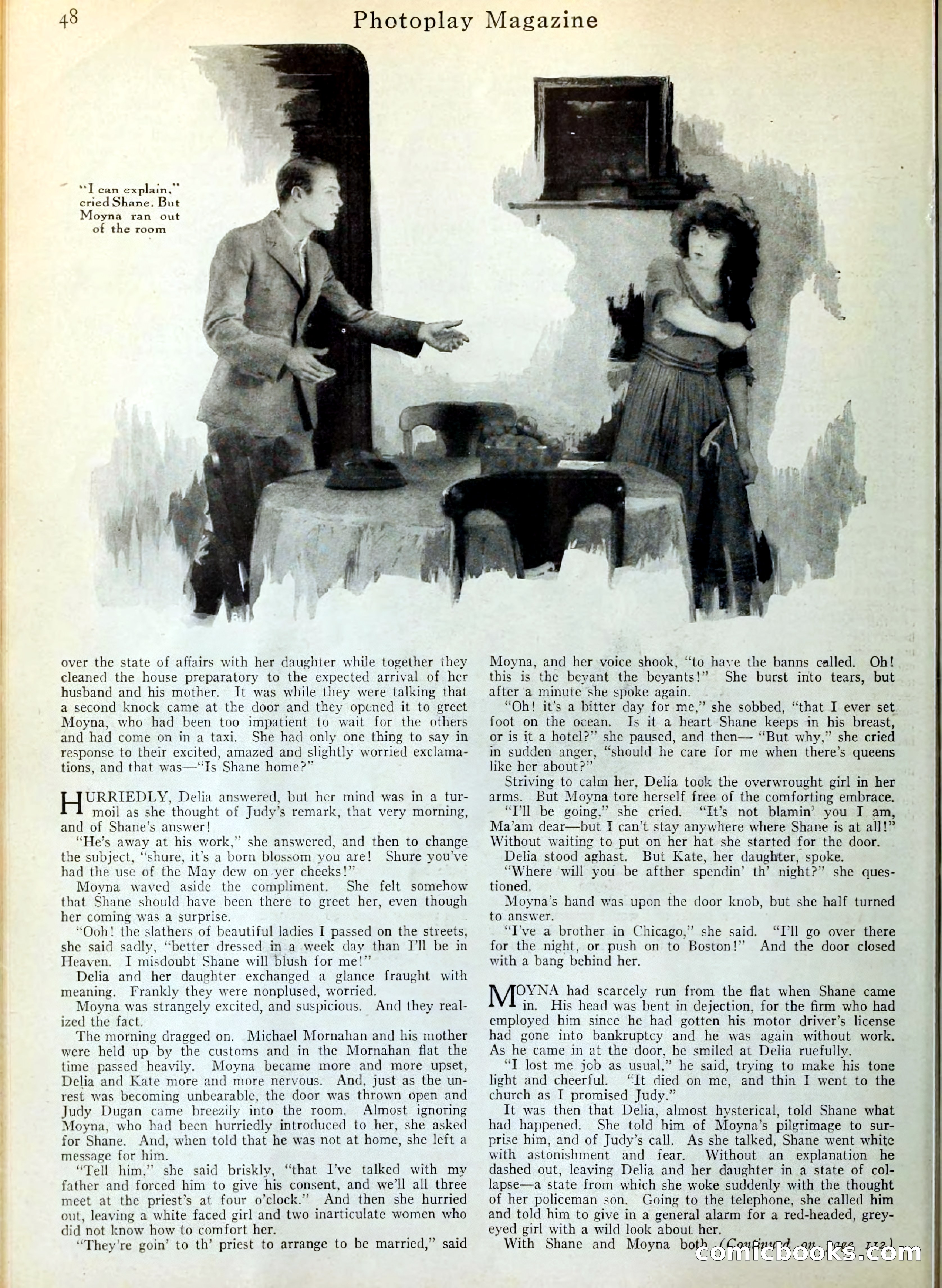
# Page 48 of Photoplay Magazine This page contains story prose illustrated with a black-and-white photograph showing three people in what appears to be a domestic interior scene. A man in a suit stands near a doorway on the left, while a woman in a dress stands on the right near a small table with a chair. The text describes a dramatic domestic conflict involving characters named Shane, Moyna, and Delia. The narrative concerns Moyna's distress over Shane's unexplained absence and her uncertainty about their relationship, with discussion of a potential marriage arrangement with a priest. The passage conveys tension and emotional turmoil among the characters, though the specific plot context remains unclear from this excerpt alone.
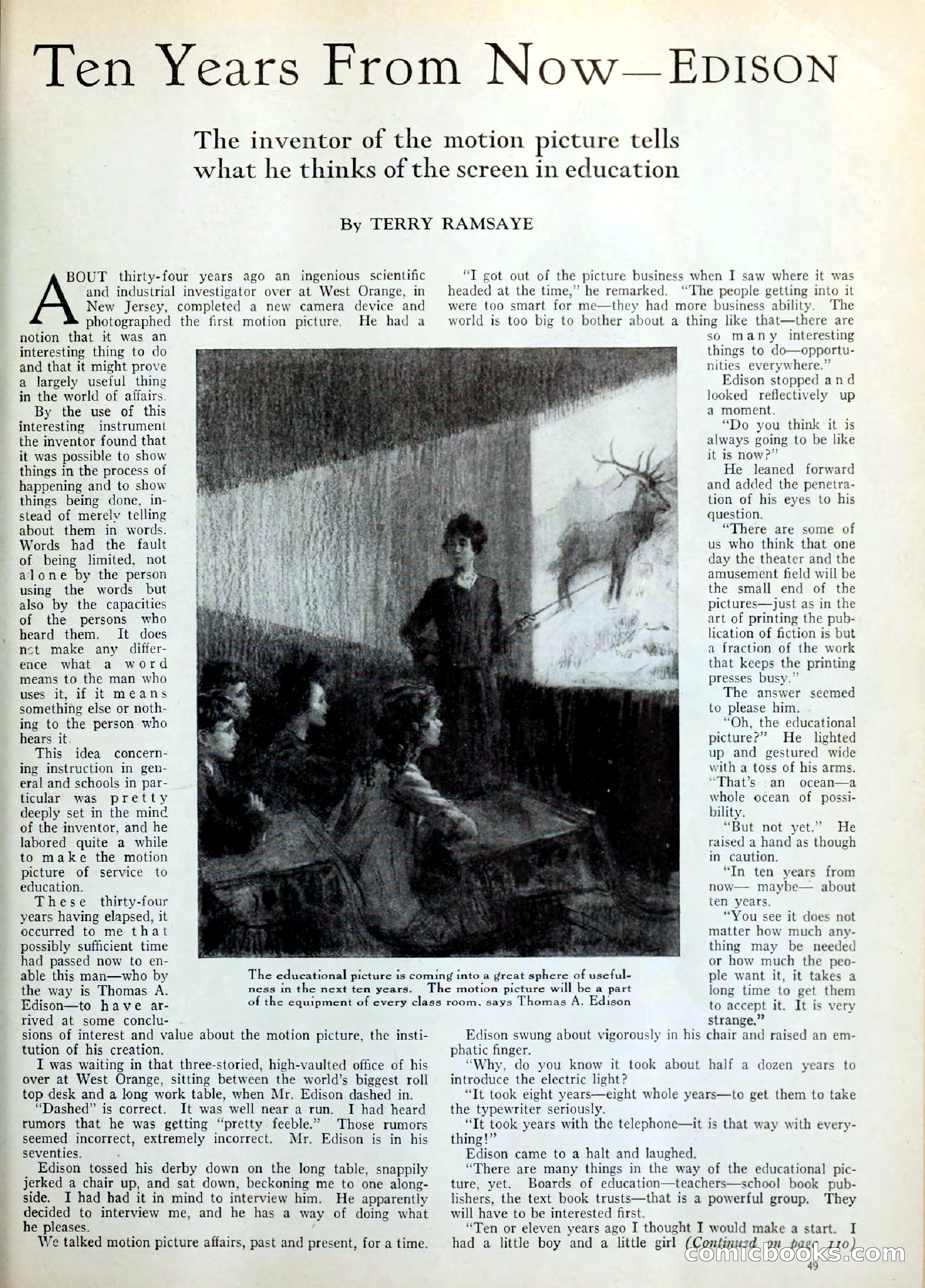
# Page Analysis This is a two-column article page with an embedded photograph. The article, titled "Ten Years From Now—Edison" and bylined by Terry Ramsaye, features an interview with Thomas A. Edison discussing the educational potential of motion pictures in schools. The central photograph shows Edison seated in a chair, gesturing while speaking. The visible text covers Edison's predictions about cinema's future role in classroom instruction, his belief that motion pictures will eventually become standard educational equipment, and his reflections on why the film industry took years to develop technically. The article appears to continue on a following page (marked "Continued on page 110").
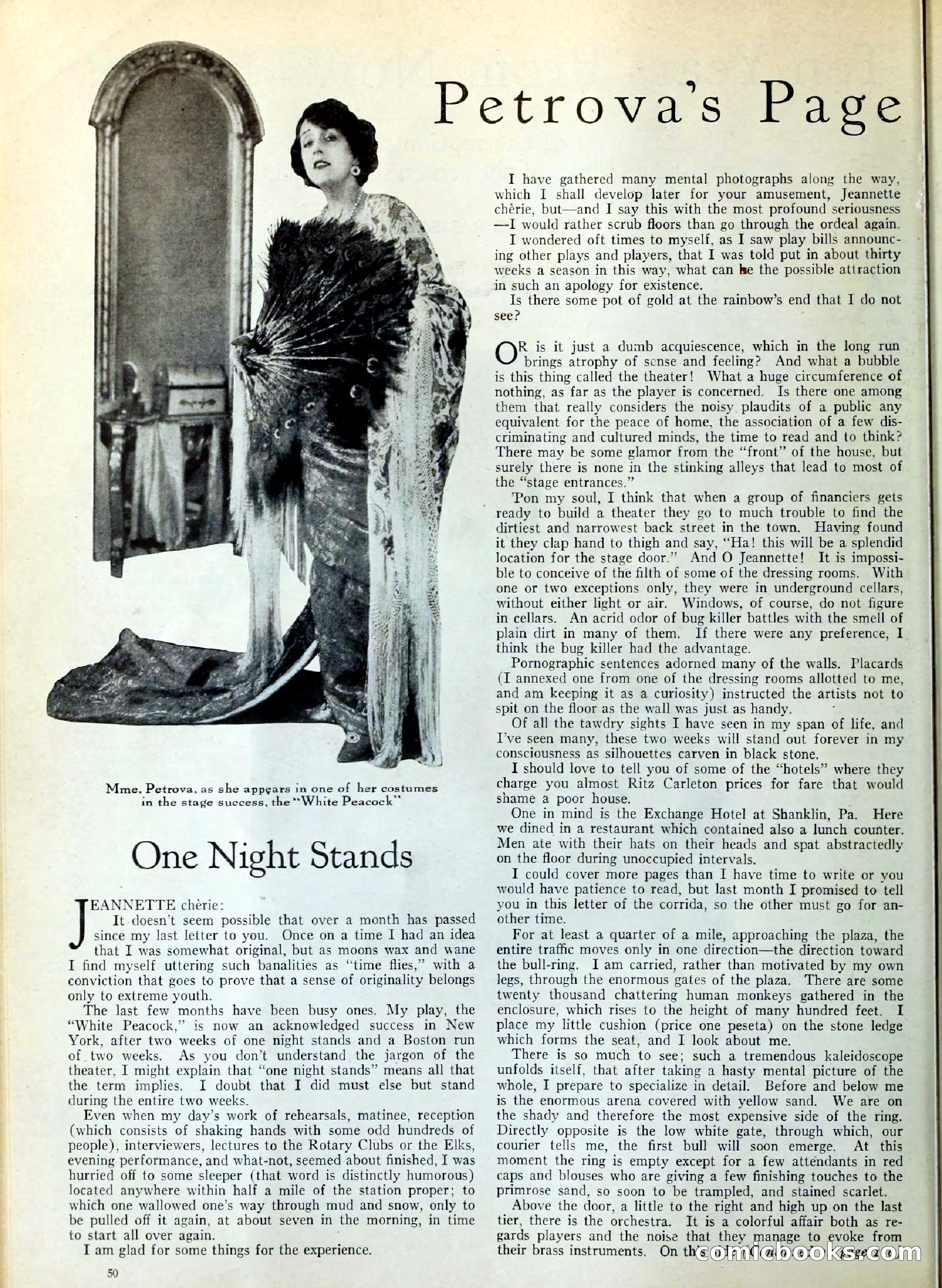
# Petrova's Page This is a story prose page featuring "Petrova's Page," a column or article by actress Mme. Petrova (shown in costume from a stage production called "The White Peacock"). The visible text discusses Petrova's experience performing in theater over two weeks, describing the demanding schedule of rehearsals, matinees, receptions, and evening performances in what appears to be New York and Boston. She reflects on the theatrical experience, backstage conditions, and various observations about theater life and venues. The page includes both a photograph of the actress in an ornate costume and several paragraphs of her personal narrative about theatrical work.
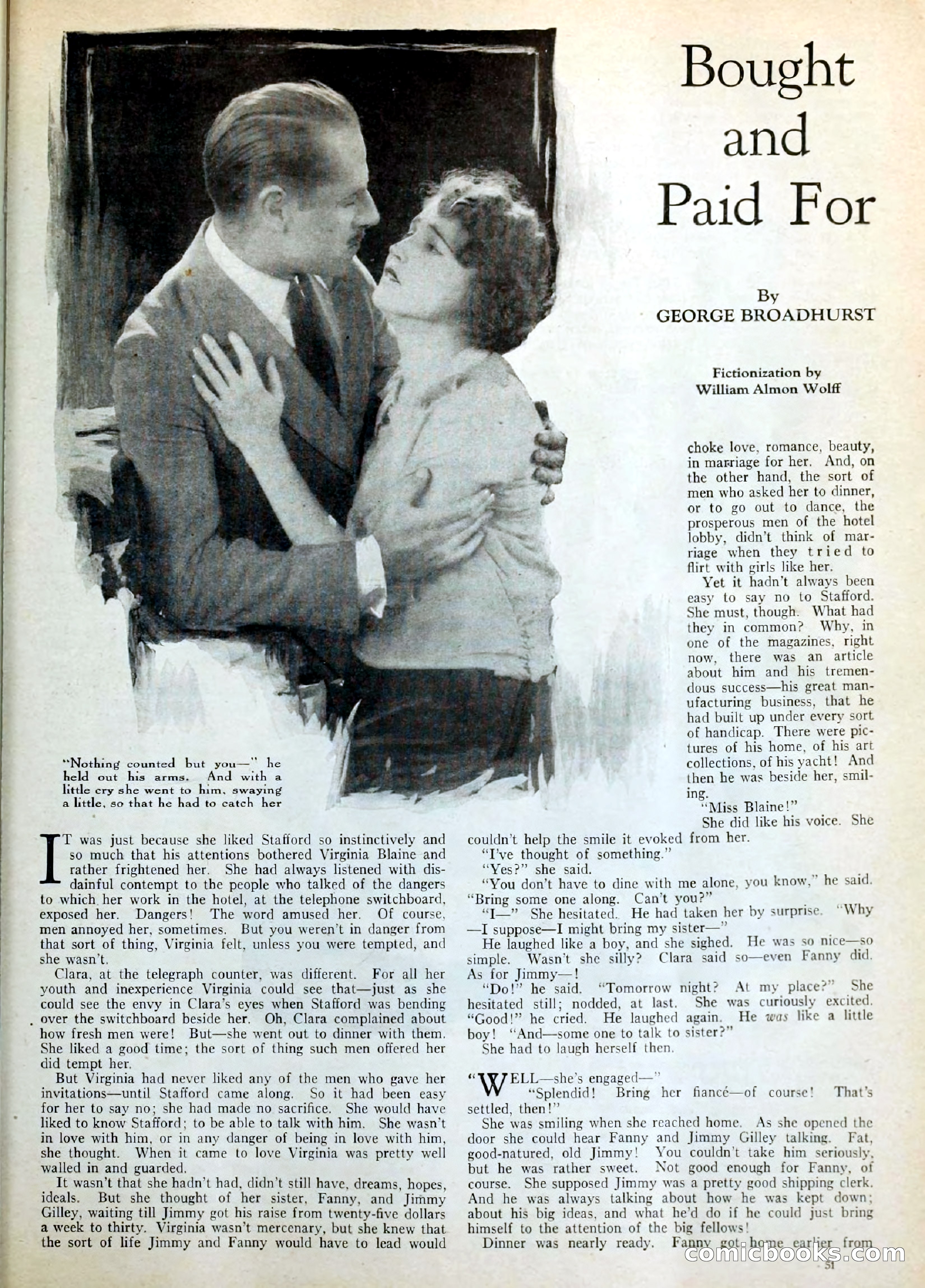
# Page Content This is an interior story page from a pulp magazine featuring both illustration and prose. The top half shows a black-and-white illustration of a romantic scene between a man and woman, with the man embracing the woman from behind. Below the illustration is a caption quoting dialogue. The story, titled "Bought and Paid For" by George Broadhurst (fictionalized by William Almon Wolff), occupies the lower half of the page. The visible text concerns a young woman named Virginia Blaine who works at a hotel switchboard and is pursued romantically by various men, particularly one named Stafford. The prose discusses Virginia's romantic considerations and an apparent engagement announcement, exploring themes of romance, social expectations, and relationships among hotel employees and guests.
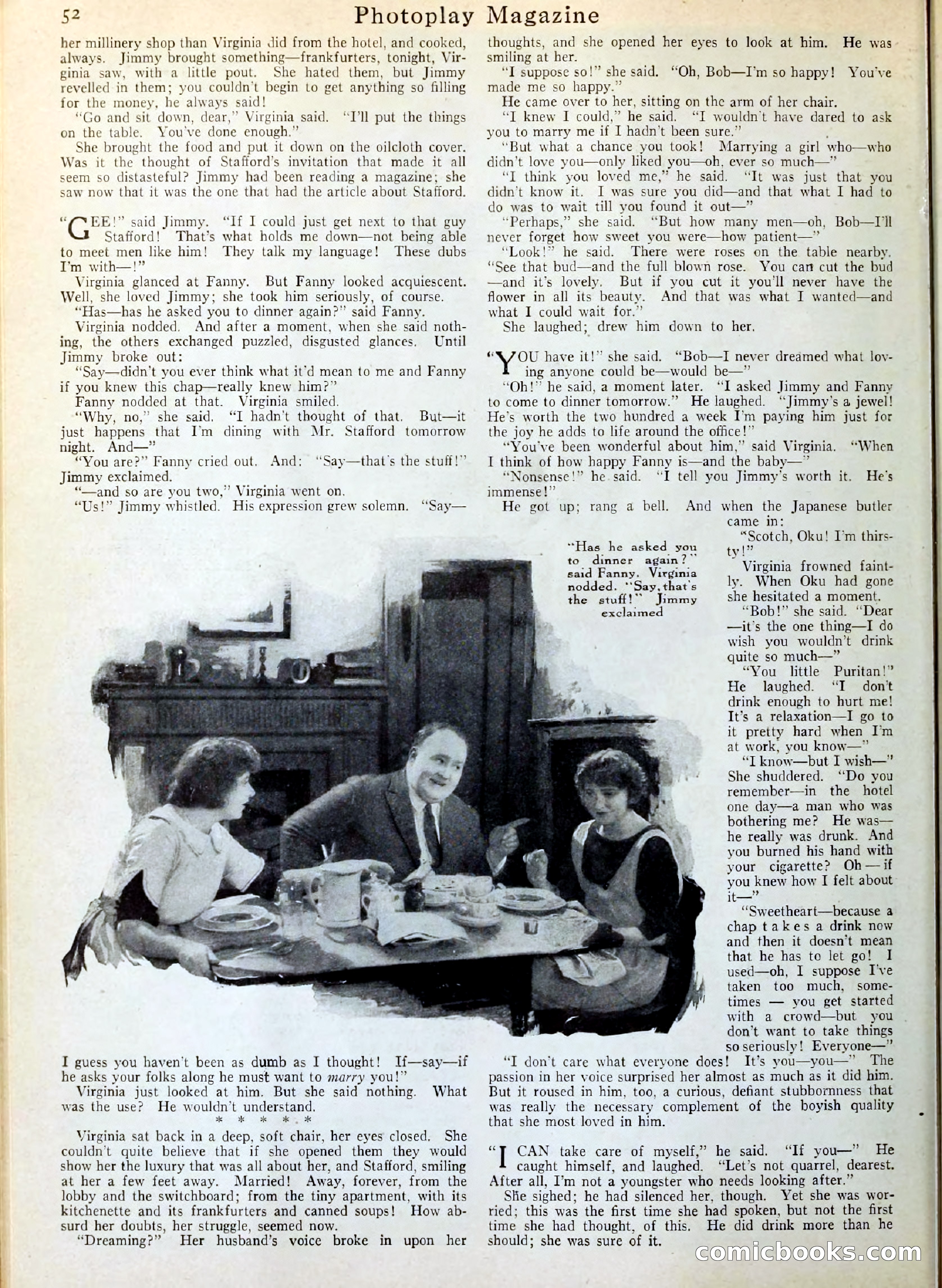
# Page 52 of Photoplay Magazine This page contains story prose with an embedded illustration. The text describes a domestic scene where Virginia, recently married to a man named Bob, reflects on her new life while conversing with her husband and friends Jimmy and Fanny. The illustration shows four people seated at a dining table, apparently during a meal. The narrative focuses on Virginia's contentment with her marriage and Bob's affectionate behavior toward her, though she experiences some self-doubt about whether she deserves his devotion. The dialogue reveals tension regarding Bob's drinking habits and past romantic interests.
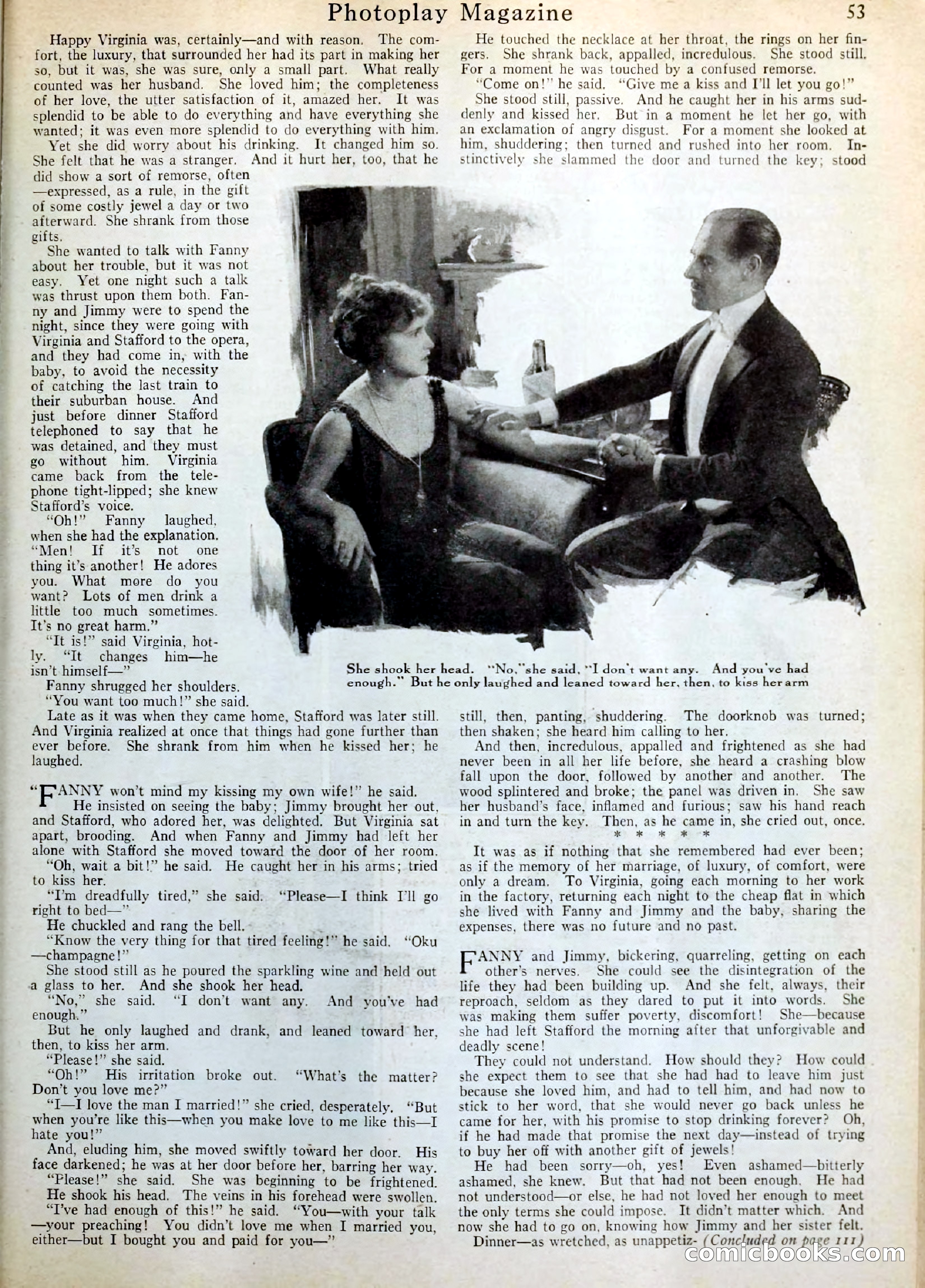
# Page 53 of Photoplay Magazine This page contains story prose with an embedded black-and-white illustration. The text depicts a domestic drama involving a wife (Virginia) confronting her husband about his drinking and infidelity. The illustration shows a man in a suit seated beside a woman, apparently during a tense conversation. The narrative describes Virginia's emotional turmoil over her husband's behavior, his dismissive attitude toward her concerns, and the deteriorating state of their marriage. The prose suggests this is adapted from a film scenario, as indicated by the "Photoplay Magazine" header. The story focuses on marital conflict and the wife's difficult decision regarding her future.
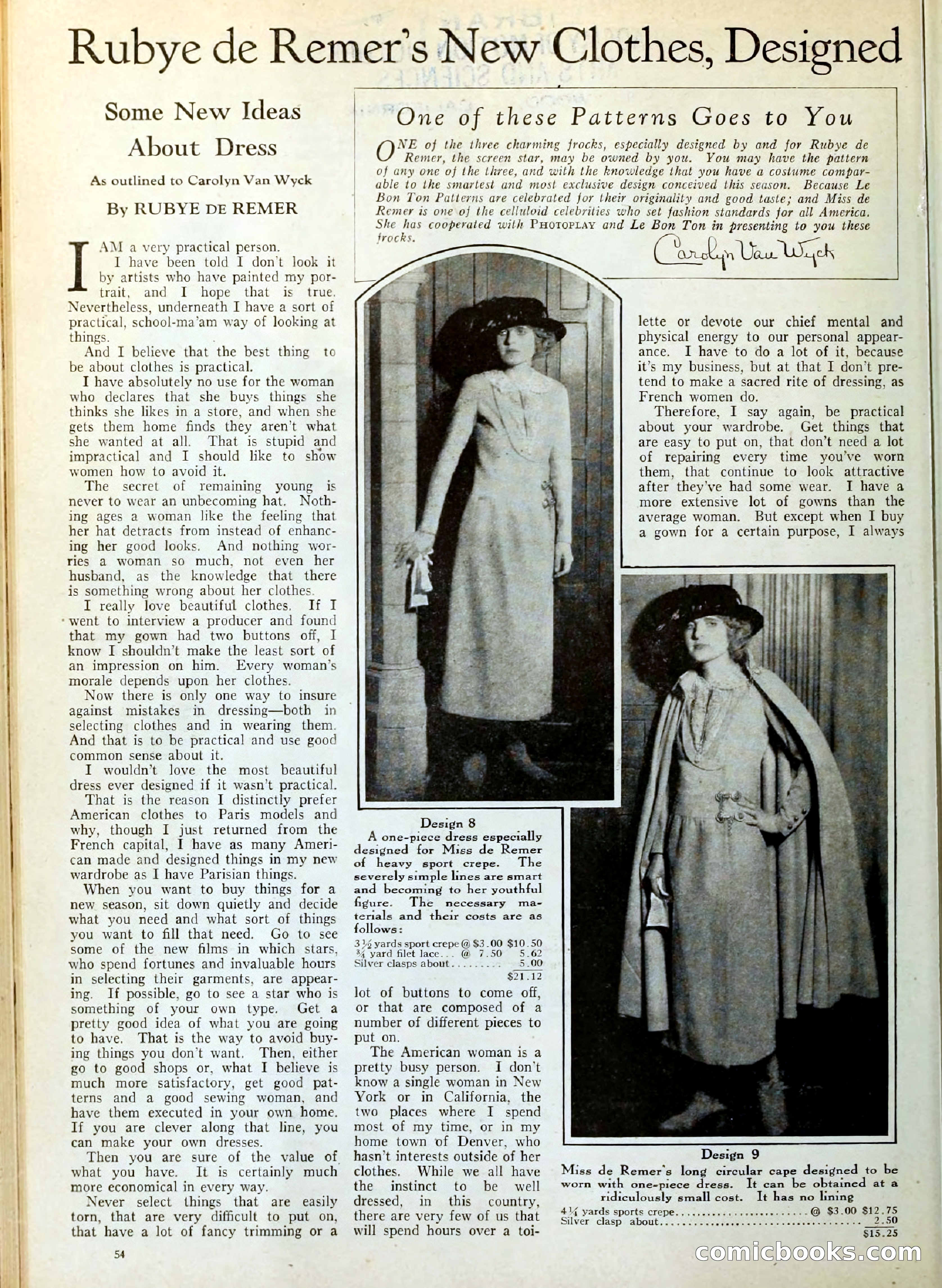
This is an interior magazine page featuring an article by Rubye de Remer about practical dress design. The page includes text discussing wardrobe philosophy and clothing practicality, along with two black-and-white photographs showing women modeling garments. The article is titled "Rubye de Remer's New Clothes, Designed" and includes a section offering one of three dress patterns to readers. Below the photographs are design specifications with material costs listed (approximately $11-15 per garment). The page appears to be from a women's fashion or lifestyle magazine, combining editorial content with a pattern-selling offer.
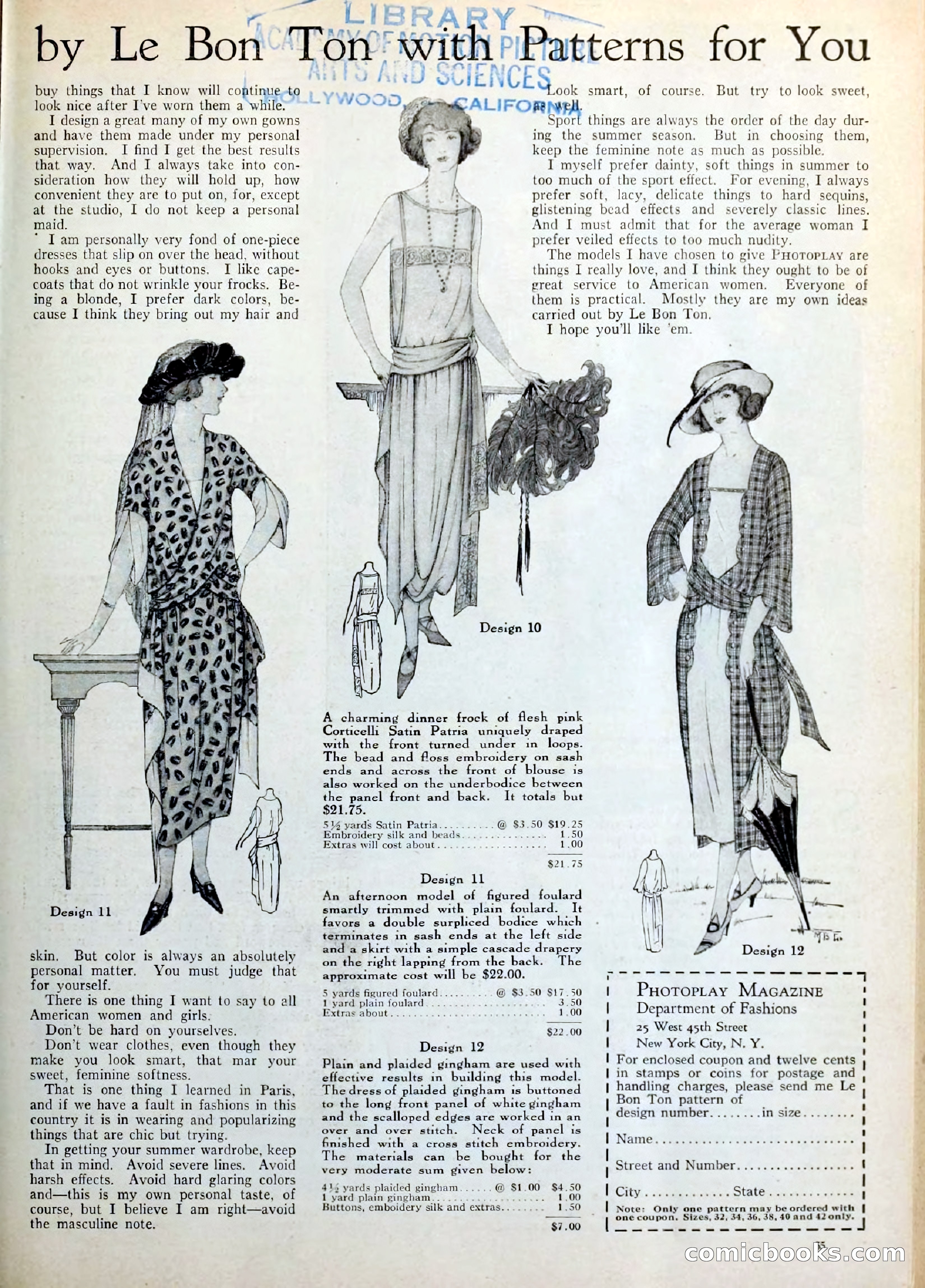
# Page Analysis This is a **fashion page** from *Photoplay Magazine* (Department of Fashions), not a pulp fiction magazine. The page features fashion advice and sewing patterns by "Le Bon Ton," showcasing three illustrated women's dress designs (numbered 10, 12, and 11). The text discusses Le Bon Ton's philosophy on choosing flattering, practical clothing—emphasizing soft, delicate fabrics and colors that suit individual complexions over following harsh trends. The three designs shown are dinner frocks and afternoon wear with detailed descriptions, material specifications, and pricing information ($21.75-$22.00) for pattern purchase. This appears to be an early-20th-century women's fashion advisory column with accompanying sewing patterns.
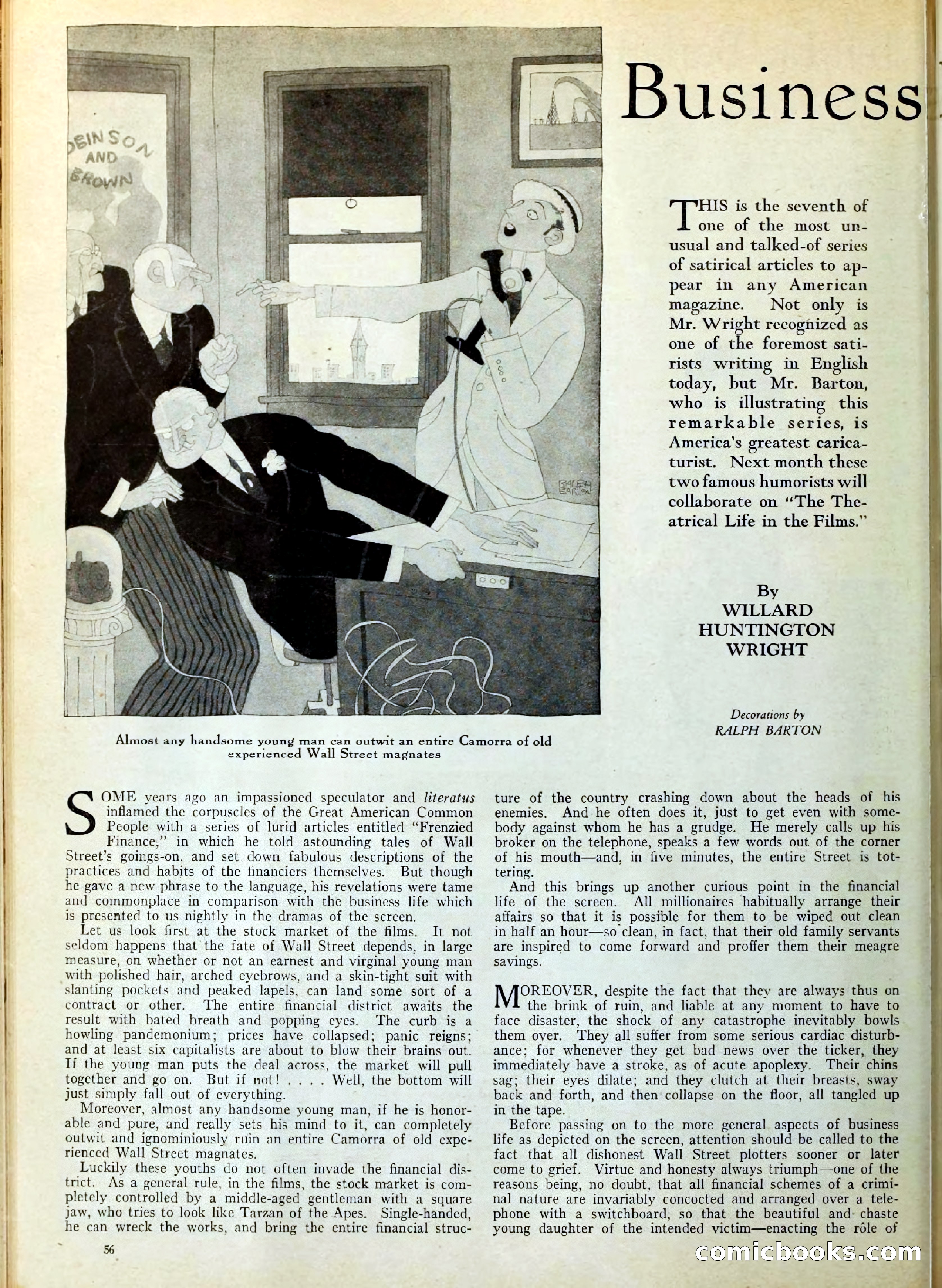
# Business This page contains an illustration and the seventh installment of a satirical article series titled "Business," written by Willard Huntington Wright and decorated by Ralph Barton. The illustration depicts a man in an office setting gesturing expressively while interacting with seated figures, apparently illustrating stock market or financial district activity. The visible text discusses Wall Street finance, stock market speculation, and the habits of financiers in the film industry. It critiques how easily handsome young men can outmaneuver experienced Wall Street operatives, and notes that dishonest Wall Street schemers frequently appear in screen dramas. The article examines how financial plots are depicted in cinema and their relationship to real business practices.
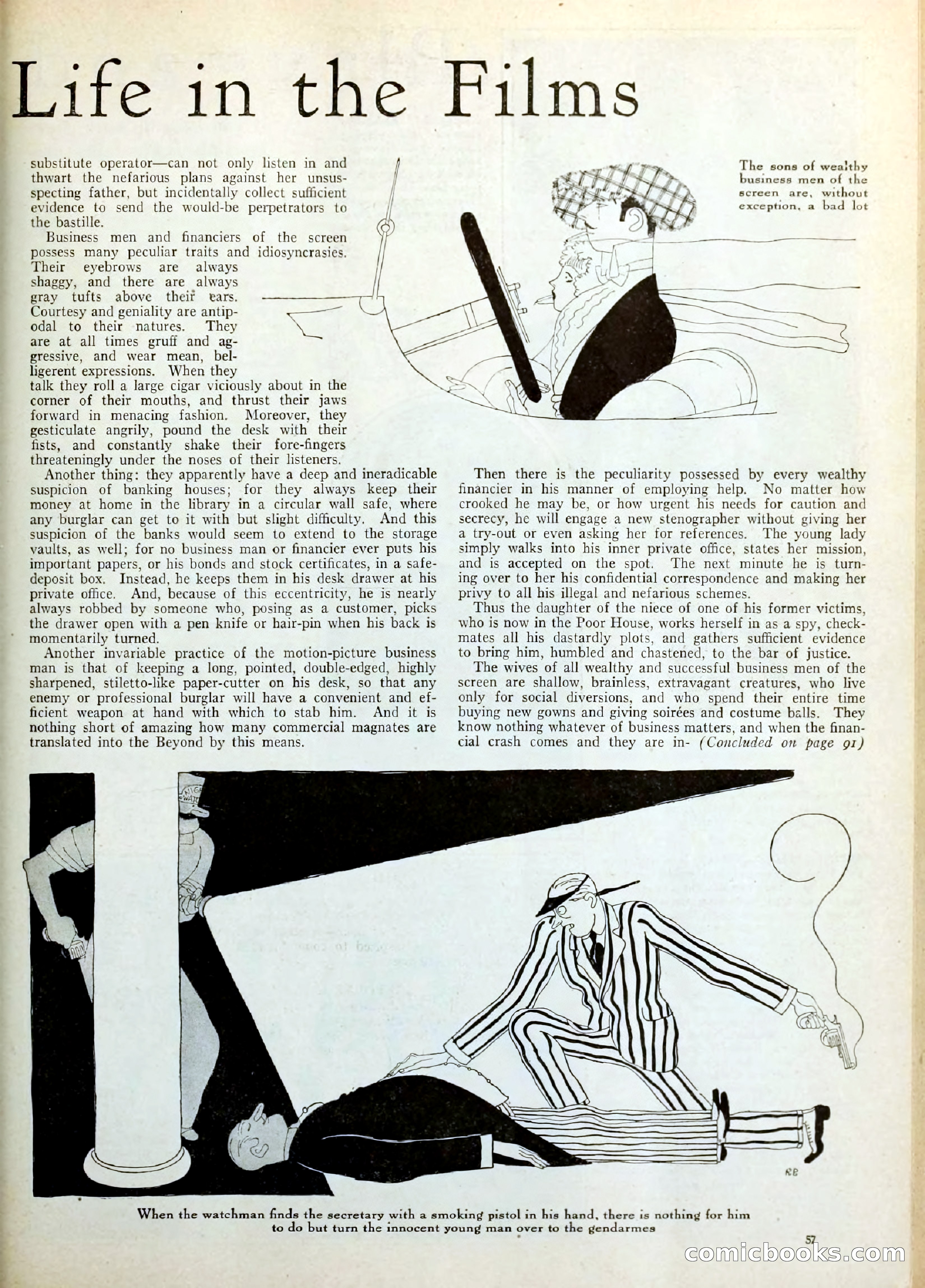
# Life in the Films This is a prose article page with accompanying illustrations satirizing the peculiar characteristics and behavior of wealthy businessmen and financiers in the film industry. The text describes their distinctive mannerisms—their shaggy eyebrows, aggressive demeanor, cigar-smoking habits, and tendency to pound desks and gesture angrily. It also notes their eccentric security practices, such as keeping money in home safes and employing paper-cutters as defensive weapons. The illustrations depict various dramatic scenes involving wealthy film financiers and what appears to be criminal intrigue or espionage. The article appears to be a humorous social commentary on film industry personalities.
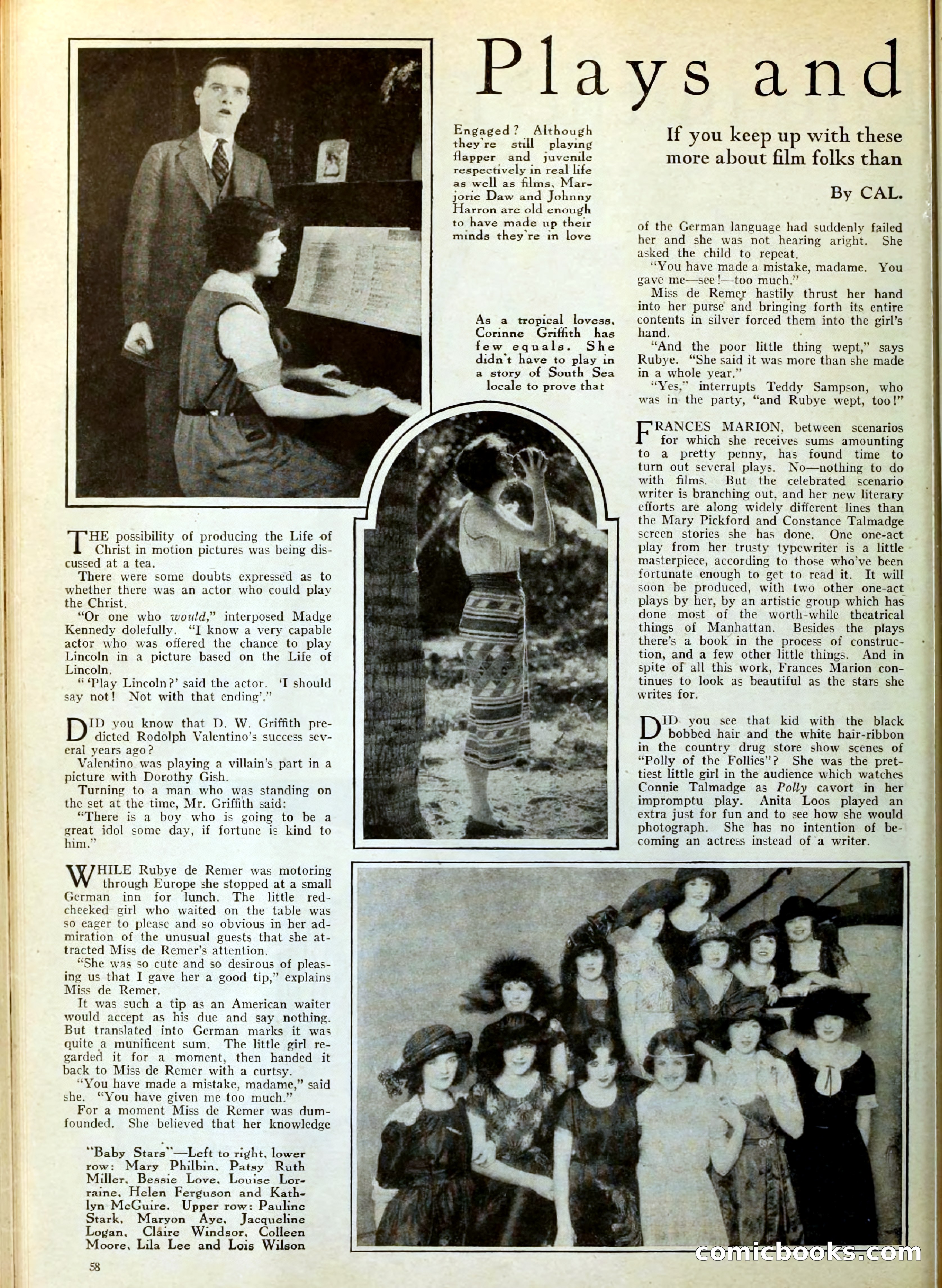
# Page Analysis This is an interior magazine page titled "Plays and" (bylined "By CAL.") that discusses early film and theater productions. The page contains three black-and-white photographs: one showing a man in formal attire holding papers, one circular image of what appears to be a dramatic scene, and one group photograph of women in hats and period costume. The text discusses whether actors from theater could successfully transition to film, mentioning specific performers like Rudolph Valentino, Frances Marion, and Rubye de Remer. It includes anecdotes about casting decisions and production stories, including a narrative about a child actress on a European location shoot. The article appears to be from the early silent film era, comparing theatrical and cinematic performance requirements.
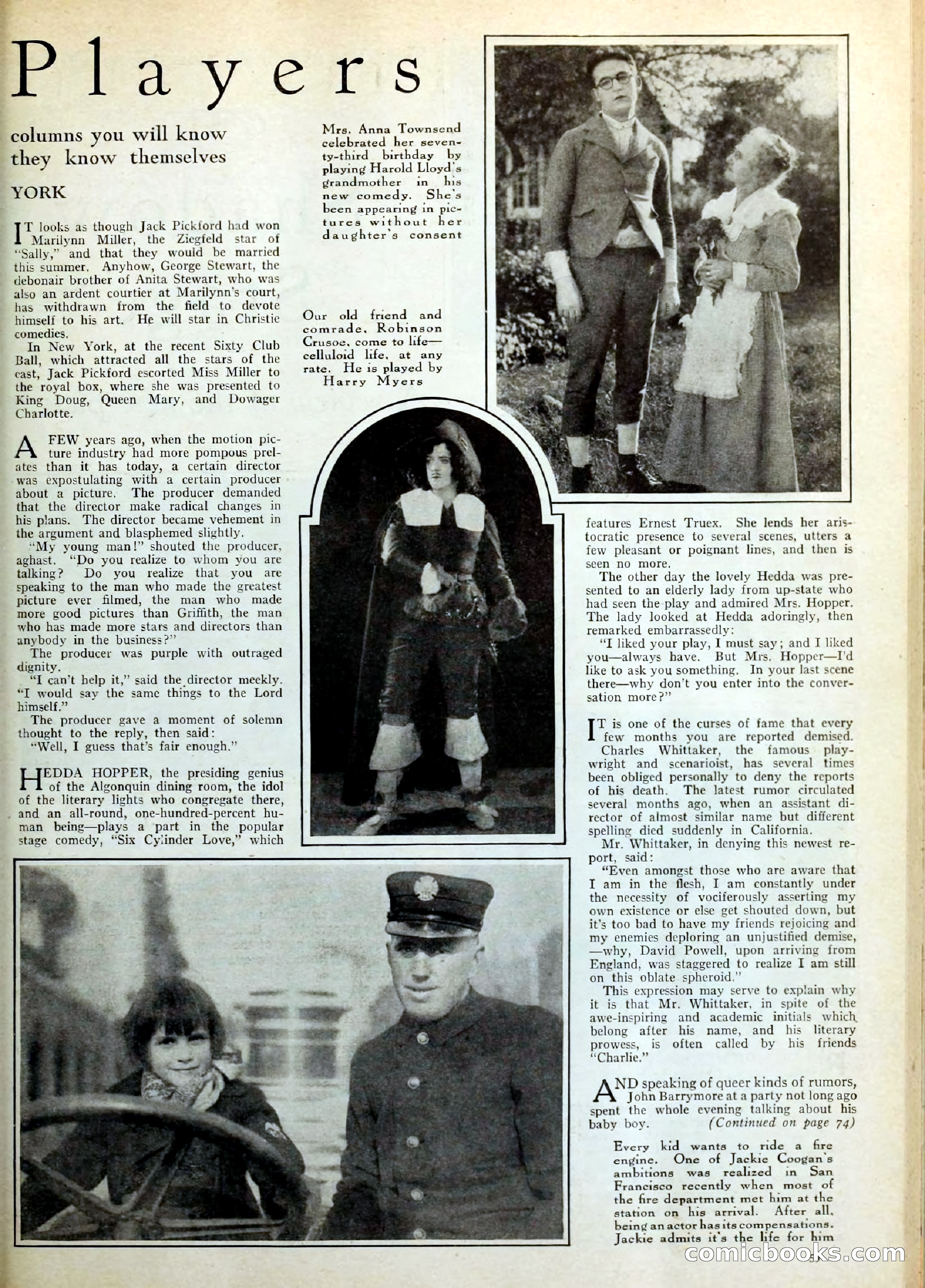
# Page Analysis This is an interior page from a **Players** column featuring entertainment gossip and industry news. The page contains three photographs accompanying text about various actors and theatrical personalities. The visible content discusses Jack Pickford's marriage plans, George Stewart's withdrawal from film to pursue art, and details about actors like Hedda Hopper and Ernest Truex. The text also addresses rumors about Charles Whittaker's death and includes anecdotes about John Barrymore and Jackie Coogan. The column appears focused on Hollywood personalities and behind-the-scenes industry gossip rather than a single narrative story.
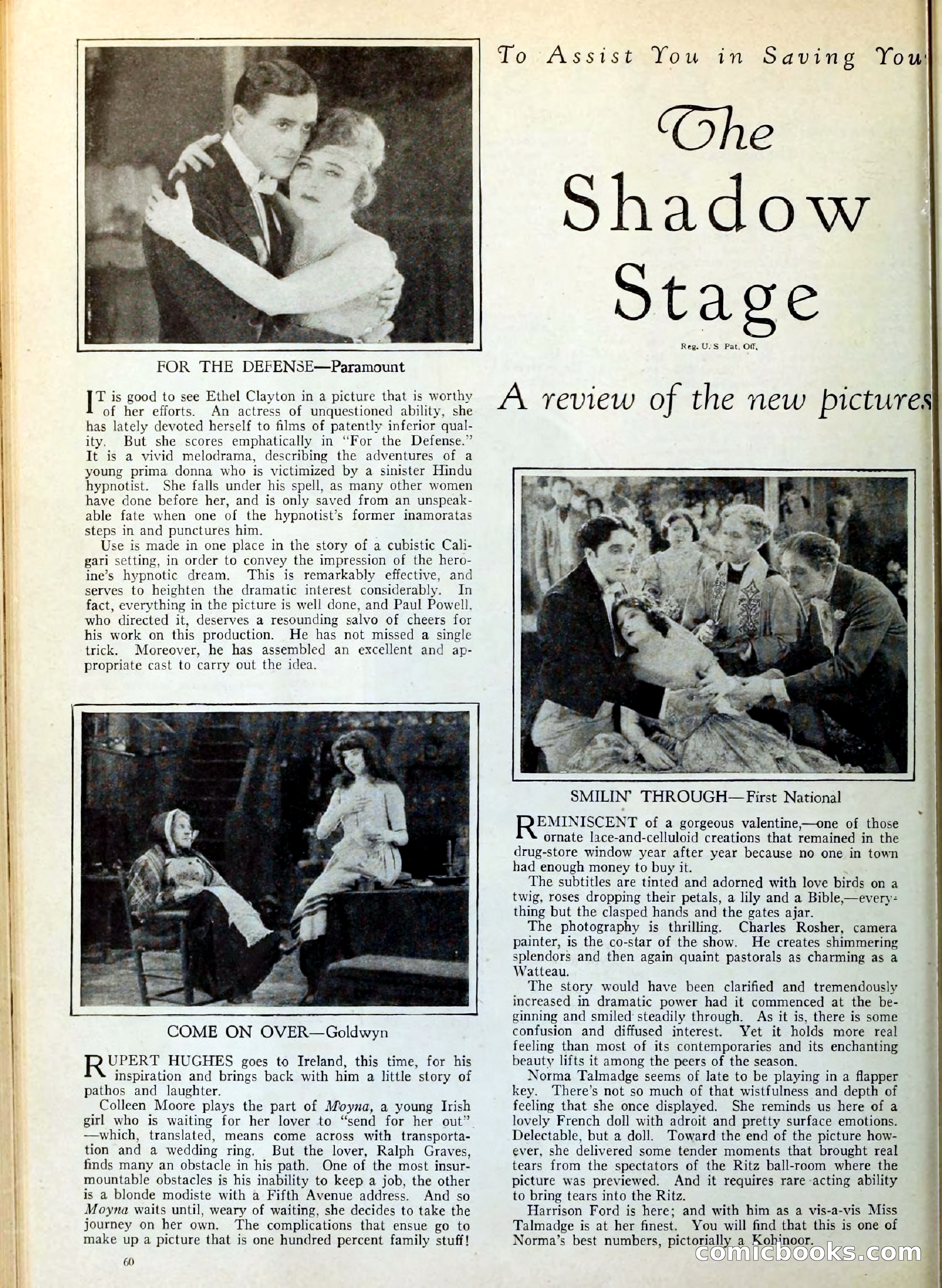
# "The Shadow Stage" - Film Review Page This is a review page from what appears to be an early 20th-century entertainment magazine. It features "The Shadow Stage," a section reviewing new motion pictures. The page contains three black-and-white film stills with accompanying reviews of movies including "For the Defense" (Paramount), "Come on Over" (Goldwyn), and "Smilin' Through" (First National). The reviews discuss plot summaries and production quality, praising elements like director Paul Powell's work and the cinematography. The text emphasizes melodramatic storylines typical of silent-era cinema, including themes of hypnosis, romance, and emotional drama. This appears to be a dedicated film criticism section rather than fiction content.
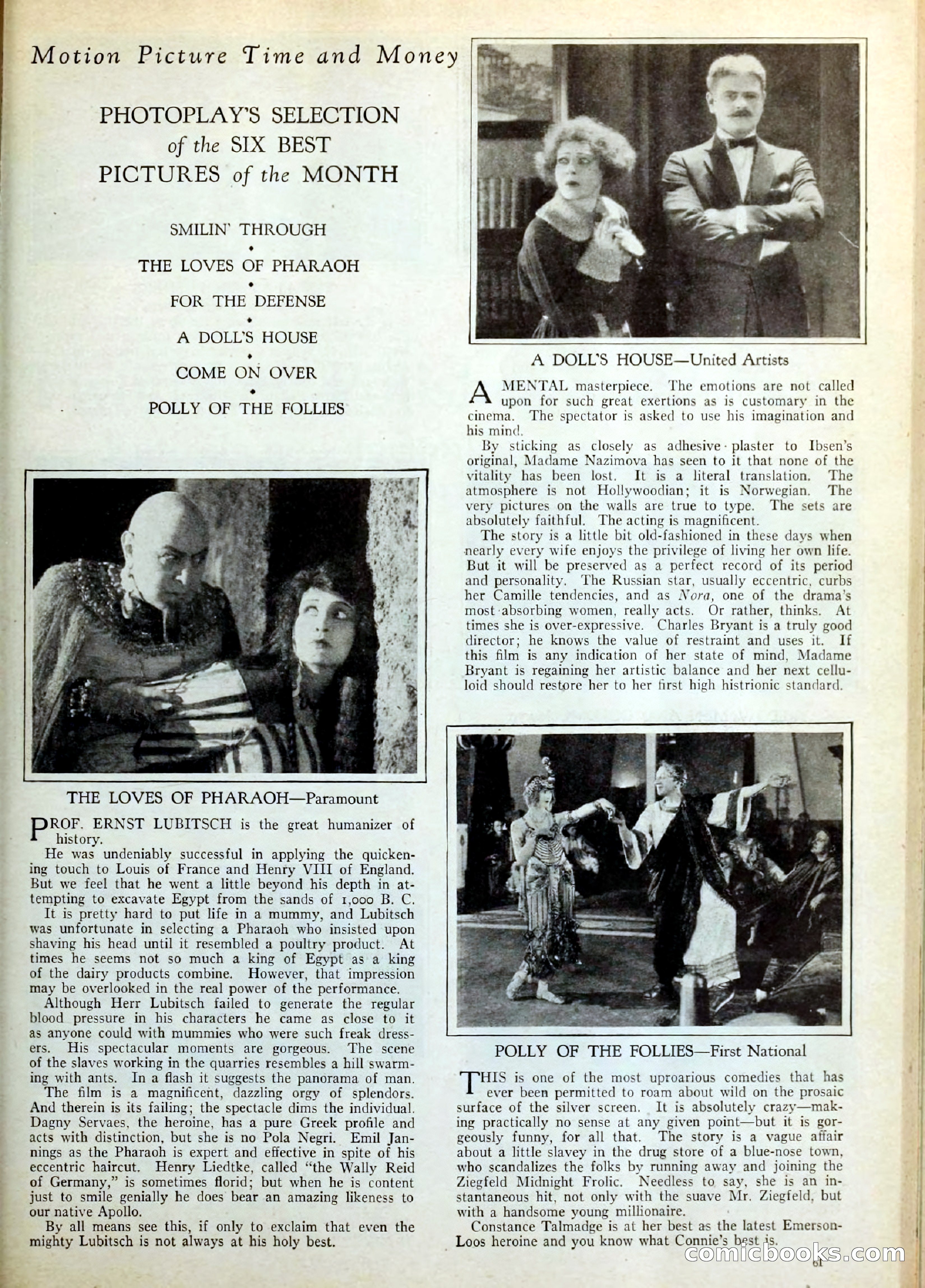
# Page Analysis This is a content page from *Motion Picture Time and Money*, a trade publication reviewing current films. It features Photoplay's selection of six best pictures of the month, with three reviews visible: "A Doll's House" (United Artists), "The Loves of Pharaoh" (Paramount), and "Polly of the Follies" (First National). Each review includes a photograph from the film and critical commentary. The page discusses the films' artistic merit, performances, and production values, addressing an audience of industry professionals interested in cinema's commercial and creative aspects.
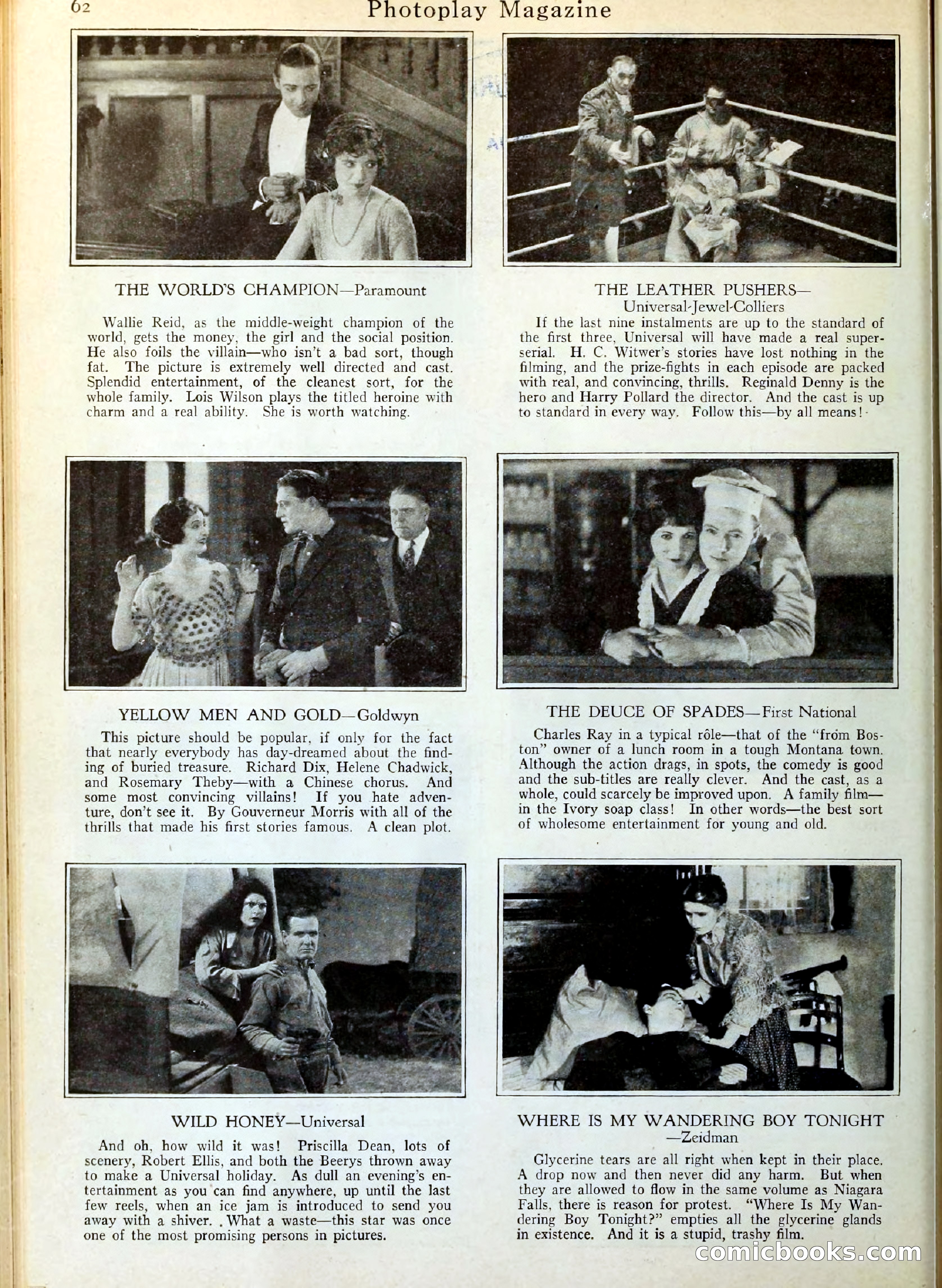
This is page 62 from *Photoplay Magazine*, featuring a grid of six film reviews with still photographs from contemporary motion pictures. The page covers six films: *The World's Champion* (Paramount), *The Leather Pushers* (Universal-Jewel-Colliers), *Yellow Men and Gold* (Goldwyn), *The Deuce of Spades* (First National), *Wild Honey* (Universal), and *Where Is My Wandering Boy Tonight* (Zeidman). Each review includes a still photograph and brief critical commentary about the film's plot, cast, and entertainment value. The reviews are generally positive, describing the films as suitable family entertainment or highlighting particular actors' performances.
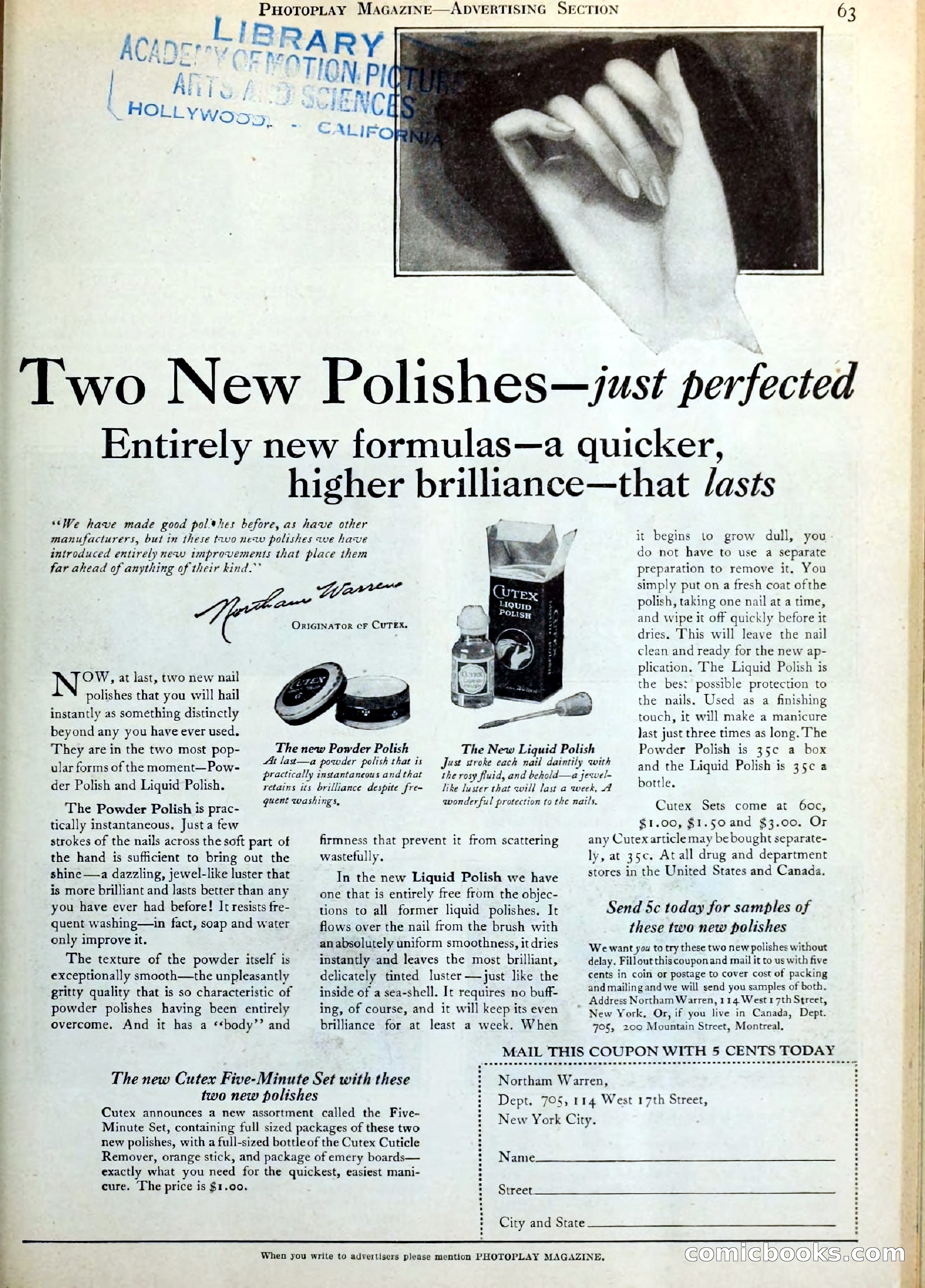
This is an advertising page from *Photoplay Magazine*'s advertising section (page 63). The ad promotes two new nail polishes manufactured by Cutex: a Powder Polish and a Liquid Polish. The page features a photograph of a woman's hand displaying the polishes' effects, along with product images and detailed descriptions of their formulations and benefits. The ad emphasizes that these are "entirely new" formulas offering superior shine and durability compared to existing products. A mail-in coupon is included at the bottom allowing readers to send five cents for samples of both polishes. The ad includes pricing information and notes that products are available at drug and department stores throughout the United States and Canada.
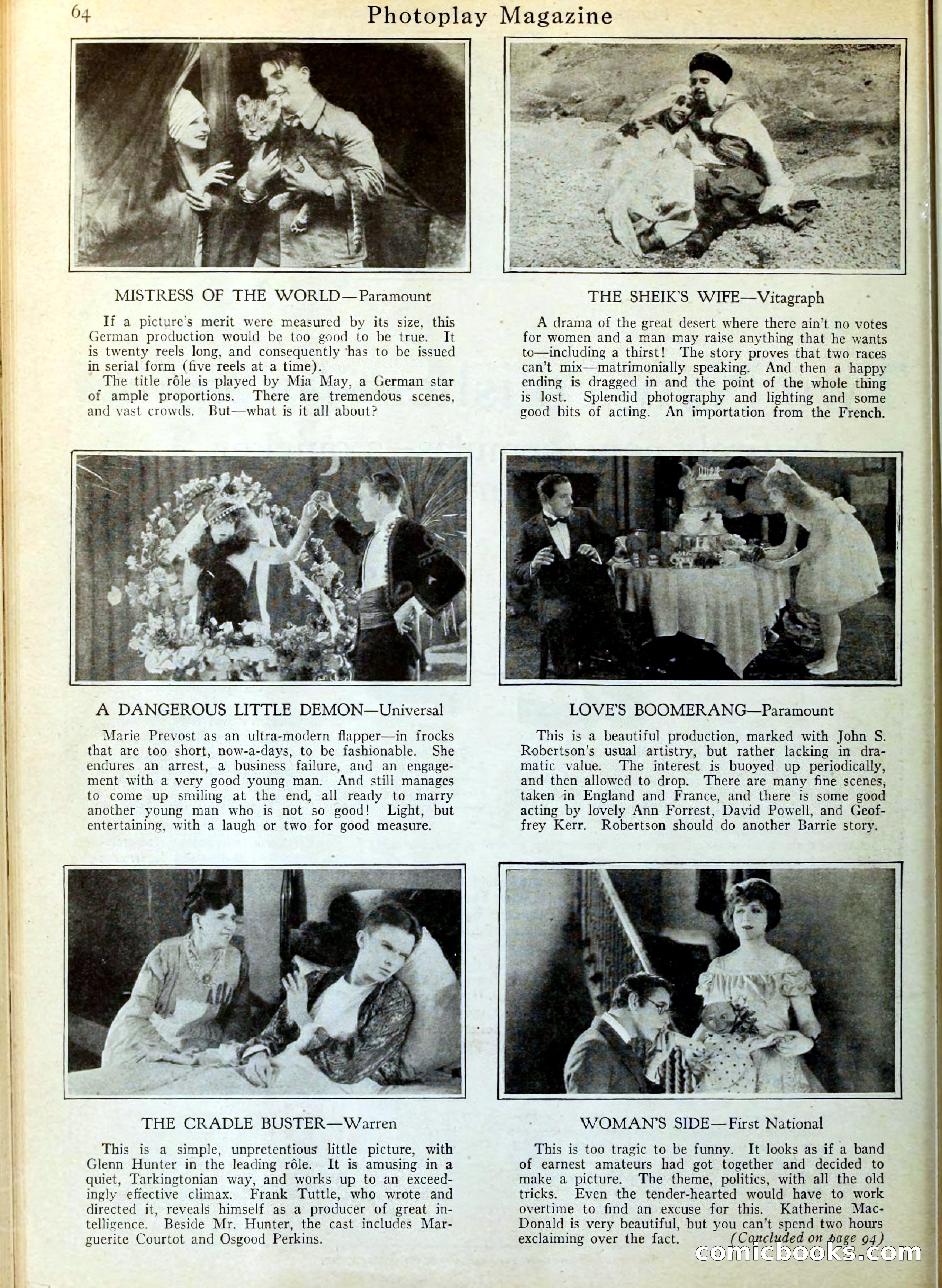
# Photoplay Magazine, Page 64 This page contains six film stills with accompanying review text for six different motion pictures from various studios (Paramount, Vitagraph, Universal, Warren, and First National). Each still shows a scene from the film, with a caption identifying the title and studio, followed by a brief critical review. The reviews discuss plot summaries and performances—including commentary on Marie Prevost as a "flapper," John S. Robertson's direction, and actors like Ann Forrest and David Powell. The page appears to be a film review section, evaluating contemporary silent-era movies for readers interested in cinema. The tone is conversational and evaluative rather than promotional.
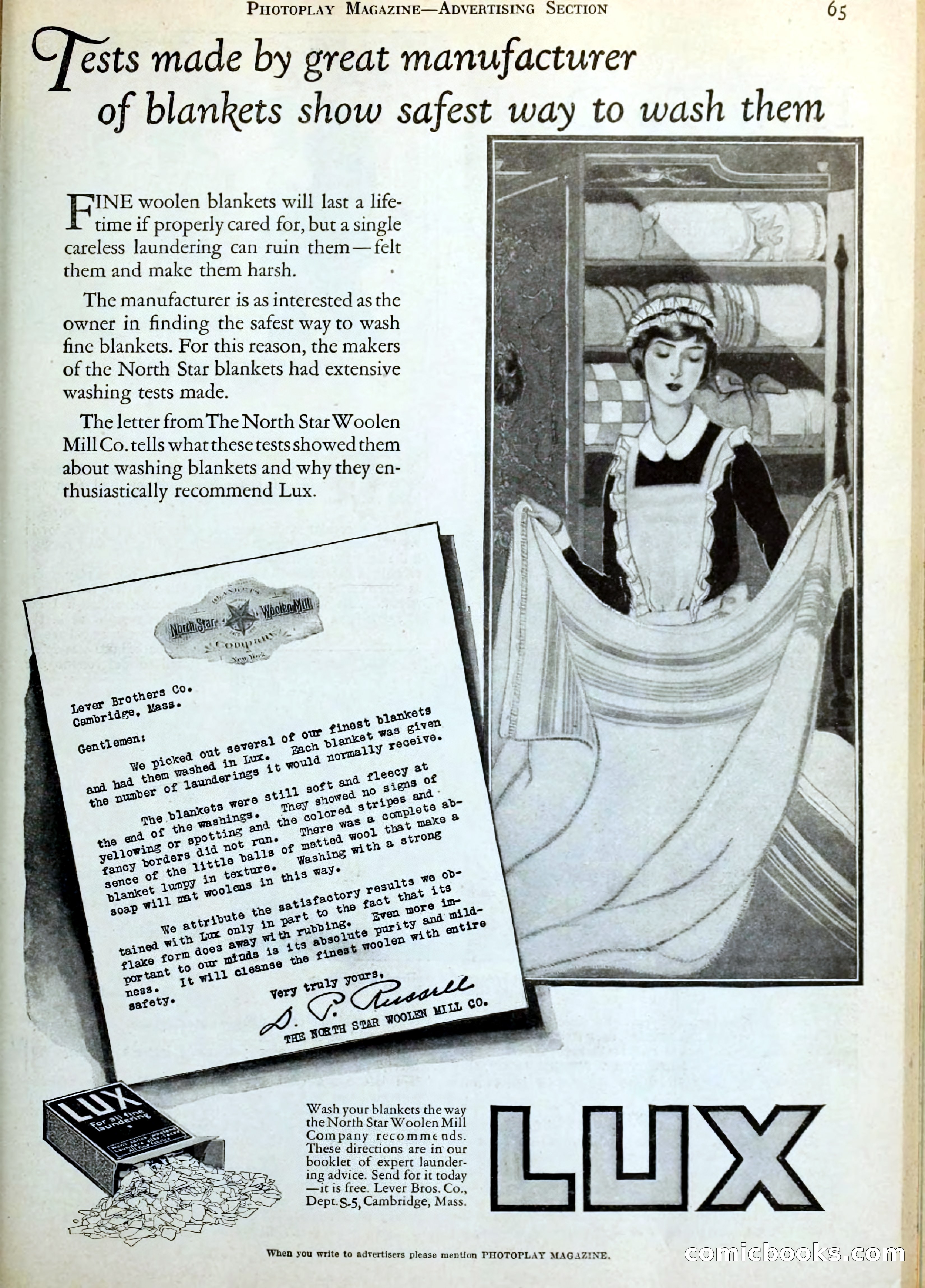
This is an advertising page from *Photoplay Magazine*'s advertising section. The page promotes Lux soap flakes through an endorsement from the North Star Woolen Mill Company. A letter from the manufacturer claims that testing showed Lux is the safest way to wash fine woolen blankets, preventing felting and harsh texture. The advertisement includes a photograph of a woman in an apron holding a blanket, alongside the letter and a product image of Lux soap flakes. The ad directs readers to request a free booklet on laundering advice from Lever Brothers Company in Cambridge, Massachusetts.
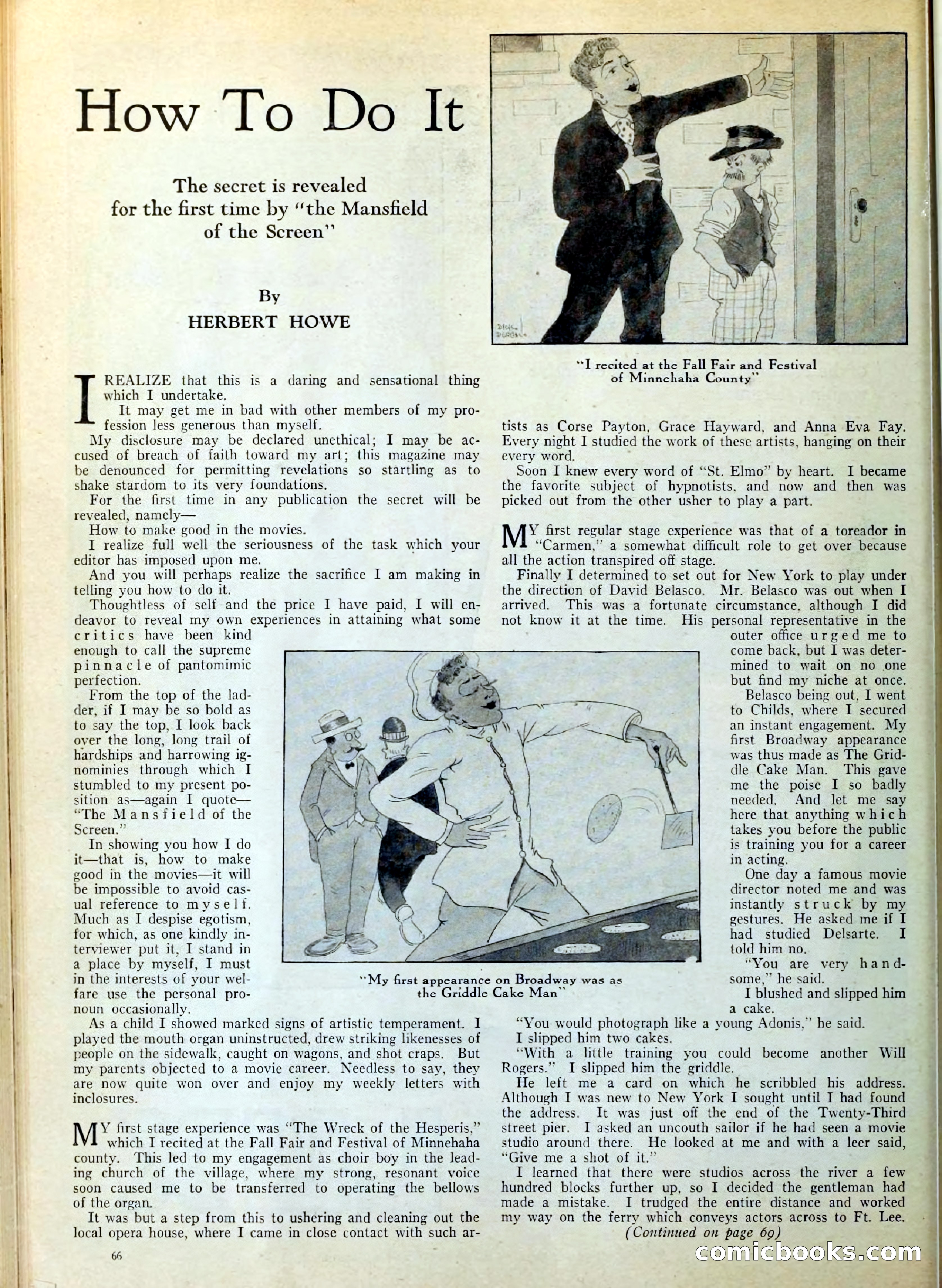
# Page Content Description This is an interior story page from a pulp magazine featuring an article titled "How To Do It" by Herbert Howe. The article appears to be a first-person account about breaking into the film industry and achieving success in movies. Two illustrations accompany the text: one showing what appears to be a tall man pointing at a shorter man in formal attire, and another sketch depicting figures in casual poses. The prose describes the author's early stage experiences, including performing in "The Wreck of the Hesperis" at a county fair and his eventual transition to Broadway and film work. The article discusses encounters with notable figures and advice about pursuing an acting career in early cinema.
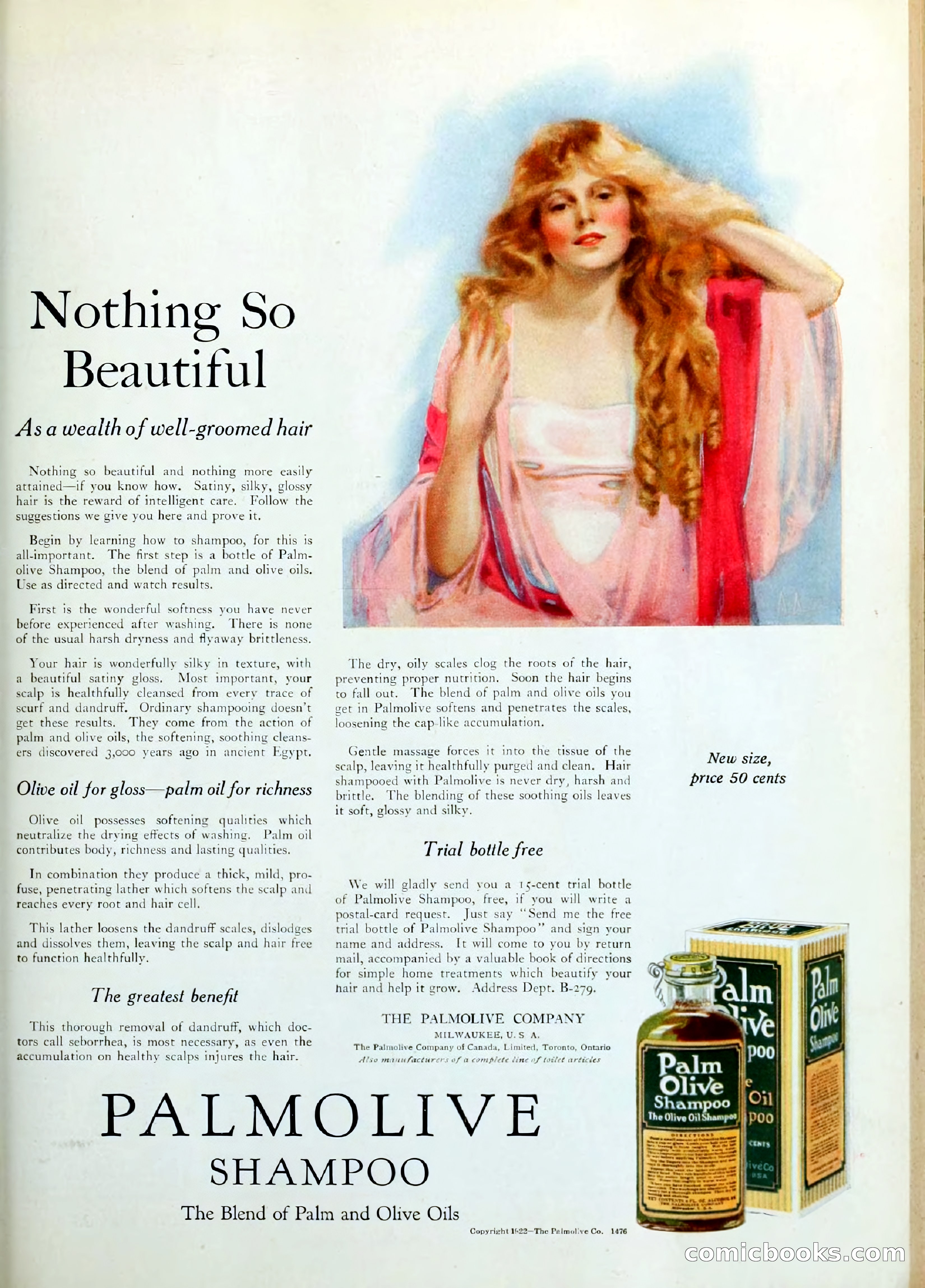
# Palmolive Shampoo Advertisement This is a full-page advertisement, not fiction content. It promotes Palmolive Shampoo, described as "The Blend of Palm and Olive Oils." The page features an illustration of a woman with long, wavy reddish-blonde hair wearing a pink garment. The ad emphasizes hair care benefits, claiming the product removes dandruff and provides softness and gloss. Text explains how palm and olive oils work together to cleanse the scalp and promote healthy hair. The advertisement offers a free 15-cent trial bottle to interested readers who request it by postcard. The Palmolive Company, with offices in Milwaukee, Wisconsin and Toronto, Ontario, is identified as the manufacturer.
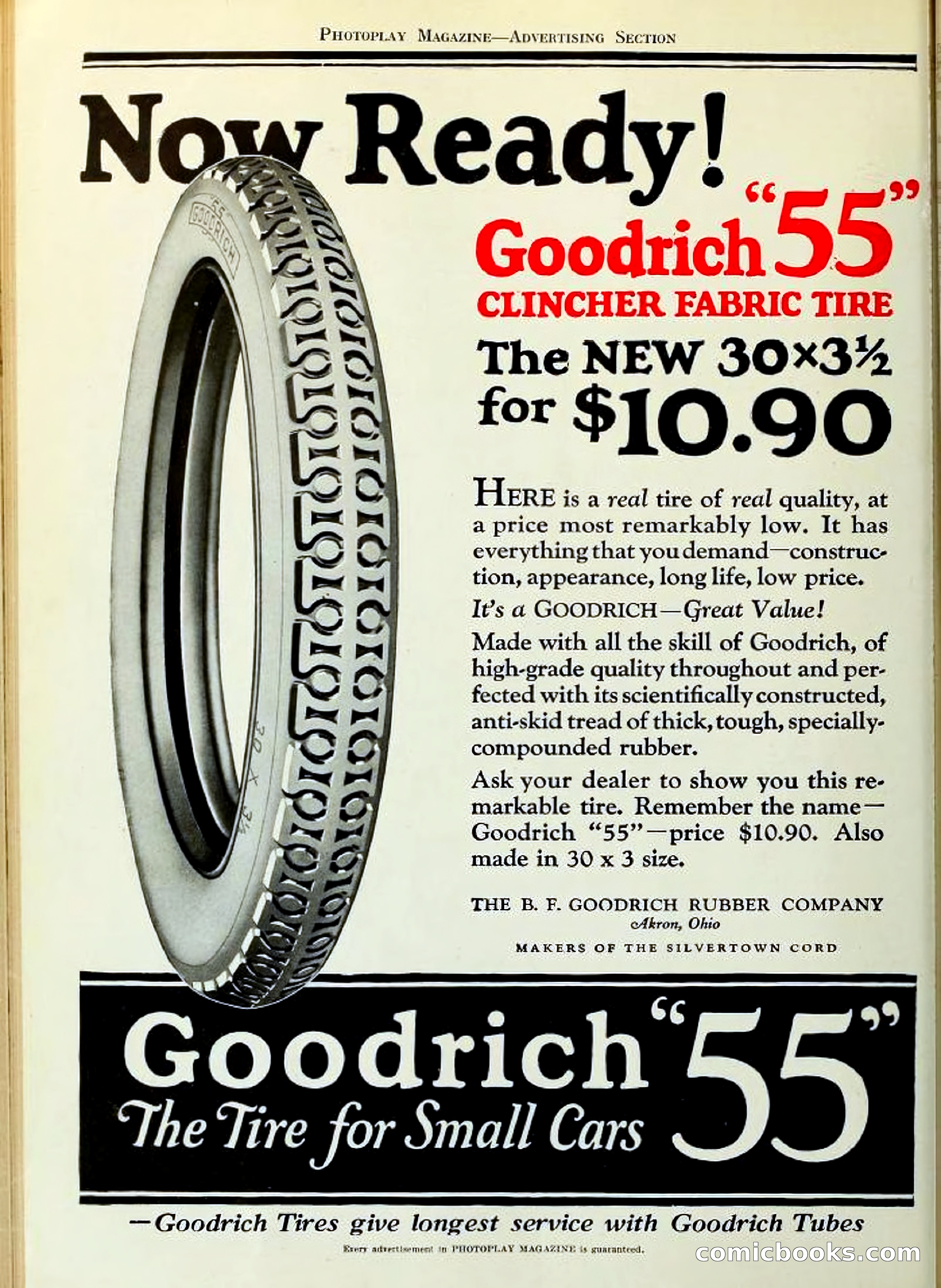
# Description This is an **advertising page** from *Photoplay Magazine's* advertising section. It features a full-page advertisement for the Goodrich "55" Clincher Fabric Tire, a new 30×3½-inch automobile tire priced at $10.90. The ad includes a large photograph of the tire on the left side and descriptive text on the right, emphasizing the tire's quality, durability, and value. The manufacturer, The B. F. Goodrich Rubber Company of Akron, Ohio, is identified at the bottom. A tagline at the foot notes that "Goodrich Tires give longest service with Goodrich Tubes."
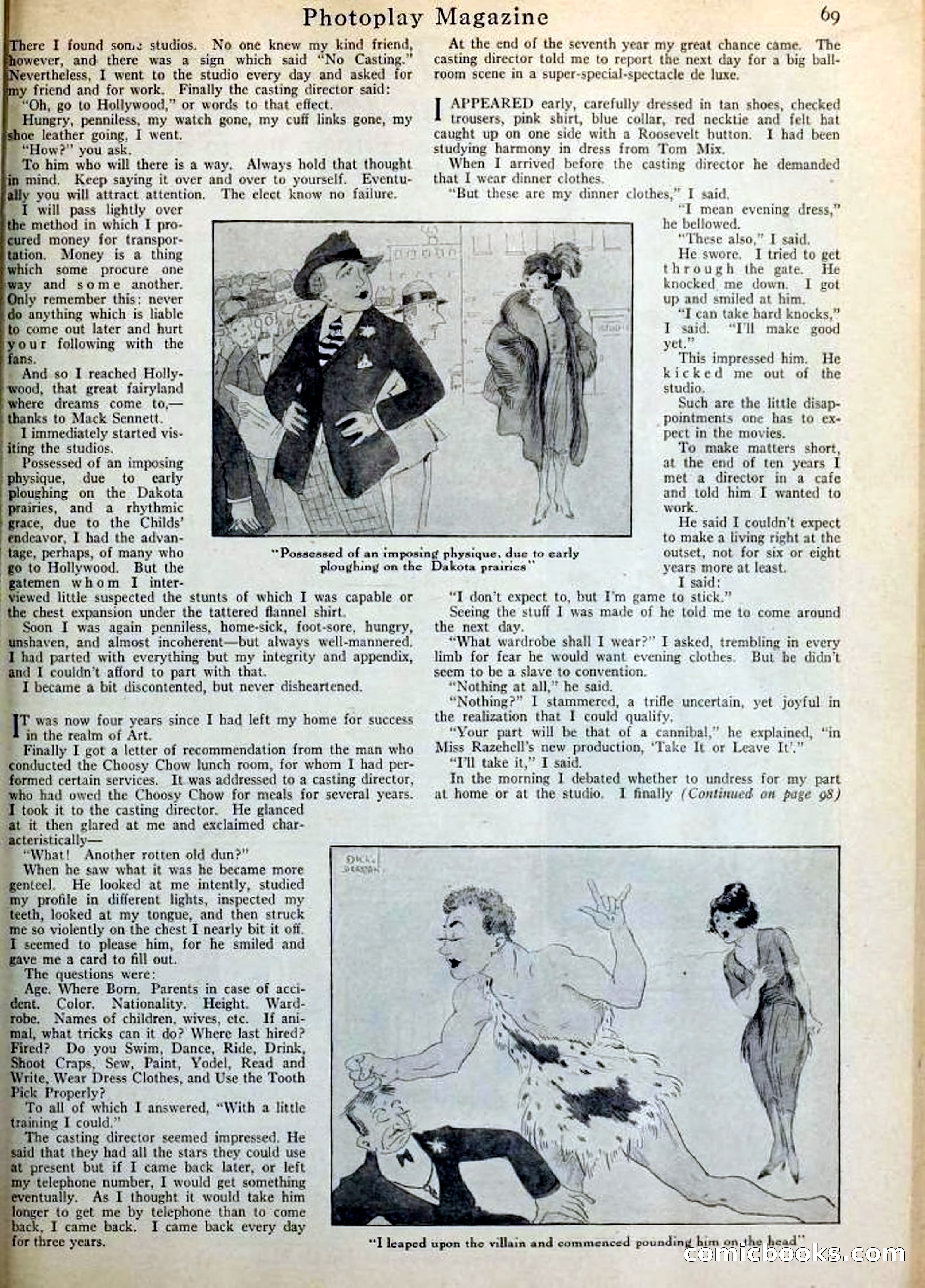
# Analysis of Photoplay Magazine Page 69 This is a story page from *Photoplay Magazine* featuring prose narrative with two illustrations. The text describes an aspiring actor's early experiences in Hollywood, including a humiliating audition where a casting director insults his appearance and dismisses him, later offering a minor role as a "cannibal." The narrative includes dialogue about wardrobe concerns and the protagonist's determination to persist despite setbacks. The two illustrations show: (1) a fashionably dressed man in a hat and coat, captioned regarding his "imposing physique"; and (2) a scene labeled "I leaped upon the villain and commenced pounding him on the head," depicting physical conflict. The page focuses on the protagonist's early career struggles in the film industry.
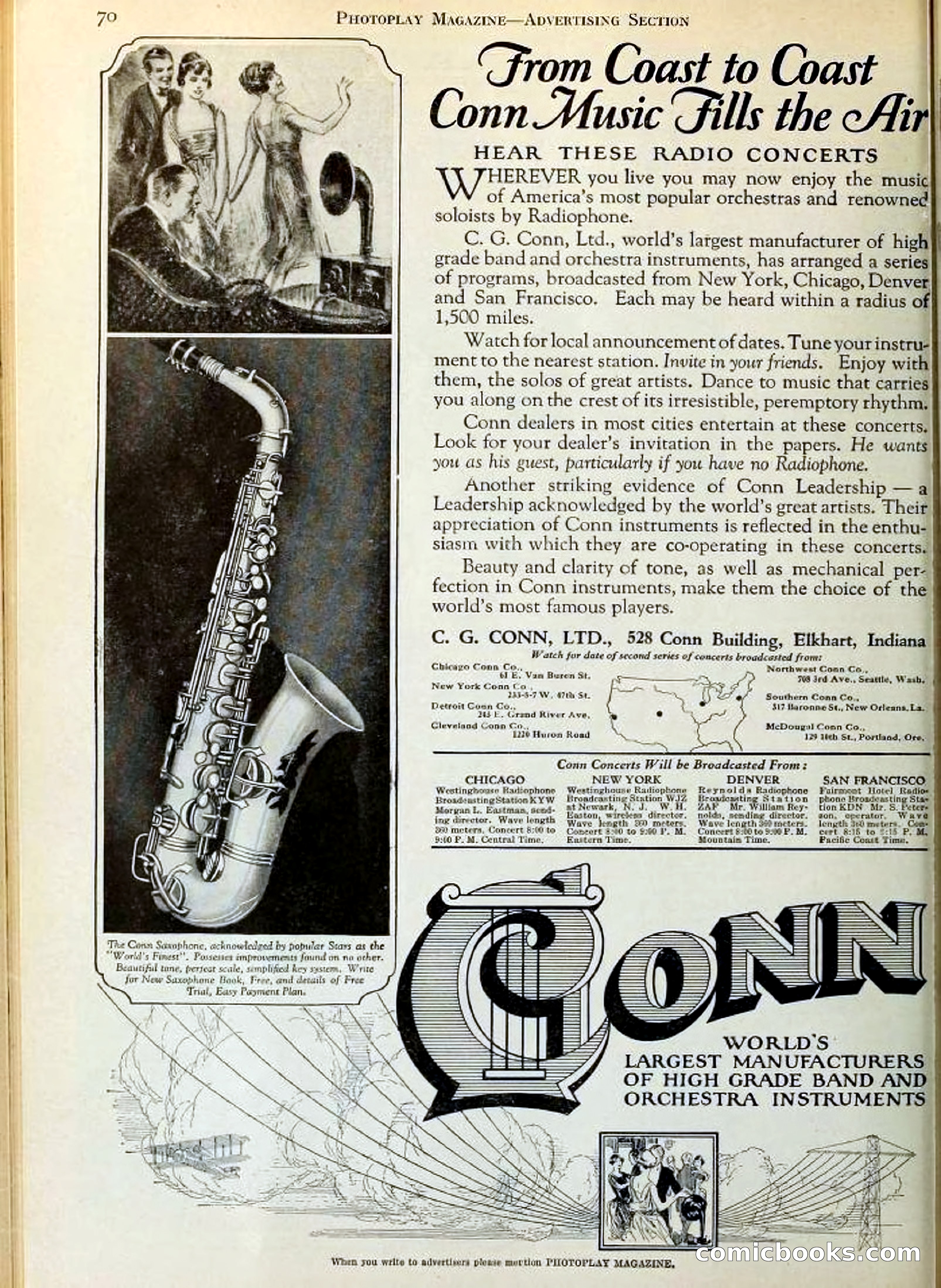
# Page 70: Photoplay Magazine Advertising Section This is an advertisement page featuring C.G. Conn, Ltd., a musical instrument manufacturer. The page promotes Conn's sponsorship of a series of radio concerts broadcast from New York, Chicago, Denver, and San Francisco. The advertisement includes an illustration of a Conn saxophone and images of people enjoying music via radio. The text emphasizes the quality and popularity of Conn instruments among professional musicians and claims they are "the world's largest manufacturers of high grade band and orchestra instruments." The page lists broadcast locations and stations where the concerts will air, along with the company's headquarters address in Elkhart, Indiana.
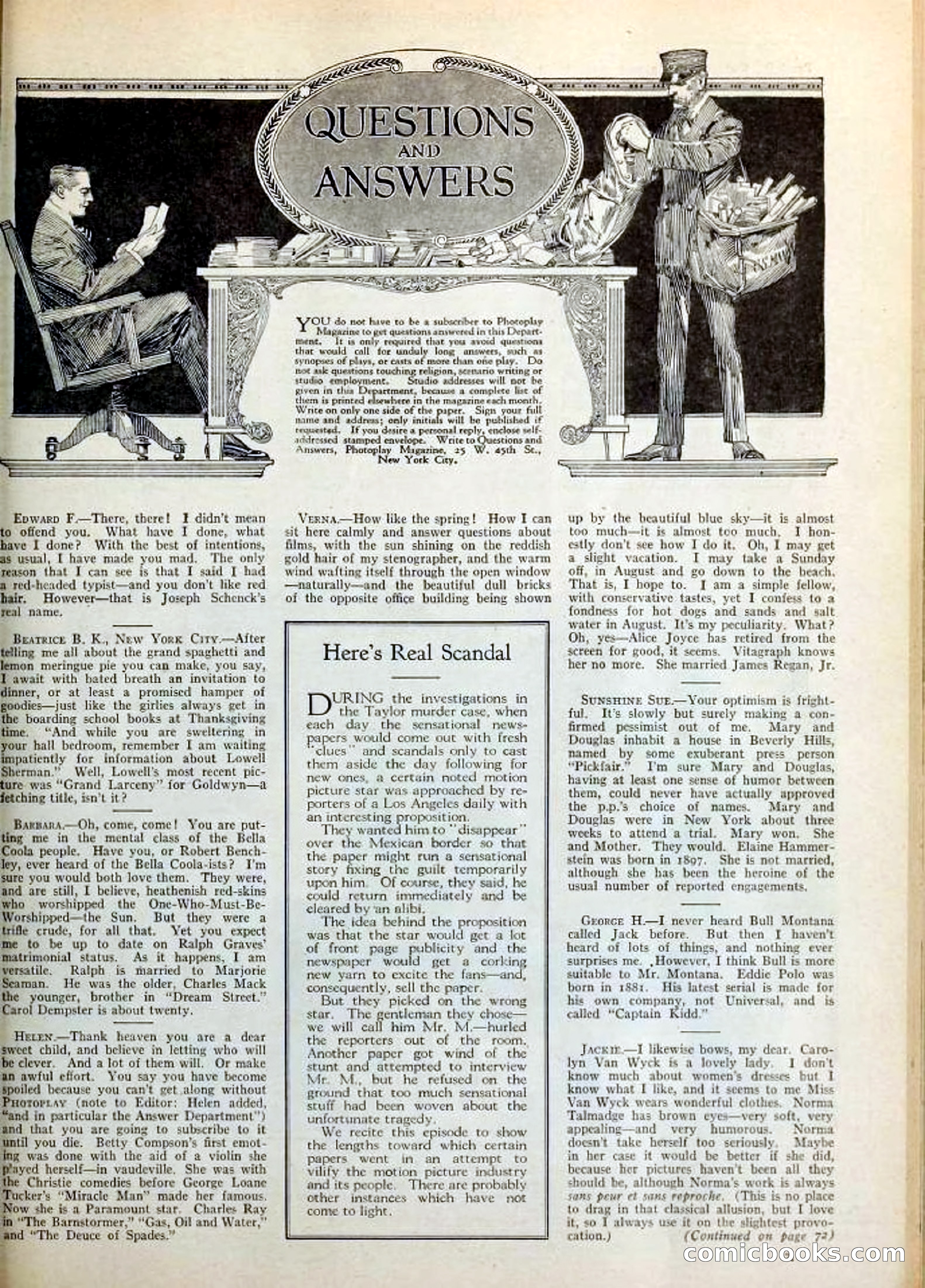
# Page Content Description This is an interior page from *Photoplay Magazine* featuring a "Questions and Answers" advice column. The page displays decorative illustrations of a man reading at left and a woman in classical dress at right, framing the column header. The visible text consists of reader letters and responses addressing various topics, including gossip about Hollywood figures and film stars. One section titled "Here's Real Scandal" discusses investigations and alleged misconduct involving unnamed entertainment industry figures and studios. The responses address personal advice, film industry rumors, and clarifications about various actors and their projects. This appears to be an entertainment magazine's reader advice section rather than fiction content.
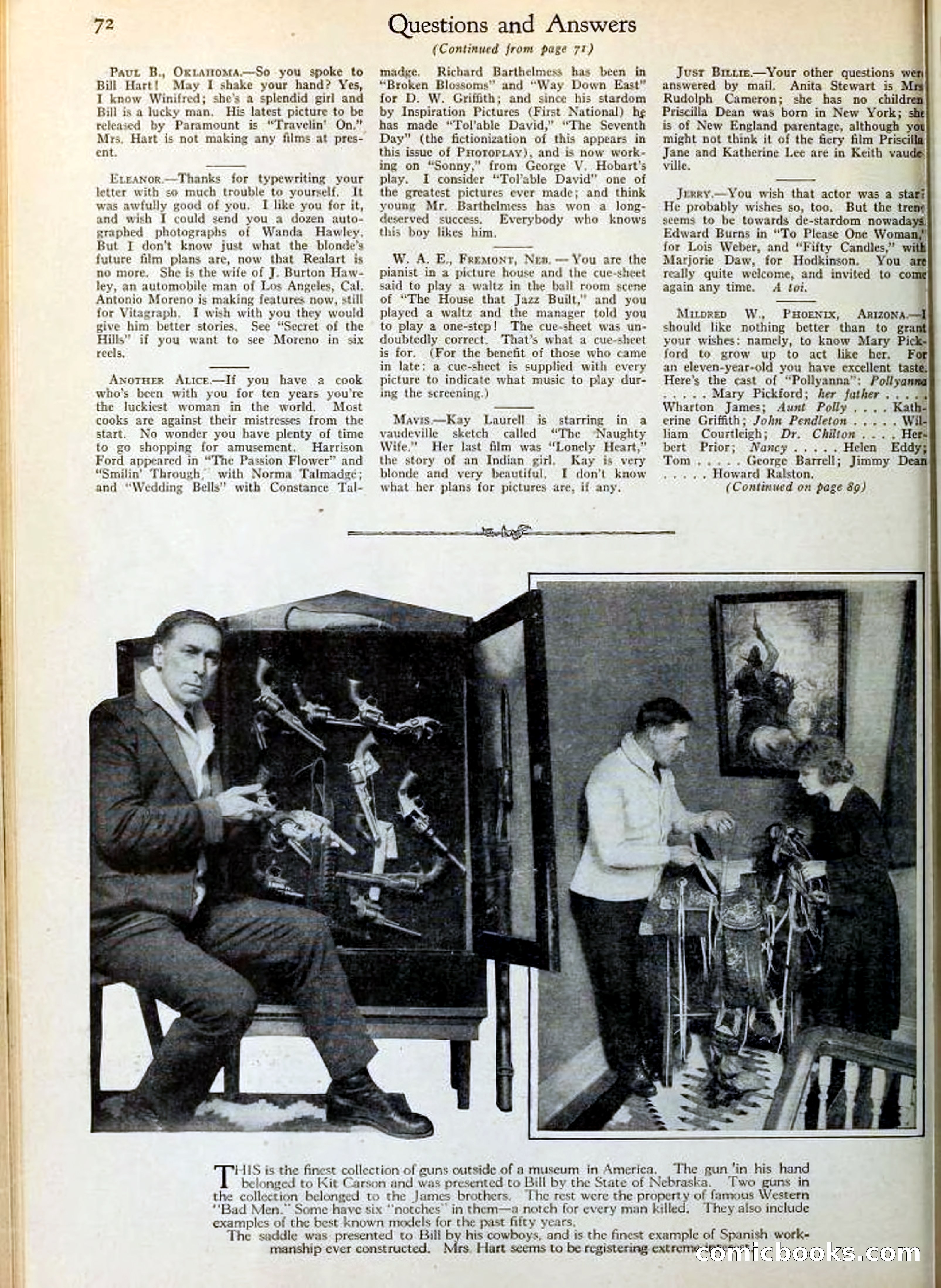
# Page Description This is a text and photo page from an early 20th-century pulp magazine's "Questions and Answers" section (page 72). The upper half contains reader correspondence addressing various film industry figures and questions about movies and actors. The lower half features two black-and-white photographs showing what appears to be Bill Hart's collection of firearms and Western memorabilia, including guns allegedly belonging to Kit Carson and the James brothers, plus a saddle described as "the finest example of Spanish workmanship ever constructed." The caption emphasizes these as historically significant Western artifacts.
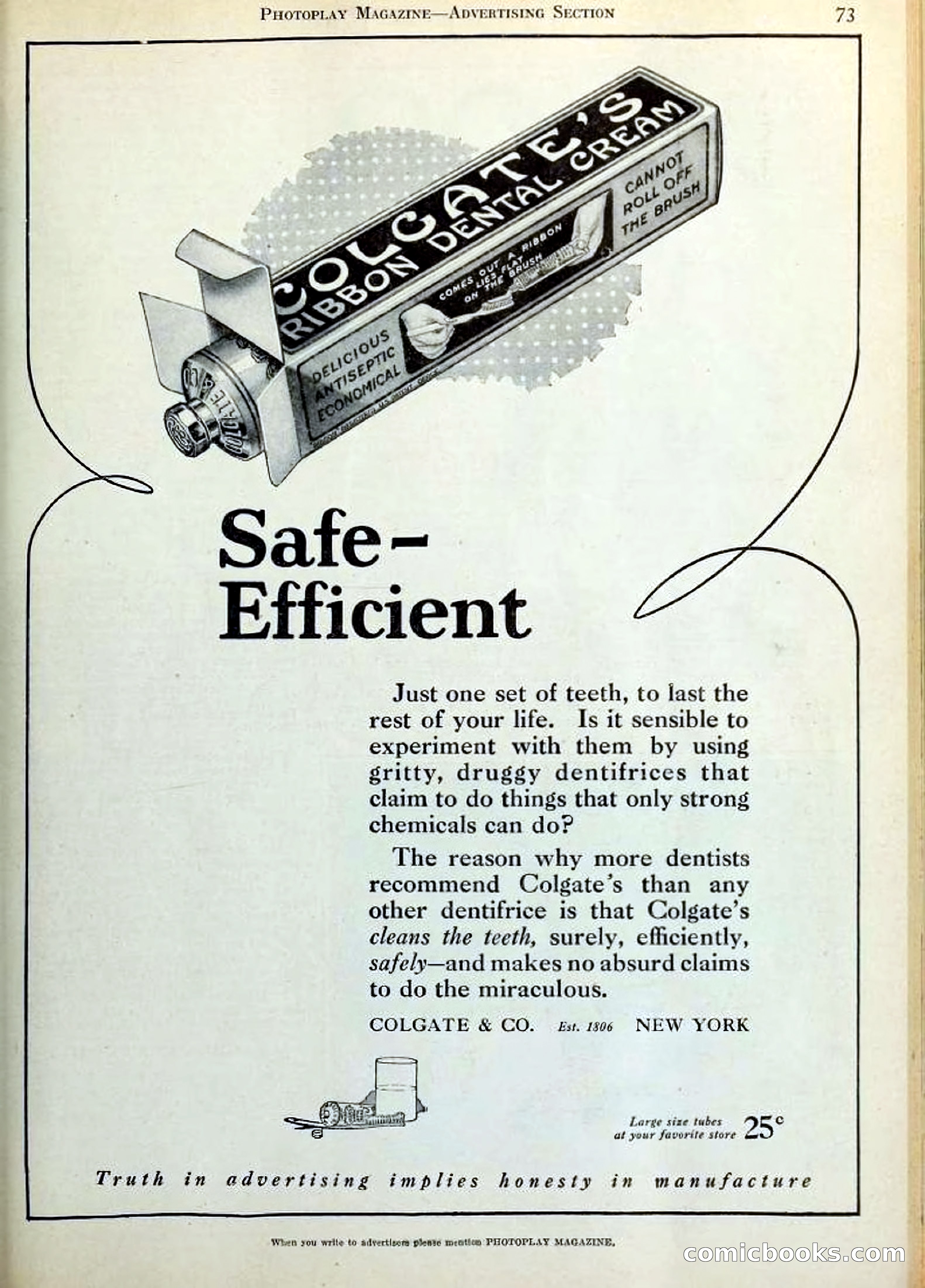
# Page Description This is an advertising page from *Photoplay Magazine*'s advertising section (page 73). It features a full-page advertisement for Colgate's Ribbon Dental Cream toothpaste, displaying an illustration of the product tube with its distinctive dispenser. The ad's headline reads "Safe-Efficient" and the copy argues that dentists recommend Colgate's more than competing brands because it cleans teeth "surely, efficiently, safely" without making exaggerated claims about miraculous results. The advertisement emphasizes practical efficacy over dramatic promises, positioning the product as a sensible choice for dental care. Large-size tubes were available at 25 cents.
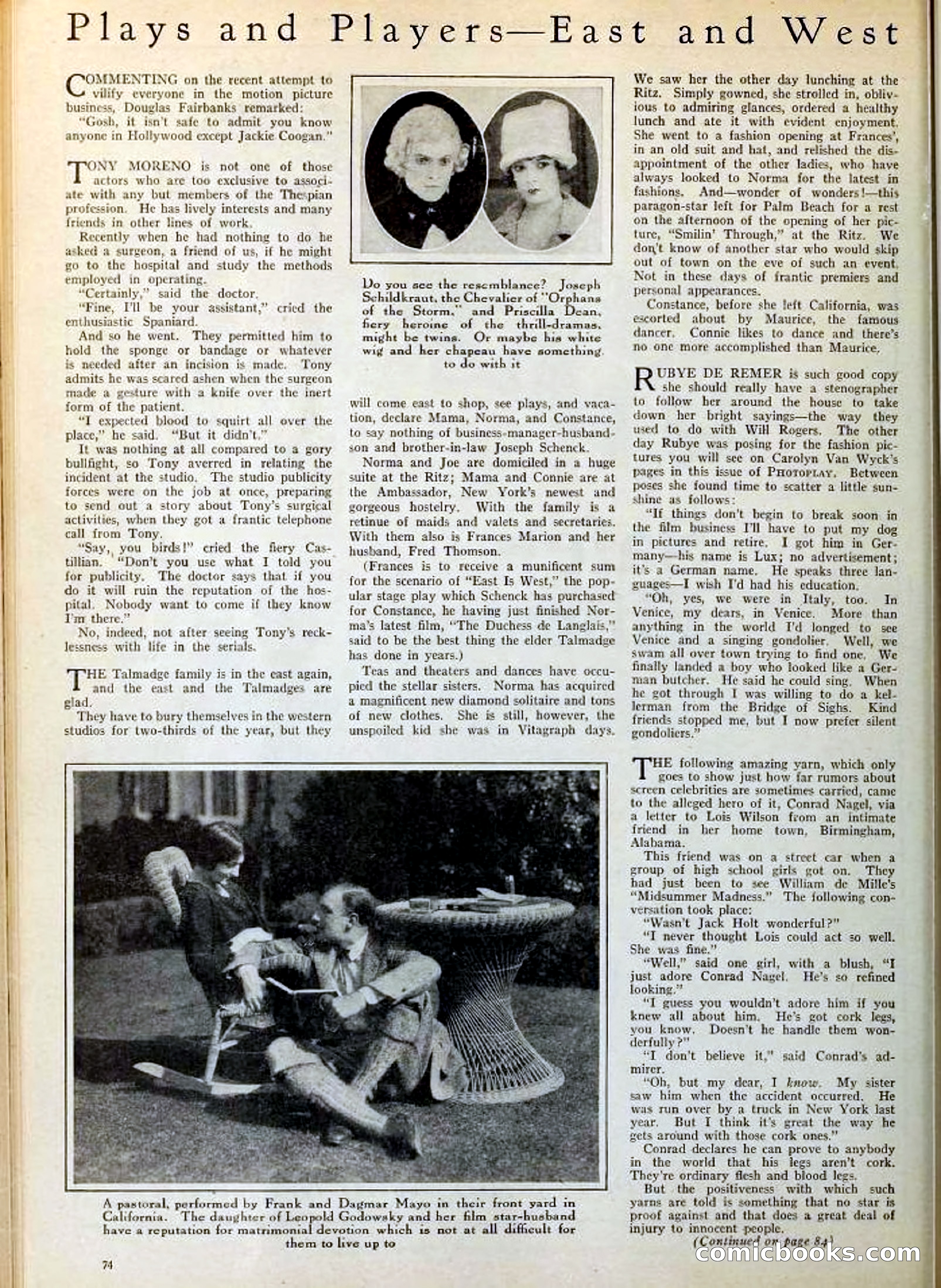
# "Plays and Players—East and West" This is a prose article page from an early 20th-century pulp magazine, featuring gossip and commentary about stage and film personalities. The page includes two photographs: portrait headshots of what appear to be actors (with a caption asking if readers see a resemblance between Joseph Schildkraut and Priscilla Dean), and a larger photograph showing what the caption identifies as "a pastoral" scene performed by Frank and Dagmar Mayo in their California front yard. The text discusses various theater productions, actors' personal lives, and includes anecdotes about Hollywood celebrities, including an extended story about rumors concerning Conrad Nagel.
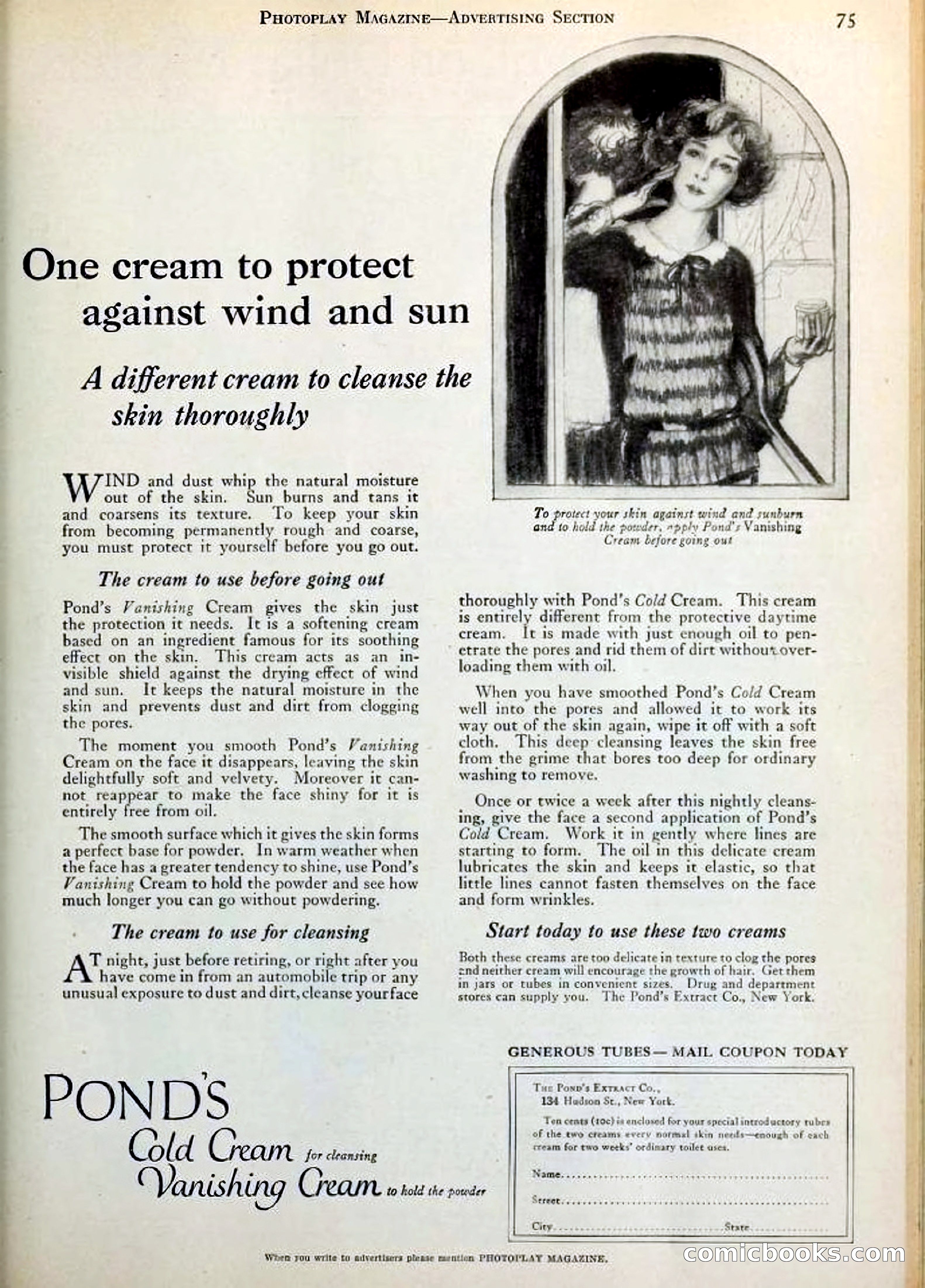
# Pond's Cold Cream and Vanishing Cream Advertisement This is an advertising page from *Photoplay Magazine*'s advertising section (page 75). The full-page advertisement promotes two Pond's skincare products: Cold Cream for cleansing and Vanishing Cream for daytime protection. The ad features a black-and-white illustration of a woman at a window and explains how each cream serves a different skincare purpose—one to protect against wind and sun, the other to cleanse thoroughly. A mail coupon at the bottom offers introductory tubes of both products for ten cents. The advertisement emphasizes the creams' ability to maintain skin texture and prevent wrinkles.
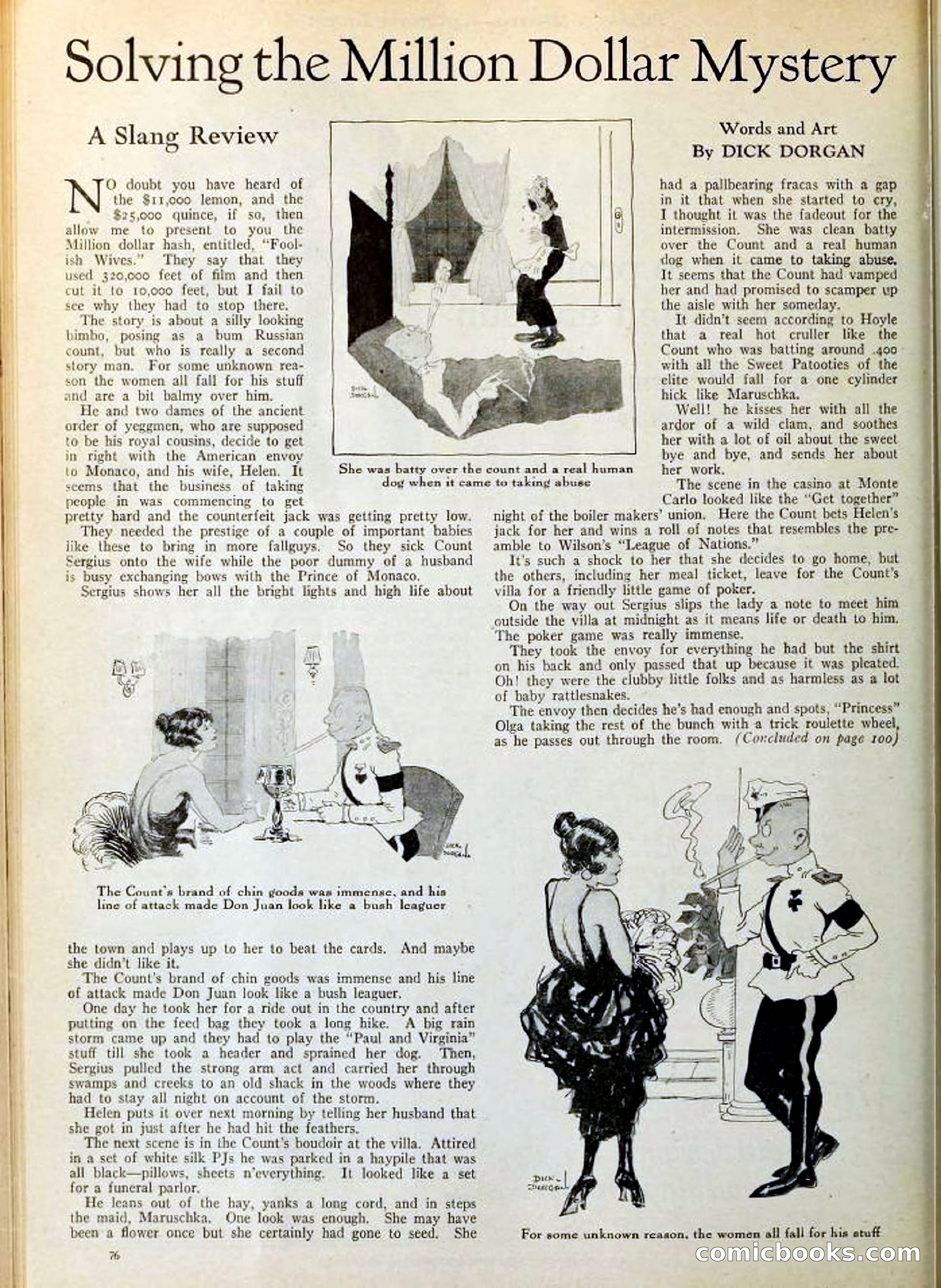
# Page Content Analysis This is an interior story page featuring prose fiction with accompanying illustrations. The article, titled "Solving the Million Dollar Mystery: A Slang Review," presents a serialized narrative about a con artist posing as a Russian count who schemes to swindle wealthy women. The story involves a female protagonist named Helen, romantic entanglements, and various deceptions at a villa. Three black-and-white illustrations by Dick Dorgan accompany the text, depicting scenes from the narrative including characters at leisure and a confrontation. The page appears mid-story, with a note indicating the narrative concludes elsewhere. The writing style and subject matter are consistent with early-20th-century pulp fiction conventions.
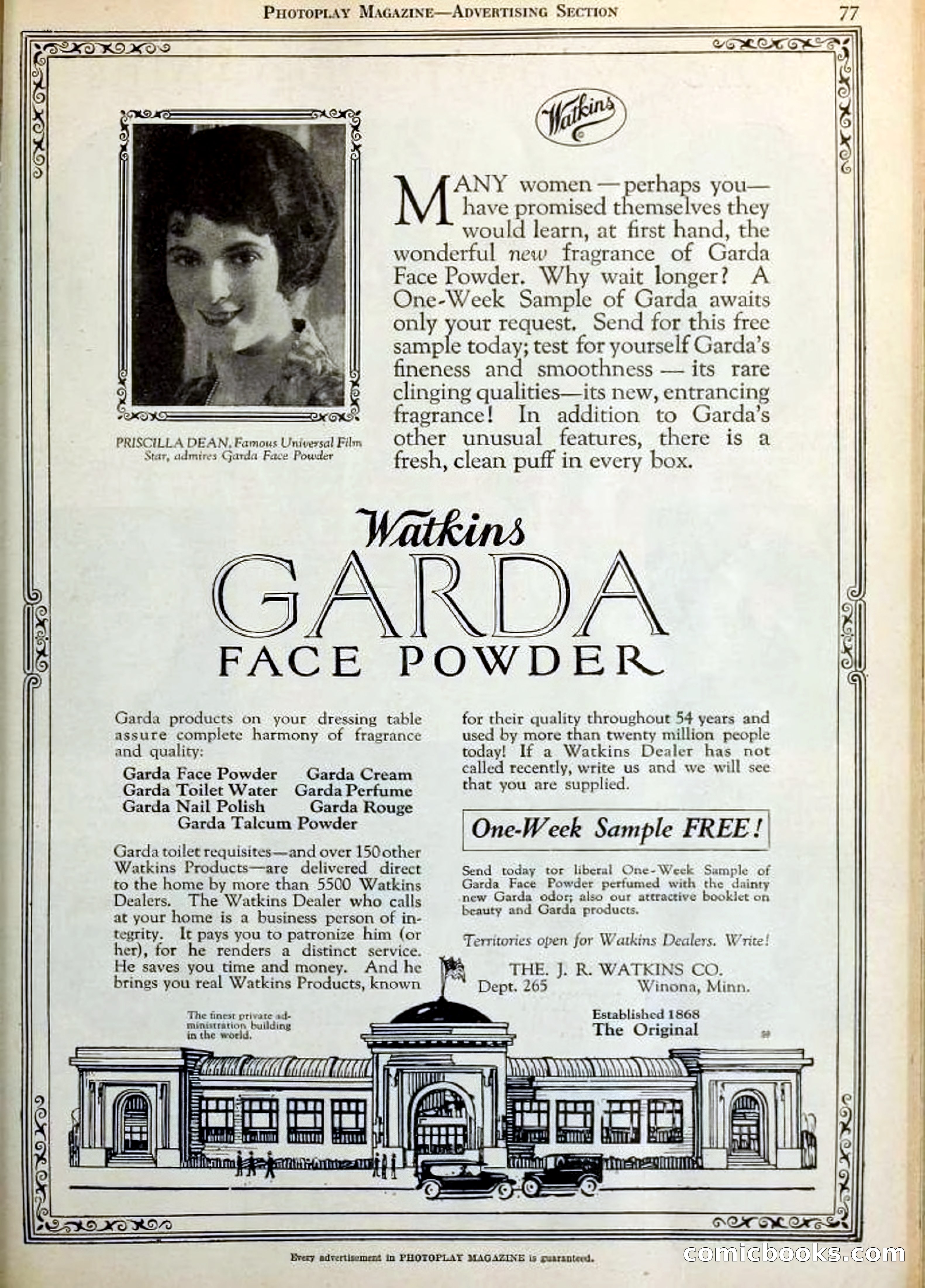
# Page Description This is an advertising page from *Photoplay Magazine*'s advertising section (page 77). It features a full-page advertisement for Watkins Garda Face Powder, a cosmetic product. The ad includes a photograph of actress Priscilla Dean (identified as a "Famous Universal Film Star") endorsing the powder. The advertisement promotes a free one-week sample of the product, emphasizing its fragrance, smoothness, and quality. It also lists other Garda products available and describes the Watkins dealer network. An illustration of the J.R. Watkins Company building in Winona, Minnesota appears at the bottom. The company claims to have been established in 1868.
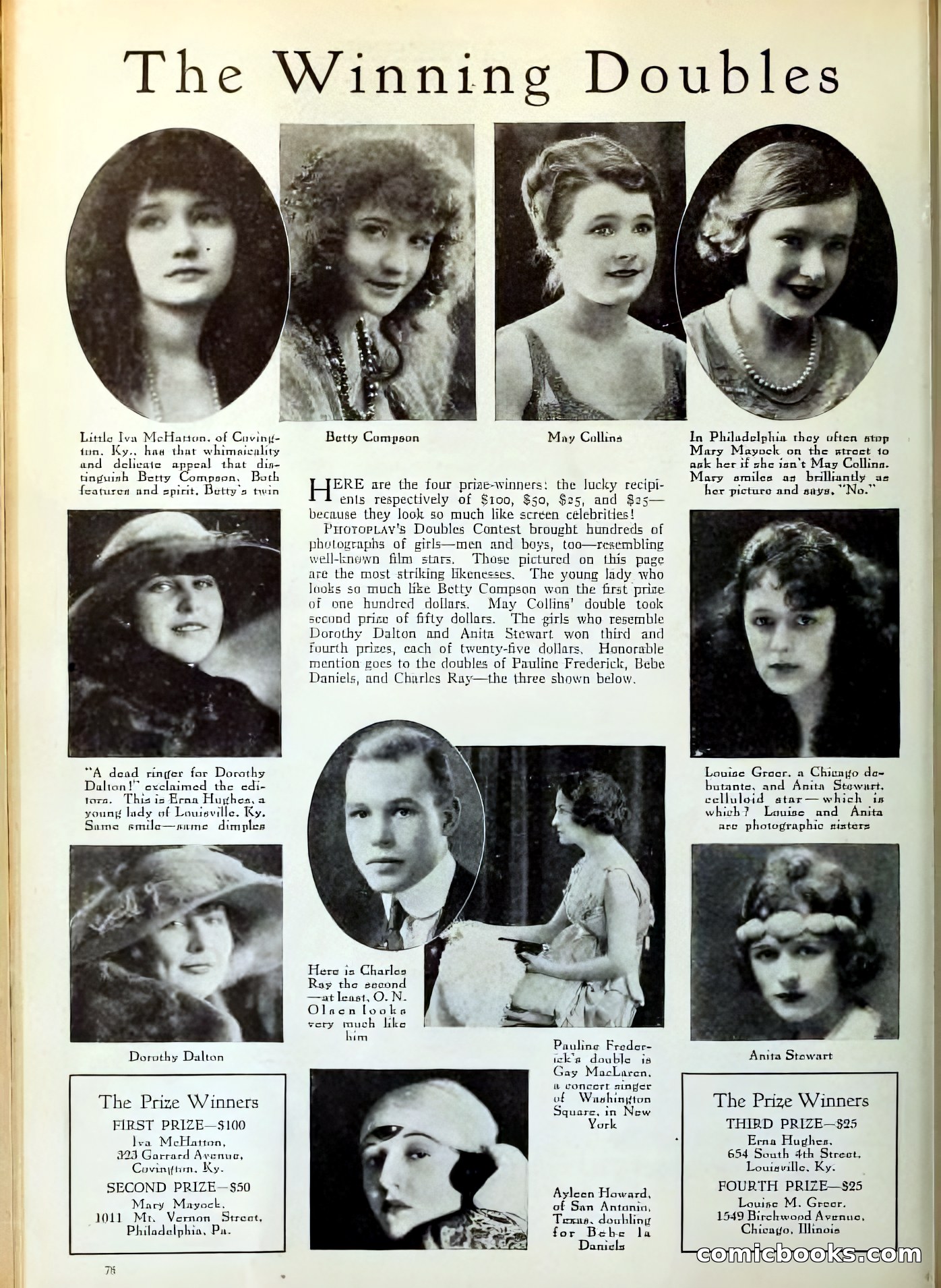
# The Winning Doubles This page features a photoplay contest results section displaying portraits of prize-winning contestants. The heading "The Winning Doubles" introduces a competition where participants submitted photographs of themselves or others resembling famous film stars. The page shows eight portrait photographs arranged around descriptive text explaining that the contest brought hundreds of submissions. Named winners include Iva McHatton (first prize, $100), Mary Mayock (second prize, $50), May Collins, Dorothy Dalton, Erna Hughes, Louise Greer, Anita Stewart, and others receiving honorable mention. The text notes striking physical resemblances between contestants and well-known screen celebrities, though the specific film stars referenced are not fully clear from this excerpt.
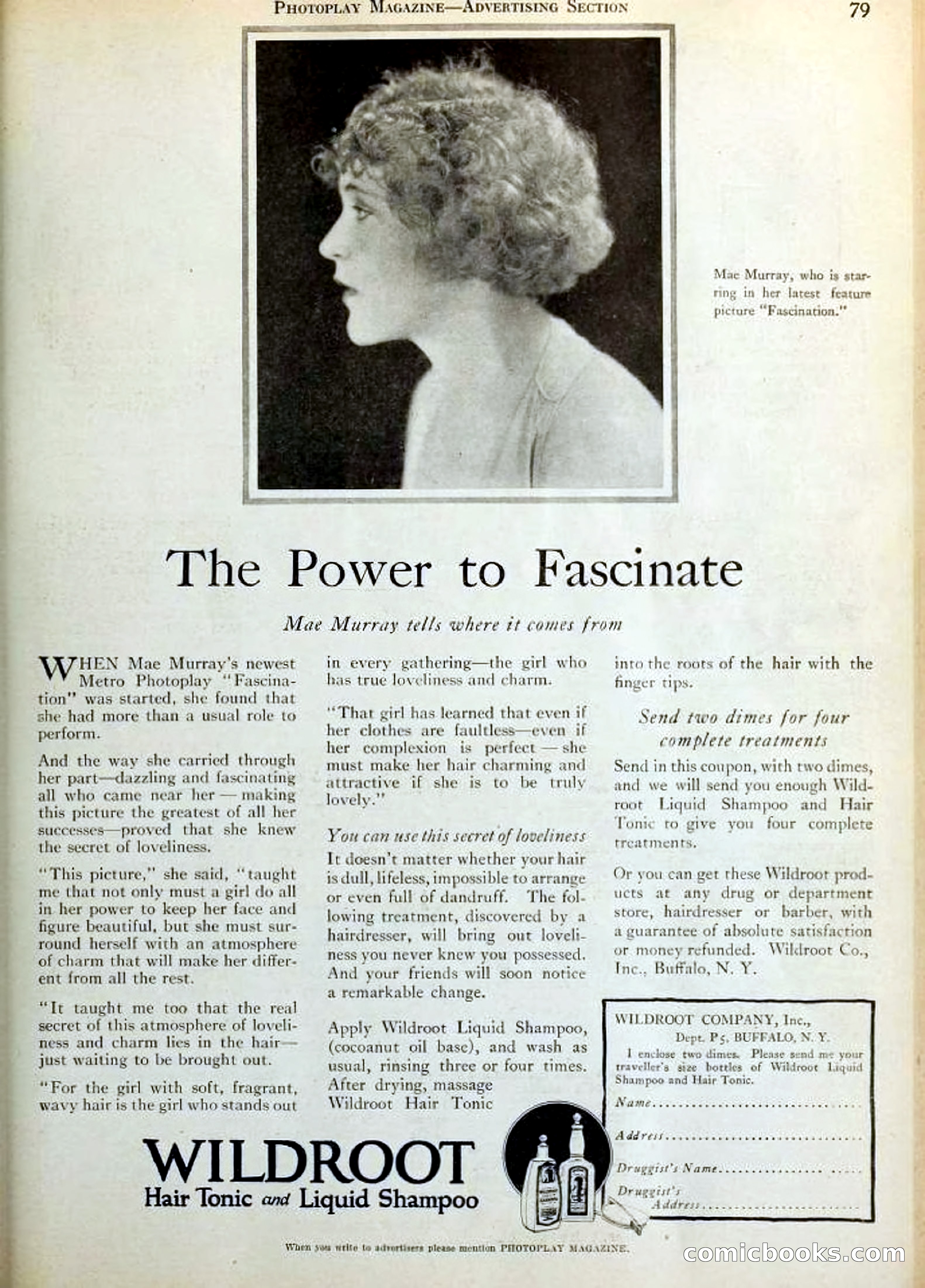
# Page Description This is an advertising page from *Photoplay Magazine*'s advertising section (page 79). It features a profile photograph of actress Mae Murray alongside a advertisement for Wildroot Hair Tonic and Liquid Shampoo. The ad, titled "The Power to Fascinate," quotes Murray discussing how proper hair care contributes to charm and loveliness. The copy emphasizes that the product can improve even dull or problematic hair. A coupon is provided for readers to request free sample treatments by mail from Wildroot Company, Inc. in Buffalo, New York. The page is entirely devoted to this single product advertisement.
# Page Analysis This is a **reader feedback/letters page** titled "Why-Do-They-Do-It," inviting readers to submit observations about movie inconsistencies and absurdities. The page contains multiple short letters from readers pointing out specific continuity errors and logical problems they've noticed in films. Examples include: actors' appearances changing between scenes ("Over the Hill"), anachronistic costume details in period pieces ("White Oak"), physical impossibilities (characters remaining dry after water scenes), and set inconsistencies. Each letter is attributed to a reader from various U.S. cities. The page solicits more such submissions, encouraging readers to report specific instances of what they perceived as sloppy filmmaking or directorial oversights.
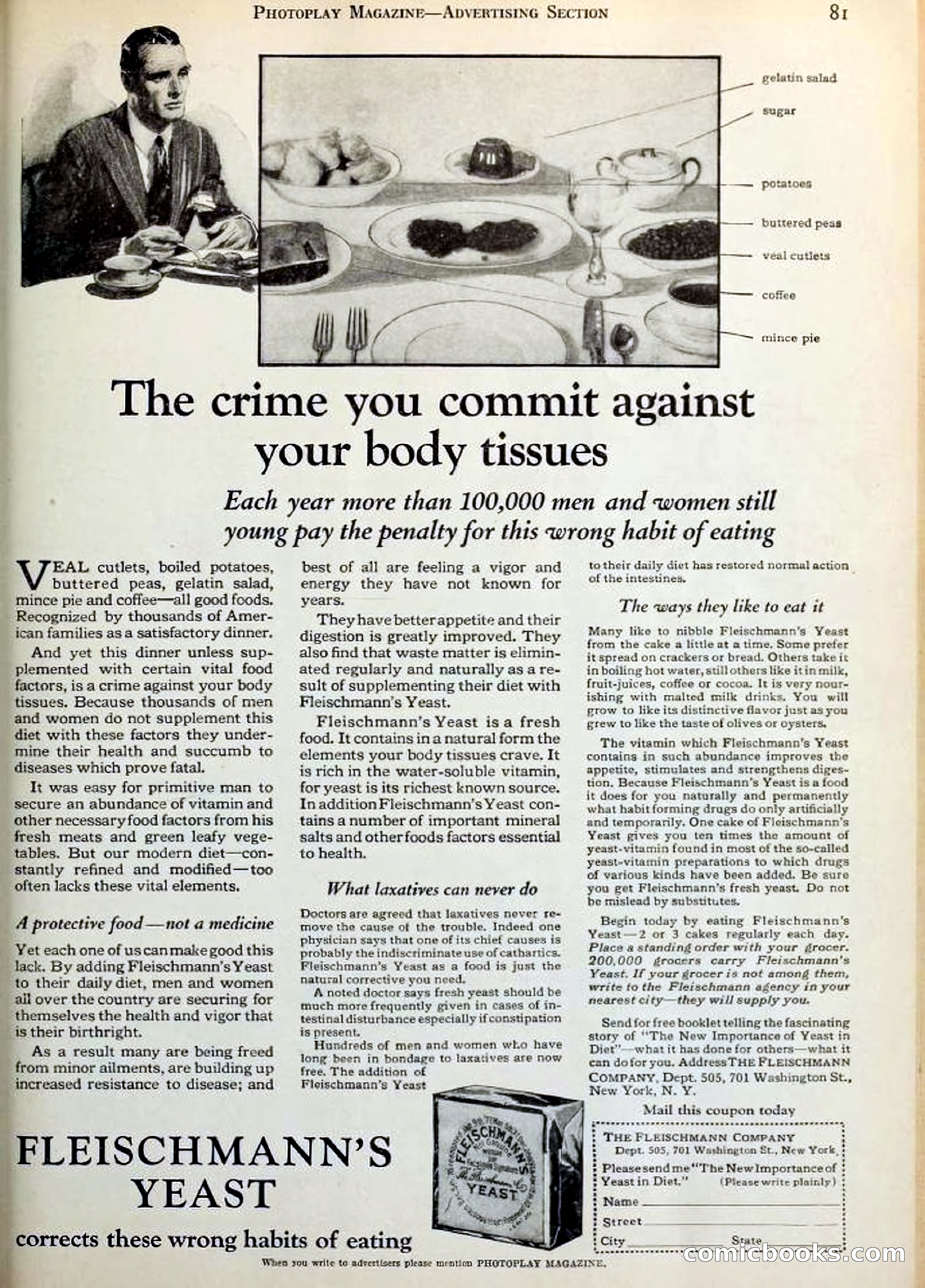
This is an advertising page from *Photoplay Magazine*'s advertising section. The page features a full-page advertisement for Fleischmann's Yeast, promoting the product as a dietary supplement to correct poor eating habits and improve health. The ad includes a photograph of a man eating dinner, alongside a labeled image of various foods (potatoes, veal cutties, buttered peas, coffee, mince pie, gelatin salad, and sugar). The text warns that inadequate diets lacking vital food factors cause disease, and claims Fleischmann's Yeast—containing water-soluble vitamins and minerals—corrects these deficiencies naturally. A coupon for a free booklet appears at the bottom.
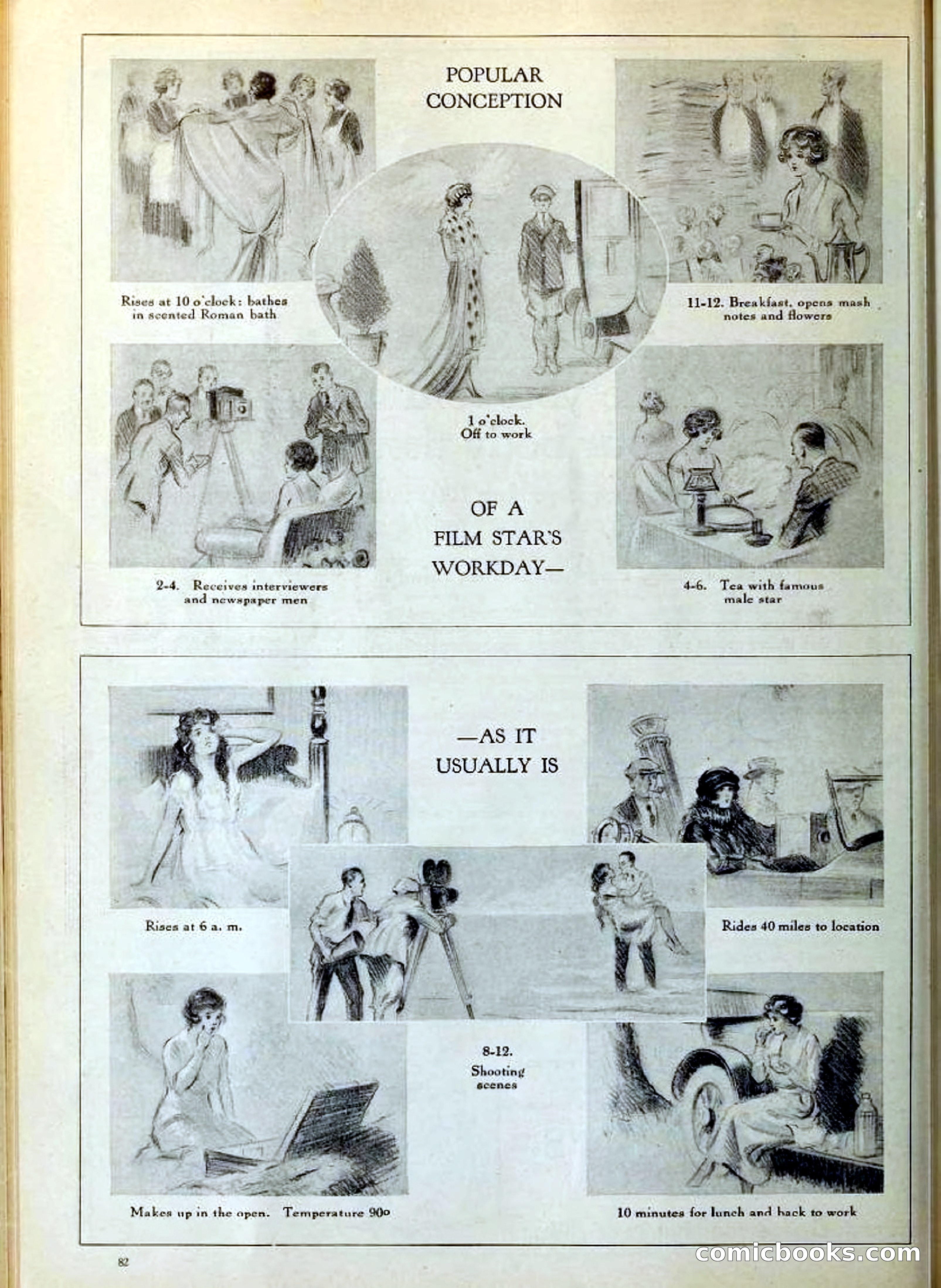
# Analysis of Page 82 This page presents two illustrated infographics comparing the "popular conception" versus the actual reality "as it usually is" of a film star's workday. The top section shows idealized activities: leisurely morning bathing, breakfast with flowers, socializing with famous actors, and receiving press attention. The bottom section depicts the genuine workday: rising at 6 a.m., traveling 40 miles to location, enduring 90-degree heat while applying makeup, shooting scenes from 8-12, and returning to work after only a 10-minute lunch. The page uses sketch illustrations to humorously contrast Hollywood fantasy with unglamorous reality, highlighting the physical demands and early hours required of film actors during the silent film era.
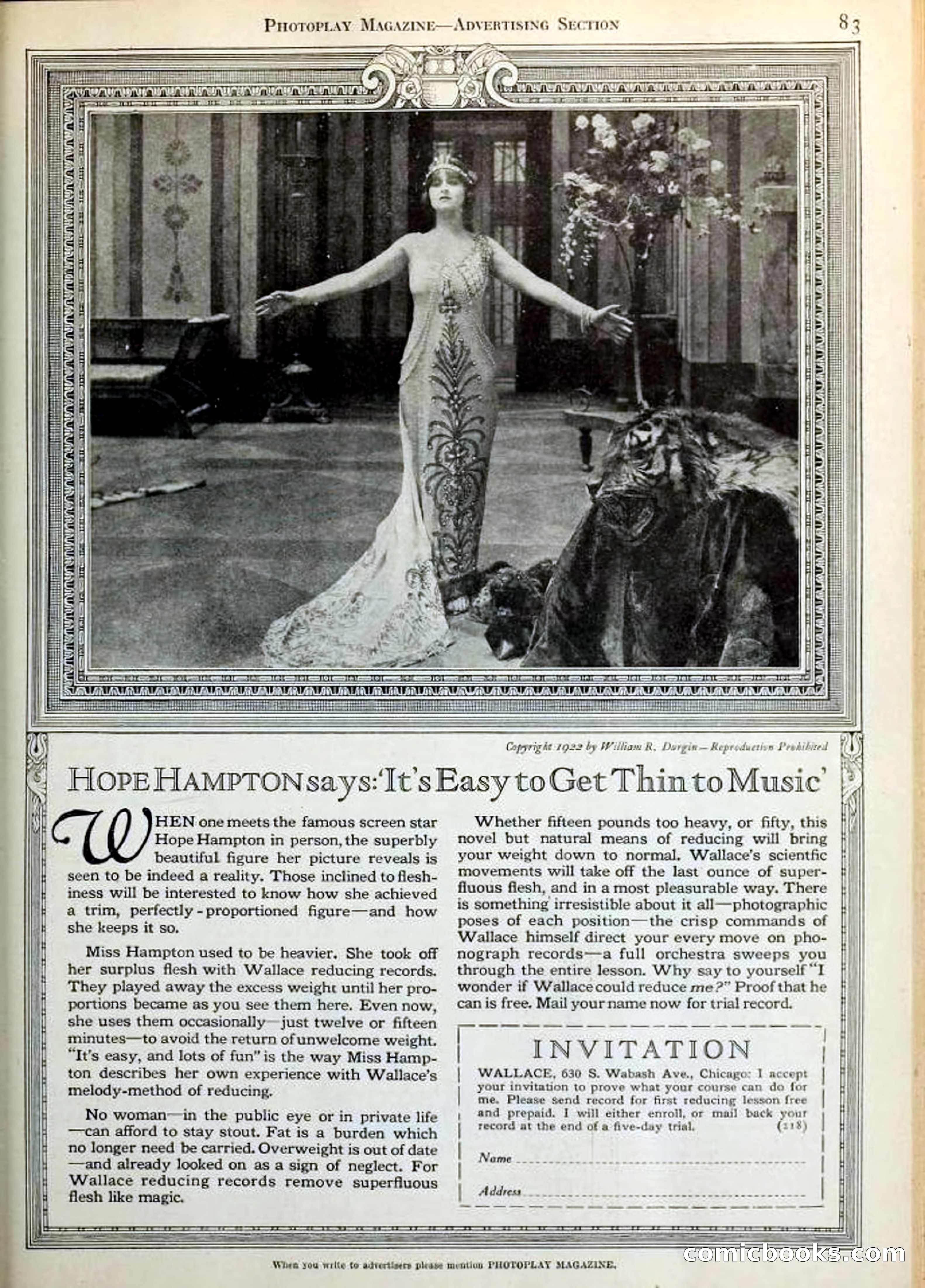
# Page Analysis This is an **advertising page** from Photoplay Magazine (1922). The upper half features a photograph showing a woman in an elegant, ornately-decorated gown with a long train, posed with arms outstretched in what appears to be a theatrical interior setting. The lower half is an advertisement claiming that actress Hope Hampton achieved her trim figure through "Wallace reducing records"—a weight-loss method involving musical recordings. The text quotes Hampton describing her experience and encourages readers to request a free trial record by mailing in their information using the provided form. The advertisement emphasizes that the method worked for Hampton and promises it can help others lose weight through what appears to be a combination of music and exercise guidance.
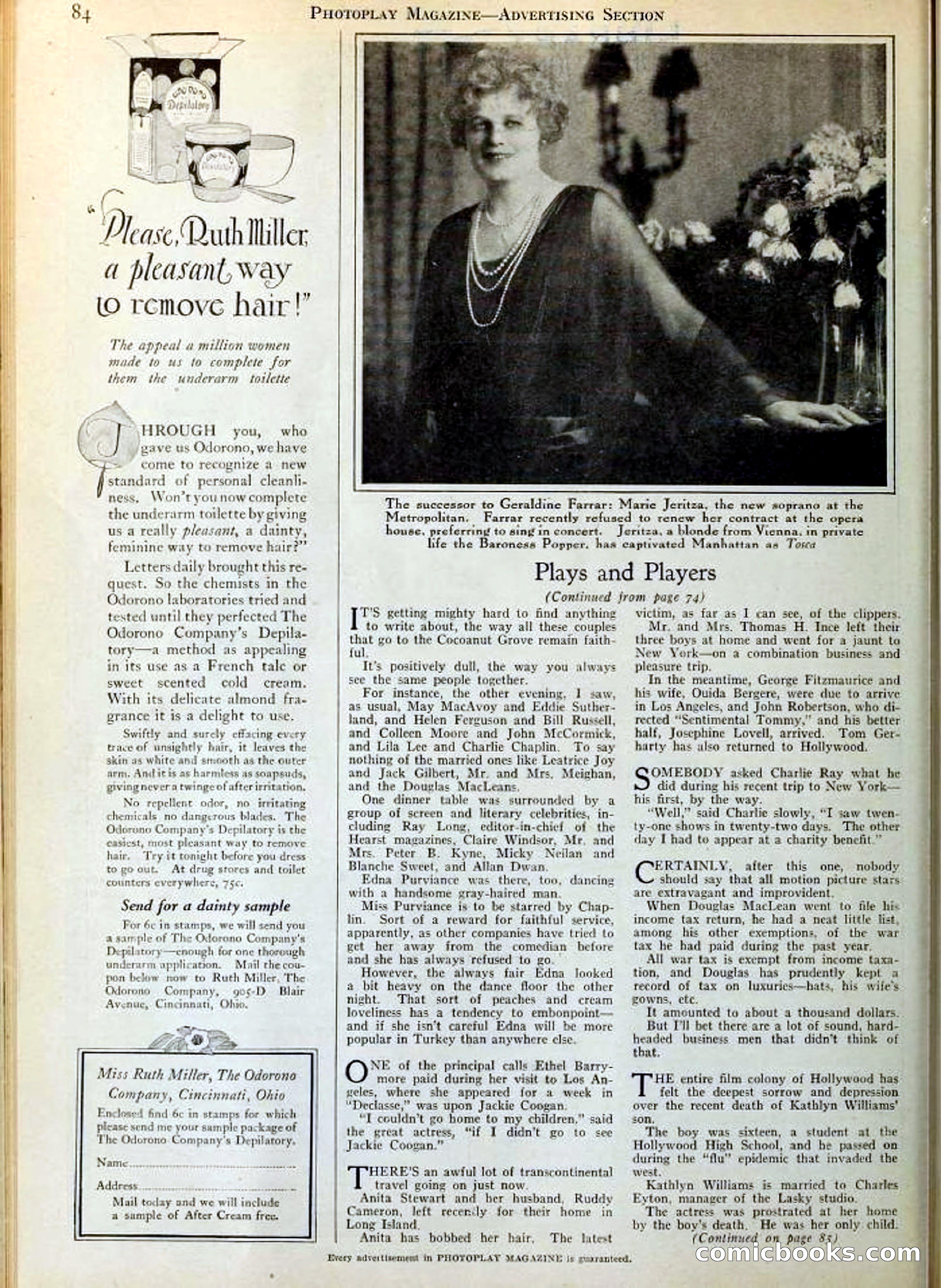
# Page Analysis This is an advertising section (page 84) from *Photoplay Magazine*. The left side features an advertisement for Odorono, a deodorant product, with the slogan "Please, Ruth Miller, a pleasant way to remove hair!" The ad includes product images and testimonial text about underarm hair removal. The right side contains a photograph of a woman identified as Marie Jeritza, described as soprano at the Metropolitan Opera, with accompanying caption text. Below that is a column titled "Plays and Players" (continued from page 74), which discusses various celebrities' social activities and appearances, including mentions of May MacAvoy, Eddie Sutherland, Charlie Ray, and Kathlyn Williams. The page mixes entertainment gossip with product advertising.
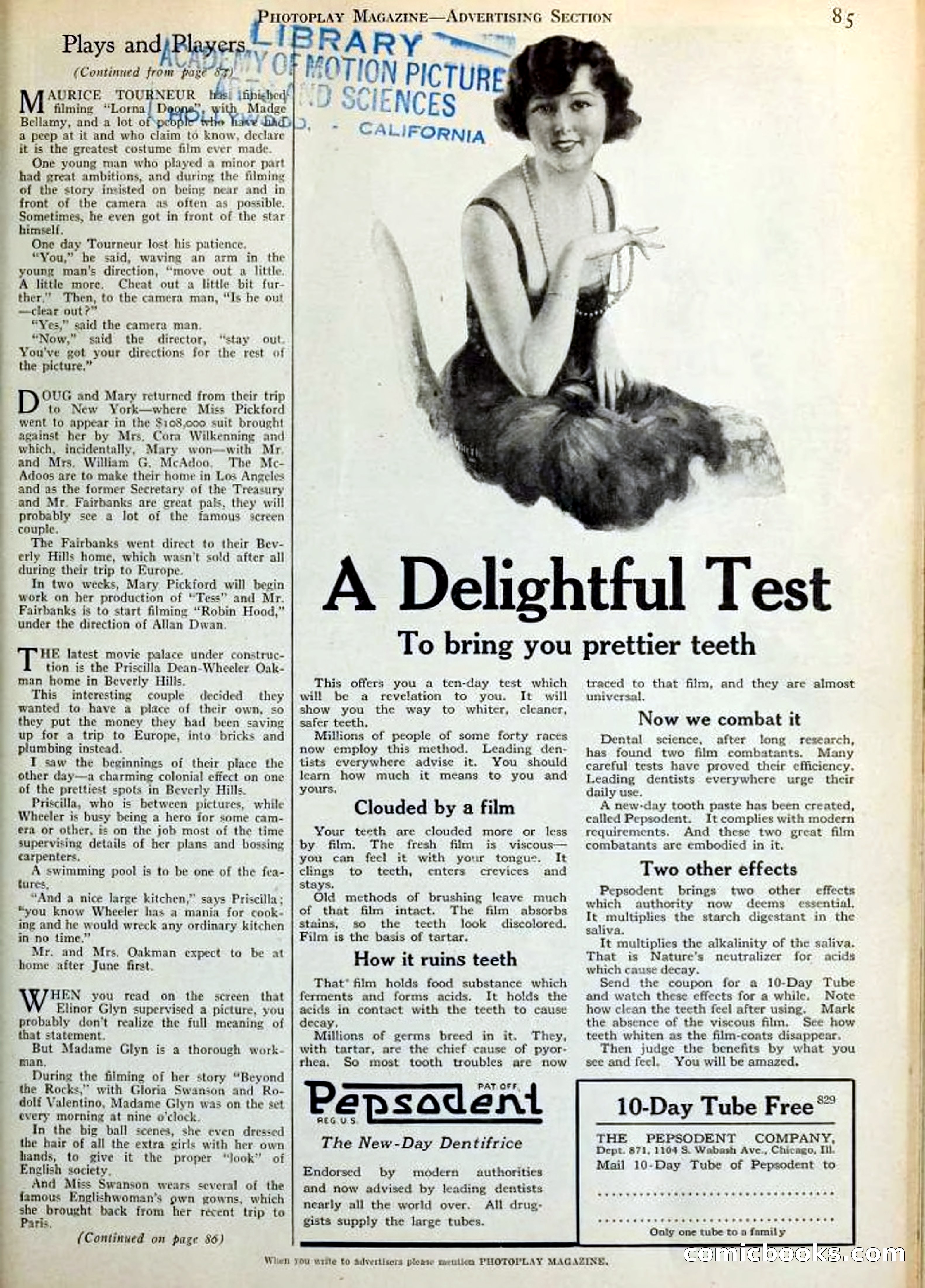
# Page 85 from Photoplay Magazine This is an advertising section from Photoplay Magazine's "Plays and Players" column. The page features entertainment industry gossip about actors including Maurice Tourneur, Doug and Mary (likely a reference to Douglas Fairbanks and Mary Pickford), and others. However, the dominant content is a full-page advertisement for Pepsodent toothpaste, featuring a glamorous woman's photograph. The ad promotes "A Delightful Test to bring you prettier teeth," explaining how a film coating on teeth causes discoloration and tartar buildup. Pepsodent claims to combat these issues through dental science. The ad offers a free 10-day tube of the product for interested readers.
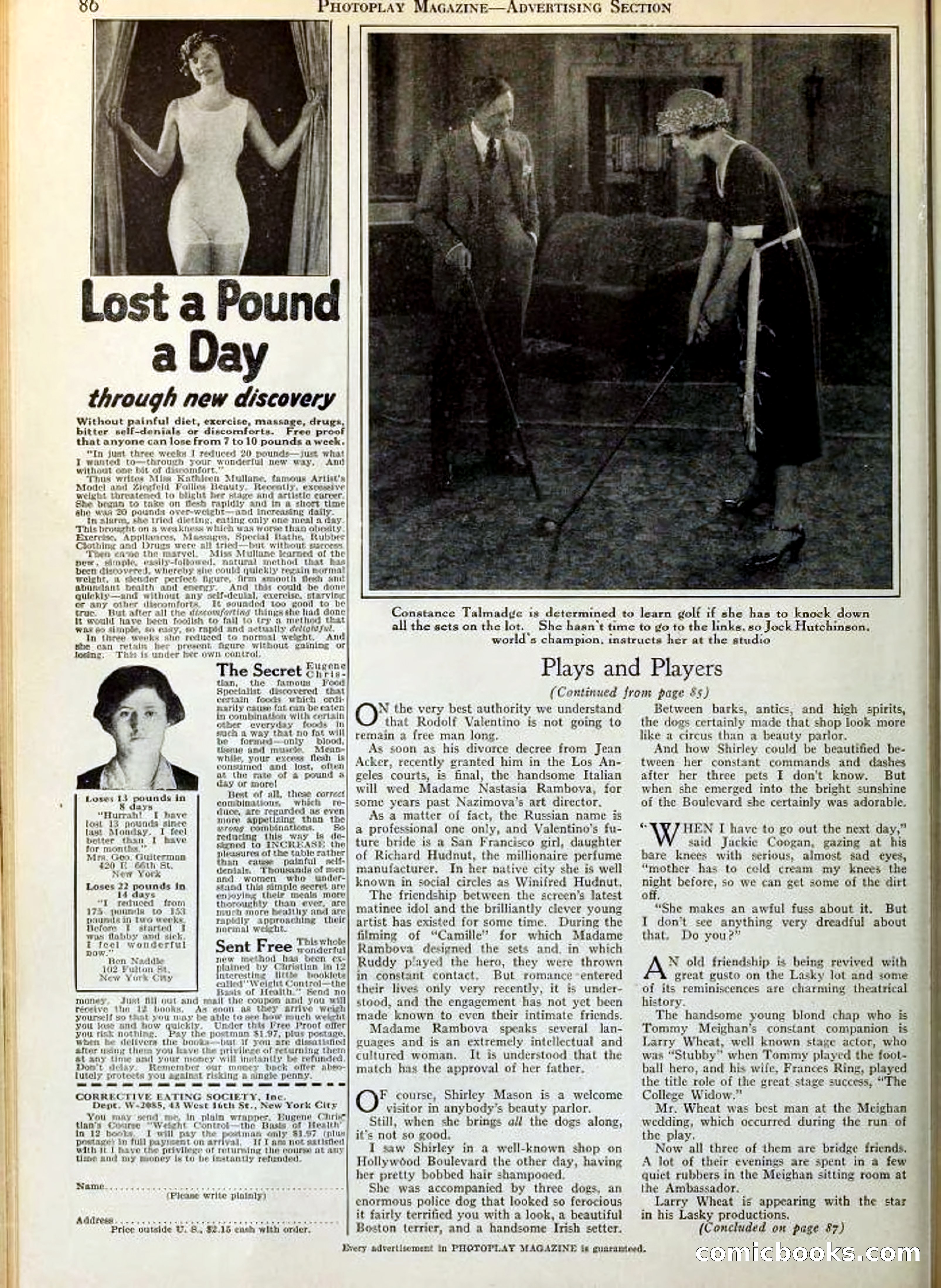
# Page 86: Photoplay Magazine Advertising Section This is an advertising and entertainment news page from Photoplay Magazine. The left side features a weight-loss advertisement titled "Lost a Pound a Day," promoting a purported new method for reducing weight without diet or exercise, accompanied by a photograph of a woman in undergarments. Below that is a "Corrective Eating Society" advertisement. The right side contains entertainment gossip and news articles about film actors and players, including discussion of Constance Talmadge, Rudolf Valentino, and other Hollywood figures. The page mixes commercial advertisements with celebrity news typical of 1920s fan magazines.
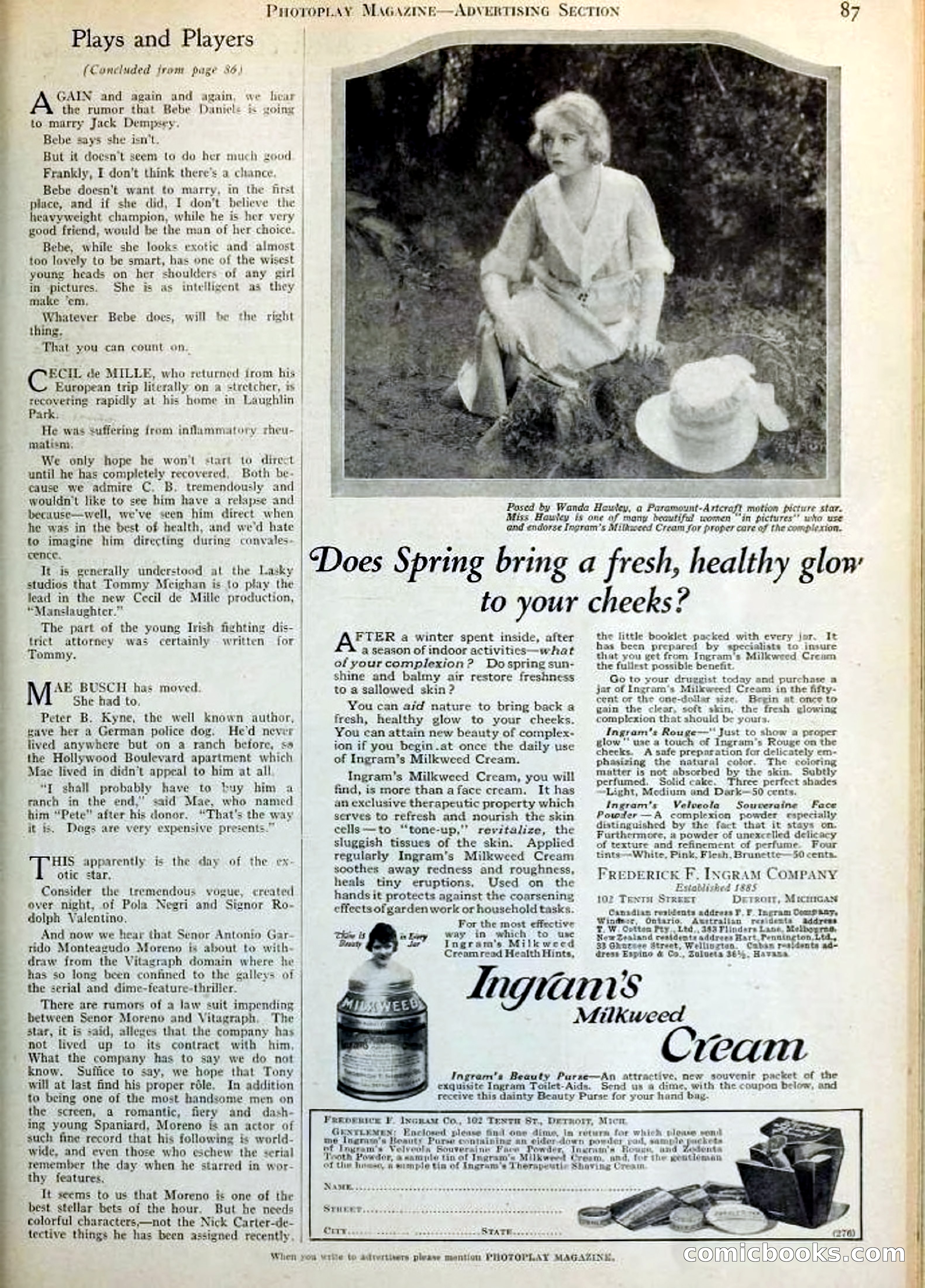
# Page Content Summary This is an advertising and editorial section from *Photoplay Magazine*. The left side contains a gossip column titled "Plays and Players" discussing Hollywood rumors, including speculation about actress Bebe Daniels potentially marrying Jack Dempsey, and updates about various film industry figures like Cecil de Mille and Mae Busch. The right side is dominated by a full-page advertisement for Ingram's Milkweed Cream, a skincare product. It features a photograph of a woman and promotes the cream as a solution for maintaining healthy, glowing complexion during spring. The ad includes product details, testimonials about its effectiveness, and a coupon for ordering.
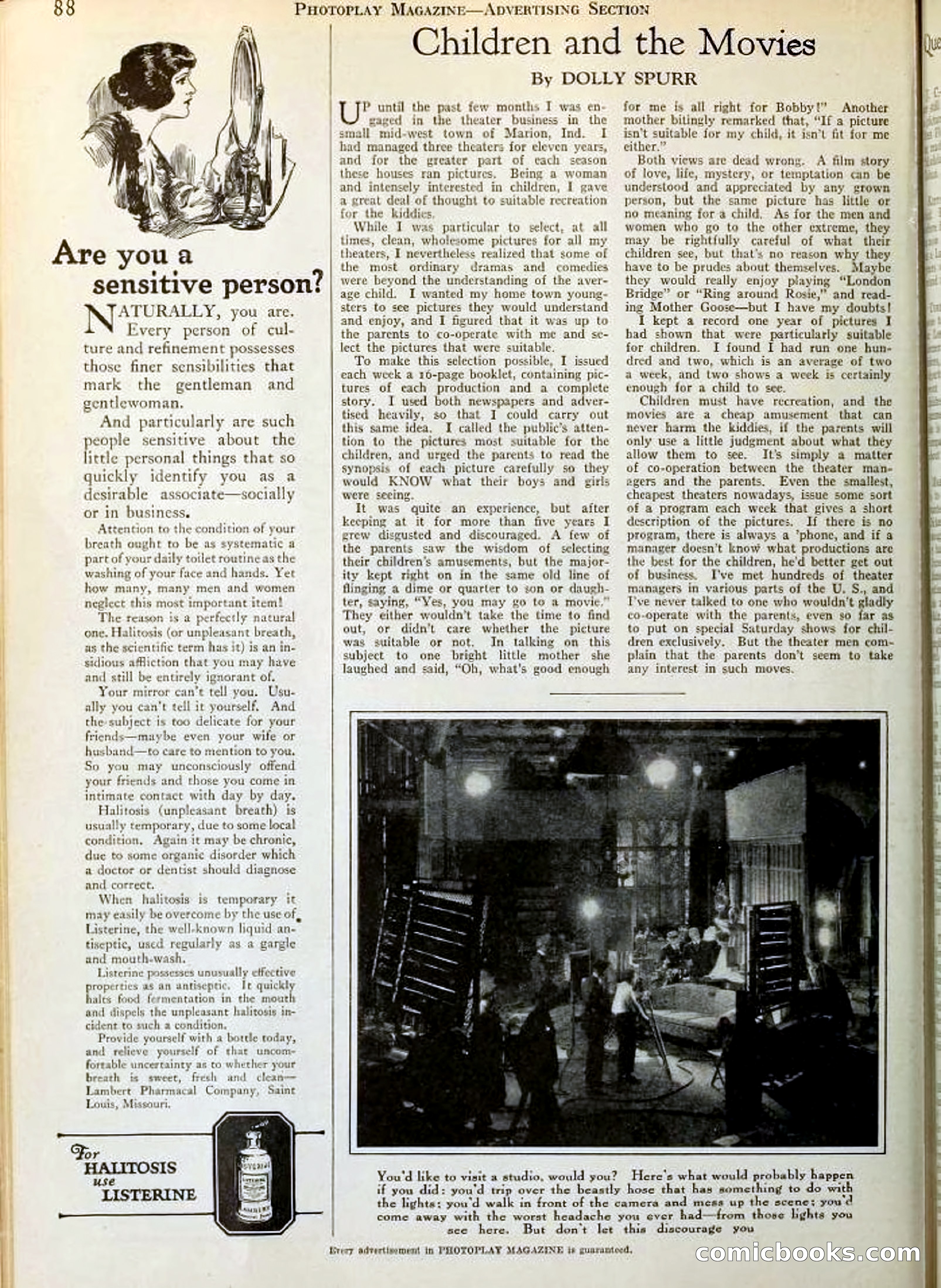
# Page Analysis This is an advertising section from Photoplay Magazine featuring two distinct articles/advertisements: **Left side:** An advertisement for Listerine mouthwash addressing "halitosis" (bad breath), framed as advice for "sensitive persons" concerned about social etiquette. **Right side:** An article titled "Children and the Movies" by Dolly Spurr, discussing whether films are appropriate entertainment for children. The author, who managed theaters in Indiana, describes her efforts to curate suitable movie selections for young audiences and addresses parental concerns about cinema's effects on children. **Center:** A black-and-white photograph showing what appears to be a film studio or stage set with theatrical lighting equipment and scenery. The page blends editorial content with commercial messaging, typical of early twentieth-century magazine layout.
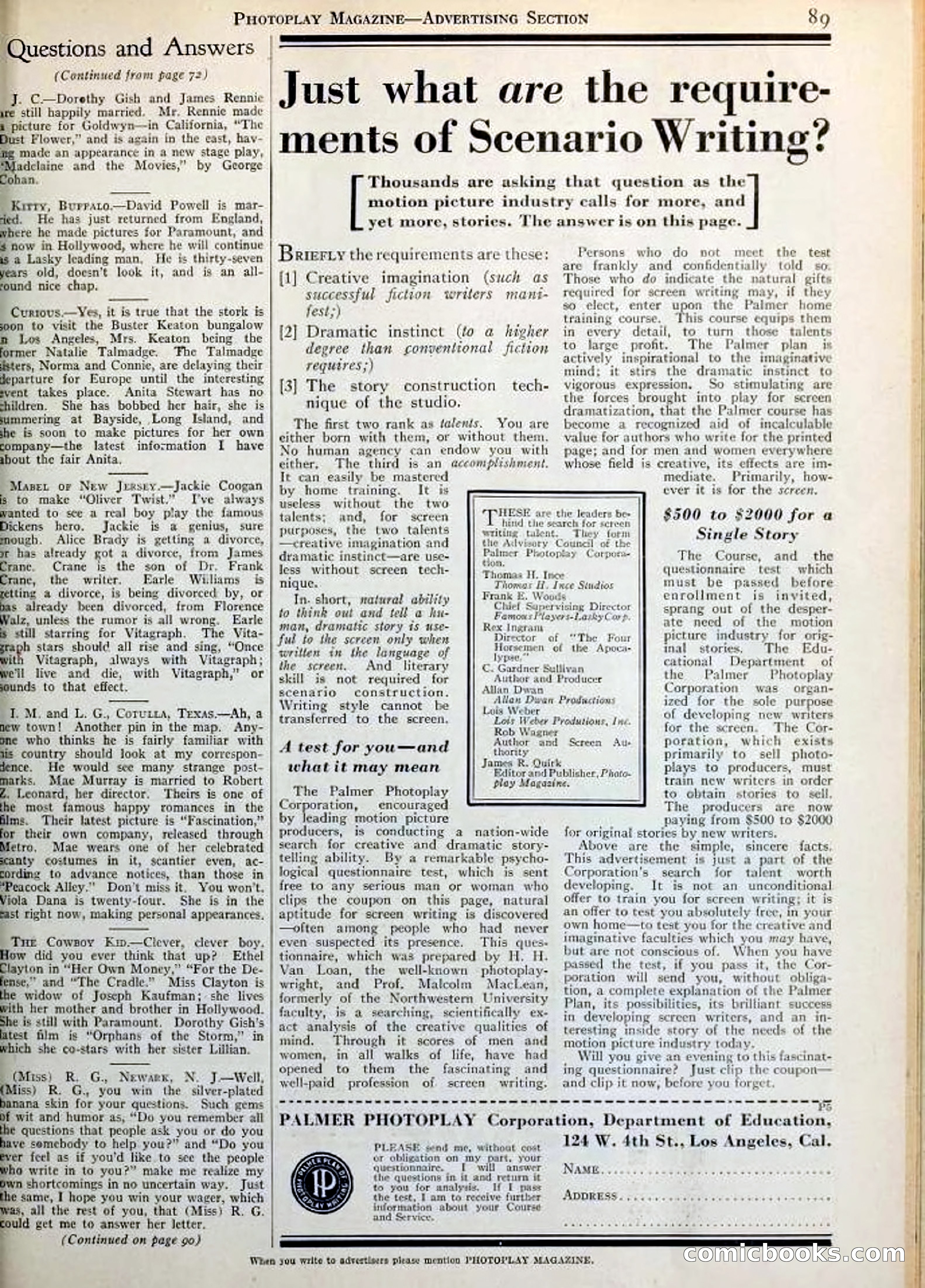
# Page Analysis This is an advertising and advice page from *Photoplay Magazine*'s advertising section (page 89). The main content is an article titled "Just what are the requirements of Scenario Writing?" which outlines the Palmer Photoplay Corporation's criteria for aspiring screenwriters, listing three key requirements: creative imagination, dramatic instinct, and story construction technique. The page also includes a "Questions and Answers" section continuing from a previous page, addressing readers' inquiries about film industry figures and gossip. At the bottom is a coupon for interested individuals to request information about the Palmer Corporation's scenario-writing course, which offers training for $500 to $2000 per accepted story.
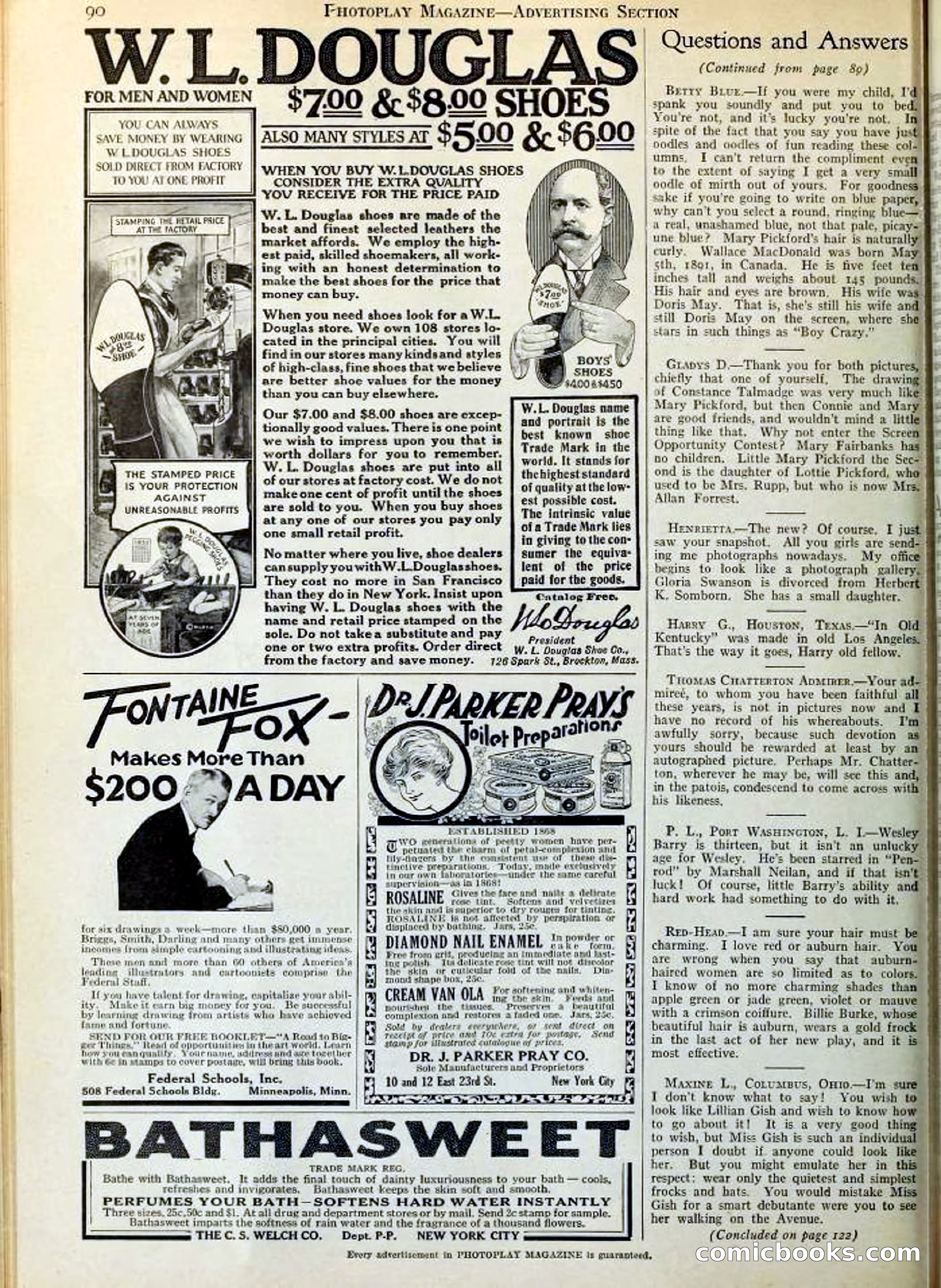
# Page Description This is an advertising and advice section from *Photoplay Magazine*. The page contains multiple advertisements for consumer products including W.L. Douglas shoes ($5-$8), Fontaine Fox (offering $200+ daily income), Dr. Parker's Toilet Preparations, Bathsweet bath products, and a drawing school advertisement. The upper right portion features a "Questions and Answers" column (continued from page 8) with reader inquiries addressed to the magazine. These appear to be fan letters about Hollywood celebrities and entertainment topics, typical of the advice column format common to entertainment magazines of this era. The page is predominantly commercial in nature, mixing product advertising with reader correspondence about entertainment personalities.
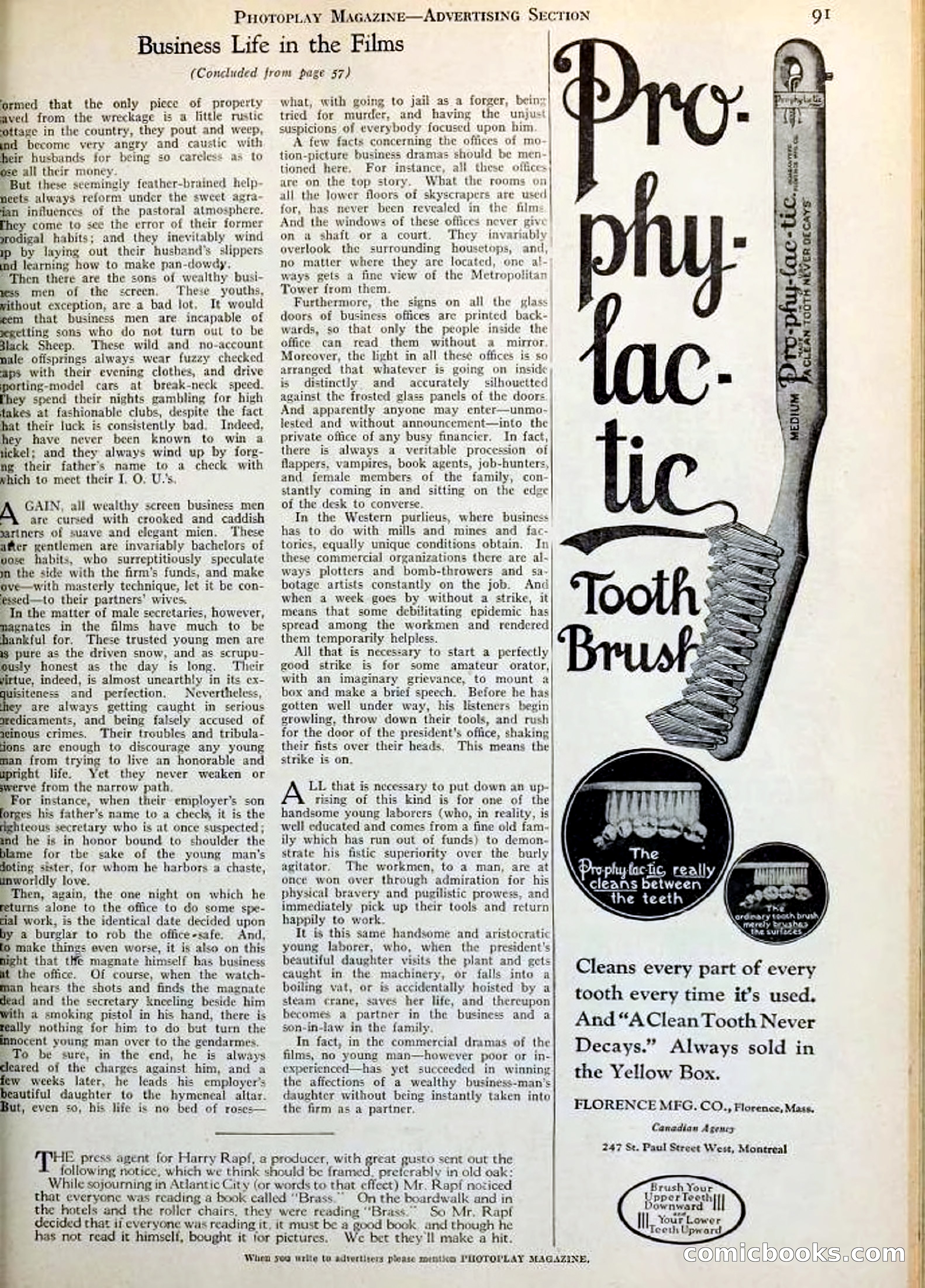
This is an advertising page from *Photoplay Magazine* containing two sections: the conclusion of an article titled "Business Life in the Films" (continuing from page 57), which discusses various aspects of how business and labor dynamics are portrayed in motion pictures; and a full-page advertisement for Prophylactic Toothbrush by Florence Manufacturing Company, featuring product images and marketing copy claiming the brush "Cleans every part of every tooth every time it's used." The page number is 91.
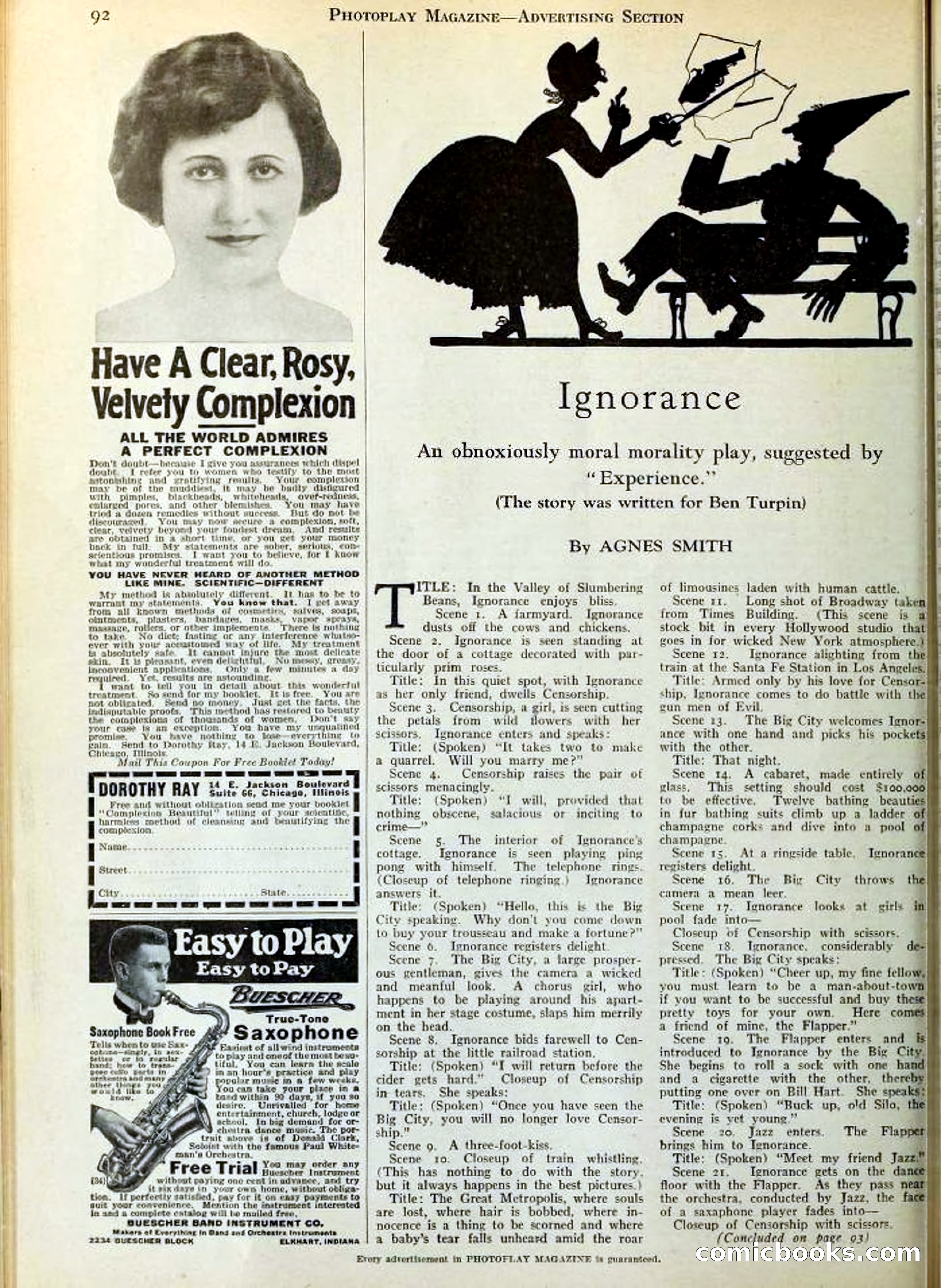
# Page 92: Photoplay Magazine Advertising Section This is an advertising and content page from *Photoplay Magazine*. The left side features a beauty product advertisement for complexion treatment, with a photograph of a woman's face. Below that are two more advertisements: one for Dorothy Ray cosmetics and another for Buescher saxophones ("Easy to Play, Easy to Pay"). The right side contains the plot synopsis for a film called *Ignorance*, described as "an obnoxiously moral morality play, suggested by 'Experience'" and written for actor Ben Turpin by Agnes Smith. The synopsis outlines approximately 20 numbered scenes involving characters named Ignorance and Censorship in various settings.
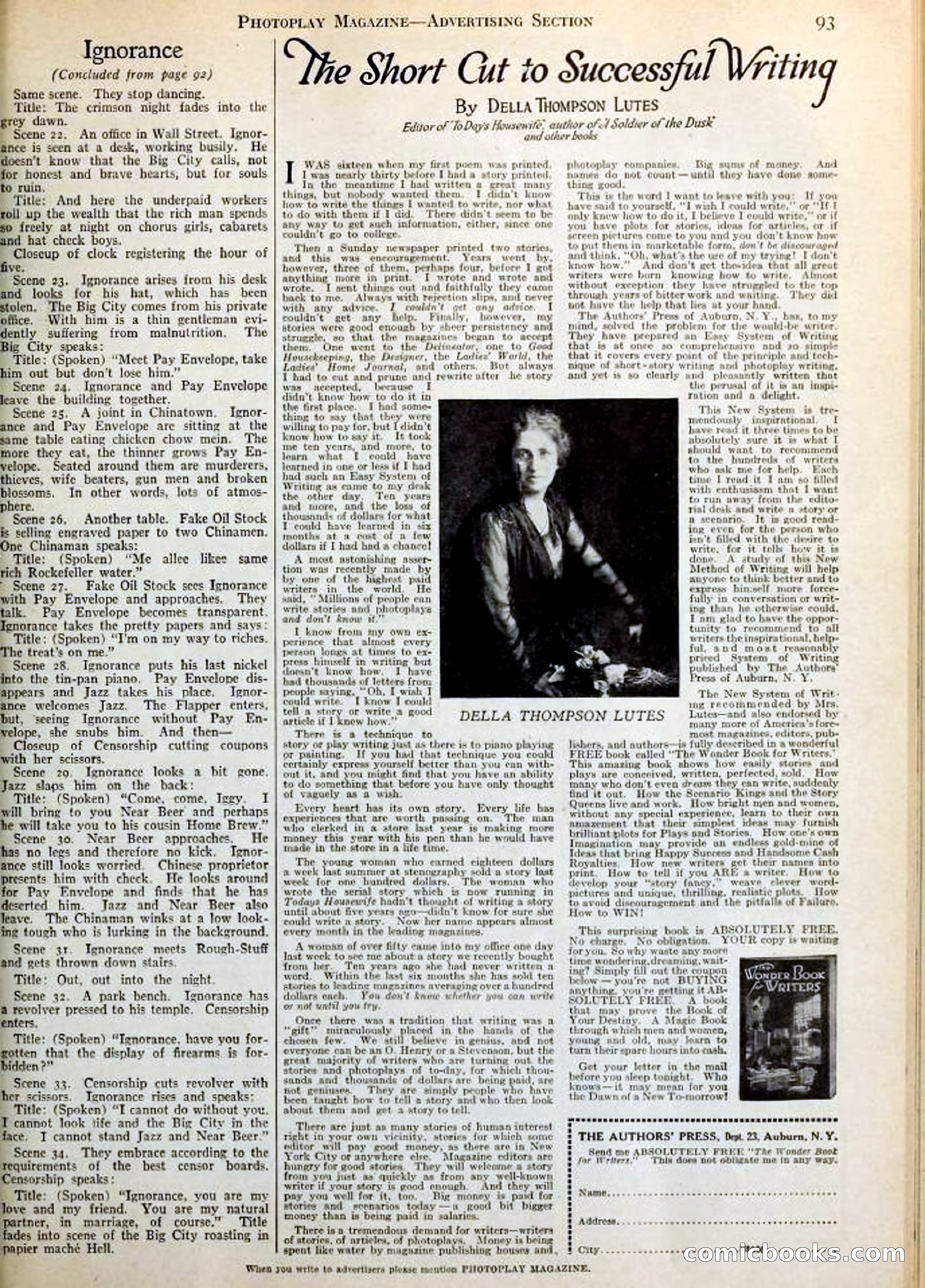
# Page Analysis This is an **advertising and editorial page** from *Photoplay Magazine*. The upper half features an article titled "The Short Cut to Successful Writing" by Della Thompson Lutes, editor of *To-Day's Housewife*. The piece offers practical advice for aspiring writers, discussing rejection, persistence, and the importance of understanding story structure. A photograph of Della Thompson Lutes accompanies the text. The lower half contains advertisements, including a prominent ad for *The New System of Writing* and a mail-in offer for "The Dawn of a New Tomorrow" from the Authors' Press of Auburn, New York. The page mixes instructional content with commercial promotions targeting would-be writers.
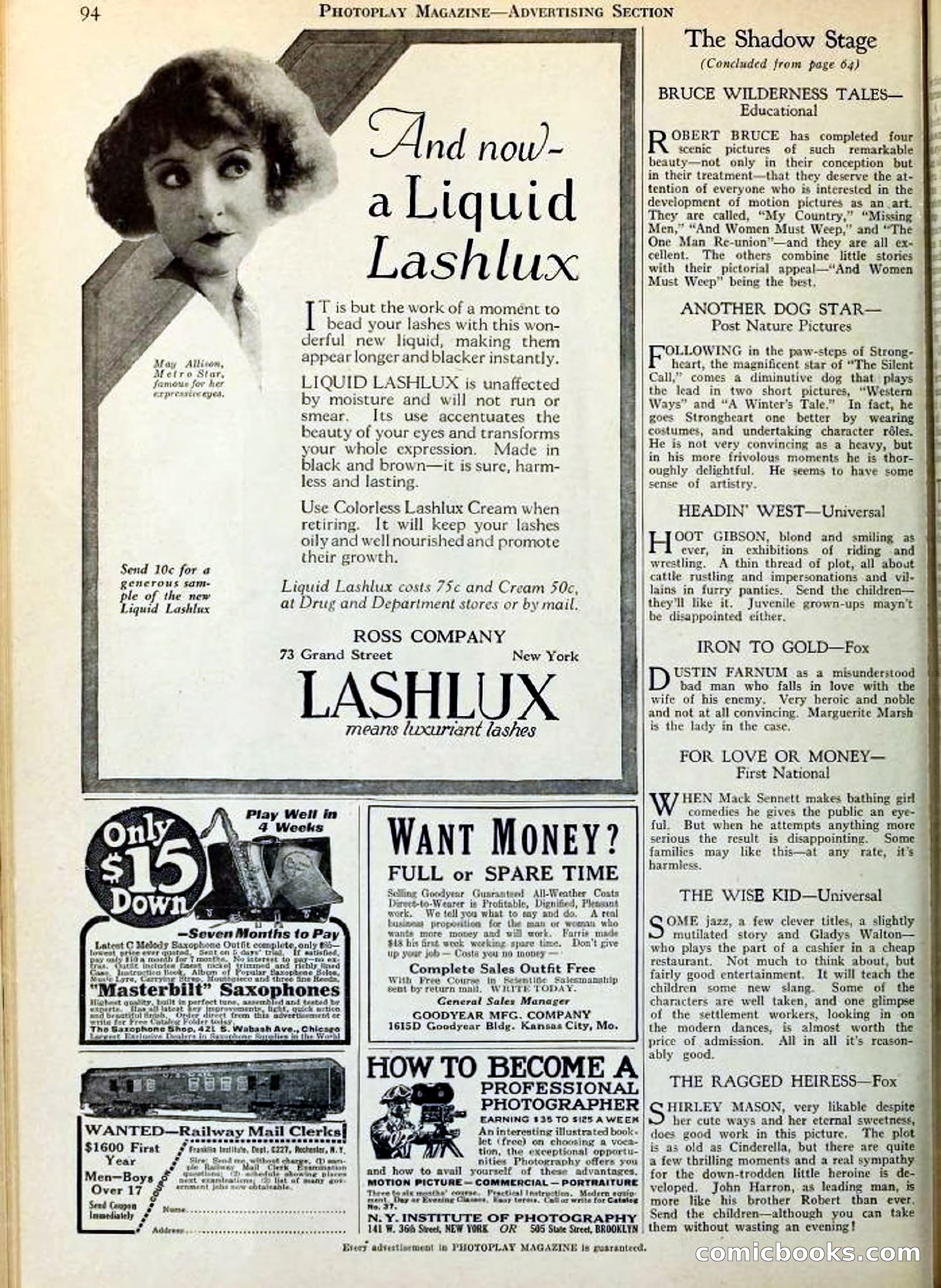
# Page Description This is an advertising section from *Photoplay Magazine*. The left side features a full-page advertisement for Liquid Lashlux, a cosmetic product for eyelashes, with a photograph of a woman's face. The right side contains "The Shadow Stage" section, which appears to be a review or commentary column discussing various films and actors, including mentions of Robert Bruce's "Bruce Wilderness Tales" educational films, a dog star named Strongheart, Hoot Gibson, Dustin Farnum, and other silent-era cinema references. The bottom of the page includes additional classified advertisements for saxophones, railroad jobs, and photography training.
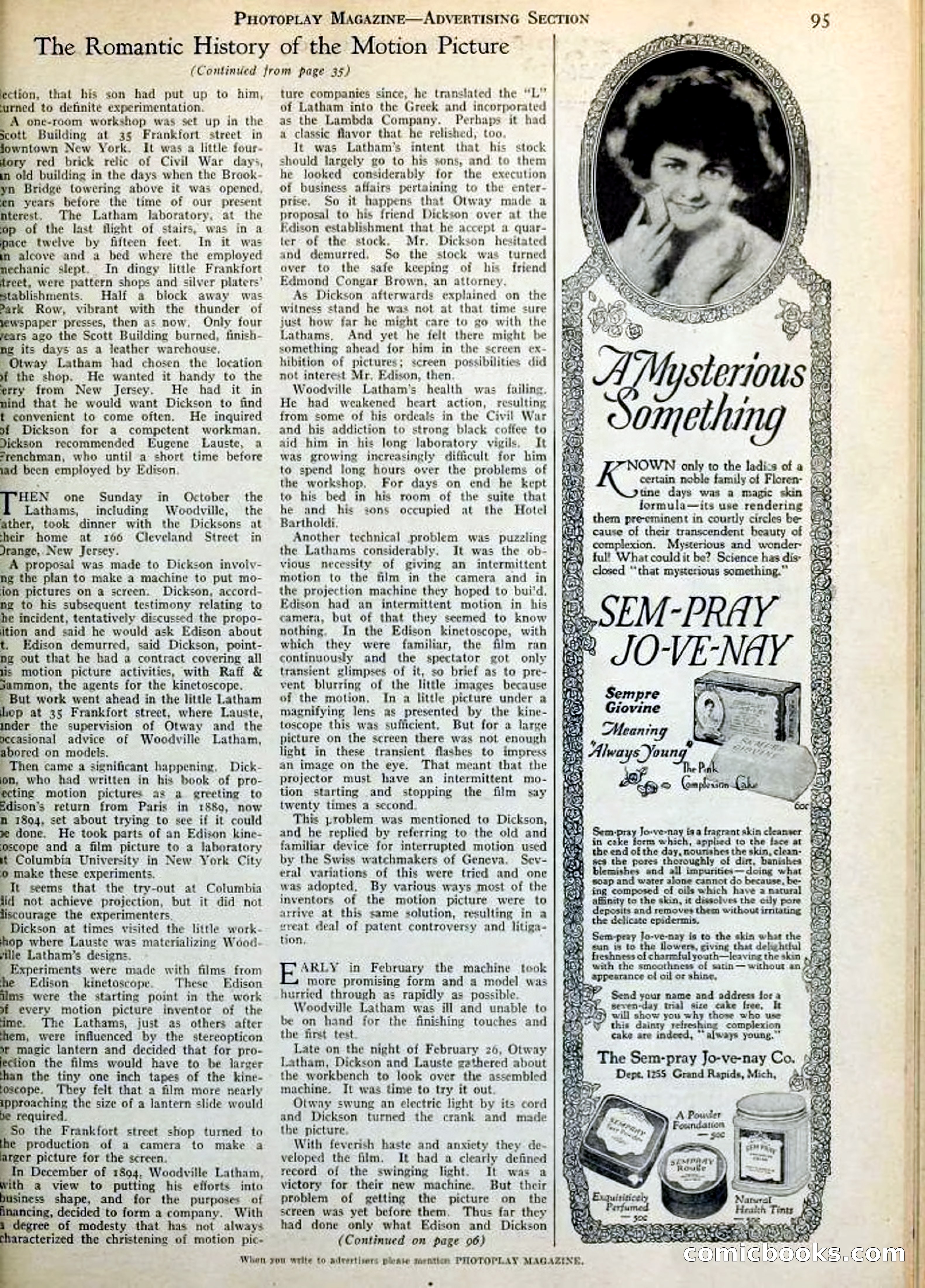
# Page Analysis This is a text page from *Photoplay Magazine's* advertising section (page 95), continuing an article titled "The Romantic History of the Motion Picture" from page 35. The left column contains prose describing early motion picture experiments by figures named Otway Latham, Dickson, and others working with film projection technology in the 1890s. On the right side is a full-page advertisement for "Sem-Pray Jo-Ve-Nay," a fragrant skin cleanser product, featuring a portrait photograph of a woman and product imagery. The advertisement emphasizes the product's cosmetic benefits, claiming it leaves skin smooth and youthful.
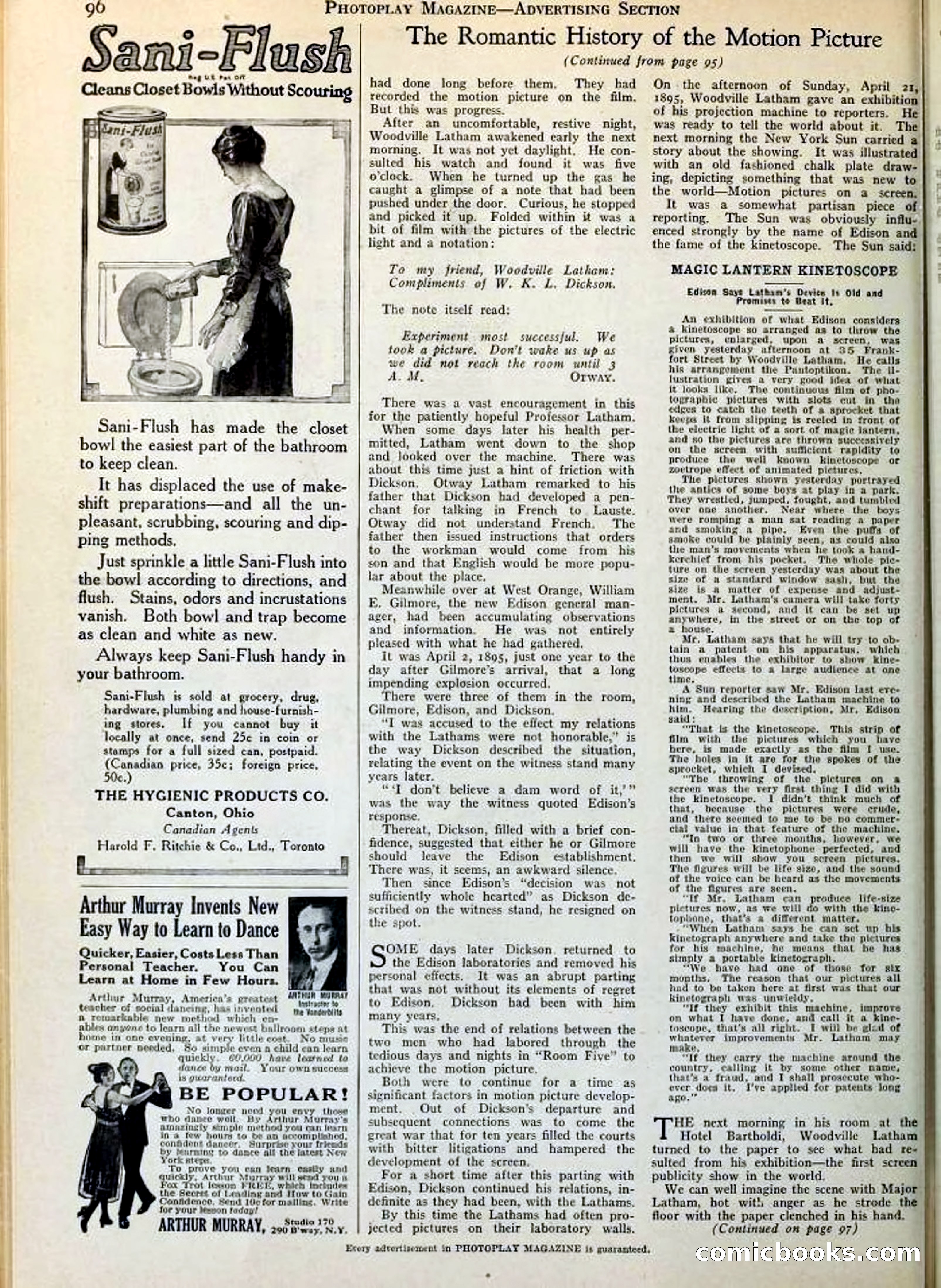
# Page Content Analysis This is page 96 from *Photoplay Magazine*'s advertising section. The page contains advertisements mixed with continuation of an article titled "The Romantic History of the Motion Picture." The visible text discusses early motion picture history, including an anecdote about Professor Latham and Edison's kinetoscope experiments. There's an advertisement for "Sani-Flush" (a bathroom cleaning product), another for "Magic Lantern Kinetoscope" by Edison, and a third promoting Arthur Murray's dance instruction method. The main article text describes the development of motion picture technology and Edison's role in early cinema, with references to Dickson and other early figures in film history.
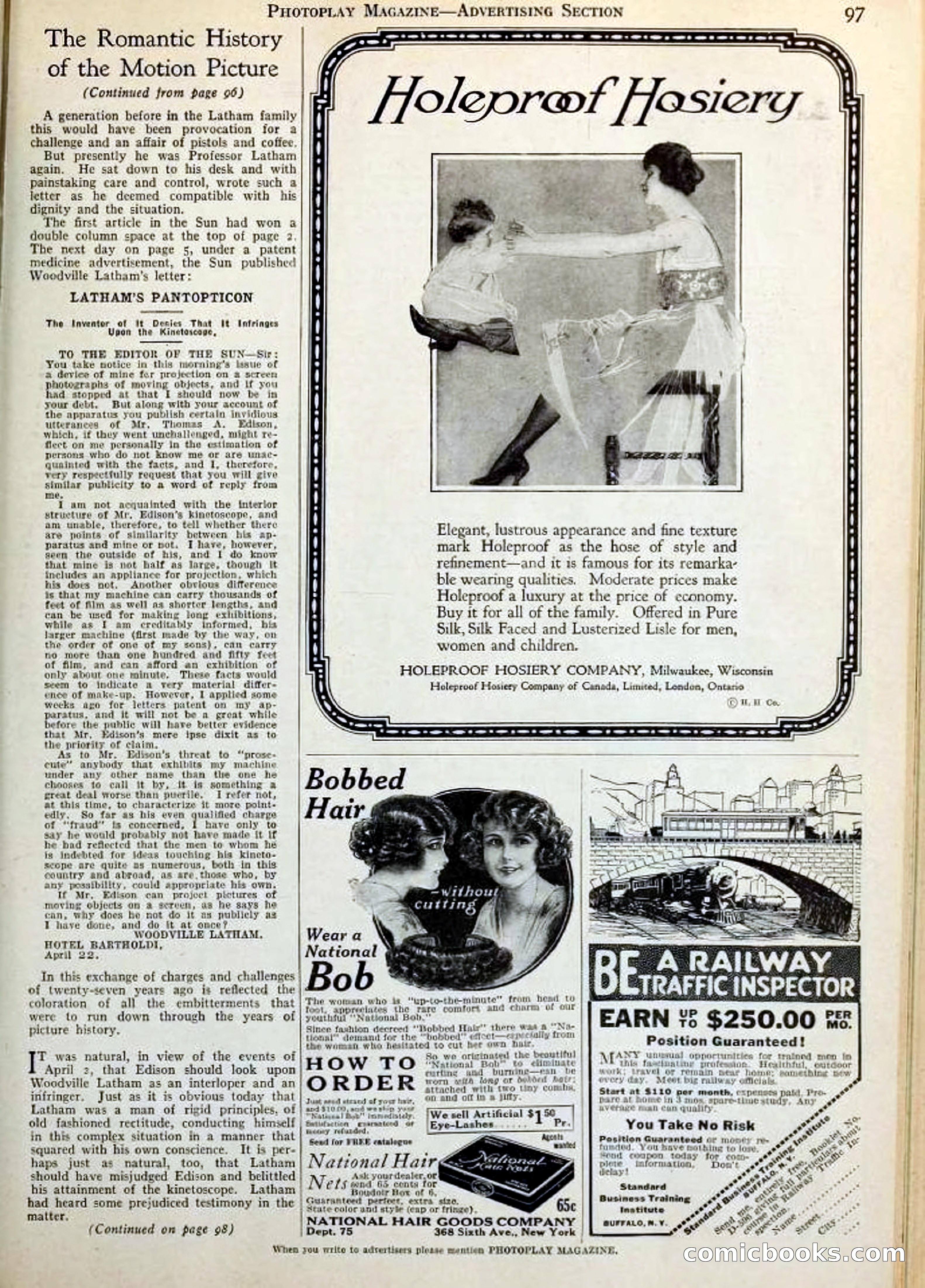
# Page Analysis This is an **advertising section** (page 97) of *Photoplay Magazine*, featuring multiple advertisements interspersed with the conclusion of an article titled "The Romantic History of the Motion Picture." The main content includes a letter from "Woodville Latham" describing his "Pantopticon" film projection invention, followed by several period advertisements: Holeproof Hosiery (featuring a photograph of women), a "Bobbed Hair" styling product ad, a National Bob hair net advertisement, a Railway Traffic Inspector job posting ($250/month), and National Hair Goods Company product. The page mixes editorial content with commercial promotions typical of early 20th-century magazine publishing.
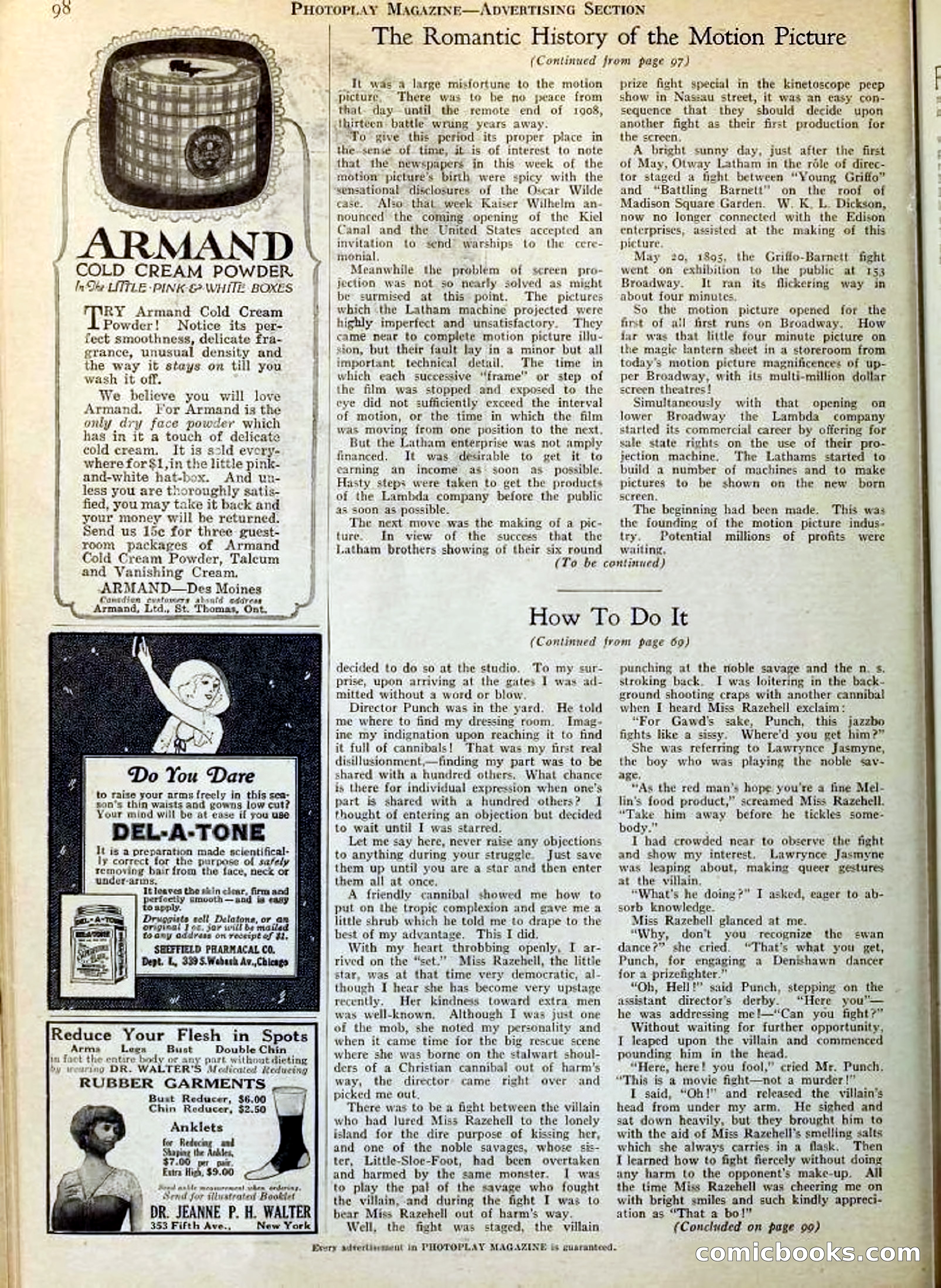
# Page 98: Photoplay Magazine Advertising Section This page is primarily an **advertising and editorial mix** from Photoplay Magazine's advertising section. The visible content includes: **Advertisements:** Armand Cold Cream Powder (left side), "Do You Dare" Delrone hair removal product, Dr. Walter's Rubber Garments for flesh reduction, and Dr. Jeanne P. H. Walter's services (bottom). **Editorial Content:** "The Romantic History of the Motion Picture" (continued from page 97) discusses early film technology and the Latham brothers' contributions to cinema. A separate section titled "How To Do It" (continued from page 69) appears to be a behind-the-scenes account of film production, describing directing, stunts, and fight choreography. The page reflects typical early-20th-century pulp magazine layout combining entertainment content with beauty and health product advertisements.
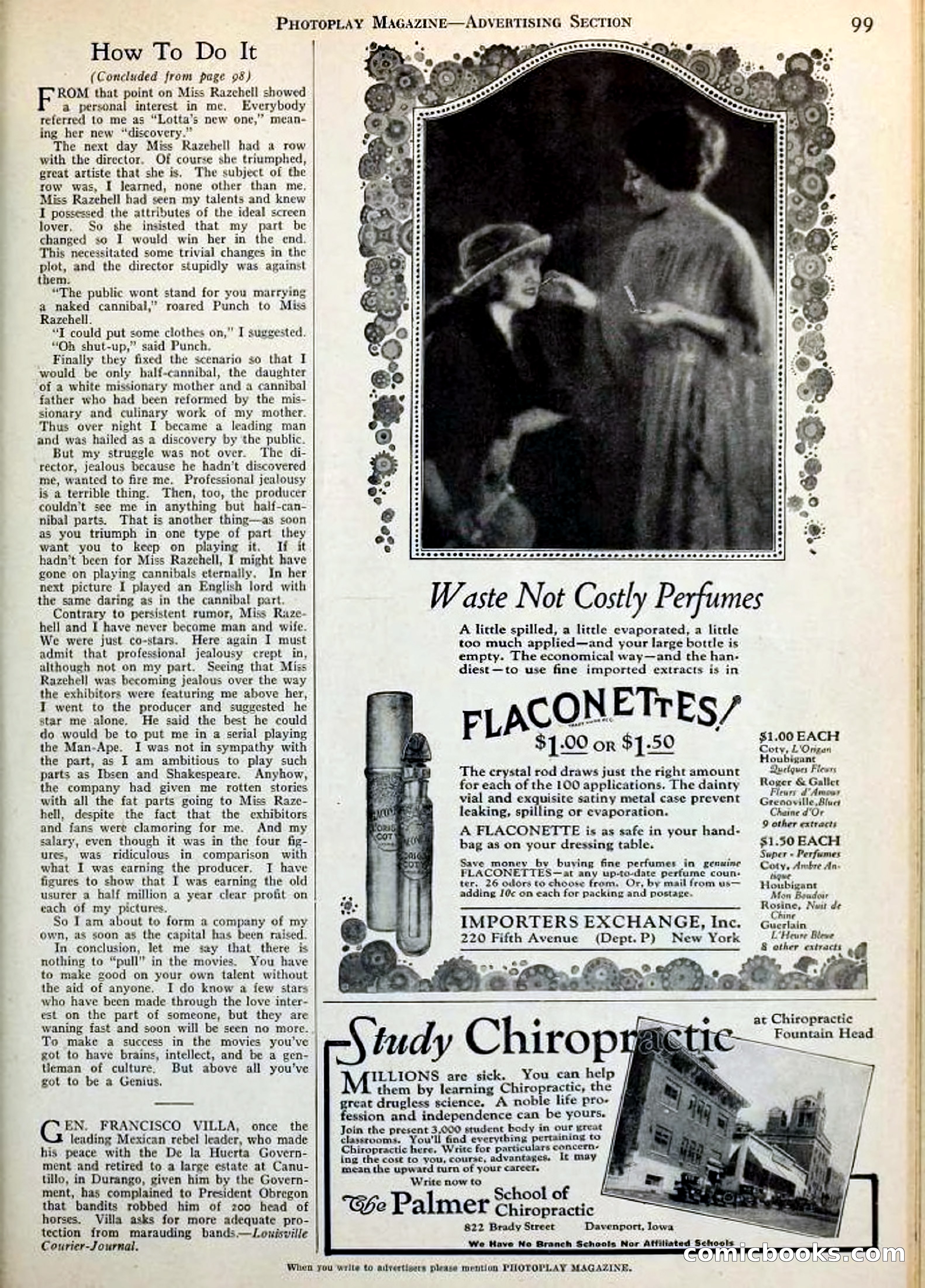
# Page 99: Photoplay Magazine Advertising Section This is an advertising section from *Photoplay Magazine*. The left column continues a story titled "How To Do It" about an actor's career struggles in early cinema, discussing conflicts with directors and producers over roles and professional jealousy. The right side features advertisements, including a prominent perfume ad for "Flaconettes" (priced $1.00-$1.50) from Importers Exchange, Inc., and an advertisement for the Palmer School of Chiropractic in Davenport, Iowa, featuring a photograph of their building. The page mixes editorial content with commercial advertising typical of early-20th-century entertainment magazines.
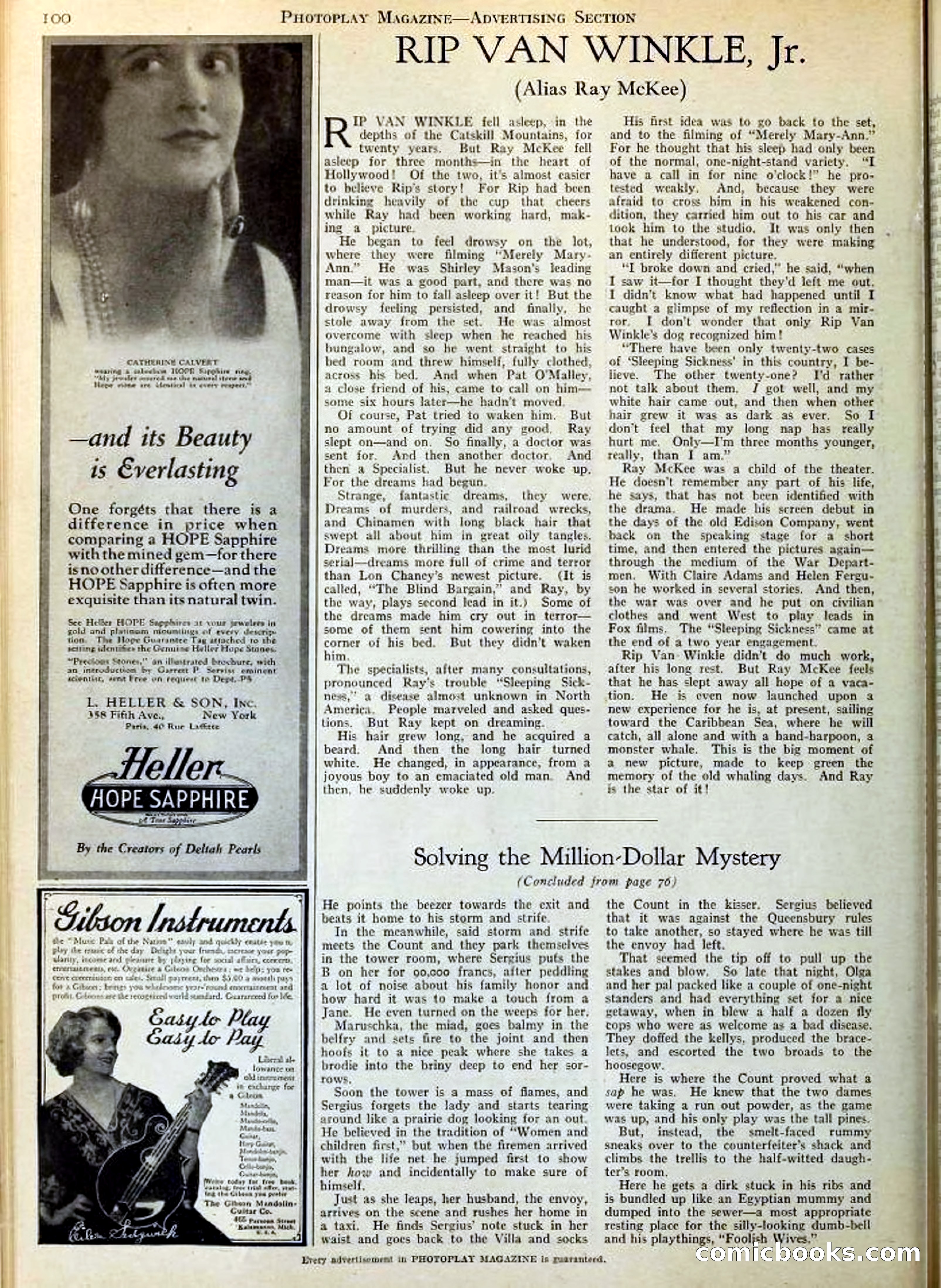
# Page Analysis This is an **advertising and editorial page** from *Photoplay Magazine*'s advertising section (page 100). The page contains multiple advertisements interspersed with editorial content about actor Rip Van Winkle Jr. (alias Ray McKee). The editorial piece describes how McKee fell asleep on a film set in the Catskill Mountains and remained unconscious for three months, experiencing vivid dreams about crime, murder, and railroad wrecks. Upon waking, he had grown long white hair and a beard, completely transforming his appearance. The article concludes with McKee preparing to sail toward the Caribbean Sea for a new film project. The page also advertises Hope Sapphire jewelry, Gibson Instruments, and other products typical of early-20th-century pulp magazine publications.
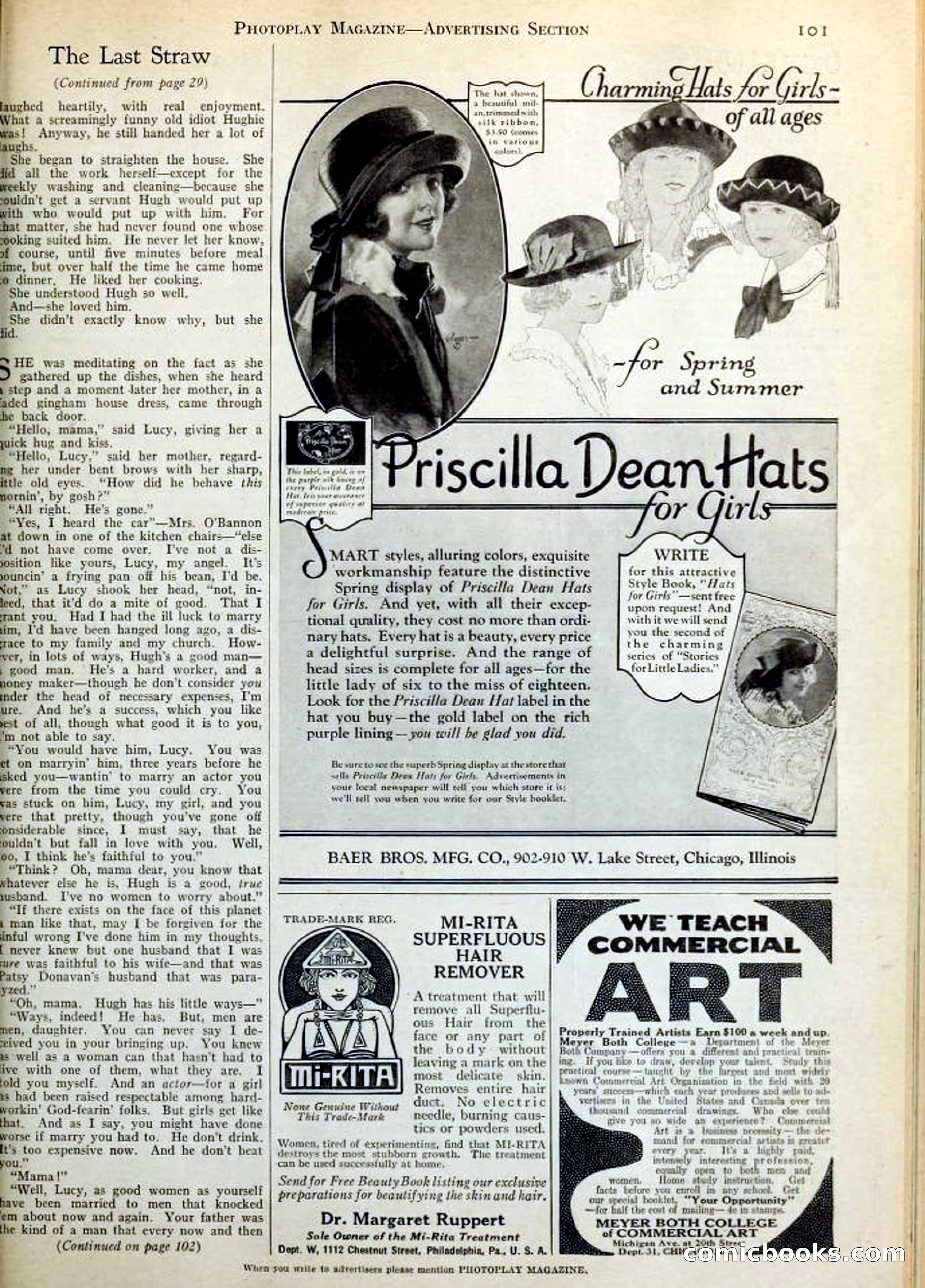
# Page Content Analysis This is an advertising section from *Photoplay Magazine* (page 101). The page is dominated by advertisements rather than editorial content. The largest ad promotes Priscilla Dean Hats for Girls, featuring illustrated hats "for Spring and Summer" with a call to write for a style book. Additional advertisements include Mi-Rita Superfluous Hair Remover (with treatment instructions by Dr. Margaret Ruppert), and an ad for Meyer Both College's Commercial Art program. A brief continuation of the story "The Last Straw" appears in the left column, detailing dialogue between characters Lucy and her mother about Lucy's past romantic relationship with an actor named Hugh.
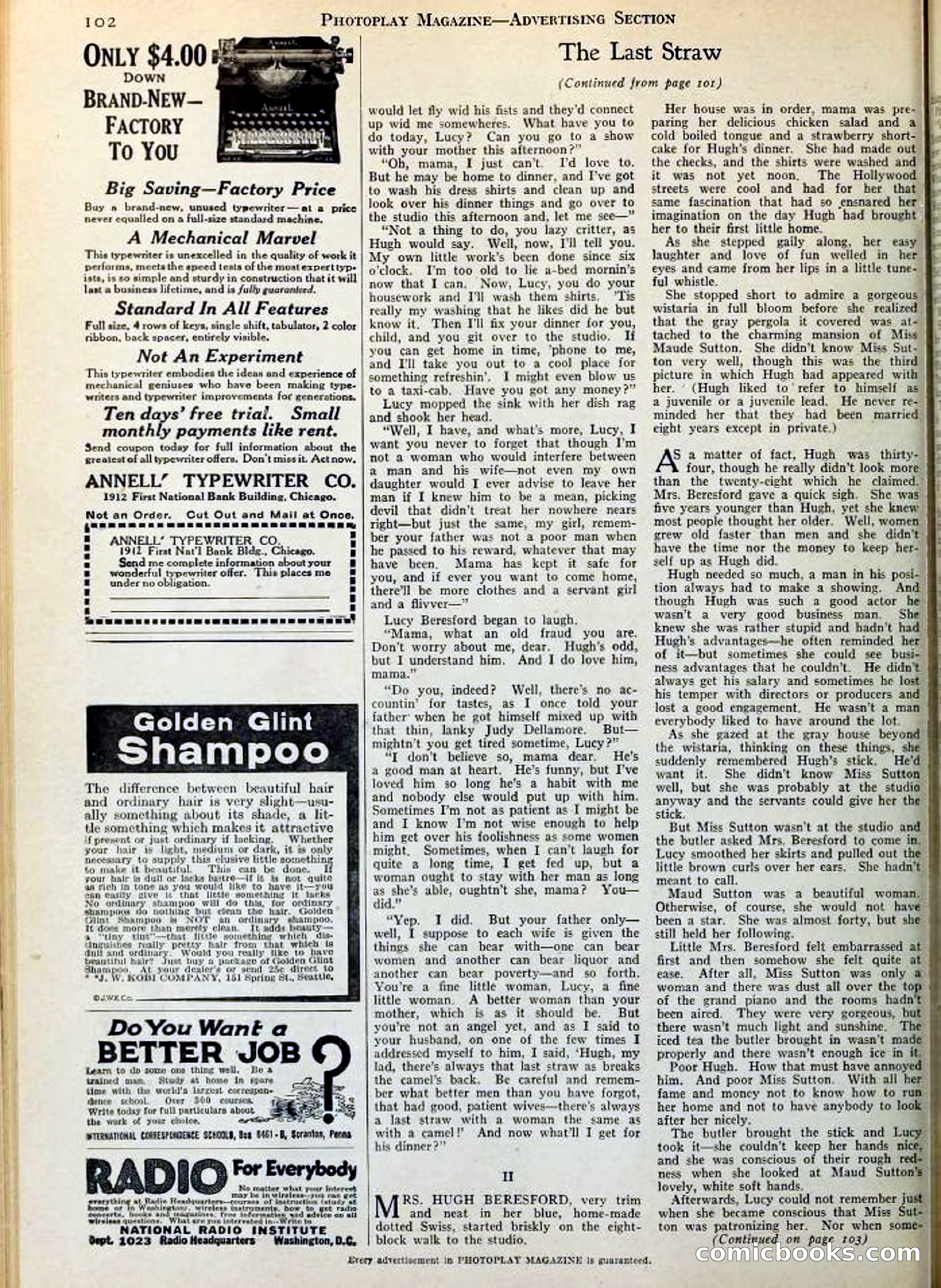
# Page Analysis This is an **advertising and story continuation page** from *Photoplay Magazine*'s advertising section (page 102). The page contains primarily **advertisements** for typewriters (Annell's), shampoo (Golden Glint), job training, and radio equipment. The visible **story text** (titled "The Last Straw," continued from page 101) appears to be a domestic drama involving characters named Lucy, Hugh, and Miss Sutton. The narrative discusses marital tensions, Hugh's career struggles, and Lucy's concerns about their finances and relationship. The story continues onto page 103. The page represents typical pulp-magazine content: commercial advertisements mixed with serialized fiction.
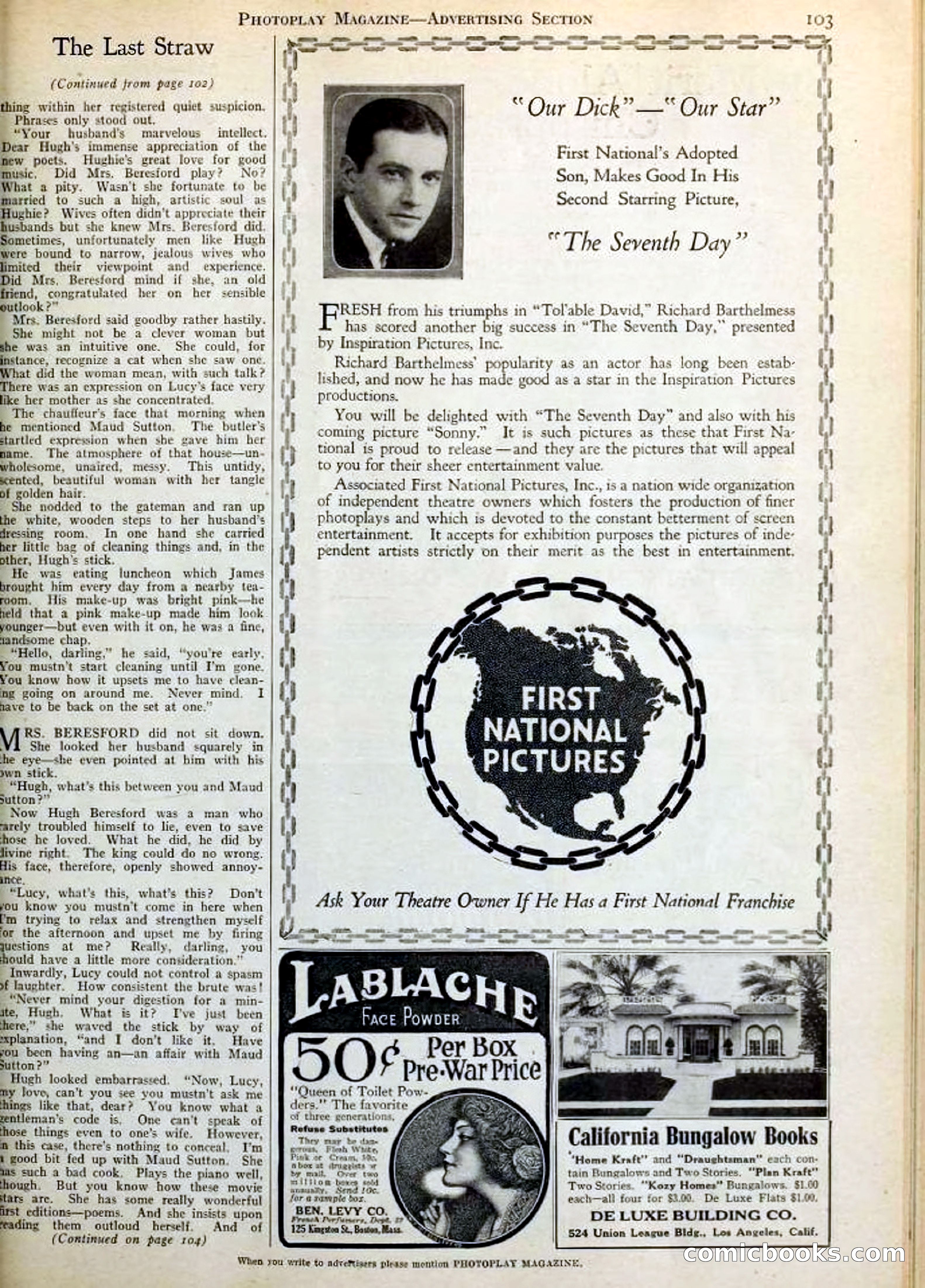
# Page Analysis This is an advertising section (page 103) from *Photoplay Magazine*. The left column continues a story titled "The Last Straw" from the previous page, featuring narrative prose about characters named Hugh Beresford and Mrs. Beresford. The right side contains advertisements, primarily for First National Pictures promoting actor Richard Barthelmess in "The Seventh Day," described as his second starring picture for the studio. Below that are ads for Lablache Face Powder (50¢ per box, pre-war price) and California Bungalow Books. The page is primarily advertising with embedded story continuation rather than a typical story page.
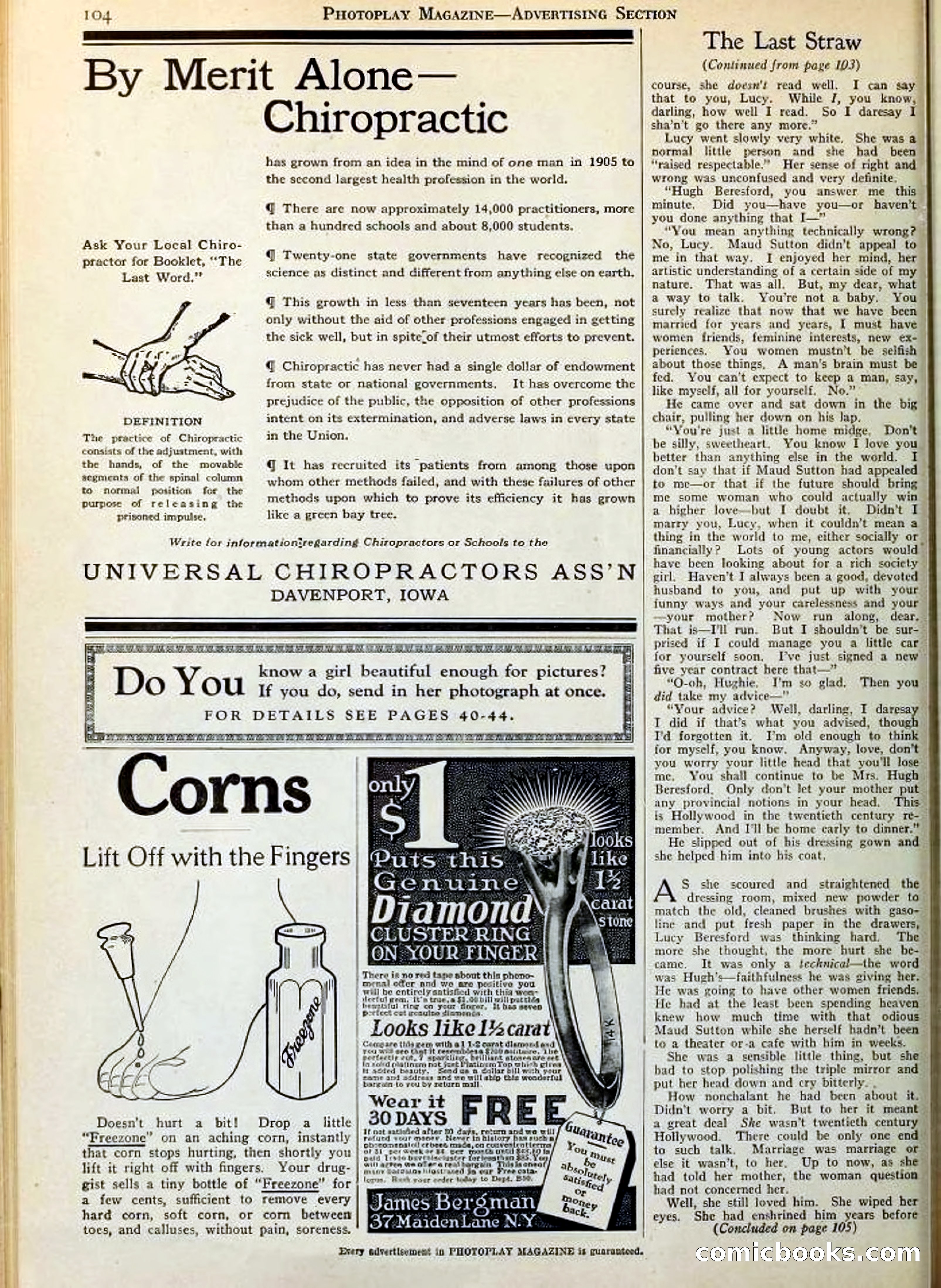
# Page 104: Photoplay Magazine Advertising Section This is an advertising page from *Photoplay Magazine*, featuring multiple commercial advertisements. The main ads promote chiropractic services (Universal Chiropractors Association, Davenport, Iowa), a corn removal product called "Freezone," and a diamond cluster ring by James Bergman of Syracuse, N.Y. On the right side, the page continues a serialized story titled "The Last Straw" (continued from page 103), which appears to be a romantic narrative involving characters named Lucy and Hugh Beresford. The page mixes story prose with period advertisements typical of early-20th-century magazine layout.
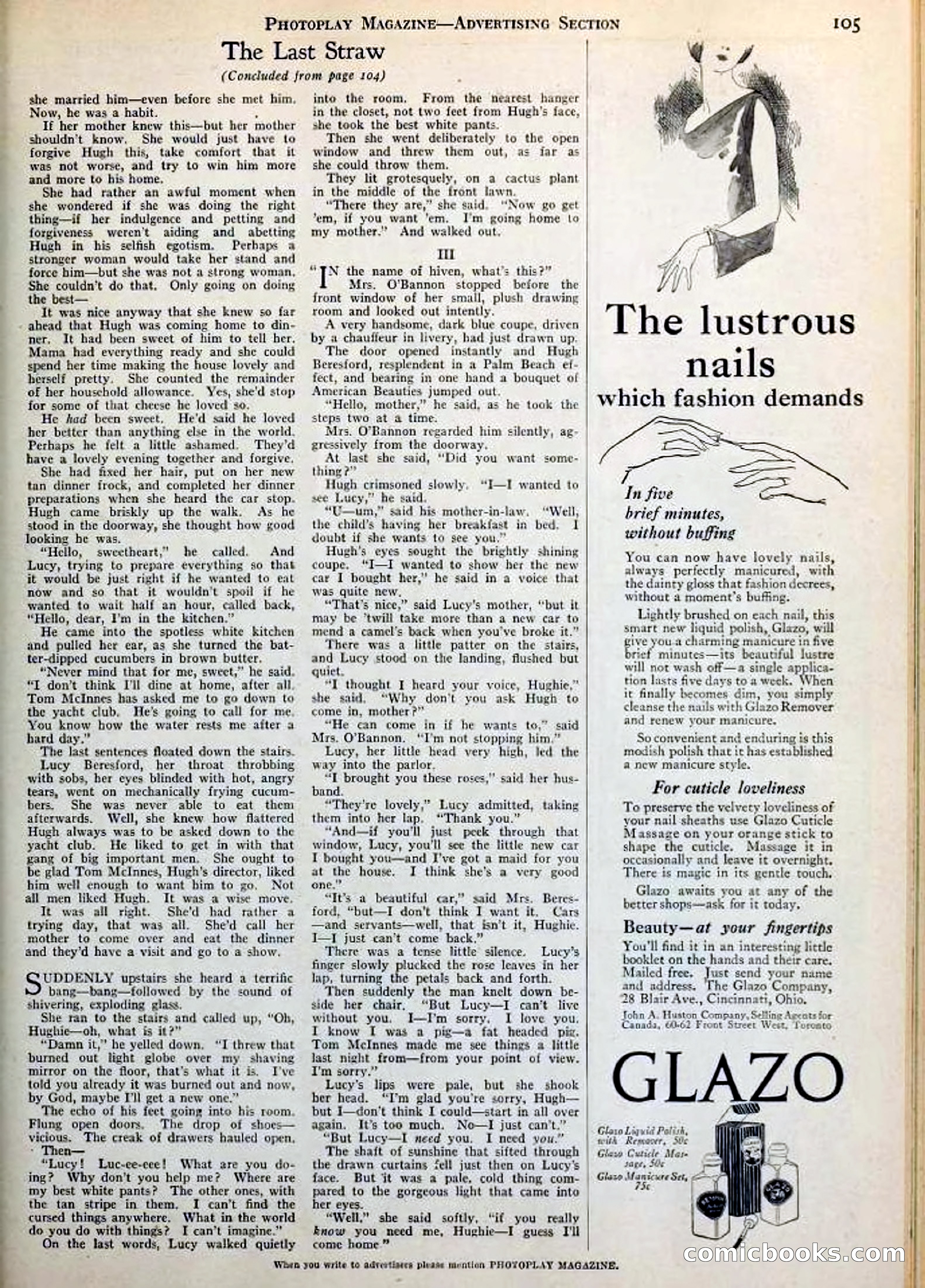
# Analysis of Page 105 This page from *Photoplay Magazine* contains the conclusion of a story titled "The Last Straw" (continued from page 104). The left two-thirds consists of prose narrative depicting domestic conflict between characters named Hugh, Lucy, and Mrs. O'Bannon, involving tensions over Hugh's mother and relationship issues. The right third of the page is a full-page advertisement for Glazo nail polish and manicure products. The ad features an illustration of a woman's hand and promotes "lustrous nails" achievable "in five brief minutes, without buffing," emphasizing convenience and beauty for fingertips.
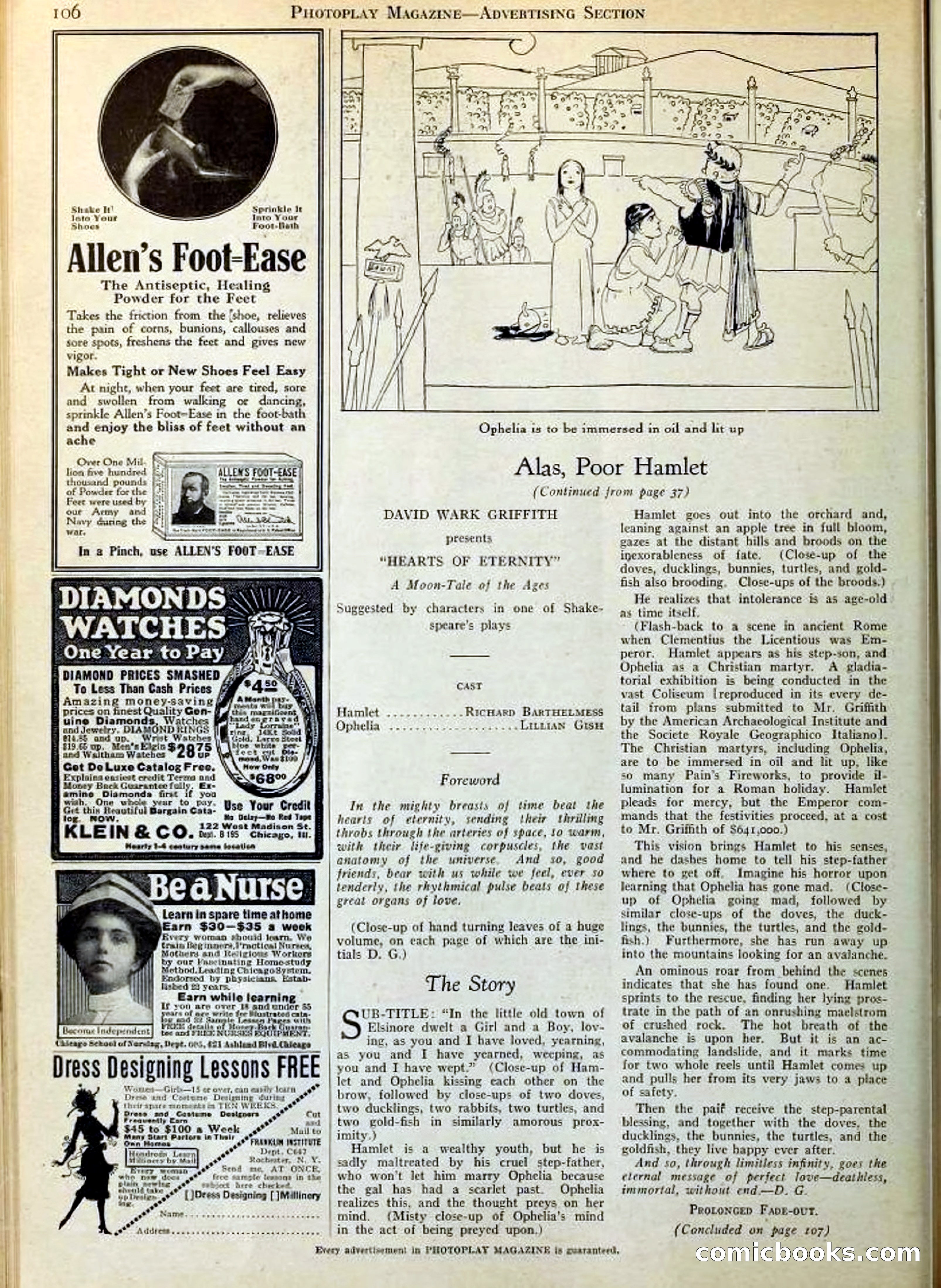
# Page 106: Photoplay Magazine Advertising Section This is an advertising page from *Photoplay Magazine*'s advertising section, as indicated by the header. The page contains multiple advertisements for various products including Allen's Foot-Ease powder, Diamonds Watches, a Bea Nurse correspondence course, and Dress Designing Lessons. On the right side is an illustration accompanying the story "Alas, Poor Hamlet," which appears to be a theatrical adaptation by David Wark Griffith featuring actors Richard Barthelmess and Lillian Gish. The illustration shows figures in what appears to be a classical setting, likely depicting a scene from this reimagined version of Shakespeare's play.
# Photoplay Magazine — Advertising Section, Page 107 This is an advertising section page featuring multiple product advertisements. The dominant ad showcases **Neet**, a hair-removal cream, endorsing actress Betty Blythe from "The Queen of Sheba." The ad emphasizes Neet's ease of use and effectiveness for underarm hair removal. Below are additional advertisements including "Have Baby Comfy" (a Gordon Motor Crib), "Bookkeeping Made Easy," a "$500 Empty Arms Prize Contest," and a "Bead Making Outfit Free" offer. The page also contains a brief plot synopsis for a film called "Alas, Poor Hamlet" featuring Erich Von Stroheim, though the main focus is commercial product promotion typical of early 20th-century magazine advertising.
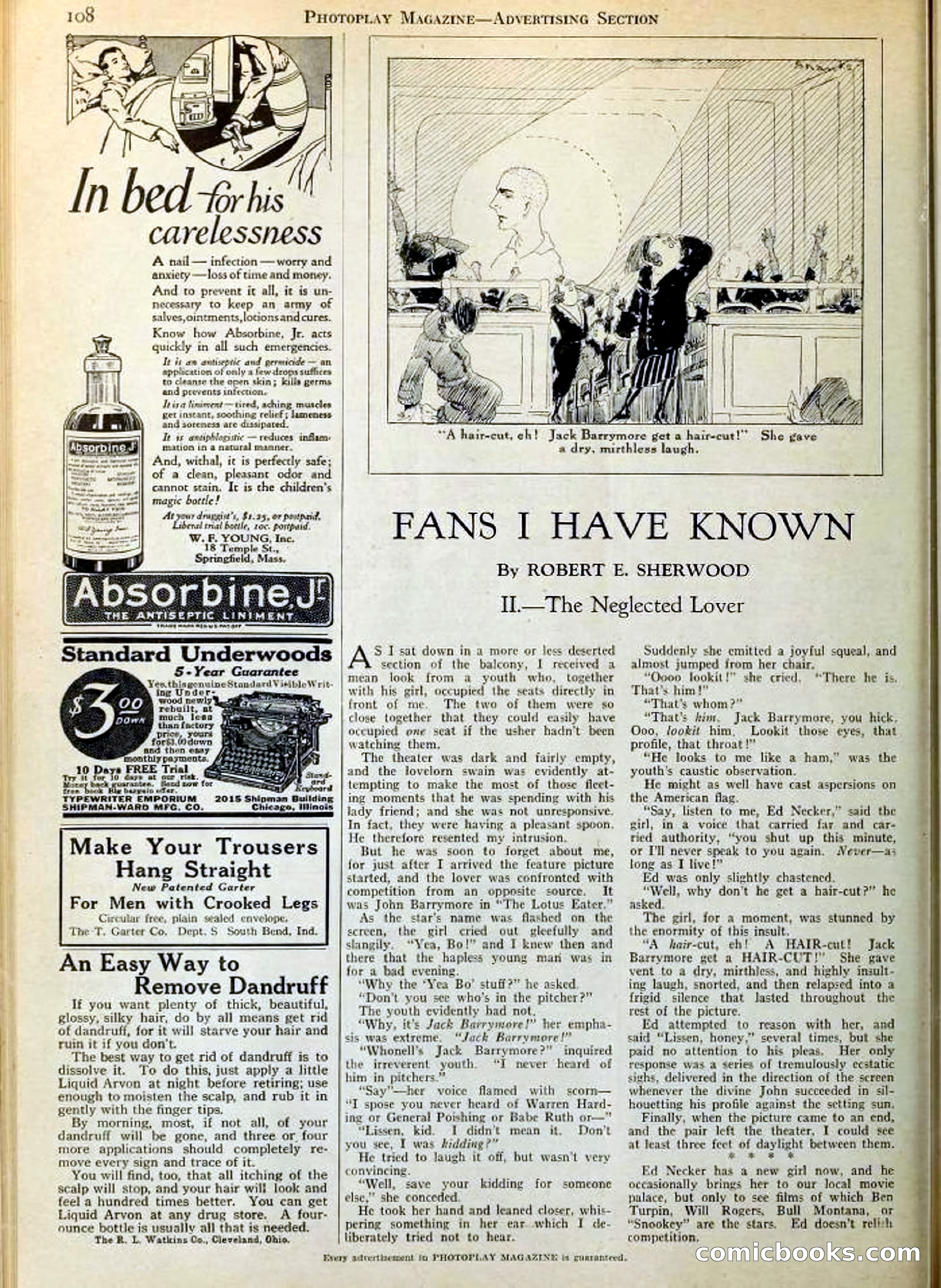
# Page Description This is an advertising and editorial page from *Photoplay Magazine*'s advertising section. The left side contains several product advertisements (Absorbine Jr. liniment, Standard Underwoods typewriters, trouser hangers, and dandruff treatments). The right side features an illustration accompanying a short story excerpt titled "Fans I Have Known II—The Neglected Lover" by Robert E. Sherwood. The illustration depicts a scene at what appears to be a theater, showing a woman laughing at a man who has apparently received a haircut, with dialogue mentioning "Jack Barrymore." The story excerpt describes an awkward romantic encounter at a movie theater.
# Page 109: Photoplay Magazine Advertising Section This is an advertising and editorial page from *Photoplay Magazine*. The top half features an advertisement for a new Corticelli Yarn Book promoting knitted sweaters and dresses, accompanied by photographs of fashionable knitwear designs. The lower half contains multiple advertisements, including products for removing freckles, a Wurlitzer musical instrument offered on trial and monthly payments, and a prominent "From Poverty to Riches" business opportunity advertisement featuring someone named Walter Michael Barry claiming to have built a $100,000 business starting with $60. The page also includes brief text columns titled "She Delivered the Goods" and "Night Life in Paris," appearing to be entertainment or society-related content.
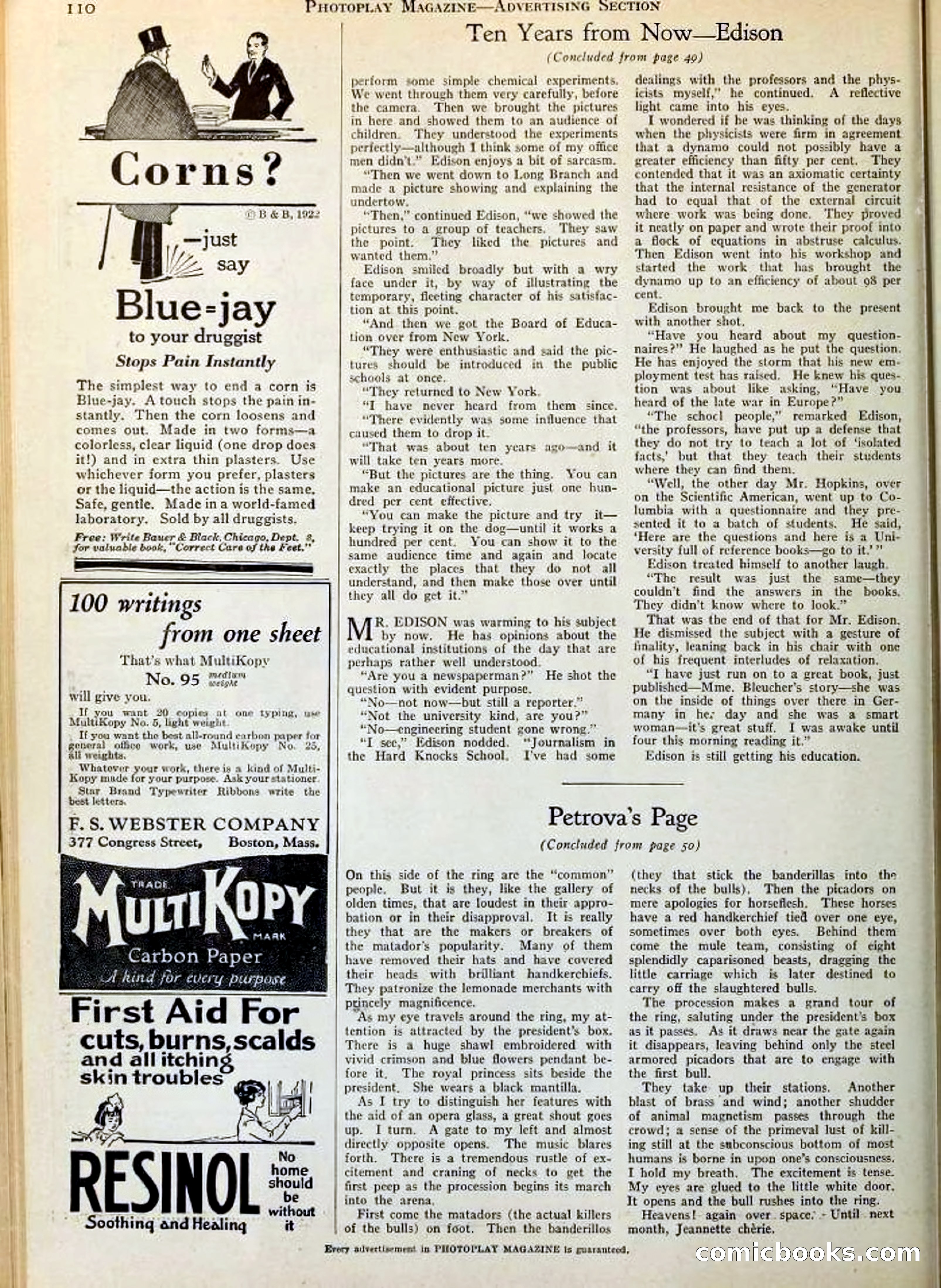
# Page Analysis This is an advertising section from *Photoplay Magazine*, page 110. The page is dominated by commercial advertisements for various products: Blue-jay corn plasters, MultiKopy carbon paper, Resinol healing ointment, and F.S. Webster Company typewriter supplies. Interspersed between these ads are two article sections: a continuation of "Ten Years from Now—Edison" (discussing Edison's educational demonstrations and philosophy), and "Petrova's Page" (describing observations from what appears to be a bullfighting ring, mentioning matadors and banderillas). The page is primarily an advertising section with minimal editorial content.
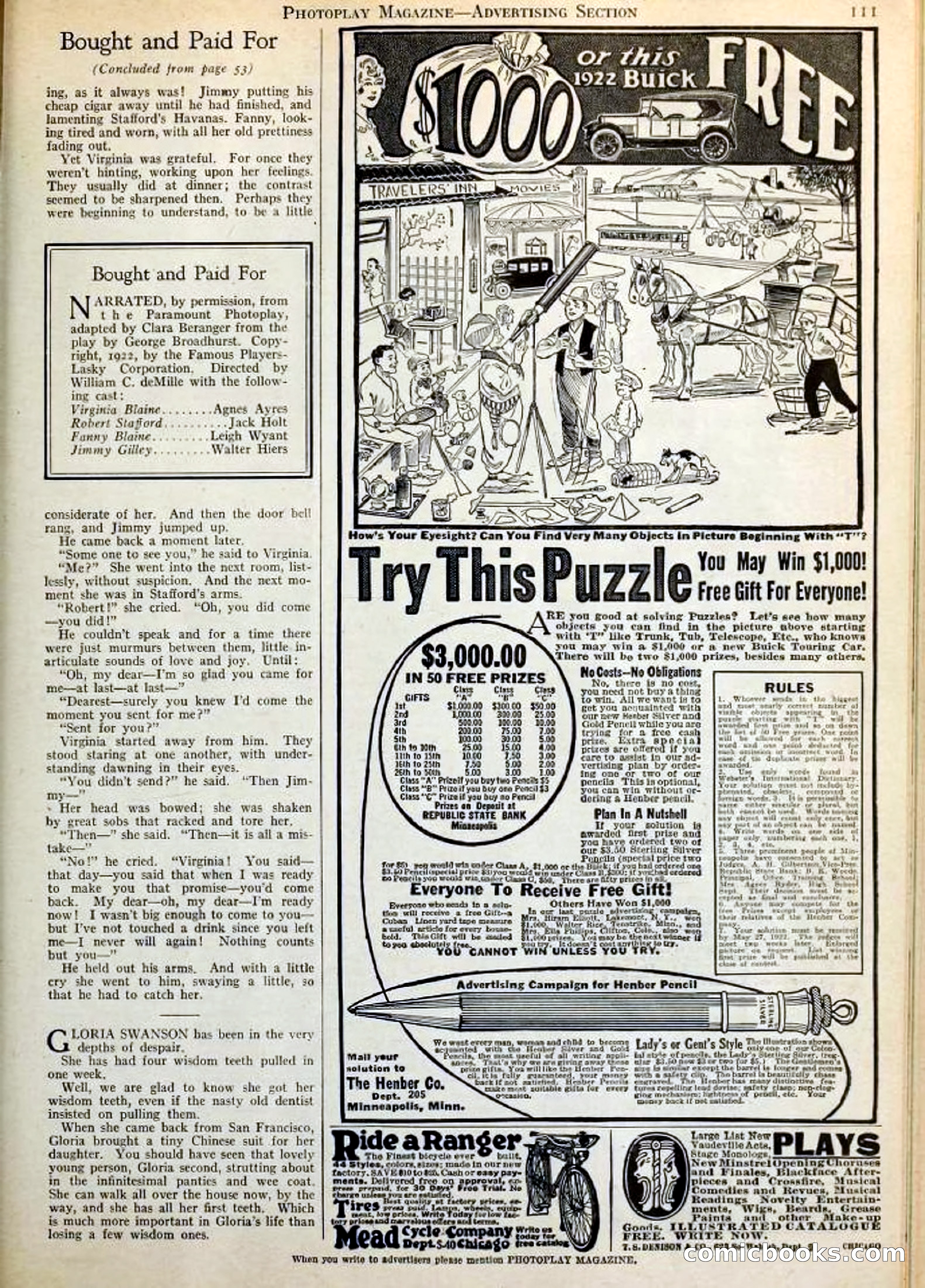
# Page Analysis This is an advertising and editorial page from *Photoplay Magazine*. The top portion contains the conclusion of a story called "Bought and Paid For," which appears to be a narrative about romantic conflict involving characters named Virginia, Jimmy, Stafford, and Fanny. The remainder of the page consists entirely of advertisements, including a prominent puzzle contest offering $3,000 in prizes from Republic State Bank, advertisements for Henber Pencils, Ride-a-Ranger bicycles, and Mead Cycle Company products. The page exemplifies how early pulp magazines intermingled serialized fiction with commercial advertising to generate revenue.
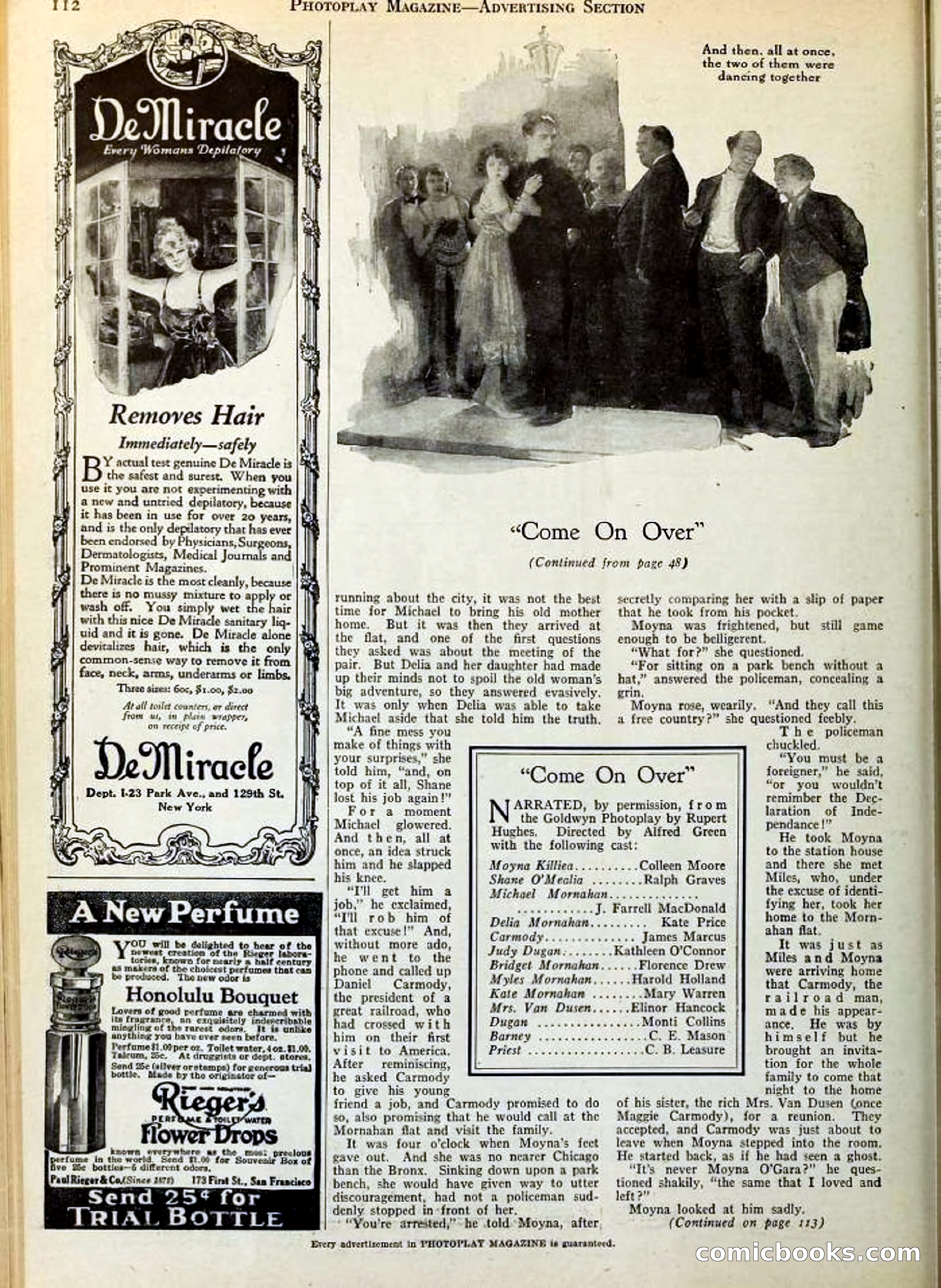
# Page 112 of Photoplay Magazine—Advertising Section This is primarily an **advertising and story content page** from an early-20th-century magazine. The left side features two advertisements: one for "De Miracle," a hair removal product marketed as "Every Woman's Depilatory," and another for "Honolulu Bouquet" perfume and related products. The right side contains story prose and an illustration from "Come On Over," a Goldwyn Photoplay directed by Alfred Green, with a cast list provided. The visible text continues a narrative involving characters named Moyna, Michael, and Delia, discussing a policeman's inquiry about their travels. The illustration shows several formally-dressed figures in what appears to be an indoor scene.
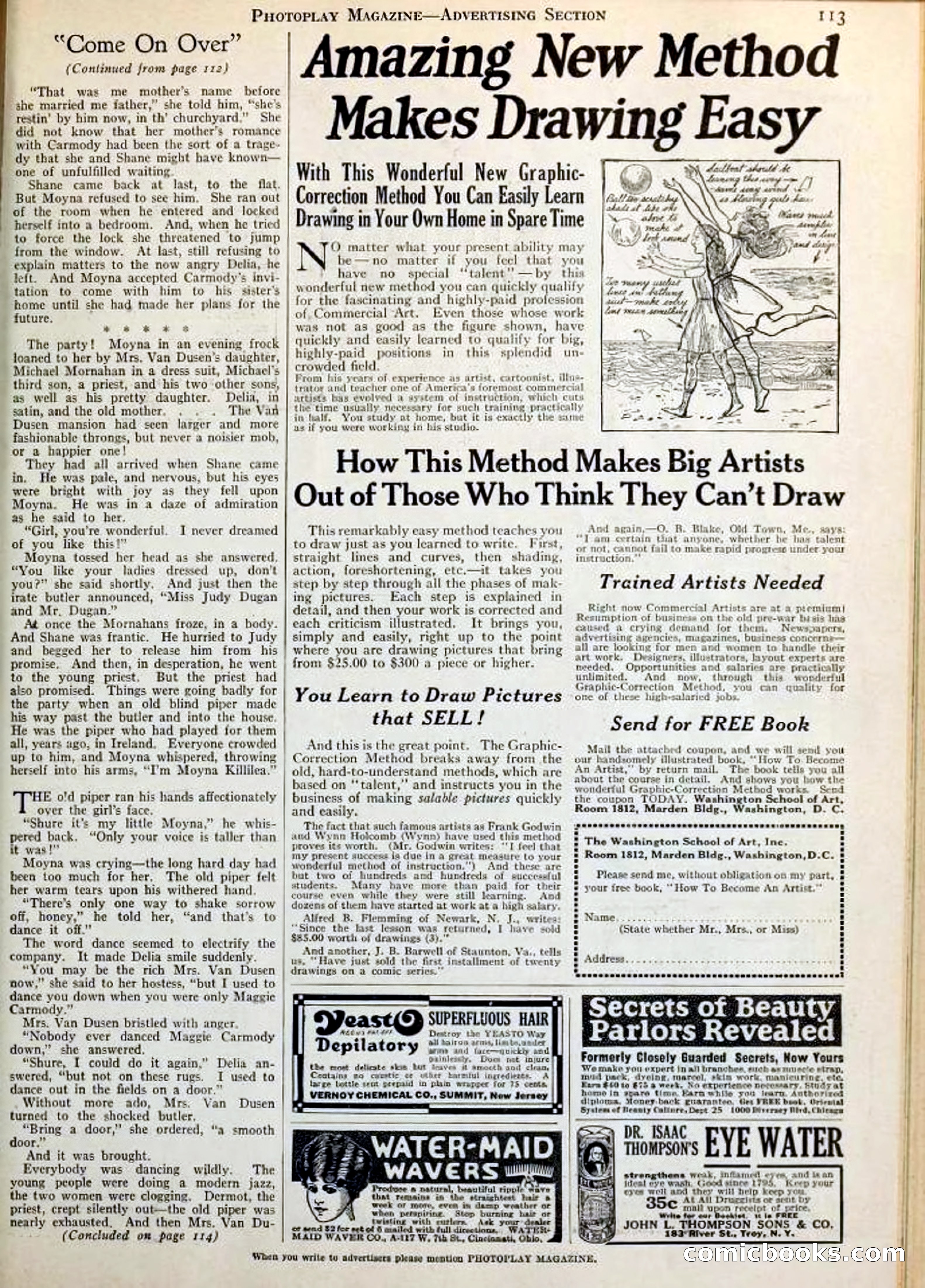
# Page Description This is an advertising section (page 113) from Photoplay Magazine. The top half features a large advertisement for "The Washington School of Art's Graphic-Correction Method," promoting an easy system for learning to draw at home. The ad includes sample drawings of a tree and includes testimonials from supposedly famous artists. The bottom half contains smaller advertisements for various products: Yeast-O Depilatory (for removing hair), Water-Maid cosmetic water, and Dr. Isaac Thompson's Eye Water. The left column continues a fiction story titled "Come On Over" from the previous page, featuring dialogue between characters named Shane, Moyna, and others at what appears to be a social gathering.
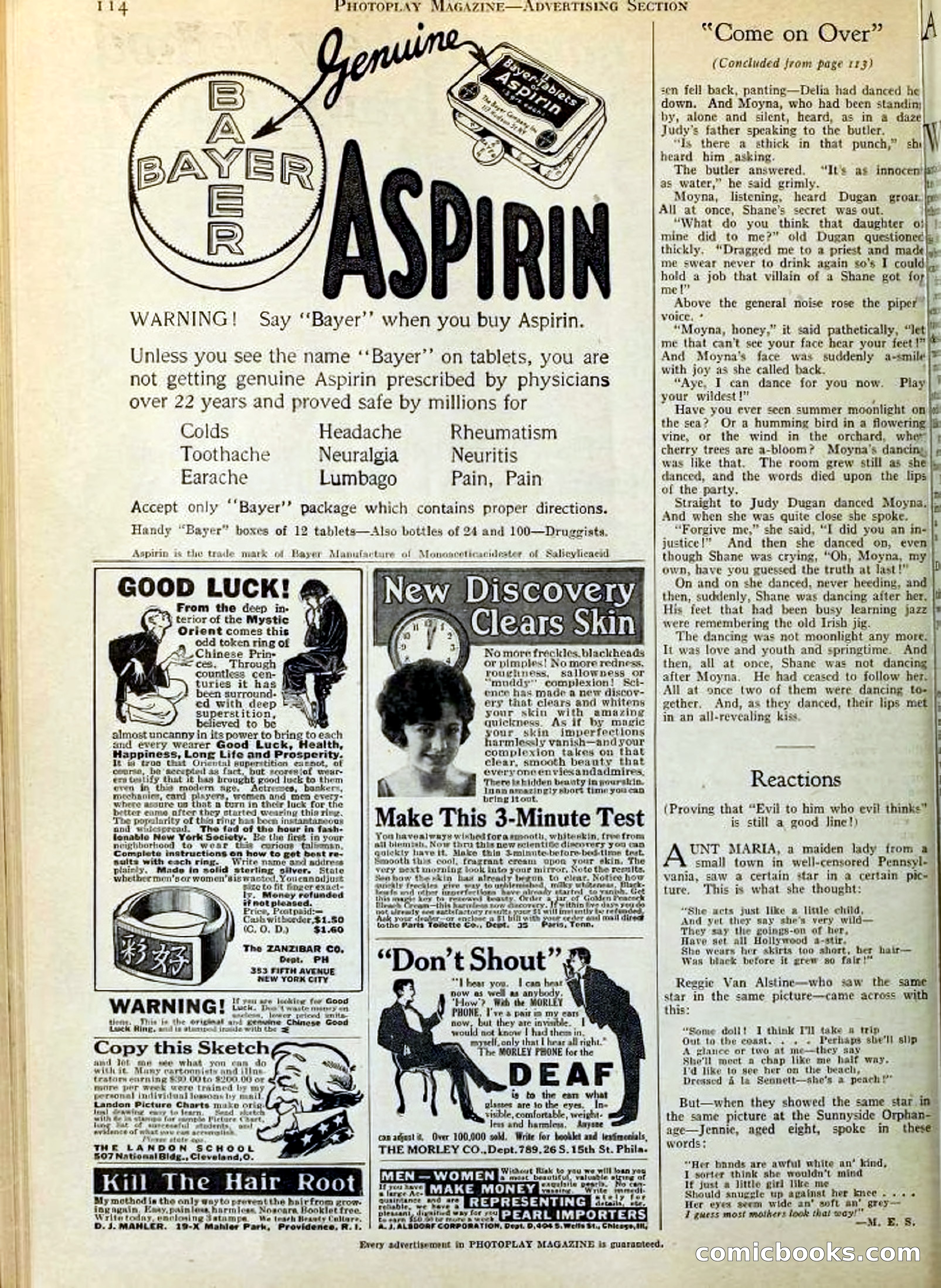
# Page Description This is an advertising section (page 114) from *Photoplay Magazine*. The page is dominated by multiple product advertisements typical of early-20th-century publications, including ads for Bayer Aspirin, skin-clearing treatments, hair removal products, and a "Morley Phone" for the deaf. On the right side, there appears to be story prose concluding a narrative titled "Come on Over" (from page 113), which describes a dancing scene between characters named Moyna and Shane. Below that is a "Reactions" column containing brief anecdotes from readers about Hollywood actors and film experiences. The page is primarily commercial in nature, mixing entertainment content with period marketing.
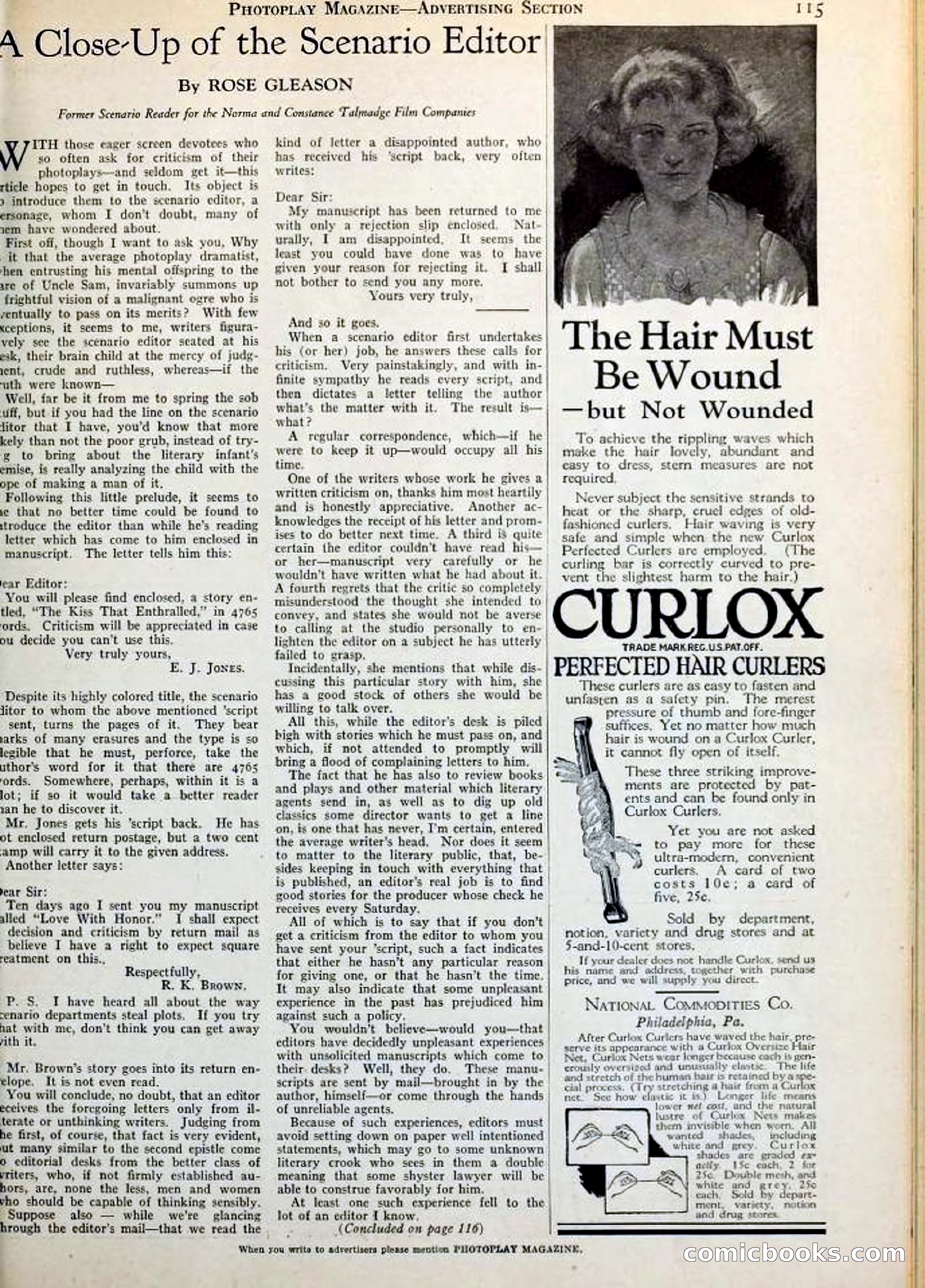
# Page Description This is an advertising section from *Photoplay Magazine* (page 115). The page contains an article titled "A Close-Up of the Scenario Editor" by Rose Gleason, discussing the role of scenario editors in film production and their interactions with writers submitting scripts. The article includes sample rejection letters from editors and explores the challenges editors face when critiquing dramatic works. On the right side is a full-page advertisement for Curlox Perfected Hair Curlers, featuring a product image and testimonials about the safety and effectiveness of the curling device. The ad emphasizes that the curlers are "safe and simple" to use.
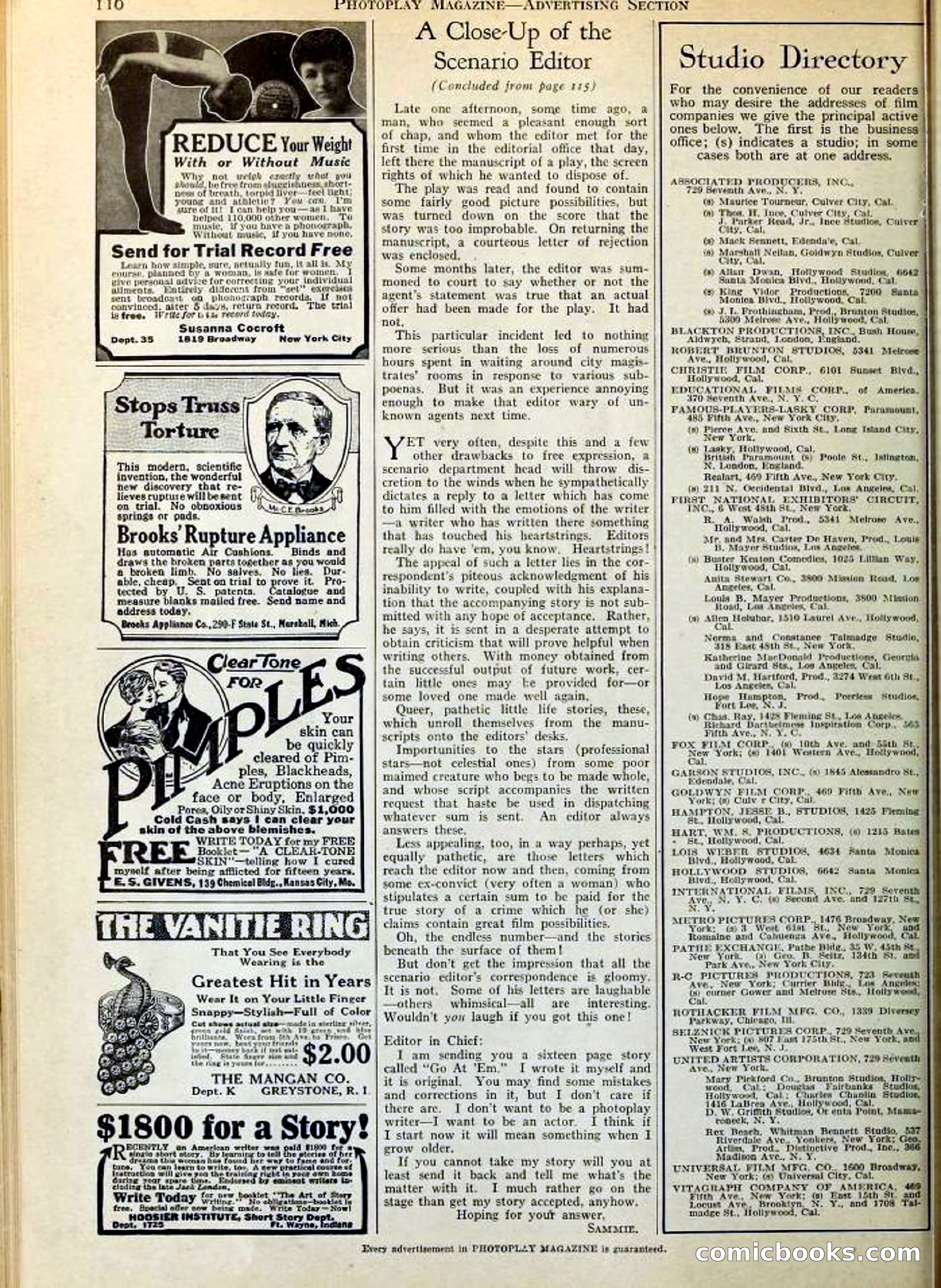
# Page Content Analysis This is an advertising and directory page (page 116) from *Photoplay Magazine*'s advertising section. The page contains primarily advertisements for various products and services (weight reduction, medical devices, skin treatments) alongside a "Studio Directory" listing film production companies and their addresses. The central feature is a continued article titled "A Close-Up of the Scenario Editor," which discusses the experiences of a script editor receiving submissions from writers. The piece describes the emotional appeals in rejection letters and the editor's process for evaluating story proposals. The page is predominantly commercial in nature, mixing editorial content with paid advertisements typical of early-20th-century magazine publishing.
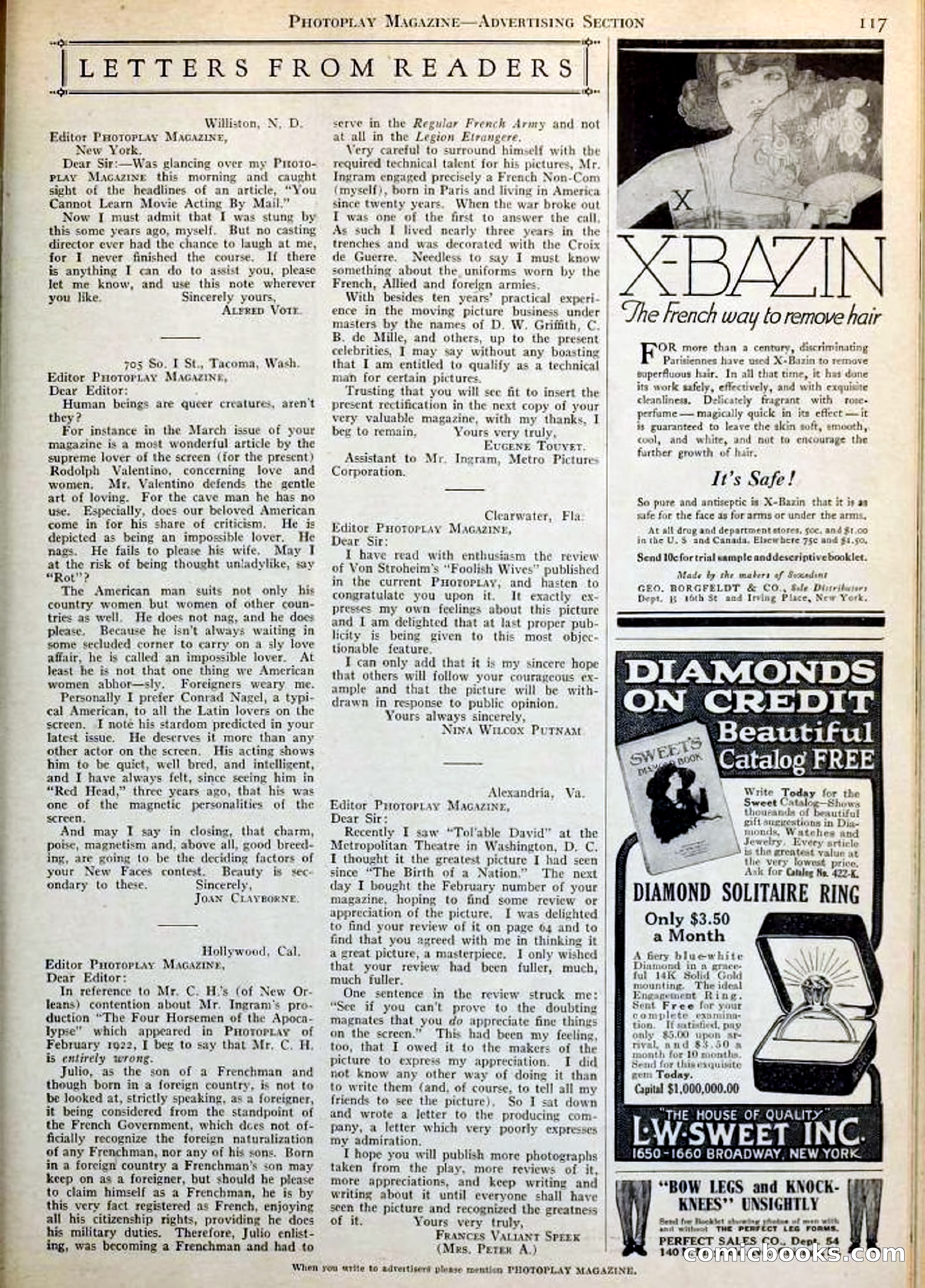
# Page Description This is an advertising section page from Photoplay Magazine featuring a "Letters from Readers" column alongside commercial advertisements. The left side contains reader correspondence addressing topics like film acting instruction, actor Rudolf Valentino's screen persona, and a review of "Tolable David." The right side displays period advertisements, including X-Bazin hair removal product, a Diamond Solitaire Ring offer, and other luxury goods. One advertisement features a photograph of a woman's face at the top. The page layout is typical of 1920s magazine design, mixing editorial content with paid advertising to generate revenue.
# Page Analysis This is an advertising and editorial page from *Photoplay Magazine*'s classified advertising section. The bulk of the page contains small classified ads for various services—agents, salesmen, old coins, ambitious writers, patents, poems, ladies' cigarettes, manuscripts typing, and photography services. Interspersed are three brief editorial pieces: "When Valentino Taught Me to Dance" (concluded from page 45), discussing Rudolph Valentino's dance instruction; "Too Sharp to Trick," about Harold Lloyd's public appearance during a vacation; and "Lines to Any Movie Star," a poem offering various romantic sentiments to address to film actors. The page emphasizes services targeting aspiring writers and performers.
# Page Analysis: Photoplay Magazine Advertising Section This is an advertising section page from *Photoplay Magazine* featuring a advice column called "Miss Van Wyck Says." The left side contains multiple personal advice letters from readers addressing fashion, beauty, and lifestyle questions—covering topics like hair care, clothing choices, and weight management. The right side shows a photograph of what appears to be two people in conversation, with accompanying text titled "Here's Where We Got Our Start," which appears to be a testimonial or advertisement. Below that are various classified advertisements for correspondence schools and business opportunities. The page functions primarily as an advice and advertising section rather than fiction content.
# Page Analysis This is an advertising section from *Photoplay Magazine* (page 121). The page is dominated by commercial advertisements for various products and services—including Maybelline cosmetics, a ukulele course, a "Make Money at Home" scheme, drawing lessons, and hair/beauty treatments. Interspersed among these ads are brief entertainment industry gossip items discussing various actors and early film productions from roughly a decade prior, including mentions of Universal players, Nat C. Goodwin, and Charles Chaplin. There is also a short article titled "Backing the Bobbers" discussing bobbed hairstyles. The page is typical pulp-era advertising with minimal editorial content.
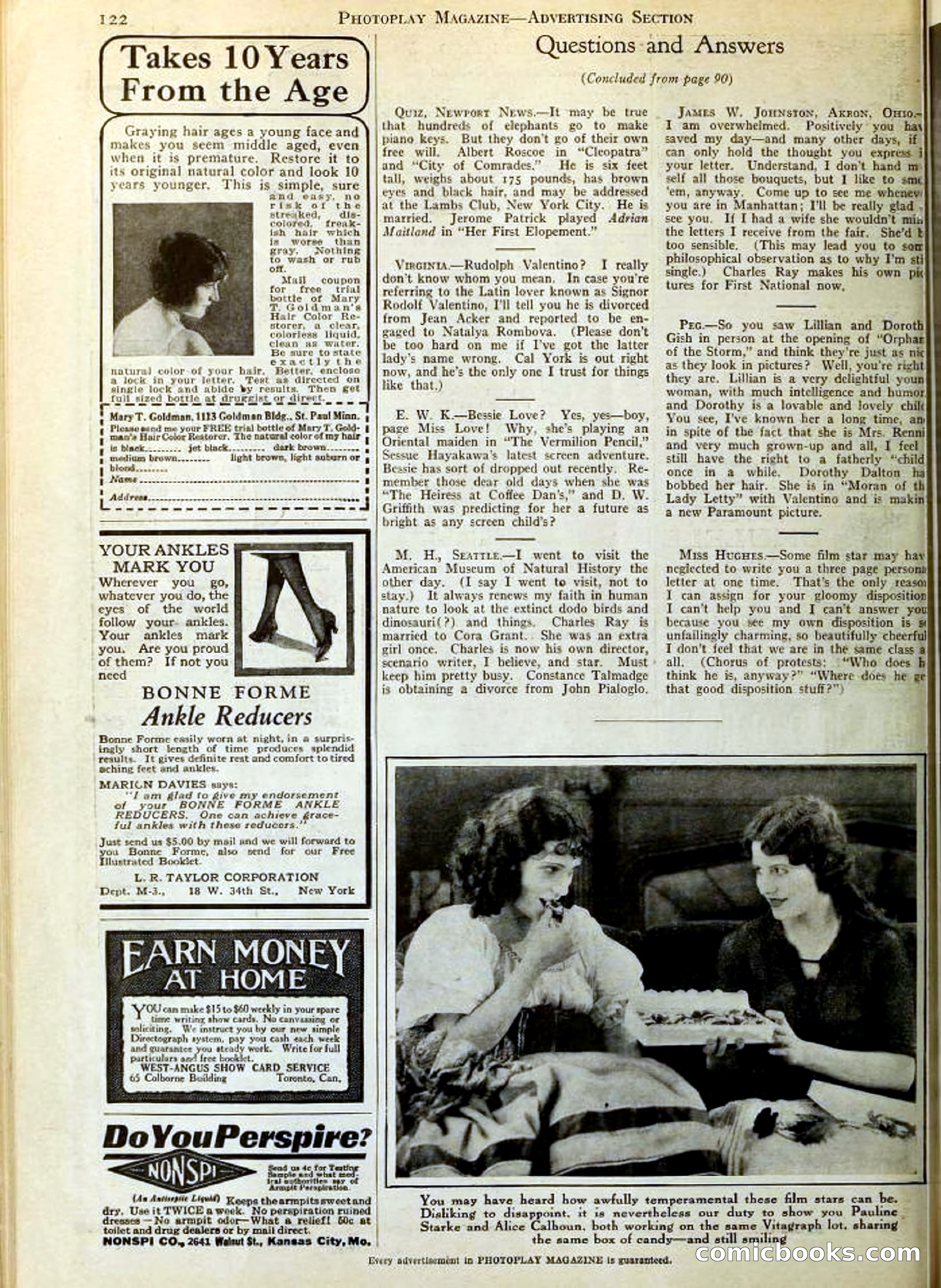
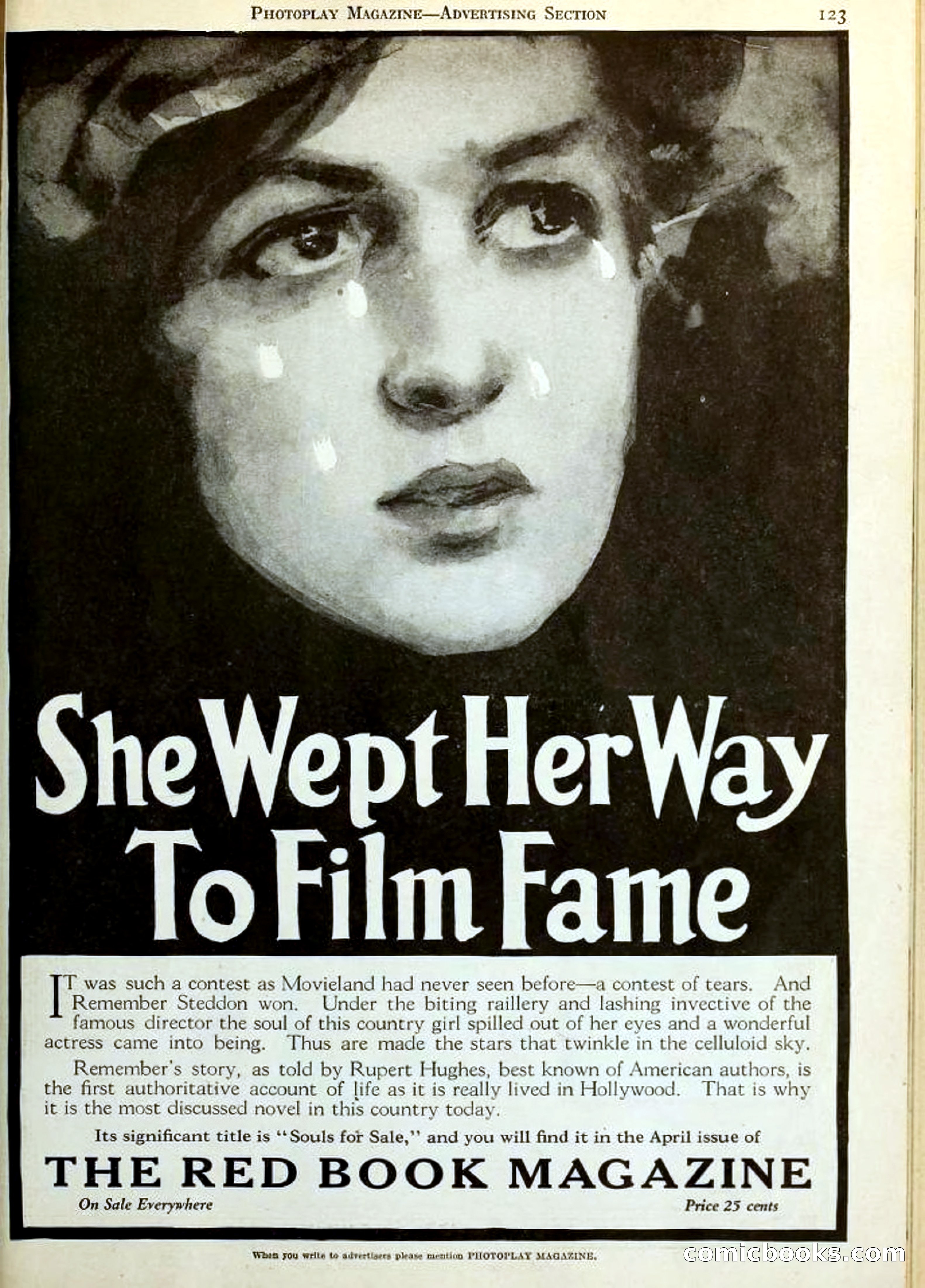
# Analysis This is an **advertisement page** (page 123 from Photoplay Magazine's advertising section) promoting *The Red Book Magazine*'s April issue. The ad features a dramatic black-and-white photograph of a woman's face with tears streaming down her cheeks. The headline reads "She Wept Her Way To Film Fame." The text describes a tearful contest in Movieland and credits author Rupert Hughes with writing "the first authoritative account of life as it is really lived in Hollywood." The featured article is titled "Souls for Sale." The ad promotes The Red Book Magazine as available everywhere for 25 cents. The page is primarily advertising rather than editorial content.
# Analysis This is an **advertising page** from Photoplay Magazine's advertising section (page 124). It features a full-page advertisement for Mellin's Food, a baby formula product. The ad shows a photograph of a young child named Margaret E. Calhoun from Vicksburg, Mississippi, wearing a white dress. The advertisement claims that "Mellin's Food and milk has raised thousands of bright and healthy babies" and invites readers to write for a free trial bottle and an instructional book titled "The Care and Feeding of Infants." The company address is listed as Boston, Massachusetts.
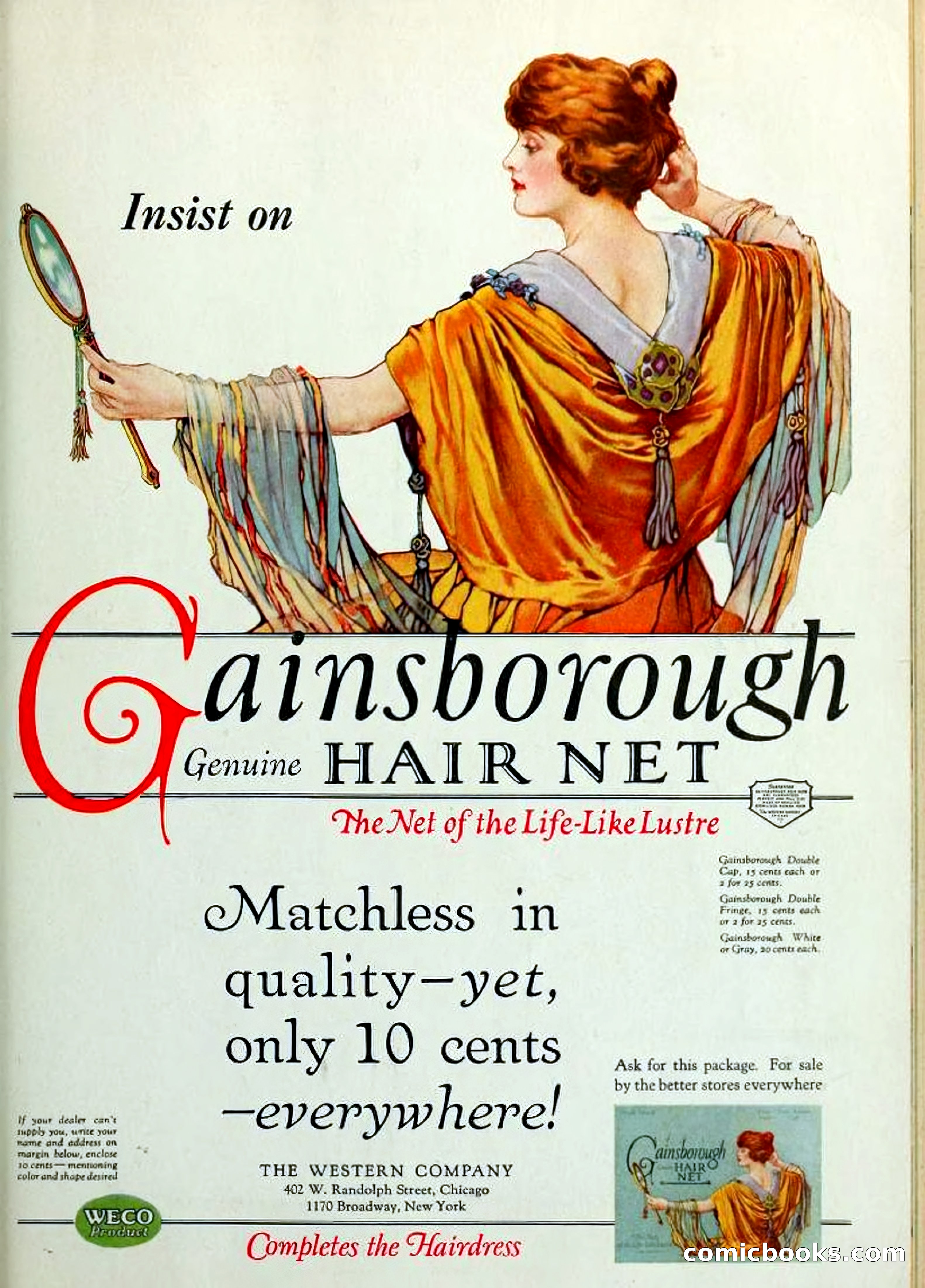
This is a vintage advertisement, not pulp fiction content. The page features a full-color illustration of a woman in classical draped clothing examining herself in a hand mirror, accompanied by text promoting Gainsborough Genuine Hair Nets. The ad emphasizes the product's quality while highlighting its low price of 10 cents, describing it as "The Net of the Life-Like Lustre" that "Completes the Hairdress." The Western Company, based in Chicago and New York, is listed as the manufacturer. Additional text notes product variants and pricing. A WECO Products logo appears at the bottom. This appears to be an early-20th-century advertisement inserted into a magazine rather than editorial content.
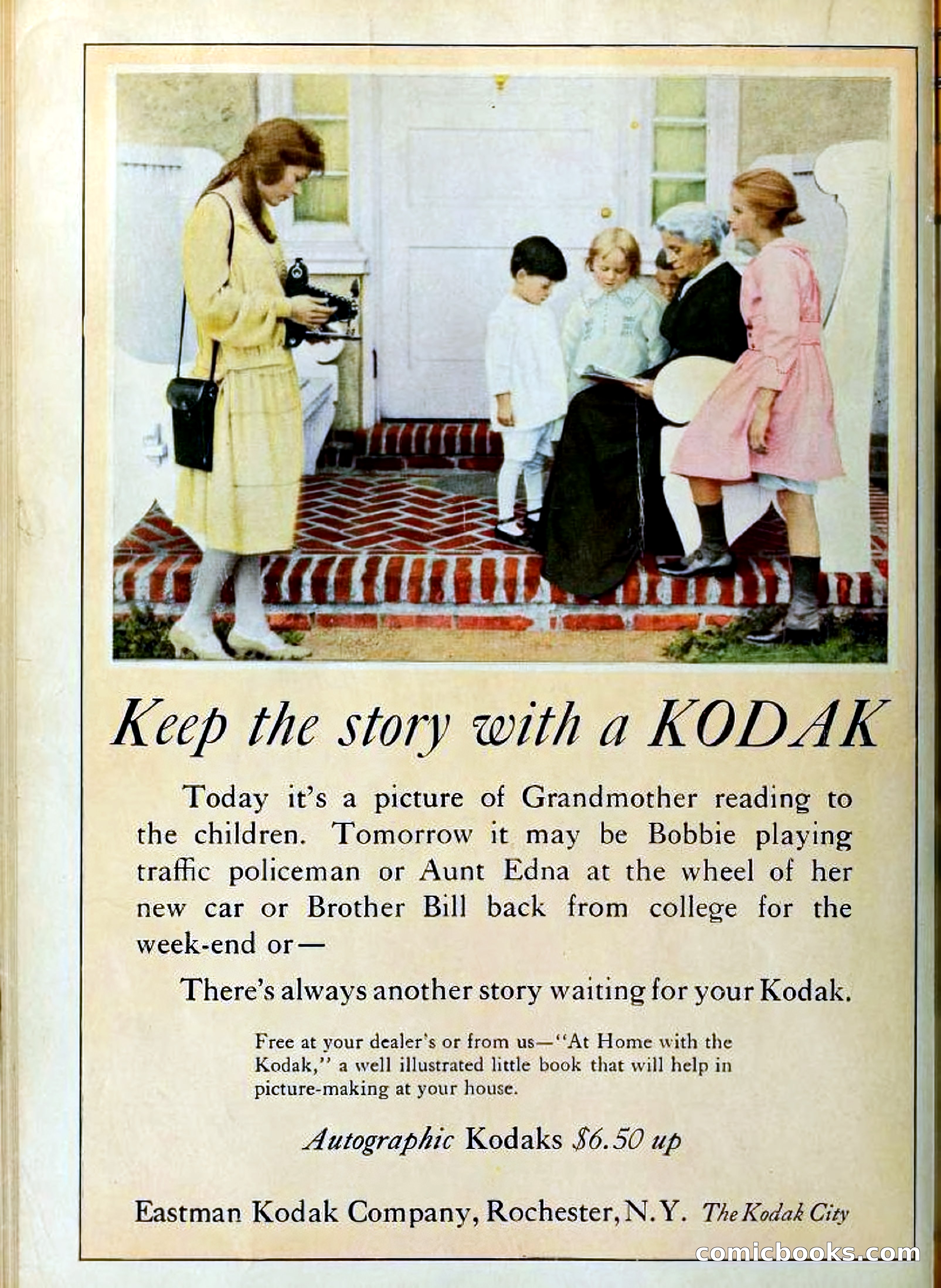
# Analysis This page is an **advertisement**, not pulp fiction content. It's a Kodak camera advertisement from the Eastman Kodak Company of Rochester, New York. The image shows a woman photographing a domestic scene of a grandmother reading to children indoors. The ad's text promotes keeping family memories through photography, suggesting that today's picture of grandmother with children might lead to tomorrow's moments of family members like "Bobbie playing traffic policeman" or "Aunt Edna at the wheel of her new car." The advertisement promotes Autographic Kodak cameras priced at $6.50 and up, and offers a free instructional booklet titled "At Home with the Kodak" to help with home photography.