
Pulp Fiction, 1922 · page 100 of 126
Photoplay Magazine Cover — page 100: what you’re looking at
What you’re looking at
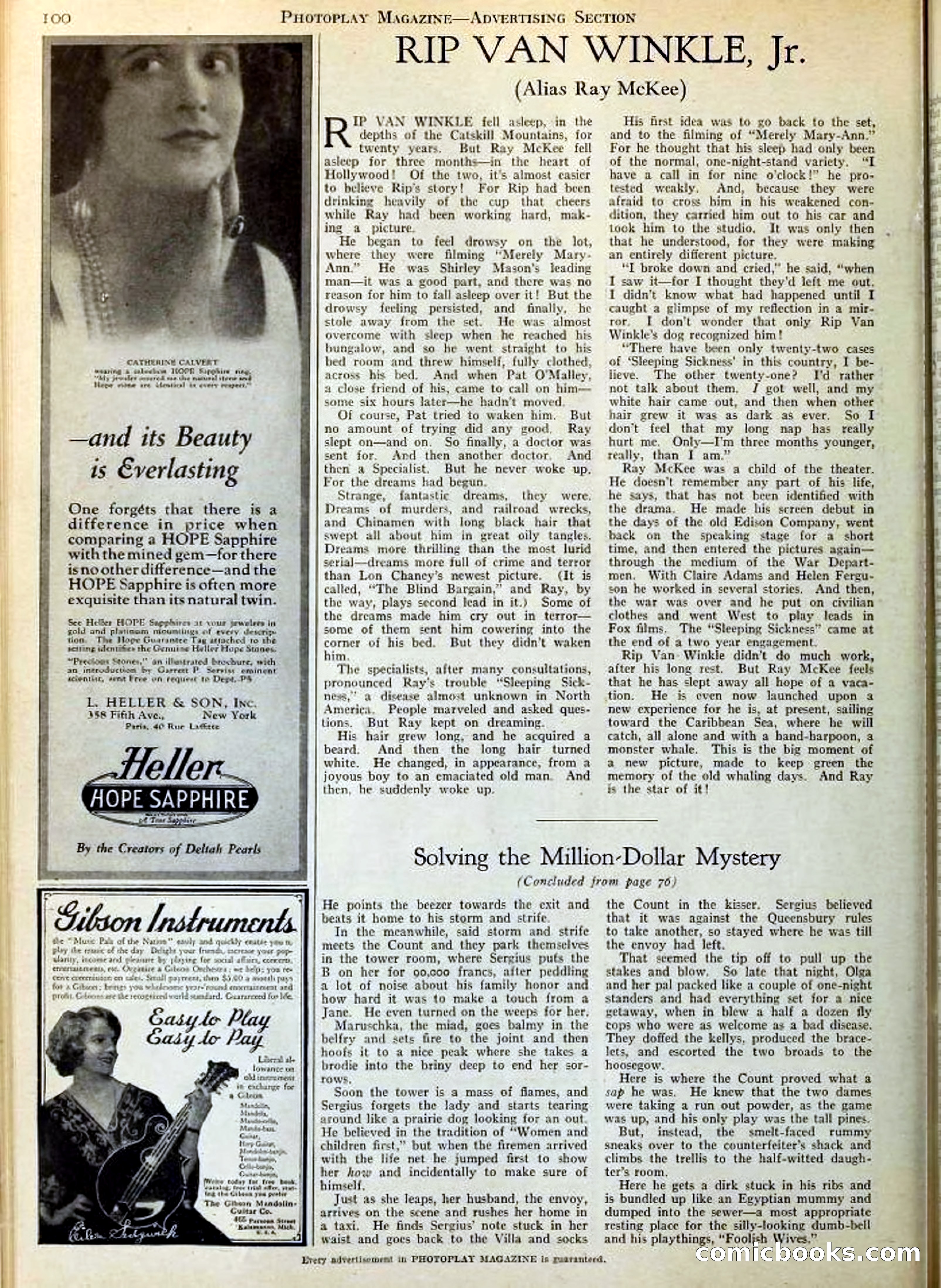
# Page Analysis This is an **advertising and editorial page** from *Photoplay Magazine*'s advertising section (page 100). The page contains multiple advertisements interspersed with editorial content about actor Rip Van Winkle Jr. (alias Ray McKee). The editorial piece describes how McKee fell asleep on a film set in the Catskill Mountains and remained unconscious for three months, experiencing vivid dreams about crime, murder, and railroad wrecks. Upon waking, he had grown long white hair and a beard, completely transforming his appearance. The article concludes with McKee preparing to sail toward the Caribbean Sea for a new film project. The page also advertises Hope Sapphire jewelry, Gibson Instruments, and other products typical of early-20th-century pulp magazine publications.
📄 Transcribed text from this page (OCR, searchable)
Machine-transcribed from the original scan — historical spelling and the odd misread are preserved.
ee too CATHENINE CALVERT wearing & leche 10K00R Supobine neg, “hh jeweler eopered woe ve nated Heew aed Nepe ohhee ere Sbeaticsl be ewery peapert.” —and its Beauty is Everlasting One forgéts that there is a difference in pr ice when comparing a HOPE Sapphire with the mined gem—for there isno other difference—and the HOPE Sapphire is often more exquisite than its natural twin. Sec Heller HOPE Sepphines ac vour jewelres in gold and Ao leeryr, mounilige of every wdescrig~ tion, The Hoge Guarsntce Tag attached ro the sciting ilentater the Genuine Heller Hope Stones: “Preeclows Stones," ilhevtrated brecbure, with an introduction by Garrett Po Serviss eminent achenthc, sent Bree on fequese 16 Depa, 4 L. HELLER & SON, Inc. 358 Fifth Ave, New York Paris, 40 Rue Lattece HOPE SAPPHIRE i Se rk 5 eal le “Mure Pak of the Narie eavly and qeicdly coatéc pow ploy the tomere of che dap Od aghe yoer (neady mcrease your pop- | wlartty, tnobesc and pleannte by playing fee social afurs, ccoxeres | ¢trtrtaatrewets, eo. Oveweire ‘Cites Oncor ray et bel; yoru te Corre coverriniosn: on cate. Serall pay rrect, then 35,00 woes mss for a Ghent > betig: pou whihessne yrar-'rocesd erexrearereeat ard prc), Gotoeres ave the renstercedl wethd eeedard. Qusrareeed fur fe lowance ver OM imeercrments ie eatharge foe a Gleam = ae [Were cotey tor oH) to ' Sateled, Foon trint eter, yee | lng the Crbien yes puotee | The Giheon Mandolin: Cubtar Co. 4 Pacvowm S00ey Baelameecesn Mick ors Brecy advertisomemt in PHOTOPLAY MAGAZINE is pearanteed. PHOTOPLAY MAGAZINE—ADVERTISING SECTION RIP VAN WINKLE, Jr. (Alias Ray McKee) IP VAN WINKLE fell asleep, in the depths of the Catskill Mountains, for twenty years. But Ray McKee’ fell asleep for three months—in the heart of Hollywood! Of the two, it’s almost casicr to believe Rip’s story! For Rip had been drinking heavily of the cup that cheers while Ray had been working hard, mak- ing a_ picture. He began to feel drowsy on the lot, where they were filming “Merely Mary- Ann.” He was Shirley Mason's leading man—it was a good part, and there was no reason for him to fall asleep over it! But the drowsy fevling persisted, and finally, he stole away from the set. We was almost overcome with seep when he reached his bungalow, and so he went straight to his hed room and threw himself, fully clothe, across his bed. And when Pat O'Malley, 4 close friend of his, came to call on him some six hours later—he hadn't moved Of course, Pat tried to waken him. But no amount of trying did any good, Ray slept on—and on. So finally, a doctor was sent for. And then another doctor, And then a Specialist. But he never woke up. Por the dreams had begun. Strange, fantastic dreams, they were; Dreams of murders, and railroad wrecks, and Chinamen with long black hair that swept all about him in great oily tangles. Dreams more thrilling than the most lurid serial—dreams more full of crime and terror than Lon Chancy’s newest picture. (It is called, “The Blind Bargain,” and Ray, by the way, plays second lead in it.) Some of the dreams made him cry out in terror— some of them cent him cowering into the corner of his bed. But they didn't waken him, The spectalists, after many consultations, pronounced Ray's trouble “Sleeping Sich- nes,’ a disease almost unknown in North America, People marveled and asked ques- tions. But Ray kept on dreaming. His hair grew long, and he acquired a beard. And then the long hair turned white. He changed, in appearance, from a joyous boy to an emaciated old man. And then, he suddenly woke up. His first idea was to go back to the set, and to the filming of “Merely Mary-Ann.” For he thought that his sleep had only been of the normal, one-night-stand variety, “I have a call in for nine o'clock!” he pro- tested weakly, And, because they were afraid to cross him in his weakened con- dition, they carried him out to his car and took him to the studio, It was only then that he understood, for they were making an entirely different picture. “T broke down and cried,” he said, “when I caw it—for I thought they'd left me out, I didn’t know what had happened until I caught a glimpse of my reflection in a mir- ror. [ don't wonder that only Rip Van Winkle’s dog recognized him! “There have been only twenty-two cases of ‘Sleeping Sickness’ in this country, I be- lieve. The other twenty-one? I'd rather not talk about them. J got well, and my white hair came out, and then when other hair grew it was as dark as ever. So I don’t feel that my long nap has really hurt me. Only—I'm three months younger, really, than I am.’ Ray McKee was a child of the theater. He doesn’t remember any part of his life, he says, that has not been identified with the drama. He made his sercen debut in the days of the old Edison Company, went back on the speaking stage for a short time, and then entered the pictures again— through the medium of the War Depart- men. With Claire Adams and Helen Ferzu- eon he worked in several stories. And then, the war was over and he put on civilian clothes and went West to play leads in Fox films. The “Sleeping Sickness” came at the end of a two year engagement. Rip Van- Winkle didn’t do much work, after his long rest. But Ray McKee feels that he has slept away all hope of a vaca- tion. He i cven now launched upon a new experience for he is, at present, sailing toward the Caribbean Sea, where he will catch, all alone and with a hand-harpoon, a monster whale. This is the big moment of a new picture, made to keep green the memory of the old whaling days. And Ray is the star of it! Solving the Muillion-Dollar Mystery (Concluded fram page 76) He points the beezer towards the exit and beats it home to his storm and strife In the meanwhile, said storm and strife meets the Count and they park themselve in the tower room, where Sergius puts the B on her for 90,co0 francs, after peddling a lot of noise about his family honor and how hard it was to make a touch from a Jane. He even turned on the weeps for her, Maruschka, the miad, gees balmy in the belfry and sets fire to the joint and then hoofs it to a mice peak where she takes a brodie into the briny deep to end her sor- rows, Soon the tower is a mass of fiames, and Sergius forgets the lady and starts tearing around like a prairie dog looking for an out He believed in the tradition of “Women and children first,” but when the firemen arrived with the life net he jumped first to show her how and incidentally to make sure of himeelf, Just as she leaps, her husband, the envoy, arrives on the scene and rushes her home in a taxi. He finds Sergius’ note stuck in her waist and gocs back to the Villa and socks the Count in the kicser. Sergius believed that it was against the Queensbury rules to take another, so ctayed where he was till the envoy had left. That seemed the tip off to pull up the stakes and blow, So late that night, Olga and her pal packed like a couple of one-night standers and had everything set for a nice getaway, when in blew a half a dozen fly cops who were as welcome as a bad disease. They doffed the kellys, produced the brace- lets, and escorted the two broads to the hoosegow. Here is where the Count proved what a sap he was. He knew that the two dames were taking a run out powder, as the game was up, and his only play was the tall pines. But, instead, the smelt-faced rummy sneaks over to the counterfeiter’s shack and climbs the trellis to the half-witted daugh- ter’s room, Here he gets a dirk stuck in his ribs and is bundled up like an Egyptian mummy and dumped into the sewer—a most appropriate resting place for the silly-looking dumb-bell and his playthings, “Foolish \Wi _ Gomi (O)(O)|