
Pulp Fiction, 1922 · page 39 of 126
Photoplay Magazine Cover — page 39: what you’re looking at
What you’re looking at
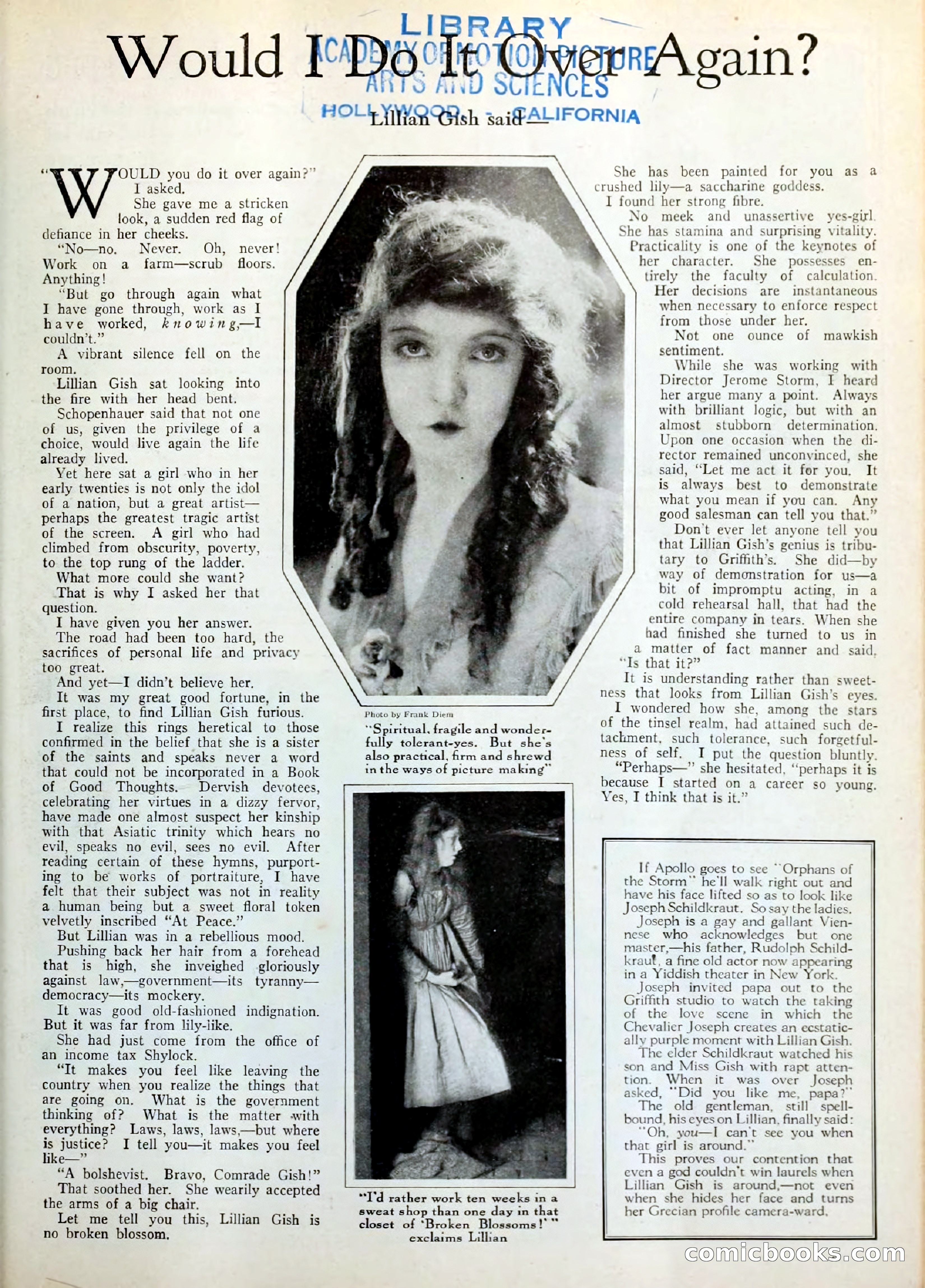
# Page Analysis This is an interior magazine page featuring an article titled "Would I Do It Over Again?" The page contains two photographs of a woman (identified as Lillian Gish in the text) along with prose text discussing her career and character. The left column presents a narrative account of a conversation about whether Gish would repeat her life choices, touching on her sacrifices and her rise from obscurity to becoming a major film artist. The right column provides character analysis, describing her as possessing "strong fibre," decisiveness, and practicality. The page appears to be from a fan magazine or similar publication focused on the film industry and Hollywood personalities of the early 20th century.
📄 Transcribed text from this page (OCR, searchable)
Machine-transcribed from the original scan — historical spelling and the odd misread are preserved.
FS OULD you do it over again?” I asked. She gave me a stricken look, a sudden red flag of defiance in her cheeks. “No—no. Never. Oh, never! Work on a farm—scrub floors. Anything! “But go through again what I have gone through, work as I have worked, knowing—lI couldn’t.” A vibrant silence fell on the room. Lillian Gish sat looking into the fire with her head bent. Schopenhauer said that not one of us, given the privilege of a choice, would live again the life already lived. Yet here sat a girl who in her early twenties is not only the idol of a nation, but a great artist— perhaps the greatest tragic artist of the screen. A girl who had climbed from obscurity, poverty, to the top rung of the ladder. What more could she want? That is why I asked her that question. I have given you her answer. The road had been too hard, the sacrifices of personal life and privacy too great. And yet—I didn’t believe her, It was my great good fortune, in the first place, to find Lillian Gish furious. I realize this rings heretical to those confirmed in the belief that she is a sister of the saints and speaks never a word that could not be incorporated in a Book of Good Thoughts. Dervish devotees, celebrating her virtues in a dizzy fervor, have made one almost suspect her kinship with that Asiatic trinity which hears no evil, speaks no evil, sees no evil. After reading certain of these hymns, purport- ing to be works of portraiture, I have felt that their subject was not in reality a human being but a sweet floral token velvetly inscribed “At Peace.” But Lilian was in a rebellious mood. Pushing back her hair from a forehead that is high, she inveighed gloriously against law,—government—its tyranny— democracy—its mockery. It was good old-fashioned indignation. But it was far from lily-like. She had just come from the office of an income tax Shylock. “It makes you feel like leaving the country when you realize the things that are going on. What is the government thinking of? What is the matter «with everything? Laws, laws, laws—but where a ces I tell you—it makes you feel ann “A bolshevist. Bravo, Comrade Gish!” That soothed her. She wearily accepted the arms of a big chair. Let me tell you this, Lillian Gish is no broken blossom, Oh; Photo by Frank Diem Spiritual, fragile and wonder- fully tolerant-yes. But she’s also practical, firm and shrewd in the ways of picture making™ ee | “I'd rather work ten weeks in a sweat shop than one day in that closet of ‘Broken Blossoms!" ™ ovIcNC BOLE YWYR sh saifALIFORNIA pA gain? She has been painted for you as a crushed lily—a saccharine goddess. A\ I found her strong fibre. No meek and unassertive yes-girl She has stamina and surprising vitality. Practicality is one of the keynotes of . her character. She possesses en- \. tirely the faculty of calculation \ Her decisions are instantaneous when necessary to enforce respect from those under her. Not one ounce of sentiment. While she was working with Director Jerome Storm, I heard her argue many a point. Always with brilliant logic, but with an almost stubborn determination. Upon one occasion when the di- rector remained unconvinced, she said, “Let me act it for you. It is always best to demonstrate what you mean if you can. Any good salesman can tell you that.” Don't ever let anyone tell you that Lillian Gish’s genius is tribu- . tary to Griffith’s. She did—by y way of demonstration for us—a i bit of impromptu acting, in a mawkish cold rehearsal hall, that had the entire company in tears. When she had finished she turned to us in a matter of fact manner and said. “Is that it?” It is understanding rather than sweet- ness that looks from Lillian Gish’s eyes. I wondered how she, among the stars of the tinsel realm, had attained such de- tachment, such tolerance, such forgetful- ness of self. I put the question bluntly. “Perhaps—” she hesitated, ‘(perhaps it is because I started on a career so young. Yes, I think that is it.” : 2 If Apollo goes to see “Orphans of the Storm” he'll walk right out and have his face lifted so as to look like Joseph Schildkraut. So say the ladies. Joseph is a gay and gallant Vien- nese who acknowledges but one master,—his father, Rudolph Schild- kraut, a fine old actor now appearing in a Yiddish theater in New York. Joseph invited papa out to the Griffith studio to watch the taking of the love scene in which the Chevalier Joseph creates an ecstatic- ally purple moment with Lillian Gish. The elder Schildkraut watched his son and Miss Gish with rapt atten- tion. When it was over Joseph asked, “Did you like me, papa?” The old gentleman, still spell- bound, his eyes on Lillian, finally said: “Oh, you—I can't see you when that girl is around.” This proves our contention that even a god couldn’t win laurels when Lillian Gish is around,—not even when she hides her face and turns her Grecian profile camera-ward, COMIIGHOOKSHEO