
Pulp Fiction, 1922 · page 35 of 126
Photoplay Magazine Cover — page 35: what you’re looking at
What you’re looking at
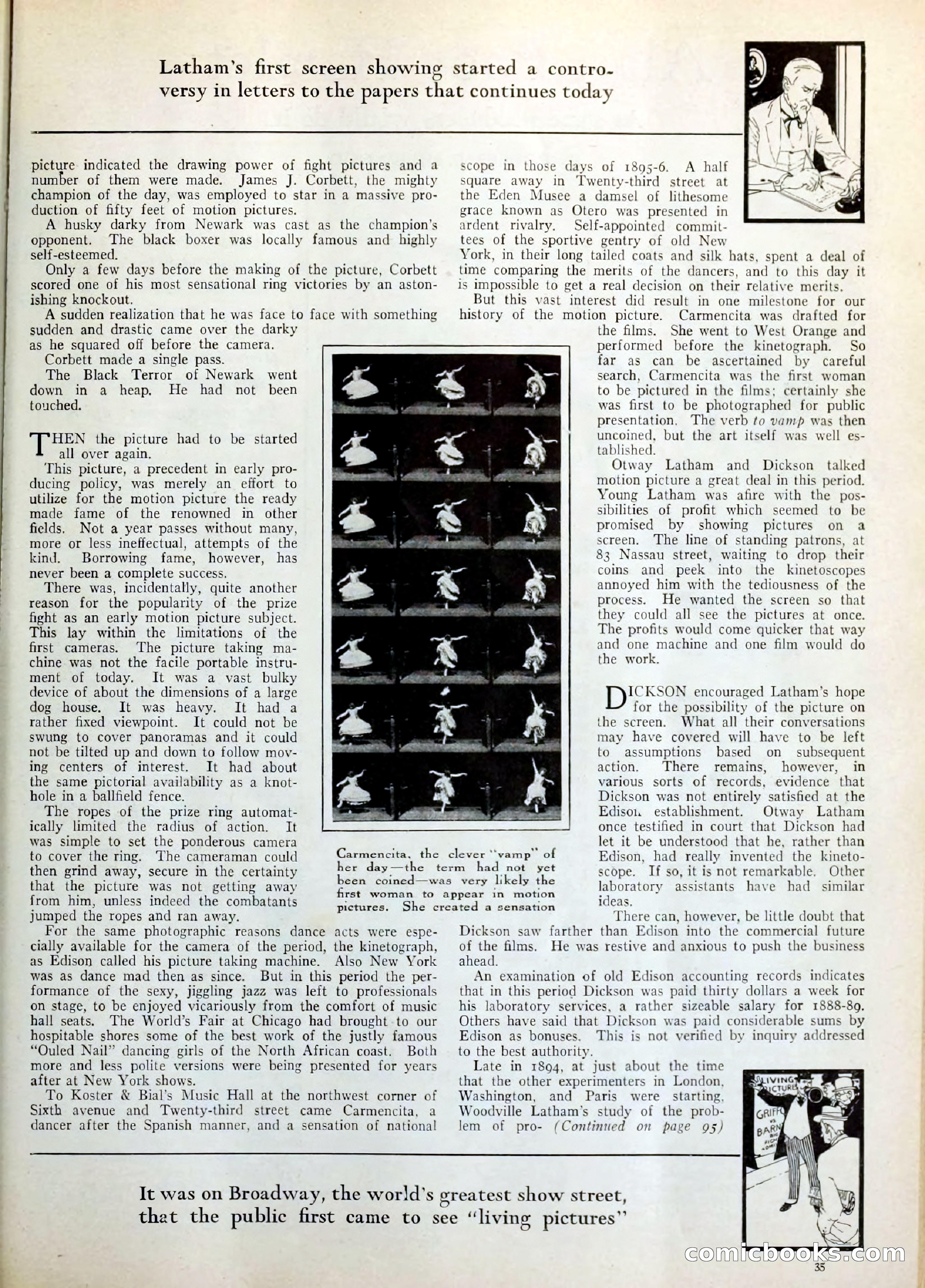
# Page Analysis This is a **text-heavy story page with embedded illustrations** from what appears to be an early cinema history article. The prose describes the making of early motion pictures, specifically focusing on a film featuring a boxer named Corbett and a dancer called Carmenita. The page includes a **filmstrip-style sequence of images** showing repeated poses of a figure in motion, likely demonstrating early cinematography techniques. Two smaller photographs appear in the margins showing what appear to be period figures. The text discusses the technical and commercial challenges of early film production, the role of Thomas Edison and others in developing motion picture technology, and how such pictures were first shown to the public on Broadway. The narrative traces the pioneering efforts to create and exhibit "living pictures."
📄 Transcribed text from this page (OCR, searchable)
Machine-transcribed from the original scan — historical spelling and the odd misread are preserved.
Latham’s first screen showing started a contro- versy in letters to the papers that continues today picture indicated the drawing power of fight pictures and a number of them were made. James J. Corbett, the mighty champion of the day, was employed to star in a massive pro- duction of fifty feet of motion pictures. A husky darky from Newark was cast as the champion’s opponent. The black boxer was locally famous and _ highly self-esteemed. Only a few days before the making of the picture, Corbett scored one of his most sensational ring victories by an aston- ishing knockout. A sudden realization that he was face to face with something sudden and drastic came over the darky as he squared off before the camera. Corbett made a single pass. The Black Terror of Newark went down in a heap, He had not been touched. || eae the picture had to be started all over again. This picture, a precedent in early pro- ducing policy, was merely an effort to utilize for the motion picture the ready made fame of the renowned in other fields. Not a year passes without many, more or less ineffectual, attempts of the kind. Borrowing fame, however, has never been a complete success, There was, incidentally, quite another reason for the popularity of the prize fight as an early motion picture subject. This lay within the limitations of the first cameras. ‘The picture taking ma- chine was not the facile portable instru- ment of today. It was a vast bulky device of about the dimensions of a large dog house. It was heavy. It had a rather fixed viewpoint. It could not be swung to cover panoramas and it could not be tilted up and down to follow mov- ing centers of interest. It had about the same pictorial availability as a knot- hole in a ballfield fence. The ropes of the prize ring automat- ically limited the radius of action. It was simple to set the ponderous camera to cover the ring. The cameraman could then grind away, secure in the certainty that the picture was not getting away from him, unless indeed the combatants jumped the ropes and ran away. For the same photographic reasons dance acts were espe- cially available for the camera of the period, the kinetograph, as Edison called his picture taking machine. Also New York was as dance mad then as since. But in this period the per- formance of the sexy, jiggling jazz was left to professionals on stage, to be enjoyed vicariously from the comfort of music hall seats. The World’s Fair at Chicago had brought to our hospitable shores some of the best work of the justly famous “Ouled Nail” dancing girls of the North African coast. Both more and less polite versions were being presented for years after at New York shows. To Koster & Bial’s Music Hall at the northwest corner of Sixth avenue and Twenty-third street came Carmencita, a dancer after the Spanish manner, and a sensation of national It was on Broadway, the world’s greatest show street, that the public first came to see “living pictures” Carmencita, the clever “vamp” of her day—the term had not yet scope. If so, it is not remarkable. Other been coined—was very likely the frst woman to appear in motion pictures, She created a sensation scope in those days of 1895-6. A half square away in Twenty-third street at the Eden Musee a damsel of lithesome grace known as Otero was presented in ardent rivalry. Self-appointed commit- tees of the sportive gentry of old New York, in their long tailed coats and silk hats, spent a deal of lime comparing the merits of the dancers, and to this day it is impossible to get a real decision on their relative merits. But this vast interest did result in one milestone for our history of the motion picture. Carmencita was drafted for the films. She went to West Orange and performed before the kinetograph. So far as can be ascertained by careful search, Carmencita was the first woman to be pictured in the films; certainly she was first to be photographed for public presentation, The verb to vamp was then uncoined, but the art itself was well es- tablished. Otway Latham and Dickson talked motion picture a great deal in this period. Young Latham was afire with the pos- sibilities of profit which seemed to be promised by showing pictures on a screen. The line of standing patrons, at 83 Nassau street, waiting to drop their coms and peek into the kinetoscopes annoyed him with the tediousness of the process. He wanted the screen so that they could all see the pictures at once. The profits would come quicker that way and one machine and one film would do the work. ICKSON encouraged Latham’s hope for the possibility of the picture on the screen. What all their conversations may have covered will have to be left to assumptions based on_ subsequent action. There remains, however, in various sorts of records, evidence that Dickson was not entirely satisfied at the Edisou. establishment. Otway Latham once testified in court that Dickson had let it be understood that he, rather than Edison, had really invented the kineto- laboratory assistants have had similar ideas, There can, however, be little doubt that Dickson saw farther than Edison into the commercial future of the films. He was restive and anxious to push the business ahead. An examination of old Edison accounting records indicates that in this period Dickson was paid thirty dollars a week for his laboratory services, a rather sizeable salary for 1888-89, Others have said that Dickson was paid considerable sums by Edison as bonuses. This is not verified by inquiry addressed to the best authority. Late in 1894, at just about the time that the other experimenters in London, Washington, and Paris were starting, Woodville Latham’s study of the prob- lem of pro- (Continued on page 95) COL