
Pulp Fiction, 1922 · page 60 of 126
Photoplay Magazine Cover — page 60: what you’re looking at
What you’re looking at
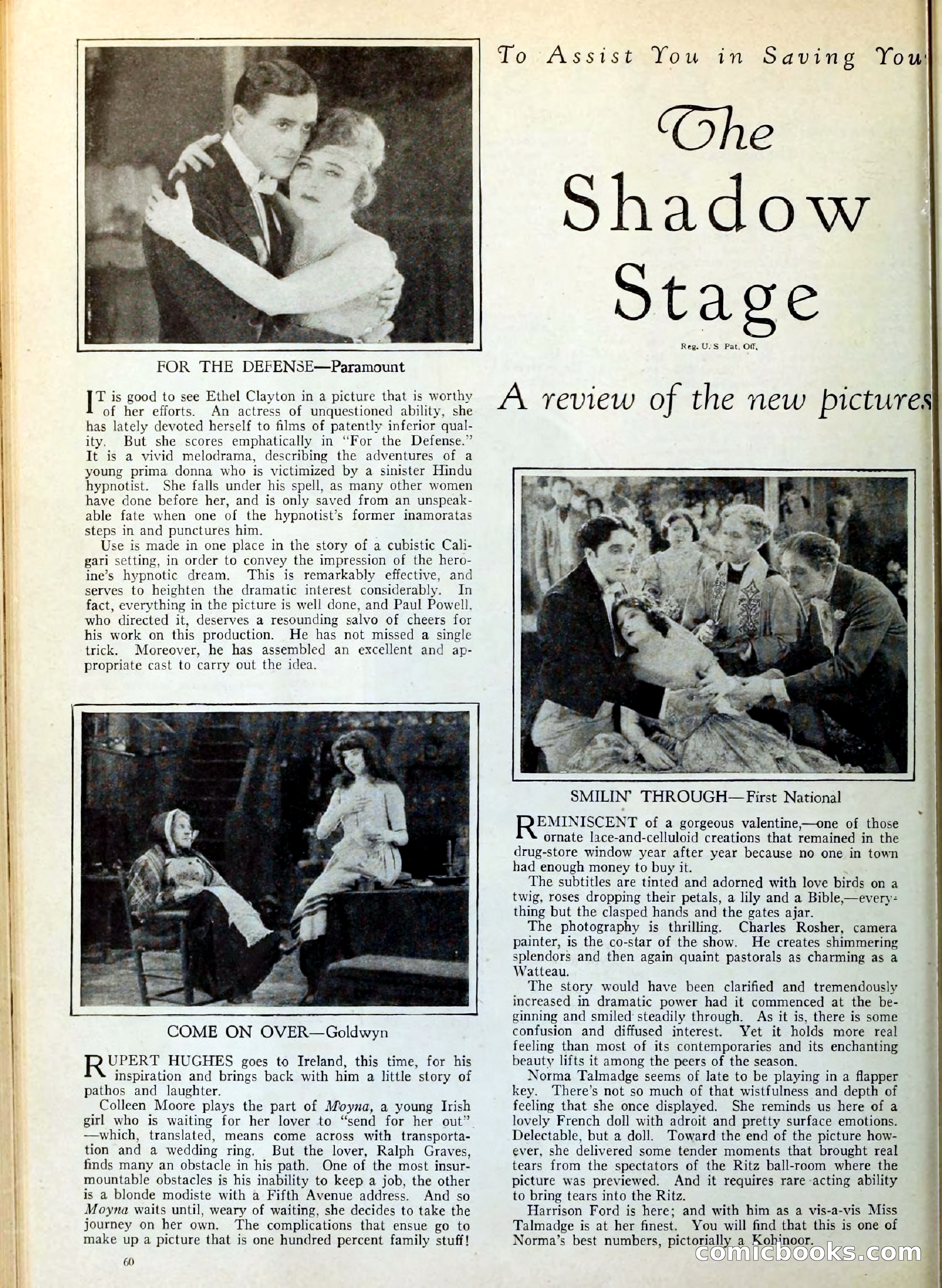
# "The Shadow Stage" - Film Review Page This is a review page from what appears to be an early 20th-century entertainment magazine. It features "The Shadow Stage," a section reviewing new motion pictures. The page contains three black-and-white film stills with accompanying reviews of movies including "For the Defense" (Paramount), "Come on Over" (Goldwyn), and "Smilin' Through" (First National). The reviews discuss plot summaries and production quality, praising elements like director Paul Powell's work and the cinematography. The text emphasizes melodramatic storylines typical of silent-era cinema, including themes of hypnosis, romance, and emotional drama. This appears to be a dedicated film criticism section rather than fiction content.
📄 Transcribed text from this page (OCR, searchable)
Machine-transcribed from the original scan — historical spelling and the odd misread are preserved.
FOR THE DEFENSE—Paramount tt is good to see Ethel Clayton in a picture that is worthy of her efforts. An actress of unquestioned ability, she has lately devoted herself to films of patently inferior qual- ity. But she scores emphatically in “For the Defense.” It is a vivid melodrama, describing the adventures of a young prima donna who is victimized by a sinister Hindu hypnotist. She falls under his spell, as many other women have done before her, and is only saved from an unspeak- able fate when one of the hypnotist’s former inamoratas steps in and punctures him. Use is made in one place in the story of a cubistic Cali- gari setting, in order to convey the impression of the hero- ine’s hypnotic dream. This is remarkably effective, and serves to heighten the dramatic interest considerably. In fact, everything in the picture is well done, and Paul Powell. who directed it, deserves a resounding salvo of cheers for his work on this production. He has not missed a single trick. Moreover, he has assembled an excellent and ap- propriate cast to carry out the idea. COME ON OVER—Goldwyn Pe HUGHES goes to Ireland, this time, for his inspiration and brings back with him a little story of pathos and laughter. Colleen Moore plays the part of Moya, a young Irish girl who is waiting for her lover to “send for her out” —which, translated, means come across with transporta- tion and a wedding ring. But the lover, Ralph Graves, finds many an obstacle in his path. One of the most insur- mountable obstacles is his inability to keep a job, the other is a blonde modiste with a Fifth Avenue address. And so Moyna waits until, weary of waiting, she decides to take the journey on her own. The complications that ensue go to make up a picture that is one hundred percent family stuff! 60 To Assist You in Saving Yow ‘(Ohe Shadow Stage Reg. U.S Pat, Of, A review of the new pictures SMILIN’ THROUGH—First National REMINISCENT of a gorgeous valentine,—one of those ornate lace-and-celluloid creations that remained in the drug-store window year after year because no one in town had enough money to buy it. The subtitles are tinted and adorned with love birds on a twig, roses dropping their petals, a lily and a Bible—every- thing but the clasped hands and the gates ajar. The photography is thrilling. Charles Rosher, camera painter, is the co-star of the show. He creates shimmering splendors and then again quaint pastorals as charming as a Watteau. The story would have been clarified and tremendously increased in dramatic power had it commenced at the be- ginning and smiled’ steadily through. As it is, there is some confusion and diffused interest. Yet it holds more real feeling than most of its contemporaries and its enchanting beauty lifts it among the peers of the season. Norma Talmadge seems of late to be playing in a flapper key. There’s not so much of that wistfulness and depth of feeling that she once displayed. She reminds us here of a lovely French doll with adroit and pretty surface emotions. Delectable, but a doll. Toward the end of the picture how- ever, she delivered some tender moments that brought real tears from the spectators of the Ritz ball-room where the picture was previewed. And it requires rare acting ability to bring tears into the Ritz. Harrison Ford is here; and with him as a vis-a-vis Miss Talmadge is at her finest. You will find that this is one of Norma’s best numbers, pictorially a icbo (Co) (©) MIGVOOKSEGO