
Pulp Fiction, 1922 · page 20 of 126
Photoplay Magazine Cover — page 20: what you’re looking at
What you’re looking at
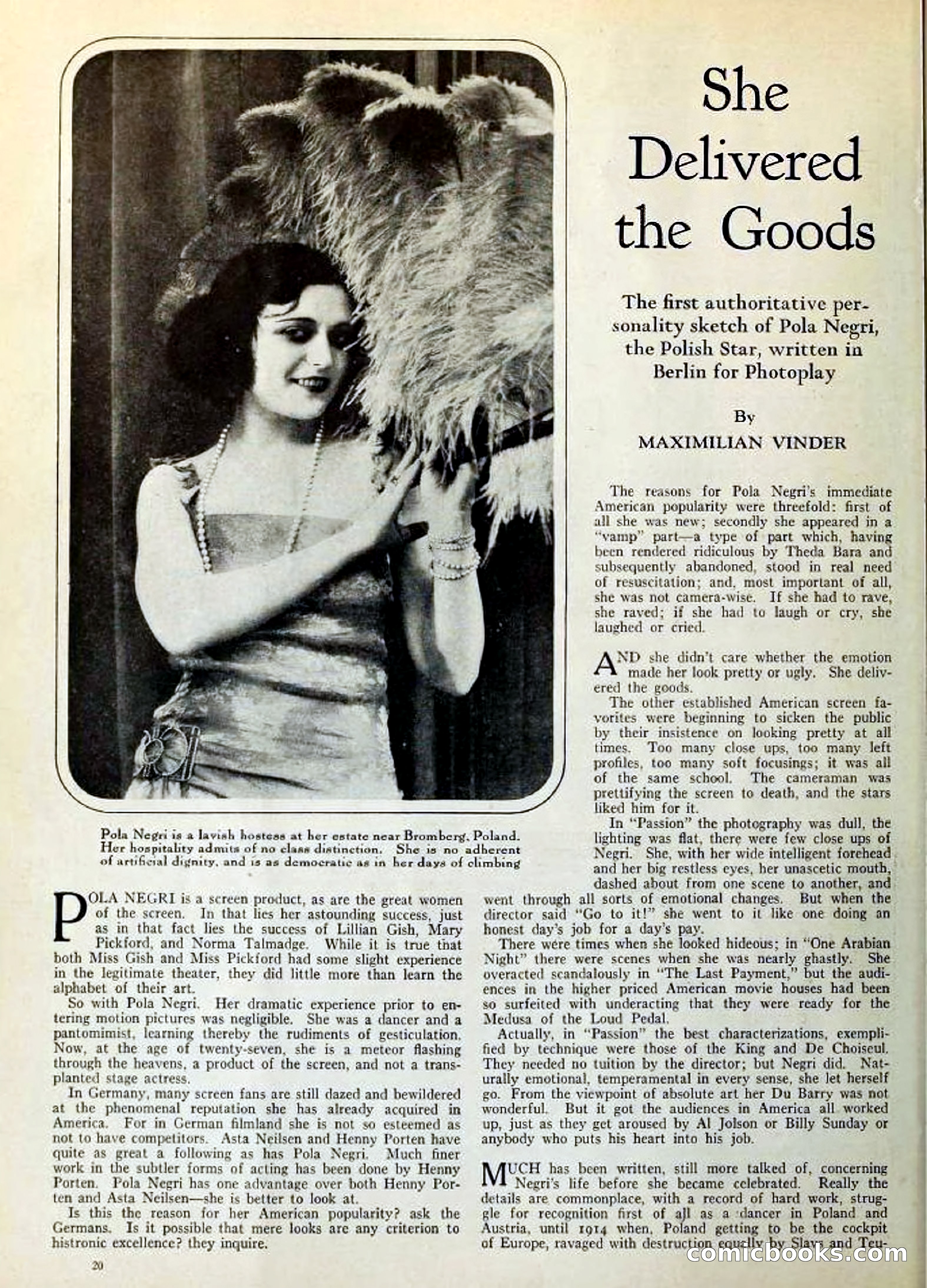
# Page Content Analysis This is an editorial/article page from a pulp magazine featuring a biographical sketch titled "She Delivered the Goods," written by Maximilian Vinder. The page includes a black-and-white photograph of Pola Negri, described as a Polish film star, positioned as a lavish hostess at her Polish estate. The text analyzes Negri's success in American cinema, attributing it to three factors: her novelty, her appearance in "vamp" roles (a type previously abandoned), and crucially, her lack of camera-consciousness—she prioritized authentic emotional performance over photogenic appearance. The article contrasts her approach with established American actresses who obsessed over looking pretty on screen, suggesting Negri's willingness to be unflattering when the role demanded it set her apart.
📄 Transcribed text from this page (OCR, searchable)
Machine-transcribed from the original scan — historical spelling and the odd misread are preserved.
Pola Negri is 2 lavish hostess at her estate near Bromberg. Poland. Her hospitality admits of no class distinction, OLA NEGRI is a screen product, as are the great women of the screen. In that lies her astounding success, just as in that fact lies the success of Lillian Gish, Mary Pickford, and Norma Talmadge. While it is true that both Miss Gish and Miss Pickford had some slight experience in the legitimate theater, they did little more than learn the alphabet of their art. 50 with Pola Negri. Her dramatic experience prior to en- tering motion pictures was negligible. She was a dancer and a pantomimist, learning thereby the rudiments of gesticulation, Now, at the age of twenty-seven, she is a meteor flashing through the heavens, a product of the screen, and not a trans- planted stage actress, In Germany, many screen fans are still dazed and bewildered at the phenomenal reputation she has already acquired in America. For in German filmland she is not s© esteemed as not to have competitors. Asta Neilsen and Henny Porten have quite as great a following as has Pola Negri. Much finer work in the subtler forms of acting has been done by Henny Porten. Pola Negri has one advantage over both Henny Por- ten and Asta Neilsen—she is better to look at. Is this the reason for her American popularity? ask the Germans, Is it possible that mere looks are any criterion to histronic excellence? they inquire. a) }OB Pp ty a She is no adherent of artifical dignity, and is as democratic as in her days of climbing She Delivered the Goods The first authoritative per- sonality sketch of Pola Negri, the Polish Star, written in Berlin for Photoplay By MAXIMILIAN VINDER The reasons for Pola Negri’s immediate American popularity were threefold: first of all she was new; secondly she appeared in a “vamp” part—a type of part which, having been rendered ridiculous by Theda Bara and subsequently abandoned, stood in real need of resuscitation; and. most important of all, she was not camera-wise. If she had to rave, she raved; if she had to laugh or cry, she laughed or cried. ND she didn’t care whether the emotion made her look pretty or ugly. She deliv- ered the goods. The other established American screen fa- vorites were beginning to sicken the public by their insistence on looking pretty at all times. Too many close ups, too many left profiles, too many soft focusings; it was all of the same school. The cameraman was prettifying the screen to death, and the stars liked him for it. In “Passion” the photography was dull, the lighting was flat, there were few close ups of Negri. She, with her wide intelligent forehead and her big restless eyes, her unascetic mouth, dashed about from one scene to another, and went through all sorts of emotional changes. But when the director said “Go to it!” she went to it like one doing an honest day’s job for a day’s pay. There were times when she looked hideous: in “One Arabian Night” there were scenes when she was nearly ghastly. She overacted scandalously in “The Last Payment,” but the audi- ences in the higher priced American movie houses had been so surfeited with underacting that they were ready for the Medusa of the Loud Pedal, Actually, in “Passion” the best characterizations, exempli- fied by technique were those of the King and De Choiseul, They needed no tuition by the director; but Negri did. Nat- urally emotional, temperamental in every sense, she let herself go. From the viewpoint of absolute art her Du Barry was not wonderful, But it got the audiences in America all worked up, just as they get aroused by Al Jolson or Billy Sunday or anybody who puts his heart into his job. UCH has been written, still more talked of, concerning Negri’s life before she became celebrated. Really the details are commonplace, with a record of hard work, strug- gle for recognition first of ajl as a ‘dancer in Poland and Austria, until rotqg when, Poland getting to be the cockpit of Europe, ravaged with She aie BOOKS: com