
Pulp Fiction, 1922 · page 31 of 126
Photoplay Magazine Cover — page 31: what you’re looking at
What you’re looking at
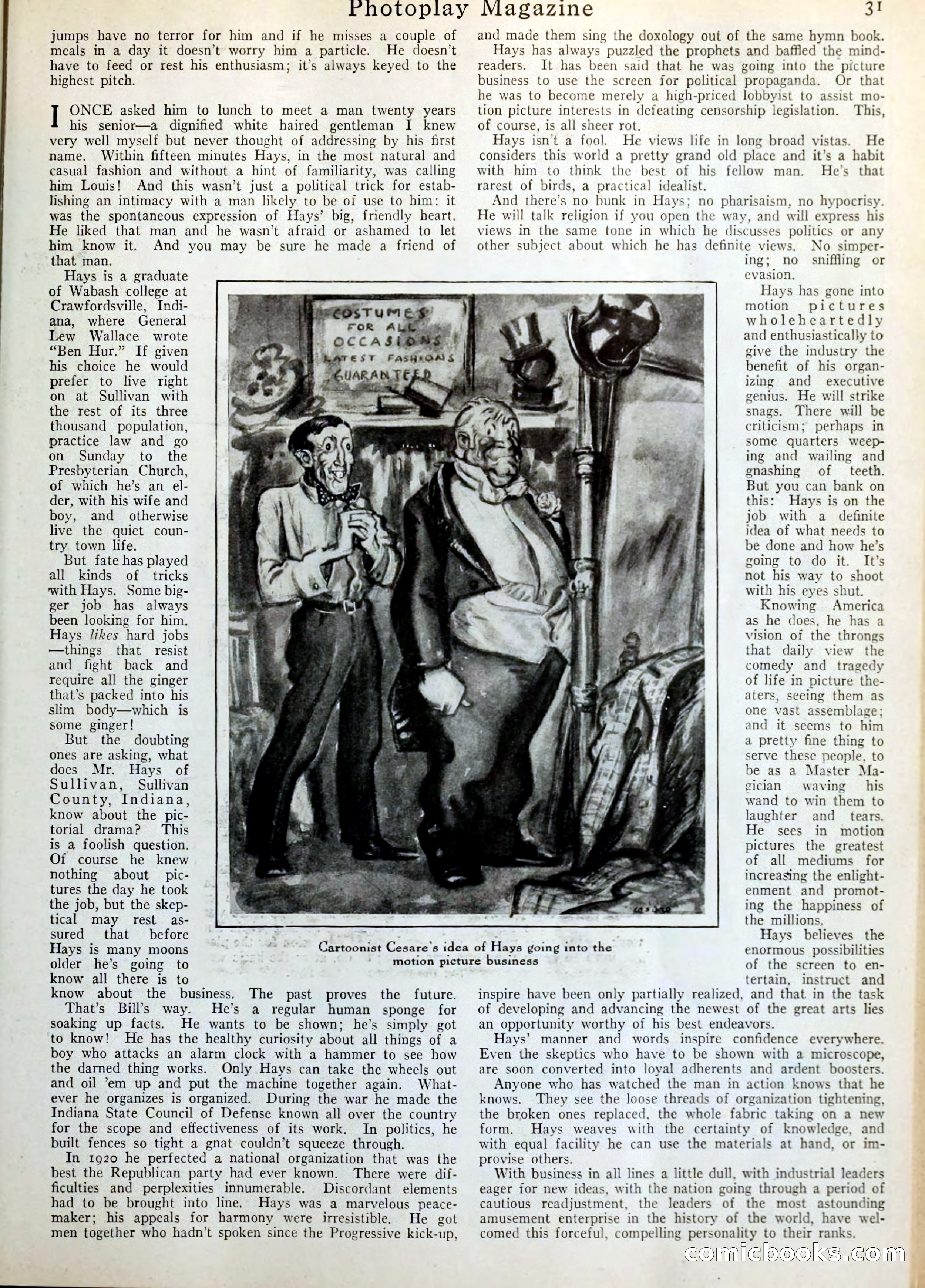
# Page Analysis This is a text page from *Photoplay Magazine* (page 31) featuring an article about film director and producer Will S. Hart (or similar figure). The page includes a black-and-white illustration depicting what appears to be a costume or wardrobe department scene, with a sign reading "COSTUMES FOR ALL OCCASIONS GUARANTEED." The article discusses the subject's background, work ethic, and approach to filmmaking. It emphasizes his practical knowledge of the motion picture industry and his ability to organize people and projects effectively. The text also mentions his work during wartime and his involvement in Republican Party organization. The visible content is primarily biographical prose with one embedded illustration, typical of entertainment journalism from this era.
📄 Transcribed text from this page (OCR, searchable)
Machine-transcribed from the original scan — historical spelling and the odd misread are preserved.
Fhotoplay Magazine jumps have no terror for him and if he misses a couple of meals in a day it doesn’t worry him a particle. He doesn’t have to feed or rest his enthusiasm; it’s always keyed to the highest pitch. ONCE asked him to lunch to meet a man twenty years his senior—a dignified white haired gentleman I knew very well myself but never thought of addressing by his first name. Within fifteen minutes Hays, in the most natural and casual fashion and without a hint of familiarity, was calling him Louis! And this wasn’t just a political trick for estab- lishing an intimacy with a man likely to be of use to him: it was the spontaneous expression of Hays’ big, friendly heart. He liked that man and he wasn’t afraid or ashamed to let him know it. And you may be sure he made a friend of that man. Hays is a graduate of Wabash college at Crawfordsville, Indi- ana, where General Lew Wallace wrote “Ben Hur.” If given his choice he would prefer to live right on at Sullivan with the rest of its three thousand population, practice law and go on Sunday to the Presbyterian Church, of which he’s an el- der, with his wife and boy, and _ otherwise live the quiet coun- try town life. But fate has played all kinds of tricks with Hays. Some big- ger job has always been looking for him. Hays likes hard jobs —things that resist and fight back and require all the ginger that’s packed into his slim body—which is some ginger! But the doubting ones are asking, what does Mr. Hays of Sullivan, Sullivan County, Indiana, know about the pic- torial drama? This is a foolish question. Of course he knew nothing about pic- tures the day he took the job, but the skep- tical may rest as- sured that before Hays is many moons older he’s going to know all there is to know about the business. That’s Bill’s way. The past proves the future. He’s a regular human sponge for soaking up facts. He wants to be shown; he’s simply got to know! He has the healthy curiosity about all things of a boy who attacks an alarm clock with a hammer to see how the darned thing works. Only Hays can take the wheels out and oil °em up and put the machine together again. What- ever he organizes is organized. During the war he made the Indiana State Council of Defense known all over the country for the scope and effectiveness of its work. In politics, he built fences so tight a gnat couldn’t squeeze through. In 1920 he perfected a national organization that was the best the Republican party had ever known. There were dif- ficulties and perplexities innumerable. Discordant elements had to be brought into line. Hays was a marvelous peace- maker; his appeals for harmony were irresistible. He got men together who hadn't spoken since the Progressive kick-up, Cartoonist Cesare's idea of Hays going into the motion picture business and made them sing the doxology out of the same hymn book. Hays has always puzzled the prophets and baffled the mind- readers, It has been said that he was going into the picture business to use the screen for political propaganda. Or that he was to become merely a high-priced lobbyist to assist mo- tion picture interests in defeating censorship legislation. This, of course, is all sheer rot. Hays isn’t a fool, He views life in long broad vistas. He considers this world a pretty grand old place and it’s a habit with him to think the best of his fellow man. He's that rarest of birds, a practical idealist. And there’s no bunk in Hays; no pharisaism, no hypocrisy He will talk religion if you open the way, and will express his views in the same tone in which he discusses politics or any other subject about which he has definite views. No simper- ing; no sniffling or evasion, Hays has gone into motion pictures wholeheartedly and enthusiastically to give the industry the benefit of his organ- izing and executive genius. He will strike snags. There will be criticism; perhaps in some quarters weep- ing and wailing and genashing of _ teeth. But you can bank on this: Hays is on the job with a definite idea of what needs to be done and how he’s going to do it. It’s not his way to shoot with his eyes shut. Knowing America as he does, he has a vision of the throngs that daily view the comedy and tragedy of life in picture the- aters, seeing them as one vast assemblage; and it seems to him a pretty fine thing to serve these people, to be as a Master Ma- ficlan waving his wand to win them to laughter and _ tears, He sees in motion pictures the greatest of all mediums for increasing the enlight- enment and promot- ing the happiness of the millions. Hays believes the enormous possibilities of the screen to en- tertain, instruct and inspire have been only partially realized, and that in the task of developing and advancing the newest of the great arts lies an opportunity worthy of his best endeavors. Hays’ manner and words inspire confidence everywhere. Even the skeptics who have to be shown with a microscope, are soon converted into loyal adherents and ardent boosters. Anyone who has watched the man in action knows that he knows. They see the loose threads of organization tightening, the broken ones replaced. the whole fabric taking on a new form. Hays weaves with the certainty of knowledge, and with equal facility he can use the materials at hand, or im- provise others. With business in all lines a little dull, with industrial leaders eager for new ideas, with the nation going through a period of cautious readjustment, the leaders of the most astounding amusement enterprise in the history of the world, have wel- comed this forceful, compelling personality to their ranks. COMicloOokKs com