
Pulp Fiction, 1922 · page 95 of 126
Photoplay Magazine Cover — page 95: what you’re looking at
What you’re looking at
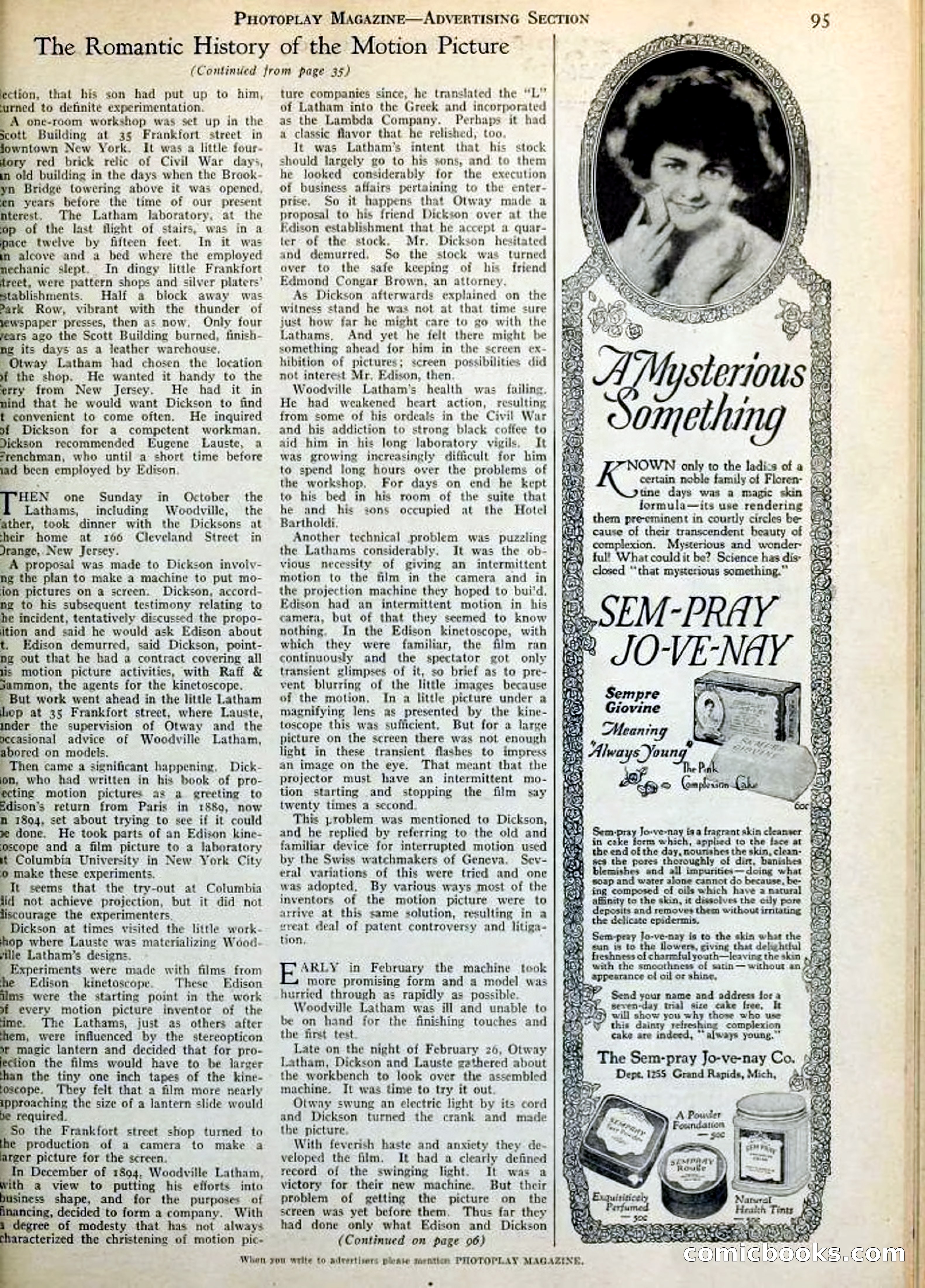
# Page Analysis This is a text page from *Photoplay Magazine's* advertising section (page 95), continuing an article titled "The Romantic History of the Motion Picture" from page 35. The left column contains prose describing early motion picture experiments by figures named Otway Latham, Dickson, and others working with film projection technology in the 1890s. On the right side is a full-page advertisement for "Sem-Pray Jo-Ve-Nay," a fragrant skin cleanser product, featuring a portrait photograph of a woman and product imagery. The advertisement emphasizes the product's cosmetic benefits, claiming it leaves skin smooth and youthful.
📄 Transcribed text from this page (OCR, searchable)
Machine-transcribed from the original scan — historical spelling and the odd misread are preserved.
ction, that his son had put up to him, d to definite experimentation. A one-room workshop was set up in the ott Building at 35 Frankfort street in owntown New York. It was a little four- lory red brick relic of Civil War days, n old building in the days when the Braok- m Bridge towering above it was opened, years before the time of our present nterest, The Latham laboratory, at the op of the last flight of stairs, was in a ¢ twelve by fifteen feet. In it was alcove and a bed where the employed nechanic slept. In dingy little Frankfort et, were pattern shope and silver plater:’ tablishments. Half a block away was ark Row, vibrant with the thunder of ewspaper presses, then as now, Only four rs ago the Scott Building burned, finish- its days as a leather warchourc, Otway Latham had chosen the location the shop. He wanted it handy to the try from New Jersey. He had it in nd that he would want Dickson to find { convenient to come often. He inquired 9 Dickson for a compctent workman. Dickson recommended Eugene Lauste, a frenchman, who until a short time before rad been employed by Edison TTHEN one Sunday in October the Lathams, including Woodville, the ther, took dinner with the Dicksons at ir home at 166 Cleveland Street in range, New Jersey. A proposal was made to Dickson involv- ng the plan to make a machine to put mo- jon pictures on a screen. Dickson, accord- ng to his subsequent testimony relating to he incident, tentatively discussed the propo- ition and said he would ask Edison about Edison demurred, said Dickson, point- ng out that he bad a contract covering all is motion picture activities, with Raff & ammon, the agents for the kinctoscope. But work went ahead in the little Latham bop at 35 Frankfort street, where Lauste, er the supervision of Otway and the ecasional advice of Woodville Latham, bored on modeis. Then came a significant happening, Dick- m, who had written in his book of pro- ( 1880, now n 1894, set about trying to see if it could % done. He took parts of an Edison kine- pe and a film picture to a laboratory Columbia University in New York City y make these experiments. Tt seems that the try-out at Columbia id not achieve projection, but it did not scourage the experimenters. Dickson at times visited the little work- op where Lauste was materializing Wood. le Latham’s designs. ‘Experiments were made with films from Edison kinetoscope. These Edison ¥ were the starting point in the work _tvery motion picture inventor of the The Lathams, just a5 others after mem, were influenced by the stereopticon Reto lantern and decided that for pro- ion the films would have to be larger n the tiny one inch tapes of the kint- oscope. They felt that a film more nearly pproaching the size of a lantern slide would be required. ‘So the Frankfort street shop turned to he production of a camera to make a irger picture for the screen. Th December of 1894. Woodville Latham, vith a view to putting his efforts into iness shape, and for the purposes of neing, decided to form a company. With t of modesty that has not always terized the christening of motion pic- w'ttn PHoOTOPLAY MAGAZINE—ADVERTISING SECTION The Romantic History of the Motion Picture (Continued from page 35) ture companies since, he tranelated the “L” of Latham into the Greek and incorporated as the Lambda Company. Perhaps it had a classic flavor that he relished, too, It was Latham’s intent that his stock should largely go to his sons, and to them he looked considerubly for the execution of business affairs pertaining to the enter- pric, So it happens that Otway made a proposal to his friend Dickson over at the Edison establishment that he accept a quar- ter of the stock. Mr. Dickson hesitated and demurred, Seo the stock was turned over to the safe keeping of his friend Edmond Congar Brown, an attorney, As Dickson afterwards explained on the witness stand he was not at that time sure just how far he might care to go with the Lathams, And yet he felt there might be something ahead for him in the screen ex- hibition of pictures; screen possibilities did not interest Mr, Edison, then. Woodville Latham’s health was failing. He had weakened heart action, resulting from some of his ordeals in the Civil War and his addiction to strong black coffee to aid him in hie long laboratory vigils. It was growing increasingly difficult for bim to spend long hours over the problems of the workshop, For days on end he kept to hit bed in his room of the suite that he anc his sons occupied at the Hotel Bartholdi, Another technical problem was puzzling the Lathams considerably. It was the ob- vious necessity of giving an intermittent motion to the film in the camera and in the projection machine they hoped to bui'd, Edison had an intermittent motion in his camera, but of that they seemed to know nothing. In the Edison kinctoscope, with which they were familiar, the film ran continuously and the spectator got only transient glimpses of it, so brief as to pre- vent blurring of the little images because of the motion, In a little picture under a magnifying lens as presented by the kine- toscope this was sufficient. But for a large picture on the screen there was not enough light In these transient flashes to impress an image on the eye. That meant that the projector must have an intermittent mo- tion starting and stopping the film say twenty times a second. This :roblem was mentioned to Dickson, and he replied by referring to the old and familiar device for interrupted motion used by the Swiss watchmakers of Geneva. Sev- ¢ral variations of this were tried and one was adopted, By various ways most of the inventors of the motion picture were to arrive at this came solution, resulting in a creat deal of patent controyersy and litiga- tion, ARLY in February the machine took more promising form and a model was hurried through as rapidly as possible. Woodville Latham was ill and unable to te on hand for the finishing touches and the first test Late on the night of February 26, Otway Latham, Dickson and Lauste gathered about the workbench to look over the assembled machine. It was time to try it out. Otway swung an electric light by its cord and Dickson turned the crank and made the picture, With feverish haste and anxicty they de- veloped the film. It had a clearly defined record of the swinging light. It was a victory for their new machine. But their problem of getting the picture on the screen was yet before them, Thue far they had done only what Edison and Dickson (Continued on page 06) When you write to aileertisers please mention PIOTOPLAY MAGAZINE, 95 a : Fis ee Sok ~ = is =? Ba " > H rf wrt . tm pean is omething \ iS 9 7) ter oh NOWN only to the ladics of a 22 Sir certain noble family of Floren- (219 (ay tine days was a magic skin fan Tate jormula—its use rendering (22 fw them preeminent in courtly circles be Bi) cause of their transcendent beauty of 465) complexion. Mysterious and won ne ful! What could it be? Science has diss 4 #4) closed “that mysterious something.” as WS. (Bio em SEM-PRAY & Wows SAG & JO-VENAY § Peee') < == ¢} “a —S—— * 2 i z 1 Ch fore Fi at ¢ LAS Hi OV gh 0 % % 5 e Po| Sem-pray Jowe-nay iva fragrant skin cleanser mee in cake forms which, appled to the lace at MWe? ebhe end of the day, mourshes the skin, clean- hen sca the pores thoroughly of dir, banishes Seu blemishes and all impurities —doing what ey soap and water alone cannot do because, be- ing com of oils which have a nacural affinity to the akin, it dissolves the cily pore deposits and removes theen withous irntating the delicate epidermis. ox Sem-peay fo-ve-nay is to the skin what the ean is to the lowers, giving that delhdal freshness of charmfual youth—lcaving the skin 5 with the smoothness of satin—without an appearance of oil or shine, s Send your name and oddress fora seven-day trial size cake free, will show you why those who use this dainty refreshing complexion cake are indeed, “always young.” The Sem-pray Jo-ve-nay Co. 3% Depe. 1255 Grand Rapids, Mich,