
Pulp Fiction, 1922 · page 53 of 126
Photoplay Magazine Cover — page 53: what you’re looking at
What you’re looking at
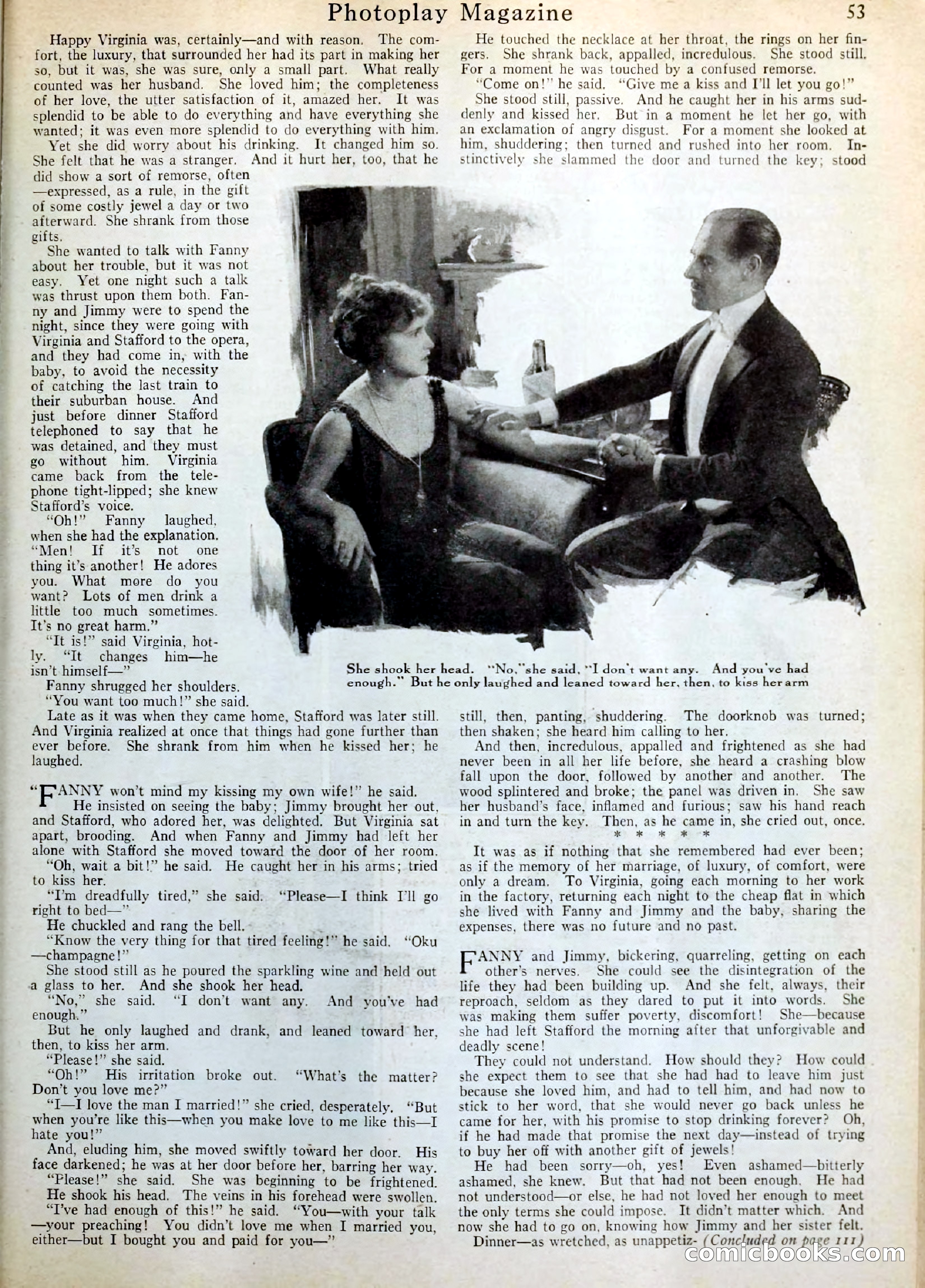
# Page 53 of Photoplay Magazine This page contains story prose with an embedded black-and-white illustration. The text depicts a domestic drama involving a wife (Virginia) confronting her husband about his drinking and infidelity. The illustration shows a man in a suit seated beside a woman, apparently during a tense conversation. The narrative describes Virginia's emotional turmoil over her husband's behavior, his dismissive attitude toward her concerns, and the deteriorating state of their marriage. The prose suggests this is adapted from a film scenario, as indicated by the "Photoplay Magazine" header. The story focuses on marital conflict and the wife's difficult decision regarding her future.
📄 Transcribed text from this page (OCR, searchable)
Machine-transcribed from the original scan — historical spelling and the odd misread are preserved.
Photoplay Magazine Happy Virginia was, certainly—and with reason. The com- fort, the luxury, that surrounded her had its part in making her so, but it was, she was sure, only a small part. What really counted was her husband. She loved him; the completeness of her love, the utter satisfaction of it, amazed her. It was splendid to be able to do everything and have everything she wanted; it was even more splendid to do everything with him. Yet she did worry about his drinking. It changed him so. She felt that he was a stranger. And it hurt her, too, that he did show a sort of remorse, often —expressed, as a rule, in the gift of some costly jewel a day or two afterward. She shrank from those gifts, She wanted to talk with Fanny about her trouble, but it was not easy. Yet one night such a talk was thrust upon them both. Fan- ny and Jimmy were to spend the night, since they were going with Virginia and Stafford to the opera, and they had come in, with the baby, to avoid the necessity of catching the last train to their suburban house. And just before dinner Stafford telephoned to say that he was detained, and they must go without him, Virginia came back from the tele- phone tight-lipped; she knew , Stafford’s voice. “Oh!” Fanny laughed, when she had the explanation. "Ment If -its not one thing it’s another! He adores you. What more do you want? Lots of men drink a little too much sometimes. It’s no great harm.” “Tt is!” said Virginia, hot- ly. “It changes him—he isn’t himself—” Fanny shrugged her shoulders. “You want too much!” she said. Late as it was when they came home, Stafford was later still. And Virginia realized at once that things had gone further than ever before. She shrank from him when he kissed her; he laughed. yd 4 \ - “TANNY won’t mind my kissing my own wife!” he said. He insisted on seeing the baby; Jimmy brought her out, and Stafford, who adored her, was delighted. But Virginia sat apart, brooding. And when Fanny and Jimmy had left her alone with Stafford she moved toward the door of her room. “Oh, wait a bit!” he said. He caught her in his arms; tried to kiss her. “Tm dreadfully tired,” she said. right to bed—”’ He chuckled and rang the bell. “Know the very thing for that tired feeling!” he said, —champagne!”’ She stood still as he poured the sparkling wine and held out a glass to her. And she shook her head. “No,” she said. “I don’t want any. enough.” But he only laughed and drank, and leaned toward her, then, to kiss her arm. “Please!” she said. “Oh!” His irritation broke out. Don't you love me?” “I—I love the man I married!” she cried, desperately. “But when you're like this—when you make love to me like this—I hate you!” And, eluding him, she moved swiftly toward her door. His face darkened; he was at her door before her, barring her way. “Please!” she said. She was beginning to be frightened. He shook his head. The veins in his forehead were swollen. “T’'ve had enough of this!” he said. “You—with your talk —your preaching! You didn’t love me when I married you, either—but I bought you and paid for you—”’ “Please—I think I'll go “Oku And you've had “What's the matter? She shook her head. enough.” But he only laughed and leaned toward her, then, to kiss her arm a0 He touched the necklace at her throat, the rings on her fin- gers, She shrank back, appalled, incredulous. She stood still. For a moment he was touched by a confused remorse. “Come on!" he said, “Give mea kiss and I'll let you go!” She stood still, passive. And he caught her in his arms sud- denly and kissed her. But in a moment he let her go, with an exclamation of angry disgust. For a moment she looked at him, shuddering; then turned and rushed into her room. In- stinctively she slammed the door and turned the key; stood And you ve had “No. she said, "I don't want any. still, then, panting, shuddering. The doorknob was turned; then shaken; she heard him calling to her. And then, incredulous, appalled and frightened as she had never been in all her life before, she heard a crashing blow fall upon the door, followed by another and another. The wood splintered and broke; the panel was driven in. She saw her husband’s face, inflamed and furious; saw his hand reach in and turn the key. Then, as he came in, she cried out, once. x. ee oe It was as if nothing that she remembered had ever been; as if the memory of her marriage, of luxury, of comfort, were only a dream, To Virginia, going each morning to her work in the factory, returning each night to the cheap flat in which she lived with Fanny and Jimmy and the baby, sharing the expenses, there was no future and no past. ANNY and Jimmy, bickering, quarreling, getting on each other’s nerves. She could see the disintegration of the life they had been building up. And she felt, always, their reproach, seldom as they dared to put it into words. She was making them suffer poverty, discomfort! She—because she had left Stafford the morning after that unforgivable and deadly scene! They could not understand. How should they? How could she expect them to see that she had had to leave him just because she loved him, and had to tell him, and had now to stick to her word, that she would never go back unless he came for her, with his promise to stop drinking forever? Oh, if he had made that promise the next day—instead of trying to buy her off with another gift of jewels! He had been sorry—oh, yes! Even ashamed—bitterly ashamed, she knew. But that had not been enough. He had not understood—or else, he had not loved her enough to meet the only terms she could impose. It didn’t matter which. And now she had to go on, knowing how Jimmy and her sister felt. Dinner—as wretched, as unappetiz- omar one re rit) (COMMUC OOO KS a CO IAA