
Pulp Fiction, 1922 · page 59 of 126
Photoplay Magazine Cover — page 59: what you’re looking at
What you’re looking at
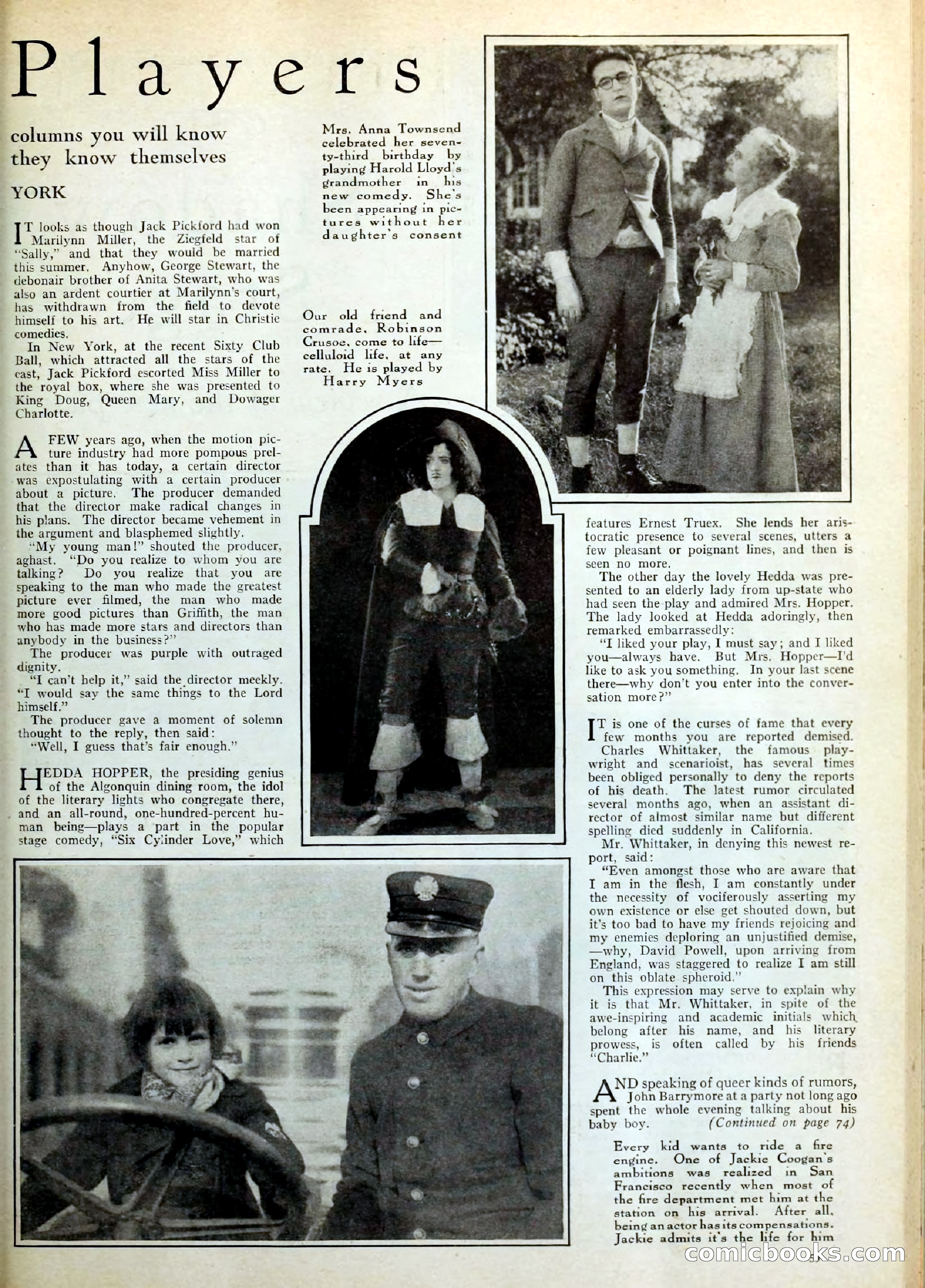
# Page Analysis This is an interior page from a **Players** column featuring entertainment gossip and industry news. The page contains three photographs accompanying text about various actors and theatrical personalities. The visible content discusses Jack Pickford's marriage plans, George Stewart's withdrawal from film to pursue art, and details about actors like Hedda Hopper and Ernest Truex. The text also addresses rumors about Charles Whittaker's death and includes anecdotes about John Barrymore and Jackie Coogan. The column appears focused on Hollywood personalities and behind-the-scenes industry gossip rather than a single narrative story.
📄 Transcribed text from this page (OCR, searchable)
Machine-transcribed from the original scan — historical spelling and the odd misread are preserved.
mera yeris columns you will know they know themselves YORK T looks as though Jack Pickford had won Marilynn Miller, the Ziegfeld star of “Sally,” and that they would be married this summer. Anyhow, George Stewart, the debonair brother of Anita Stewart, who was also an ardent courtier at Marilynn’s court, has withdrawn from the field to devote himself to his art. He will star in Christie comedies, In New York, at the recent Sixty Club Ball, which attracted all the stars of the cast, Jack Pickford escorted Miss Miller to the royal box, where she was presented to King Doug, Queen Mary, and Dowager Charlotte. FEW years ago, when the motion pic- ture industry had more pompous prel- ates than it has today, a certain director was expostulating with a certain producer about a picture. The producer demanded that the director make radical changes in his plans. The director became vehement in the argument and blasphemed slightly, “My young man!” shouted the producer, aghast. “Do you realize to whom you are talking? Do you realize that you are speaking to the man who made the greatest picture ever filmed, the man who made more good pictures than Griffith, the man who has made more stars and directors than anybody in the business?” The producer was purple with outraged dignity. “I can’t help it,” said the director meekly. “IT would say the same things to the Lord himself.” The producer gave a moment of solemn thought to the reply, then said: “Well, I guess that’s fair enough.” EDDA HOPPER, the presiding genius of the Algonquin dining room, the idol of the literary lights who congregate there, _ and an all-round, one-hundred-percent hu- man being—plays a part in the popular stage comedy, “Six Cyiinder Love,” which Mrs. Anna Townsend celebrated her seven- ty-third birthday by playing Harold Lloyd's grandmother in his new comedy. She's been appearing in pic- tures without her daughter's consent Our old friend and comrade, Robinson Crusoe, come to life— celluloid life, at any rate. He is played by Harry Myers features Ernest Truex. She lends her aris- tocratic presence to several scenes, utters a few pleasant or poignant lines, and then is scen no more, The other day the lovely Hedda was pre- sented to an elderly lady from up-state who had seen the play and admired Mrs. Hopper. The lady looked at Hedda adoringly, then remarked embarrassedly: “T liked your play, I must say; and I liked you—always have. But Mrs, Hopper—l'd like to ask you something, In your last scene there—why don’t you enter into the conver- sation more?” T is one of the curses of fame that every few months you are reported demised. Charles Whittaker, the famous play- wright and scenarioist, has several times been obliged personally to deny the reports of his death. The latest rumor circulated several months ago, when an assistant di- rector of almost similar name but different spelling died suddenly in California. Mr. Whittaker, in denying this newest re- port, said: “Even amongst those who are aware that I am in the flesh, I am constantly under the necessity of vociferously asserting my own existence or else get shouted down, but it’s too bad to have my friends rejoicing and my enemies deploring an unjustified demise, —why, David Powell, upon arriving from England, was staggered to realize I am still on this oblate spheroid,” This expression may serve to explain why it is that Mr. Whittaker, in spite of the awe-inspiring and academic initials which belong after his name, and his literary prowess, is often called by his friends “Charlie,” oa speaking of queer kinds of rumors, John Barrymore at a party not long ago spent the whole evening talking about his baby boy. (Continued on page 74) Every kid wants to ride a fire engine. One of Jackie Coogan's ambitions was realized in San Francisco recently when most of the fire department met him at the station on his arrival. After all. being an actor hasits compensations. Jackie admits it’s the life for him CORNICLOCKS.EO