
Pulp Fiction, 1922 · page 33 of 126
Photoplay Magazine Cover — page 33: what you’re looking at
What you’re looking at
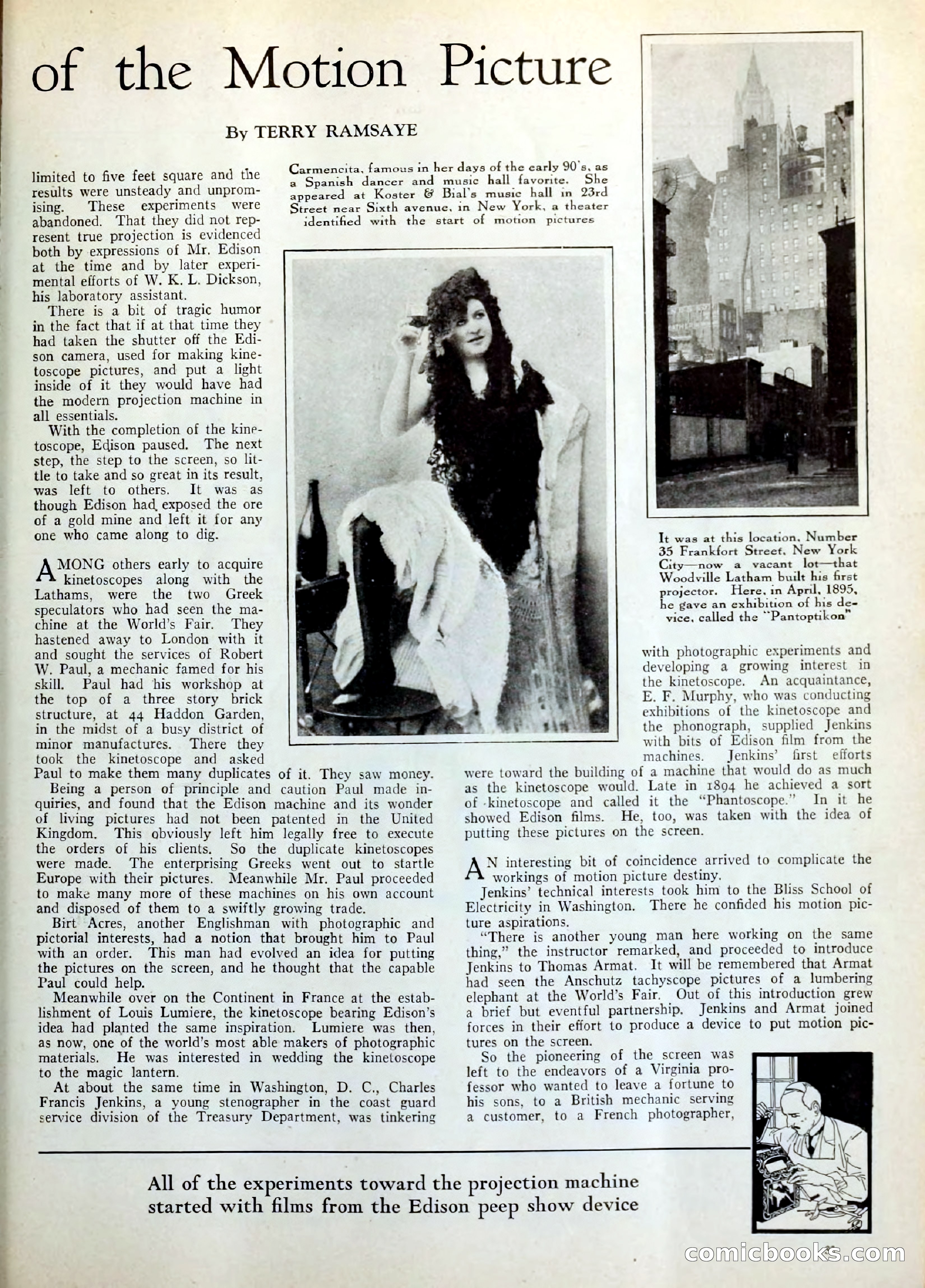
# Analysis of This Page This is an **interior story page** from a pulp magazine, containing illustrated prose text by Terry Ramsaye about the early history of motion picture projection technology. The page features three photographs: a portrait of a woman (identified as Carmencita, a Spanish dancer from the 1890s), a street scene showing New York City buildings, and a small illustration of a man working at machinery. The text discusses Thomas Edison's kinetoscope invention and the early experimenters who developed projection machines, including figures like Robert W. Paul and Charles Francis Jenkins. It describes how these pioneers worked to transition from peepshow devices to screen projection, establishing the foundations of cinema technology in the 1890s.
📄 Transcribed text from this page (OCR, searchable)
Machine-transcribed from the original scan — historical spelling and the odd misread are preserved.
A aie of the Motion Picture By TERRY RAMSAYE limited to five feet square and the results were unsteady and unprom- ising. These experiments were abandoned. That they did not rep- resent true projection is evidenced both by expressions of Mr. Edison at the time and by later experi- mental efforts of W. K. L. Dickson, his laboratory assistant. There is a bit of tragic humor in the fact that if at that time they had taken the shutter off the Edi- son camera, used for making kine- toscope pictures, and put a light inside of it they would have had the modern projection machine in all essentials. With the completion of the kine- toscope, Edison paused. The next step, the step to the screen, so lit- tle to take and so great in its result, was left to others. It was as though Edison had, exposed the ore of a gold mine and left it for any one who came along to dig. AMONG others early to acquire kinetoscopes along with the Lathams, were the two Greek speculators who had seen the ma- chine at the World’s Fair. They hastened away to London with it and sought the services of Robert W. Paul, a mechanic famed for his skill. Paul had his workshop at the top of a three story brick structure, at 44 Haddon Garden, in the midst of a busy district of minor manufactures. There they took the kinetoscope and asked Paul to make them many duplicates of it. They saw money. Being a person of principle and caution Paul made in- quiries, and found that the Edison machine and its wonder of living pictures had not been patented in the United Kingdom. This abviously left him legally free to execute the orders of his clients. So the duplicate kinetoscopes were made. ‘The enterprising Greeks went out to startle Europe with their pictures. Meanwhile Mr. Paul proceeded to make many more of these machines on his own account and disposed of them to a swiftly growing trade. Birt Acres, another Englishman with photographic and pictorial interests, had a notion that brought him to Paul with an order. This man had evolved an idea for putting the pictures on the screen, and he thought that the capable Paul could help. Meanwhile over on the Continent in France at the estab- lishment of Louis Lumiere, the kinetoscope bearing Edison’s idea had planted the same inspiration. Lumiere was then, as now, one of the world’s most able makers of photographic materials. He was interested in wedding the kinetoscope to the magic lantern. At about the same time in Washington, D. C., Charles Francis Jenkins, a young stenographer in the coast guard service division of the Treasury Department, was tinkering a Spanis Carmencita, famous in her days of the early 90's. as L ancer and music hall favorite. he appeared at Koster & Bial’s music hall in 23rd Street near Sixth avenue, in New York, a theater identified with the start of motion pictures It was at this location. Number 35 Frankfort Street. New York City—now a vacant lot—that Woodville Latham built his first projector. Here, in Apmil, 1895, he gave an exhibition of his de- vice, called the ““Pantoptikon”™ with photographic experiments and developing a growing interest in the kinetoscope. An acquaintance, E. F. Murphy, who was conducting exhibitions of the kinetoscope and the phonograph, supplied Jenkins with bits of Edison film from the machines. Jenkins’ first efforts were toward the building of a machine that would do as much as the kinetoscope would. Late in 1894 he achieved a sort of -kinetoscope and called it the “Phantoscope.” In it he showed Edison films. He, too, was taken with the idea of putting these pictures on the screen. N interesting bit of coincidence arrived to complicate the workings of motion picture destiny. Jenkins’ technical interests took him to the Bliss School of Electricity in Washington. There he confided his motion pic- ture aspirations. “There is another young man here working on the same thing,” the instructor remarked, and proceeded to introduce Jenkins to Thomas Armat. It will be remembered that Armat had seen the Anschutz tachyscope pictures of a lumbering elephant at the World’s Fair. Out of this introduction grew a brief but eventful partnership. Jenkins and Armat joined forces in their effort to produce a device to put motion pic- tures on the screen. So the pioneering of the screen was left to the endeavors of a Virginia pro- fessor who wanted to leave a fortune to his sons, to a British mechanic serving a customer, to a French photographer, All of the experiments toward the projection machine started with films from the Edison peep show device Conn)