
Pulp Fiction, 1922 · page 52 of 126
Photoplay Magazine Cover — page 52: what you’re looking at
What you’re looking at
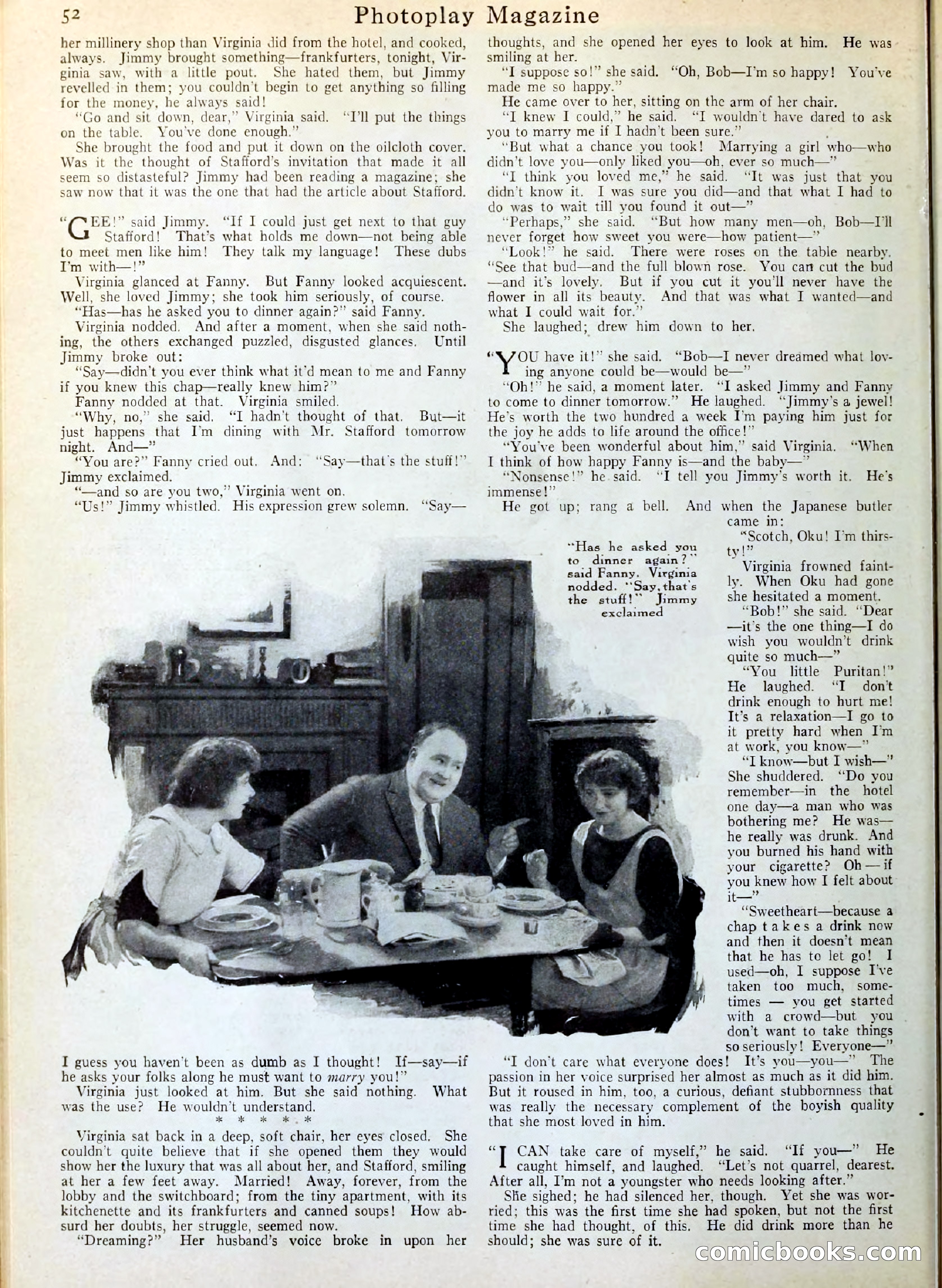
# Page 52 of Photoplay Magazine This page contains story prose with an embedded illustration. The text describes a domestic scene where Virginia, recently married to a man named Bob, reflects on her new life while conversing with her husband and friends Jimmy and Fanny. The illustration shows four people seated at a dining table, apparently during a meal. The narrative focuses on Virginia's contentment with her marriage and Bob's affectionate behavior toward her, though she experiences some self-doubt about whether she deserves his devotion. The dialogue reveals tension regarding Bob's drinking habits and past romantic interests.
📄 Transcribed text from this page (OCR, searchable)
Machine-transcribed from the original scan — historical spelling and the odd misread are preserved.
a a a a : : 2 52 Photoplay Magazine her millinery shop than Virginia did from the hotel, and cooked, always. Jimmy brought something—frankfurters, tonight, Vir- ginia saw, with a little pout. She hated them, but Jimmy revelled in them; you couldn't begin to get anything so filling for the money, he always said! “Go and sit down, dear,” Virginia said. “Ill put the things on the table. You've done enough,” She brought the food and put it down on the oilcloth cover. Was it the thought of Stafford’s invitation that made it all seem so distasteful? Jimmy had been reading a magazine; she saw now that it was the one that had the article about Stafford. ““NEE!” said Jimmy. “If I could just get next to that guy Stafford! That’s what holds me down—not being able to meet men like him! They talk my language! These dubs I'm with—!” Virginia glanced at Fanny. But Fanny looked acquiescent. Well, she loved Jimmy; she took him seriously, of course. “Has—has he asked you to dinner again?” said Fanny. Virginia nodded. And after a moment, when she said noth- ing, the others exchanged puzzled, disgusted glances. Until Jimmy broke out: “Say—didn't you ever think what it’d mean to me and Fanny if you knew this chap—really knew him?” Fanny nodded at that. Virginia smiled. “Why, no,” she said. “I hadn't thought of that. But—it just happens that I’m dining with Mr. Stafford tomorrow night. And—” “You are?” Fanny cried out. And: ‘Say—that’s the stuff!” Jimmy exclaimed. “and so are you two,” Virginia went on. “Us!” Jimmy whistled. His expression grew solemn. “Say— I guess you haven't been as dumb as I thought! If—say—if he asks your folks along he must want to marry you!” Virginia just looked at him. But she said nothing. What was the use? He wouldn’t understand. k *K # #9 Virginia sat back in a deep, soft chair, her eyes closed, She couldn't quite believe that if she opened them they would show her the luxury that was all about her, and Stafford, smiling at her a few feet away. Married! Away, forever, from the lobby and the switchboard; from the tiny apartment, with its kitchenette and its frankfurters and canned soups! How ab- surd her doubts, her struggle, seemed now. “Dreaming?” Her husband's voice broke in upon her thoughts, and she opened her eyes to look at him. He was- smiling at her. “IT suppose so!” she said. “Oh, Bob—I’m so happy! You've made me so happy.” He came over to her, sitting on the arm of her chair. “IT knew I could,” he said. “I wouldn't have dared to ask you to marry me if I hadn't been sure.” ‘ “But what a chance you took! Marrying a girl who—who didn't love you—only liked you—oh, ever so much—” “I think you loved me,” he said. “It was just that you didn’t know it. I was sure you did—and that what I had to do was to wait till vou found it out—” “Perhaps,” she said. “But how many men—oh, Bob—I'll never forget how sweet you were—how patient—” “Look!” he said. There were roses on the table nearby. ‘See that bud—and the full blown rose. You can cut the bud —and it’s lovely, But if you cut it you'll never have the flower in all its beauty. And that was what I wanted—and what I could wait for.” She laughed; drew him down to her. “ZOU have it!” she said. “Bob—I never dreamed what loy- ing anyone could be—would be—” “Oh!” he said, a moment later. “I asked Jimmy and Fanny to come to dinner tomorrow.” He laughed. ‘“Jimmy’s a jewel! He’s worth the two hundred a week I’m paying him just for the joy he adds to life around the office!” “You've been wonderful about him,” said Virginia. “When I think of how happy Fanny is—and the baby—” “Nonsense!” he. said. “I tell you Jimmy’s worth it. He’s immense!” He got up; rang a bell. And when the Japanese butler came in: “Epis asked ae ee Oku! I’m thirs to dinner again?” Soe . ead oe. Vitginia Virginia frowned faint- wadded “Sad thats ly. When Oku had gone the stuff!" Jimmy she hesitated a moment. exclaimed “Bob!” she said. ‘‘Dear —it’s the one thing—I do wish you wouldn’t drink quite so much—” “Vou little Puritan!” He laughed. “I dont drink enough to hurt me! It’s a relaxation—I go to it pretty hard when I’m at work, you know—” “I know—but I wish—” She shuddered. ‘Do you remember—in the hotel one day—a man who was bothering me? He was— he really was drunk. And you burned his hand with your cigarette? Oh—if you knew how I felt about ih “Sweetheart—because a chap takes a drink now and then it doesn’t mean that he has to let go! I used—oh, I suppose I've taken too much, some- times — you get started with a crowd—but you don’t want to take things so seriously! Everyone—” “T don’t care what everyone does! It’s you—you—” The passion in her voice surprised her almost as much as it did him. But it roused in him, too, a curious, defiant stubbornness that was really the necessary complement of the boyish quality that she most loved in him. | CAN take care of myself,” he said. “If you—” He caught himself, and laughed. ‘“Let’s not quarrel, dearest. After all, I’m not a youngster who needs looking after.” Slie sighed; he had silenced her, though. Yet she was wor- ried; this was the first time she had spoken, but not the first time she had thought, of this. He did drink more than he should; she was sure of it. o Eomicbooks.co