
Pulp Fiction, 1922 · page 49 of 126
Photoplay Magazine Cover — page 49: what you’re looking at
What you’re looking at
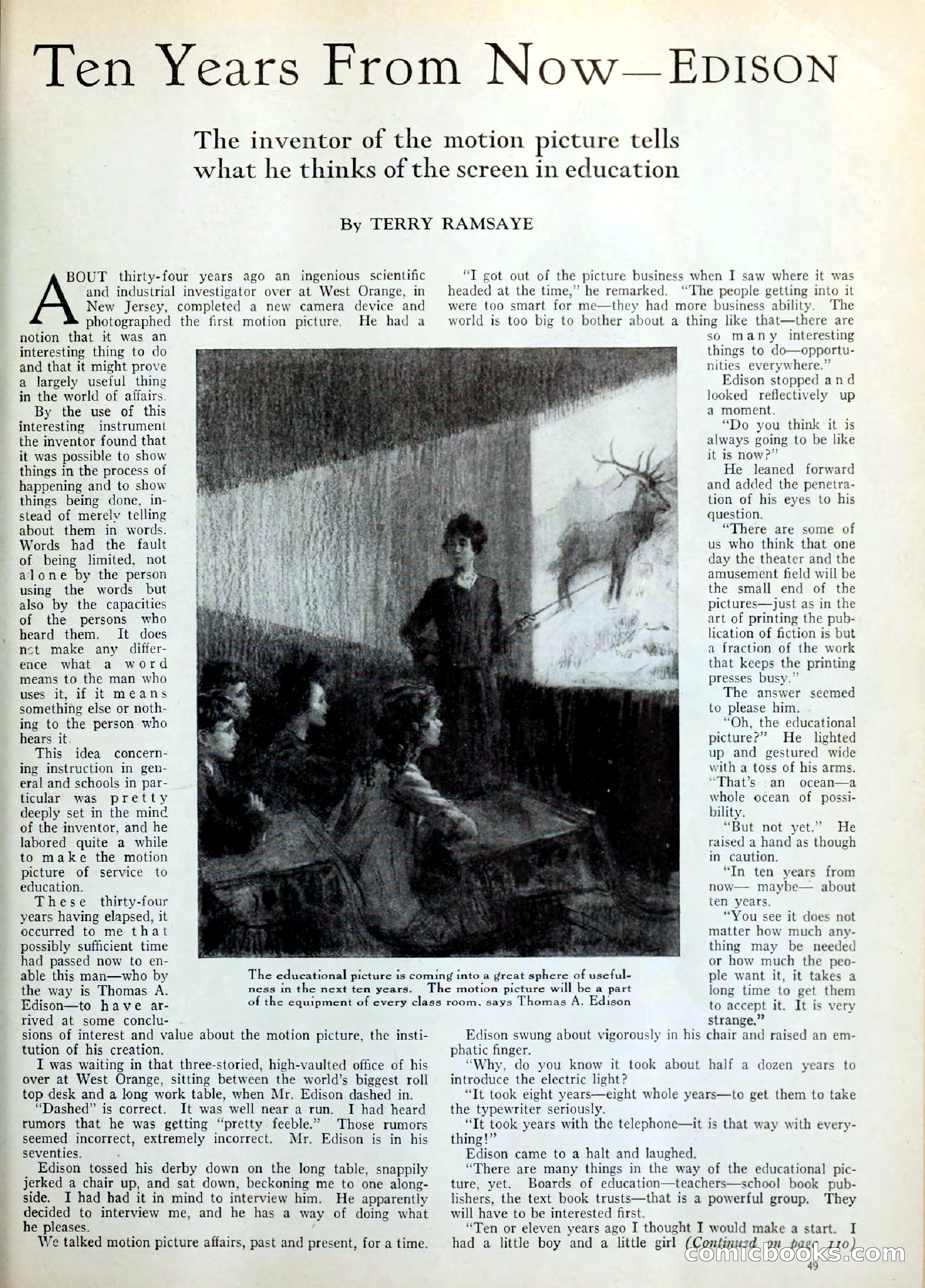
# Page Analysis This is a two-column article page with an embedded photograph. The article, titled "Ten Years From Now—Edison" and bylined by Terry Ramsaye, features an interview with Thomas A. Edison discussing the educational potential of motion pictures in schools. The central photograph shows Edison seated in a chair, gesturing while speaking. The visible text covers Edison's predictions about cinema's future role in classroom instruction, his belief that motion pictures will eventually become standard educational equipment, and his reflections on why the film industry took years to develop technically. The article appears to continue on a following page (marked "Continued on page 110").
📄 Transcribed text from this page (OCR, searchable)
Machine-transcribed from the original scan — historical spelling and the odd misread are preserved.
Ten Years From Now — EDISON The inventor of the motion picture tells what he thinks of the screen in education By TERRY RAMSAYE BOUT thirty-four years ago an ingenious scientific and industrial investigator over at West Orange, in New Jersey, completed a new camera device and photographed the first motion picture. He had a notion that it was an interesting thing to do and that it might prove a largely useful thing in the world of affairs. By the use of this interesting instrument the inventor found that it was possible to show things in the process of happening and to show things being done, in- stead of merelv telling about them in words. Words had the fault of being limited, not alone by the person using the words but also by the capacities of the persons who heard them. It does net make any differ- ence what a word means to the man who uses it, if it means something else or noth- ing to the person who hears it This idea concern- ing instruction In gen- eral and schools in par- ticular was pretty deeply set in the mind of the inventor, and he labored quite a while to make the motion picture of service to education. These thirty-four years having elapsed, it occurred to me that possibly sufficient time had passed now to en- “T got out of the picture business when I saw where it was headed at the time,” he remarked. “The people getting into it were too smart for me—they had more business ability. The world is too big to bother about a thing like that—there are so many _ interesting things to do—opportu- nities everywhere.” Edison stopped and looked reflectively up a moment. “Do you think it is always going to be like it Is now?” He leaned forward and added the penetra- tion of his eyes to his question. “There are some of us who think that one day the theater and the amusement field will be the small end of the pictures—Just as in the art of printing the pub- lication of fiction is but a fraction of the work that keeps the printing presses busy.”’ The answer seemed to please him. “Oh, the educational picture?” He lighted up and gestured wide with a toss of his arms. “That’s an ocean—a whole ocean of possi- bility, “But not yet.” He raised a hand as though in caution. “In ten years from now— maybe— about ten years. “You see it does not matter how much any- thing may be needed or how much the peo- able this man—who b The educational picture is coming into a great sphere of useful- nle want it, it takes a y “saad ; I the way is Thomas A. ness in the next ten years. The motion picture will be a part long time to get them Edison—to have ar- of the equipment of every class room, says Thomas A. Edison to accept it, It is very rived at some conclu- sions of interest and value about the motion picture, the insti- tution of his creation. I was waiting in that three-storied, high-vaulted office of his over at West Orange, sitting between the world’s biggest roll top desk and a long work table, when Mr. Edison dashed in. “Dashed” is correct. It was well near a run. I had heard rumors that he was getting ‘pretty feeble.’ Those rumors seemed incorrect, extremely incorrect. Mr. Edison is in his seventies. Edison tossed his derby down on the long table, snappily jerked a chair up, and sat down, beckoning me to one along- side. I had had it in mind to interview him. He apparently decided to interview me, and he has a way of doing what he pleases. We talked motion picture affairs, past and present, for a time. strange.” Edison swung about vigorously in his chair and raised an em- phatic finger. “Why, do you know it took about half a dozen years to introduce the electric light? “Tt took eight years—eight whole years—to get them to take the typewriter seriously. “It took years with the telephone—it is that way with every- thing!” Edison came to a halt and laughed. “There are many things in the way of the educational pic- ture, yet. Boards of education—teachers—school book pub- lishers, the text book trusts—that is a powerful group. They will have to be interested first. “Ten or eleven years ago I thought I would make a start. had a little boy and a little girl (Goi fa 220