
Pulp Fiction, 1922 · page 58 of 126
Photoplay Magazine Cover — page 58: what you’re looking at
What you’re looking at
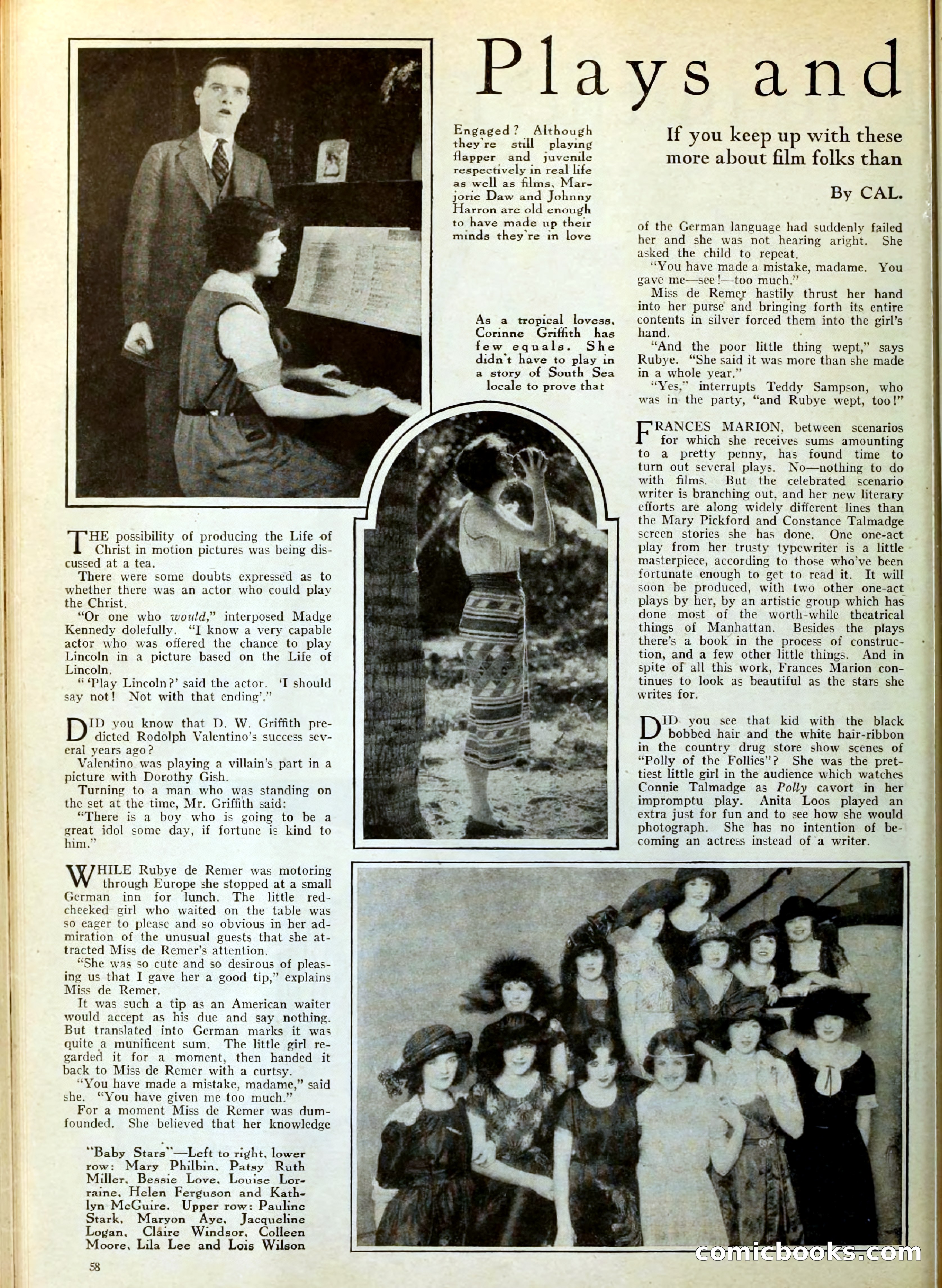
# Page Analysis This is an interior magazine page titled "Plays and" (bylined "By CAL.") that discusses early film and theater productions. The page contains three black-and-white photographs: one showing a man in formal attire holding papers, one circular image of what appears to be a dramatic scene, and one group photograph of women in hats and period costume. The text discusses whether actors from theater could successfully transition to film, mentioning specific performers like Rudolph Valentino, Frances Marion, and Rubye de Remer. It includes anecdotes about casting decisions and production stories, including a narrative about a child actress on a European location shoot. The article appears to be from the early silent film era, comparing theatrical and cinematic performance requirements.
📄 Transcribed text from this page (OCR, searchable)
Machine-transcribed from the original scan — historical spelling and the odd misread are preserved.
HE possibility of producing the Life of Christ in motion pictures was being dis- cussed at a tea. There were some doubts expressed as to whether there was an actor who could play the Christ, “Or one who would,” interposed Madge Kennedy dolefully. “I know a very capable actor who was offered the chance to play Lincoln in a picture based on the Life of Lincoln, “ “Play Lincoln pe’ said the actor, ‘I should say not! Not with that ending’,” ID you know that D. W. Griffith pre- dicted Rodolph Valentino's success sev- eral years ago? Valentino was playing a villain’s part in a picture with Dorothy Gish. Turning to a man who was standing on the set at the time, Mr. Griffith said: “There is a boy who is going to be a great idol some day, if fortune is kind to him,” HILE Rubye de Remer was motoring through Europe she stopped at a small German inn for lunch. The little red- cheeked girl who waited on the table was so eager to please and so obvious in her ad- miration of the unusual guests that she at- tracted Miss de Remer’s attention, “She was so cute and so desirous of pleas- ing us that I gave her a good tip,” explains Miss de Remer. It was such a tip as an American waiter would accept as his due and say nothing. But translated into German marks it was quite a munificent sum. The little girl re- garded it for a moment, then handed it back to Miss de Remer with a curtsy. “You have made a mistake, madame,” said she. “You have given me too much.” For a moment Miss de Remer was dum- founded, She believed that her knowledge “Baby Stars’ —Left to right, lower row : Mary Philbin, Patsy Ruth raine. Helen Ferguson and Kath- lyn McGuire. Upper row: Pauline Stark, Maryon Aye, Jacqueline Logan, Claire Windsor, Colleen Moore, Lila Lee and Lois Wilson 58 Plays aa Engaged? Although they re still playing flapper and juvenile respectively in real life as well as films, Mar- arron are ald enough to have made up their minds they're in love As a tropical lovess, Corinne Griffith has few equals. She didn’t have to play in a story of South Sea locale to prove that If you keep up with these more about film folks than By CAL. of the German language had suddenly failed her and she was not hearing aright. She asked the child to repeat, “You have made a mistake, madame. You gave me—see !—too much,” Miss de Remer hastily thrust her hand into her purse and bringing forth its entire contents in silver forced them into the girl’s hand. ‘And the poor little thing wept,” says Rubye. “She said it was more than she made in a whole year.” “Yes,” mterrupts Teddy Sampson, who was in the party, “and Rubye wept, too!” RANCES MARION, between scenarios for which she receives sums amounting to a pretty penny, has found time to turn out several plays. No—nothing to do with films. But the celebrated scenario writer is branching out, and her new literary efforts are along widely different lines than the Mary Pickford and Constance Talmadge screen stories she has done. One one-act play from her trusty typewriter is a little masterpiece, according to those who’ve been fortunate enough to get to read it. It will soon be produced, with two other one-act plays by her, by an artistic group which has done most of the worth-while theatrical things of Manhattan. Besides the plays there’s a book in the process of construc- tion, and a few other little things. And in spite of all this work, Frances Marion con- tinues to look as beautiful as the stars she writes for, ID you see that kid with the black bobbed hair and the white hair-ribbon in the country drug store show scenes of “Polly of the Follies’? She was the pret- tiest little girl in the audience which watches Connie Talmadge as Polly cavort in her impromptu play. Anita Loos played an extra just for fun and to see how she would photograph. She has no intention of be- coming an actress instead of a writer.