
Pulp Fiction, 1922 · page 32 of 126
Photoplay Magazine Cover — page 32: what you’re looking at
What you’re looking at
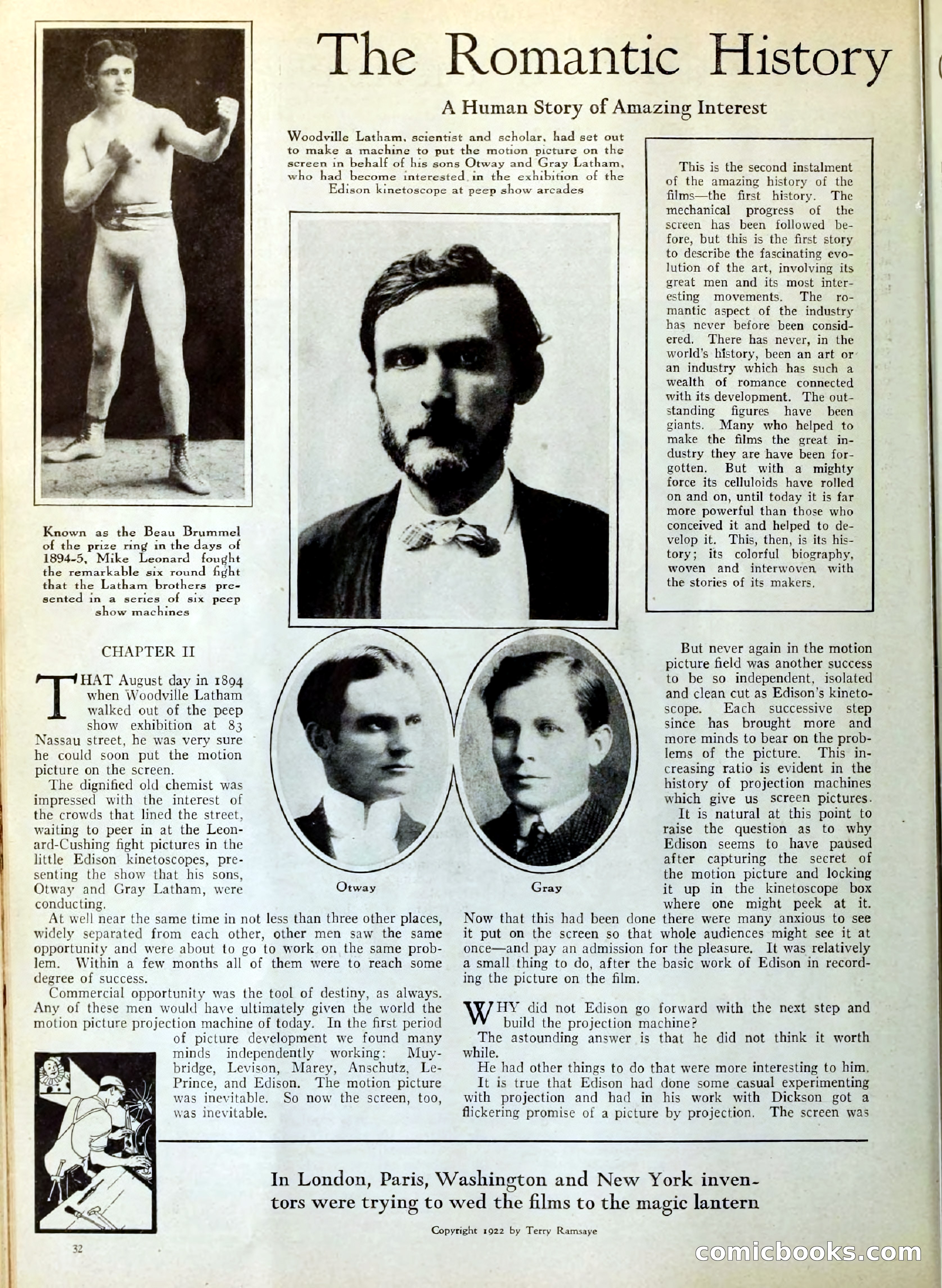
# "The Romantic History" - Chapter II This is a story text page with period photographs and illustrations. The visible content describes how Woodville Latham attempted to project motion pictures on a screen in 1894, building on Edison's kinetoscope technology. The page details the early history of motion picture projection, explaining how Latham and others (including his sons Otway and Gray, pictured here) worked to advance the technology. The text notes that Edison himself did not pursue projection further, considering it unworthy of his time, leaving the field open for other inventors in London, Paris, Washington, and New York to develop the technology. The page combines narrative prose with portrait photographs of key figures in this history.
📄 Transcribed text from this page (OCR, searchable)
Machine-transcribed from the original scan — historical spelling and the odd misread are preserved.
Known as the Beau Brummel of the prize ring in the days of 1894-5, Mike Leonard fought the remarkable six round fight that the Latham brothers pre- sented in a series of six peep show machines CHAPTER II HAT August day in 1894 when Woodville Latham walked out of the peep show exhibition at 83 Nassau street, he was very sure he could soon put the motion picture on the screen. The dignified old chemist was impressed with the interest of the crowds that lined the street, waiting to peer in at the Leon- ard-Cushing fight pictures in the little Edison kinetoscopes, pre- senting the show that his sons, Otway and Gray Latham, were conducting. At well near the same time in not less than three other places, widely separated from each other, other men saw the same opportunity and were about to go to work on the same prob- lem. Within a few months all of them were to reach some degree of success. Commercial opportunity was the tool of destiny, as always. Any of these men would have ultimately given the world the motion picture projection machine of today. In the first period of picture development we found many minds independently working: Muy- bridge, Levison, Marey, Anschutz, Le- Prince, and Edison. The motion picture was inevitable. So now the screen, too, was inevitable. Otway Woodville Latham, scientist and scholar, had set out to make a machine to put the motion picture on the screen in behalf of his sons Otway and Gray who had become interested in the exhibition of the Edison kinetoscope at peep show arcades The Romantic History | A Human Story of Amazing Interest atham, This is the second instalment of the amazing history of the films—the first history. The mechanical progress of the screen has been followed be- fore, but this is the first story to describe the fascinating evo- lution of the art, involving its great men and its most inter- esting movements. The ro- mantic aspect of the industry has never before been consid- ered, There has never, in the world’s history, been an art or an industry which has such a wealth of romance connected with its development. The out- standing figures have been giants. Many who helped to make the films the great in- dustry they are have been for- gotten. But with a mighty force its celluloids have rolled on and on, until today it is far more powerful than those who conceived it and helped to de- velop it. This, then, is its his- tory; its colorful biography, woven and interwoven with the stories of its makers, But never again in the motion picture field was another success to be so independent, isolated and clean cut as Edison’s kineto- scope. Each successive step since has brought more and more minds to bear on the prob- lems of the picture. This in- creasing ratio is evident in the history of projection machines which give us screen pictures. It is natural at this point to raise the question as to why Edison seems to have paused after capturing the secret of the motion picture and locking it up in the kinetoscope box where one might peek at it. Now that this had been done there were many anxious to see it put on the screen so that whole audiences might see it at once—and pay an admission for the pleasure. It was relatively a small thing to do, after the basic work of Edison in record- ing the picture on the film. Gray HY did not Edison go forward with the next step and build the projection machine? The astounding answer is that he did not think it worth while. He had other things to do that were more interesting to him, It is true that Edison had done some casual experimenting with projection and had in his work with Dickson got a flickering promise of a picture by projection, The screen was In London, Paris, Washington and New York inven- tors were trying to wed the films to the magic lantern Copyright 1922 by Terry Ramsaye a Eomicbooks. co ;