
Pulp Fiction, 1922 · page 34 of 126
Photoplay Magazine Cover — page 34: what you’re looking at
What you’re looking at
# Page Analysis This is a text-heavy article page (page 34) with two embedded photographs and illustrations. The prose discusses the early history of motion picture technology and the Latham Brothers' contributions to film projection, specifically their work with the kinetoscope and the Leonard-Cushing fight filmed at Edison's studio. The text also covers William E. Gilmore's role at Edison enterprises and mentions conflicts between Edison and various inventors over patent claims and competing technologies. Two photographs show Woodville Latham's projection machine and what appears to be early film equipment. Small illustrations of boxers and a "Scarab" poster appear in the margins.
📄 Transcribed text from this page (OCR, searchable)
Machine-transcribed from the original scan — historical spelling and the odd misread are preserved.
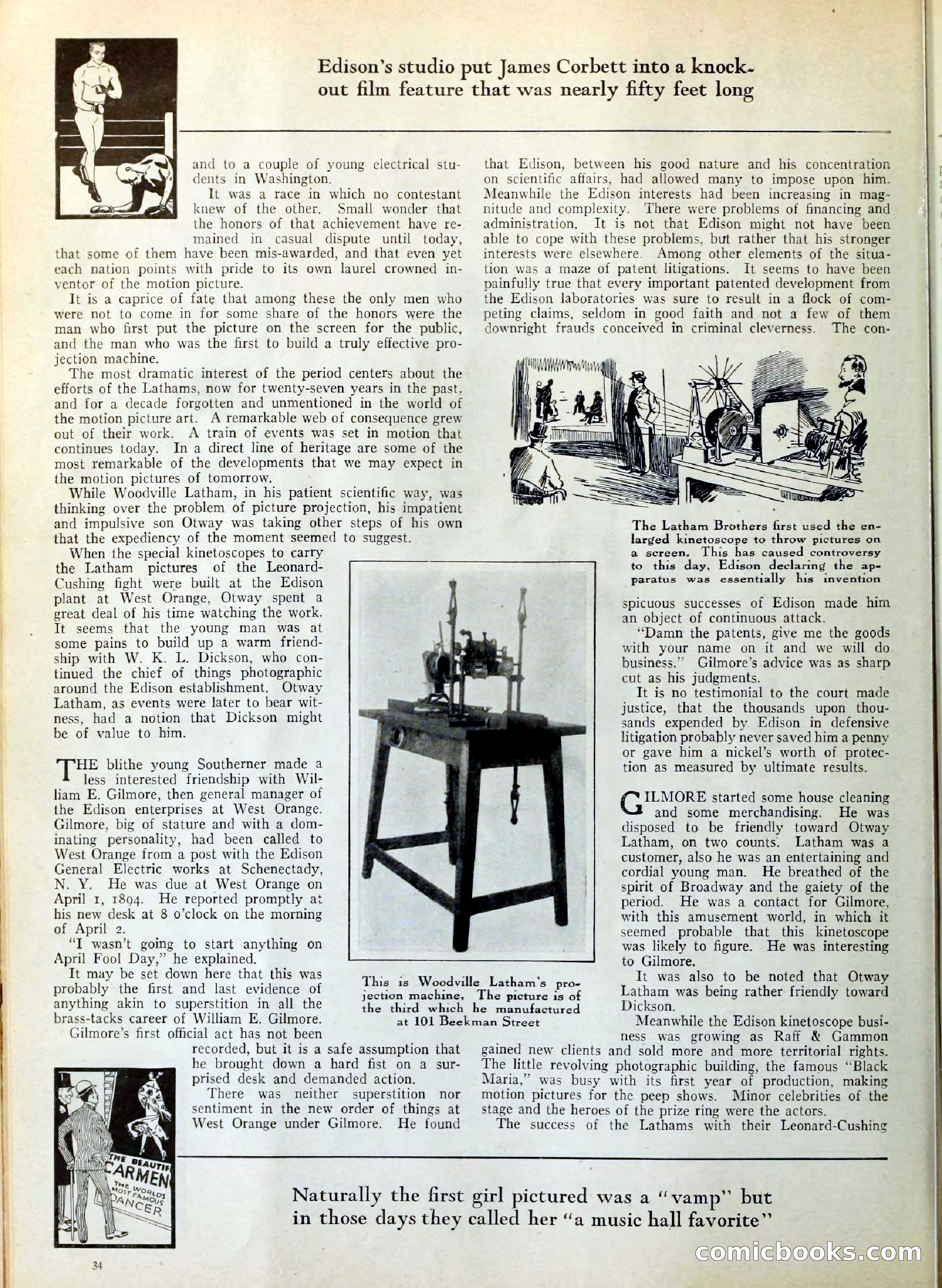
and to a couple of young electrical stu- dents in Washington. It was a race in which no contestant knew of the other. Small wonder that the honors of that achievement have re- mained in casual dispute until today, that some of them have been mis-awarded, and that even yet each nation points with pride to its own laurel crowned in- ventor of the motion picture. It is a caprice of fate that among these the only men who were not to come in for some share of the honors were the man who first put the picture on the screen for the public, and the man who was the first to build a truly effective pro- jection machine, The most dramatic interest of the period centers about the efforts of the Lathams, now for twenty-seven years in the past, and for a decade forgotten and unmentioned in the world of the motion picture art. A remarkable web of consequence grew out of their work. A train of events was set in motion that continues today. In a direct line of heritage are some of the most remarkable of the developments that we may expect in the motion pictures of tomorrow. While Woodville Latham, in his patient scientific way, was thinking over the problem of picture projection, his impatient and impulsive son Otway was taking other steps of his own that the expediency of the moment seemed to suggest. When the special kinetoscopes to carry the Latham pictures of the Leonard- Cushing fight were built at the Edison plant at West Orange, Otway spent a great deal of his time watching the work. It seems that the young man was at some pains to build up a warm friend- ship with W. K. L. Dickson, who con- tinued the chief of things photographic around the Edison establishment. Otway Latham, as events were later to bear wit- ness, had a notion that Dickson might be of value to him. Sh blithe young Southerner made a less interested friendship with Wil- liam E. Gilmore, then general manager of the Edison enterprises at West Orange. Gilmore, big of stature and with a dom- inating personality, had been called to West Orange from a post with the Edison General Electric works at Schenectady, N. Y. He was due at West Orange on April 1, 1894. He reported promptly at his new desk at 8 o’clock on the morning of April 2. “T wasn’t going to start anything on April Fool Day,” he explained. It may be set down here that this was probably the first and last evidence of anything akin to superstition in all the brass-tacks career of William E. Gilmore. Gilmore’s first official act has not been recorded, but it is a safe assumption that he brought down a hard fist on a sur- prised desk and demanded action. There was neither superstition nor sentiment in the new order of things at West Orange under Gilmore. He found jection machine, This 1s Woodville Latham's pro- the third which he manufactured at 101 Beekman Street Edison’s studio put James Corbett into a knock- out film feature that was nearly fifty feet long that Edison, between his good nature and his concentration on scientific affairs, had allowed many to impose upon him. Meanwhile the Edison interests had been increasing in mag- nitude and complexity. There were problems of financing and administration. It is not that Edison might not have been able to cope with these problems, but rather that his stronger interests were elsewhere. Among other elements of the situa- tion was a maze of patent litigations. It seems to have been painfully true that every important patented development from the Edison laboratories was sure to result in a flock of com- peting claims, seldom in good faith and not a few of them downright frauds conceived in criminal cleverness. The con- ng /} 2 i I 1 | i " The Latham Brothers first used the en- larged kinetoscope to throw pictures on a screen, 1s has cause controversy to this day, Edison declaring the ap- paratus was essentially his invention spicuous successes of Edison made him an object of continuous attack. “Damn the patents, give me the goods with your name on it and we will do business.’ Gilmore's advice was as sharp cut as his judgments. It is no testimonial to the court made justice, that the thousands upon thou- sands expended by Edison in defensive litigation probably never saved him a penny or gave him a nickel’s worth of protec- tion as measured by ultimate results. Co started some house cleaning and some merchandising. He was disposed to be friendly toward Otway Latham, on two counts. Latham was a customer, also he was an entertaining and cordial young man. He breathed of the spirit of Broadway and the gaiety of the period. He was a contact for Gilmore, with this amusement world, in which it seemed probable that this kinetoscope was likely to figure. He was interesting to Gilmore. It was also to be noted that Otway Latham was being rather friendly toward Dickson, Meanwhile the Edison kinetoscope busi- ‘ ness was growing as Raff & Gammon gained new clients and sold more and more territorial rights. The little revolving photographic building, the famous “Black Maria,” was busy with its first year of production, making motion pictures for the peep shows. Minor celebrities of the stage and the heroes of the prize ring were the actors. The success of the Lathams with their Leonard-Cushing he picture is of Naturally the first girl pictured was a “vamp” but in those days they called her “a music hall favorite” a comicbook