
Pulp Fiction, 1922 · page 28 of 126
Photoplay Magazine Cover — page 28: what you’re looking at
What you’re looking at
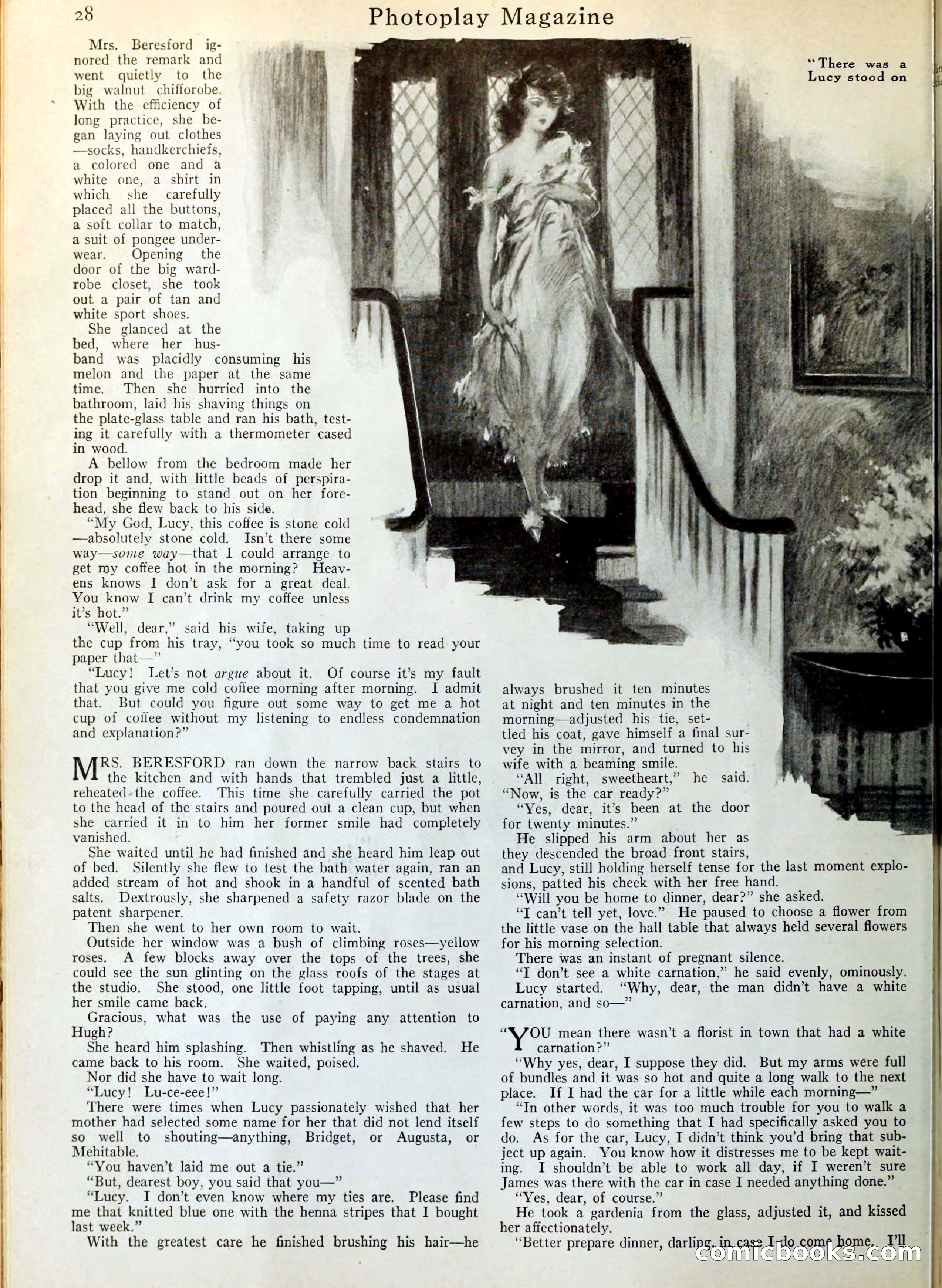
# Page 28 from Photoplay Magazine This is a story page containing prose fiction alongside a black-and-white illustration. The illustration depicts a woman in 1920s attire standing in a bedroom doorway, appearing tense or anxious. The visible text concerns a domestic dispute between a married couple named Lucy and her husband. Lucy has been unable to get her husband hot coffee in the morning, and he complains about it. The narrative follows Lucy's efforts to prepare the coffee while her husband shaves and prepares for the day. The couple discusses whether Lucy can arrange for hot coffee without listening to his complaints, and mentions an errand involving a car and flowers.
📄 Transcribed text from this page (OCR, searchable)
Machine-transcribed from the original scan — historical spelling and the odd misread are preserved.
28 Photoplay Magazine Mrs. Beresford ig- nored the remark and went quietly to the big walnut chifforobe. With the efficiency of long practice, she be- gan laying out clothes —socks, handkerchiefs, a colored one and a white one, a shirt in which she _ carefully placed all the buttons, a soft collar to match, a suit of pongee under- wear. Opening the door of the big ward- robe closet, she took : out a pair of tan and ca white sport shoes. She glanced at the bed, where her hus- band was placidly consuming his melon and the paper at the same time. Then she hurried into the bathroom, laid his shaving things on the plate-glass table and ran his bath, test- ing it carefully with a thermometer cased in wood. A bellow from the bedroom made her drop it and, with little beads of perspira- tion beginning to stand out on her fore- head, she flew back to his side. “My God, Lucy, this coffee is stone cold —absolutely stone cold. Isn’t there some way—sole way—that I could arrange to get my coffee hot in the morning? Heav- ens knows I don’t ask for a great deal. You know I can’t drink my coffee unless it’s hot.” “Well, dear,” said his wife, taking up the cup from his tray, “you took so much time to read your paper that—”’ “Lucy! Let’s not argue about it. Of course it’s my fault that you give me cold coffee morning after morning. I admit that. But could you figure out some way to get me a hot cup of coffee without my listening to endless condemnation and explanation?” RS. BERESFORD ran down the narrow back stairs to the kitchen and with hands that trembled just a little, reheated-the coffee. This time she carefully carried the pot to the head of the stairs and poured out a clean cup, but when she carried it in to him her former smile had completely vanished. She waited until he had finished and she heard him leap out of bed. Silently she flew to test the bath water again, ran an added stream of hot and shook in a handful of scented bath salts. Dextrously, she sharpened a safety razor blade on the patent sharpener. Then she went to her own room to wait. Outside her window was a bush of climbing roses—yellow roses. A few blocks away over the tops of the trees, she could see the sun glinting on the glass roofs of the stages at the studio, She stood, one little foot tapping, until as usual her smile came back. Gracious, what was the use of paying any attention to Hugh? She heard him splashing. Then whistling as he shaved. He came back to his room. She waited, poised. Nor did she have to wait long. “Lucy! Lu-ce-eee!” There were times when Lucy passionately wished that her mother had selected some name for her that did not lend itself so well to shouting—anything, Bridget, or Augusta, or Mehitable. “You haven’t laid me out a tie.” “But, dearest boy, you said that you—” “Lucy. I don’t even know where my ties are. Please find me that knitted blue one with the henna stripes that I bought last week.” With the greatest care he finished brushing his hair—he “There was a Lucy stood on always brushed it ten minutes at night and ten minutes in the morning—adjusted his tie, set- tled his coat, gave himself a final sur- vey in the mirror, and turned to his wife with a beaming smile. “All right, sweetheart,” he “Now, is the car ready?” “Yes, dear, it’s been at the door for twenty minutes.” He slipped his arm about her as they descended the broad front stairs, and Lucy, still holding herself tense for the last moment explo- sions, patted his cheek with her free hand. “Will you be home to dinner, dear?” she asked. “T can’t tell yet, love.” He paused to choose a flower from the little vase on the hall table that always held several flowers for his morning selection. There was an instant of pregnant silence. “T don’t see a white carnation,” he said evenly, ominously. Lucy started. ‘Why, dear, the man didn’t have a white carnation, and so—” said. “SX 7OU mean there wasn’t a florist in town that had a white carnation?” ‘Why yes, dear, I suppose they did. But my arms were full of bundles and it was so hot and quite a long walk to the next place. If I had the car for a little while each morning—” “In other words, it was too much trouble for you to walk a few steps to do something that I had specifically asked you to do. As for the car, Lucy, I didn’t think you’d bring that sub- ject up again. You know how it distresses me to be kept wait- ing. I shouldn’t be able to work all day, if I weren’t sure James was there with the car in case I needed anything done.” “Yes, dear, of course.” He took a gardenia from the glass, adjusted it, and kissed her affectionately. “Better prepare dinner, darlig rao ooksecom