
Pulp Fiction, 1922 · page 120 of 126
Photoplay Magazine Cover — page 120: what you’re looking at
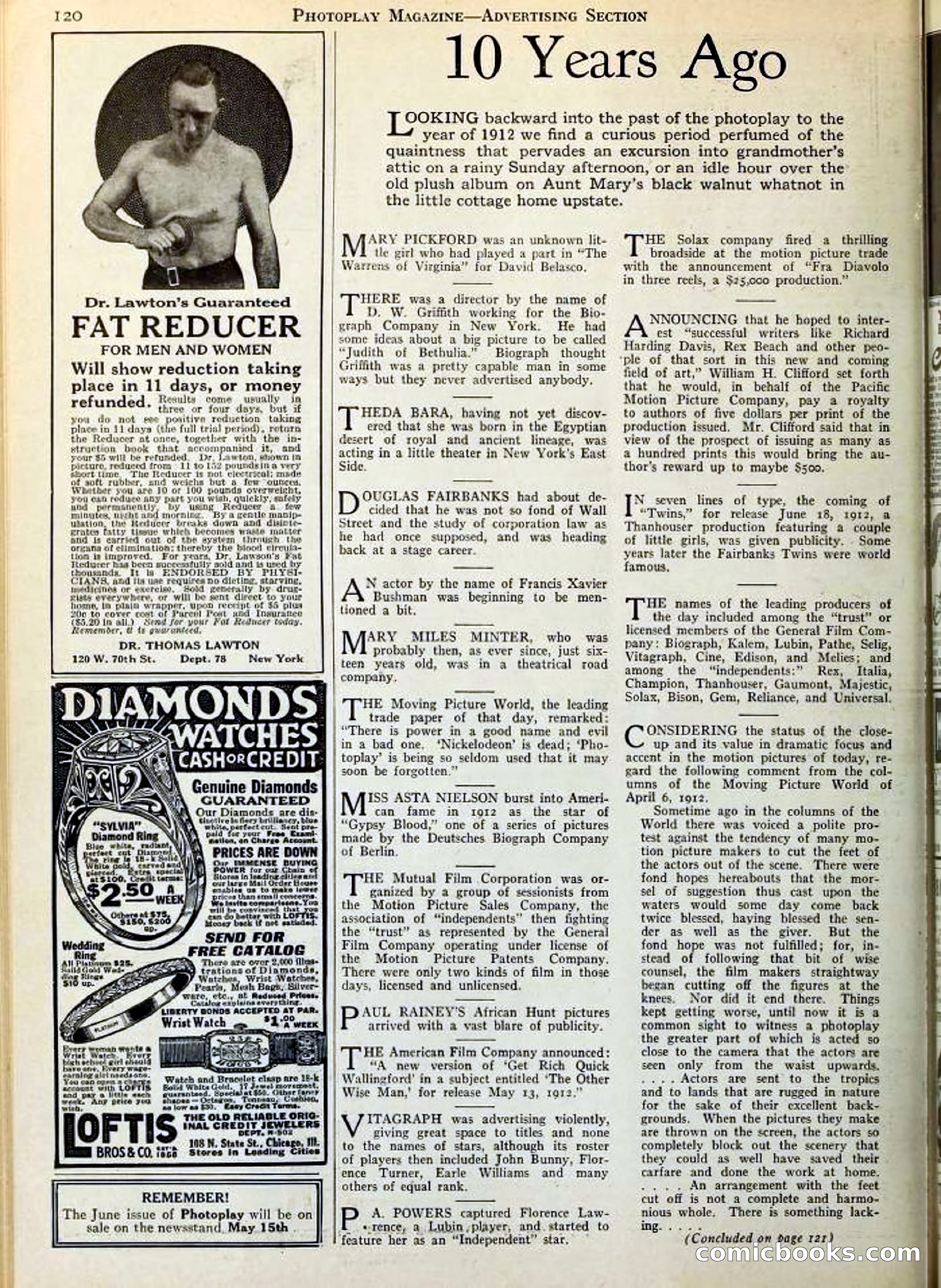
A restored page from Pulp Fiction, 1922. Page through the whole issue in the reader above.
📄 Transcribed text from this page (OCR, searchable)
Machine-transcribed from the original scan — historical spelling and the odd misread are preserved.
Dr. Lawton’s Guaranteed FAT REDUCER FOR MEN AND WOMEN Will show reduction taking place in 11 days, or money , Reaults come usually in refunded. three or four days, but if you do not eee pomtires, reduction taking place in 11) days (the full trial period), retorn the Reducer at once, together with the in- structéton book that accor nPwten, it, and your $5 wilt be re naar Dr. |.aveton, ebown In picture, reduced from 11 te Loe pour nile ih a very short time, The Reducer is mot cleetrical; meade of sott rubber, and weichs but 6 fow outew. Whether you are 10 of 100 pounds overwelrht, yOu can rodiee Any part you wish, quickly, mfely nod permenentiiy, by using Reducer a few minutes. leche aed mocnise, By a gerue manip Wiation. the Meducer breaks down and disinte- Erntes fatty therue whieh becomes waste matter aud is carried out of the systern through the oreuna of etimination: thereby the biool ciroula- tom is improred. For rears, Dr, Lawson's Pat Rederer has bern successfully sold and is used bh thousands It la ENDORSED BY PHYSI- CIANS, and tts uae requires no Gicting, starving, rmediqinha of exere Sok! gemtrally by. drug- flets everywhere, or will be sent direct to your hose, io plaim wrapper, Upen receipt of $6 plus 200 to corer cost of Fareo! Peat amd Inauranee ($5.20 In all.) Send for your Fat Reducer today, Rememoer, U te gwar anced, DR. THOMAS LAWTON 120 W. 70th St. Dept. 78 New York aN lesey, thos mat gy dg your Cxami- wires Charge Accosnt. Sas Freer very wane loFTis == BROS&CO.fsch seeres ni Eptd REMEMBER! The June issue of Photoplay will be on sale on the newsstand, May 15th . Woz } A ; : Be i Ra == ? K © 3 Ae fri ¥ ae é ue ul E PHOTOPLAY MAGAZINE—ADVERTISING SECTION 10 Years Ago [ockuc backward into the past of the photoplay to the year of 1912 we find a curious period perfumed of the quaintness that pervades an excursion into grandmother’s attic on a rainy Sunday afternoon, or an idle hour over the’ old plush album on Aunt Mary’s black walnut whatnot in the little cottage home upstate. ARY PICKFORD was an unknown lit- tle girl who had played 4 part in “The Warrens of Virginia’ for David Belasco, HERE was a director by the name of D. W. Griffith working for the Bio- graph Company in New York. He had some ideas about a big picture to be called “Judith of Bethulia.” Biograph thought Griffith was a pretty capable man in some ways but they never advertised anybody. HEDA BARA, having not yet discov- ered that she was born in the Egyptian desert of royal and ancient lineage, was acting in a little theater in New York's East Side. OUGLAS FAIRBANKS had about de- cided that he was not so fond of Wall Street and the study of corporation law as he had once supposed, and was heading back at a stage career. N actor by the name of Francis Xavier Bushman was beginning to be men- tioned a bit. ARY MILES MINTER, who was probably then, as ever since, just six- teen years old, was in a theatrical road company. HE Moving Picture World, the leading trade paper of that day, remarked : “There is power in a good name and evil in a bad one, ‘Nickelodeon’ is dead; ‘Pho- toplay’ is being so seldom used that it may soon be forgotten.” ISS ASTA NIELSON burst into Ameri- can fame in t1orz as the star of “Gypsy Blood,” one of a serics of pictures made by the Deutsches Biograph Company of Berlin. G he Mutual Film Corporation was or- anized by a group of séssionists from the Motion Picture Sales Company, the association of “independents” then fighting the “trust” as represented by the General Film Company operating under license of the Motion Picture Patents Company. There were only two kinds of film in those days, licensed and unlicensed, AUL RAINEY’S African Hunt pictures arrived with a vast blare of publicity. HE American Film Company announced: “A new version of ‘Get Rich Quick Wallingford’ in a subject entitled ‘The Other Wise Man,’ for release May 13, 1012," ITAGRAPH was advertising violently, giving great space to titles and none to the names of stars, although its roster of players then included John Bunny, Fler- ence Turner, Earle Williams and many others of equal rank. A. POWERS captured Florence Law- «rence, &@ Lubin player, and. started to feature her as an “Independent” star, 4 es Solax company fired a_ thrilling broadside at the motion picture trade with the announcement of “Fra Diavyolo in three reeks, a $25,cco production.” NNOUNCING that he hoped to inter- est “successful writers like Richard Harding Davis, Rex Beach and other peo- ‘ple of that sort in this new and coming field of art,” William H. Clifford set forth that he would, in behalf of the Pacific Motion Picture Company, pay a royalty to authors of five doilars per print of the production issued. Mr. Clifford said that in view of the prospect of issuing as many as 2 hundred prints this would bring the au- thor'’s reward up to maybe $500. N_ seven lines of type, the coming of “Twins,” for release June 18, 1912, a Thanhouser production featuring a couple of little girls, was given publicity. Some years later the Fairbanks Twins were world famous. HE names of the leading producers of the day included among the “trust” or licensed members of the General Film Com- pany: Biograph, Kalem, Lubin, Pathe, Selig, Vitagraph, Cine, Edison, and Melies; and among the “independents:” Rex, Italia, Champion, Thanhouser, Gaumont, Majestic, Solax, Bison, Gem, Reliance, and Universal. ONSIDERING the status of the close- up and its value in dramatic focus and accent in the motion pictures of today, re- gard the following comment from the col- umns of the Moving Picture World of April 6, 1912. Sometime ago in the columns of the World there was voiced a polite pro- test against the tendency of many mo- tion picture makers to cut the feet of the actors out of the scene. There were fond hopes hereabouts that the mor- sel of suggestion thus cast upon the waters would some day come back twice blessed, haying blessed the sen- der as well as the giver. But the fond hope was not fulfilled; for, in- stead of following that bit of whe counsel, the film makers straichtway becan cutting off the figures at the knees. Nor did it end there. Things kept getting worse, until now it is a common sight to witness a photoplay the greater part of which is acted so close to the camera that the actors are seen only from the waist upwards, ..,. Actors are sent to the tropics and to lands that are rugged in nature for the sake of their excellent back- grounds. When the pictures they make are thrown on the screen, the actors so completely block out the scenery that they could as well have saved their. carfare and done the work at home. ... . An arrangement with the feet cut off is not a complete and harmo-~ nious whole. There is something lack- 7 Loa te'hs age r27 (oo) S Gomi (Eloy ay ae, ee a 1 — ee ome : 2 ee ee ee ee -